
人教版九年级英语上册知识点归纳【新整理】
人教版九年级英语全册知识点归纳及习题(最新)Unit 1 How can we become good learners?短语总结:1. good learners 优秀的学习者2. work with friends 和朋友一起学习3. study for a test 备考4.have conversations with 与……交谈5.speaking skills 口语技巧6.a little 有点儿7.at first 起初起先8.the secret to......,.......的秘诀9.because of 因为10.as well 也11.look up (在词典中等)查阅;抬头看12.so that 以便,为了13.the meaning of ……的意思14.make mistakes 犯错误15.talk to 交谈16.depend on 依靠依赖17.in common 共有的18.pay attention to 注意关注19.connect ……with ……把……联系。
20.for example 例如21.think about 考虑22.even if 即使尽管纵容23.look for 寻找24.worry about 担心担忧25.make word cards 制作单词卡片26.ask the teacher for help 向老师求助27.read aloud 大声读28.spoken English 英语口语29.give a report 作报告30.word by word 一字一字地31.so……that 如此……以至于32.fall in love with 爱上33.something interesting 有趣的事情34.take notes 记笔记35.how often 多久一次36.a lot of 许多37.the ability to do sth. 做某事的能力38.learning habits 学习习惯39.be interested in 对……感兴趣40.get bored 感到无聊41.be good at 在……方面擅长42.be afraid of 害怕43.each other 彼此互相44.instead of 代替而不是二.用法集萃1. by doing sth 通过做某事2.it +be+adj+to do sth 做某事是……的3.finish doing sth 完成某事4.what about doing sth?做某事怎么样?5.try to do sth 尽力做某事6.the +比较近,the+比较近越……,就越……7.find it+adj+to do sth 发现做某事8.be afraid of doing sth 害怕做某事9.help sb (to) do sth 帮助某人做某事10.practice doing sth 练习做某事11.keep doing sth 一直做某事12.be afraid to do sth害怕做某事13.begin to do sth 开始做某事14.want to do sth 想要做某事15.need to do sth 需要做某事16.remember to do sth记得做某事17.shoot 射(射着,射死等表结果)18.shoot at(瞄准)射Unit1 检测题一.单项选择1.—_______ do you study English? —By listening to tapes.A. HowB. WhereC. WhenD. Why2.You can improve your English practicing more. A.byB.withC.ofD.in3. Why not practice your _________English in _________ English-speaking country?A. speaking, aB. speaking, anC. spoken, an4. ________conversations with others is one of the secrets to _________a successful learner.A. Practice, becomeB. Practice, becomingC. Practicing, becoming5 ---There’re a few new words in the article? ---What about _________in your dictionary?A. looking it upB. looking up itC. looking them up6. We’ll go out to play _________ it rains tomorrow. A. so B. unless C. because7. Can you ________which is the right answer to the question? A. look for B. find C. find out8. Jenny used to be afraid to ________in class, so she always ________nothing.A. speak, talkedB. speak, saidC. say, spoke9.— Why not listen to BBC news to improve your listening skills? —It’s ________ difficult _______ I can’t follow. A. too; t o B. so; thatC. such; that10. A good learner often thinks about ________he needs to practicemore.A. thatB. whatC. how11.--I’m going to listen _______the tape. --OK. Remember to listen ________the key words.A. to, toB. to ,forC. for, to12. ________or not you can learn well depends on your learning habits.A. IfB. WeatherC. Whether13. I have finished _________my report. May I start to learn ________the guitar?A. writing, playingB. writing, to playC. to write, playing14. ---I often make mistakes _______grammar. ---Why not ask your teacher _______help?A. in, toB. in, forC. at, to15. _________write down the new words in your notebook?A. Would you likeB. How aboutC. Could you please16. ---Jack used to have ________writing practice. ---Yes, and he had learned _________.A. a lot of, a lot ofB. a lot of, a lotC. a lot, a lot of17. The more careful you are, ________mistakes you’ll make.A. fewerB. the fewerC. the less18. Good learners aren’t afraid _______mistakes. Instead, they learn ________mistakes.A. of making, inB. to make, fromC. to make, in19. For the first time, pay attention _________quickly to get the main ideas.A. to readB. readingC. to reading20.I discovered that listening to is the secret language learning.A.something interesting, toB.interesting something, toC.something interested, ofD.interested something of21.Jenny found it very easy English well. A.learning B.to learnC.learnD.learned22. He_____ with the girl with golden hair and will soon get married____ her.A. falls in love; toB. is in love; toC. loves; withD. loves; to23. My father thinks _____ is a great way to learn English.A. study grammar.B. I study grammar.C. studying grammar.D. studies grammar24 Why not ___ your teacher for help when you can’t finish _____ it by yourself?A. ask; writeB. to ask; writingC. ask; writingD. asking; write25. I wonder if I can learn English well.—. All things are difficult before they are easy.A. I am afraid soB. You’re slowC. It takes timeD. It’s a piece of cake26 You’ll find _____________ easy to learn it well. A. that B. its C. it D. this27. –I don’t have a partner to practice English ______________.---Why not join an English language club to practice _______________?A. /; speakingB. with; to speakC. /; to speakD. with; speaking28. ---She hardly makes mistakes _________English grammar.---No, it seems that she was born ________the ability to learn languages.A. in, withB. with, inC. in, inD. with, with二用所给单词的适当形式填空。
(精)最新人教版九年级英语上册知识点总结(史上最全)

(精)最新人教版九年级英语上册知识点总
结(史上最全)
本文档旨在为九年级学生提供对最新人教版九年级英语上册知识点的全面总结。
以下是本文档的内容:
单元一:Greetings and Introductions
- 研究如何用英语进行问候和自我介绍
- 了解常见的礼貌用语和日常交际用语
单元二:School Life
- 研究关于学校生活的词汇,如课程、学科、教师等
- 了解并使用表达日常研究活动的动词短语
单元三:Hobbies and Interests
- 研究如何谈论自己的爱好和兴趣
- 掌握相关的动词短语和形容词
单元四:Health and Fitness
- 研究健康和健身方面的词汇和表达方式
- 探讨如何保持健康的生活方式和饮食惯
单元五:Technology and Media
- 研究与科技和媒体相关的词汇和表达方式
- 了解新闻报道和广告的语言特点
单元六:Travel and Tourism
- 研究旅行和旅游方面的词汇和表达方式
- 掌握询问和给予旅行信息的技巧
单元七:Global Citizenship
- 研究全球公民意识的相关词汇和概念
- 探讨全球问题,并提出自己的观点和解决方案
单元八:Jobs and Careers
- 研究与职业相关的词汇和表达方式
- 探索不同的职业选择和求职技巧
以上是最新人教版九年级英语上册的知识点总结,希望对九年级的学生们有所帮助。
人教版初三英语上册知识点总结【最新整理】

人教版初三英语上册知识点总结【最新整理】初中英语上册是研究英语的基础阶段,掌握好这个阶段的知识点对于后续的研究至关重要。
下面是人教版初三英语上册的知识点总结。
语法知识点1. 时态:包括一般现在时、一般过去时、一般将来时等基本时态的用法,以及现在进行时、过去进行时等进行时态的用法。
2. 语态:包括被动语态的构成和用法。
3. 情态动词:包括can、could、may、might、must、shall、should、will、would等情态动词的用法。
4. 定语从句:包括关系代词和关系副词的用法,及限制性和非限制性定语从句的区别。
5. 状语从句:包括时间状语从句、条件状语从句、原因状语从句、目的状语从句等的引导词和用法。
词汇知识点1. 常用词汇:包括基本的日常用词和研究用词,如颜色、天气、动物、食物等。
2. 同义词和反义词:包括一些常用的同义词和反义词替换,以提高词汇量和表达能力。
3. 词组和固定搭配:包括一些固定的词组和常用的搭配,如动词短语、形容词短语等。
句型知识点1. 简单句:包括主谓结构、主谓宾结构等基本的句子结构。
2. 复合句:包括并列句、条件句、宾语从句、定语从句、状语从句等的构成和用法。
3. 祈使句:包括祈使句的基本结构和用法。
4. 感叹句:包括感叹句的基本结构和用法。
阅读技巧1. 题型解读:包括选择题、填空题、判断题等题型的解题技巧。
2. 阅读策略:包括快速阅读、精读细读、略读等阅读方法的应用。
3. 主旨理解:包括判断文章主旨的方法和技巧。
4. 推理判断:包括通过文章内容进行推理和判断的能力。
以上是人教版初三英语上册的知识点总结,希望对你的学习有所帮助。
请根据具体情况进行复习和巩固,加油!。
人教版九年级英语上册各单元知识点汇总
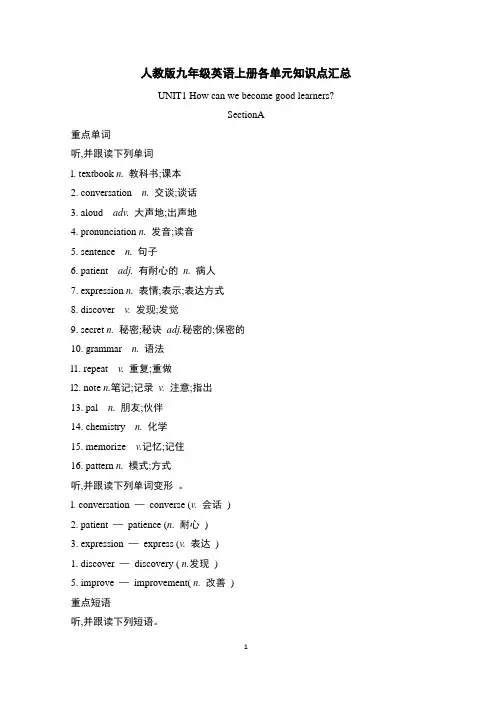
人教版九年级英语上册各单元知识点汇总UNIT1 How can we become good learners?SectionA重点单词听,并跟读下列单词l. textbook n.教科书;课本2. conversation n.交谈;谈话3. aloud adv.大声地;出声地4. pronunciation n.发音;读音5. sentence n.句子6. patient adj.有耐心的n.病人7. expression n.表情;表示;表达方式8. discover v.发现;发觉9. secret n.秘密;秘诀adj.秘密的;保密的10. grammar n.语法l1. repeat v.重复;重做l2. note n.笔记;记录v.注意;指出13. pal n.朋友;伙伴14. chemistry n.化学15. memorize v.记忆;记住16. pattern n.模式;方式听,并跟读下列单词变形。
l. conversation —converse (v.会话)2. patient —patience (n.耐心)3. expression —express (v.表达)1. discover —discovery ( n.发现)5. improve —improvement( n.改善)重点短语听,并跟读下列短语。
l. make word cards 制作单词卡片2. ask sb. for ... 向某人寻求……3. have conversations with sb. 和某人谈话4. at first 起初, 起先5. give a report 做报告6. take notes 记/做笔记7. word by word 逐词地8. so... that 如此……以至于9. write e-mails to sb. 给某人写电子邮件10. be afraid to do sth. /be afraid of doing sth.害怕做某事11. because of 由于;因为12. fall in love with 爱上13. a piece of cake 小菜一碟14. look up( 在词典、参考书中或通过电脑)查阅;抬头看15. so that 以便重点句型听,并跟读下列句子。
人教版英语九年级上册知识点汇总
人教版英语九年级上册知识点汇总Unit 1: Finding your way- Vocabulary:- Words related to directions: north, south, east, west, turn left, turn right, go straight, crossroads, etc.- Words related to transportation: bus, subway, taxi, bike, etc.- Words related to buildings and landmarks: bank, hospital, library, museum, park, etc.- Grammar:- Prepositions of place: in, on, at, etc.Unit 2: No one knew who I was- Vocabulary:- Words related to personal identity: appearance, personality, character traits, etc.- Words related to emotions: happy, sad, angry, excited, etc.- Words related to personal relationships: friends, classmates, siblings, etc.- Grammar:- Indirect speech: reporting statements and questions in the past tense using reporting verbs such as said, told, asked, etc.Unit 3: Travel journal- Vocabulary:- Words related to travel: journey, adventure, tourist attractions, etc.- Words related to countries and nationalities: China, America, Chinese, American, etc.- Words related to travel activities: sightseeing, taking photos, exploring, etc.- Grammar:- Present perfect tense: talking about past experiences and actions with a present resultUnit 4: Our world- Vocabulary:- Words related to the environment: pollution, recycling, renewable energy, etc.- Words related to nature: forests, oceans, wildlife, etc.- Words related to problems and solutions: climate change, global warming, conservation, etc.- Grammar:- Passive voice: describing actions done to the subject instead of by the subject- Modal verbs: expressing ability, possibility, permission, etc.Unit 5: Metal health matters- Vocabulary:- Words related to mental health: stress, anxiety, depression, etc.- Words related to emotions and feelings: happy, sad, worried, confident, etc.- Words related to coping strategies: meditation, exercise, hobbies, etc.- Grammar:- Modal verbs: expressing advice, suggestions, and obligations- Infinitives and gerunds: using verbs as nouns or to show purpose Unit 6: A charity walk- Vocabulary:- Words related to charity: donation, fundraising, volunteers, etc.- Words related to social issues: poverty, hunger, education, etc.- Words related to charity events: walkathon, marathon, sponsorship, etc.- Grammar:- Adverb clauses of condition: if, unless, as long as, etc.Unit 7: Teenagers should be allowed to choose their own clothes- Vocabulary:- Words related to clothing: fashion, style, dress code, etc.- Words related to personal preferences: like, dislike, prefer, etc.- Words related to rules and regulations: restrictions, freedom, rights, etc.- Grammar:- Modal verbs: expressing permission, prohibition, and obligation - Indirect questions: polite ways of asking questionsUnit 8: Sports and health- Vocabulary:- Words related to sports: soccer, basketball, swimming, etc.- Words related to health and fitness: exercise, diet, nutrition, etc.- Grammar:- Passive voice: talking about sports events and results- Adverb clauses of time: when, before, after, while, etc.Unit 9: Great inventions- Vocabulary:- Words related to technological advancements: internet, smartphone, robot, etc.- Words related to scientific discoveries: gravity, DNA, theory, etc.- Grammar:- Past perfect tense: talking about actions that happened before another past action or time- Adjective clauses: describing nouns with relative pronouns such as who, which, that, etc.Unit 10: On the radio- Vocabulary:- Words related to radio and broadcasting: program, news, interview, etc.- Words related to music: singer, band, song, etc.- Grammar:- Reported speech: reporting statements and questions in the past tense using reporting verbs such as said, told, asked, etc.- Narrative tenses: using past simple, past continuous, and past perfect to tell stories以上是人教版英语九年级上册各单元的主要知识点和语法内容的汇总。
人教版初三英语上册知识点汇总

九年级英语上册知识点汇总Unit1 The Changing World Topic1 Our country has developed rapidly.【短语和句型归纳】1.have a good summer holiday暑假过得愉快e back from从......回来3.have/has been to去过4.have/has gone to去了5.not...any more再也不...6.take photos照相7.by the way顺便问一下8.take part in参加9.around/all over/throughout the world全世界10.tell sb.something about...告诉某人关于某事11.have/live a happy/hard life过着幸福/艰苦的生活12.describe...in detail详细描述13.give support to支持...14.see...oneself亲眼看见15.keep in touch with与...保持联系16.far away遥远的17.kinds/sorts of各种各样的...18.not only...but also不仅...而且...19.make progress取得进步20.more than/over多于21.develop/improve rapidly迅速发展/改善22.tell sb.(not)to do sth.告诉某人(别)做某事23.ask sb.(not)to do sth.要求某人(别)做某事24.in order to do sth.为了做某事25.have to do sth.不得不做某事26.It s+形容词+for sb.to do sth.对于某人来说做某事是...的27.why not do sth.为什么不做某事28.succeed/be successful in doing sth.成功地做某事29.dream about doing sth.梦想做某事30.see/hear sb.do/doing sth.看见/听见某人做/正在做某事【语法点归纳】现在完成时一.现在完成时的基本结构肯定句:主语+have/has+动词的过去分词+其他否定句:主语+have/has+not+动词的过去分词+其他一般疑问句:Have/Has+主语+动词的过去分词+其他特殊疑问句:特殊疑问词+一般疑问句(have/has+主语+过去分词+其他)二.现在完成时的用法1.现在完成时用来表示过去已经完成的动作对现在造成影响或后果。
人教版九年级上册英语知识点归纳总结
人教版九年级上册英语知识点归纳总结Unit 1: Hello!- Greeting: Learn different ways to greet someone, such as "Hello," "Hi," and "How are you?"- Introduction: Practice introducing yourself and others using basic phrases like "My name is..." and "Nice to meet you."Unit 2: How do you spend your day?- Daily routines: Discuss how you spend your day and learn vocabulary related to daily activities.Unit 3: What are you doing for vacation?- Future plans: Talk about what you are going to do for your vacation and use phrases like "I am going to..." and "I will..."- Vacation activities: Learn vocabulary related to vacation activities such as swimming, hiking, and sightseeing.Unit 4: I used to be afraid of the dark.- Past experiences: Discuss past experiences and use the structure "used to + verb" to talk about things that happened in the past but are not happening now.Unit 5: What does he look like?- Physical appearances: Describe people's physical appearances using adjectives such as tall, short, and thin.- Personal traits: Talk about people's personalities and use adjectives like friendly, funny, and smart.Unit 6: I'm more outgoing than my sister.- Invitations: Learn to invite people to events and respond to invitations using phrases like "Can you...," "I would love to," and "I'm sorry, but..."- Party preparations: Discuss party preparations and learn vocabulary related to organizing an event.Unit 8: What's the best movie theater?- Preferences: Talk about preferences and express opinions using phrases like "In my opinion," "I think," and "I like... better."Unit 9: How was your weekend?- Past events: Discuss past events and use the simple past tense to talk about activities that happened over the weekend.- Weekend activities: Share weekend activities and learn vocabulary related to leisure and free time.Unit 10: It's a nice day, isn't it?- Weather expressions: Learn vocabulary related to weather conditions and use weather expressions like "It's sunny," "It's raining," and "It's snowing."- Small talk: Practice making small talk and engaging in conversations about the weather.Unit 11: What's the matter with you?- Giving advice: Give advice to someone who is not feeling well using phrases like "You should..." and "Why don't you...?"Unit 12: How do you make a banana milkshake?- Recipes: Learn how to write and follow a recipe using imperative verbs and measurement vocabulary.- Cooking instructions: Share cooking instructions and describe the process of making a specific dish.以上是人教版九年级上册英语知识点的归纳总结。
人教版九年级上册英语知识点汇总
一、词汇九年级上册英语涉及了丰富的词汇,包括但不限于:•动词:expect(期望)、catch up with(追上,赶上)、remind…of…(使某人想起或意识到……)、dance to sth.(随着……跳舞)、prefer(更喜欢)、dislike(不喜欢)、depend on(取决于;依靠)等。
•名词:music(音乐)、musician(音乐家)、fun(有趣)、energy(活力)、photograph(照片)、photographer(摄影师)、conversation(交谈)等。
•形容词与副词:important(重要的)、quiet and gentle(轻柔的)、lucky (幸运的)、unlucky(不幸运的)、relaxed(放松的)、mainly(主要地)等。
•短语:by oneself(靠自己)、one of the best known(最著名的之一)、be bad for sth.(对……有坏处)、be in agreement(意见一致)等。
二、短语与固定搭配•by doing sth.:通过做某事,表示方式或手段。
•ask sb. for sth.:向某人要某物。
•make a conversation:编对话。
•have a conversation with sb.:与某人交谈。
•expect to do sth./expect sb. to do sth.:期望做某事/期望某人做某事。
•prefer sth./prefer to do sth./prefer sth. to sth./prefer doing to doing:更喜欢某事/宁愿做某事/与……相比更喜欢……/宁愿做某事而不愿做某事。
•drop by:偶然拜访,顺便拜访。
•be supposed to do:被期望/应该做……。
•shake hands:握手。
•look up:查阅。
•repeat out loud:大声跟读。
人教九年级英语上知识点
人教九年级英语上知识点一、语法知识点1. 一般现在时一般现在时用来表示经常性、习惯性的动作或真理。
句子结构为:主语+动词原形。
2. 一般过去时一般过去时用来表示过去某个时间发生的动作或状态。
句子结构为:主语+动词过去式。
3. 一般将来时一般将来时用来表示将要发生的动作或存在的状态。
句子结构为:主语+will+动词原形。
4. 现在进行时现在进行时用来表示正在进行的动作。
句子结构为:主语+am/is/are+动词-ing。
5. 过去进行时过去进行时用来表示过去某个时间正在进行的动作。
句子结构为:主语+was/were+动词-ing。
6. 现在完成时现在完成时用来表示过去发生的动作对现在产生的影响或结果。
句子结构为:主语+have/has+动词过去分词。
7. 过去完成时过去完成时用来表示过去某个时间或动作发生在过去的过去。
句子结构为:主语+had+动词过去分词。
8. 一般将来进行时一般将来进行时用来表示将来某个时间正在进行的动作。
句子结构为:主语+will be+动词-ing。
9. 祈使句祈使句用来表示请求、命令、建议等。
句子结构为:动词原形(+其他)。
10. 被动语态被动语态用来表示动作的承受者在句中较为重要,而动作的执行者则不那么重要。
句子结构为:主语+be+动词过去分词。
11. 定语从句定语从句用来修饰名词,起到限定或说明的作用。
由关系词引导,关系词有:who, whom, whose, which, that。
二、词汇知识点1. 动词动词是表示人或物的动作、行为或状态的词语。
常见动词有:play, eat, sleep, read等。
2. 名词名词是用来表示人、事物、地方或抽象概念的词语。
常见名词有:book, student, teacher, love等。
形容词是用来描述名词或代词的特征或性质的词语。
常见形容词有:beautiful, tall, happy, interesting等。
4. 副词副词是用来修饰动词、形容词或其他副词的词语。
九年级上册英语重点短语归纳人教版
九年级上册英语重点短语归纳人教版Unit 1 How can we become good learners?1. ask sb. for help:向某人寻求帮助。
2. read aloud:大声朗读。
3. be afraid to do sth.:害怕做某事。
4. fall in love with:爱上。
5. look up:查阅(字典等)6. connect…with…:把……和……连接或联系起来。
7. pay attention to:注意;关注。
8. depend on:取决于;依靠。
9. in common:共同的;共有的。
Unit 2 I think that mooncakes are delicious!1. put on:增加(体重);发胖;穿上。
2. lay out:摆开;布置。
3. end up:最终成为;最后处于。
4. share sth. with sb.:与某人分享某物。
5. as a result:结果。
6. care about:关心;在意。
7. remind sb. of sth.:使某人想起某事。
Unit 3 Could you please tell me where the restrooms are?1. used to do sth.:过去常常做某事。
2. be used to doing sth.:习惯于做某事。
3. be used for (doing) sth.:被用于(做)某事。
4. on one's way to…:在某人去……的路上。
5. pass by:路过;经过。
6. pardon me:抱歉;对不起;请再说一遍。
7. from time to time:有时;偶尔。
Unit 4 I used to be afraid of the dark.1. deal with:应对;处理。
2. be proud of:为……骄傲;感到自豪。
最新人教版英语九年级上册知识点总结(精华版)
最新人教版英语九年级上册知识点总结
(精华版)
本文档是对最新人教版英语九年级上册的知识点进行总结,旨在帮助学生进行复和备考。
以下是该教材的重点内容:
Unit 1: Great Scientists
- 本单元主要介绍了一些伟大的科学家及他们的贡献,包括爱因斯坦、居里夫人等。
- 重点词汇包括:genius、discover、theory等。
- 难点语法为现在完成时和一般过去时的用法。
Unit 2: Growing Pains
- 本单元主要围绕青少年成长中的问题展开,包括睡眠问题、沟通问题等。
- 重点词汇包括:believe、change、advice等。
- 难点语法为情态动词的用法。
Unit 3: Travel Journal
- 本单元通过旅行记述的方式,介绍了一些旅行经历和相关事宜。
- 重点词汇包括:impression、guide、tour等。
- 难点语法为过去进行时和过去完成时的用法。
Unit 4: Ancient Civilizations
- 本单元介绍了一些古代文明,包括埃及文明、中国古代文明等。
- 重点词汇包括:pyramid、philosophy、dynasty等。
- 难点语法为被动语态的用法。
Unit 5: Heroes
- 本单元以不同英雄人物为主题,介绍了一些英雄的事迹。
- 重点词汇包括:brave、rescue、inspire等。
- 难点语法为现在完成进行时的用法。
...
以上是最新人教版英语九年级上册的知识点总结,希望对你的研究有所帮助。