
2014最新人教版八年级英语下册各单元语法点汇总
(1)询问某人患了何种疾病或遇到了何种麻烦时,常用以下几种结构来表达:What¡¯s the matter (with sb.)?(某人)怎么了?What¡¯s wrong (with sb.)?(某人)怎么了?What¡¯s the trouble (with sb.)?(某人)出什么事了?What happened (to sb.)?(某人)发生了什么事?Are you OK?你没事吧?Is there anything wrong with sb.?某人有什么事吗?(2)要表达身体疼痛或不舒服,可用以下结构:①某人+have/has+病症.The twins have colds.双胞胎感冒了。
?某人+have/has+a+headache/toothache/stomachache/backache/earache.She had a stomachache last night.她昨晚肚子痛。
③某人+have/has+a+sore+发病部位. He has a sore throat.他喉咙痛。
④某人+hurt(s)+身体部位或反身代词. He hurt his leg.他的腿受伤了。
⑤某部位+hurt(s).My head hurts badly.我头痛得厉害。
⑥某人+have/has+a pain+in one¡¯s+身体部位, I have a pain in my chest.我胸口痛。
⑦(There is)something wrong with one¡¯s+身体部位.There is something wrong with my right eye..我的右眼有毛病。
⑧其他表达方式She has a heart trouble.她有心脏病。
He got hit on the head他头部受到了撞击。
She cut her finger.她割破手指了。
二情态动词should的用法1.Should为情态动词,意为“应该;应当”,否定式为shouldn¡¯t,其后接动词原形,无人称和数的变化。
常用来表示征询意见、建议、劝告、要求或义务等。
You should drink hot water with honey.你应该喝加有蜂蜜的开水。
He should put his head back他应该把头后仰。
We should try our best to help him.我们应当尽力去帮助他。
You shouldn‘t watch TV.你不应该看电视。
2.Should用于主语为第一人称的疑问句,表示征询意见。
Should I put some medicine on it?我应当给它敷上药吗? Should we tell her about it?我们应该告诉她这件事吗?【拓展】在英语中,表示建议的说法有很多,而且都是中考考查的重点。
主要结构有:①Would you like (to do) sth.?你想要/愿意(做)某事吗?Would you like to play basketball with me?你想要和我一起打篮球吗?②Shall I/we do sth ?我/我们做??好吗?Shall we go to the zoo tomorrow?明天我们去动物园,好吗?③Why not do sth ?为什么不??呢?Why not join us?为什么不加入到我们当中来呢?④How/What about doing sth ?做某事怎么样? How about going swimming?去游泳怎么样?⑤Let¡¯s do sth让我们做??吧。
Let¡¯s go home.咱们回家吧。
⑥You¡¯d better (not) do sth你最好(不)要做某事。
You¡¯d better not go there alone.你最好不要一个人去那儿。
Unit 2 I'll help clean up the city parks动词不定式(1)询问某人患了何种疾病或遇到了何种麻烦时,常用以下几种结构来表达:What¡¯s the matter (with sb.)?(某人)怎么了?What¡¯s wrong (with sb.)?(某人)怎么了?What¡¯s the trouble (with sb.)?(某人)出什么事了?What happened (to sb.)?(某人)发生了什么事?Are you OK?你没事吧?Is there anything wrong with sb.?某人有什么事吗?(2)要表达身体疼痛或不舒服,可用以下结构:①某人+have/has+病症.The twins have colds.双胞胎感冒了。
?某人+have/has+a+headache/toothache/stomachache/backache/earache.She had a stomachache last night.她昨晚肚子痛。
③某人+have/has+a+sore+发病部位. He has a sore throat.他喉咙痛。
④某人+hurt(s)+身体部位或反身代词. He hurt his leg.他的腿受伤了。
⑤某部位+hurt(s).My head hurts badly.我头痛得厉害。
⑥某人+have/has+a pain+in one¡¯s+身体部位, I have a pain in my chest.我胸口痛。
⑦(There is)something wrong with one¡¯s+身体部位.There is something wrong with my right eye..我的右眼有毛病。
⑧其他表达方式She has a heart trouble.她有心脏病。
He got hit on the head他头部受到了撞击。
She cut her finger.她割破手指了。
二情态动词should的用法1.Should为情态动词,意为“应该;应当”,否定式为shouldn¡¯t,其后接动词原形,无人称和数的变化。
常用来表示征询意见、建议、劝告、要求或义务等。
You should drink hot water with honey.你应该喝加有蜂蜜的开水。
He should put his head back他应该把头后仰。
We should try our best to help him.我们应当尽力去帮助他。
You shouldn‘t watch TV.你不应该看电视。
2.Should用于主语为第一人称的疑问句,表示征询意见。
Should I put some medicine on it?我应当给它敷上药吗? Should we tell her about it?我们应该告诉她这件事吗?【拓展】在英语中,表示建议的说法有很多,而且都是中考考查的重点。
主要结构有:①Would you like (to do) sth.?你想要/愿意(做)某事吗?Would you like to play basketball with me?你想要和我一起打篮球吗?②Shall I/we do sth ?我/我们做??好吗?Shall we go to the zoo tomorrow?明天我们去动物园,好吗?③Why not do sth ?为什么不??呢?Why not join us?为什么不加入到我们当中来呢?④How/What about doing sth ?做某事怎么样? How about going swimming?去游泳怎么样?⑤Let¡¯s do sth让我们做??吧。
Let¡¯s go home.咱们回家吧。
⑥You¡¯d better (not) do sth你最好(不)要做某事。
You¡¯d better not go there alone.你最好不要一个人去那儿。
Unit 2 I'll help clean up the city parks动词不定式(1)询问某人患了何种疾病或遇到了何种麻烦时,常用以下几种结构来表达:What¡¯s the matter (with sb.)?(某人)怎么了?What¡¯s wrong (with sb.)?(某人)怎么了?What¡¯s the trouble (with sb.)?(某人)出什么事了?What happened (to sb.)?(某人)发生了什么事?Are you OK?你没事吧?Is there anything wrong with sb.?某人有什么事吗?(2)要表达身体疼痛或不舒服,可用以下结构:①某人+have/has+病症.The twins have colds.双胞胎感冒了。
?某人+have/has+a+headache/toothache/stomachache/backache/earache.She had a stomachache last night.她昨晚肚子痛。
③某人+have/has+a+sore+发病部位. He has a sore throat.他喉咙痛。
④某人+hurt(s)+身体部位或反身代词. He hurt his leg.他的腿受伤了。
⑤某部位+hurt(s).My head hurts badly.我头痛得厉害。
⑥某人+have/has+a pain+in one¡¯s+身体部位, I have a pain in my chest.我胸口痛。
⑦(There is)something wrong with one¡¯s+身体部位.There is something wrong with my right eye..我的右眼有毛病。
⑧其他表达方式She has a heart trouble.她有心脏病。
He got hit on the head他头部受到了撞击。
She cut her finger.她割破手指了。
人教版英语八年级下册Unit 1-5 单元语法知识梳理
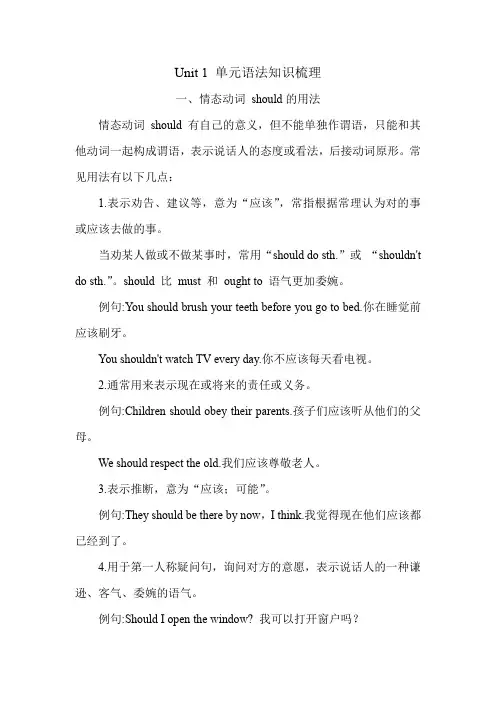
Unit 1 单元语法知识梳理一、情态动词should的用法情态动词should有自己的意义,但不能单独作谓语,只能和其他动词一起构成谓语,表示说话人的态度或看法,后接动词原形。
常见用法有以下几点:1.表示劝告、建议等,意为“应该”,常指根据常理认为对的事或应该去做的事。
当劝某人做或不做某事时,常用“should do sth.”或“shouldn't do sth.”。
should 比must 和ought to 语气更加委婉。
例句:You should brush your teeth before you go to bed.你在睡觉前应该刷牙。
You shouldn't watch TV every day.你不应该每天看电视。
2.通常用来表示现在或将来的责任或义务。
例句:Children should obey their parents.孩子们应该听从他们的父母。
We should respect the old.我们应该尊敬老人。
3.表示推断,意为“应该;可能”。
例句:They should be there by now,I think.我觉得现在他们应该都已经到了。
4.用于第一人称疑问句,询问对方的意愿,表示说话人的一种谦逊、客气、委婉的语气。
例句:Should I open the window? 我可以打开窗户吗?What should we do now? 我们现在该干什么呢?5.表示某种感情色彩,意为“竟会”,常用于以how, why开头引导的特殊疑问句中。
例句:Why should you be so early today? 你今天为什么会如此早?二、反身代词1.反身代词的构成反身代词是一种表示反射或强调的代词。
它由第一人称、第二人称的形容词性物主代词和第三人称代词的宾格加词尾-self或-selves构成。
其构成如下表:反身代词与它所指代的名词或代词形成互指关系,两者在人称和数上应保持一致。
(完整版)人教版英语八年级下册重点词组、句型及语法点汇总,推荐文档

13.be back 回来14.be angry with sb 生某人的气15.throw down 扔下16.the minute=as soon as 一…就…e over 过来18.sit down 坐下19.take sb. for a walk 带某人去散步20.all the time 频繁;反复21.all day / evening 整日/夜22.shout back 大声回应23.walk away 走开24.in surprise 惊讶地25.share the housework 分担家务26.hang out 闲逛27.do chores 做杂务28.go to the store 去商店29.buy drinks and snacks 买饮料和点心30.make sb. do sth. 使某人做某事31.have enough stress from 有来自…足够的压力32.a waste of time 浪费时间33.in order to 为了34.get good grades 取得好成绩35.depend on 依赖;依靠36.have no idea 不知道37.develop children’s independence 发展孩子独立性38.look after=take care of 照顾;照看39.as a result 结果40.agree with sb 同意某人的观点/意见disagree with sb 不同意某人的观点/意见二、常见搭配1.finish doing sth. 完成做某事2.a few “几个”,后接可数名词复数few “很少,几乎没有”,后接可数名词复数a little “一点儿”,后接不可数名词little “很少,几乎没有”,后接不可数名词3.1> question “问题”,需要回答的问题,与ask或answer 搭配2> problem “问题”,需要解决的问题,与solve 搭配in the front of “在…前面”,在所说范围之内5.as…as… “与…一样…”,中间加形容词或副词原级,。
人教版八年级下册英语各单元重点短语句型及语法
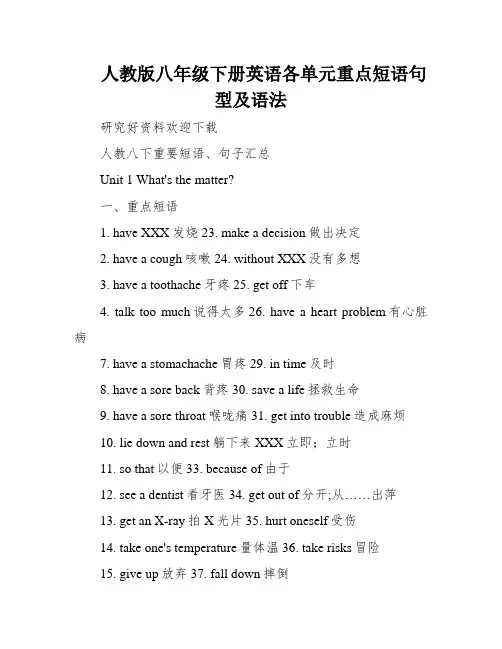
人教版八年级下册英语各单元重点短语句型及语法研究好资料欢迎下载人教八下重要短语、句子汇总Unit 1 What's the matter?一、重点短语1. have XXX发烧23. make a decision做出决定2. have a cough咳嗽24. without XXX没有多想3. have a toothache牙疼25. get off下车4. talk too much说得太多26. have a heart problem有心脏病7. have a stomachache胃疼29. in time及时8. have a sore back背疼30. save a life拯救生命9. have a sore throat喉咙痛31. get into trouble造成麻烦10. lie down and rest躺下来XXX立即;立时11. so that以便33. because of由于12. see a dentist看牙医34. get out of分开;从……出萍13. get an X-ray拍X光片35. hurt oneself受伤14. take one's temperature量体温36. take risks冒险15. give up放弃37. fall down摔倒16. keep on doing sth.坚持做某事38. feel sick感触恶心/感触不舒服17. sound like听起来像39. have a nosebleed流鼻血18. run out (of)用完;用尽40. so. . . that云云……以致于…19. in the same way以同样的方式41. have problems breathing呼吸困难20. be used to doing sth.惯做某事42. be in control of掌管;管理21. go along沿着……走2、重点句型1. What' s the matter with you? / What' s wrong with you?你怎么了?2. What should she do?她该怎么办呢?→主语+ XXX't +动词真相. ..①You should lie down and rest.你应当躺下苏息一会儿。
人教版八年级英语下册重要语法知识点汇总
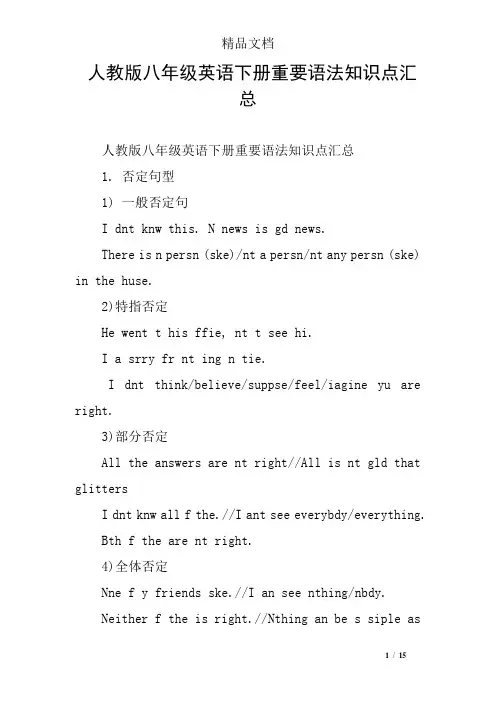
人教版八年级英语下册重要语法知识点汇总人教版八年级英语下册重要语法知识点汇总1. 否定句型1) 一般否定句I dnt knw this. N news is gd news.There is n persn (ske)/nt a persn/nt any persn (ske) in the huse.2)特指否定He went t his ffie, nt t see hi.I a srry fr nt ing n tie.I dnt think/believe/suppse/feel/iagine yu are right.3)部分否定All the answers are nt right//All is nt gld that glittersI dnt knw all f the.//I ant see everybdy/everything.Bth f the are nt right.4)全体否定Nne f y friends ske.//I an see nthing/nbdy.Neither f the is right.//Nthing an be s siple asthis.5) 延续否定yu didnt see hi, neither/nr did I.yu dnt knw, I dnt knw either.He desnt knw English, let alne/t say nthing f/nt t speak f (更不用说) Frenh.6) 半否定句e seld/hardly/sarely/barely hear suh fine singing.I knw little English. I saw few peple.7) 双重否定yu ant ake sething ut f nthing.//hats dne annt be undne.There is n sweet withut sweat.//N gain withut pains.I ant help /keep/ laughing whenever I hear it.N an is s ld but (that) he an learn.8)排除否定Everyne is ready exept yu.//He did nthing but play.But fr yur help, I uldnt d it.9)加强否定I wnt d it at all.//I ant see it any re.//He is n lnger a by.2. 判断句型1) 一般判断句It is iprtant fr us t learn English.It is kind f yu t help e sinere eans hnest.The by is alled/naed T.e regarded/nsider it as an hnr.2)强调判断It is English that we shuld learn.//It is he wh helped e a lt.3)弱式判断yur sentene desnt sund/lk/appear/feel right.yu lk/see as if/as thught yu had been there befre.aybe/Perhaps/ she is ill.He is prbably ill.//He is likely ill. //It is pssible that he is late4) 注释判断He an reeber s any English wrds, that is (t say) he is a living ditinary.(活字典)5) 正反判断That sunds all right, but in fat it is nt.6) 比较判断It is re a piture than a pe.7) 互斥判断He r yu are wrng. Either he is right r I a.3. 祝愿祁使句式1) 一般句式Study hard and keep fit. Be brave! Dnt be shy! Get ut f here.2)强语式D tell e. Never tell a lie.3) 委婉祈使句Please tell e the true. uld/ill/nt d e a favr?uld/D yu ind y sking? hat/Hw/ abut ging n ft?4)建议祈使句Let us g. Let us knw the tie. Dnt let the fire ut.Lets nt waste the tie. yud better start early.Shall we listen t se usi? hy dnt yu get sething t drink?Suppse/suppsing yu pik e up at abut six?I suggest we (shuld) take the train.5)祝愿句Suess t yu! //ish yu a gd urney.ay yu have a happy arriage. //Heres t yur suess!Allw e t prpse a tast t ur friendship!4. 感叹句型Hw well he speaks! //Hw kind she is! //hat a nie weather it is!Here he es! //Suh is life! //nderful! // Help!5. 疑问句型1) 一般疑问句Is he a dtr?//D yu the way t the statin?2)反意疑问句He is a teaher, isnt he?//It is quite heap, dnt yu think?3) 特殊疑问句hat is the distane/width/size/ppulatin/teperature/fare?h is he? hat is he?(干什么的)//hat is he like? // Hw is he?Hw d yu like hi? //hat d yu think f hi?hat ever d yu ean by saying this?4)选择疑问句He is a dtr r a nurse?5)间接疑问句D yu knw hw ld he is? //Tell e if (whether) yu like it.hat d yu think/say/suppse I shuld d?6. 数词句型1) 表数目It is exatly ten lk.//It is five iles away fr here.He is re than/ver/ at least nt less than 20.He is under/at st/n re than 20.2)表年月日He was brn n April 22 1994/in 1994 n the rning f t.1.3)表年龄He is 20 years ld/years f age.//He is at the agef 10.4)表倍数It is fur ties that f last years.This is fur ties as big (again) as that ne.This is fur ties bigger than that ne.The ine is duble what it was.The utput f al was 200% greater than in 1998.5)表计量It is 10 eters lng/wide/high.//It sts e 100 yuan.I spent 10 hurs t finish it.//It tk e 10 days t finish it.It is wrth 100 yuan.7. 关联指代句型1)两项关连I have tw bks, ne is hinese; the ther English.I have five bks, ne is hinese; the thers English.T say is ne thing, but/and/ t d is anther.ne the ne hand, I a yur teaher, and n the ther hand, I a als yu friend.Se like t play ftball, thers are fnd f basketball.2)先后顺序First/firstly, I wish gd health, send/sendly suess in yur study, third/thirdly gd luk in everything.First stp, then lk, finally rss.At first/in the beginning/ he wrd hard. Later/Afterwards he is nt s diligent.3)修饰限制This is the sae bk as I lst yesterday.This is the sae bk that I lst yesterday.(同一本书)Dnt trust suh a an as ver praise yu.He/ne/Thse/They wh shuld e failed t appear.A an/A persn/The ne/Anyne/Peple wh saw her liked her very uh.The day/tie/ent will e when hina is strngest in the wrld.4) 两项连接He an speak nt nly English but als Frenh.The bk is bth interesting and instrutive.It is neither ld nr ht.Please either e in r g ut.The ld wrker has experiene and knwledge as well.5)加和关系Besides literature, we have graar and writing.Apart fr xygen, there are se ther gases in the air.In additin t "if", there is any ther nuntins that an intrdue nditinal lauses.I ust g nw, inidentally, if yu want that bk.yu see t like tea, s d I.8. 比较句型1)等比句He is as tall as I. // He is the sae height as I.She is n less diligent than he. The lab is n better than a ttage.2) 差比句I speak English wrse than he des.//He is nt s/astall as I a.ur knwledge is uh inferir t their.3) 极比句He is the tallest f all in the lass.Nne/N ne/ is s blind as thse that wnt see.Nthing is s easy as this.4)比例句The re a an knws, the re he feels his ignrane(无知).5) 择比句He is taller than any ther by in the lassIt is better late than never.//They wuld die than live as slavesHe prefers ding t talking//He prefers t d rather than t talk.He prefers atheatis t English.//Id rather stay here.6)对比句yu think e idle, but n the ntrary, I a busy.They are wrking hard while yu are wasting yur tie.9. 比喻句型e ust wrk like hi.//He behaves as his father des.He speaks English as if/thugh he was a freigner.10. 条件假设句1) 一般事实If we sueed, what will the peple say?Suppse it rains, what shall we d?Persevere(坚持) and yull sueed.2)虚拟条件句If I were yu, I wuld g.//If yu had seen it, yu wuld have been ved.3)反条件句Unless yu try, yull never sueed.//Dnt ve, r/else/therwise Ill sht.4)唯一条件句If nly I have anther hane, I shall d better.nly in this way an we learn English well.S/As lng as we dnt lse heart, well sueed.5)推论条件句Sine that is s, there is n re t say.Nw that yu are grwn up, yu ust stp this behavir.11. 时间句型1)一般时hen I see hi, Ill tell hi.2) 表同时yull grw wiser as yu grw lder.rk while yu wrk, play while yu play.He wrked, at the sae/in the eantie he listened t the usi.3)限制时Every/eah tie when I went t his huse, he was ut.By the tie that we gt there, he was ut.4)交替时Seties he sings, seties he danes.At ne tie the baby ries, at anther it talks.5)先时I stpped he befre he began t talk with e.6)后时Ill tell yu after I finish it.7)紧接时As sn as I see hi, Ill tell hi.ne yu begin, yu ust ntinue.The (very) ent/instant (that) I saw hi, I regnized hi.n hearing the news, she bust int tears.Hardly had I seen the light, when I heard a lud thundering.8)延续时I havent seen hi sine I ae here.A friend is never knw till/until a an have need.12. 地点句型1) 一般地点here have yu been?here there is a will, there is a way.2)方位Hebei lies in the east f hina.apan is lies t the east f hina.The huse faes (t) the suth.He is sitting at the frnt f the lassrHe is standing in frnt f/befre e.He is sitting at the bak f/behind e.He is sitting in the bak f/at the rear f the lassr. He is sitting next t/besides e.He is sitting lse t/near e.At the tp f/n tp f the shelf, there are se bks. He is sitting n the left/right.The untain yu see t the right is the Purple untain.13. 原因句型He didnt g t shl beause he was ill.Sine we are all here, lets begin ur eeting.It ight rain yesterday, fr the grund was wet.Nw (that) we have finished the wrk, we an g he.I a glad t eet yu.I a srry that I hear that.Thank yu fr yur help.That is why he failed t e.He didnt e beause f/n aunt f the weather.He went ut f urisity.I sueeded thanks t his help.This failure is due t the fat they lak experiene.wing t ur int effrts, the task was fulfilled.hat are studying English fr?Fr what reasn did yu hse this?hats the pint f asking his t d that?Hw e yu never tld e abut it?hat with the wind and what with the rain, ur walk was spiled.14. 目的句型He stpped aside s that she uld g in.He sits in the frnt in rder that he an see wrds learly.He gets up early s as t/in rder t have tie t d exerises.He repeated it fr fear that there shuld be any istake.15. 结果句型It was very ld, s that the river frze.They st a lt f ney, s/therefre we use the arefully.He is suh a gd an that every ne likes hi.He ran s fast that n ne uld ath hi.He hurried t the huse nly t find that it was epty.I was aught in the rain. As a result, I had a bad ld.16. 程度句型Hw ften d yu write t yur parents?Hw lng d yu stay at he?It is s beautiful that we all lve it.It is t big fr yu.He is t exited t speak.He is nt ld enugh t knw this.The letter ust be sent as sn as pssibleyu ust wrk as hard as yu an.As far as I knw, I an speak nly English.17. 让步句型Thugh/Althugh he is rih, (yet/still) he desnt shw ff.yang as he is, he knw a lt f things.Even if/thugh he sueeded, he was nt prud.N atter what yu say, Ill still try t d it.keep al, whatever happens.In spite f this, we ust g ahead with ur plans.Regardless f all the diffiulties, well fight it ut t the end.18. 转折句型I searhed everywhere but uld nt find hi.yu ay g, nly return quikly.He is seriusly ill, still there is hpe f his revery.It lked like rain, hwever it was lear in the afternn.He is still yung, yet he is high up in the psitin.He didnt tell e the truth, I knw it, thugh.19. 省略句I think/say/suppse/expet/believe/hpe s.hy nt e earlier next tie?。
(完整版)Unit1人教版八年级英语下册语法与知识点,推荐文档
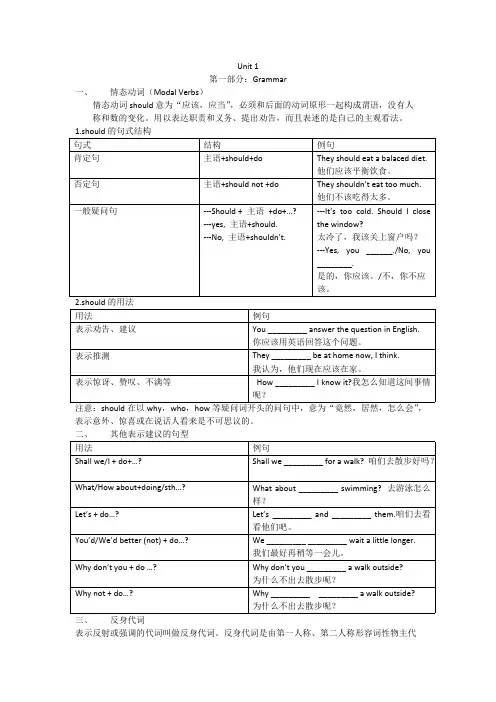
Unit 1第一部分:Grammar一、情态动词(Modal Verbs)情态动词should意为“应该,应当”,必须和后面的动词原形一起构成谓语,没有人称和数的变化。
用以表达职责和义务、提出劝告,而且表述的是自己的主观看法。
1.should的句式结构句式结构例句肯定句主语+should+do They should eat a balaced diet.他们应该平衡饮食。
否定句主语+should not +do They shouldn’t eat too much.他们不该吃得太多。
一般疑问句---Should + 主语+do+…?---yes, 主语+should.---No, 主语+shouldn’t.---It’s too cold. Should I close the window?太冷了,我该关上窗户吗?---Yes, you ______./No, you ________.是的,你应该。
/不,你不应该。
2.should的用法用法例句表示劝告、建议You _________ answer the question in English.你应该用英语回答这个问题。
表示推测They _________ be at home now, I think.我认为,他们现在应该在家。
表示惊讶、赞叹、不满等How _________ I know it?我怎么知道这间事情呢?注意:should在以why,who,how等疑问词开头的问句中,意为“竟然,居然,怎么会”,表示意外、惊喜或在说话人看来是不可思议的。
二、其他表示建议的句型用法例句Shall we/I + do+…?Shall we _________ for a walk? 咱们去散步好吗?What/How about+doing/sth…?What about _________ swimming? 去游泳怎么样?Let’s + do…?Let’s _________ and _________ them.咱们去看看他们吧。
最全面人教版八年级下册英语各单元知识点总复习归纳总结
最全面人教版八年级下册英语各单元知识点总复习归纳总结Unit 1 How often do you exercise?词汇1. frequently 经常地2. hardly 几乎不3. ever 曾经4. once in a while 时不时5. rarely 很少语法一般现在时1. 频率副词放在动词前:I always read newspapers.2. 否定句用don't或doesn't+动词原形:I don't watch TV every day.3. 疑问句用do或does+主语+动词原形:Do you play soccer every week?Unit 2 I used to be afraid of the dark.词汇1. used to 过去常常2. get over 克服3. nervous 紧张的4. confident 有信心的5. stage 舞台语法1. Be used to+动名词表示惯或适应,I am used to studying English at night.2. Used to+动词原形表示过去常常,I used to read books every day.3. Get over+名词/代词/动名词,表示克服,She got over the flu last week.Unit 3 Could you please tell me where the restaurants are?词汇1. instruction 说明2. turn right/left 向右/左转3. excuse me 对不起4. straight 直走5. opposite 对面语法1. Could you please/could/may I+动词原形,请求礼貌地做事,Could you please help me with my English?2. Would like+名词 / 动名词,表示想要做某事,I would like to go shopping with you.3. May I ask+句子,礼貌地询问某事,May I ask where the restroom is?Unit 4 Why don't you talk to your parents?词汇1. conversation 对话2. listener 听众3. honest 诚实的4. conversation starter 聊天开场白5. effective 有效的语法1. How about/What about+动名词/名词,表示建议和提议,What about watching a movie?2. Why not+动词原形,表示建议和提议,Why not go swimming?3. Let's+动词原形,表示建议和提议,Let's have a party on the weekend.Unit 5 It must belong to Carla.词汇1. sweater 毛衣2. by accident 偶然地3. honest 诚实的4. lose 丢失5. owner 拥有者语法1. Can/Can't+动词原形,表示能力或可能性,I can dance.2. Must/Mustn't+动词原形,表示肯定或否定的推断,She must be the new teacher.3. Have/Has to+动词原形,表示必须做的事情,I have to finish my homework first.词汇1. graduate 毕业生2. physics 物理学3. ambitious 有抱负的4. career 职业5. education 教育语法一般将来时1. be going to+动词原形,表示打算做某事,I am going to see a film tonight.3. be + going to+现在进行时,表示不久会发生的事情,They are going to sing a song later.Unit 7 How do you make a banana milk shake?词汇1. recipe 食谱2. whip 打(奶油)3. peel 去皮4. slice 切片5. pour 倒语法1. What/How/Which+系动词+主语+谓语,表示特定的主语或具体的内容。
人教版八年级英语下册各单元知识点总结完整版
Unit 1 What’s the matter?一、重点短语1. have a fever 发烧2. have a cough 咳嗽3. have a toothache 牙疼4. talk too much 说得太多5. drink enough water 喝足够的水6. have a cold 受凉;感冒7. have a stomachache 胃疼8. have a sore back 背疼9. have a sore throat 喉咙痛10. lie down and rest躺下来休息11. hot tea with honey加蜂蜜的热茶12. see a dentist看牙医13. get an X-ray拍X光片14. take one’ s temperature量体温15. put some medicine on sth在……上面敷药16. feel very hot 感到很热17. sound like 听起来像18. all weekend 整个周末19. in the same way以同样的方式20. go to a doctor 看医生21. go along 沿着……走22. on the side of the road 在马路边23. shout for help 大声呼救24. without thinking twice 没有多想25. get off 下车26. have a heart problem 有心脏病27. to one’ s surprise 使……惊讶的28. thanks to 多亏了;由于29. in time及时30. save a life 挽救生命31. get into trouble 造成麻烦32. right away 立刻;马上33. because of 由于34. get out of 离开35. hurt oneself 受伤36. put a bandage on sth. 用绷带包扎37. fall down 摔倒38. feel sick 感到恶心39. have a nosebleed 流鼻血40. cut his knee割伤他的膝盖41. put her head back 把她的头向后仰42.have problems breathing呼吸困难43. mountain climbing登山运动44. be used to doing sth. 习惯做某事45. run out (of) 用完;用尽46. so that 以便47. so…that 如此……以至于……48. be in control of 掌管;管理49. in a difficult situation 在逆境屮50. keep on doing sth.坚持做某事51. make a decision做出决定52. take risks 冒险53. give up 放弃二、知识点解析1. What’s the matter? 怎么了?若是询问“某人怎么了?”要用“What’s the matter with sb.?”拓展:What’s the matter with sb.? 的同义句:What’s wrong with sb.? / What’s the trouble with sb.?2.疾病类短语:have a +疾病. e.g. :have a fever 发烧have a cold 感冒have a cough 咳嗽.have a +身体部位-ache. e.g.: have a headache 头痛have a toothache 牙痛.have a sore+身体部位. e.g.: have a sore throat咽喉痛have a sore back背痛例题:Mom, I____________.I’m sorry to hear that, dear. We must go to see the dentist right away.A. have a headacheB. have a stomachacheC. have a toothacheD. have a fever3. lie down 躺下V. 躺,平躺。
八年级下册英语各单元重点短语+句型语法 人教版
八年级下册英语各单元重点短语+句型语法人教版1. Unit 1Important phrases:- get to know: I want to get to know my new classmates.- make friends with: I hope to make friends with some local students.- be interested in: She is interested in learning a new language.- take part in: Are you going to take part in the school talent show?- show off: Don't show off in front of your friends.- be proud of: I am proud of my brother for winning the race.Sentence patterns and grammar:- Present continuous tense: He is playing football in the park.- Comparative adjectives: My sister is taller than me.- Superlative adjectives: This is the best pizza I've ever tasted.2. Unit 2Important phrases:- turn off: Don't forget to turn off the lights before you leave.- set off: We will set off for the beach early in the morning.- look forward to: I am looking forward to the schooltrip next week.- get along with: I get along with my classmates very well.- break down: Our car broke down on the way to the airport.- run out of: We ran out of milk, so I need to go to the store.Sentence patterns and grammar:- Past continuous tense: They were playing basketball when the rain started.- Modal verbs: You should study harder for the exam.- Reported speech: She said that she was going to the movies.3. Unit 3Important phrases:- be strict with: My teacher is very strict with homework deadlines.- get into: She wants to get into a good university.- take care of: Don't forget to take care of your little brother.- be good at: I am good at playing the piano.- look up to: I look up to my older sister as a role model.- come up with: We need to come up with a plan for the project.Sentence patterns and grammar:- Future perfect tense: By next year, I will havefinished high school.- Present perfect continuous tense: She has been studying English for five years.- Conditional sentences: If I had known, I would have helped you.4. Unit 4Important phrases:- call for: This situation calls for a serious discussion.- hold on: Please hold on while I transfer your call.- look out: Look out for the car coming down the road.- put off: Don't put off until tomorrow what you can do today.- try out: I want to try out for the school basketball team.- fall apart: Our friendship fell apart after the argument.Sentence patterns and grammar:- Present perfect tense: I have finished my homework.- Past perfect tense: She had already left when I arrived.- Passive voice: The cake was made by my mom.5. Unit 5Important phrases:- set up: We need to set up the equipment for the presentation.- take off: The plane will take off in an hour.- go through: I will go through my notes before the exam.- look into: The police will look into the matter.- pick up: Can you pick up some milk on your way home?- be satisfied with: I am satisfied with my test results.Sentence patterns and grammar:- Future continuous tense: They will be having dinner at7 PM.- Reported questions: He asked her where she was goingfor the holidays.- Relative clauses: The boy who won the race is my friend.6. Unit 6Important phrases:- be proud of: She is proud of her achievements.- look after: My sister looks after our pet dog.- give up: Don't give up on your dreams.- make a decision: I need to make a decision about which college to attend.- put up with: I can't put up with his behavior any longer.- take after: My son takes after his father in terms of looks.Sentence patterns and grammar:- Past perfect continuous tense: She had been studying all night when her parents arrived.- Reported commands: He told her to clean her room.- Adverb clauses: I will call you when I get home.。
人教版八年级下册各单元英语语法解析知识重点总结
新目标英语八年级(下)重点短语及句型总Unit 1 Will people have robots?1. fewer people 更少的人(fewer 修饰名词复数,表示否定)2. less free time 更少的空闲时间(less 修饰不可数名词,表示否定)3. in ten years 10年后(in 的时间短语用于将来时,提问用How soon)4. fall in love with … 爱上……例:When I met Mr. Xu for the first time, I fell inlove with him at once.当我第一次见到许老师,我立刻爱上他。
5. live alone 单独居住6. feel lonely 感到孤独(比较:live alone/ go alone 等)The girl walked alone along the street, but shedidn't feel lonely.那女孩独自沿着街道走,但她并不感到孤独。
7. keep/ feed a pet pig 养一头宠物猪8. fly to the moon 飞上月球9. hundreds of + 复数数百/几百(概数,类似还有thousands of;millions of)10. the same as 和……相同11. A be different from B A与B不同(= There is a difference/ Thgere aredifferences between A and B)12. wake up 醒来(wake sb. up 表示“唤醒某人”)13. get bored 变得厌倦(get/ become 是连系动词,后跟形容词如tired/angry/ excited 等)14. go skating 去滑冰(类似还有go hiking/ fishing /skating/ bike riding 等)15. lots of/ a lot of 许多(修饰可数名词、不可数名词都可以)16. at the weekends 在周末17. study at home on computers 在家通过电脑学习18. agree with sb. 同意某人(的意见)19. I don't agree. = I disagree. 我不同意。
新人教版八年级下册英语语法大全【强烈推荐】
所以 that 从句前有一个受 such 修饰的名词;而 so 是副词,用以修饰形容词或副词, 因此 that 从句前一般不出现名词。如 They are such kind-hearted teachers that people in the village all respect them. The exam was so difficult that many students failed to pass it. a) 如果名词是可数名词的单数形式,such 和 so 的位置不同:
她那样的嗓子。 � Such 常和表示结果的 that 从句搭配,表示“如此….以至于…”如 It was such a hot day that we all had to stay at home.
2
�
Such…that…和 so…that…都可用来引出一个结果状语从句。 由于 such 是形容词,
其它”结构。 h) 表示“越….越….”, 可使用“the+形容词或副词的比较级,the+形容词或副词
的比较级”结构。 2 .一般将来时
a)
一般将来时的构成: 由助动词 shall 或 will 加动词原形构成, shall 用于第一人称。
在口语中,will 在名词或代词后常简略为’ll, will not 常简略为 won’t。这个时态的 肯定,否定和疑问结构可表示如下:
的动作。这一特定的过去时间,除有上,下文暗示以外,一般用时间状语来表示 2. not …until 直到…才。表示动作在某时之前尚未开始,直到此时动作才开始。 not…until 可以用 after 或 when 来代替,但主句谓语动词要用肯定形式。Until 为连词 时后接时间状语从句,until 作介词时,后面接表示时间的名词。Until 用于肯定句多 表示动作或状态一直延续到 until 所表示的时间为止,意思为“直到…” from..till…中 till 往往表示不太具体的时间。From …to…或 from…until 常用来表示具体的时间。 3. find it…to do,it 在此句中为形式宾语代表动词不定式,动词不定式为真正的宾 语,常用于这种用法的动词有 find, feel, think, make 等。 4. “疑问词+不定式“结构相当于一个名词性从句,常常可用同等成分的从句代替。 改写时,只需在疑问词后面加一个适当的主语(这个主语一般与主句的主语一致) , 并将不定式改成适当形式的谓语即可。如,Where to go is still a question.= Where we should go is still a question. 5. when 与 while:when 连接的状语从句是个特殊句型,“前一个分句(谓语动词用 过去进行时)+when(作并列连词,意思为“这时,突然”)+后一个分句(谓语动词用一 般过去时)”表示在前一个动作正在进行的过程中突然发生了后一个动作, when 强