
Unit 3 My weekend plan
book store
bookstore
What are you going to do?
I’m going to buy an English book in the bookstore.
What books can you buy in a bookstore?
postcard
你知道这些 书的名称吗?
A.He has homework to do. B.He is fishing now.
Let’s talk
Mike:What are you going to do tomorrow? Sarah:I'm going to have an art lesson.
Mike:What are you going to do in your lesson? Sarah:We're going to draw some pictures in
_d_r_a_w__s_o_m_e__p_ic_t_u_r_e_s_ in Renmin Park. b. Mike has to _d_o__h_is__h_o_m_e_w_o_r_k__now.
Talk about our classmates’ weekend plan.
What is he/she going to do? He/She is going to… What are they going to do? They are going to…
-What are you going to do today?
-I’m going to ….
这个句型用来询问和回答将要做什 么事,时态是一般将来时。
play computer games read books
Make some sentences. I’m going to … this weekend. We’re going to … this weekend.
Let's talk
Let's wrap it up
单元小结 重点词汇 小练习
重点句型
What is Chen Jie going to do? She is going to see a film.
visit my grandparents see a film take a trip go to the supermarket
重点词汇:
单元小结
visit 拜访 see a film 看电影
supermarket 超市 take a trip 去旅行
evening 晚上;傍晚 tonight 在今晚
tomorrow 明天 dictionary 词典 word book 单词书
next week 下周 postcard 明信片 comic book (儿童的)
Unit 3 My weekend plan
目录
Part A
Let's learn
Let's try
Make a plan
Let's talk
Part B Let's learn Role-play Let's try
Read and write Tips for pronunciation Let's check
连环画册
重点句型: 1.—What are you going to do?
你打算做什么?
—I am going to... 我打算…… 2.—Where are you going? 你打算去哪里?
—I am going to... 我打算去…… 3.—When are you going?你打算什么时候去?
Renmin Park. Mike:Sounds great! I'm going to see a film
tomorrow. Sarah:Have a good time!
Mike:You too. I have to do my homework now. Bye. Sarah:OK. Bye.
1.Questions: a. What is Sarah going to do tomorrow? b. What is Mike going to do tomorrow?
2.Read it again and fill in the blanks. a. Sarah and her classmates are going to
They are going to read a poem.
see a film
read a comic book going to the bookstore
buy a postcard
e.g. 1.What are you going to do? 2.Where is she going?
Team work
Questions
Answer
Where are you going this afternoon?
What are you going to do there?
When are you going ?
His aunt is going to make mooncakes. His grandma is going to tell them a story.
N__o_,it__is_n_'t_.________________
Let’s talk
Read and answer the questions: 1.Who is going to visit John? 2.Where are John and Jack going
next week? 3.When are they going?
play ping-pong swim
小组对话
plant trees
go on a picnic clean the street
plant flowers
Let’s try 1.Can Mike go swimming today?
A.Yes,he can. B.No,he can't. 2.Why or why not?
dictionary dictionaries
英汉连连看
dictionary
明信片
comic book
连环画册
word book
词典
postcard
单词书
练一练:
用下面的句型分组对话。
Where are you going this afternoon?
I’m going to the pet shop.
Let's try John is on his way home. He sees Amy.
Listen and answer. 1.What is Amy going to do?
S_h_e__is_g_o_i_ng__to__b_u_y_s_om__e_f_o_o_d_. _ 2.Is the ice cream for John?
—This evening.今晚。
小练习
一、将下列单词与汉语连线。
1. takzine
b.去旅行
3. go to the cinema
c.今晚
4. this evening
d.明天
5. tomorrow
e.看杂志
二、根据画线部分写问句。
Thank you!
讲解: 1.new words:space travel 宇宙之旅
half price 半价 2.lots of = a lot of = many 许多 3.on Tuesday在周二
在星期几,在某一天用on。 eg: on Monday, on September 1st, on a
sunny day
人教PEP版英语六年级上册Unit 3 My weekend plan课件

Nunc viverra imperdiet enim. Fusce est. Vivamus a tellus.
六上英语
Unit 3
梦幻太空
Nunc viverra imperdiet enim. Fusce est. Vivamus a tellus.
第一课时
我的周末计划
visit my grandparents
♦解析:
④Sounds great! 听起来棒极了! ⑤Have a good time! 祝你过的愉快!
课后问题:
第三课时
♦解析: 短语词组:
talk about 谈论 weekend plan 周末计划 go ice-skating 去溜冰 wash clothes 洗衣服 make a snowman 堆雪人 go for a picnic 去野餐
I'm going to have an art lesson.
♦解析:
②have to的用法:
表示客观事实上需要做的事情,意为“必须”、 “不得不”,后跟动词原形。
例:I have to do my homework. I have to clean my room.
♦解析: ③短语词组:
have an art lesson上美术课 draw some pictures画一些画 in Renmon Park在人民公园 see a film看电影 do my homework做我的家庭作业
♦解析:短语词组:
make a plan 制作一个计划
this morning 今天早上
this afternoon 今天下午
this evening 今天晚上 tonight 在今晚
人教版六年级上册 Unit 3 My weekend plan
Why not go on Tuesday? 句型结构:Why not + 动词原形 ...? (意为“为什么不……?”)
Why don't you + 动词原形?
eg. Why not go swimming? = Why don’t you go swimming?
Amy: Why not go on Tuesday? It’s half price then!
"must"侧重于说话者的主观看法,认为有必要或有义务去做某事。 We must obey the traffic rules.
A: What is … going to do? B: He/She is going to…
A: What are they going to do? B: They are going to…
What are you going to do
this evening tonight
?
tomorrow
next week
I'm going to...
I am not going to visit the park.
Tomorrow is Sunday. (在通电话) It’s Saturday morning. Sarah is on the phone with Mike. Listen and circle.
9、dictionary 名词,词典 复数:dictionaries eg:Pass me that dictionary . 把那本词典递给我。
10、comic 形容词,滑稽的 近义词:funny 滑稽的
短语:comic character 喜剧人 comic book (儿童的)连环画册 storybook 故事书 notebook 笔记本 word book 单词书 bookstore 书店 bookmark 书 签
Unit3Myweekendplan(讲义)人教PEP版英语六年级上册
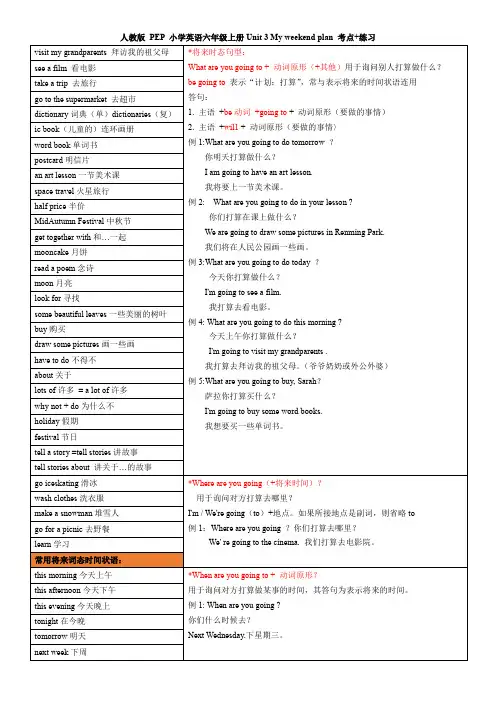
人教版PEP 小学英语六年级上册Unit 3 My weekend plan 考点+练习一、用下划线标出下列单词的重读音节。
(1)visit (2)tonight (3)postcard (4)together (5)dictionary (6)ic二、选出下列每组单词中与其他两项不同类的一项。
(1)()A.word book B.ic book C.next week (2)()A.post office B.maths book C.pet shop (3)()A.tonight B.tomorrow C.visit (4)()A.postcard B.take C.dictionary (5)()A.lesson B.moon C.sun三、英汉互译(1)明信片(2)去旅行(3)词典(4)下周(5)看电影(6)超市(7)this morning (8)get together (9)tomorrow (10)ic book四、单选题1.She a film tomorrow.A.is going to see B.seeing C.sees2.My cousin lives in Hong Kong. Next week, I her. A.visit B.is visiting C.am going to visit 3.Mike is going to visit his grandparents . A.next week B.every day C.now4.Sarah Chinese and does her homework. A.teach B.study C.studies5. I'm going to buy some .A.dictionary B.ic book C.ic books 6.—are you going to do tomorrow?—I am going to play sports in the playground.A.What B.When C.Where7. I'm going to buy a book space travel.A.about B.in C.of8.Lucy is going to Beijing .A.next Saturday B.every day C.last week 9.John is going to a ic book.A.buy B.buying C.buys10.—are you going?—We are going at 8:00.A.Who B.When C.What五、选内容补全对话。
Unit3Myweekendplan(讲义)人教PEP版英语六年级上册
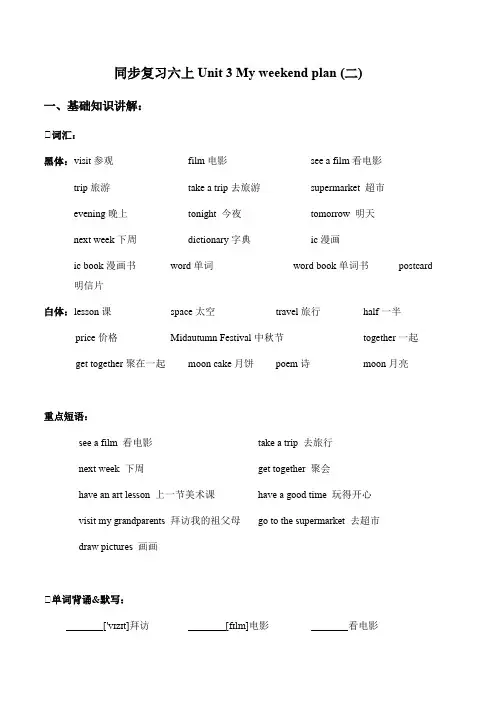
同步复习六上Unit 3 My weekend plan (二)一、基础知识讲解:◇词汇:黑体:visit参观film电影see a film看电影trip旅游take a trip去旅游supermarket 超市evening晚上tonight 今夜tomorrow 明天next week下周dictionary字典ic漫画ic book漫画书word单词word book单词书postcard 明信片白体:lesson课space太空travel旅行 half一半price价格Midautumn Festival中秋节together一起get together聚在一起moon cake月饼 poem诗moon月亮重点短语:see a film 看电影take a trip 去旅行next week 下周get together 聚会have an art lesson 上一节美术课have a good time 玩得开心visit my grandparents 拜访我的祖父母go to the supermarket 去超市draw pictures 画画◇单词背诵&默写:['vɪzɪt]拜访[fɪlm]电影看电影[trɪp]旅行去旅行['sjuːpəˌmɑːkɪt]超市['iːvnɪŋ]晚上;傍晚[tə'naɪt]在今晚[tə'mɔːrəʊ]明天下周['dɪkʃəneri]词典[ˈkɒmɪk]滑稽的连环画册[wɜːd]单词单词书['pəʊstˌkɑːd]明信片['lesn]课[speɪs]太空['trævl]旅行[hɑːf]一半[praɪs]价格中秋节[tə'geðə]一起聚会[muːnkeɪk]月饼[ˈpəʊɪm]诗[muːn]月亮◇短语背诵&默写:ride a bike make kitesplay the violin go swimminggo iceskating draw picturesgo for a picnic visit my grandparentssee a film take a tripgo to the supermarket Have a good time!in the future space travelwant to do sth. Why not do sth.on Tuesday◇重点句型:1.“What are you going to do + 共他?” 用来询问对方打算做什么。
Unit 3 My weekend plan (教案)人教版(PEP三起)六年级英语上册
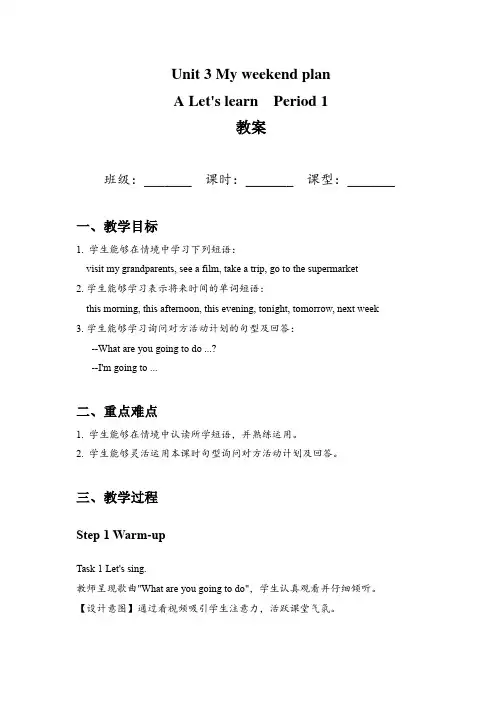
Unit 3 My weekend planA Let's learn Period 1教案班级:_______ 课时:_______ 课型:_______一、教学目标1. 学生能够在情境中学习下列短语:visit my grandparents, see a film, take a trip, go to the supermarket2.学生能够学习表示将来时间的单词短语:this morning, this afternoon, this evening, tonight, tomorrow, next week 3.学生能够学习询问对方活动计划的句型及回答:--What are you going to do ...?--I'm going to ...二、重点难点1. 学生能够在情境中认读所学短语,并熟练运用。
2. 学生能够灵活运用本课时句型询问对方活动计划及回答。
三、教学过程Step 1 Warm-upTask 1 Let's sing.教师呈现歌曲"What are you going to do",学生认真观看并仔细倾听。
【设计意图】通过看视频吸引学生注意力,活跃课堂气氛。
教师逐一点击屏幕出现短语,学生大声说出相应短语。
【设计意图】通过练习初步了解本课时要学习的内容。
Step 2 PresentationTask 1 Let's listen.(1)教师呈现Chen Jie和Sarah打电话的情境。
(2)教师呈现对话,并播放音频让学生跟读(3)教师由句子引出本课时重点单词短语,并播放音频让学生跟读。
(4)教师逐个讲解本课时学习的单词短语。
【设计意图】通过情境和对话引出单词短语,带领学生学习本课时单词短语和对话,教师纠正学生发音。
Task 2 Listen and imitate.教师呈现本课时所学单词短语和对话,点击屏幕播放音频,学生认真倾听并模仿朗读。
《Unit 3 My weekend plan》教学设计
《Unit3My weekend plan》教学设计
一、教学目标
1.学会本单元的动词短语,如see a film、take a trip、go to the supermarket
等。
2.掌握be going to句型,用于表达未来计划。
3.培养学生的计划制定和时间管理能力。
二、教学重难点
1.重点
1.掌握动词短语和be going to句型。
2.能运用句型描述自己的周末计划。
2.难点
1.理解be going to句型的用法和意义。
三、教学方法
任务驱动法、小组讨论法、情景模拟法。
四、教学过程
1.导入
1.提问学生周末通常做什么,引出话题。
2.词汇学习
1.教授动词短语,通过动作演示等方式帮助学生理解。
3.句型学习
1.讲解be going to句型,举例说明用法。
4.小组活动
1.小组讨论周末计划,并用be going to句型进行汇报。
5.情景模拟
1.模拟周末活动场景,让学生进行对话练习。
6.总结
1.总结周末计划的表达和时间管理的重要性。
7.作业
1.写一篇自己的周末计划作文。
人教版六年级英语下册第三单元my weekend plan
Unit 3 my weekend plan.(计划,将来) 一:理解意思Weekend: [ˌwiːkˈend]周末plan: [plæn] 计划,打算,规划,安排I plan to visit my friend next week.(动词)My plan is …..(名词)二:解释将要发生时什么意思?(还没有来的事情)过去的时间:yesterday before last week现在的时间:right now, now将来的时间(未来的):tomorrow,after tomorrow,next week ,tonightAfter (在…之后),next(下一个)三:句型:be going to / will to 后面和will后面加动词原形。
what are you going to do tomorrow?What will you do tomorrow?I am what are you going to do tomorrow? I am going to play football tomorrow. He is what is he going to do tomorrow? He is going to play football tomorrow. She is what is she going to do tomorrow? She is going to play football tomorrow. They are what are they going to do tomorrow? They are going to play football tomorrow.be:is am areI (我) amWe (我们) areYou (你)areYou (你们) areHe (他) isShe (她) isIt (它) isThey (他们) arePeter (彼得) isThe girls (那些女孩们) are三.选择正确答案( ) 1.What are you going to do this afternoon?A. I’m going to buy a book.B.I’m a student.C. I go to school by bike.D. Are you a teacher?( ) 2. Excuse me. Where is the library?A. Where’s the museum?B. Where’s the school?C. Where’s the hospital?D. It’s next to the post office.( ) 3.I’m going to buy an English book.A. Do you have comic book?B. What are you going to buy?C. This afternoon.D. I’m going to plant trees.( ) 4. 当你去商店时,售货员通常首先会说:A. How are you ?B. What are you going to do?C. Are you a student?D. Can I help you ?( ) 5. Where are you going this afternoon?A. I’m going to buy some comic books.B. I’m going to the bookstor e.C. Can I help you?D. I’m going to visit my aunt. ( ) 6. How do you go there?A. I’m going to buy a magazine about plants.B. By bus.C. I’m fine.D. I’m going to the shoe store. ( ) 7.This afternoon.A. Where are you going?B. What are you going to do?C. When are you going?D. What’s your name?( ) 8. What are you going to buy?__________A. By a trin.B. I’m busy.C. A book.D. Good idea.( )11.What___________they_____________next week?A.do;doB.are;doingC.are; going to do( )13.I’m going to buy some magazines___________cars.A. forB. withC. about( )14.She’s going to ______________the Great Wall next week.A. visitB.visitsC.visiting( ) 15.__________are you going there? -On foot.A.HowB.WhereC.What四、给下面的问题选择正确的答案,并用线连起来。
新人教版(PEP)六年级上册英语《Unit3Myweekendplan》说课稿
新人教版(PEP)六年级上册英语《Unit3 My weekend plan》说课稿一. 教材分析新人教版(PEP)六年级上册英语《Unit 3 My weekend plan》主要讲述的是关于周末计划的内容。
本节课主要通过谈论周末计划来帮助学生掌握一般将来时态的运用。
教材通过丰富的情景对话和活动,让学生在实际语境中学习、实践和应用英语,提高他们的语言运用能力。
二. 学情分析六年级的学生已经掌握了基本的英语语法知识和词汇,具备一定的听说读写能力。
但学生在运用英语进行实际交流时,仍存在一定的困难,特别是在口语表达和语法运用上。
因此,在教学过程中,需要关注学生的个体差异,因材施教,引导他们正确运用所学知识进行实际交流。
三. 说教学目标1.知识目标:学生能够掌握一般将来时态的构成和用法,正确运用相关词汇和句型谈论周末计划。
2.能力目标:学生能够在实际情境中运用英语进行交流,提高他们的口语表达能力。
3.情感目标:培养学生热爱生活、积极规划周末生活的态度。
四. 说教学重难点1.重难点:一般将来时态的构成和用法。
2.原因:学生对于一般将来时态的掌握还不够熟练,需要在实际语境中多加练习和应用。
五. 说教学方法与手段1.任务型教学法:通过设置不同的任务,让学生在实际语境中运用所学知识,提高他们的语言运用能力。
2.情境教学法:创设真实的语境,让学生在交流互动中掌握一般将来时态的运用。
3.合作学习:引导学生分组讨论,培养学生的团队协作能力和沟通能力。
六. 说教学过程1.热身(5分钟):通过谈论日常生活中的计划,引导学生回顾已学知识,为新课的学习做好铺垫。
2.引入(10分钟):展示一幅周末活动的图片,引导学生猜测并说出相关词汇,激发学生的学习兴趣。
3.呈现(10分钟):通过展示教材中的情景对话,引导学生学习一般将来时态的构成和用法。
4.操练(10分钟):设置不同的任务,让学生在小组内运用所学知识进行交流,巩固所学内容。
人教PEP版英语六上Unit3《Myweekendplan》(ALet’slearn)说课稿
人教PEP版英语六上Unit 3《My weekend plan》(A Let’s learn )说课稿一. 教材分析《人教PEP版英语六上Unit 3 My weekend plan》是小学英语课程中的一个重要单元,该单元的主题是关于描述周末计划。
通过本单元的学习,学生能够掌握一般将来时态的运用,学会用英语描述自己的周末计划,提高学生的语言运用能力和思维能力。
本节课的内容与学生的生活紧密相连,有利于激发学生的学习兴趣和参与度。
二. 学情分析通过对学生的了解,大部分学生在五年级的学习中已经掌握了基本的英语语法和词汇,具备一定的英语听说读写能力。
但是,对于一些表达周末活动的高级词汇和短语,学生可能还比较陌生。
因此,在教学过程中,需要关注学生的个体差异,针对不同水平的学生给予适当的辅导和指导。
三. 说教学目标1.知识目标:学生能够掌握一般将来时态的构成和用法,学会用英语描述自己的周末计划。
2.能力目标:通过听力、口语、阅读和写作的实践,提高学生的英语综合运用能力。
3.情感目标:培养学生的团队合作意识,增强学生对英语学习的兴趣和自信心。
四. 说教学重难点1.重点:学生能够运用一般将来时态准确地描述自己的周末计划。
2.难点:掌握表达周末活动的高级词汇和短语,并能灵活运用到实际情景中。
五. 说教学方法与手段1.任务型教学法:通过设定各种真实的任务,让学生在完成任务的过程中自然地学习和运用英语。
2.情境教学法:创设各种情境,让学生在实际语境中学习英语,提高学生的语言运用能力。
3.合作学习法:鼓励学生分组合作,进行互动交流,培养学生的团队合作意识。
六. 说教学过程1.热身(5分钟):通过与学生谈论日常话题,如天气、学校活动等,激发学生的英语学习兴趣,营造轻松愉快的课堂氛围。
2.导入(10分钟):教师展示一张自己的周末计划照片,引导学生用英语描述照片中的活动。
学生分组讨论,分享彼此的想法和计划。
3.新课呈现(15分钟):教师通过多媒体课件展示本节课的主要内容,包括一般将来时态的构成和用法,以及描述周末活动的词汇和短语。
人教PEP版英语六上《Unit 3 My weekend plan》教案
人教PEP版英语六上《Unit 3 My weekend plan》教案一. 教材分析《Unit 3 My weekend plan》是人教PEP版英语六上册的一单元,主题是关于周末计划的描述。
本节课通过谈论人们的周末活动,让学生学会表达自己的周末计划,并能够询问他人的周末安排。
教材包括三个部分:Part A, Part B和Part C。
Part A和Part B主要是通过听力、口语和阅读活动来练习本节课的重点词汇和句型,而Part C则是通过写作活动来巩固所学内容。
二. 学情分析学生在进入本节课之前,已经学习了有关日常活动的词汇和句型,如go shopping, visit friends等。
他们具备一定的听、说、读、写的能力,但对于一些复杂的情境和表达方式还需要进一步引导和练习。
因此,在教学过程中,需要关注学生的个体差异,给予不同层次的学生适当的指导和帮助。
三. 教学目标1.知识目标:–能够听懂、会说、会读本节课的重点词汇和句型,如go swimming, play basketball等。
–能够正确运用一般现在时描述自己的周末计划。
2.能力目标:–能够用英语简单描述自己的周末计划,并能够询问他人的周末安排。
–能够听懂他人的描述,并进行适当的反馈。
3.情感目标:–激发学生对英语学习的兴趣,培养他们积极学习的态度。
–培养学生与人分享和交流的习惯,提高他们的团队协作能力。
四. 教学重难点•能够听懂、会说、会读本节课的重点词汇和句型。
•能够用英语描述自己的周末计划,并能够询问他人的周末安排。
•正确运用一般现在时描述自己的周末计划。
•听懂他人的描述,并进行适当的反馈。
五. 教学方法1.任务型教学法:通过设定各种任务,让学生在实际情境中运用所学知识,提高他们的语言实际运用能力。
2.情境教学法:通过创设各种情境,让学生在轻松愉快的氛围中学习英语,提高他们的学习兴趣。
3.交际法:通过生生、师生之间的互动,培养学生的交际能力,提高他们的语言实际运用能力。