
七年级英语(外研版)上册Starter Module 2 Unit 3公开课PPT课件
最新外研版初中英语七年级上册Starter Module 2 Unit 3 I’m twelve公开课教学设计
PartⅣ: Do exercises:
Step 1: Listen and repeat the number in Activity 2.
11 12 13 14 15
eleven twelve thirteen fou rteen fifteen
16 17 18 19 20
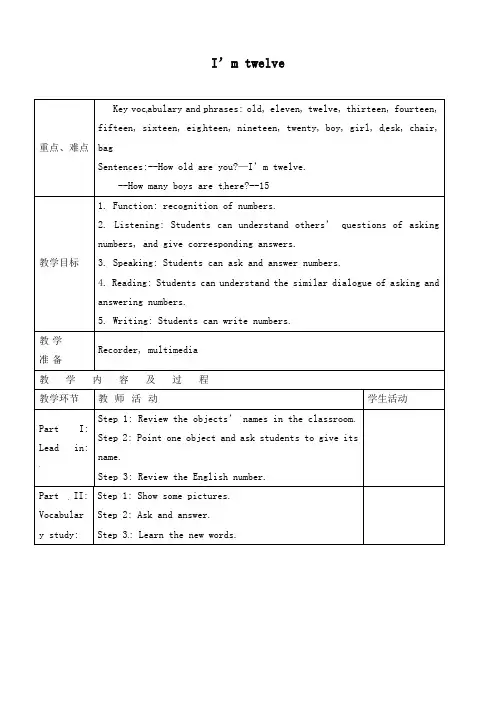
I’m twelve
重点、难点
Key voc abulary and phrases: old, eleven, twelve, thirteen, fourteen, fifteen, sixteen, eig hteen, nineteen, twenty, boy, girl, d esk, chair, bag
sixteen seventeen eighteen nineteen twenty
Step 2: Match the number in Activity 3.
seventeen t welve nineteen fiftee n sixteen
thirteen twenty eleven fourteen eighteen
Step 9: Listen and match
12 13 14 15 16 17 18 19 20
boys girls desks chairs books bags
Ke ys: 12 17 20 19 16 14
Step 10: Call back the answer from the whole class and check the answer.
Pa rtⅤWork in pairs.
Ask and answer.
How many… are there?
新外研版初中英语七年级上册Starter Module 2 My English lesson优质课公开课教案

Module 2 My English lessonUnit 1 Open your book.Ⅰ. Analysis of the textIn this text students will learn how to recognize objects in the class.Ⅱ. Arrangement of teaching in this moduleThree periods for this module, one period for one unit.Ⅲ. Teaching focus1. Master language of asking the name of specific objects in the class, and master the words of objects in the class.Key vocabulary and phrases: sit, down, sit down, open, book, listen, draw, put, up, hand, stand, stand up, close What’s this in English?, What’s this?, It’s…,instruction pronoun this.2. Be skilled in oral expression of asking the name of specific objects in the class and give corresponding answers.Ⅳ. Teaching aims1. Function: recognition of objects in the class.2. Listening: Students can understand others’ questions of asking the names of specific objects, and give corresponding answers.3. Speaking: Students can ask and answer objects’ names.4. Reading: Students can understand the similar dialogue of asking and answering objects’ names.5. Writing: Students can write the names of objects in the class.Ⅴ. Teaching ProceduresPart I: Lead inStep 1: Review the greeting phrases in the previous period by having the whole class play the dialogue in real situation.Step 2: Ask some students to introduce their partners to the class.Step 3: Enjoy a song: Hello and how are you?Part II: Vocabulary studyStep 1: Show some pictures of objects in the class by PPT, give students the names of the objects.Step 2: Play the recording and have them point out the words and phrases in Activity 1. Step 3: Listen and read.Good morning, class.Good morning, Miss Zhou.Please sit down.Step 4: Play the recording and have them point out the words and phrases in Activity 2. Sit down.Open your bookListen.Draw.Put up your hand.Stand up.Close your book.Step 5: Play the recording again and have them read after the tape.Step 6: Listen again and do.Part Ⅲ: Dialogue studyStep 1: Teacher ask the whole class the objects in the PPT’s names.Step 2: Match the expressions in Activity 3.1. Put up a) your book2. Open b) …down3. Stand c)… up4. Sit d)…your hand.Step 3: Check the answers.Keys: 1. d 2. a 3. c 4. bStep 4: Write the letters in Activity 5.Step 5: Listen and check.Step 6: Work in pairs, one student point one object in the PPT, the other answer the question.Step 7: Work in pairs and fill the blanks in Activity 6. Have some of them to perform the dialogue for the whole class.Stand up.Yes.Open your book.Yes.Step 8: Work in pairs. Say and do.Unit 2 What’s your number?Ⅰ. Analysis of the textIn this text students will learn how to express English number.Ⅱ. Arrangement of teaching in this moduleThree periods for this module, one period for one unit.Ⅲ.Teaching focusKey vocabulary and phrases: student, new, here, in, one, two, three, four, five, six, seven, eight, nine, ten, telephone, numberⅣ. Teaching aims1. Function: recognition of numbers.2. Listening: Students can understand others’questions of asking numbers, and give corresponding answers.3. Speaking: Students can ask and answer numbers.4. Reading: Students can understand the similar dialogue of asking and answering numbers.5. Writing: Students can write numbers.Ⅴ. Teaching ProceduresPart I: Vocabulary studyStep 1: Learn English number from one to ten.Step 2: Enjoy a song: Ten little Indians.Part II: Listening practice.Step 1: Look at the pictures in Activity 1.Step 2: Listen and read.—Hello. Are you a new student here?—Yes, I am.— What class are you in?—I’m in Class 3. Mr. Chen’s class.Ste p 3: Listen and repeat.one two three four fivesix seven eight nine tenStep 4: Listen and chant.One, two, three, four, five.Once I caught a fish alive.Six, seven, eight, nine, ten,Part III: Dialogue studyStep 1: Ask the students to read the conversation silently.Step 2: Play the recording and ask the students to listen and read the conversation. Step 3: Read the conversation.Step 4: Act it out.Step 5: Language pointsWhat’s your telephone number?What’s your telephone number? 用于询问对方的电话号码,回答时用“It’s +电话号码.”结构。
2023年秋七年级英语外研版上册教案:StarterModule2Unit3
本章节的核心素养目标主要包括:
1.语言能力:通过学习家庭成员和职业的词汇、句型,提升学生的英语表达能力,使其能够自信地进行自我介绍和家庭背景介绍;
2.文化意识:通过了解不同国家的家庭成员称呼及其文化背景,培养学生对文化差异的敏感性,增强跨文化交际意识;
3.思维品质:通过运用一般现在时描述家庭成员的职业,锻炼学生的逻辑思维和语言组织能力;
2.句型:掌握介绍家庭成员和职业的句型,例如:"This is my mom/dad. She/He is a doctor/teacher.";
3.对话:学会进行简单的自我介绍和家庭背景介绍,并能进行类似的对话交流;
4.语法:了解并运用一般现在时描述家庭成员的职业;
5.文化:了解不同国家的家庭成员称呼及其文化背景。
最后,我意识到在教学中要不断调整和优化教学方法,关注学生的兴趣和需求。在今后的教学中,我将尽量让课堂氛围更加轻松愉快,让同学们在愉悦的氛围中学习英语,提高他们的语言运用能力。
-教学难点举例:在拼读与记忆词汇方面,教师可以设计一些记忆游戏,如单词接龙、拼写比赛等,帮助学生克服记忆困难。在句型构造与应用上,教师可以提供一些填空练习,让学生在填空的过程中掌握句型结构。至于时态的运用,教师可以通过举例和练习,让学生明白如何在不同情境下使用一般现在时。在文化差异理解上,教师可以简要介绍不同国家的家庭结构和称呼习惯,帮助学生拓宽视野。
此外,今天的实践活动和小组讨论环节,同学们表现出了很高的积极性。他们能够将所学的知识运用到实际中,并提出自己的观点和想法。但在引导和启发学生思考方面,我觉得还有待提高。今后,我将更加关注学生的个体差异,针对不同学生的需求提出更具针对性的问题,帮助他们深入思考和理解。
七年级英语外研版上册教案: Starter Module 2 Unit 3-精选教学文档
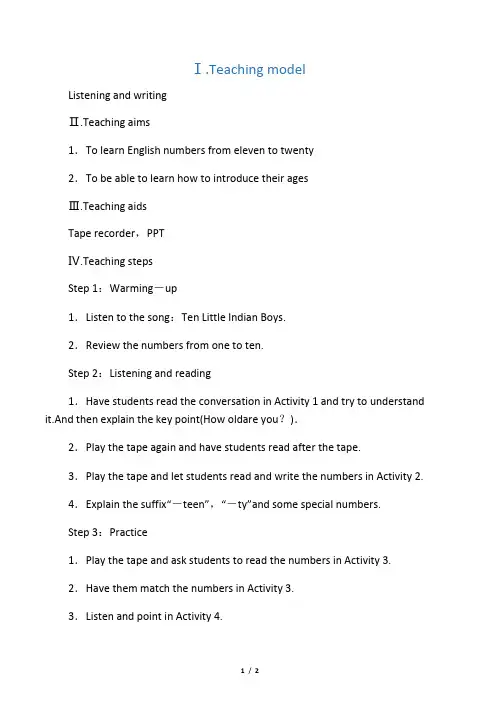
Ⅰ.Teaching modelListening and writingⅡ.Teaching aims1.To learn English numbers from eleven to twenty2.To be able to learn how to introduce their agesⅢ.Teaching aidsTape recorder,PPTⅣ.Teaching stepsStep 1:Warming-up1.Listen to the song:Ten Little Indian Boys.2.Review the numbers from one to ten.Step 2:Listening and reading1.Have students read the conversation in Activity 1 and try to understand it.And then explain the key point(How oldare you?).2.Play the tape again and have students read after the tape.3.Play the tape and let students read and write the numbers in Activity 2.4.Explain the suffix“-teen”,“-ty”and some special numbers.Step 3:Practice1.Play the tape and ask students to read the numbers in Activity 3.2.Have them match the numbers in Activity 3.3.Listen and point in Activity 4.4.Look at Activity 8.5.And then explain the points(How many…are there?)6.Work in pairs.Ask and answer the conversations.Step 4:Listening and writing1.Ask students to look at Activities 5 and 6.2.Play the tape and ask the students to listen and write in Activities 5 and 6.3.And then check the answers one by one.4.Have them read the words in Activity 7.5.Play the tape and ask the students to listen and match the numbers with the words in the box.6.Then check the answers.Step 5:Homework1.Practice writing the numbers.2.Revise all the key points in this unit.3.Finish the workbook.Blackboard DesignUnit 3I'm twelve.1.—How old are you?—I'm twelve.2.—How many boys are there?—15.。
外研版七年级英语上册公开课课件 Starter Module 3 Unit 2PPT
panda
duck
monkey
Hale Waihona Puke comput -er外研版七年级英语上册课件 Starter Module 3 Unit 2【公开课课件】
3 Read and match. a)You’re welcome. b)Yes, D-E-S-K. c)It’s D-E-S-K. d)Yes, of course.
New words
help me of
course of course classroom
v.帮助 prep.(宾格)我 prep.……的 adv.当然 是的,当然 n.教室
know say that
again welcome You’re welcome.
v. 知道,懂得 v.说;讲 pron.那;那个 adv.再(次), 又(一次) adj.受欢迎的 int.欢迎 不用谢,别客气。
外研版七年级英语上册课件 Starter Module 3 Unit 2【公开课课件】
A: Can you help me, please? B: Yes, of course. A: What’s this in English? B: It’s a___________.
外研版七年级英语上册课件 Starter Module 3 Unit 2【公开课课件】
外研版七年级英语上册课件 Starter Module 3 Unit 2【公开课课件】
5 Work in pairs. Ask and answer.
A: Can you help me, please? B: Yes, of course. A: What’s this in English? B: It’s a…
外研版七年级英语上册课件 Starter Module 3 Unit 2【公开课课件】
外研版新标准七年级英语上册Starter Module 2Unit3教学设计
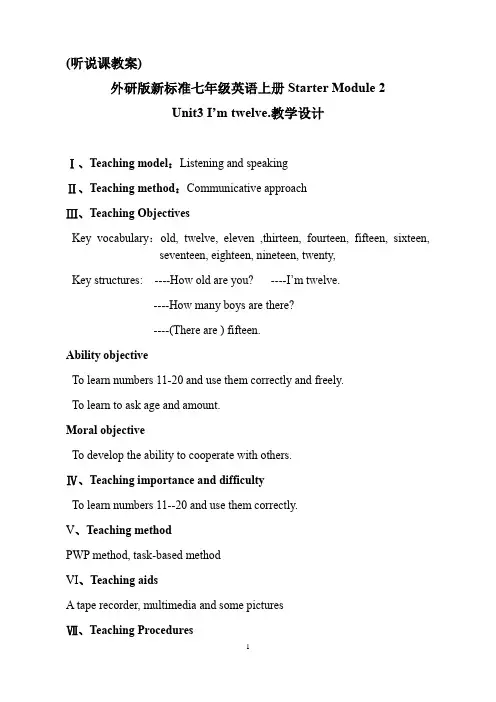
(听说课教案)外研版新标准七年级英语上册Starter Module 2Unit3I’m twelve.教学设计Ⅰ、Teaching model:Listening and speakingⅡ、Teaching method:Communicative approachⅢ、Teaching ObjectivesKey vocabulary:old, twelve, eleven ,thirteen, fourteen, fifteen, sixteen,seventeen, eighteen, nineteen, twenty,Key structures: ----How old are you? ----I’m twelve.----How many boys are there?----(There are ) fifteen.Ability objectiveTo learn numbers 11-20 and use them correctly and freely.To learn to ask age and amount.Moral objectiveTo develop the ability to cooperate with others.Ⅳ、Teaching importance and difficultyTo learn numbers 11--20 and use them correctly.V、Teaching methodPWP method, task-based methodVI、Teaching aidsA tape recorder, multimedia and some picturesⅦ、Teaching ProceduresLearning Aims (学习目标)1. To learn numbers 11-20 and use them correctly and freely.2. To learn to ask the age and the amount.(师傅学友明确学习任务)Review numbers 1-10.1).Use number cards to review 1-10.2) Ask some students to say 1-10.3) Play a relay game.Step 1: Check the new words . (学习单词)1.师友朗读old, twelve, eleven ,thirteen, fourteen, fifteen, sixteen,seventeen, eighteen, nineteen, twenty,(师傅注意学友的发音)2.教师检查Task1:请快速说出你看到的单词(师友举手抢答)Step 2: Talk and learn.(学习对话)I.师友听读感知Listen and read.(Activity 1)Ask several students“How old are you? ”and help then answer:“I’m eleven/twelve/thirteen.Work in pairs. Ask and answer. Try to understand the sentences.(先自主完成再互助交流)2)师友听读互助Listen and read.(Activity2)Listen and follow the tape to read numbers 11-20 again and again. Pay attention to the stress.(友情提示:先自主完成再互助交流)3)教师点拨1. 在很多情况下,我们会问别人的年龄,但西方人比较注重隐私,尤其有不问女性年龄的习惯。
新外研版七年级上册英语 Starter Module 2 Unit 3 教案(教学设计)
Module 2 My English lesson Unit 3 I'm twelve.知识目标单词old,twelve, eleven,thirteen, fourteen,sixteen, seventeen, eighteen, nineteen,twenty, boy, girl, desk, chair, bag词组how many,How old are you句型How old is he?—He is eight years old.What's your telephone number?It'sseven two six,nine two three.技能目标能听懂本课时的听力材料,能说出本课时的重要句型,能运用句式用英语谈论学习方法To read and write down 11-20.学习读写数字11-20。
Step 1GreetingT: Welcome to our class. I believe we will have a good year.思考:Can you read and write down 11-20?Ⅰ Analysis of the text:In this text students will learn how to introduce their ages and English numbers from eleven to twenty..Ⅱ Arrangement of teaching in this moduleThree periods for this module, one period for one unit.Ⅲ Teaching focus:ⅰ Master language of say your age and learn the numbers from 11 to 20.Key vocabulary and phrases: old, twelve, eleven, thirteen, fourteen, fifteen, sixteen, seventeen, eighteen, nineteen, twenty, boy, girl, chair, bagUseful sentences: -- How old are you? -- I’m twelve.-- How many boys are there? -- 15.ⅱ Be skilled in oral expression of English number from eleven to twenty.Ⅳ Teaching aims:ⅰ Function: learn to use the numbers from 11-20.ⅱ Listening: Students can understand numbers from 11-20.ⅲ Speaking: Students can say numbers from 11-20.ⅳ Reading: Students can understand the similar dialogues.ⅴ Writing: Students can write the numbers from 11-20.Ⅴ Learning strategies:Self study and Cooperate studyVI Teaching Procedures:Part I: Lead in:Step 1: Review the last two lessons in the previous period by having the whole class play the dialoges in real situation .Part II: V ocabulary study:Step 1:Play the recording and have them point out the words and phrases in Activity 1.Step 2: Play the recording again and have them read after the tape.Step 3: Have the students match the words in Activity 3 and check their answer with their partner.Step 4: Listen the dialogue in Activity 4 and point.Step 5: Write the right numbers in Activity 5.Step 6: listen to the tape and write the numbers in Activity 6.Part Ⅲ: Dialogue study:Step 1: Listen sentences in Activity 8 and practice.Step 2: Work in group of 4 and match in Activity 7, then have some groups of them to perform the dialoge for the whole class.()1.—________ are you?—I'm ten.A.How B.What C.How old D.How much( )2.—________ classes are there in your school?—Twenty.A.How B.How many C.How much D.What答案:1.C 2.B完成请完成《》P2对应习题本课时以问答形式与学生互动来导入新课,引出课时的中心—Can you read and write down 11-20? 这样既增长了学生关于一般疑问句的知识,又锻炼了学生的思考能力。
外研版七年级英语上册 Starter Module 2 Unit 3 I'm twelve教案
Starter Module 2 Unit 3 I'm twelveⅠ Analysis of the text:In this text students will learn how to introduce their ages and English numbers from eleven to twenty.Ⅱ Arrangement of teaching in this moduleThree periods for this module, one period for one unitⅢ Teaching focus:1. Master language of say your age and learn the numbers from 11 to 20.Key vocabulary and phrases: old, twelve, eleven, thirteen, fourteen, fifteen, sixteen, seventeen, eighteen, nineteen, twenty, boy, girl, chair, bag Useful sentences: -- How old are you? -- I’m twelve.-- How many boys are there? -- 15.2. Be skilled in oral expression of English number from eleven to twenty.Ⅳ Teaching aims:ⅰ Function: learn to use the numbers from 11-20.ⅱ Listening: Stude nts can understand numbers from 11-20.ⅲ Speaking: Students can say numbers from 11-20.ⅳ Reading: Students can understand the similar dialogues.ⅴ Writing: Students can write the numbers from 11-20.Ⅴ Learning strategies:Self study and Cooperate studyVI Teaching Procedures:Part I: Lead in:Step 1: Review the last two lessons in the previous period by having the wholeclass play the dialogues in real situation.Part II: Vocabulary study:Step 1: Play the recording and have them point out the words and phrases in Activity 1.Step 2: Play the recording again and have them read after the tape.Step 3: Have the students match the words in Activity 3 and check their answer with their partner.Step 4: Listen the dialogue in Activity 4 and point.Step 5: Write the right numbers in Activity 5.Step 6: listen to the tape and write the numbers in Activity 6.Part Ⅲ: Dialogue study:Step 1: Listen sentences in Activity 8 and practice.Step 2: Work in group of 4 and match in Activity 7, then have some groups of them to perform the dialogue for the whole class.。
新外研版初中英语七年级上册Starter Module 2 Unit 3 I'm twelve优质课公开课教案
Starter Module 2 Unit 3 I'm twelveⅠ Analysis of the text:In this text students will learn how to introduce their ages and English numbers from eleven to twenty.Ⅱ Arrangement of teaching in this moduleThree periods for this module, one period for one unitⅢ Teaching focus:1. Master language of say your age and learn the numbers from 11 to 20.Key vocabulary and phrases: old, twelve, eleven, thirteen, fourteen, fifteen, sixteen, seventeen, eighteen, nineteen, twenty, boy, girl, chair, bagUseful sentences: -- How old are you? -- I’m twelve.-- How many boys are there? -- 15.2. Be skilled in oral expression of English number from eleven to twenty.Ⅳ Teaching aims:ⅰ Function: learn to use the numbers from 11-20.ⅱ Listening: Stude nts can understand numbers from 11-20.ⅲ Speaking: Students can say numbers from 11-20.ⅳ Reading: Students can understand the similar dialogues.ⅴ Writing: Students can write the numbers from 11-20.Ⅴ Learning strategies:Self study and Cooperate studyVI Teaching Procedures:Part I: Lead in:Step 1: Review the last two lessons in the previous period by having the whole class play the dialogues in real situation.Part II: Vocabulary study:Step 1: Play the recording and have them point out the words and phrases in Activity 1.Step 2: Play the recording again and have them read after the tape.Step 3: Have the students match the words in Activity 3 and check their answer with their partner.Step 4: Listen the dialogue in Activity 4 and point.Step 5: Write the right numbers in Activity 5.Step 6: listen to the tape and write the numbers in Activity 6.Part Ⅲ: Dialogue study:Step 1: Listen sentences in Activity 8 and practice.Step 2: Work in group of 4 and match in Activity 7, then have some groups of them to perform the dialogue for the whole class.。
外研版七年级英语上册《starter module2 my English lesson unit
外研版七年级英语上册《starter module2 my English lesson unit 3 I’m twelve》教学设计一. 教材分析《starter module2 my English lesson unit 3 I’m twelve》这一课主要介绍年龄和班级的基本用语。
通过本课的学习,学生能够掌握如何用英语询问和回答他人的年龄和班级,以及如何用英语介绍自己。
教材内容贴近学生的生活实际,有利于激发学生的学习兴趣。
二. 学情分析七年级的学生已经掌握了基本的英语语法和词汇,对于本课的内容,他们需要通过听、说、读、写的实践来进一步提高他们的语言运用能力。
同时,学生应该已经具备了一定的合作意识和自主学习能力,这将为课堂活动的开展提供有利条件。
三. 教学目标1.知识目标:学生能够听懂、会说、会读、会写关于年龄和班级的词汇;学生能够用英语询问和回答他人的年龄和班级,以及如何用英语介绍自己。
2.能力目标:通过小组合作和角色扮演等活动,提高学生的口语表达能力和交际能力。
3.情感目标:激发学生学习英语的兴趣,培养他们积极向上的学习态度。
四. 教学重难点1.重点:学生能够用英语询问和回答他人的年龄和班级,以及如何用英语介绍自己。
2.难点:学生能够熟练运用所学的词汇和句型进行实际的交际。
五. 教学方法1.任务型教学法:通过设置各种实际任务,让学生在完成任务的过程中运用所学知识。
2.情境教学法:通过模拟生活情境,让学生在真实的环境中学习英语。
3.合作学习法:通过小组合作完成任务,培养学生的团队协作能力。
六. 教学准备1.教师准备:准备好教学PPT,包括本课的词汇、句型和对话。
2.学生准备:学生预习本课的内容,熟悉新的词汇和句型。
七. 教学过程1.导入(5分钟)教师通过提问方式引导学生复习已学的年龄和班级的词汇,如:“How old are you?”“What class are you in?”等,然后引入本课的主题。