
英语七年级上册Unit3_4知识点
北斗达焦老师七年级3-4总结一、单词1.for short简称2. in the same class 在同一班3.study … with… 与…一起学习…3.very much 非常4. No problem 没问题5.Of course =Sure 当然 15.at home在家6.help"study each other 互相帮助/学习7.learn from one another互相学习8.pen pal笔友9.speak Chinese 讲汉语 10.want to do sth. 想要做某事 11.visit the Great Wall 参观长城12. in English 用英语13. be helpful to… 对…有帮助 14.at the English corner 在英语角二、句型:1. May I do sth.? 我可以做某事吗?e.g. : May I know"have"ask your name?May I study English with you?May I call you Mike?2.Could you please tell me your name?你可以告诉我你的名字吗?Sure. My name is …当然可以,我叫……2. like … very much " a lot 非常喜欢……like … a little 有点喜欢…not like … at all 根本不喜欢……not like … very much 不是很喜欢……三、语法:(一) 一般现在时1.肯定句: We speak Chinese否定句: We don't speak Chinese.一般疑问句: Do you speak Chinese?回答: Yes, we do. No, we don't.2.肯定句: Mike speaks English.否定句: Mike doesn't speak English.一般疑问句: Does Mike speak English?回答: Yes, he does. No, he doesn't.3.动词第三人称单数构成形式:见书本107页(二)代词人称代词: 数/格人称单数复数主格宾格主格宾格第一人称I me we us第二人称you you you you第三人称hesheit himheritthey them主格:在句中当句子主语e.g. I have a good friend.He has a good friend.宾格: 在句中当动词的宾语或介词的宾语,形成动宾或介宾结构.Please call me Mike. (动宾)Give it (动宾) to me (介宾) .Help us find him. (动宾)人称代词排列顺序:(可记住口诀)you, he and I; we, you and they; he and she 口诀:对你尊重you在前,谦虚礼貌I最后;我们人多力量大,we要排在you之前,they委屈垫在后;两性并列不平等,绅士风度放一边,he 在前she在后。
特殊情况:1. 为了强调某人称,或是出现在承认错误之类的句中时,应把第一人称的I,放在前。
2. 当说话人I的身份很高或回忆往事时,可以先说I。
物主代词:人称单数复数形容词性物主代词名词性物主代词形容词性物主代词名词性物主代词第一人称my mine our ours 第二人称your yours your yours第三人称hisheritshishersitstheir theirs形容词性物主代词,也称非独立性物主代词,不能单独使用,必须与名词共同使用.e.g. my name/ your mother/ his friend/ their teacher仁爱英语七年级上unit3 topic 2语言点Topic2 This is a photo of my family.一、单词1.职业名称teach (教) --------- teacher (教师)study (学习) --------- student (学生)work (工作) --------- worker (工人) drive (驾驶) --------- driver (驾驶员)farm (农场) --------- farmer (农夫) cook (烹调) --------- cook (厨师) 2. 对应词:teacher --------- student nurse --------- doctor 3. office worker公务员policeman警察waiter男服务员 --------- waitress女服务员 salesman 男售货员 --------- salesgirl女售货员4. 家庭成员grandfather --------- grandmother grandpa --------- grandma father --------- motherDad --------- Mum Uncle --------- aunt son --------- daughter brother ------- sistercousin二、词组1.工作场所:in a school 在学校 in a hospital 在医院 in an office 在办公室 in a shop / store 在商店on a farm 在农场 2.be home到家3.make oneself at home 请随意,别拘束。
4. have a seat.= sit down ,please! = take a seat.请坐.5. a photo of my family 一张我家的相片6.the young woman in yellow 穿黄衣服的年轻女士7. on the sofa 在沙发上8. a happy family 幸福的家9. a student in Grade Seven 一名七年级的学生10. live in… 居住在11. live with…和……住在一起12. look after…照顾……; 保管……三、句型:1. I'm home. 我回来了.2. Come in and make yourselves at home. 请进, 请别客气.3. What a nice place! 多漂亮的一个地方!4. There are five people in my family.我家有五口人。
There be …“有……”,表示“某处有某人/物”,be动词的单复数形式根据所跟名词的单复数一致; people单复数同形。
5. My parents are both office workers. 我父母二个都是公务员.We all love our work. 我们都喜爱我们的工作.注意:both指两者"都"; all指三者或三者以上"都"四、语法:(一) 提问职业:1.What do you do? I am a doctor.2.What does he "she do? He "She is a doctor.(二) 提问工作场所:1. Where do you work?I work in a hospital"school2.Where does he "she work ?He"She works in an office"on a farm.(三) 名词所有格: s' 或's, 表示"……的"Kangkang's grandfather康康的祖父母Jane's family tree 珍妮的家谱Teachers' book 教师用书(教师们的书)仁爱英语七年级unit3 topic 3 Topic3 Would you like something to eat?一、词汇:Fruit: (可数) apple orangeFood: (可数) cake hamburger egg French fries dumpling noodles(不可数) rice porridge bread meat chicken fish beefDrink: (不可数) tea milk Coke coffee water juiceEat (吃) + drink (喝) = have something to drink 喝的东西 something to eat 吃的东西have dinner 吃饭;吃正餐 have breakfast 吃早饭 have lunch 吃午饭have supper 吃晚饭二、词组1.Help yourself"yourselves to…请随便吃……2.would like …想要……3.What about …= How about…表示征求意见。
4.Why not+动词原形…?= Why don’t you +动词原形…?“为什么不?”5.Good idea !好主意!6.take sb’s order记下某人点的饭菜7.Wait a moment, please.请稍等。
二、句型;1. help oneself (to sth) 请自便 (吃些某物)2. would like = want 想要Would you like some eggs? = Do you want some eggs?What would you like to drink? = What do you like to drink?3. Give me some meat. = Give some meat to me.4. Why not have some milk? 表示提建议5. Let's have some milk. 表示提建议6. May I take your order? = May I help you?(限于用餐)7. Wait a moment, please.请稍等片刻.8. What do you think of the coffee? = How do you like the coffee? 你觉得咖啡怎么样?9. Would you like to have dinner with me? (表邀请) Ok. I'd love to10. I'm very glad to be here.我非常乐意呆在这儿11. Any more rice? 再来些米饭怎么样?12. They are all friendly "kind to me.他们都对我很友好。
仁爱英语七年级上册U4T3知识点

仁爱英语七年级上册U4T3知识点在仁爱英语七年级上册的第四单元第三课,我们学习了一些重要的知识点。
这些知识点是我们学好英语的基础,所以我们要认真学习和掌握。
下面是这些知识点的详细介绍。
1. 动词的时态
在英语中,动词的时态分为三种:现在时、过去时和将来时。
现在时表示现在正在进行或经常发生的事情;过去时表示过去已经发生过的事情;将来时则表示将来将要发生的事情。
我们要学会根据句子的语境和时态去使用正确的动词时态。
2. 数词的用法
数词在英语中有两种,分别是基数词和序数词。
基数词用于表示数量,而序数词则用于表示顺序。
我们要根据具体情况正确地使用这两种数词。
3. 形容词的比较级和最高级
形容词的比较级和最高级分别用于表示两个或多个事物之间的比较和最高程度。
比较级通常使用“-er”或“more”来构成,而最高级则使用“-est”或“most”来构成。
4. 祈使句的用法
祈使句用于表示请求、命令等,这种句子的语气比较强硬。
我们要熟练掌握祈使句的用法,根据具体情况正确地使用祈使句。
5. 代词的用法
代词是用来代替名词的,常见的代词有人称代词、指示代词和不定代词等。
我们要认真学习代词的用法,熟练掌握它们的用法和区别。
6. 物主代词的用法
物主代词是用来表示所属关系的,常见的物主代词有“my”、“your”、“his”、“her”等。
我们要认真学习物主代词的用法,熟练掌握它们的用法和区别。
以上就是本课的重点知识点,我们要认真学习和掌握。
只有强化基础,才能在英语学习的道路上越走越远。
Unit+4+Lesson+3+知识点清单+2024-2025学年冀教版(2024)七年级英语上册
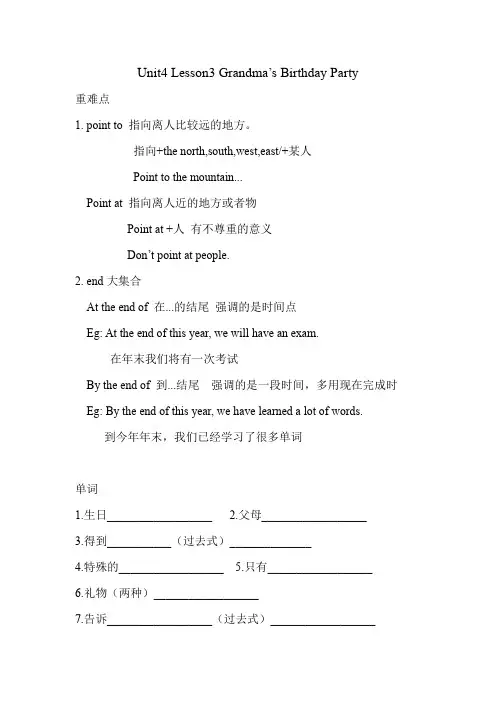
Unit4 Lesson3 Grandma’s Birthday Party重难点1. point to 指向离人比较远的地方。
指向+the north,south,west,east/+某人Point to the mountain...Point at 指向离人近的地方或者物Point at +人有不尊重的意义Don’t point at people.2. end大集合At the end of 在...的结尾强调的是时间点Eg: At the end of this year, we will have an exam.在年末我们将有一次考试By the end of 到...结尾强调的是一段时间,多用现在完成时Eg: By the end of this year, we have learned a lot of words.到今年年末,我们已经学习了很多单词单词1.生日__________________2.父母__________________3.得到___________(过去式)______________4.特殊的__________________5.只有__________________6.礼物(两种)__________________7.告诉__________________(过去式)__________________8.大笑__________________ 9.当...的时候__________________ 10.路过__________________ 11.微笑__________________12.走开__________________ 13.堂兄弟姐妹__________________ 14.秘密__________________ 15.最后__________________16.带来__________________(过去式)__________________17.移动__________________18.写___________(现在进行时)__________(过去式)___________19.跑________(现在分词)___________20游泳___________(现在分词)____________短语1.在厨房里做饭____________________2.摆放餐具____________________3.玩游戏____________________4.指向____________________5.在...的结尾____________________6.带给某人某物(两种)____________________7.跳出来____________________8.绕着房间跑____________________句子1.你的生日你想要什么?_____________________________________2.你想为他们做什么?_______________________________________。
仁爱版七年级上册英语笔记Unit3Topic3-Unit4Topic1知识点总结
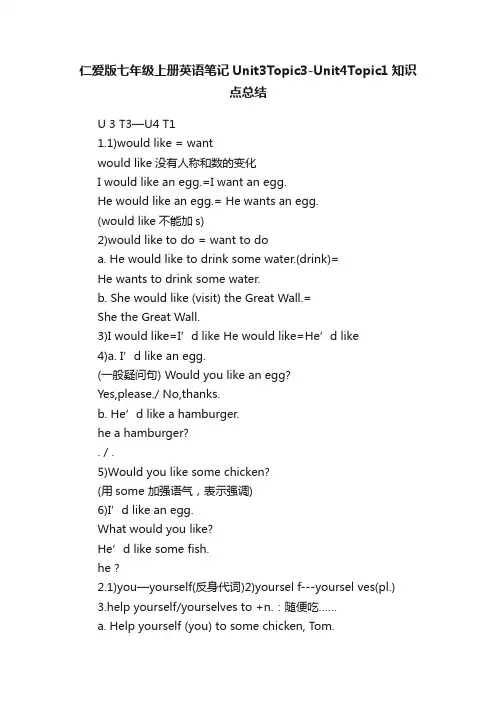
仁爱版七年级上册英语笔记Unit3Topic3-Unit4Topic1知识点总结U 3 T3—U4 T11.1)would like = wantwould like没有人称和数的变化I would like an egg.=I want an egg.He would like an egg.= He wants an egg.(would like不能加s)2)would like to do = want to doa. He would like to drink some water.(drink)=He wants to drink some water.b. She would like (visit) the Great Wall.=She the Great Wall.3)I would like=I’d like He would like=He’d like4)a. I’d like an egg.(一般疑问句) Would you like an egg?Yes,please./ No,thanks.b. He’d like a hamburger.he a hamburger?. / .5)Would you like some chicken?(用some 加强语气,表示强调)6)I’d like an egg.What would you like?He’d like some fish.he ?2.1)you—yourself(反身代词)2)yoursel f---yoursel ves(pl.)3.help yourself/yourselves to +n.:随便吃……a. Help yourself (you) to some chicken, Tom.b. Help yourselves (you) to some chicken, kids.4.1)可数名词[C]:有单数和复数的形式.2)不可数名词[UC]:一般没有复数的形式.3)常见的不可数名词有:milk,rice,fish(鱼肉),chicken(鸡肉),(apple/orange) juice,water,bread5.fish:1)作为“鱼” , 是可数名词.fish—fish(pl.)2)作为“鱼肉”, 是不可数名词.some fish6.chicken:1)作为“鸡” , 是可数名词.a chicken2)作为“鸡肉”, 是不可数名词.some chicken7.some + n.(pl.),some+ [UC]some eggssome fish/chicken/milk/apple juice/rice8.---Help yourselves.---Thank you.9.---Would you like…? ---Yes, please. /No, thanks.10.What/How about +sb(宾格)/sth?What about him/her/some milk?11.All right.行,好吧(表示对别人的建议表示赞同)---I’d like some rice and chicken.---All right./doc/6e6981861.html,k for me.13.Me,too.14.表示建议:---What about …? ---Good idea.15.an ideaa good ideaHomework:1.I’d like a hamburger.(一般疑问句) a hamburger?(肯否回答) ./ .2.She’d like some orange juice.she ?3. , boys and girls.(随便吃些鸡肉吧)4.She likes it very much.(否)She it .5..(我想喝些牛奶).6.他们怎么样?Unit 3 T 3 Section B—D1.1)usually:70-80%,often:50-60%2)usually,often放在be之后,行为动词之前.I usually have breakfast at home.2.have…for breakfast/lunch/supper/dinner1)He usually has an egg and some milk for breakfast.2)We usually have some rice and chicken for supper.3.一日三餐前不加a/an/the,后不加s.What do you usually have for/ breakfast?4.1)He usually has some bread for lunch.What does he usually have for lunch?2)We usually have some juice and fish for dinner. usuallyfor dinner?5.have:1)有2)吃,喝:have milk/bread6.[UC]前面不加a/an/the,后不加s.He has / milk and/ bread for breakfast.7.What/How about +sb(宾格)/sth?8.with带着/有,(表示伴随关系)have chicken/fish with vegetables9.some rice10.three meals(餐):breakfast,lunch,supper/dinner11.food:[UC],食物的总称,作主语,谓语用单数.My favorite food is (be) chicken and fish.12.Chinese /English food13.wait(v.)—waiter(指人)(男服务员)---waitress(女服务员)14.take one’s orderMay I take your order?15.something to drink/eat1)修饰词如不定式(to do) ,形容词修饰something时,放在something之后.2)something:某事(肯定句)anything:任何事(否/疑问)nothing:没有什么事(表否定意思的陈述句)3)Would you like +something?Would you likesomething to eat ?16.[UC]表示数量的表达法:1)a glass of apple juice/watera bag of rice /milk2)a glass of apple juice---two/some glasses of apple juice3) a bag of milk---five bags of milk17.wait/just a moment18.Let me see.让我想一想.I see. 我明白了.19.1)Would you like some vegetables?2)some vegetables/rice20.something to drink21.banana juice----Section C1.eat out2.eat---eating(现在分词)3.would like to doWould you like to have (have) dinner with me?4.have / breakfast/lunch/supper/dinner5.with sb(宾格)6.Would you like to have lunch with him?7.Yes, I’d like/love to.(to不能省略)8.1)May/can I help you?=What can I do for you?2)情态动词may/can/could+动原May I help (help) you?9.sir—madam(对应词)10.What would you liketo eat (eat)?11.Why not+动原? =Why don’t you +动原?Why not study (study) with me? = Why don’t you study with me?12.表示建议:1)What about…? 2)Why not…?肯定回答:Good idea.13.Here you are.14.---Would you like sth to drink?---Yes,please./No,thanks.Section D1.in+地点: in China2.many+n(pl.)many friends3.1)all,bothall指三者或三者以上“都”both指两者“都”2)all,both放在be之后,行为动词之前They are all students.We all like school.4.be kind to sbThe teacher is kind to us.5.have dinner with them6.such as +若干例子7.Sichuan food8.be glad to do sthObama is glad to visit (visit) the Great Wall.9.1)here,there是介词,前不加介词.2)be here/thereI’m glad to be (be) here.10.let sb do sthLet me (I) see (see).Homework:1.他晚饭通常吃什么?he usually2.你可以点菜了吗?3.Tom,为什么不随便吃些汉堡包呢,?,Tom?4.你想喝些什么东西吗?来两杯香蕉汁. Would you like.5.She’s glad (be) there.6.I’d like (work) with you.7.Would you like something (say)?8.Why not (tell) him about it.= him about it.9.他对我很友善.He .10.I usually have some rice for lunch. usually for lunch?1.---Do you like…?---Yes, I like …very much/a lot/a little. (No, I don’t like …at all.)Section D1.at / homeHe has a dog at home.2.it’s, its(它是)(它的)a cat. name’s Mimi.3.Tommy =T om4.Zhou Lan likes it a lot.= Zhou Lan likes it very much. (否)Zhou Lan doesn’t li ke it at all.5.some,anyShe has some pets.(否)She doesn’t have any pets.(疑问)Does she have any pets?6.1)人称代词:主格---宾格I—me,you-you,he-him,she-her,it-itwe-us,they-them2)形物代—名物代my-mine,your-yours,his-his,her-hers,its-its,our-ours,their-theirsThis is a girl. name is Lily. is twelve. We like .(Her,She,her) Unit 4 T1 Section A1.What can I do for you?=Can/May I help you?2.madam---sir(对应词)3.want to do = would like to do1)She wants to have milk and bread.=She would like to have milk and bread.2)Would you like a glass of apple juice?=Do you want a glass of apple juice?3)Would she like some vegetables?=Does she want any vegetables?4.clothes:衣服的总称,复数名词,作主语时,谓语用复数形式。
仁爱版七年级上册英语笔记 Unit3 Topic3-Unit4 Topic1知识点
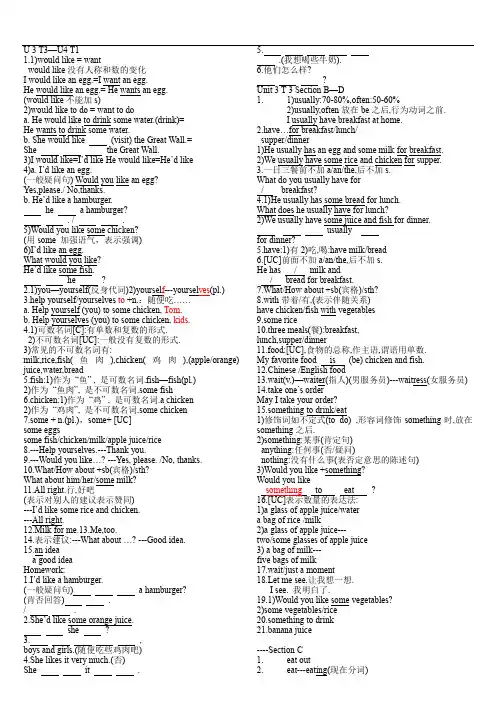
U 3 T3—U4 T11.1)would like = wantwould like没有人称和数的变化I would like an egg.=I want an egg.He would like an egg.= He wants an egg.(would like不能加s)2)would like to do = want to doa. He would like to drink some water.(drink)=He wants to drink some water.b. She would like (visit) the Great Wall.=She the Great Wall.3)I would like=I’d like He would like=He’d like4)a. I’d like an egg.(一般疑问句) Would you like an egg?Yes,please./ No,thanks.b. He’d like a hamburger.he a hamburger?. / .5)Would you like some chicken?(用some 加强语气,表示强调)6)I’d like an egg.What would you like?He’d like some fish.he ?2.1)you—yourself(反身代词)2)yoursel f---yoursel ves(pl.)3.help yourself/yourselves to +n.:随便吃……a. Help yourself (you) to some chicken, Tom.b. Help yourselves (you) to some chicken, kids.4.1)可数名词[C]:有单数和复数的形式.2)不可数名词[UC]:一般没有复数的形式.3)常见的不可数名词有:milk,rice,fish(鱼肉),chicken(鸡肉),(apple/orange) juice,water,bread5.fish:1)作为“鱼” , 是可数名词.fish—fish(pl.)2)作为“鱼肉”, 是不可数名词.some fish6.chicken:1)作为“鸡” , 是可数名词.a chicken2)作为“鸡肉”, 是不可数名词.some chicken7.some + n.(pl.),some+ [UC]some eggssome fish/chicken/milk/apple juice/rice8.---Help yourselves.---Thank you.9.---Would you like…? ---Yes, please. /No, thanks.10.What/How about +sb(宾格)/sth?What about him/her/some milk?11.All right.行,好吧(表示对别人的建议表示赞同)---I’d like some rice and chicken.---All right.k for me.13.Me,too.14.表示建议:---What about …? ---Good idea.15.an ideaa good ideaHomework:1.I’d like a hamburger.(一般疑问句) a hamburger?(肯否回答) ./ .2.She’d like some orange juice.she ?3. ,boys and girls.(随便吃些鸡肉吧)4.She likes it very much.(否)She it . 5..(我想喝些牛奶).6.他们怎么样??Unit 3 T 3 Section B—D1.1)usually:70-80%,often:50-60%2)usually,often放在be之后,行为动词之前.I usually have breakfast at home.2.have…for breakfast/lunch/supper/dinner1)He usually has an egg and some milk for breakfast.2)We usually have some rice and chicken for supper.3.一日三餐前不加a/an/the,后不加s.What do you usually have for/ breakfast?4.1)He usually has some bread for lunch.What does he usually have for lunch?2)We usually have some juice and fish for dinner.usuallyfor dinner?5.have:1)有2)吃,喝:have milk/bread6.[UC]前面不加a/an/the,后不加s.He has / milk and/ bread for breakfast.7.What/How about +sb(宾格)/sth?8.with带着/有,(表示伴随关系)have chicken/fish with vegetables9.some rice10.three meals(餐):breakfast,lunch,supper/dinner11.food:[UC],食物的总称,作主语,谓语用单数.My favorite food is (be) chicken and fish.12.Chinese /English food13.wait(v.)—waiter(指人)(男服务员)---waitress(女服务员)14.take one’s orderMay I take your order?15.something to drink/eat1)修饰词如不定式(to do) ,形容词修饰something时,放在something之后.2)something:某事(肯定句)anything:任何事(否/疑问)nothing:没有什么事(表否定意思的陈述句)3)Would you like +something?Would you likesomething to eat ?16.[UC]表示数量的表达法:1)a glass of apple juice/watera bag of rice /milk2)a glass of apple juice---two/some glasses of apple juice3) a bag of milk---five bags of milk17.wait/just a moment18.Let me see.让我想一想.I see. 我明白了.19.1)Would you like some vegetables?2)some vegetables/rice20.something to drink21.banana juice----Section C1.eat out2.eat---eating(现在分词)3.would like to doWould you like to have (have) dinner with me?4.have / breakfast/lunch/supper/dinner5.with sb(宾格)6.Would you like to have lunch with him?7.Yes, I’d like/love to.(to不能省略)8.1)May/can I help you?=What can I do for you?2)情态动词may/can/could+动原May I help (help) you?9.sir—madam(对应词)10.What would you liketo eat (eat)?11.Why not+动原? =Why don’t you +动原?Why not study (study) with me? = Why don’t you study with me?12.表示建议:1)What about…? 2)Why not…?肯定回答:Good idea.13.Here you are.14.---Would you like sth to drink?---Yes,please./No,thanks.Section D1.in+地点: in China2.many+n(pl.)many friends3.1)all,bothall指三者或三者以上“都”both指两者“都”2)all,both放在be之后,行为动词之前They are all students.We all like school.4.be kind to sbThe teacher is kind to us.5.have dinner with them6.such as +若干例子7.Sichuan food8.be glad to do sthObama is glad to visit (visit) the Great Wall.9.1)here,there是介词,前不加介词.2)be here/thereI’m glad to be (be) here.10.let sb do sthLet me (I) see (see).Homework:1.他晚饭通常吃什么?he usually?2.你可以点菜了吗??3.Tom,为什么不随便吃些汉堡包呢,?,Tom?4.你想喝些什么东西吗?来两杯香蕉汁.Would you like?.5.She’s glad (be) there.6.I’d like (work) with you.7.Would you like something(say)?8.Why not (tell) him about it.= him about it.9.他对我很友善.He .10.I usually have some rice for lunch.usually for lunch?1.---Do you like…?---Yes, I like …very much/a lot/a little.(No, I don’t like …at all.)Section D1.at / homeHe has a dog at home.2.it’s, its(它是)(它的)a cat. name’s Mimi.3.Tommy =Tom4.Zhou Lan likes it a lot.= Zhou Lan likes it very much.(否)Zhou Lan doesn’t like it at all.5.some,anyShe has some pets.(否)She doesn’t have any pets.(疑问)Does she have any pets?6.1)人称代词:主格---宾格I—me,you-you,he-him,she-her,it-itwe-us,they-them2)形物代—名物代my-mine,your-yours,his-his,her-hers,its-its,our-ours,their-theirsThis is a girl. name is Lily. is twelve. We like .(Her,She,her)Unit 4 T1 Section A1.What can I do for you?=Can/May I help you?2.madam---sir(对应词)3.want to do = would like to do1)She wants to have milk and bread.=She would like to have milk and bread.2)Would you like a glass of apple juice?=Do you want a glass of apple juice?3)Would she like some vegetables?=Does she want any vegetables?4.clothes:衣服的总称,复数名词,作主语时,谓语用复数形式。
2022年人教版七年级上册unit3---4单元复习知识点总结

Unit3 Is this your pencil?知识点大全1a—1c基本句型Is this/that your pencil?这/那是你的铅笔吗?简略回答:(肯定) Yes, it is. (否定)No, it isn’t.完整回答(肯定)Yes, it’s my pencil. / Yes, it’s mine.(否定)No, it is not my pencil. / No, it is not mine.Are these/those your pencil cases?简略回答:(肯定)Yes, they are.(否定)No, they aren’t.完整回答:(肯定)Yes, they are my pencil cases. / Yes, they’re mine.(否定) No, they are not my pencil cases. / No, they are not mine.重要单词pencil box 笔盒一般情况:这类由两个名词组合成的“名词短语”,若含义上可数,则单数变复数时只变第二个单词。
e.g. pencil box—> pencil boxes. 笔盒特殊情况:若第一个单词为man, woman等词时,两个都要变复数。
e.g. woman teacher—> women teachers 女老师man worker—> men workers 男工人eraser n.橡皮注意:一块橡皮为:an eraser。
知识点大全2a—2cExcuse me,Grace.打扰了,格雷丝。
本句是向别人提出请求、询问事情或打扰别人时常用的交际用语。
e.g.Excuse me. How can I get to the hospital?请问,我可以怎么去医院呢?Excuse me. Is this your book?打扰了,这是你的书吗?补充:excuse me 与sorry的区别sorry一般用于对事后所犯的错误或者是不能满足对方的要求,不能帮助对方时表示歉意,常表示“对不起,不好意思”。
新人教版七年级(上册)Unit 3 知识点总结

新人教版七年级(上册)Unit 3 知识点总结Unit 3 My School一、课内短语归纳1. dining hall 餐厅2. in front of在……(外部的)前面3. in the front of在……(内部的)前面4. across from 在对面5. sports field 运动场6. put up 张贴;搭建7. desk drawer 书桌抽屉8. at the back(of) 在(…)后面9. reading corner 阅读角10. in the corner of 在……的角落里11. on/at the corner of 在…的转角处12. be famous as 作为…而出名13. be famous for因……而出名14. at school在学校15. be different from与……不一样16. do exercises 做体操17. change seats 换座位18. similar to类似的;相像的19. sounds fun 听起来很有趣20. tell sb(not)to do sth告诉某人(不要)做某事21. tell sb about sth 告诉某人关于某事22. bye for now再见23. most of.………的大多数/大部分24. How about ...? ...怎么样?25. share with a partner 和同伴分享26. raise the flag 升旗27. welcome to our school 欢迎来到我们学校28. show sb. around 带某人四处参观二、必背经典句1. --Where’s the dining hall? 餐厅在哪里?--It’s in front of the art building. 它在艺术楼前面。
2. --Is there a gym in this school? 学校里有体育馆吗?--Yes, there is./ No, there isn’t. 是的,有。
仁爱版七年级上册英语笔记 Unit3 Topic3-Unit4 Topic1知识点总结
U 3 T3—U4 T11.1)would like = wantwould like没有人称和数的变化I would like an egg.=I want an egg.He would like an egg.= He wants an egg.(would like不能加s)2)would like to do = want to doa. He would like to drink some water.(drink)=He wants to drink some water.b. She would like (visit) the Great Wall.=She the Great Wall.3)I would like=I’d like He would like=He’d like4)a. I’d like an egg.(一般疑问句) Would you like an egg?Yes,please./ No,thanks.b. He’d like a hamburger.he a hamburger?. / .5)Would you like some chicken?(用some 加强语气,表示强调)6)I’d like an egg.What would you like?He’d like some fish.he ?2.1)you—yourself(反身代词)2)yoursel f---yoursel ves(pl.)3.help yourself/yourselves to +n.:随便吃……a. Help yourself (you) to some chicken, Tom.b. Help yourselves (you) to some chicken, kids.4.1)可数名词[C]:有单数和复数的形式.2)不可数名词[UC]:一般没有复数的形式.3)常见的不可数名词有:milk,rice,fish(鱼肉),chicken(鸡肉),(apple/orange) juice,water,bread5.fish:1)作为“鱼” , 是可数名词.fish—fish(pl.)2)作为“鱼肉”, 是不可数名词.some fish6.chicken:1)作为“鸡” , 是可数名词.a chicken2)作为“鸡肉”, 是不可数名词.some chicken7.some + n.(pl.),some+ [UC]some eggssome fish/chicken/milk/apple juice/rice8.---Help yourselves.---Thank you.9.---Would you like…? ---Yes, please. /No, thanks.10.What/How about +sb(宾格)/sth?What about him/her/some milk?11.All right.行,好吧(表示对别人的建议表示赞同)---I’d like some rice and chicken.---All right.k for me.13.Me,too.14.表示建议:---What about …? ---Good idea.15.an ideaa good ideaHomework:1.I’d like a hamburger.(一般疑问句) a hamburger?(肯否回答) ./ .2.She’d like some orange juice.she ?3. , boys and girls.(随便吃些鸡肉吧)4.She likes it very much.(否)She it .5..(我想喝些牛奶).6.他们怎么样??Unit 3 T 3 Section B—D1.1)usually:70-80%,often:50-60%2)usually,often放在be之后,行为动词之前.I usually have breakfast at home.2.have…for breakfast/lunch/supper/dinner1)He usually has an egg and some milk for breakfast.2)We usually have some rice and chicken for supper.3.一日三餐前不加a/an/the,后不加s.What do you usually have for/ breakfast?4.1)He usually has some bread for lunch.What does he usually have for lunch?2)We usually have some juice and fish for dinner.usuallyfor dinner?5.have:1)有2)吃,喝:have milk/bread6.[UC]前面不加a/an/the,后不加s.He has / milk and/ bread for breakfast.7.What/How about +sb(宾格)/sth?8.with带着/有,(表示伴随关系)have chicken/fish with vegetables9.some rice10.three meals(餐):breakfast,lunch,supper/dinner11.food:[UC],食物的总称,作主语,谓语用单数.My favorite food is (be) chicken and fish.12.Chinese /English food13.wait(v.)—waiter(指人)(男服务员)---waitress(女服务员)14.take one’s orderMay I take your order?15.something to drink/eat1)修饰词如不定式(to do) ,形容词修饰something时,放在something之后.2)something:某事(肯定句)anything:任何事(否/疑问)nothing:没有什么事(表否定意思的陈述句)3)Would you like +something?Would you likesomething to eat ?16.[UC]表示数量的表达法:1)a glass of apple juice/watera bag of rice /milk2)a glass of apple juice---two/some glasses of apple juice3) a bag of milk---five bags of milk17.wait/just a moment18.Let me see.让我想一想.I see. 我明白了.19.1)Would you like some vegetables?2)some vegetables/rice20.something to drink21.banana juice----Section C1.eat out2.eat---eating(现在分词)3.would like to doWould you like to have (have) dinner with me?4.have / breakfast/lunch/supper/dinner5.with sb(宾格)6.Would you like to have lunch with him?7.Yes, I’d like/love to.(to不能省略)8.1)May/can I help you?=What can I do for you?2)情态动词may/can/could+动原May I help (help) you?9.sir—madam(对应词)10.What would you liketo eat (eat)?11.Why not+动原? =Why don’t you +动原?Why not study (study) with me? = Why don’t you study with me?12.表示建议:1)What about…? 2)Why not…?肯定回答:Good idea.13.Here you are.14.---Would you like sth to drink?---Yes,please./No,thanks.Section D1.in+地点: in China2.many+n(pl.)many friends3.1)all,bothall指三者或三者以上“都”both指两者“都”2)all,both放在be之后,行为动词之前They are all students.We all like school.4.be kind to sbThe teacher is kind to us.5.have dinner with them6.such as +若干例子7.Sichuan food8.be glad to do sthObama is glad to visit (visit) the Great Wall.9.1)here,there是介词,前不加介词.2)be here/thereI’m glad to be (be) here.10.let sb do sthLet me (I) see (see).Homework:1.他晚饭通常吃什么?he usually?2.你可以点菜了吗??3.Tom,为什么不随便吃些汉堡包呢,?,Tom?4.你想喝些什么东西吗?来两杯香蕉汁.Would you like?.5.She’s glad (be) there.6.I’d like (work) with you.7.Would you like something(say)?8.Why not (tell) him about it.= him about it.9.他对我很友善.He .10.I usually have some rice for lunch.usually for lunch?1.---Do you like…?---Yes, I like …very much/a lot/a little.(No, I don’t like …at all.)Section D1.at / homeHe has a dog at home.2.it’s, its(它是)(它的)a cat. name’s Mimi.3.Tommy =Tom4.Zhou Lan likes it a lot.= Zhou Lan likes it very much.(否)Zhou Lan doesn’t like it at all.5.some,anyShe has some pets.(否)She doesn’t have any pets.(疑问)Does she have any pets?6.1)人称代词:主格---宾格I—me,you-you,he-him,she-her,it-itwe-us,they-them2)形物代—名物代my-mine,your-yours,his-his,her-hers,its-its,our-ours,their-theirsThis is a girl. name is Lily. is twelve. We like .(Her,She,her)Unit 4 T1 Section A1.What can I do for you?=Can/May I help you?2.madam---sir(对应词)3.want to do = would like to do1)She wants to have milk and bread.=She would like to have milk and bread.2)Would you like a glass of apple juice?=Do you want a glass of apple juice?3)Would she like some vegetables?=Does she want any vegetables?4.clothes:衣服的总称,复数名词,作主语时,谓语用复数形式。
七年级英语上册 unit3-unit4 知识点汇总
七年级英语上册 unit3-unit4 知识点汇总七年级英语上册 unit3-unit4 知识点汇总U词汇:1.称呼类词汇:sister 姐;妹 mother妈妈father爸爸brother兄;弟grandmother祖母;外祖母grandfather祖父;外祖父aunt姑母;伯母;婶母uncle叔;伯;舅;姨夫son 儿子cousin表(堂)兄弟(姐妹) daughter女儿2. 本单元出现的缩写:that’s = that is he’本单元出现的指示代词:these 这些 those 那些a为……而感谢句式:1. This/that/These+ be动词+ sb’s …TThabThese are his b2. be动词+代词+…Iu?Iu?Tha… Thaur familHere +be 动词+… HamilU词汇:1.本单元出现的家具类词汇:table桌子 bed床bookcase书橱,书柜 sofa沙发 chair椅子 drawer抽屉 2.表位置的介词短语:undable在桌子下面a在沙发上in the backpack在双肩背包里 under the bed在床下面air在椅子上dresser在梳妆台上able在桌子上drawer在抽屉里loor在地板上3.math book数学书4.alarm clock闹钟puter game电脑游戏6.video tape录像带7.tab.把某物带给某人tags to you把这些东西带给你姐姐8.ID card身份证9.bringlace把某物到给某地bringgl把一些物品带到学校10.pencil case铅笔盒bedroom在卧室12在厨房句式:1.询问地点——Where + be动词 + sth. 答语——It is/They are + 表位置的介词短语—Where’s my backpack?—It’s undable.—Where are your books?—They’a2.询问某物是否在某地的句型及答语—Is the baseballa?—No,it isn’t. It’s unda—Abed?—No,they’祈使句——Please do sth. Please tags to you…an引导的一般疑问句 Can you bringgl?5.倒装句——Here + be动词 + 主语 HHere aappl)_______(this) are my pa2)_______(that)ad)Iather? No,_______ isn’A.it B)Iur friend? Yes,________A.he Bu5)Thanks _________youg bA.for B. very much C.a l)There _______ ad)My parents are_________teaA.both B.all C.each。
仁爱英语七年级上册Unit3-4知识点总结整合
仁爱英语七年级上册Unit3-4知识点总结整合七年级上unit 3-4 知识点整合重点短语及句型:1.Could you please + 动词原形…?肯定回答:Sure/Of course./No problem. 否定回答:Sorry.2. tell sb. sth. =tell sth. to sb.I tell my name to him. I tell him my name.4. speak some Chinese5. help sb. with sth.=heip sb. to do sth.6. want to do sth. / want sth. / want sb. to do sth7.live in +地点住在某地live with + sb. 和某人住在一起8 each other We love each other very much.9. not … at all I don’t like English a t all.单选:1.I like the little cat a lot but she likes it __.A. a lotB. at allC. a littleD. very much2. We often help __.A. herB. sheC. heD. my3. Do they __English a lot?A. sayB. talkC. speakD.tell4. He ------to visit China.A. wantB. to wantC. w antsD. don’t want5. ---- Could you give me an apple? ----__. I have three.A. Sorry.B. Thank youC. No problemD. Please句型转换:1.我想在英语方面帮助他I __to help him__his English.2. Kate likes the food. 用not… at all 改写Kate__like the food ____.3. I often help him and he often helps me. 合为一句He and I often help ____.4. She lives in the U.S.A. 对划线部分提问____she live?Topic 2重点短语及句型:1. be home/at home/go home/get home2. Glad to meet you.3. have a seat4. What do/ doe s sb.do? =What is sb.?=What’s one’s job?Sb + be + 职业6. in a hospital / in hospitalHe works in a hospital. He is ill in hospital.on a farm/ in a school / in an office/ in a factory / in a shop/ in a restaurant/ at homeAt, in 两个介词接地点时的区别At 常表示的位置是某一个具体的地点,一般用来指比较小的地方,如车站,村庄,建筑物,城镇等At school gate/ at the stationIn一般指大地方,如大城市,省,行政区,国家等如In shangha/ in the USA7. family 作为整体概念在句中作主语时,谓语动词用单数形式。
Unit+3-Unit4语法知识精讲 仁爱版英语七年级上册
Some 和 any 意为 一些, 用于修饰可数和不可数名词
Some flags OR Any flags ?
Please read these sentences carefully
There are some flags in the picture .
some 用于肯定句
Are there any flags in the picture ? There aren't any flags in the picture.
用所给代词的适当形式填空:
• 1. Show __m_e__ how to draw a pig, OK? (I) • 2. Let’s play with __hi_m__. (he ) • 3. _T_h_e_y don’t know his name. Would you please
tell _th_e_m____? ( They ) • 4._S_h_e__( her) want to buy a book for _m_e_ (I)
Could you give me some stars ?
Sure!
some 还可用于表示 请求的一般疑问句中
用some 或 any 填空
1. I have __s_o_m__e_ books.
2. Do you have __a_n__y__ apples? 3. He doesn't have ___a_n_y___ money.
不可数名词
(1)不能用具体的数目来表示,前面不能加a/an,没有复数形式。 如:milk, chicken, bread, Coke, coffee, rice, juice, fish, tea, water, chocolate等。 (2)液体,肉类,金木水火土,米面茶肉布,油盐糖酒醋 (3)抽象名词 (4)不可数名词若要表示数量,可用:数词+量词+ of + 不可数名词。 如:a glass of milk 一杯牛奶;ten bottles of apple juice; ten loaves of bread 十条面包