
仁爱英语七下英语知识点
2016-2017学年七下英语复习资料Unit 5 topic 1重点词组去上学go to school 回家go home去公园go to the park 去购物/游泳go shopping / swimming 步行on foot 乘飞机by plane 坐火车by train 坐船by ship 坐公共汽车by bus 骑自行车by bike 走路去上学go to school on foot /walk to school 乘飞机去上海go to Shang hai by plane/ take a plane to Shang hai 坐公共汽车去公园go to the park by bus/ take a bus to the park 骑自行车去上班go to school by bike /ride a bike to school乘地铁去上学go to school by subway/take the subway to school 开车去学校go to school by car/drive a car to school 放学以后after school 晚饭后after supper 弹钢琴/吉他play the piano/guitar 打篮球/踢足球play basketball/football 玩电脑游戏play computer games 在工作日on weekdays 在周末at weekends 吃早餐/中餐have breakfast / lunch上课have classes / lessons 上英语课have an English class 看电视/电影watch TV / movies 在某人有空的时候in one’s free time 结束be over频率副词及词组:never, seldom, sometimes, often, usually, always 一星期一次once a week 一个月两次twice a moth 一年三次three times a year 每天every day 疑问词how often时态:一般现在时谓语动词的形式: be- am/is/aredo/does一般疑问句:Do/Does 主语do--------?否定句:主语don’t/doesn’t do --------.特殊疑问句:疑问词+ 一般疑问句?情景题:1 如果你想知道对方怎样去上学,你可以这样问:How do you usually go to school?2 你想知道对方通常是骑自行车上学还是走路上学,你可以这样问:Do you usually go to school by bike or on foot?3 你想知道对方多久打篮球一次,你可以这样问:How often do you play basketball?4 你想知道对方放学后经常做什么,你可以这样问:What do you often do after school?5 你想知道对方早上起床的时间,你可以这样问:What time do you usually get up in the morning?6 你想告诉对方你父亲从不开车去上班,你可以这样说:My father never goes to work by car.7 你想知道对方放学的时间,你可以这样问:What time is school over?8你想知道对方上课的时间,你可以这样问:What time do classes begin?9你想告诉对方是上课的时候了,你可以这样说:It’s time for class.Unit 5 topic 2重点词组听音乐listen to music写信write letters 会见朋友meet friends画画draw pictures 做运动play sports 看电视watch TV解答数学题work on math problems 打牌play cards 制作卡片make cards 做作业do one’s homework 在操场上on the playground 在图书馆里in the library 在健身馆in the gym 在书架上on the shelf/shelves 在电话里on the phone 看书/报纸read books/newspapers 准时on time 寻找look for 举行足球赛have a soccer game 和某人聊天talk to -- 喜欢做某事like/love doing时态:现在进行时谓语动词的形式: am/is/are + doing现在分词(doing)构成法:go – going play – playinghave – having drive – driving make—making dance—dancingrun–running swim –swimming begin –beginning plan—planning shop-shopping sit—sitting put – putting一般疑问句:Am/Is/Are 主语----------?否定句:主语am/is/are not doing ----.特殊疑问句:疑问词+ 一般疑问句?情景题:1如果你想知道对方正在做什么,你可以这样问:What are you doing?2 你想知道对方是否正在做作业,你可以这样问:Are you doing your homework now?3 你想知道对方正在看电视还是在画画,你可以这样问:Are you watching TV or drawing pictures?4 你想向对方借用自行车,你可以这样问:May I borrow your bike?5 你想知道这些书可以借多久,你可以这样问:How long can I keep these books?6如果你想知道对方的妹妹正在做什么,你可以这样问:What is your sister doing now?7你想告诉对方康康在听音乐,你可以这样说:Kangkang is listening to music.6如果你想知道对方正在上哪节课,你可以这样问:What class are you having now?in the evening, often usually, pool often, zooUnit 5 topic 3重点词组到家get home 到校get to school 每个星期四every Thursday 在星期一on Monday 在星期二晚上on Tuesday evening 与…不同be different from 与…相同be the same as 进行户外活动do outdoor activities 在…与…之间between…and…向…学习learn from 了解过去learn about the past 某人最喜欢的科目/食物/季节one’s favorite subject/food/season 最喜欢—like --- best 讨论talk about 从---到--- from--- to ---- 谢谢你做某事thank you for ----/doing sth.反义词:boring –interesting difficult –easy情景题:1如果你想知道今天星期几,你可以这样问:What day is it today?2 你想知道对方每周上几节英语课,你可以这样问:How many English lessons do you have every week?3 你想知道对方最喜欢的科目,你可以这样问:What’s your favorite subject? Which subject do you like best?4 你想知道对方最喜欢数学的原因,你可以这样问:Why do you like maths best?5 你想知道对方对音乐这一科目的看法,你可以这样问:What do you think of music? How do you like music?6 你想告诉对方你不喜欢物理的原因,你可以这样说:I don’t like physics because it’s boring.7 你想告诉对方你对语文这一科的观点,你可以这样说:I think Chinese is interesting.music class after school, basketball dance, three times a week now, Chinese class listen, English songs look, do one’s homework now, playground do exercise, gymUnit 6 topic 1重点词组在第二层on the second floor看一看have a look 看一看--- have a look at ---- 紧挨着next to 在……的前面in front of 在……的前部in the front of 收到某人的来信hear from sb 上楼go upstairs 把……收起来put ---- away 照顾;照看look after 玩钢笔play with a pen 为什么不做某事why not do sth? 在厨房in the kitchen 在书房in the study 在---的后面at the back of 在----的中心in the centre of 在-----的左/右边on the left/right of 在树上in/on the tree写信给某人write (a letter) to 某人重点句型there be 句型表示"某地或某时间存在某人/某物"。
肯定句:There is +单数名词/不可数名词…There are+复数名词…There is +单数名词+and+复数名词…(就近原则)There are+复数名词+and+单数名词…(就近原则)否定句:be 后面直接加‘ not’一般疑问句:be 动词直接提前。
否定句和一般疑问句中要用“any”代替“some”。
特殊疑问句:what’s +介词短语?意思:某地有什么?问数量How many + 复数名词are there -----------?问数量How much + 不可数名词is there ----------?情景题:1如果你想告诉对方你的书房里有一台电脑,你可以这样说:There is a computer in my study.2如果你想告诉对方树上有一些小鸟在唱歌,你可以这样说:There are some birds singing in the tree.3如果你想告诉对方操场上有一些学生在打篮球,你可以这样说:There are some students playing basketball on the playground.4如果你想告诉对方杯子里没有牛奶,你可以这样说:There isn’t any milk in the glass. There is no milk in the glass.5 你想知道墙上有什么,你可以这样问:What’s on the wall?6 你想知道门后面有什么,你可以这样问:What’s behind the door?7 你想知道桌子上有多少个苹果,你可以这样问:How many apples are there on the desk?8 你想知道袋子里有多少大米,你可以这样问:How much rice is there in the bag?cat under clock near close toUnit 6 topic 2重点词组在农村in the countryside 出租for rent 每月500元以下under 500 yuan a month 一栋18层的公寓楼an apartment building with 18 floors 打某人电话call sb. at 2868888 存钱keep money寄信post letters 在街道的拐角处on the street corner 在----的尽头at the end of ---- 做运动do sports 向某人求助ask sb for help 远离be far from 从某地搬到某地move from---- to---- 生活费用the cost of living 看医生see a doctor 靠近close to 打119求助call 119 for help 对某人友好be kind/friendly to sb 居住在live in -- 和某人住在一起live with sb 居住在第四层live on the fourth floor情景题:1你想向别人求助,你可以这样说:Could you help me,please?2你想向别人提供帮助,你可以这样说:Can I help you? Would you like me to help you?3 你想知道对方居住在什么样的房子,你可以这样问:What kind of home do you live in ?4 你想告诉对方你住在一栋八层的单元楼里,你可以这样:I live in an apartment building with eight floors.5 你想告诉对方你的家离邮局很远,你可以这样说:My home is far from the post office.6 你想问对方觉得城市的交通怎么样,你可以这样问:What do you think of the traffic in the city?7 你想问对方是否想租一间双人房,你可以这样问:Do you want to rent a room with two beds?8 你父亲吩咐你不要在街上踢足球,他可以这样说:Don’t play football in the street.9 你建议对方不要在墙上画画,你可以这样说:Don’t draw pictures on the wall.10 你希望对方不要在阳光下看书,你可以这样说:Don’t read books in the sun.favorite, subject orange ,favorite there ,birds, tree, singtree, behind, thereUnit 6 topic 3重点词组向左/右转turn left/right 在第一个十字路口at the first crossing 沿着-----走go/walk along/down ---- 在左/右边on the left/right 在你的左右边on your left/right 过桥go across the bridge 在-----的对面across from ---- 在----的拐角处on the corner of ---- 在---和---之间between --- and ---- 继续走walk on 需要做某事need to do sth 换乘2路公交车change to Bus No.2 受伤get hurt 保证安全keep safe 失去生命lose one’s life 在交通事故中in traffic accidents 遵守交通规则obey the traffic rules 我们所有人all of us 小心be careful在街上玩play on the street. 一张----的罚单 a ticket for ---- 保持安静be quiet 情景题:1你想问对方去书店的路,你可以这样问:Excuse me, how can I get to the booksore?Excuse me, could you tell me the way to the bookstore?Excuse me, which is the way to the bookstore?Excuse me, where is the bookstore?2你想知道对方的家到学校有多远,你可以这样问:How far is your home from your school?3 交警告诫司机不要在这里停车,他可以这样说:Don’t park here.4你妈妈让你不要把风筝放在桌子上,她这样对你说:Don’t put your kite on the desk.5交警告诫孩子们不要街上玩耍,他可以这样说:Don’t play on the street.6 老师告诉学生们在图书馆里要安静,他可以这样说:Be quiet in the library,please.7你想知道对方正在找什么,你可以这样问:What are you looking for?8你想告诉你妈妈你正在书房里做作业,你应该这样说:I am doing my homework in the study.9王老师想知道你爸爸的电话号码,他可以这样问:What’s your father’s telephone number?10 你想知道对方为什么不喜欢英语的原因,你可以这样问:Why don’t you like English、11你想知道这辆自行车能借多久,你这样问你朋友:How long can I keep your bike?12你想告诉对方你班上有25名女生,你可以这样说:There are 25 girls in my class.13你想告诉对方在河的对面有一个漂亮的花园,你可以这样说:There is a beautiful garden across from the river.14你想告诉朋友有一天你能参观长城,你可以这样说:I can visit the Great Wall one day.Unit 7 topic 1重点词组出生于(某年/月/地)be born in -- 出生于某一天(早上/下午/晚上)be born on 在九月in September ----的一个粉丝 a fan of ---- 下周日next Sunday计划做某事plan to do sth 给某人举行生日晚会have a birthday party for sb 我恐怕--- I’m afraid ----- 像---- be like ---- 看起来像---- look like ---- -----的形状the shape of ----- 我猜到了I get it 做一顿丰盛的晚餐cook a big dinner 用某物来做某事use sth to do sth/for doing sth 给某人买某物buy sth for sb/buy sb sth 时态:be 动词的过去式am/is – was are --- wereHe was born in 2005 She was born in BeijingThey were born in October. He was born on June 1st序数词:one--- first two --- second three ---- thirdfour --- fourth five--- fifth six --- sixth seven --- seventheight --- eighth nine --- ninth ten --- tenth eleven --- eleventhtwelve – twelfth thirteen – thirteenth fourteen –fourteenthfifteen – fifteenth sixteen – sixteenth seventeen –seventeentheighteen – eighteenth nineteen – nineteenth twenty—twentieth情景题:1你想知道今天几月几号,你可以这样问:What’s the date today?2你想知道对方是否出生在加拿大,你可以这样问:Were you born in Canada?3你想知道对方的出生地,你可以这样问:Where were you born?4你想知道对方的出生日期,你可以这样问:When were you born?5你想知道对方什么时候生日,你可以这样问:When is your birthday?6你想告诉对方你的父母计划给你举办一个生日聚会,你可以这样说:My parents plan to have a birthday party for me.7你想问对方电脑的用途,你可以这样问:What do we use computers for?8你想问对方的尺子有多长,你可以这样问:How long is your ruler?9你想知道对方给康康的生日礼物的形状,你可以这样问:What’s the shape of your present for Kangkang?10你想告诉对方MP4的用途,你可以这样说:I use an MP4 to listen to music.11你想告诉对方你出生于2005年4月1号,你可以这样说:I was born on April 1st, 2005.Unit 7 topic 2重点词组拍照take photos 在某人的生日聚会上at one’s birthday party 弹钢琴play the piano 表演芭蕾舞perform ballet 跳迪斯科dance to disco 得开心have a good time/enjoy oneself 其它什么what else 制作飞机模型make model planes 唱英文歌sing English songs 带--- 去某地take ----- to ---- 一年前one year ago 两年前two years ago在过去in the past 在五岁时at the age of five/when 某人was five 去年last year在某人的帮助下with one’s help/with the help of sb 想成为--- want to be ----- 对某人来说很难be hard for sb 不再not ------ any more ------出了问题there is/was something wrong with ------ 放风筝fly a kite 打乒乓球play ping-pong 去钓鱼go fishing情态动词:can 表示现在会/能做某事句子结构:I /he/ she /they /we can do sth.(肯定句)Can you/he/she/they do sth? (一般疑问句)I /he/ she /they /we can not do sth.(否定句)情态动词:could表示过去会/能做某事句子结构:I /he/ she /they /we could do sth.(肯定句)Could you/he/she/they do sth? (一般疑问句)I /he/ she /they /we could not do sth.(否定句)情景题:1你想知道对方是否会骑自行车,你可以这样问:Can you ride a bike?2你想知道对方的妹妹是否会唱英文歌,你可以这样问:Can your sister sing English songs?3你想知道对方是会弹钢琴还是会表演芭蕾舞,你可以这样问:Can you play the piano or perform ballet?4你想知道对方想在康康的生日晚会做什么,你可以这样问:What do you want to do at Kangkang’s birthday party?5你想告诉对方你的自行车出了点问题,你可以这样说:There is something wrong with my bike.6你想告诉对方你在五岁时就会画画,你可以这样说:I could draw pictures when I was five.7你想知道对方会做什么,你可以这样问;What can you do?8你想告诉对方你想要成为一名医生,你可以这样说:I want to be a doctor.can kite could last year not a month agoUnit 7 topic 3重点词组表演魔术perform magic tricks在聚会上at the party 表演武术perform Chinese kung fu 玩游戏play games 没抢着椅子miss the chair 摔倒fall down 受伤get hurt/hurt oneself 立刻at once 请这边走this way,please.回来come/get back 昨晚last night/yesterday evening 洗手wash one’s hands 告诉某人要做某事tell sb to do sth 许愿make a wish 亲手by hand 一个插着13根蜡烛的蛋糕a birthday cake with 13 candles on it 围坐sit around -- 吹灭blow out 弹吉他play the guitar 上个星期天last Sunday时态:一般过去时表示过去某个时候“做了某事”表示过去的时间词组:last year/month/week/Sunday/nighta month ago two weeks agojust now before yesterday yesterday morning规则动词的过去式:play—played look—looked watch---watchedlike—liked dance---danced celebrate ---celebratedstop---stopped plan---plannedcarry--- carried不规则动词的过去式:be---was/were have---had do --- did begin---began sing---sang go—went get---got forget----forgot come---came make---- made give----gave sit---sat blow ---blew fall---fell say---said bring ---- brought buy---bought take --- took tell---told put --- put hurt---hurt lose---lost wear—wore fly---flew eat---ate see ---saw句子结构:主语+动词的过去式------ + 过去的时间。
仁爱七年级下册英语u5知识点

仁爱七年级下册英语u5知识点Unit 5主要学习了“Can you come to my party?”一课,以下是本课的重点内容。
一、语法知识1. Can的用法表示“能,会”的意思,常用于一般疑问句、否定疑问句、肯定回答和否定回答。
例如:Can he swim? 他会游泳吗?Can’t you come to my party? 你不能来我的聚会吗?Yes, I can. / No, I can’t. 是的,我能来。
/ 不,我不能来。
2. 反意疑问句反意疑问句的结构为主句,助动词+not+主语,疑问句用肯定或否定形式。
例如:You can come to my party, can’t you? 你能来我的聚会,对吗?3. 疑问词的用法疑问词常见的有what, when, where, who, why, how等,用于提问。
例如:What time is the party? 聚会什么时候举行?When are you leaving for the party? 你什么时候去参加聚会?4. 一般将来时一般将来时表示将来会发生的动作或存在的状态,常用will / won’t + 动词原形。
例如:I will go to the party. 我会去参加聚会。
She won’t come to the party. 她不会来参加聚会。
二、词汇知识1. party 聚会2. invitation 邀请3. present 礼物4. celebrate 庆祝5. birthday 生日6. holiday 假期7. weekend 周末8. vacation 假期三、阅读技巧1. 阅读全文首先阅读全文,捕捉重点信息,确定文章主题。
2. 理解重要段落找出文章中的关键段落,理解段落中的细节、事实和人物。
3. 抓住关键词抓住文章中的关键词,可涉及具体情节、人物、时间和地点等。
四、听力技巧1. 提前预测在听力开始前,可以预测听到的主题和话题,加深对话题的理解。
(完整版)仁爱版七年级英语下册知识点总结
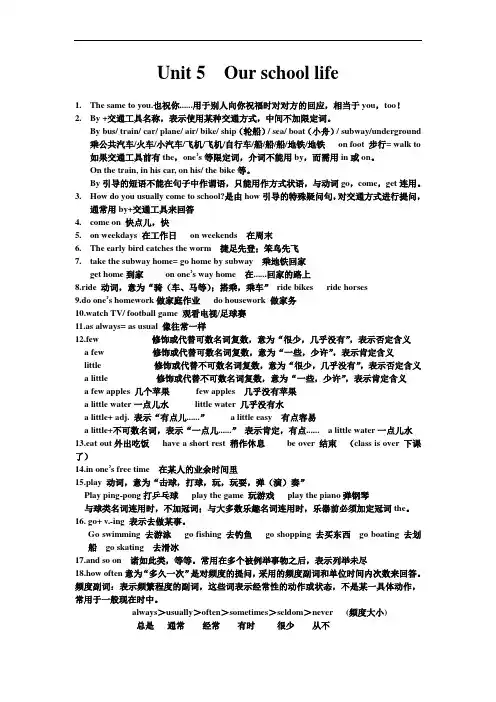
Unit 5 Our school life1.The same to you.也祝你......用于别人向你祝福时对对方的回应,相当于you,too!2.By +交通工具名称,表示使用某种交通方式,中间不加限定词。
By bus/ train/ car/ plane/ air/ bike/ ship(轮船)/ sea/ boat(小舟)/ subway/underground 乘公共汽车/火车/小汽车/飞机/飞机/自行车/船/船/船/地铁/地铁on foot 步行= walk to 如果交通工具前有the,one’s等限定词,介词不能用by,而需用in或on。
On the train, in his car, on his/ the bike等。
By引导的短语不能在句子中作谓语,只能用作方式状语,与动词go,come,get连用。
3.How do you usually come to school?是由how引导的特殊疑问句,对交通方式进行提问,通常用by+交通工具来回答e on 快点儿,快5.on weekdays 在工作日on weekends 在周末6.The early bird catches the worm 捷足先登;笨鸟先飞7.take the subway home= go home by subway 乘地铁回家get home到家on one’s way home 在......回家的路上8.ride 动词,意为“骑(车、马等);搭乘,乘车”ride bikes ride horses9.do one’s homework做家庭作业do housework 做家务10.watch TV/ football game 观看电视/足球赛11.as always= as usual 像往常一样12.few 修饰或代替可数名词复数,意为“很少,几乎没有”,表示否定含义a few 修饰或代替可数名词复数,意为“一些,少许”,表示肯定含义little 修饰或代替不可数名词复数,意为“很少,几乎没有”,表示否定含义a little 修饰或代替不可数名词复数,意为“一些,少许”,表示肯定含义a few apples 几个苹果few apples 几乎没有苹果a little water一点儿水little water 几乎没有水a little+ adj. 表示“有点儿......” a little easy 有点容易a little+不可数名词,表示“一点儿......”表示肯定,有点...... a little water一点儿水13.eat out外出吃饭have a short rest 稍作休息be over 结束(class is over 下课了)14.in one’s free time 在某人的业余时间里15.play 动词,意为“击球,打球,玩,玩耍,弹(演)奏”Play ping-pong打乒乓球play the game 玩游戏play the piano弹钢琴与球类名词连用时,不加冠词;与大多数乐趣名词连用时,乐器前必须加定冠词the。
仁爱英语七年级下册unit8知识点

仁爱英语七年级下册unit8知识点仁爱英语七年级下册unit8主要包括了四个知识点:爱好、频度副词、现在进行时和以be动词为主语的句子。
一、爱好关于爱好,我们可以用动词+ing形式的结构来描述,例如:- I like playing basketball.- She enjoys listening to music.- He hates watching horror movies.二、频度副词频度副词是用来描述某个动作发生的次数的。
常见的频度副词有:always、usually、often、sometimes、rarely和never。
我们可以将频度副词放在句首或者句末,例如:- He always brushes his teeth before going to bed.- I usually eat breakfast at 7 o'clock in the morning.- They sometimes go to the park on weekends.- She rarely drinks coffee because it makes her nervous.- We never miss our English class.三、现在进行时现在进行时用来描述正在进行的动作,其结构为:be动词+现在分词。
例如:- He is playing basketball with his friends now.- They are watching TV in the living room.- She is studying English at the library.- We are listening to music in the classroom.需要注意的是,某些动词不宜用于现在进行时,例如感官动词(see、hear、smell、notice、feel、taste)和状态动词(be、seem、appear、look、feel、sound、taste)。
仁爱版英语七年级下册unit6知识点

仁爱版英语七年级下册unit6知识点仁爱版英语七年级下册unit6是一个非常重要的单元,本文将对该单元的知识点进行详细地介绍,以帮助学生更好地掌握英语知识。
一、单词
1. add:加
2. back:回来,后面
3. borrow:借
4. cinema:电影院
5. while:当……的时候
二、重点短语
1. add up:计算总和
2. go back:回来
3. borrow sb. sth.:借给某人某物
4. go to the cinema:去电影院
5. while doing:在做……的时候
三、语法
1. There be句型
There be句型表示“有”、“存在”之意,例如:There is a book on the desk.即桌子上有一本书。
2. 句型I'm + doing sth.
这种结构常用来表达我们正在做某件事情,例如:I'm playing basketball. 即我正在打篮球。
四、例句
1. There is a cinema near our school.(我们学校附近有一家电影院。
)
2. I'm studying English while listening to music.(我边听音乐边学英语。
)
3. Can I borrow your pen for a moment?(我可以借用你的笔一下吗?)
总结
通过对仁爱版英语七年级下册unit6的学习,我们了解了很多单词、短语和语法结构。
好的掌握这些知识点,一定会对我们的英语学习帮助很大。
希望大家能够认真学习,并不断提高自己的英语能力。
七年级下册英语unit7仁爱版知识点

七年级下册英语unit7仁爱版知识点Unit 7主要介绍了购物和做家务的相关语言知识。
以下是本单元的重点知识:
一、购物语言
1.询问价格和折扣:
- How much is it?(这个多少钱?)
- Is it on sale?(打折吗?)
- What's the discount?(有多少折扣?)
2.询问购物需求:
- Can I help you?(需要帮忙吗?)
- What size/color do you need?(你需要什么尺码/颜色?)
- What do you want to buy?(你想买什么?)
3.支付和找零:
- How do you want to pay?(你想用什么方式支付?)- Here's your change.(这是找给您的钱)
二、家务语言
1. 做家务的动词:
- sweep(扫地)
- mop(拖地)
- vacuum(吸尘)
- wipe(擦拭)
- dust(擦灰尘)
- clean(清洁)
- wash(洗)
- iron(熨烫)
2. 做家务的时间:
- on weekends(在周末)
- in the morning(早上)
- after school/work(放学/下班后)
- before bedtime(睡觉前)
3. 表示强调的副词:
- really(真的)
- very(非常)
- extremely(极其)
以上是本单元的重点知识,掌握上述语言知识可以帮助你更好地与他人交流。
希望你能够认真学习,在日常生活中灵活运用。
仁爱版英语七年级下册Unit7Topic2知识点总结

仁爱版英语七年级下册Unit7Topic2知识点总结Unit 7 Topic 2: Knowledge Points Summary in Ren'ai English Textbook for 7th GradeIn the seventh grade English textbook of Ren'ai, Unit 7 Topic 2 focuses on various knowledge points related to the English language. This article will provide a comprehensive summary of the key concepts covered in this topic.1. Verb tenses:- Present Simple: Used to talk about habitual actions, general truths, and permanent situations.- Present Continuous: Used to talk about actions happening now or around the present time.- Past Simple: Used to talk about completed actions in the past.- Past Continuous: Used to talk about actions that were in progress at a specific time in the past.- Future (be going to): Used to talk about future plans and intentions.2. Adverbs of frequency:- Adverbs such as always, usually, often, sometimes, and never are used to express how often an action occurs.- They are usually placed before the main verb, except when the main verb is "to be." In that case, the adverb is placed after "be."3. Comparatives and superlatives:- Comparatives are used to compare two things, while superlatives are used to compare more than two things.- Comparatives are formed by adding "-er" to short adjectives or using "more" before long adjectives.- Superlatives are formed by adding "-est" to short adjectives or using "most" before long adjectives.4. Quantifiers:- Quantifiers are words or phrases used to specify the quantity or amount of something.- Some common quantifiers include much, many, a lot of, a few, a little, and some.- They can be used with countable and uncountable nouns, but the choice of quantifier depends on the noun.5. Modal verbs:- Modal verbs are auxiliary verbs that express ability, possibility, necessity, or permission.- Common modal verbs include can, could, may, might, must, should, and would.6. Question forms:- There are two types of questions: yes/no questions and information questions.- Yes/no questions are formed by inverting the subject and the helping verb.- Information questions are formed by placing the question word at the beginning of the sentence.7. Direct and indirect speech:- Direct speech is when we report someone's words exactly as they were spoken.- Indirect speech is when we report someone's words indirectly, without using their exact words.- When changing from direct to indirect speech, tenses, pronouns, and time references often need to be adjusted.8. Prepositions of time and place:- Prepositions such as on, at, and in are used to express time and place relationships.- "On" is used with specific days, "at" is used with specific times, and "in" is used with months, years, and longer periods.- Prepositions of place, such as "in," "on," and "at," indicate where something is located.This summary provides a brief overview of the key knowledge points covered in Unit 7 Topic 2 of the Ren'ai English textbook for seventh graders.By understanding and practicing these concepts, students can enhance their English language skills and improve their proficiency in communication.。
仁爱版英语七年级下全部知识点总结
七年级下英语知识点总结Unit 5 Topic1㈠短语总结1.在学校大门口 at the school gate2.来学校 come to school3.去学校 go to school4.上课 have class / have classes5.步行 on foot6.骑自行车 ride a bike/ ride bikes/ bybike / on a bike7.坐公交 by bus / take a bus8.坐地铁 by subway / take the subway /on the subway9.坐飞机 by plane/ take the plane / onthe plane10.坐小汽车 by car / in a car/ take a car/drive a car11.坐轮船 by ship12.坐小船 by boat13.坐火车 by train / on the train14.在我们组 in our group15.一群学生 a group of students16.我们中的三个人 three of us17.在平日 on weekdays18.在周末 on the weekends / at weekends19.起床 get up20.睡觉 go to bed21.早起 get up early 22.回家 go home23.到家 get home24.去动物园 go to the zoo25.去公园 go to the park26.看电影 see a movie / film27.看电视 watch TV28.在晚上 in the evening / at night29.帮助父母 help parents30.做某人的家庭作业 do one’s ( my/ her/his/ your/ their)homework31.在学校 at school32.知道,了解 know about / learn about33.校园生活 school life34.一个美国学生 an American student35.在美国 in America / in the 许多学生 manystudents/ a lot of students/ lots of students36.很少 very few37.吃午饭 have lunch38.出去吃饭 eat out39.在校期间 on school days40.休息一会 have a short rest/ break41.午饭后 after lunch42.在某人的业余时间in one’s ( my/ his/ her/their…)free/ spare time43.打篮球 play basketball44.踢足球play soccer / football45.弹钢琴 play the piano46.弹吉他play the guitar47.拉二胡 play erhu48.去游泳 go swimming / go for a swim49.去划船 go boating50.球赛 a ball game / ball games51.一年四次 four times a year52.听音乐 listen to music53.读书 read books54.看报 read newspapers 55.看医生 see a doctor56.去图书馆 go to the library57.一周两次 twice a week58.见朋友 meet friends59.每天 every day60.在七点半 at half past seven61.一小会 for a little while / for a shorttime62.晚饭后 after supper63.吃饭 have dinner64.吃早饭 have breakfast㈡重要句型1.I usually come to school by subway.同义句: I usually take the subway to school.对划线部分提问: How do you usually come to school类似的有:go to school by bike=go to schoolon a bike= ride a bike to school=ride to schoolgo home by bus=go home on a bus=take a bus home2.How do you usually/ often…你通常/经常怎样…3.It’s time for class.=It’s time to haveclass. =It’s time for having class.4.What about you =How about you5.How often …询问频率,回答可以用频率副词:always, usually, often, sometimes, seldom, never, every day ,every +其他时间名词或表示频率的短语回答表示频率的短语:次数+单位时间. : once a day / twice a week / three timesa month6. The early bird catches the work. (谚语) 笨鸟先飞7. Work / Study must come first. 工作/ 学习必须放在第一位!8. Classes begin at eight. =Class begins at eight.提问: What time does the class begin / What time do the classes begin㈢重要单词的用法1.look (感官动词) 看起来,后面加形容词His mother looks very young.They look very cute.Her dress looks very nice.You look very cool in this coat.2.by 介词by 后面直接加表示交通工具的名词,中间不用任何词修饰,如:by bikeby +动词ing形式,表示通过某种方式People show love to their mothers by giving cards.You can be a good student by working hard.3.over (形容词)School / Class is over.4.begin现在分词: beginning 过去式: beganbegin to do sth , begin doing sthHe begins to write a letter. =He begins writing a letter.如果begin本身为分词,只能用begin to do sthHe is beginning to run.5.listen to 听(动作), hear 听见(结果)6.always 反义词 never7.本话题涉及的时态为一般现在时,句中常有频率副词或表示频率的短语,如果主语为三单,动词一定要用三单!(四)易错题1.You new watch ______ (look) very nice!2.Here ______(be) some news.3.Oh, come on! It’s time_____ going toschool.4.They usually go to school on________(feet).5.In my class, forty of _______(we) go toschool by bike.6.The early bird ______ (catch) the worm.7.Kangkang often _____ (ride) a bike to thepark.8.What time _____ (be)school over9.Work must come ______(once).10.It’s time ____you to get up.11.We often _____ books in the morning.12.Jill’s friend like ______(study) in ourschool.13.Mr. Wang teaches ______(we) English._____ of us like him.14.How about ______(go) out with me15.Most students go to school _____ theschool bus.16._______ do you go shopping with yourmotherA. How soonB. How farC. How oftenD. How much17.What time do you usually get up _____weekdays18.He ______ busy, so he has no time to playwith us.A. is alwaysB. seldom isC. always isD. often is19. The last class______(finish) at twelve o’clock.20. Let’s go______(boat).21. It’s time to have breakfast. (同义句) _________________________________________ _____________.22. Michael often rides a bike to school. (同义句)_________________________________________ _____________.23. I always go to work on foot. (对划线部分提问)_________________________________________ _____________.24. My mother goes shopping twice a week. (对划线部分提问)_________________________________________ _____________.25. Mary always reads books in the library. (反义句)_________________________________________ _____________.26. He usually does his homework at school. (否定句)_________________________________________ _____________.27. They often go to school by bus in the morning. (对划线部分提问)_________________________________________ _____________.28. Jane seldom watches TV on weekdays. (改为一般疑问句)_________________________________________ _____________.29. He usually has lunch at home. (对划线部分提问)_________________________________________ _____________.30. Li Ping often goes to work on foot. (同义句)_________________________________________ _____________.31. 几乎没有学生乘地铁去学校。
仁爱英语七年级下册unit8 知识点
仁爱英语七年级下册unit8 知识点在仁爱英语七年级下册的unit8中,主要学习有关聚会、过生日和购物等话题的词汇和句型。
本文将对其中的知识点进行详细讲解,帮助同学们更好地掌握这些内容。
一、聚会1. invite sb. to sth. 邀请某人参加某事。
例如:I invite you to my party. 我邀请你参加我的聚会。
2. bring sth. to the party. 带某物到聚会。
例如:Don't forget to bring some snacks to the party. 别忘了带一些小吃到聚会上。
3. decorate the room. 装饰房间。
例如:We need to decorate the room before the party. 我们需要在聚会前装饰房间。
二、过生日1. Happy birthday! 生日快乐!2. blow out the candles. 吹灭蜡烛。
例如:Make a wish and blow out the candles. 许个愿望,然后吹灭蜡烛。
3. cut the cake. 切蛋糕。
例如:Let's sing "Happy birthday" and cut the cake. 让我们唱“生日快乐歌”然后切蛋糕。
三、购物1. How much is it? 多少钱?例如:How much is this T-shirt? 这件T恤多少钱?2. Can I try it on? 可以试穿一下吗?例如:Excuse me, can I try on these shoes? 不好意思,我能试穿这双鞋吗?3. I'll take it. 我要买了。
例如:This bag is perfect, I'll take it. 这个包非常完美,我要买了。
以上便是仁爱英语七年级下册unit8的主要知识点,同学们可以通过这些词汇和句型,更好地应对有关聚会、过生日和购物等话题的会话。
仁爱版七年级下册英语复习知识点
仁爱版七年级下册英语复习知识点仁爱版七年级下册英语复习知识1重点语法There be句型Wh-questions重点句型What’s your home like? What’s the matter?Sorry, I can’t hear you. I’ll get someone to check it right now.There is something wrong with mykitchen fan.重点讲解1 house with three bedrooms.有三间卧室的房子。
with “有,带有”。
with还可以意为“和(某人/某物)在一起”2 apartment for a family of two.适合两口之家的公寓。
(1) for表示“给……”表示目的或功能。
后接物主代词或名词,但通常带’s.或者后接表示无生命物体的名词。
Here is a letter foryou.(2)of的含义为“属于某人/某事物”。
She is a friend of Lily’s. = She is Lily’s friend.3 What’s the matter?怎么了?该句常用来询问某或某物出了什么什么问题或毛病;询问具体某人或某物出了什么问题时,还可以表达为:What’s the matter with sb./sth.某人或某物出了什么毛病。
What’s the matter? = What’swrong?4 Ihear you playing the piano.我听见你在弹钢琴。
hear…doing sth.“听见……在做某事”,强调正在进行的动作。
hear…dosth.“听见……做了某事”,强调全过程。
hearabout sth.听到关于某事物的消息 hear from sb.接到某人的来信、电话等hear of sb./sth.听到或知道某人或某事物的情况5 a lot of = lots of许多后接可数名词,相当于many;后接不可数名词,相当于much,用于肯定句中;但是注意:如果是否定句,则常用many或much.6 be far from… 离……远(抽象距离)be…away from…离……远(具体距离)My school is not far from thebookstore. The sea is 2 miles away fromthe hotel.7 There is something wrong with sb./sth.某人或某物出问题/有毛病了。
仁爱版七年级(下)英语单词词汇表
仁爱版七年级(下)英语单词词汇表Unit 5Topic 1 How do you usually come to school?gate n. 大门by prep. 乘(车等);靠近,在……旁;在……时间;不迟于;被;用;由subway(也作:underground)n. 地下铁道;地铁交通always adv. 总是,一直,永远the same to 对……也一样come on快点儿;加油;来吧on foot走路,步行go to school 去上学plane n. 飞机train v. 培训,训练n. 火车ship n.船,轮船boat n. 小船,小舟Ms.n.女士(用在婚姻状况不明的女士姓名前)grandmother n.奶奶;外婆group n.组,群weekday n.平日(星期一至星期五的任何一天)early adv.早地adj. 早的bird n.鸟catch v.捉住;接住;赶上;染上(疾病)worm n.软体虫,蠕虫(尤指蚯蚓)seldom adv.很少;不常walk v.& n.步行;散步never adv.决不,从来没有sometimes adv. 有时ride v. 骑(自行车、马等);乘车n.乘车旅行park v.停放(汽车)n. 公园homework n.家庭作业watch v.观看,注视;当心,注意n.手表,表TV = television n.电视;电视机do(one’s)homework做家庭作业watch TV看电视life n.生活;生命;人生American adj.美国的;美国人的n. 美国人or conj.还是,或;否则few adj.很少的,不多的pron. 不多,少数afternoon n.下午;午后day n.(一)天,(一)日;白天rest n.休息;剩余的部分,其余的人(物)v. 休息,歇息play v. 打(球);玩;游戏;播放n. 玩耍;戏剧basketball n.篮球soccer(也作:football)n.足球(运动)swim v.& n.游;游泳ball n.球;舞会game n.比赛;运动;游戏have lunch吃午饭at school在学校;在上课have a rest休息go swimming去游泳listen v.听,仔细听music n.音乐;乐曲read v.读;朗读library n.图书馆,图书室must v.(情态动词)必须,应当;必定是n.必须做(或看、买等)的事first adv.& adj.第一;首次;最初num.第一once adv.一次;从前,一度conj.一旦week n. 星期,周twice adv.两次;两倍every adj.每一,每个的listen to听……begin v.开始;着手while n.一会儿,一段时间conj. ……而,虽然;在……的时候;和……同时bed n.床wall n. 墙have classes上课go to bed睡觉Topic 2 He is playing soccer on the playground. make v.制造,做;使得card n.卡片;名片;纸牌soon adv.很快,马上,不久playground n.操场,运动场dance v.&n.跳舞gym = gymnasium n.体育馆,健身房;体操dormitory(缩写形式:dorm)n.学生宿舍sleep n. 睡觉v.睡觉;睡clean v.弄干净,擦干净adj.清洁的,干净的lab = laboratory n. 实验室computer n.电子计算机;电脑room n.室,房间;空间;地方hall n.大厅,会堂,礼堂;过道classroom n.教室building n. 大楼;建筑物;房屋swimming n.游泳,游泳运动pool n.水池,水塘run v.跑,奔跑dining hall 餐厅;食堂borrow v. (向别人)借用;借project n.专题研究;工程;项目workbook n.练习册;作业本course n.过程;经过;课程use v.使用,利用,应用n.用,使用,得到利用better adj.(good和well的比较级)较好的;更好的adv.更好地;更shelf(复数形式:shelves)n.架子;搁板;搁层;礁;陆架keep v.保存;保持;继续不断return v.归还;回,归pleasure n.高兴,愉快post n.邮件;邮政,邮寄v.投寄,邮寄bye-bye interj.再见a few一些,少量of course当然look for寻找on time准时,按时telephone n.电话(机)v. 打电话talk v. 讲话,交谈n.谈话,演讲purse n.钱包money n.钱;货币else adv.别的,其他的picture n.照片;图片;画片put v.放,摆put on穿,戴上;上演Lost and Found失物招领处around adv.在周围;在附近;大约prep.在……周围sit(过去式:sat)v. 坐write v.写,书写;写作,著述show sb. around领(某人)参观at the back of在……的后面draw v.绘画;绘制;拉,拖because conj.因为Japanese adj.日本的;日本人的;日语的n.日本人;日语wonderful adj.了不起的;美妙的,精彩的;太好了also adv.也,而且,此外Topic 3 My school life is very interesting. today adv.在今天,在今日n.今天Wednesday n.星期三Monday n. 星期一physics n.物理(学)Tuesday n.星期二geography n. 地理(学)Thursday n.星期四P.E.(physical education的缩写)n.体育Friday n.星期五art n.美术,艺术;技艺timetable n.(学校)课表;(火车、公共汽车等)时间表math n.数学science n.科学,自然科学history n.历史;历史学biology n. 生物(学)politics n.政治meeting n.会;集会;会见;汇合点outdoor adj. 户外的;室外的activity n. 活动lesson n. 课,功课;教训learn v. 学,学习,学会outdoor activity户外活动easy adj.容易的,不费力的interesting adj.有趣的difficult adj.难的,艰难的;不易相处的boring adj.乏味的,无聊的which pron.那(哪)一个;那(哪)些subject n.学科;主语;主题;主体;题目best(good和well的最高级)adj.&adv. 最好地(的)story n.故事,小说friendly adj. 友好的other adj. 别的,另外的pron. 别人,别的东西news n. 新闻,消息attention n. 注意,关心between prep.在(两者)之间;在……中间stamp n.邮票collection n.收集物,收藏品world n. 世界Saturday n.星期六night n.夜,夜间place n.地点,地方program n.节目;项目from … to …从……到……February(缩写形式:Feb.)n.二月newspaper n.报纸hard adj.努力的,辛苦的;困难的,艰难的;硬的adv.努力地;使劲;猛烈地wish n. 愿望,祝愿v.希望,想要,祝愿Unit 6Topic 1 Is there a computer in your study?second num.第二adj.第二的n.秒floor n.(楼房的)层;地面,地板bedroom n.卧室,寝室upstairs adv.到楼上,在楼上kitchen n.厨房garden n.花园,果园,菜园bathroom n.浴室,盥洗室next to在……近旁;紧邻come in进入,进来dining room餐厅living room客厅;起居室front n. 前面;前部;前线adj. 前面的;前部的house n. 房子,住宅grandfather n.爷爷;外公behind prep.(表示位置)在……后面adv.在后面;向后door n.门in front of在……前面near prep.在……附近,靠近adj.近的lamp n. 灯,油灯;光源clock n. 钟under prep.&adv.在……下面;向……下面table n.桌子;表格key n.钥匙;答案;键;关键away adv.离开,远离thing n.东西,物;(复数时)物品,用品;事情dad(口语)n.爸爸,爹爹talk about谈论,议论put away将……收起;把……放回原处window n.窗户;计算机的窗口model n.模型,原形;范例;模范river n. 河;江;水道center n. 中心,中央yard n.院子;场地;码beautiful adj.美的,美丽的,美观的flower n.花large adj.大的,巨大的left n.左,左边adv.向左adj.左边的people n. 人;人们in the center of在……中心mirror n.镜子drawer n. 抽屉chair n.椅子keyboard n.键盘pencil-box n.铅笔盒Topic 2 What’s your home like?apartment n.楼中单元房,一套房间;房间townhouse n.排房;城市住宅farmhouse n.农场住宅,农舍(农场主的主要住房)country n.农村,乡下;国家rent n.租金v.租用,租借;出租month n.月,月份Mrs.(称呼已婚妇女)n.夫人,太太furniture n.(总称)家具quiet adj.安静的;寂静的per prep.每,每一neighbor n.邻居,邻人store n.商店;大百货公司bank n.银行;(河,海,湖等的)岸,堤street n.街,街道corner n. (街道)拐角;角;角落bookstore n.书店museum n.博物馆,博物院supermarket n. 超级市场station n. 车站,站,所mail v.邮寄n.邮政;邮递post office邮局restaurant n.饭馆,饭店matter n.问题;要紧事,事情v.要紧;有重大关系hear v.听见;听说,得知piano n.钢琴loud adj.大声的really adv.真正地;到底;确实loudly adv.大声地end n.末尾,终点,结束road n. 路,道路reading room阅览室at the end of…在……的结尾/末端community n.社区;社会child(复数形式:children)n.儿童,小孩close adj.近,靠近;亲密的adv.近,靠近v.(发音与前两个词性的发音不一样)关,关闭far adj.远的adv.远地service n.服务area n.地区;范围;面积stop n.(停车)站,停v.停止;阻止a lot of(=lots of)许多,大量close to靠近far from远离fan n.风扇;(电影、运动等的)迷;热心的爱好者(支持者)line n.电话线路;线,线路;行,排bad adj.坏的,不好的someone pron.某一个人check v.检查;核对;批改n.检查;批改right now马上,立即move v.搬家;移动,搬动city n.市,城市,都市suburb n.郊区;城外noisy adj.喧闹的,嘈杂的traffic n.交通;来往车辆cost n.费用;花费;加钱v.值(多少钱);花费town n.城镇,城London n.伦敦Topic 3 Which is the way to the post office?bridge n.桥along prep.沿着,顺着adv.向前;和……一起;一同turn n.转弯;轮流;(轮流的)顺序v.转弯;转变;旋转,翻转across prep.横过,穿过meter n.米,公尺across from在对面Tsinghua University 清华大学Peking University北京大学Haidian Theater海淀剧院until conj.& prep.直到……为止miss v.错过;未见到;未听到;思念kilometer n.千米(公里)should(情态动词,也是shall的过去式)v.会,应该,应当change v.更换;变化,改变n.零钱;找头sidewalk n.人行道pubic adj. 公共的,公众的n.公众light n.灯;灯光;光,光亮adj.明亮的;浅色的;轻的v.点(火),点燃crosswalk n.行人穿越线;斑马线straight adj.一直的;直的adv. 一直地;直地U-turn n.U形转弯,180度转弯danger n.危险safe adj.安全的hurt adj.(身体上)受伤的v.受伤;伤害;使疼痛;感到疼痛lose v.丢失,失去accident n.事故,意外的事obey v.服从,听从,顺从rule n.规定,规则v.统治;支配most adj.大部分的;大多数的;几乎全部的adv.最pron.大多数,大部分part n.部分;成分;角色;部件,零件before conj.在……之前prep.在……以前;在……前面adv.以前cross v.穿过;越过n.十字形的东西third num.第三last n. 最后adj.最近刚过去的;最后的adv.最后地;最近刚过去v.持续ticket n.罚款单;票;券speed v. (使)加速n.速度fast adj.快的,迅速的adv.快地,迅速地when conj.当……的时候adv.什么时候,何时careful adj.小心的,仔细的,谨慎的late adj.晚的,迟的adv.晚地,迟地be late for迟到wait for等候,等待down prep.沿着,沿……而下adv.向下Unit 7Topic 1 When is your birthday?sport n.体育运动,锻炼was(am,is的过去式)v.是born adj.出生June(缩写形式:Jun.)n.六月March(缩写形式:Mar.)n.三月April(缩写形式:Apr.)n.四月May n.五月July(缩写形式:Jul.)n.七月August(缩写形式:Aug.)n.八月September(缩写形式:Sept.)n.九月October(缩写形式:Oct.)n.十月November(缩写形式:Nov.)n.十一月December(缩写形式:Dec.)n.十二月January(缩写形式:Jan.)n.一月were(are的过去式)v.是alone adj.单独的,孤独的thousand num.千birthday n.生日date n.日期;约会plan n. 计划,打算;平面图v.计划,打算celebrate v.庆祝party n.聚会,宴会;党派fourth num.第四fifth num.第五sixth num.第六seventh num.第七eighth num.第八ninth num.第九tenth num.第十eleventh num.第十一twelfth num.第十二thirteenth num.第十三twentieth num.第二十present n.礼物,赠品shape n.形状,外形v.使成型;制造;塑造hill n.小山;丘陵;土堆;斜坡just now 刚才circle n.圆;圆圈v.将……圈起来ago adv.以前square n.正方形;广场adj.平方的;方形的triangle n.三角形rectangle n.长方形oval n.椭圆adj.椭圆形的centimeter(缩写形式:cm)n. 厘米,公分football n.(美式)橄榄球;(英式)足球special adj.特别的,专门的candle n.蜡烛surprise n.惊奇,诧异v.使惊奇,使诧异do some cleaning做扫除Topic 2 Can you dance or draw?disco n. 迪斯科(一种舞蹈)perform v.表演;履行;行动ballet n.芭蕾舞have a good time玩得高兴,过得愉快smart adj.聪明的,灵巧的;(人、服装等)时髦的,帅的count v. 数,点数climb v.爬,攀登pig n.猪ping-pong n.乒乓球be good at擅长于age n.年龄;时代anything pron.任何事(物);无论何事(物)word n.单词,词;话mean v.意思是,意指at the age of在……岁时Topic 3 We had a wonderful party. did(do,does的过去式)v. 做,干recite v.朗读;背诵poem n.诗magic adj.有魔力的trick n.把戏,诡计enjoy v.喜欢;欣赏;享受……的乐趣himself pron.他自己certainly adv.当然,是的;一定;无疑enjoy oneself过得愉快kung fu n.功夫yesterday adv.&n.昨天fall v.倒;落(下),降落(过去式:fell)n. 秋季(也作:autumn)wash v.&n.洗(涤),冲洗washroom n. 盥洗室happen v.(偶然)发生stand v.站;立;起立;坐落;经受;持久at once立刻,马上stand up站起,站立;起立lie v.说谎;躺;平放;位于n.谎言video n.录像,视频truth n.真相,事实;真理;实际情况everyone pron.每人,人人had(have的过去式)v.有;吃;喝;进行;经受angry adj.愤怒的,生气的come back回来;回想起来video game电子游戏tell a lie撒谎each pron.&adj.每人,每个,每件silent adj. 无声的;无对话的blow v.吹;刮风;吹气n.猛击;打击;吹breath n.气息;呼吸blow out被(风等)吹灭;熄灭sunny adj. 晴朗的,阳光充足的delicious adj.美味的,可口的funny adj.有趣的,滑稽可笑的Unit 8Topic 1 What’s the weather like in spring?weather n.天气spring n.春天,春季;泉,泉水warm adj.暖和的,温暖的;热情的season n.季,季节summer n.夏天,夏季hot adj.热的;辣的winter n.冬天,冬季cold adj.冷的,寒的n.寒冷;感冒,伤风rain v.下雨n.雨,雨水snow v.下雪n.雪ground n.地面holiday n.假日,假期cloudy adj.多云的,阴天的foggy adj.多雾的snowy adj.下雪的,多(积)雪的;雪(白)的rainy adj.下雨的,多雨的windy adj.有风的,多风的bright adj.明亮的;聪明的take a walk散步temperature n.温度low adj.&adv.低;矮if conj.如果,假使;是否,是不是wear(过去式:wore)v.穿,戴umbrella n.伞,雨伞Australia n.澳大利亚;澳洲remember v.记起,想起sun n.太阳,阳光shine(过去式:shone)v.照耀,发光brightly adv.明亮地sunglasses n.太阳眼镜,墨镜shorts n.短裤;运动短裤suddenly adv.突然;忽然;猛地passage n.(文章等的)一节,一段;通道;走廊had better(do sth.)最好(做某事)go out 出去;熄灭later on后来;以后;随后be different from与……不同arrive v.到达;达到Beijing Opera京剧ourselves pron.我们自己hope v.&n.希望heavily adv.大量地;重地harvest n.收割;收获(物)v.收割busy adj.忙(碌)的leaf n.(树,菜)叶wind n.风strongly adv.强烈地;浓重地come back to life复苏;复活be busy doing sth.忙于做某事report n.&v.报道,报告Topic 2 The summer holidays are coming. travel v.&n.旅行together adv.一起,共同interest n.兴趣,趣味get together聚会,联欢places of interest名胜the United States n.美国Germany n.德国New Zealand n.新西兰Brazil n. 巴西Thailand n.泰国Indonesia n.印度尼西亚India n.印度anytime adv.在任何时候;随便什么时候sound v.听起来;发出声音n.声音expensive adj.昂贵的camera n.照相机;摄像机a pair of一双,一副tent n.帐篷raincoat n.雨衣trip n.旅行,旅程custom n.习俗,风俗习惯enter v.进入off adv.离开;(电、自来水)停了,中断prep.离开,脱离,(走)开point v.指向,指n.点;分数wet adj.湿的,潮的;多雨的Muslim n.穆斯林;伊斯兰教信徒touch v.触摸;接触take off脱下;摘掉;起飞point to指向Korea n.朝鲜,韩国Italy n.意大利sign n.符号,标记;指示牌finger n.手指wrap v.包,裹(礼物等)lucky adj.运气好的,侥幸的paper n.纸;报纸pass v.传,递;经过;通过during prep.在……期间;在……过程中stay v.&n.待;逗留;停留lucky money 压岁钱May Day国际劳动节,五一劳动节greeting n.问候;祝贺Chinatown n.唐人街,中国城the day before yesterday前天make money赚钱Topic 3 Let’s celebrate!festival n.节日;节期;喜庆日Spring Festival春节dumpling n.饺子dragon n.(传说中的)龙Christmas n.圣诞节(12月25日)turkey n.火鸡lantern n.灯笼;提灯Lantern Festival元宵节lunar adj.月亮的;月球的sweet adj.甜的;可爱的;亲切的n.甜食;蜜饯;甜点;糖果;芳香luck n.运气,好运riddle n.谜语;谜Thanksgiving n.感恩节pumpkin n.南瓜pie n.甜馅饼eve n.(尤指宗教节假日的)前夜,前夕midnight n.午夜Easter n.复活节believe v.相信,认为Christ n.基督;耶稣基督fool n.傻子,蠢人Mid-autumn Festival中秋节mooncake n.月饼full adj.满的;饱的moon n.月亮,月球;月光not…unti l 直到……才important adj. 重要的prepare v.准备,预备;调制decorate v.装饰,修饰colorful adj.颜色鲜艳的;五彩缤纷的church n.教堂;教会stocking n.长筒袜fireplace n.壁炉open v.打开,开adj.开着的,开口的Santa Claus n.圣诞老人gift n.礼品,赠品get-tegether n.(非正式的)集会greet v.问候;向……致敬merry adj.愉快的,高兴的put up挂起;举起;贴(广告等)Spain n.西班牙grape n.葡萄Jewish adj.犹太人的honey n.蜂蜜event n.事件,大事start v. 开始,着手;出发whole adj.整个的stay up 深夜不睡;熬夜Halloween n. 万圣节前夕scary adj.恐怖的;吓人的ghost n.鬼;鬼魂;幽灵knock v.&n.敲;击;打shout v.&n.喊,高声呼喊treat n.款待v.对待,看待trick or treat是请吃糖,还是想遭殃knock on/at敲international adj.国际的labor n.劳动International Labor Day 国际劳动节Dragon Boat Festival龙舟节(端午节)hold v.举行;进行race n.竞赛,赛跑;种族,民族v.(速度)竞赛,比赛national adj.国家的,全国性的,民族的National Day 国庆节the PRC(the People’s Republic of China的缩写)中华人民共和国capital n.首都,省会;大写flag n.旗;旗舰;标志burn v.燃,烧,着火;使烧焦;使晒黑god n.神;(大写God)上帝。