
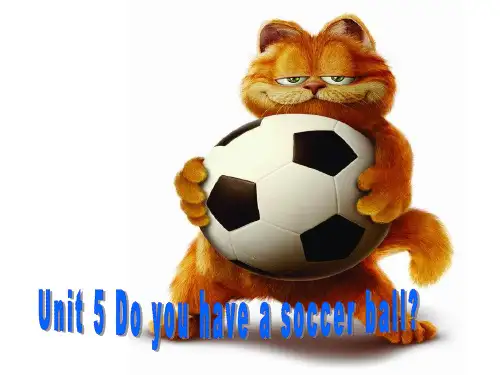
unit5_Do_you_have_a_soccer_ball?ppt
basketball
Do you have a basketball?
√
Yes, I do.
I have a basketball.
tennis ball
Do you have a
tennis ball?
×
No, I don’t.
I don’t have a tennis ball.
soccer ball
• Does she have a ping-pong ball and a ping-pong bat? • No, she doesn’t.
• Does he have a tennis? • No, he doesn’t.
Does he have a … ? Yes, he does. No, he doesn’t .
tennis ball
/e/ / I /
ping-pong ball 仔细观察,小组讨 baseball
/ I/ /ɒ/ 论,你能说出这些 红色字母或者字母 baseball bat volleyball 组合的发音吗? /æ / /ɒ/
have
/æ /
soccer ball
/ɒ/ /ə/ /ɔ:/
Unit 5 Do you have a basketball ?
( Period1 Section A 1a---2b )
学习目标:
• 1.词汇:do ,have, tennis, ball, ping-pong, bat, soccer, soccer ball, volleyball, basketball • 2.句型:I/We/They have a/an…. • He/she has a/an….. • --Do you have…?—Yes,I do. /No, I don’t. • --Does she/he have…?---Yes,she/he does. • /No,she/ he doesn’t. • 3.掌握have和has的区别. • 4.理解听力内容.
A: Does he have … ? B: Yes, he does. /No, he doesn’t.
He is Jim.
He has a basketball.
Does he _______ have a ______ basketball?
does . Yes, he _______
He is Mike. has a He ______ volleyball. Does ____ he have ____ a basketball? doesn’t No, he _______.
c 3.soccer ball__
a Do you have a ping-pong bat? Do you have a ping-pong ball? Yes, I do.
No, I don’t. d
c
e 4.volleyball__ d 5.basketball__ b 6.baseball bat __
___you _____ Do have a computer? Yes, I_______. do I ______ have a computer
√
___you _____ Do have a ruler?
don’t No, I _______.
have a ruler. I don’t __________
…
Does she have a … ? Yes, she does . No, she doesn’t .
Does she have … ?
Does she have … ?
Does she have … ?
A: Does she have …? B: Yes, she does. /No, she doesn’t.
basketball
baseball
volleyball
soccer ball
tennis ball
ping-pong ball
baseball bat
ping-pong bat
have v. 有
do aux v.
用于构成否定句和一般疑问句
basketball
/ɑ :/ / I / /ei/
2a Listen to the conversations and number
the pict
1
2
Listen again (2b:P26)
3 1 Paul 4
2
Dale
Section A,P26 2a Listen and fill in the blanks. • Conversation1 Do • Bob: _______ you _____ have a soccer ball,Paul? • Paul: No,I____. don’t Does have • Bob: ______your brother Alan _______one?. does. • Paul: Yes,he _______. 1.want to do sth. • Conversation2 2.Want sb.to do sth. John: Hi,_____. Mike John Mike:Hi,______. 3.=would like • John: I want________________. to play basketball Play+球类 Do • ____you_____a basketball? have • Mike: Yes,I______. do • Mike:_______. Great
Section A,P26 2a Listen and fill in the blanks. • Conversation3 • Jane: Hi, Sally. Sally:Hi,Jane. • Jane:Sally,___ friend,Anna. this____my is • Sally:Hi,Anna.Nice to ______you. meet Nice. meet you,Sally. • Anna:___to =Let us Do. Let’s play tennis have • Sally:_______________.___you_____a tennis ball ball,Jane? Play+球类 don’t • Jane:Sorry,I_____. • Conversation4 Do • Frank:____you___a_______,Dale? have Volleyball don’t • Dale:No,I_____.But my brother____. does Let’s go find • ____ ____and_____him.
=Let us Let sb. do sth.
She is Mary, She has a tennis _______and a tennis racket _____________.
does She ______ not _______ have a volleyball.
do
/u:/
ping-pong bat
I have a basketball. 肯定句
I don’t have a basketball. 否定句 Do you have a basketball?一般疑问句 Yes, I do.
No, I don’t. (do not = don’t)
I have a
/du:/
Do you have a ping-pong ball?
/hæv/
Yes, I do. No, I don’t.
/dəʊnt/
I have a ping-pong ball. I don’t have a ping-pong ball.
Do you have a basketball? Yes, I do. No, I don’t. I have a basketball. I don’t have a basketball.
I don’t
仔细观察,小组 ? 讨论,这个句子 是怎样由肯定句 否定句 have a basketball . 变成否定句呢?
肯定句 basketball.
have前加______ 肯定句变否定句时,在实意动词____ do not ,
缩写为______, don’t do not don’t 即_________=________.
Do you have a baseball bat?
√
Yes, I_______. do I ______ have a baseball bat.
hat
Do you have a hat?
×
don’t No, I _______.
don’t have I __________ a hat.
computer
Do you have a soccer ball?
√
Yes, I do.
I have a soccer ball.
ping-pong bat
Do you have a
ping-pong bat?
×
No, I don’t.
I don’t have a ping-pong bat.
baseball bat
Do you have a volleyball? Yes, I do. No, I don’t. I have a volleyball. I don’t have a volleyball.
• Does he have a basketball? • Yes, he does.
• Does he have a soccer ball? • Yes, he does.
合集下载
课件:unit5_Do_you_have_a_soccer_ball?

have + 宾语。 + ______
4. I / They don’t have ……..是否定句.用来 表达某人没有某物。
句型是
I You have +宾语。 don’t ________ +________ We They
Grammar Focus:
I have a TV .
I don’t have a TV.
三. 句型展示 1. ——你有乒乓球吗? Do _____ you _____ have a ping-pong ball? — ______ ——是的,我有。/不,我没有。 Yes, _____ I do —_____, ______. / ______, ________. No, _____ I don’t 2. ——她有足球吗? Does _____ she ______ have a soccer ball? — ______ ——是的,她有。/不,她没有。 Yes, _____ she _____ does . /_____, No, ______ she doesn’t —_____, _____.
Yes
No
Yes, I do. I have a soccer ball.
No, I don’t. I don’t have a soccer ball.
Do they have a soccer ball?
Yes No
Yes, they do. They have a soccer ball.
No, they don’t. Theydon’t have a soccer ball
--Yes, she does. She has a ping-pong ball. --Does she have a baseball?
新目标英语七年级上unit_5_Do_you_have_a_soccer_ball(全课件)
1
4
2
5
3
6
Let’s play sports! Do you play tennis? Do you play volleyball? We have many sports clubs: basketball, ping-pong, soccer, and more!
1) play sports
B: That sounds good.
A: Let’s(让咱们) play volleyball. B: I don’t have a volleyball. A: Well, let’s play soccer. B: That sounds good/interesting/fun…
Do you have a basketball?
Does he have a/an…? Yes, he does. No, he doesn’t.
Does she have a …? Yes, she does. No, she doesn’t .
Does he have a …? Yes, he does.
No, he doesn’t.
Let’s play soccer. I don’t have a soccer ball. Let’s play … That sounds good.
Let’s play basketball.
Let’s play ping-pong. Let’s play tennis.
Let’s play baseball.
A: Let’s play basketball. (let’s=let us) B: I don’t have a basketball. A: Well, let’s play ping-pong.
Unit5 DoyouhaveasoccerballSectionA课件人教版七年级英语上册
Does Jack have a basketball? 2.他没有排球。 He doesn’t have a basketball. 3.你哥哥上学迟到了。 Your brother is late for school. 4.让我们问老师要英语书吧。
Let’s ask the teacher for English books. 5.请去给我拿一个杯子来。 Please get a cup for me.
I can’t be late . 4.get,let,ball,me,the
Let me get the ball . 5.see,basketball,you,the,can
Can you see the basketball ?
七、 完形填空。 Hello!I’m 1 .I’m an English boy.I 2 two sisters. 3 are Sonia and
Unit 5 Do you have a soccer ball
第1课时 Section A 1a~1c
一、 看图片写球类单词。
1. basketball
2. baseball
3. volleyball
4. ping-pong
5. tennis
二、 用所给词的适当形式填空。 1.Do you have (have) a ball? 2. Does (do) your cousin have a volleyball? 3.The boy has (have) two pencil boxes. 4.The hats (hat) are Jack’s. 5.We have two soccer balls (ball).
( C )1.How many volleyballs does Barry have?
Let’s ask the teacher for English books. 5.请去给我拿一个杯子来。 Please get a cup for me.
I can’t be late . 4.get,let,ball,me,the
Let me get the ball . 5.see,basketball,you,the,can
Can you see the basketball ?
七、 完形填空。 Hello!I’m 1 .I’m an English boy.I 2 two sisters. 3 are Sonia and
Unit 5 Do you have a soccer ball
第1课时 Section A 1a~1c
一、 看图片写球类单词。
1. basketball
2. baseball
3. volleyball
4. ping-pong
5. tennis
二、 用所给词的适当形式填空。 1.Do you have (have) a ball? 2. Does (do) your cousin have a volleyball? 3.The boy has (have) two pencil boxes. 4.The hats (hat) are Jack’s. 5.We have two soccer balls (ball).
( C )1.How many volleyballs does Barry have?
七年级英语上册Unit5Doyouhaveasoccerball第一课时课件人教新目标版
Let's play soccer.
How about playing basketball?
That sounds good.
课文解析
课文内容:介绍soccer的基本知识和规则 重点词汇:讲解课文中出现的重点词汇和短语 语法点:分析课文中的语法点和句子结构 文化背景:介绍与课文相关的文化背景和体育精神
布置作业和提 出要求,引导 学生进行课后 复习和巩固。
设计评价策略
课堂观察:观 察学生在课堂 上的表现,了 解学生的学习 状况和需求。
作业评估:通 过布置和批改 作业,了解学 生对课堂知识 的掌握程度。
测验与考试: 定期进行测验 和考试,检测 学生的学习成
果和水平。
师生互动:鼓 励学生提问和 参与讨论,及 时了解学生的 学习困难和问
任务驱动:设计多样化 的学习任务,让学生在 完成任务中掌握知识, 提高语言运用能力。
合作学习:组织学 生进行小组讨论、 合作探究,培养学 生的团队协作精神。
个性化教学:关注学生 的个体差异,设计个性 化的学习方案,满足不 同学生的学习需求。
学生活动
分组讨论:学生分组讨论与主题相关的内容,提高口语表达能力。 角色扮演:学生扮演不同角色,模拟真实场景进行对话练习。 游戏互动:通过游戏形式,让学生在轻松愉快的氛围中学习英语。 课堂展示:学生展示自己的学习成果,增强自信心和成就感。
添加标题
添加标题
添加标题
添加标题
练习方式:采用多种形式,如个人 练习、小组讨论、全班互动等,以 增加学生的参与度和兴趣
反馈机制:及时给予学生反馈和评 价,指出学生的不足和进步,并给 出相应的建议和指导
归纳小结
回顾本课时的 重点内容,包 括词汇、语法
初中英语优秀ppt课件
Helen: Oh, no, I don’t. It’s on the chair. Let me get it.
Cindy: And your hat, too!
26
Hel最e新n课:件OK, I have my jacket and hat. Let’s go.
3C Pairwork: Look at the picture. Ask your partner if he or she has these things.
No, I don’t.
16
最新课件
Let’s practice!
Do you have a / an… ?
Yes, I do. / No I don’t. I have a …
17
最新课件
Let’s play!
向同伴描述你 家的一个房间, 并请他画出这
A: Do you have a soccer ball? B: Yes. I do A: Where is the soccer ball? B: It’s on the floor.
个房间。想象
中的画是不是
和你的一样,
告知方位。
Use “ Where
18
is … ”
最新课件
He has a jacket.
She has a radio.
has
有
19
最新课件
Does Linda have a schoolbag?
Yes, she does.
Linda
No, she doesn’t.
• basketball 篮球
10
最新课件
1a Match the words with the things in
七年级上册Unit5 Do you have a soccer ball 课件
e.g. Let __m__e__d_o_i_t__. 让我来做吧。 Let __h_im__ guess. 让他猜一猜。
let’s是let us的缩写形式,意为“咱们一起 做某事吧”,通常表示建议、请求或命令。 肯定回答:一般用“OK”,“All right”, “Yes, let’s …”; 否定回答:一般用“Sorry, I …” 。
be → are;
have → 原形have
e.g. 我们是好朋友。
We are good friends. 我们有两个棒球拍。
We have two baseball bats.
3. 第二人称单(复)数:you (你/你们) be → are; have → 原形have e.g. 你(们)有三只乒乓球拍。 You have three ping-pong pats.
__d_o_n_’_t _
3. have (第三人称单数形式) ___h_a_s__
4. we (宾格)
___u_s___
5. on (反义词)
_u_n_d_e_r_
6. we (形容词性物主代词) __o_u_r___
7. 乒乓球拍
_p_i_n_g_-p__o_b__a_ll_b_a_t_ 9. 让我们走吧。
一、英语中的人称和数(在一般现在时态中)在英语句子中,谓语动 词的形式要与句子主语的人称和数相对应。
1. 第一人称单数:I (我) be → am, have → 原形have
e.g. 我是一个学生。 我有一个排球。
I am a student. I have a volleyball.
2. 第一人称复数:we (我们)
3. A: Do your friends have a basketball? B: Yes, they do. They have two basketballs. A: Well, let’s play basketball. B: That sounds good.
let’s是let us的缩写形式,意为“咱们一起 做某事吧”,通常表示建议、请求或命令。 肯定回答:一般用“OK”,“All right”, “Yes, let’s …”; 否定回答:一般用“Sorry, I …” 。
be → are;
have → 原形have
e.g. 我们是好朋友。
We are good friends. 我们有两个棒球拍。
We have two baseball bats.
3. 第二人称单(复)数:you (你/你们) be → are; have → 原形have e.g. 你(们)有三只乒乓球拍。 You have three ping-pong pats.
__d_o_n_’_t _
3. have (第三人称单数形式) ___h_a_s__
4. we (宾格)
___u_s___
5. on (反义词)
_u_n_d_e_r_
6. we (形容词性物主代词) __o_u_r___
7. 乒乓球拍
_p_i_n_g_-p__o_b__a_ll_b_a_t_ 9. 让我们走吧。
一、英语中的人称和数(在一般现在时态中)在英语句子中,谓语动 词的形式要与句子主语的人称和数相对应。
1. 第一人称单数:I (我) be → am, have → 原形have
e.g. 我是一个学生。 我有一个排球。
I am a student. I have a volleyball.
2. 第一人称复数:we (我们)
3. A: Do your friends have a basketball? B: Yes, they do. They have two basketballs. A: Well, let’s play basketball. B: That sounds good.
Do-you-have-a-soccer-ball?说课稿市公开课一等奖课件名师大赛获奖课件
(1) I_h_a_ve__ a ping-pong bat.我有一种乒乓球拍。 (2) _D_o__you _h_a_v_e a ping-pong bat?你有一种乒乓
球拍吗? Y_e_s_,_I_d_o_. 是的,我有。
(3) _D_o_you h_a_v_e_a TV?你有一台电视机吗? __N_o___,__I d_o_n_’_.t_I _d_o_n_’_t_h_a_v_e_a_T_V.不. ,我没有。 我没有电视机.
Do you have .
Do you have a ping-pong bat?
No, I don’t.
Do yoIu have a backpack ?.
Yes, I do.
have: 有
Do yoIu have an apple .?
No,I don’t. I don’t have an
Learning
soccer 英式足球(运动) tennis 网球 ping-pong 乒乓球(运动)
volleyball 排球 basketball 篮球
soccer ball 英式足球 tennis racket 网球拍 ping-pong ball 乒乓球 ping-pong bat 乒乓球拍
B: Yes, I do. No, I don’t. I don’t have a/an…
1b Listen and circle the words you hear.
ping-pong bat soccer ball volleyball computer game
Listen and repeat.(听录音并重复)
A: Do you have a computer game? B: No, I don’t. A: Do you have a ping-pong bat? B: Yes, I do.
球拍吗? Y_e_s_,_I_d_o_. 是的,我有。
(3) _D_o_you h_a_v_e_a TV?你有一台电视机吗? __N_o___,__I d_o_n_’_.t_I _d_o_n_’_t_h_a_v_e_a_T_V.不. ,我没有。 我没有电视机.
Do you have .
Do you have a ping-pong bat?
No, I don’t.
Do yoIu have a backpack ?.
Yes, I do.
have: 有
Do yoIu have an apple .?
No,I don’t. I don’t have an
Learning
soccer 英式足球(运动) tennis 网球 ping-pong 乒乓球(运动)
volleyball 排球 basketball 篮球
soccer ball 英式足球 tennis racket 网球拍 ping-pong ball 乒乓球 ping-pong bat 乒乓球拍
B: Yes, I do. No, I don’t. I don’t have a/an…
1b Listen and circle the words you hear.
ping-pong bat soccer ball volleyball computer game
Listen and repeat.(听录音并重复)
A: Do you have a computer game? B: No, I don’t. A: Do you have a ping-pong bat? B: Yes, I do.
《英语七年级上Unit 5 Do you have a soccer ball?》课件
While-reading
Scanning Read the survey results again and answer the questions.
1. Where do Frank and his brother play soccer? _A_t_s_c_h_o_o_l._/T__h_ey__p_l_ay__s_o_c_ce_r__at_s_c_h_o_o_l_. _____
1) 介词“和……在一起” I live with my parents. 我和我的父母住在一起。
2) 介词“带有”
He is a boy with black hair. 他是一个黑头发的男孩。
3) 介词“使用”
We can see with our eyes. 我们可以用眼睛看。
Post-reading
《英语七年级上Unit 5 Do you have a soccer ball?》
Warming up
Quick eyes What’s this in English?
Warming up
Free talk Do you like sports? What sports things do you have?
volleyballs, four basketballs and five classmates. 班级; 课
同班同学
Post-reading
Language points
1. I don’t have a soccer ball, but my brother Alan does. (教材P29 2b)
Language points
4. I love sports, but I don’t play them — I only watch them on TV! (教材P29 2b)
人教版七年级英语上册《Unit5Doyouhaveasoccerball?Lesson2》课件
Yes, we do. / No, we don’t.
3,他们有大量的网球。
They have many tennis balls. Do they have many tennis balls? Yes, they do. / No, they • don’t.
•
A: Do they have a …? B: Yes, they do. They have a … A: Do they have a …? B: No, they don’t. They don’t have a ...
他们
•
A: Do they(他们) have a ping-pong ball? B: Yes, they do. They have a ping-pong ball. A: Do they have a ping-pong bat ? B: No, they don’t. They don’t have a ping-pong ba
or
a soccer ball.
组 .卷 .网
•
I need a soccer ball.
A: Do you have a soccer ball? B: Yes, I do . I havea soccer ball. / No, I don’t . I don’t havea soccer ball.
×
×
•
×
A: Do you have a tennis ball? C&D: Yes, we do. We have a tennis ball . / No, we don’t. We don’t have a tennis ball A: Do they have a tennis ball ? B: Yes, they do. They have a tennis ball . / No, they don’t. They don’t have a tennis ball
人教版七年级上Unit5Doyouhaveasoccerball说课稿课件
• Task 4 Exercise 设置了四个达成学习目标的基本 练习,且人称不拘泥于you,采用小组竞赛的方式 让学生学会如何使用动词have,练习该节课的重 点句型,落实学生听、说、读、写的任务。同时 培养了学生的团队意识,合作精神。• Task 5 Gro Nhomakorabeap work
• 扮演角色采访小组成员,操练句型。
• 5.在用新句型采访同组同学时插入了倒计时钟, 给学生做限时训练,以便养成惜时、注意力集中 的好习惯。
• 6 .发挥好动好表现的优势,通过采访同组同学的 方式进行新句型与新知识的操练,有助于加深学 生对所学知识的记忆,且能寓教于乐。
六、教学过程:
• (一)直观导入,激发兴趣。 • Lead-in 导入 • 从展示中学生最崇拜的篮球明星姚明导入新课的have句
• 2. 能力目标:
• (1)掌握所给的有关体育词汇,运用所属 关系句型:Do you have a soccer ball?进 行问答,并能把它们运用到生活中去。培 养学生良好的听、说、读、写的能力。
• (2)通过观察、想象、模仿和表演等能熟 练、生动地模拟操练、运用句型,并具有 一定的独创性。
• 3. 情感目标:
• (1)通过球类运动词汇的学习与运用,让 学生体会到一种学习的成功感。可以提高 他们学习英语的兴趣,积极参与英语实践 活动。
• (2)在与同伴合作完成任务中,体验一种 集体荣誉感,增强团队精神。
• (3)热爱学习,热爱运动。
三、教学重点难点分析
• 教学重点: • 1.词汇: • have, tennis , soccer ball ,ping-pong ball ,
四、学情分析 :
• 七年级的学生对英语学习都有兴趣的,但还没养 成良好的英语语言学习习惯,而且抽象思维能力 较低,形象思维能力强,注意力容易分散。本课 采用游戏、小组活动、歌曲等形式,增强学生的 兴趣和注意力。根据教育心理学,如果学生对于 一件事物有极大的兴趣,他们就会排出主观和客 观的种种消极因素,尽量全身心地投入到知识的 学习中去。另外,学生对英语学习兴趣还不稳定, 但好奇心强,求知欲旺盛。对刺激记忆手段多的 知识记忆深刻。