
人教版七年级上册英语知识点归纳
第一讲:动词一.Be 动词(am, is, are)的用法口诀:I 用am , you 用are ,is 连着他(he)她(she)它(it)。
单数全部用is,复数一律都用are. 变疑问,往前提,句末问号莫丢弃,变否定,更容易,be 后not莫忘记,句首大写莫迟疑。
I ________ a student. You ________ Japanese.He _______ my brother. She_______ very nice.My name ________Harry. LiLei _________ very tall.This book________ very interesting. Li Lei and I __________ good friends.These ________ apples. Those_________ bananas.They _________students. There _______ some bread on the plate.The cat________ black. The black pants ______ for Su Yang.Here ______ some sweaters for you. There ______ a girl in the room.There some milk for me. There ______ some apples on the tree.Gao Shan's shirt _______ over there. Some tea ______ in the glass.二.一般现在时态1.用法:(1).表示习惯性,经常性的动作,常与often, always, usually, every day/week/month…等词连用I often play soccer.(2).表示主语具备的性格或能力:He likes to eat bananas.2.在一般现在时态中,当主语是第三人称单数时,谓语动词也用第三人称单数, 第三人称单数的构成规则(主语不是第三人称单数时谓语动词用原形):a.一般情况下在动词词尾加s 如:get----gets like----likes play—plays,want—wants,work—works,b. 以字母s、x、ch, sh,o结尾的动词加-es:guess—guesses,fix—fixes,teach—teaches,brush—brushes,go—goes,c. 以辅音字母+y结尾的动词,先变y为i,再加-es:study—studies,carry—carries,fly—flies,特殊词:have----has一写出下列动词的三单形式。
take like play run dowatch wish eat have wantteach start go study二用所给词的适当形式填空。
1. We often _________ (play) in the playground.2. He __________ (get) up at six o’clock.7. At eight at night, she_________ (watch) TV with his parents.8 _______Mike ________ (read) English every day?9. How many lessons_________ your classmate________ (have) on Monday?10. What time _______his mother__________ (do) the housework?12. She______ (have) blues eyes. 14. The boy _________ (like) playing football.17. It _____ (rain) quite often during the month of July every year.19. Mike usually_________ (ride) a bike with his friends in the park.26. We _______ (not watch) TV on Monday.27. Sandy usually _______ (play) the piano on Sundays.28. The cat________ (like) eating fish every much.29. Su Hai and Su Yang _______ (have) eight lessons this term.30. She and I ________ (take) a walk together every evening.34. She__________ (like) fish, but she ________________ (not like) meat.第二讲:代词(一)人称代词及物主代词(默写出此表格)一.主格只能作主语;宾格作宾语I(主语)am hungry, please give me(宾语) something to eat.我饿了,请给我一些吃的东西。
主语: 句子要说明的人或事物The sun rises in the east.太阳从东方升起。
He likes dancing.他喜欢跳舞。
谓语: 主语的动作、状态和特征,由动词来充当.We study English. 我们学习英语 2. He is asleep. 他睡着了。
宾语:动作、行为的对象.I like China.我喜欢中国。
) 2.You can help me. 你能帮助我。
二.形容词性物主代词修饰名词,必须放在名词前面,名词性物主代词相当于名词,后面不能再加名词用所给词的适当形式填空1. That is not _________ kite. That kite is very small, but _________ is very big. ( I )2. The dress is _________. Give it to _________. (she)3. Is this _________ watch? (you) No, it’s not _________. (I)4. _________ is my brother. _________ name is Jack. Look! Those stamps are _________. (he)5. _________ dresses are red. (we) What color are _________? (you)6. Here are many books, which one is _________? (she)7. I can find my toy, but where’s _________? (you)9. I have a beautiful cat. _________name is Mimi. These cakes are _________. (it )10. Are these _________ tickets? No, _________ are not _________. _________ aren’t here. (they )11. Shall _________ have a look at that classroom? That is _________ classroom. (we )12. _________ is my aunt. Do you know _________ job? _________ a nurse. (she )13. That is not _________ camera. _________is at home. (he )14. Where are _________? I can’t find _________. Let’s call _________ parents. (they )15. Don’t touch _________. _________ not a cat, _________ a tiger! (it)16. _________ sister is ill. Please go and get _________. (she )17. ________ don’t know her name. Would you please tell _________. (we )18. So many dogs. Let’s count _________. (they )第三讲:名词(一)名词的分类名词包括可数名词和不可数名词,可数名词有单,复数之分,单数在前面加a/an来表示不可数名词没有复数形式,前面也不能用a/an来表示单数。
如:water,tea,bread,rice, milk, money, time.。
ice-cream, salad, chicken(既可作可数名词,又可作不可数名词)(二)可数名词复数构成规则(1)一般情况下在词尾加s.. book——books,dog——dogs,pen——pens,boy——boys 辅音结尾的名词后的s的读音为[s],以浊辅音和元音结尾名词后的s读音为〔z〕。
(2)以s,x,ch,sh结尾的词名词变复数时,要在词尾加es.e.g. beach——beaches,brush——brushes,bus——buses,box—boxes(es读音为〔iz〕(3)以“辅音字母+y”结尾的名词,先变y为i,再加es.e.g. city——cities,family——families,documentary——documentaries,country——countries,(4)以o结尾的名词有生命的词加es如:. tomato,potato,hero,Negro;无生命的加s:. zoo—zoos,radio——radios注:zero变复数时,既可加s,也可加es: zeros/zeroes注:不规则变化:. man——men,woman——wome,,Englishman——Englishmen,child——children,Chinese- Chinese,sheep-sheep,(5)另外,①当一个名词作定语说明另一个名词时,这个名词一般用单数。
(完整版)人教版七年级上册英语全册语法知识点梳理,推荐文档
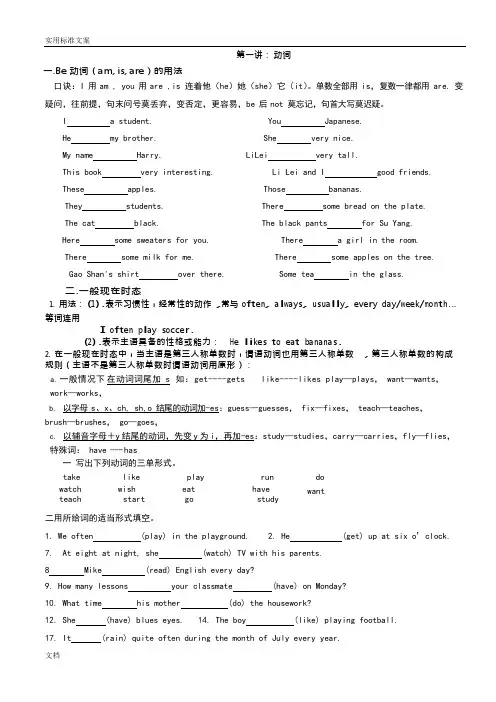
第一讲:动词一.Be 动词(am, is, are)的用法口诀:I 用 am , you 用 are ,is 连着他(he)她(she)它(it)。
单数全部用 is,复数一律都用 are. 变疑问,往前提,句末问号莫丢弃,变否定,更容易,be 后 not 莫忘记,句首大写莫迟疑。
I a student. You Japanese.He my brother. She very nice.My name Harry. LiLei very tall.This book very interesting. Li Lei and I good friends.These apples. Those bananas.They students. There some bread on the plate.The cat black. The black pants for Su Yang.Here some sweaters for you. There a girl in the room.There some milk for me. There some apples on the tree.Gao Shan's shirt over there. Some tea in the glass.二.一般现在时态1.用法:(1).表示习惯性,经常性的动作,常与o f t e n,a l w a y s,u s u a ll y,e v e r y d a y/w ee k/m o n t h…等词连用I o f t e n p l a y s o cc e r.(2).表示主语具备的性格或能力:H e li k e s t o e a t b a n a n a s.2.在一般现在时态中,当主语是第三人称单数时,谓语动词也用第三人称单数, 第三人称单数的构成规则(主语不是第三人称单数时谓语动词用原形):a.一般情况下在动词词尾加 s 如:get----gets like----likes play—plays, want—wants,work—works,b.以字母 s、x、ch, sh,o 结尾的动词加-es:guess—guesses, fix—fixes, teach—teaches,brush—brushes, go—goes,c.以辅音字母+y 结尾的动词,先变y 为i,再加-es:study—studies,carry—carries,fly—flies,特殊词: have --- has一写出下列动词的三单形式。
英语人教版七年级上册知识点

英语人教版七年级上册知识点一、词汇。
1. 问候语:hello, hi。
2. 人称代词:I, you, he, she, it, we, they。
3. 指示代词:this, that。
4. 数字:zero 到 nine。
5. 颜色:red, yellow, green, blue, black, white, purple, brown, pink, orange。
6. 家庭成员:father, mother, parent, sister, brother, grandmother, grandfather, grandparent。
7. 学习用品:pencil, pen, book, eraser, ruler, schoolbag, dictionary。
二、语法。
1. 一般现在时:主语 + be 动词(am/is/are) + 其他。
- I am a student.- You are nice.- He/She is my friend.2. 指示代词 this/that 的用法。
- This is a pen. That is a book.3. 名词的单复数。
- 一般在名词后加 -s 表示复数,如:book - books。
- 以 s, x, ch, sh 结尾的名词加 -es,如:box - boxes。
- 不规则变化,如:man - men, woman - women。
4. 形容词性物主代词。
- my(我的),your(你的/你们的),his(他的),her(她的),its(它的),our(我们的),their(他们的/她们的)三、句型。
1. 打招呼和自我介绍。
- -Hello! I'm Mary.- -Hi! My name is Tom.2. 询问物品。
- -What's this/that in English?- -It's a/an...3. 确认物品所属。
人教七年级上册英语知识点
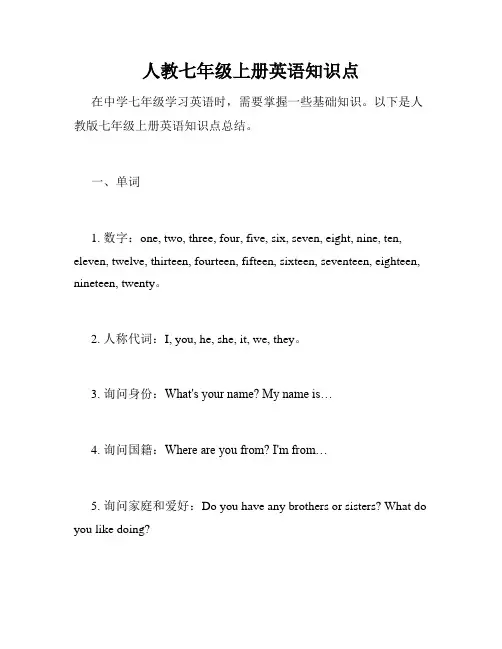
人教七年级上册英语知识点在中学七年级学习英语时,需要掌握一些基础知识。
以下是人教版七年级上册英语知识点总结。
一、单词1. 数字:one, two, three, four, five, six, seven, eight, nine, ten, eleven, twelve, thirteen, fourteen, fifteen, sixteen, seventeen, eighteen, nineteen, twenty。
2. 人称代词:I, you, he, she, it, we, they。
3. 询问身份:What's your name? My name is…4. 询问国籍:Where are you from? I'm from…5. 询问家庭和爱好:Do you have any brothers or sisters? What do you like doing?6. 表示时间:hour, minute, second, morning, afternoon, evening, night。
二、句型1. be 动词的运用:am, is, are。
2. be 动词与语序的搭配:S+be+adj. (I am happy.)3. 一般现在时的运用:S(主语)+V(动词原型)+O(宾语)。
(He likes playing football.)4. 句子的疑问与回答:Do you like English? Yes, I do./No, I don't。
5. 特殊疑问句的用法:What, where, who, which, when, why, how。
6. 欲望和能力:want to, can。
三、语法1. 名词的数:单数和复数。
(one book, two books)2. 形容词的比较级和最高级:前加 more/er/the most,或变化规则。
人教版初中英语七年级上册语法知识点
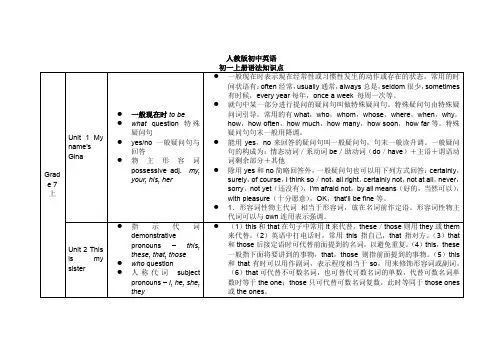
have表示“有”时,其否定形式有两种:在其后直接加not,但常用于非正式用语中;利用助动词do加not。
②如果句子的谓语是实义动词,在谓语动词前加don't,doesn't,didn't。
③no,never,seldom,hardly,nobody,little,few,nothing等否定词也可以构成否定形式。
1.表示经常性或习惯性发生的动作2.表示现在存在的状态或情况3.表示正在发生的动作或存在的状态4.表示客观事实、真理和自然现象5.用于表示较固定的、按计划、规定将要发生的动作,但只限于begin,come,go,leave,arrive,stop,return,close,open,take,start,take,place等少数动作,6.用于if,unless,once,even if(即使)等引导的条件状语从句,when,before,until,as soon as,the moment(一……就)等引导的时间状语从句,no matter+wh-/-how-或wh-ever/however等引导的让步状语从句中,代替一般将来时
人教版初中英语
初一上册语法知识点
Grade 7
上
Unit 1 My name’s Gina
人教版七年级上册英语知识点总结

人教版七年级上册英语知识点总结人教版七年级上册英语知识1【重点单词】banana /b?'na:n?/ n. 香蕉hamburger /'h?mb?:g?/ n. 汉堡包tomato /t?'ma:t?u/ n. 西红柿ice-cream /ais'kri:m/ n. 冰激凌salad /'s?l?d/ n. 沙拉strawberry /'str?:b?ri/ n. 草莓pear /pe?/ n. 梨milk /milk/ n. 牛奶bread /bred/ n. 面包birthday /'b?:θdai/ n. 生日dinner /'din?/ n. (中午或晚上吃的)正餐week /wi:k/ n. 周;星期think about 思考;思索food /fu:d/ n. 食物sure /?u?/ adv. 当然;肯定;一定How about...? (提出建议)......怎么样? burger /'b?:g?/ n. (=hamburger)汉堡包vegetable /'ved?t?bl/ n. 蔬菜fruit /fru:t/ n. 水果right /rait/ adj. 正确的;适当的apple /'?pl/ n. 苹果then /?en/ adv. 那么egg /eg/ n. 蛋;鸡蛋carrot /'k?r?t/ n. 胡萝卜rice /rais/ n. 大米;米饭chicken /'t?ikin/ n. 鸡肉so /s?u/ conj. (引出评论或问题)那么breakfast /'brekf?st/ n. 早餐;早饭lunch /l?nt?/ n. 午餐star /sta:/ n. 明星;星星eat /i:t/ v. 吃well /wel/ adv. 好;令人满意地habit /'h?bit/ n. 习惯healthy /'helθi/ adj. 健康的really /'ri:?li/ adv. 真正地question /'kwest??n/ n. 问题want /w?nt/ v. 需要;想要be /bi:/ v. 变成fat /f?t/ adj. 肥的;肥胖的一.短语归纳1.John’s birthdaydinner 约翰的生日晚餐2.next week 下周3.think about 思考、考虑4.how about 怎么样5.some fruit 一些水果6.his birthday 他的生日7.sport star 体育明星 8.eating habits 饮食习惯9.for breakfast 作为早餐 10.for dinner 作为晚餐11.one lastquestion 最后一个问题 12.healthy food 健康的食品二.重点句型:1.have sth 吃……2.—Do you like…? 你喜欢…吗?—Yes, I do / No, I don’t. 是的,我喜欢/不,我不喜欢。
人教版七年级上册英语重点知识点

人教版七年级上册英语重点知识点一、英语字母和发音英语字母共有26个,包括五个元音字母a、e、i、o、u和21个辅音字母。
每个字母都有自己的发音,需要正确掌握。
二、日常用语和问候1. 问候语(Greetings): Good morning!(早上好!)Good afternoon!(下午好!)Good evening!(晚上好!)Hi!(嗨!)Hello!(你好!)2. 自我介绍(Introductions):My name is…(我叫……)I am…years old.(我……岁了。
)3. 询问他人身份(Asking about someone):What's your name?(你叫什么名字?)How old are you?(你多大了?)三、数字和时间表达1. 数字(Numbers):英语中使用阿拉伯数字表示数字,例如:0、1、2、3等。
2. 时间表达(Time expressions):What time is it?(现在几点了?)It's ______ o'clock.(现在是几点。
)表示差几点,用英语表述多少点前或多少点后。
四、日常用语及对话1. 询问和回答(Asking and answering):- What’s this in English?(这个用英语怎么说?)- It’s a/an _______.(这是一个……。
)2. 问路(Asking for directions):- Excuse me, where is the _______?(请问,_______在哪里?)- Go straight and turn left/right.(一直直走然后左转/右转。
)五、课堂用语及对话1. 请假(Asking for leave):- Can I go to the toilet, please?(我可以去洗手间吗?)- May I leave the classroom?(我可以离开教室吗?)2. 求救(Asking for help):- Help me, please!(请帮帮我!)- Can you help me?(你能帮助我吗?)六、家庭成员1. 父亲(Father):father/dad/daddy2. 母亲(Mother):mother/mom/mummy3. 儿子(Son):son4. 女儿(Daughter):daughter5. 兄弟(Brother):brother6. 姐妹(Sister):sister七、日常动词1. 是(be):am/is/are2. 有(have):have/has3. 去(go):go/goes4. 学习(study):study/studies5. 做(do):do/does6. 看(watch):watch/watches7. 喜欢(like):like/likes8. 在(in):in9. 玩(play):play/plays10. 坐(sit):sit/sits以上是人教版七年级上册英语的部分重点知识点,希望对你的学习有所帮助。
人教版英语七年级上册知识点
以下是人教版英语七年级上册的重点知识点整理:1. 短语和句子:如“Good morning”(早上好)、“Good afternoon”(下午好)、“Good evening”(晚上好)、“How are you?”(你好吗?)、“I’m fine, thanks. And you?”(我很好,谢谢。
你呢?)等。
2. 英文名字和身份的表达:如“Alice”(爱丽丝)、“Bob”(鲍勃)等常见的英文名字,以及如何使用“He/She is…”来介绍他人的身份。
3. be动词的用法:be动词有三种变形,分别是am, is, are。
记忆口诀是:“我”用am,“你”用are,is用于“他、她、它”;单数全都用is,复数全部都用are。
4. 电话号码的表达:如何询问和回答电话号码,例如“What’s your telephone number?”(你的电话号码是多少?)和“My telephone number is…”(我的电话号码是……)。
5. 家庭成员的称谓:如“father”(父亲)、“mother”(母亲)、“brother”(兄弟)、“sister”(姐妹)等,以及如何询问他人的家庭成员,例如“What’s your father’s name?”(你父亲叫什么名字?)。
6. 见面问候和自我介绍:如“Nice to meet you.”(见到你很高兴。
)和“My name is…”(我叫……)。
7. 物品所属和颜色的表达:例如“This is my book.”(这是我的书。
)和“The pen is black.”(这支笔是黑色的。
)。
8. 时间表达法:如几点几分、上午、下午、晚上等时间的英文表达。
9. 方位介词:如in, on, under等介词的使用,以及它们在句子中的正确位置。
人教版英语七年级上册还包括以下一些重要内容:1. 词汇:学生需要掌握大量的新词汇,包括名词、动词、形容词、副词等各类词汇。
人教版七年级英语上册-重要知识点笔记归纳
人教版七年级英语上册-重要知识点笔记归纳一、词汇1.1 常用动词:•be 动词:am, is, are•have 动词:have, has•动词原形:like, want, study, play, watch, do, speak, listen, read, write, run, swim, dance, sing, eat, drink, etc.1.2 重点名词:•人称代词:I, you, he, she, it, we, you, they•形容词:beautiful, big, small, good, bad, tall, short, long, etc.•名词:book, desk, computer, bag, teacher, student, friend, family, etc.1.3 常用介词:•in, on, at, with, of, for, to, from二、语法2.1 to be 动词的用法:•表示身份:My name is John. I am a student.•表示国籍:I am Chinese. He is Japanese.•表示外貌特征:She is tall and beautiful.•表示年龄:I am thirteen years old.•表示情感状态:I am happy. He is sad.•表示位置:The cat is on the table.2.2 一般现在时的用法:•表示经常性的动作:I usually get up at six o’clock.•表示客观事实:The earth goes around the sun.•表示通用真理:Water boils at 100 degrees Celsius.•表示当前情况:He is reading a book now.2.3 词性转换:•名词变形为形容词:happy - happy + ness = happiness•动词变形为名词:read - read + er = reader•形容词变形为副词:quick - quick + ly = quickly三、基础句型3.1 be 动词句型:•肯定句:I am a student. / He is my friend.•否定句:I am not a teacher. / She is not tall.•疑问句:Are you Chinese? / Is he a doctor?3.2 一般现在时句型:•肯定句:I usually go to school by bus.•否定句:I don’t like sports.•疑问句:Do you like pizza? / Does she speak English?3.3 祈使句:•意义:表示命令、请求、建议等。
新版人教版七年级英语上册各单元知识点
空间
form Monday to Friday 从周一到周五
form Beijing to Shanghai 从北京到上海
6.finish的用法
finish作不及物动词时,意为“完成;做好”
They start work early and finish late every day.他们每天开工早收工晚。
作及物动词,后接动词时,要用动名词形式,即finish doing sth. 表示“做完某事,
完成某事”
Jim usually finishes doing his homework before 8:00.吉姆通常在8点前做完作业。
7.thank sb for的用法:
thank sb for意为“因……而感谢某人”,for是介词,后接名词、代词或动名词,表感
谢的原因或内容。
Thank him for telling me. 谢谢他告诉我。
Thank you for helping with my English.多谢你帮我学英语。
8.for two hours的用法:
“for+一段时间”是介词短语,意为“……时间”,表示某事持续多长时间。
对其提问要用
how long
—How long will you stay in Beijing 你将在北京待多长时间?
—For about three days. 大约三天。
2024 人教版七年级英语上册知识点
2024人教版七年级英语上册知识点1.Starter Unit1Good morning!(1)重点短语:∙Good morning!(早上好!)∙Good afternoon!(下午好!)∙Good evening!(晚上好!)∙How are you?(你好吗?)∙I'm fine,thanks.(我很好,谢谢。
)(2)例句:∙Good morning,Miss Li!(早上好,李老师!)∙Good afternoon!Nice to see you.(下午好!很高兴见到你。
)∙Good evening!What are you doing?(晚上好!你在做什么?)∙How are you today?(你今天怎么样?)∙I'm fine,thanks.And you?(我很好,谢谢。
你呢?)(3)重点语法:∙字母的读音和书写:掌握26个英文字母的大小写形式、读音及基本书写规范,这是学习英语的基础。
∙音标基础:初步接触一些简单的音标,为后续学习单词的正确发音做准备,比如元音音标/æ/、/e/、/ɪ/等和一些简单的辅音音标/p/、/b/、/t/等。
∙Be动词的简单用法:学习Be动词am、is、are的最基本用法。
在这个单元中,主要让学生了解I搭配am,you搭配are,这是最基础的Be动词搭配形式。
2.Starter Unit2What's this in English?:(1)重点单词:map(地图)cup(杯子)ruler(尺子)pen(钢笔)orange(橙子)jacket(夹克衫)key(钥匙)quilt(被子)what(什么)in(在……里)English(英语;英文)。
(2)重点短语:∙询问物品:What's this in English?(这个用英语怎么说?)、What's that inEnglish?(那个用英语怎么说?)∙回答方式:It's a/an...(它是一个……)。