
人教版七年级上册英语unit5doyouhaveasoccerball-sectiona(grammarfocus—3c)
________ ________a ping-pong bat.
【巩固提高训练】
三、根据汉语意思完成句子
1.他没有篮球。
He_________ ____________ a____________.
2.你有一些纸吗?
__________you have_________paper?
3.让我们打网球吧!
_______play___________!
4.那听起来不错。
That________ _________.
5.汤姆有23个足球。
Tom__________23__________ __________.
参考答案
一、1. have 2.have 3.have 4.has 5.have
2.Paul has a tennis ball.(改为一般疑问句,并作否定回答)
—_________Paul________a tennis ball?
—No, he_________.
3.Alice has a tennis racket.(改为一般疑问句)
_______Alice______a tennis racket?
二、1. Does, play 2.Does,have,doesn't 3.Does,have4.She has
三、1.doesn't have,basketball
2.Do,any
3.Let's,tennis
4.sounds good
5.has,soccer balls
Unit 5 Do you have a soccer ball?-Section A (Grammar focus—3c)
【基础知识全练】
一、选用have或has填பைடு நூலகம்。
1. Do you________any sisters?
2. We_______a good English teacher.
3.Mary and Kate_______time to go to the park.
4. My father_______many books.
5. Does he______a soccer ball?
二、按要求完成句子
1. Mike plays computer games every day.(改为一般疑问句)
_________Mike__________computer games every day?
最新人教版七年级英语上册《Unit 5 Do you have a soccer ball【全套】》精品课件
A. soccer ball B. sound good C. tennis ball D. ping-pong bat E. baseball bat
1a
Match the words with the things in the picture.
1.tennis ball___a__ 2.ping-pong bat__f__
R·七年级上册
Revision
Does Mary have a soccer ball?
No, she doesn’t.
Do you have a baseball?
No, I don’t.
Do you have a tennis ball?
Yes, I do.
I have …
But I don’t have …
have/has和there be结构
表示“有”时,侧重于主观方面,有 have/has “归……所有”的意思,常用于“某
人 (某物) 有……”的句型。
表示“有”时,侧重于客观存在,常用 there be 于“某地 (某时) 有某人/某物”的句
型,至于此物属于谁则无关紧要。
I have a computer. 我有一台电脑。 There is a book on the table. 桌子上有一本书。
3. —
your sister have a volleyball?
— No, she
.
A. Do; don’t
B. Does; don’t
C. Does; doesn’t
D. Do; doesn’t
4. My soccer ball under the bed. Let
A. are; we
人教版英语七上 U5 Do you have a soccer ball 讲义
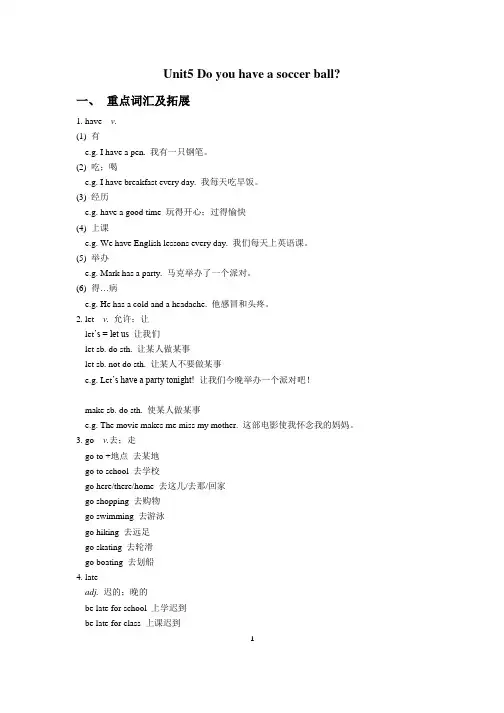
Unit5 Do you have a soccer ball?一、重点词汇及拓展1. have v.(1) 有e.g. I have a pen. 我有一只钢笔。
(2) 吃;喝e.g. I have breakfast every day. 我每天吃早饭。
(3) 经历e.g. have a good time 玩得开心;过得愉快(4) 上课e.g. We have English lessons every day. 我们每天上英语课。
(5) 举办e.g. Mark has a party. 马克举办了一个派对。
(6) 得…病e.g. He has a cold and a headache. 他感冒和头疼。
2. let v.允许;让let’s = let us 让我们let sb. do sth. 让某人做某事let sb. not do sth. 让某人不要做某事e.g. Let’s have a party tonight! 让我们今晚举办一个派对吧!make sb. do sth. 使某人做某事e.g. The movie makes me miss my mother. 这部电影使我怀念我的妈妈。
3. go v.去;走go to +地点去某地go to school 去学校go here/there/home 去这儿/去那/回家go shopping 去购物go swimming 去游泳go hiking 去远足go skating 去轮滑go boating 去划船4. lateadj. 迟的;晚的be late for school 上学迟到be late for class 上课迟到1be late for work 上班迟到adv. 迟地;晚地later adv. 后来;以后e.g. Three days later, he found his father. (句中有段时间+later,句子用一般过去时)三天后,他找到了他的爸爸。
Unit 5 Do you have a soccer ball 知识点归纳-七年级上册英语
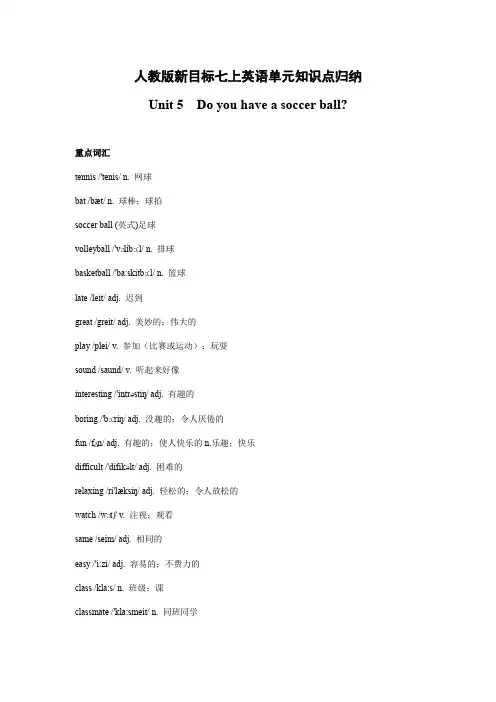
人教版新目标七上英语单元知识点归纳Unit 5 Do you have a soccer ball?重点词汇tennis/'tenis/ n. 网球bat /bæt/ n. 球棒;球拍soccer ball (英式)足球volleyball/'vɔlibɔ:l/ n. 排球basketball/'ba:skitbɔ:l/ n. 篮球late/leit/ adj. 迟到great/greit/ adj. 美妙的;伟大的play/plei/ v. 参加(比赛或运动);玩耍sound/saund/ v. 听起来好像interesting/'intrəstiŋ/ adj. 有趣的boring/'bɔ:riŋ/ adj. 没趣的;令人厌倦的fun/fʌn/ adj. 有趣的;使人快乐的n.乐趣;快乐difficult/'difikəlt/ adj. 困难的relaxing/ri'læksiŋ/ adj. 轻松的;令人放松的watch/wɔtʃ/ v. 注视;观看same/seim/ adj. 相同的easy/'i:zi/ adj. 容易的;不费力的class/kla:s/ n. 班级;课classmate/'kla:smeit/ n. 同班同学重点短语:a tennis bat 一个网球拍play basketball 打篮球baseball bat 棒球棒have a soccer ball 有一个足球play soccer 踢足球with our friends 和我们的朋友一起have a ping-pong ball 有一个乒乓球play ping-pong 打乒乓球have a volleyball 有一个排球play volleyball 打排球at school 在校,上学play sports 做运动watch TV 看电视in my bag 在我的包里be late 迟到on TV 电视上必背典句:1. Do you have a soccer ball? 你有一个足球吗?2. Does he/she have a ping-pong ball?他/她有一个乒乓球吗?3. Do you play sports with your classmates? 你和你的同学一起做运动吗?4. Let’s play soccer together! 我们一起踢足球吧!5. How many sports do you like?你喜欢多少种运动?6. I like playing soccer and basketball. 我喜欢踢足球和打篮球。
Unit 5 Do you have a soccer ball 七年级上课文原文及重点
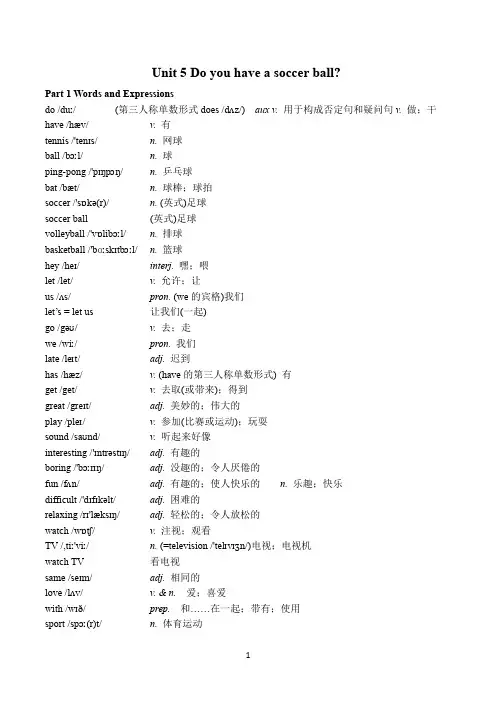
Unit 5 Do you have a soccer ball?Part 1 Words and Expressionsdo /duː/ (第三人称单数形式does /dʌz/) aux v.用于构成否定句和疑问句v.做;干have /hæv/ v.有tennis /'tenɪs/ n. 网球ball /bɔːl/ n.球ping-pong /'pɪŋpɔŋ/ n. 乒乓球bat /bæt/ n. 球棒;球拍soccer /'sɒkə(r)/ n. (英式)足球soccer ball (英式)足球volleyball /'vɒlibɔːl/ n.排球basketball /'bɑːskɪtbɔːl/ n.篮球hey /heɪ/ interj.嘿;喂let /let/ v. 允许;让us /ʌs/ pron. (we的宾格)我们let’s = let us 让我们(一起)go /gəʊ/ v.去;走we /wiː/ pron.我们late /leɪt/ adj. 迟到has /hæz/ v. (have的第三人称单数形式) 有get /get/ v.去取(或带来);得到great /greɪt/ adj.美妙的;伟大的play /pleɪ/ v. 参加(比赛或运动);玩耍sound /saʊnd/ v.听起来好像interesting /'ɪntrəstɪŋ/ adj.有趣的boring /'bɔːrɪŋ/adj.没趣的;令人厌倦的fun /fʌn/ adj.有趣的;使人快乐的n.乐趣;快乐difficult /'dɪfɪkəlt/ adj. 困难的relaxing /rɪ'læksɪŋ/ adj.轻松的;令人放松的watch /wɒtʃ/ v.注视;观看TV /,tiː'viː/ n. (=television /'telɪvɪʒn/)电视;电视机watch TV看电视same /seɪm/ adj. 相同的love /lʌv/ v. & n. 爱;喜爱with /wɪð/ prep.和……在一起;带有;使用sport /spɔː(r)t/ n. 体育运动them /ðəm/ pron. (they的宾格) 他(她、它)们only /'əʊnli/ adv.只;仅like /laɪk/ v. 喜欢;喜爱easy /'iːzi/ adj.容易的;不费力的after /'ɑːftə(r)/prep. & conj.在……之后class /klɑːs/ n.班级;课classmate /'klɑːsmeɪt/ n.同班同学Bill /bɪl/比尔(男名)Part 2:Texts课文(一)Cindy:Hey, Helen, let’s go! We’re late!Helen: OK.Cindy: Do you have the baseball?Helen: Yes, I do. It’s in my bag.Cindy: And where’s our baseball bat?Helen: Bill has it.Cindy: Oh, yeah. And do you have your jacket?Helen: Oh, no, I don’t. It’s on the chair. Let me get it. Cindy: And your hat, too!Helen: OK, I have my jacket and hat. Let’s go!Structure1. Do you have a baseball?Yes, I do./No, I don’t. I have a volleyball.2. Do you have a ping-pong bat?Yes, I do./No, I don’t. I have a ping-pong ball.3. Does she have a tennis ball?Yes, she does./No, she doesn’t. She has a baseball.4. Does he have a soccer ball?Yes, he does./No. he doesn’t. He has two ping-pong bats. 5. Do they have a basketball?句型:—Do/Does sb. have…?—Yes, sb. do / does.—No, sb. don’t / doesn’t.Write each word in the correct place in the chart.将方框中的单词填入表格中正确的位置。
七年级英语上册Unit5-Do-you-have-a-soccer-ball优秀教案

Unit 5 Do you have a soccer ball? Learning objectives (教学目标)Analyze and rearrange teaching materials (教材分析和重组)1. 教材分析本单元以“Do you have a soccer ball?”为话题, 共设计了三个部分的内容。
Section A该部分有4个模块:第一模块围绕“Do you have a soccer ball?”这一话题展开词汇学(1a)、听力(1b)、口语(1c)训练;第二模块继续围绕“Do /Does… have a…?”进行听力(2a-2b)、口语训练(2c);第三模块围绕“Make suggestions.”这一话题展开训练,训练形式为单词填空(3a)和角色表演谈论图画为训练形式(3b);第四模块就“Complete the forms according to the sports club you like.”以结对活动形式进行介绍。
Section B该部分有4个模块:第一模块是词汇的学习(1a)与运用(1b);第二模块仍然围绕(1a-1b) 的词汇进行听力训练(2a-2b)、围绕提建议进行口语训练(2c);第三模块继续围绕“Ownership”这一话题展开有关收藏品阅读(3a), 写作训练(3b-3c);第四模块仍就“Ownership”这一话题以口语训练形式展开全班活动。
Self Check该部分有3个模块:第一模块以填空形式对所学词汇进行训练;第二模块以默写已学过的五个单词的形式对所学的词汇继续巩固复习; 第三模块围绕有关ownership和suggestions对话开展口语训练和写作训练。
教材重组和课时分配Period 1 (Section A: 1a, 1b, 1c) New function presenting Period 2 (Section A: 2a, 2b, 2c, 3a, 3b, 4) PracticePeriod 3 (Section B: 1a, 1b, 2a, 2b, 2c) V ocabulary building Period 4 (Section B: 3a, 3b, 4) Integrating skillsPeriod 5 (Self Check: 1, 2, 3 & Workbook) Self CheckPeriod 6 WritingTeaching procedures and ways (教学过程与方式)Period One New function presentingLanguage goals (语言目标)1. Words & expressions: have, soccer ball, tennis, racket, tennis racket,ping–pong, volleyball, basketball, bat (P25)2.Key sentences: Do you have a ping–pong ball?Yes, I do. No, I don’t. (P25)Ability goals (能力目标)Enable the students to understand and talk about ownership and make suggestions.Emotion & attitude goals (情感和态度目标)Enable the students to form positive attitude toward sports collection and love sports, keep healthy and learn to make suggestions politely. Strategy goals (策略目标)To understand the target language by reading pictures, drawing pictures, countingnumbers, drawing a chart.Culture awareness goals (文化意识目标)People’s attitude toward sports collections is different in English speaking countries.Teaching important points (教学重点)Talk about ownership and make suggestions.Teaching procedures & ways (教学过程和方式)Step 1. Revision and Lead-inAsk one or more students to show their homework.T: In the last unit, I ask you to do a project about filling in the chart because we want to have a ball game. But we don’t know what kind of balls you have. Please ask your classmates in the group what balls he /she has. Then write down the information in the chart. Now who wants to display your project on the blackboard?T: Do you have tennis? S: Yes, I do.Second point to the others in the classroom.T: Does Wang Wei have tennis? S: Yes, he does.Third point to Li Hong in the classroom who has ping–pong ball, but no tennis.T: Do you have tennis?S: No, I don’t.T: Do you have a ping–pong ball?S: Yes, I do.T: Does Li Hong have tennis?Ss: No, she doesn’t.T: Does Li Hong have a ping–pong ball?Ss: Yes, she does.T: Today we are going to learn how to talk about ownership and make suggestions.Step 2. Listing and SpeakingAsk the students to read the picture on Page 25.T: What can you see in the picture?Ss: We can see a ping–pong ball, a ping–pong bat, a tennis racket, a soccer ball, volleyball, a basketball, a TV, a computer game.T: Ask the students to match the words with the things in the picture.Ss: Say, Number 1 is (C), tennis racket. Number 2 is (a), ping–pong ball…After checking the answers in 1a, ask the students to read aloud the new words again and again, ask and answer about them in pairs. And then play the recording again. This time students listen to conversation and circle the words they hear. And then check the answers. Students circle ping–pong bat and computer game.Step 3. Pair workAsk the students to read the example conversation. Have students repeat. And then point to the television in the illustration and substitute that word in the conversation. Have students repeat again. And then ask students to practice the conversation in pairs and remind them to use various objects from the illustration. As students practice, move around the classroom to check progress and help with pronunciation.Ask for more ideas from the students and write their ideas on the blackboard.p hone, cars, pencil case, eraser, pen, book, dictionary, watch, key, notebook, ring, sister , brother, chair, bookcase, CD, video tape, hat, desk, dresser…Show the following to the students and then ask them to practice in pairs.—Do you have a phone?—Yes, I do.—Do you have a CD?—No, I don’t.T: Now work in pairs, make conversations with the newwords in 1a and act it out around the students.Sample conversations:1. S1: Do you have a ping–pong bat?S2: Yes, I do.S1: Do you have a ping–pong bat?S2: No, I don’t.2. S3: Do you have volleyball?S4: Yes, I do.S3: Do you have a basketball?S4: No, I don’t.3. S5: Do you have a tennis racket?S6: Yes, I do.S5: Do you have a TV?S6: No, I don’t.Step 4. Homework1. Ask the students to do more practice as required in 1 c on Page 25.2. Ask the students to prepare the next period. Think about the usage of “Does she /he have…?”Period Two PracticeLanguage goals (语言目标)1. Words & expressions: does, doesn’t, let, us, let’s, play, well, sound,good, sport, we, many, club, more, class (P26)2. Key sentences:—Let’s play volleyball.—That sounds good. (P26)Ability goals (能力目标)Enable the students to make suggestions politely.Emotion & attitude goals (情感和态度目标)Train the Ss to make suggestions politely and take activity part in school sports club and keep healthy.Strategy goals (策略目标)Enable the students to match the problems and worries.Culture awareness goals (文化意识目标)Learn to how to make suggestions politely.Teaching important points (教学重点)Talk about making suggestions.Teaching procedures & ways (教学过程和方式)Step 1. RevisionBefore class, let’s have a revision. First make up a conversation with “Do you have…?”about ownership, and then in threes make up a conversation with “Do you have…? Does she /he have…?”Sample dialogues:1. S1: Do you have a soccer ball? S2: Yes, I do.S1: Do you have a basketball? S2: No, I don’t.2. S1: Do you have a computer game? S2: No, I don’t.S1: Do you have a ping–pong bat? S2: Yes, I do.S3: Does he have a computer game? S1: No, he doesn’t.S3: Does he have a ping–pong bat? S1: Yes, he does.Step 2. Listening PracticePlay the recording for the first time.T: Listen to the tape. You only listen.Play the recording for the second time. Then check the answers.T: You’ll hear the same conversation again in the picture. This time please listen for the names in the pictures, and then number the pictures (1-4).After that ask a few students to say out their answers in 2a.S1: The answers are 3, 1, 4, 2.S2: Number the pictures: 3, 1, 4, 2.Play the recording for the third time.T: You will hear the conversations for the third time. You are to match the people from activity 2a to the balls in the recording for the fourth time and then correct the answers.T: You listen to the tape and write the numbers from the pictures in 2b next to the correct balls.After doing listening, talk about the dialogue about 2b, and then ask some students to say out their answers in 2b.S3: The answers are 3, 2, 1, 4.S4: They are 3, 2, 1, 4.Step 3. Pair workLook at the things in the picture. Ask your partner if he /she has the things in 2c.Ask the students to act out the conversation in pairs.Sample conversations:1. S1: Do you have a dictionary? S2: Yes, I do.S1: Do you have an eraser? S2: No, I don’t.2. S3: Do you have a baseball? S4: No, I don’t.S3: Do you have a football? S4: Yes, I do.3. S5: Does Tom have volleyball? S6: Yes, he does.S6: Does Mike have a pen? S5: No, he doesn’t.Step 4. PracticeLook at 3a, point out the words in the box and then ask a student to read aloud the four words to the class.T: Fill in the blanks with the words from the box alone. I’m sure you’ll fill in the correct answers. And now who’ll tell me the answers? Please hand up if you know the answers. Oh, thank you, --------!S1: The answers are: 1. don’t,2. Let’s,3; have,4. soccer.T: You are right. Thank you. Now let’s practise reading aloud the conversations in pairs and act them out. And then tell the students how to make suggestions politely using “Let’s…!”For example:T: Let’s play ping–pong ball./ Let’s play tennis./ Let’s play volleyball…S: That sounds good.After finishing practising the conversations in 3a, ask the students to make conversations with their partners according to the pictures below in 3b. Ask the students to point to each one and describe each object. Show the students how to use the pairs of pictures as substitutes in the conversation.For example:T: Let’s play basketball.S: I don’t have a basketball.T: Well, let’s play football.S: That sounds good.Ask pairs of students to perform the conversation for the class and tell them how to make suggestions politely in 3b.Step 5. Writing and practiceThis activity gives students a chance to role play a conversation about sports. Students review the language of introductions, and then complete the form, introduce themselves to the coach.T: What sports do you like to play? Who are your favorite sportsmen and sports women? What sports are available at school?S1: I like to play football. My favorite sports man is Liu Xiang. Basketball and volleyball are available at our school.T: Our school has a sports Club with all the sport that you would like to play. If you would like to join the school sports club, please fill in the form with your personal information. When students have completed filling in the form, divide them into pairs.T: Wha t’s your first name? What’s your last name? What sports do you like? Do you like…? What class are you in?S: My first name is Li. My last name is . I like ping–pong ball. I’m in Class 4, Grade 7.Have students role play the conversation between a student and coach. Walk around the class and offer help where necessary.Step 6. SummaryAsk some students to sum up what we have learned key vocabulary and the target languages.Step 7. Today’s homeworkT: First make up dialogues with “ownership and make suggestions” in pairs /in groups. Next class I’ll ask you to act them out. Second, prepare for the next class P 28 (1a, 1b, 2a, 2b, 2c).Period Three New vocabularyLanguage goals (语言目标)1.Words & expressions:interesting, boring, fun, difficult,relaxing, watch, watch TV (P28)2. Key sentences: (1) Let’s play computer games.(2) That sounds interesting. (P28)Ability goals (能力目标)Enable the students to learn to make suggestions politely and responses.Emotion & attitude goals (情感和态度目标)Enable the students to learn to express their feelings about different suggestions.Strategy goals (策略目标)Enable the students to know how to express their feelings aboutdifferent suggestions.Culture awareness goals (文化意识目标)Different countries, different suggestions.Teaching important points (教学重点)Learn to how to express different suggestions and responses. Teaching procedures & ways (教学过程和方式)Step 1. Revision and word studyCheck the homework:T: Last class we asked the students to make up conversationswith “ownership and make suggestions”in pairs /ingroups. Now we’ll ask you to act them out.Point to the five words and ask the students to repeat each one,and then point to the five pictures and ask the students tomatch each picture with one of the words in section B (1a).Ask the students to write the letter of the picture on the linenext to each word.Ask the students to say out the answers. Go around the room,asking students to point to a picture and say the word that goeswith that picture. The answers are: 1. c; 2. d; 3. e; 4. b; 5. a.Step 2. Guessing the wordsThis activity makes students practise using the vocabularywords from this unit. Point to the picture in 1a and reviewthe words.T: Now please draw pictures that show somethinginteresting, boring, fun, difficult or relaxing. Please showyour pictures to some of your classmates. Everyone triesto guess the meaning.Step 3. Listening and word studyBefore playing the recording for the first time, point out thefive words in 1a above and ask a student to read them aloudto the class.Play the recording for the first time in 2a.T: Listen to the tape carefully and remember the fouradjective words you hear.Play the recording for the second time.T: Listen to the conversation and put a checkmark to the leftof each word in 1a that you hear.Ask the two students to say out their answers.Ss: The answers are: a. interesting; b. boring; c. fun;d. difficult;e. relaxing.Step 4. Listening and writingT: I’ll ask a student to read the name of each activity to theclass. And then I’ll play the tape. Listen to the tapecarefully for the first time and remember what Tony saysabout these activities. I’ll play the recording again. Thistime listen to the conversation and write the word in theblank.After listening to the tape for the second time, ask somestudents to read the same example to the class.Ss: The answers are: 1. interesting; 2. difficult; 3. boring; 4. fun.Step 5. Practice and actingBefore asking the two students to read the dialogues, listthese activities on the blackboard: play computer games,play volleyball, watch TV, play basketball.T: I’ll ask the two students to act out the dialogues, talkingabout the activities in 2b.One acts as Jenny, the other acts as Tony, move around theclassroom offering languages support and checkingprogress when the students talk about the activities. Ask afew pairs of students to perform their conversations for theclass.Sample dialogues:1. S1: Let’s play volleyball.S2: That sounds fun.2. S3: Let’s watch TV.S4: That sounds boring.Step 6. Summary1. This class we have learned how to make suggestions andresponses politely. We also have learned how to use somedescription adjectives.2. Prepare for the next class.Step 7. Today’s homework1. Make up dialogues about “Make suggestions and responses”.2. Prepare for the next lesson.Period Four Integrating skillsLanguage goals (语言目标)1. Words & expressions:has, great, collection, but, play sports,only,them, a great sports collection, tennis racket, soccer ball, onTV, everyday (P29)2.Key sentences: (1) Ed Smith has a great collection.(2) But he doesn’t play sports—he only watches them on TV.Ability goals (能力目标)Train the ability of the students about reading and writing.Emotion & attitude goals (情感和态度目标)Enable students to form wide interests and hobbies.Strategy goals (策略目标)Enable students to collect what they like.Culture awareness goals (文化意识目标)Enable students to understand different people have different interests and hobbies.Teaching important & difficult points (教学重点和教学难点)1. The plural form of noun.2. The Present Simple TenseTeaching procedures & ways (教学过程与方式)Step 1. RevisionFirst check the homework, and then ask a few pairs to act out the conversation about: Making suggestions and responses.T: Who can make up a dialogue about making suggestions and responses in pairs?S1: Let’s play football.S2: That sounds fun, but I don’t have a football.S1: Well, do you have a basketball?S2: Yes, I do.S1: Then let’s play basketball.S2: Oh, basketball is so different.S1: OK. Let’s play ping–pong ball.S2: That sounds boring. Let’s play computer game! Do you havea computer?S1: Yes, I do.S2: That sounds interesting.Step 2. ReadingBefore reading this magazine article, ask students to name everything they see in the picture (3a).T: Read the article by yourself, and then circle the vocabulary words that are about sports activities.Give examples such as a stamps collection or a coin collection.T: Please close your books, look at the overhead projector, listen to me carefully, and then fill in the blanks with the sports things in 3a. Please tell the students the answers.S1: 1. tennis racket; 2. basketball; 3. baseball; 4. soccer ball; 5. volleyballT: Y ou’re right. OK. Thank you! Pay attention to the usage of thePresent Simple Tense and the plural form of noun.Explain the usage of the grammar and some key sentences, ask the students to retell the text next class.Step 3. Reading and writingBefore reading this article, ask students to name everything they see in the picture (3b). And then read the article to the class. Ask students to look at the picture and fill in the blanks by themselves. After that, let the students correct the answers in pairs. Ask three students to write their answers on the blackboard. (The answers are: 1. baseball; 2. basketball; 3. tennis rackets; 4. volleyball.)After finishing filling in the blanks, explain the usage of the Present Simple Tense, the plural form of noun and some key words, key sentences. Ask students to recite the text (3b).Step 4. Writing and SpeakingT: After finishing learning the articles about 3a and 3b, now you write about yourself. Talk about your hobbies and interests such as:What sports do you play?What sports things do you have?What other things do you do? And so on.After a while I’ll ask some students to read their stories to the class.S1: I collect coins. I have ten American coins, five Russian coins.S2: I have a great toy cars collection. I have two Chinese toy cars, threeJapanese toy cars, four British toy cars. I play them every day.Step 5. Spoken English and writingNow look at 4 Survey, write “have,you, an alarm clock, do”on the blackboard.T: Please say the words in the correct order to make a question. Come tothe blackboard, Wang Fei.S1: Do you have an alarm clock?T: OK, you’re right. Thank you. Please write a student’s name under thequestion on the blackboard. Who can do it? OK, Yang Fan, please.S2: Li Gang.T: OK, Li Gang, please come to the blackboard. Do you have an alarm clock?Guide him to answer “Yes, I do. /No, I don’t.”S3: Yes, I do.T: Now, please write four questions like this. After that ask students to say other things they might ask. As the students complete the questions, move around the classroom checking progress and offering suggestions as needed, at the same time ask students to move around the room, asking their questions and writing in names. In this way the students learn the target language easily. Step 6. Today’s homework1. Write a story about your /his /her collection.2. Make up dialogue with “Do you have…?”3. Finish off all the exercises on the small blackboard.Period FiveLanguage goals (语言目标)1. Words & expressions: basketball, tennis racket, baseball bat, ping–pong ball,soccer ball, volleyball, interesting, boring, run, difficult, relaxing, TV2. Key sentences: (1) Do you have a ball? Yes, I do.(2) —Let’s play soccer.—That sounds good./It’s boring.Ability goals (能力目标)Train students’ writing abilities.Emotion & attitude goals (情感和态度目标)Learn to talk about ownership and make suggestions.Strategy goals (策略目标)Enable students to form wide interests and hobbies.Culture awareness goals (文化意识目标)Enable students to understand the different countries have different suggestions and hobbies.Teaching important & difficult points (教学重点和教学难点)Learn to how to talk about ownership and make suggestions. Teaching procedures & ways (教学过程与方式)Step 1. RevisionBefore class ask a few students to read aloud the stories about themselves, and then have some pairs act out dialogues about ownership. Also give students three minutes to have a free talk.Step 2. Words checkingThis activity provides a comprehensive review of key vocabulary presented in this unit.T: Now let’s go over key vocabulary in this unit. I speak Chinese, you speak English. First answer my questions one by one, and then answer my questions together. OK let’s begin.有趣的,无聊的,休闲的……篮球,网球球拍……Ss: Interesting , boring, relaxing…T: OK, so much for this. Now take out your English exercises books, write five new words in it, and then share your lists with your groups.Step 3. Reading and writingThis activity focuses on students understanding of the target language in the unit.T: Please read aloud the following sentences in 3a, and then number the sentences to make a conversation that follows the situations in the pictures by yourself.After a while, check the students’ answers. The answers are: 5, 1, 4, 2, 3, 6, 7.After checking the answers, ask the students to act out the dialogue and recite it.T: Now look at the chart on the blackboard with the names of five activities and five words at the top: interesting, boring, fun, difficult, relaxing. And then make up a dialogue talking about ownership and makingAsk two students to act out the dialogue.S1: Let’s play baseball!S2: That sounds interesting, but I don’t have a baseball.S1: …S2: …Step 4. Group workT: The class ball games will be held soon. The students in the class are training recently. Please give suggestions to your group and ask them to train after class.As you make up conversations, please use the drills “Do you have a…? /Yes, I do. /No, I don’t / Let’s… /No, it’s boring.”Step 5. Homework1. Finish off all he exercises in the workbook.2. Talk about your friends’hobbies. (play basketball /soccer ball /ping–pong ball /watch TV /play computer games /play sports every day)Period Six Writing(ppt展示)Teaching Resources (教学资源库)1.语法:(1) 名词复数的构成及读音规律:特别提醒:名词复数的不规则变化是:①只变元音字母,如:man—men, woman —women, foot—feet, policeman—policemen ②单复数形式一样,如:a fish—some fish, a Japanese —some Japanese ③其它变化,如:child—children等。
人教版七年级上册英语Unit5Doyouhaveasoccerball

人教版七年级上册英语Unit5 Do you have a soccer ball一. 教材分析人教版七年级上册英语Unit5的主题是“Do you have a soccer ball?”,本节课主要围绕球类运动展开,通过学习球类运动的名称和询问是否拥有某项球类运动的对话,让学生掌握球类运动的名称以及如何用英语询问和回答是否拥有某项球类运动。
二. 学情分析七年级的学生已经具备了一定的英语基础,对于基本的日常对话和简单的问题已经能够进行回答。
但是对于球类运动的名称和如何用英语询问和回答是否拥有某项球类运动还比较陌生,因此需要通过本节课的学习来掌握。
三. 说教学目标1.知识目标:学生能够掌握球类运动的名称,如:soccer, basketball,volleyball, table tennis等。
2.能力目标:学生能够用英语询问和回答是否拥有某项球类运动,如:“Do you have a soccer ball?”“Yes, I do.”“No, I don’t.”3.情感目标:通过本节课的学习,学生能够对球类运动产生浓厚的兴趣,增强学生的运动意识。
四. 说教学重难点1.重点:球类运动的名称和如何用英语询问和回答是否拥有某项球类运动。
2.难点:如何用英语询问和回答是否拥有某项球类运动,以及球类运动的名称的掌握。
五. 说教学方法与手段本节课采用任务型教学法,通过学生自主探究、小组合作、角色扮演等方式进行学习。
同时,利用多媒体教学手段,如图片、视频等,帮助学生更好地理解和掌握知识。
六. 说教学过程1.导入:通过展示球类运动的图片,引导学生谈论球类运动,激发学生的学习兴趣。
2.新课呈现:教师展示球类运动的名称和图片,引导学生学习和掌握球类运动的名称。
3.对话练习:学生两人一组,模拟对话场景,练习如何用英语询问和回答是否拥有某项球类运动。
4.小组活动:学生分成小组,进行角色扮演,模拟真实场景,运用所学知识进行对话。
人教版英语七年级上册Unit-5--do-you-have-a-soccer-ball
人教版英语七年级上册Unit 5 Do you have a soccer ball?单元教材分析本单元主要学习动词have的一般现在时的用法;使用do和does引导的一般疑问句的构成以及简单回答。
本单元围绕“和朋友一起欢度时光”这一话题安排了三个任务:一是列举所学的运动项目,从中挑选出各自喜欢的体育项目,并说明原因,目的是巩固并新学一些体育项目的名词;二是让学生互相询问所爱好的运动,并根据情况发出邀请,学会用have对物品的所属进行提问与回答,掌握用do和does引导的一般疑问句的构成及使用,了解用Let’s 提建议的句型;三是写作,把任务一、二的完成情况写成日记,进一步复习、巩固所学的语言目标。
通过本单元的学习,学会用have对物品的所属进行提问与回答;学会用let’s…句型提建议;能够谈论自己喜欢哪些球类运动,不喜欢哪些球类运动及原因;能够谈论怎样和自己的朋友度过一段愉快的时光。
单元总体目标.1. 在询问对方是否有某物的对话中学会使用do和does引导的一般疑问句。
2. 学会使用描述性的形容词来评价事物。
3. 学会在对话中使用名词复数。
4. 学会用祈使句来向对方提出建议。
5. 学会用祈使句询问某人是否有某物。
6. 学会向他人提出建议的句子。
7. 学习了解一般现在时。
8. 在本单元中,通过阅读有关运动的文章和对话,使学生更加热爱体育活动并培养一种适合自己的体育爱好。
9.在小组活动中,培养学生团结协作精神。
单元重难点一览表本单元的主题是使用have对物品的所属进行提问及回答,以掌握行为动词在一般现在时中的构成和使用;同时引导学生使用所学的句型谈论自己在球类运动中的喜好。
行为动词在一般现在时的肯定句、否定句和一般疑问句中的构成和使用是初中英语教学中非常重要的内容,本单元知识的掌握程度将直接影响今后的英语学习。
学生在以前的学习中已经掌握了be动词在一般现在时中的构成和使用,在学生的头脑中也已经形成了一个模式,这种模式将直接影响学生对本单元知识内容的接受,所以教师在教学中一定要善于引导,以免学生养成不良习惯。
Unit 5 Do you have a soccer ball复习课件 人教版英语七年级上册
baseballs and bats. 14. 我喜欢运动,但我不做运动,我只在电视上看看。
I love sports, but I don’t play them .I only watch them on TV. 15. 对我来说,那很简单。
It’s easy for me.
16. 课后,我和同学打乒乓球。
After class, I play ping-pong with my classmates. 17. 我弟弟和我在同一个学校。
My brother and I are in the same school. 18. 我没有棒球,但我又一个足球。
7.The story is very interesting. 这个故事很有趣。
(1) interesting adj. 有趣的 1)interesting & interested
interesting
以-ing结尾的形容词,表示“令人感兴趣的”,常用来修饰事或物。
interested
以-ed结尾的形容词,表示“感兴趣的”,常用来修饰人。
02
重难点分析
Lorem ipsum dolor sit amet, consectetur adipisicing elit.
1. Do you have a ping-pong bat? (1)do aux v. & v. 1)做实义动词时,意为“做;干”。
I often do some housework for my parents. 2) 做助动词时,用于构成否定句和疑问句,没有实际意义。 She doesn’t like apples.
人教版英语七年级上册Unit 5 Do you have a soccer ball教学设计
人教版英语七年级上册Unit 5 Do you have a soccer ball教学设计一. 教材分析人教版英语七年级上册Unit 5主要围绕着球类运动展开,本节课将学习到关于足球的词汇和句型。
教材通过介绍不同球类运动,引导学生运用英语进行交流,提高他们的语言运用能力。
本节课的主要内容包括词汇:soccer ball, basketball, volleyball, table tennis等,以及句型:Do you have a …? Yes, I do. No, I don’t. How many … do you have?二. 学情分析七年级的学生已经掌握了基本的英语语法和词汇,具备一定的听说读写能力。
他们在日常生活中对球类运动有浓厚的兴趣,因此本节课的主题能够激发他们的学习兴趣。
然而,部分学生可能在英语表达上还存在一定的困难,需要教师在课堂上给予更多的关注和引导。
三. 教学目标1.知识目标:学生能够掌握关于球类运动的词汇和句型,正确运用Doyou have a …? 和How many … do you have? 进行交流。
2.能力目标:学生能够在小组活动中用英语介绍自己的球类运动用品,提高他们的语言运用能力。
3.情感目标:培养学生对球类运动的热爱,增强他们的团队协作精神。
四. 教学重难点1.重点:学生能够掌握关于球类运动的词汇和句型。
2.难点:学生能够正确运用Do you have a …? 和How many … do youhave? 进行交流。
五. 教学方法1.任务型教学法:通过设置不同的任务,让学生在实践中运用英语,提高他们的语言能力。
2.合作学习法:通过小组活动,培养学生的团队协作精神,激发他们的学习兴趣。
3.游戏教学法:通过球类游戏,让学生在轻松愉快的氛围中学习英语。
六. 教学准备1.教师准备:提前准备球类运动的图片、词汇卡片、录音机等教学用具。
2.学生准备:带上课本、笔记本,提前预习本节课的内容。
七年级英语上册Unit5Doyouhaveasoccerball第一课时课件人教新目标版
Let's play soccer.
How about playing basketball?
That sounds good.
课文解析
课文内容:介绍soccer的基本知识和规则 重点词汇:讲解课文中出现的重点词汇和短语 语法点:分析课文中的语法点和句子结构 文化背景:介绍与课文相关的文化背景和体育精神
布置作业和提 出要求,引导 学生进行课后 复习和巩固。
设计评价策略
课堂观察:观 察学生在课堂 上的表现,了 解学生的学习 状况和需求。
作业评估:通 过布置和批改 作业,了解学 生对课堂知识 的掌握程度。
测验与考试: 定期进行测验 和考试,检测 学生的学习成
果和水平。
师生互动:鼓 励学生提问和 参与讨论,及 时了解学生的 学习困难和问
任务驱动:设计多样化 的学习任务,让学生在 完成任务中掌握知识, 提高语言运用能力。
合作学习:组织学 生进行小组讨论、 合作探究,培养学 生的团队协作精神。
个性化教学:关注学生 的个体差异,设计个性 化的学习方案,满足不 同学生的学习需求。
学生活动
分组讨论:学生分组讨论与主题相关的内容,提高口语表达能力。 角色扮演:学生扮演不同角色,模拟真实场景进行对话练习。 游戏互动:通过游戏形式,让学生在轻松愉快的氛围中学习英语。 课堂展示:学生展示自己的学习成果,增强自信心和成就感。
添加标题
添加标题
添加标题
添加标题
练习方式:采用多种形式,如个人 练习、小组讨论、全班互动等,以 增加学生的参与度和兴趣
反馈机制:及时给予学生反馈和评 价,指出学生的不足和进步,并给 出相应的建议和指导
归纳小结
回顾本课时的 重点内容,包 括词汇、语法