
最新人教版PEP英语五年级上册—英语知识点归纳
五年级上册英语知识点归纳
Unit 1 W hat’s he like?
描述人的外貌单词
old 老的young 年轻的tall 高的short 矮的
fat 胖的thin 年轻的
描述人的性格的单词
kind 和蔼的strict 严厉的polite 有礼貌的clever 聪明的
hard-working 努力的helpful 乐于帮助人的
重点句型
(1)---Who’s your English/ music/art/science/maths/Chinese teacher?
(谁是你的英语/音乐/美术/科学/数学/语文老师?)
---Mr. /Miss./Mrs./Ms. Jones. 琼斯先生/琼斯小姐/琼斯太太/琼斯女士
(2)---What’s she/he like? ---She/He is clever.
对人的性格和外貌提问,可用上面表示外貌和性格的单词回答。
(3)---Is he/she strict? 他/她严厉么?
肯定回答Yes, he/ she is. 是,很严厉。
否定回答No, he/ she is n’t. 不,不严厉。
Unit 2 My week
1.星期一到星期天首字母要大写。
Monday 星期一(Mon.)Tuesday 星期二(Tues.) Wednesday 星期三(wed.)
Thursday 星期四 (Thur.) Friday星期五(Fri.) Saturday 星期六 (Sat.)
Sunday 星期天(Sun.)
2.watch TV 看电视do homework 家庭read books 看书
wash my clothes洗衣服play football踢足球
3.本单单元重点学习怎样问星期及怎样回答。
今天是星期几?What day is it today?
今天是星期一。
It’s Monday.
4.问星期的某天常干什么事及回答。
你星期六常干什么? What do you often do on Saturday?
我常做家庭作业. I often do homework.
你们星期三常上些什么课? What do you have on
Wednesday?
我们上语文、数学和英语. We have Chinese math and English.
3.What about you? 那你呢?(用于来问别人同样的问题而又不重复前面的问句。
)
4. John likes Mondays and Fridays, because he likes P.E.
Unit 3 What would like?
1.食品类(hungry 饿的时候吃eat)
ice cream 冰淇淋hamburger 汉堡包sandwich 三明治salad 沙拉
2.饮料类(thirsty 渴的时候喝drink)
tea 茶milk 牛奶juice 果汁water 水
3.形容味道类单词
delicious 好吃的healthy 健康的fresh 新鲜的sweet 甜的hot 辣的
4.吃饭时,询问他人想吃和想喝什么时,
----What would you like to eat/drink? (你想要吃喝什么?)
----I’d like a sandwich/hamburger/ an ice cream, please (我想要一个三明治/汉堡/冰淇淋.)
tea/milk/juice/water , please. 我想要点茶/牛奶/果汁/水。
注意:可数的食物也可以在前面加上数字,表示几个如:I’d like two hamburgers/three sandwiches/five ice creams, please.
我想要两个汉堡/三个三明治/五个冰淇淋.
5.当你想知道你朋友或父母最爱吃的食物或最爱喝的东西是什么时,
---What’s your favourite food/drink?
---Ice cream. It’s sweet./ Salad. It’s healthy.
Unit4 What can you do?
1.我们的才艺爱好
dance 跳舞draw cartoons 画漫画do kung fu 练武术
sing English songs 唱英语歌play the pipa
弹琵琶
swim 游泳speak English 说英语cook 烹饪
play basketball打篮球play ping-pong 打乒乓球
注意:乐器名词前要加the,但是球类名词前不加the。
2.当举办宴会时,调查同学们会什么时,可以这样问:
---what can you do for the party? (你能为聚会做什么?) ---I can dance/do kung fu/ play the pipa. (我会跳舞/打武术/弹琵琶。
)
3. ---Can you swim/cook/play ping-pong? (你会游泳/烹饪/打乒乓球吗?)
----Yes.,I can./ No, I can’t. 是的,我会。
/不,我不会。
Unit5&Unit6
1.there be句型包括:(1)单数形式(只有)there is a/an…..+名词单数
如:There is a clock/bike/photo/plant/water bottle.
(这里有一个钟/自行车/相片/水瓶)
There is an apple/egg.( 这里有一个苹果/鸡蛋)
(2)复数形式(两个及以上的)
There are +具体数字(two/three)/many/some+名词复数
如:There are two bikes. 这里有两辆自行车。
There are some buildings. 这里有一些建筑。
There are many trees. 这里有许多树。
2.当询问他人这里有什么吗时,只需要把There is… 变成Is there…? T here are…变成Are there...?
如:(1)There is a river/hill/forest/lake/mountain.
(这里有一条河/一座小山/一片森林/一座高山。
)
Is there a river/hill/forest/lake/mountain?
(这里有一条河/一座小山/一片森林/一座高山吗?) 肯定回答:Yes,there is.
否定回答:No,there isn’t.
(2) There are four bridges/villages. (这里有四架桥/四个村庄)
Are there four bridges/villages?(这里有四架桥/四个村庄吗?)
肯定回答:Yes,there are.
否定回答:No,there aren’t.
3.当问球在哪里时,应该问:
---Where is the ball?
---It’s in beside/ behind/above/in front of the dog.
(他在小狗的旁边/后面/上面/前面。
)。
新人教版PEP五年级英语上册各单元知识点复习总结

新人教版PEP五年级英语上册各单元知识点复习总结新版PEP五年级上册知识点总结Unit 1 What’s he like?重点单词old 老的,年纪大的young 年轻的,岁数不大的funny 滑稽的,可笑的kind 体贴的,慈祥的,宽容的strict 要求严格的,严厉的polite 有礼貌的,客气的shy 羞怯的,腼腆的,怕生的helpful 有用的,愿意帮忙的clever 聪明的,聪颖的hard-working工作努力的,辛勤的music 音乐art 美术science 科学English 英语maths/math 数学Chinese 语文,中文sometimes 有时,间或robot 机器人speak 会说,会讲(某种语言);用(某种语言)说话重点句子1. —Who’s your art teacher? 谁是你的美术老师?—Mr. Jones.琼斯老师。
2. —Is he young? 他年轻吗?—Yes, he is. 是的,他年轻。
—No, he isn’t.不,他不年轻。
3. —What’s Wu Yifan like? 吴一帆怎样?—He’s hard-working. 他很勤奋。
4. Ms Wang will be our new Chinese teacher. 王老师会成为我们的新语文老师。
5. He is very helpful at home. 他在家很能干。
6. Robin is short but strong. 罗宾个子矮,但是身体强壮。
7. He can speak Chinese and English. 他会说中文和英语。
8. He makes me finish my homework. 他让我写作业。
语音字母y在单词中的发音:1、双音节或多音节词末发[ i ]。
例:bab y happ y windy sunn y sorr y cand y man y famil y part y婴儿开心的有风的晴朗的对不起糖果许多家庭聚会课外补充:2、y在单音节词末发[ ai ]例:b y 乘坐m y 我的wh y 为什么cr y 哭fl y 飞重点知识及语法1、询问他人的外貌或性格:-What’s he/she like? - He/She is kind/…2、一般疑问句的问与答:—Is he/she…?—Yes, he/she is.—No, he/she isn’t.—Do you know…? —Yes, I do.—No, I don’t3、be动词的三种形式am, is, are与人称代词连用的用法:I + am,He, she, it,人名、物名+ isWe, you, they + are4、Ms., Miss, Mr., Mrs.的区别:Ms. [miz](缩略词)(用于女子的姓氏或姓名前,不指明婚否)女士;Miss [mis](用于未婚女子的姓氏或姓名前,以示礼貌)小姐,女士;Mr. [mist](mister的缩略词)(用于男子的姓氏或姓名前)先生;识记口诀:我用am, 你用are, is用于他、她、它,所有复数都用are。
新人教版PEP五年级英语上册各单元知识点总结(完美版)
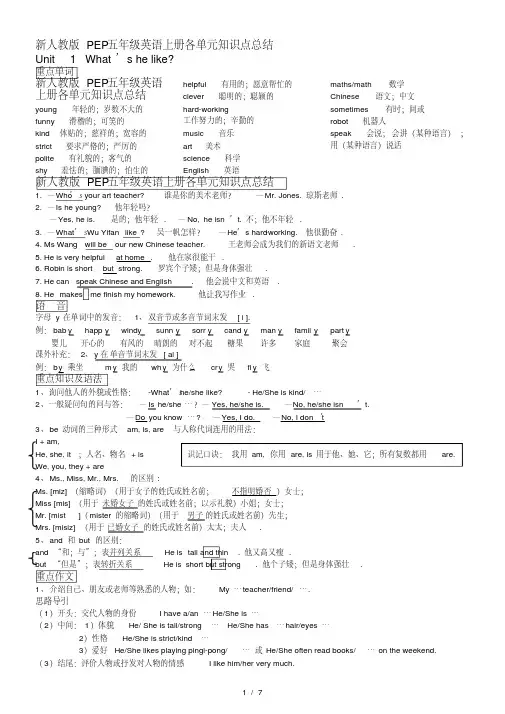
新人教版PEP五年级英语上册各单元知识点总结Unit 1 What’s he like?重点单词新人教版PEP五年级英语上册各单元知识点总结young 年轻的;岁数不大的funny 滑稽的;可笑的kind 体贴的;慈祥的;宽容的strict 要求严格的;严厉的polite 有礼貌的;客气的shy 羞怯的;腼腆的;怕生的helpful 有用的;愿意帮忙的clever 聪明的;聪颖的hard-working工作努力的;辛勤的music 音乐art 美术science 科学English 英语maths/math 数学Chinese 语文;中文sometimes 有时;间或robot 机器人speak 会说;会讲(某种语言);用(某种语言)说话新人教版PEP五年级英语上册各单元知识点总结1. —Who’s your art teacher? 谁是你的美术老师?—Mr. Jones.琼斯老师.2. —Is he young? 他年轻吗?—Yes, he is. 是的;他年轻. —No, he isn’t.不;他不年轻.3. —What’s Wu Yifan like? 吴一帆怎样?—He’s hard-working. 他很勤奋.4. Ms Wang will be our new Chinese teacher. 王老师会成为我们的新语文老师.5. He is very helpful at home. 他在家很能干.6. Robin is short but strong. 罗宾个子矮;但是身体强壮.7. He can speak Chinese and English. 他会说中文和英语.8. He makes me finish my homework. 他让我写作业.语音字母y在单词中的发音:1、双音节或多音节词末发[ i ].例:bab y happ y windy sunn y sorr y cand y man y famil y part y婴儿开心的有风的晴朗的对不起糖果许多家庭聚会课外补充:2、y在单音节词末发[ ai ]例:by 乘坐m y 我的wh y 为什么cry 哭fl y 飞重点知识及语法1、询问他人的外貌或性格:-What’s he/she like? - He/She is kind/…2、一般疑问句的问与答:—Is he/she…?—Yes, he/she is.—No, he/she isn’t.—Do you know…? —Yes, I do.—No, I don’t3、be动词的三种形式am, is, are与人称代词连用的用法:I + am,He, she, it;人名、物名+ isWe, you, they + are4、Ms., Miss, Mr., Mrs.的区别:Ms. [miz](缩略词)(用于女子的姓氏或姓名前;不指明婚否)女士;Miss [mis](用于未婚女子的姓氏或姓名前;以示礼貌)小姐;女士;Mr. [mist](mister的缩略词)(用于男子的姓氏或姓名前)先生;Mrs. [misiz](用于已婚女子的姓氏或姓名前)太太;夫人.5、and和but的区别:and “和;与”;表并列关系He is tall and thin. 他又高又瘦.but “但是”;表转折关系He is short but strong. 他个子矮;但是身体强壮.重点作文1、介绍自己、朋友或老师等熟悉的人物;如:My …teacher/friend/….思路导引(1)开头:交代人物的身份I have a/an…He/She is…(2)中间:1)体貌He/ She is tall/strong…He/She has …hair/eyes…2)性格He/She is strict/kind…3)爱好He/She likes playing pingi-pong/…或He/She often read books/… on the weekend. (3)结尾:评价人物或抒发对人物的情感I like him/her very much.识记口诀:我用am, 你用are, is用于他、她、它;所有复数都用are.2、范文:(1)课本P9 Read and write(2)My Chinese teacherI have a new Chinese teacher. She is Ms. Chen. She is tall and thin. She has big eyes and long black hair. She is kind and funny. Sometimes she is strict, too. She is hard-working. She likes reading. Her class is so much fun. We all like her.Unit 2My week重点单词新人教版PEP五年级英语上册各单元知识点总结Monday (Mon.) 周一Tuesday (Tue./Tues.) 周二Wednesday (Wed./Weds.) 周三Thursday (Thur./Thurs.) 周四Friday (Fri.) 周五Saturday (Sat.) 周六weekend 周末(周六、日)wash my clothes 洗衣服watch TV 看电视do homework 做作业read books 看书play football 踢足球on the weekend 在周末play sports/do sports 做体育运动listen to music 听音乐play ping-pong 打乒乓球新人教版PEP五年级英语上册各单元知识点总结1. —What do you have on Thursday s? 星期四你们上什么课?—I have math, English and music. 我们上数学、英语和音乐课.2. —What do you do on Thursdays, Grandpa? 爷爷;星期四你要做什么?—I have a cooking class with your grandma. 我和你奶奶去上烹饪课.3. —Do you often read books in this park? 你经常在这个公园看书吗?—Yes, I do.是的—No, I don’t.不是4. Look at my picture. 看我的图片.5. You look tired. 你看起来很累.6. You should play sports every day. 你应该每天做运动.语音字母组合ee, ea在单词中的的发音:[ i: ]例:fee t bee f m eet see fee d tea rea d ea t rep ea t脚牛肉遇见看见喂养茶阅读吃重复注:1、ee组合绝大部分发长音[ i: ];只有少部分发短音[ i ];如:coffee 咖啡2、ea字母组合除了发[ i: ];还有可能发[ e ]等发音;如:bread 面包;或者发[ ei ];如:great 好极了重点知识及语法1、询问做什么事/活动:—What do you do …? —I often play ping-pong…询问星期几上什么课:—What do you have on…? —We have English class…2、一般疑问句的问与答:—Do you often read books? —Yes, I do. —No, I don’t.3、on+具体某一天(年月日;星期);如:on Monday/Tuesday…课外at+具体时刻(…点钟);如:at 12 o’clock 在十二点整补充:in+大致时间(年月;早中晚);如:in 2014 在2014年in the morning/afternoon/evening4、play + 球类、棋类、娱乐活动;如:play football/ping-pong补充:play + the + 乐器(第四单元知识);如:play the pipa/piano/violin…重点作文1、描写一周的生活;如:My week思路导引(1)开头:简单的自我介绍:My name’s…/ I’m…(2)中间:1)介绍周一至周五的情况;可以着重介绍自己最喜欢的那一天:I go to school from Monday to Friday. I like…because I have…2)介绍自己周六、日的活动:I often watch TV/…on the weekend.(3)结尾:This is my week. What about yours?2、范文:My weekMy name is Li Ming. I go to school from Monday to Friday. I like Tuesdays and Thursdays, because I havemusic and PE. I often do my homework and read books on Saturdays. I often play ping-pong on Sundays.Unit 3What would you like? 重点单词新人教版PEP五年级英语上册各单元知识点总结hamburger 汉堡包tea 茶sandwich 三文治salad 沙拉fresh 新鲜的;刚摘的healthy 健康的delicious 美味的;可口的hot 辣的;辛辣的sweet 含糖的;甜的hungry 饿的thirsty 渴的;口渴的favourite 特别喜爱的food 食物drink 喝;饮carrot 胡萝卜chicken 鸡肉onion 洋葱milk 牛奶bread 面包beef noodles 牛肉面fish sandwich 鱼肉三明治tomato soup 西红柿汤新人教版PEP五年级英语上册各单元知识点总结1.—What would you like to eat? 你想吃什么?—A sandwich, please. 请给我一个三明治.—What would you like to drink? 你想喝什么?—I’d like some water. 我想喝点水.2. —What’s your favourite food?你最喜欢吃什么食物?—Noodles. They are delicious. 面条.面条很好吃.3. My/His /Her favourite food is fish. 我/他/她最喜欢的食物是鱼.4. I’m hungry/thirsty. 我饿/渴了.5. I don’t like beef but chicken is OK. 我不喜欢牛肉但是鸡肉也可以.6. Onions are my favourite vegetable. 洋葱是我最喜欢的蔬菜.7. I like vegetables but not carrots. 我喜欢吃蔬菜但不喜欢胡萝卜.语音字母组合ow在单词中的发音:[ au ] ;[例:[ au ] cow奶牛flow er 花wow哇dow n 向下how如何;怎样now现在[slow慢的snow雪yellow黄色window窗户snow y 下雪的tomorrow明天重点知识及语法1、询问想要吃/喝什么:—What would you like to eat/drink? —I’d like…2、询问最喜欢的事物:—What’s your favourite food/vegetable/…? —My favourite food/…is…/I like…3、名词复数的规则变化:(1)直接加s;(2)以s, x, sh, ch结尾的;加es;如;bus es box es sandwich es(3)以o结尾;有生命的加es;如;potato es tomato es无生命的加s;如;photo s piano s zoo s补充:(4)以辅音加y结尾;改y为i再加es;如;famil ies bab ies以元音加y结尾;直接加s;如;boy s day s(5)以f或fe结尾;改f为v再加es;如knife-kni ves小刀leaf-lea ves树叶4、some+可数/不可数名词例:some apple s(可数)some water/rice/juice/bread/…(不可数)课外补充:不可数名词(词后不可以加-s/es;所接动词用单数is /V-s/es)液体water milk tea orange(桔汁)coke juice气体air(空气)食物food rice bread fruit肉类meat(肉)fish beef chicken物质work(工作)paper(纸)time music weather(天气)snow money重点作文1、描述自己和家人最喜爱的食物思路导引(1)开头:简单介绍自己的家庭成员:There are…people in my family. They are…(2)中间:分别介绍每个家庭成员最喜爱的食物时什么:…favourite food is…/…is…favourite./…like(s)…best.(3)结尾:穿插说明喜欢的原因:It’s/They’re…2、范文:(1)课本P29 Read and write(2)There are four people in my family. They are my parents, my brother and me. My mother likes saladbest. It’s fresh. Beef is my father’s favourite. He thinks(认为)it’s delicious. My brother likes ice cream. It’ssweet. My favourite food is fish. It’s very healthy.Unit 4 What can you do?重点单词新人教版PEP五年级英语上册各单元知识点总结sing English songs 唱英文歌曲play the pipa 弹琵琶do kung fu 打功夫draw cartoons 画漫画swim 游泳speak English 说英语cook 烹饪;烹调play basketball 打篮球play ping-pong 打兵乓球draw pictures 画画clean the classroom 打扫课室新人教版PEP五年级英语上册各单元知识点总结1. We’ll have an English party next Tuesday! 我们下周二将举行英语派对.2. —What can you do for the party? 你能为派对做些什么呢?—I can sing English songs. 我能唱英文歌.3. How/What about you? 你呢?4. Can you do any kung fu? 你会打功夫吗?—Yes, I can. 是的;我会. —No, I can’t. 不;我不会.5. No problem. I can help you. 没问题.我会帮你.6. I can play ping-pong, but I can’t swim. 我会打乒乓球;但我不会游泳.7. Please send me an email at robin@. 请给我发邮件;邮箱robin@.语音字母组合oo在单词中的发音:[ u ];[ u: ]例:[ u ] loo k 看goo d 好的boo k 书coo k 烹饪woo d 木头foo t 脚助记口诀: 1. 看look好good书book;砍柴wood做饭cook洗脚foot.2. 押韵记忆:Look good book, cook wood foot.[ u: ] ball oo n 气球foo d 食物zoo动物园noo dles 面条注:字母组合oo发音少数发短音[ u ];多数发长音[ u: ] .重点知识及语法1、询问对方会做什么事情:—What can you do? —I can play the pipa.2、can句型的否定句:I can’t play the pipa.3、can句型的一般疑问句的问与答:—Can you do any kung fu? —Yes, I can./No, I can’t.4、play + the + 乐器;例play the erhu /pipa /piano…play + 球类、棋类、娱乐活动;例play basketball/football/ping-pong…5、some与any的异同:相同之处:都有“一些”的含义;不同之处:some+可数名词复数/不可数名词(用于肯定句中)例:I can do some kung fu. 我会打功夫.any+可数名词复数/不可数名词(用于否定句或疑问句中)例:I can’t do any kung fu. 我不会打功夫. Can you do any kung fu? 你会打功夫吗?课外补充:1)any还可以用于肯定句;作“任何的”解.例:Any student can answer this question. 任何学生都能回答这个问题.2)在表示建议;请求的疑问句中;或期望得到肯定回答时;用some而不用any.例:Would you like some coffee? 你想来点咖啡吗?重点作文1、描写自己或家庭成员会做的事情;如:I’m helpful / Super family;思路导引(1)开头:介绍自己或家庭成员的基本情况:I’m… I’m…years old.I have a super family. There are three people in my family. They are…(2)中间:介绍自己在家和在学校里会做的事情/介绍家人的外貌性格以及会做的事情:I can…at school. I can…at home.My father is strong. He can do some kung fu. My mother is…She can…(3)结尾:总结This is me. What can you do?This is my family. I love my family. Can you tell me your family?/What about your family?2、范文:(1)课本P43 Read and write(2)Hello, I’m Zhao Ming. I’m eleven years old. I’m helpful. I can clean the windows and sweep the floorat school. I can cook and wash my clothes at home.I often play the pipa on the weekend. I can play basketball. I like English very much. I can speak English well. What can you do?Unit 5重点单词新人教版PEP五年级英语上册各单元知识点总结photo 照片;相片plant 植物water bottle 水瓶bike 自行车;脚踏车in front of 在……前面beside 在旁边(附近)between 在……中间behind 在(或向)……后面above 在(或向)……上面so many 许多their 他们的lots of 许多dirty 肮脏的near 在附近house 房屋;房子;住宅新人教版PEP五年级英语上册各单元知识点总结1. Your room is really nice! 你的房间真漂亮!2. There is a big bed. 有一张床.3. 我的电脑在书桌这里.4. This is my room. 这是我的房间.5. There are so many picture s here. 这有许多照片.6. My father can draw very well. 我父亲画的很好.7 .—Where is the ball? 球在哪里?—It’s in front of the dog. 在狗的前面.8. There is a tree in front of the house. 在房子前有棵树.9. I live near the nature park. 我住在自然公园附近.语音字母组合ai, ay在单词中的发音:[ ei ]例:rai ny 下雨的rai nbow 彩虹pai nt 涂色wait 等待say说way路;方法birthd ay生日Mond ay周一day天;日子tod ay今天may可以课外补充:元音字母a在开音节中也发[ ei ] 例:cake 蛋糕face 脸name 名字重点知识及语法1、there be(is, are)句型的单复数形式:There is a clock. There are lots of flower s.课外补充:(1)There be句型的动词就近原则:例:There is a bed, a desk, two photos in my room.There are two photos, a bed and a desk in my room.(2)there be与have/has的异同:相同之处:都有“有”的含义不同之处:there be表示“某地有……”(无生命的);主语放在句末;例:There is a book on the desk. 书桌上有一本书.have/has表示“某人有……”(有生命的);放在主语(人)的后面.例:I have a book. 我有一本书.2、询问方位或地点:—Where is the ball? —It’sin front of the dog.3、lots of + 可数/不可数名词= a lot of + 可数/不可数名词“许多……”比较:many + 可数名词复数“许多……”例:There are many tree s in the forest.much + 不可数名词“许多…....”例:I drink much water every day. 我每天喝很多水. 4、动词+very well例:My father can draw very well我爸爸画的很好比较:be (am/is/are)+very good例:The book is very good. 这本书非常好.重点作文1、描写房间、卧室;如:My room / bedroom;思路导引(1)开头:总体概括自己卧室的特征I have a nice/big/clean/…room.(2)中间:描述卧室里的物品、摆设There is/are….on/beside/…… is on the desk/….(3)结尾:抒发对卧室的情感I like/love my bedroom (very much)! Can you tell me yours?2、范文:(1)课本P53 Read and write(2)My bedroomI have a nice bedroom. It’s not big but clean.I like my bedroom. Can you tell me yours?Unit 6 重点单词新人教版PEP五年级英语上册各单元知识点总结hill 山丘;小山river 河;江mountain 高山;山岳lake 湖;湖泊village 村庄;村镇house 房屋;房子;住宅tree 树;树木;乔木bridge 桥go boating 去划船nature park 自然公园people 人;人们rabbit 兔子duck 鸭子animal 动物high 高的children 孩子们(child的复数形式)新人教版PEP五年级英语上册各单元知识点总结1. Children, let’s go to the forest. 孩子们;让我们去森林吧.2. —Is there a river in the forest? 森林里有河流吗?—Yes, there is.是;有的. —No, there isn’t.不;没有.3. The nature park is so quiet! 自然公园这么安静!4. There aren’t many people. (这里)人不多.5. —Are there any tall building s in the nature park? 自然公园例有高楼吗?—Yes, there are.是;有的. —No, there aren’t.不;没有.6. —How many? 多少? —Two. 两个.7. Robin is at Mr. Jones’ house. 罗宾在琼斯先生的房子里.语音字母组合ou在单词中的发音:[ au ]例:hou se 房屋;房子mou se 老鼠sou nd 声音;听起来cou nt 数数提示:字母组合ow也有些发[ au ];例:cow奶牛how如何;怎样dow n 向下课外补充:字母组合ou在单词中还可读[ u: ];如sou p 汤grou p 群;团体;和[ ;如you ng 年轻的.重点知识及语法1、there be句型的一般疑问句的问与答:—Is there a lake? —Yes, there is. —No, there isn’t.—Are there any animal s? —Yes, there are. —No, there aren’t. 2、there be(is, are)句型的单复数形式(具体见Unit 5的重点知识及语法):例:There is a nature park near the house. There are many duck s on the lake.3、some与any在肯定句、否定句及问句中的用法:some+可数名词复数/不可数名词(用于肯定句中)例:There are some books on the desk.any+可数名词复数/不可数名词(用于否定句或疑问句中)例:There aren’t any people in the forest.Are there any tall buildings in the natures park?4、people人;人们(集体名词;明为单数;实为复数;词末不能加-s)例:There are many people in the park.重点作文1、描写景物;如:看图作文(风景图)思路导引(1)开头:Look at the picture.(2)中间:用There is/are…beside/in front of…句型描述图中所有的景物及其位置;注意要有明确的观察主线;即观察的顺序性与条理性.2、范文:(1)课本P63 Read and write(2)看图作文Look at the picture. This is a beautiful village. There are three houses in thepicture. There are many trees near them. In front of the houses, there is a river.The bridge is over the river. Behind the houses, there is a forest and a mountain.。
人教版PEP三起小学英语五年级上册知识点总结
千里之行,始于足下。
人教版PEP三起小学英语五年级上册知识点总
结
1. 单词:五年级上册的英语单词主要包括一些日常生活中常见的词汇,如动物、食物、家具、运动、职业等。
学生需要通过课堂学习、练习和复习来记忆和掌握这些单词。
2. 语法:五年级上册的英语语法主要涉及以下几个方面:
- 第三人称单数的一般现在时态:主语为第三人称单数时,动词要加-s 或-es。
- 一般现在时:表示经常性的动作或现状,谓语动词用原形。
- 现在进行时:表示现在正进行的动作,谓语动词由be动词+动词ing 形式构成。
- be动词纠错:根据句子的主语和谓语动词的人称和数来确定正确的be动词形式。
3. 句型:五年级上册的英语句型包括基础的肯定句、否定句和疑问句,以及表示时间、地点、原因、目的、方式等的句子结构。
4. 短语:五年级上册的英语短语主要包括一些常用的日常生活短语,如问候语、道别语、谢谢、对不起等。
学生需要通过实际应用和练习来掌握和运用这些短语。
5. 句子结构:五年级上册的英语句子结构包括主语+谓语动词+宾语和主语+谓语动词+宾语+宾语补足语等。
学生需要通过阅读和写作练习来熟悉和掌握这些句子结构。
第1页/共2页
锲而不舍,金石可镂。
总的来说,五年级上册的英语主要涉及基础词汇、语法、句型和句子结构等方面的知识点,学生需要通过课堂学习和练习来掌握并应用这些知识点。
最新pep人教版小学五年级英语上册各单元知识点归纳
最新pep人教版小学五年级英语上册各单元知识点归纳最新版人教版小学五年级英语上册复习重点知识Unit1Whathelike重点单词:old年老的young年轻的funny滑稽的kind和蔼的trict 严格的polite有礼貌的hard-working工作努力的helpful有用的clever聪明的A:What’helike她怎么样?B:She’verykind她很和蔼A:Ihetrict她严格吗?2、A:DoyouknowMrYoung你认识杨先生吗?B:No,Idon’t(否定回答)不,不认识。
Ye,Ido(肯定回答)是的,我认识。
3、A:Whoiyourmathteacher谁是你的数学老师?B:MrLi李先生。
4、A:Ihetrict她严格吗?B:Ye,hei.(肯定回答)是的,她严格。
No,heinot.(否定回答),不严格。
Unit2Myweek重点单词:Monday星期一Tueday星期二Wedneday星期三Thurday 星期四Friday星期五Saturday星期六Sunday星期日weekend周末wahmyclothe洗衣服watchTV看电视dohomework做家庭作业readbook读书playfootball踢足球often通常cooking烹饪tired疲惫的port体育运动hould应该day一天重点句子:1、A:WhatdoyouhaveonFriday星期五你有什么课?B:IhaveaPEcla我有体育课2、Doyouoftenplayport你常常做运动吗?No,Idon’t.Idon’tlikeport不是.我不喜欢做运动3、A:WhatdowehaveonWedneday星期三我们都有什么课?4、A:WhatdoyoudoonWedneday?你星期三都在做什么?B:IoftendomyhomeworkonWedneday我星期三通常写我的家庭作业。
pep人教版五年级英语上册各单元知识点归纳
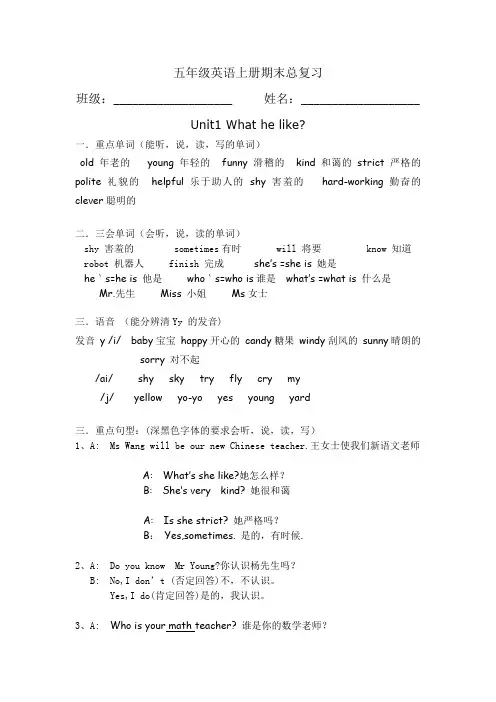
五年级英语上册期末总复习班级:___________________ 姓名:___________________Unit1 What he like?一.重点单词(能听,说,读,写的单词)old年老的young年轻的funny 滑稽的kind和蔼的strict严格的polite 礼貌的helpful乐于助人的shy害羞的hard-working勤奋的clever聪明的二.三会单词(会听,说,读的单词)shy 害羞的 sometimes有时 will 将要 know 知道robot 机器人 finish 完成she’s =she is 她是he‵s=he is 他是who‵s=who is谁是what’s =what is 什么是Mr.先生Miss 小姐Ms女士三.语音(能分辨清Yy 的发音)发音y /i/ baby宝宝happy开心的candy糖果windy刮风的sunny晴朗的sorry 对不起/ai/ shy sky try fly cry my/j/ yellow yo-yo yes young yard三.重点句型:(深黑色字体的要求会听,说,读,写)1、A: Ms Wang will be our new Chinese teacher.王女士使我们新语文老师A: What’s she like?她怎么样?B: She’s very kind? 她很和蔼A: Is she strict? 她严格吗?B:Yes,sometimes. 是的,有时候.2、A: Do you know Mr Young?你认识杨先生吗?B: No,I don’t (否定回答)不,不认识。
Yes,I do(肯定回答)是的,我认识。
3、A: Who is your math teacher? 谁是你的数学老师?B: Mr Li李先生。
4、A: Is she strict? 她严格吗?B: Yes,she is.(肯定回答)是的,她严格。
最新人教版PEP英语五年级上册各单元知识点归纳

最新人教版PEP英语五年级上册各单元知识点归纳Unit 1 What’s he like?一、核心词汇1.表示人体貌特征及性格特点的形容词: old老的;年纪大的young年轻的;岁数不大的funny 滑稽的;可笑的kind 体贴的;慈祥的;宽容的strict 要求严格的;严厉的polite有礼貌的;客气的hard-working 工作努力的;辛勤的helpful 有用的;愿意帮忙的clever 聪明的;聪颖的shy 羞怯的;腼腆的;怕生的2.短语: head teacher校长birthday party生日派对二、了解词汇1. 单词: know知道;了解our我们的Ms (用于女子的姓氏或姓名前,不指明婚否)女士will(谈及将来)将要sometimes 有时;间或robot机器人him(用作宾语或表语)他speak会说;会讲(某种语言);用(某种语言)说话finish 完成;做好2.短语: be strict with …对……要求严格be going to打算三、核心句型1. —Who’s your English teacher?谁是你们的英语老师?—Miss White.怀特老师。
解读:这是询问某个学科的老师是谁的句型及回答。
2. —What’s she like?她什么样?—She’s kind.她很和蔼。
解读:这是询问某人的体貌特征或性格特点的句型及回答。
3. —Is she kind? 她和蔼吗?—Yes, she is.是的,她和蔼。
解读:这是询问某人性格特点的一般疑问句,用yes或no回答。
4. He is very helpful at home.他在家里非常愿意帮忙。
解读:这是描述他人特征的句型。
四、了解句型1. Hey, Ms Wang will be our new Chinese teacher.嘿,王老师将会是我们的新语文老师。
解读: will表示将要发生的动作或状态,意思是“将要”,后加动词原形。
人教PEP版小学英语五年级上册知识点汇总(全一册)
PEP版小学英语五年级上册知识点汇总Unit 1 What’s he like?1. 描述人的外貌单词old 老的young 年轻的tall 高的short 矮的fat 胖的thin 瘦的2. 描述人的性格的单词kind 和蔼的strict 严厉的polite 有礼貌的clever 聪明的hard-working 努力的helpful 乐于帮助人的3. 重点句型(1)---Who’s your E nglish/ music/art/science/maths/Chinese teacher?(谁是你的英语/音乐/美术/科学/数学/语文老师?)---Mr. /Miss./Mrs./Ms. Jones. 琼斯先生/琼斯小姐/琼斯太太/琼斯女士(2)---What’s she/he like? ---She/He is clever.对人的性格和外貌提问,可用上面表示外貌和性格的单词回答。
(3)---Is he/she strict? 他/她严厉么?肯定回答Yes, he/ she is. 是,很严厉。
否定回答No, he/ she isn’t. 不,不严厉。
人教PEP版小学英语五年级上册知识点汇总Unit 2 My week1.星期一到星期天首字母要大写。
Monday 星期一(Mon.)Tuesday 星期二(Tues.)Wednesday 星期三(wed.)Thursday 星期四(Thur.)Friday星期五(Fri.) Saturday 星期六(Sat.)Sunday 星期天(Sun.)2.watch TV 看电视do homework 家庭read books 看书wash my clothes洗衣服play football踢足球3.本单单元重点学习怎样问星期及怎样回答。
今天是星期几?What day is it today?1。
Unit1What'shelike?(知识清单)-2024-2025学年人教PEP版英语五年级上册
Unit 1 What's he like?知识清单一、重点词汇解析1. “old”:可用来形容人年龄大,也可形容物品老旧。
例如:The old man is walking slowly.(这位老人走得很慢。
)This book is old.(这本书很旧。
)2. “young”:与“old”相对,表示年轻。
如:She is young and beautiful.(她年轻又漂亮。
)3. “funny”:常指人或事物有趣、滑稽。
例如:The joke he told is really funny.(他讲的笑话真的很滑稽。
)4. “kind”:强调人的善良、和蔼。
如:Our teacher is very kind to us.(我们的老师对我们很和蔼。
)5. “strict”:表示要求严格。
例如:My parents are strict with my study.(我的父母对我的学习要求严格。
)6. “polite”:有礼貌的。
例如:It's polite to say thank you when you receivea gift.(当你收到礼物时说谢谢是有礼貌的。
)7. “hardworking”:努力工作的、勤奋的。
例如:He is a hardworking student.(他是一个勤奋的学生。
)8. “helpful”:乐于助人的。
例如:She is always helpful to others.(她总是乐于助人。
)9. “clever”:聪明的。
例如:The little boy is very clever.(这个小男孩很聪明。
)二、重点句型分析1. “What's he/she like?”:这是询问某人性格、品质等特征的常用句型。
回答可以用上述的形容词来描述。
例如:—What's your mother like? —She is kind and hardworking.(—你的妈妈什么样?—她既善良又勤奋。
新人教版PEP五年级英语上册各单元知识点总结
新版PEP五年级上册知识点总结Unit 1 What’s he likeold 老的,年纪大的young 年轻的,岁数不大的funny 滑稽的,可笑的kind 体贴的,慈祥的,宽容的strict 要求严格的,严厉的polite 有礼貌的,客气的shy 羞怯的,腼腆的,怕生的helpful 有用的,愿意帮忙的clever 聪明的,聪颖的hard-working工作努力的,辛勤的music 音乐art 美术science 科学English 英语maths/math 数学Chinese 语文,中文sometimes 有时,间或robot 机器人speak 会说,会讲(某种语言);用(某种语言)说话1. —Who’s your art teacher 谁是你的美术老师—Mr. Jones.琼斯老师。
2. —Is he young 他年轻吗—Yes, he is. 是的,他年轻。
—No, he isn’t. 不,他不年轻。
3. —What’s Wu Yifan like吴一帆怎样—He’s hard-working. 他很勤奋。
4. Ms Wang will be our new Chinese teacher. 王老师会成为我们的新语文老师。
5. He is very helpful at home. 他在家很能干。
6. Robin is short but strong. 罗宾个子矮,但是身体强壮。
7. He can speak Chinese and English. 他会说中文和英语。
8. He他让我写作业。
字母y在单词中的发音:1、双音节或多音节词末发[ i ]。
例:bab y happ y windy sunn y sorr y cand y man y famil y part y婴儿开心的有风的晴朗的对不起糖果许多家庭聚会课外补充:2、y在单音节词末发[ ai ]例:b y 乘坐 m y 我的 wh y 为什么 cr y 哭 fl y 飞1、询问他人的外貌或性格:-What’s he/she like - He/She is kind/…2、一般疑问句的问与答:—Is he/she…—Yes, he/she is.—No, he/she isn’t.—Do you know…—Yes, I do.—No, I don’t3、be动词的三种形式am, is, are与人称代词连用的用法:I + am,,人名、物名+ isWe, you, they + are4、Ms., Miss, Mr., Mrs.的区别:(缩略词)(用于女子的姓氏或姓名前,不指明婚否)女士;Miss [mis](用于未婚女子的姓氏或姓名前,以示礼貌)小姐,女士;Mr. [mist](mister的缩略词)(用于男子的姓氏或姓名前)先生;Mrs. [misiz](用于已婚女子的姓氏或姓名前)太太;夫人。
人教版五年级上册英语知识点汇总
人教版五年级上册英语知识点汇总一、词汇1. 日常生活词汇•家庭生活相关词汇(如housework, chores, cleaning, cooking等)•饮食习惯与健康(如healthy, unhealthy, fruit, vegetable, junk food等)•购物与交易(如shop, market, buy, sell, price等)2. 学校与学习•学习态度与方法(如study hard, careful, practice, revise等)•学科词汇扩展(如physics, geography, history等)•学校活动与规则(如rules, library rules, school trip, sports day等)3. 自然与环境•天气与自然现象(如cloudy, foggy, thunder, lightning等)•动物与植物世界(如wild animals, rainforest, plant, tree species等)4. 情感与社交•情感表达词汇(如happy, sad, angry, excited, surprised等)•社交技能与礼仪(如invite, thank, apologize, polite, impolite等)二、语法1. 现在进行时复习与深入•巩固现在进行时的基本用法,进一步学习在不同语境中的应用。
2. 一般过去时•学习并掌握一般过去时的基本结构和用法,用于描述过去发生的动作或状态。
•句型:主语+ 动词过去式+ 其他成分3. 情态动词的初步接触•学习几个基本的情态动词(如can, could, may, might, should, must等)的基本用法和区别。
4. 简单的形容词比较级和最高级复习•复习并巩固形容词比较级和最高级的用法,注意规则变化与不规则变化。
三、句型与对话•能够围绕日常生活、学校生活、兴趣爱好等话题进行流畅的对话和交流。