
人教版新目标英语七年级下册Unit11 Section B(2a-2c)教案-新版
Unit11 Section B(2a-2c)教案
【教学目标】
1. 能拼读并准确识记下列生词和短语:lovely, expensive, exciting, cheap, slow, fast , robot, guide, gift , everything ,interested , be interested in, dark ,hear。
2. 能运用扫读和精读的方法理解2b的旅行日记,并按要求筛选和提取信息。
3. 能运用一般过去时描述自己或他人的旅行活动并表达感受。
4. 通过交流旅行心得,了解英美国家学生的旅行活动,学会合理安排业余时间。
【教学重难点】
●重点:学习形容词的用法和如何用英语写日记。
●难点:能熟练运用一般过去时描述旅行活动并运用恰当的形容词来表达感受。
【教学方法】三步阅读法、任务型教学法、自主学习与合作学习相结合。
【教学进程】Teaching procedures
【新课导入】
Step 1: Warming-up
Role-play the conversation of 1b.
(设计意图:学生在操练过程中很自然地用到一些形容词,为下一步的教学打下基础。
)【新知呈现】
Step 2: Presentation
l. Show some pictures and get students to describe them with proper adjectives.
(设计意图:鼓励学生尝试用恰当的形容词来描述。
)
2. Get students to read the adjectives of 2a. And put a √ for good and an ×for bad. Leave a blank if they can mean both.
3. Use through learning: Choose proper adjectives to describe somebody or something.
(设计意图:对于这些形容词发表自己的见解,这一步是为了让学生正确地运用所学的形容词及句型表达自己真实的感受。
)
【新知学习】
Step 3: Reading
1. Lead-in: Show some pictures and introduce like this:
These are Helen and Jim. They had a school trip on June15th. And where did they go? What did they do? Do you want to know? If you do, you can read 2b. There are two diaries. One is ~from Helen, and the other is from Jim.
2. Skimming: Read the diaries of 2b and answer the questions:
(l) Did Helen and Jim go on the same trip?
(2) How do they feel about the trip?
3. Scanning
Task l. Read Helen’s diary and fill in the chart.
Task 2. Read Jim’s diary and fill in the chart.
4. Detailed reading
Task 1. Underline some associated words.
(方法指导:细读两篇日记,画出文中的关联词,并体会它们的用法。
去掉它们再读句子,语感和语意有何不同?)
Task 2. Complete the chart of 2c.
(设计意图:阅读两篇日记,然后回答问题并完成2c的表格,为了让学生能更好地落实所学的形容词,同时达到巩固写日记的目的。
)
5. Retell the passages with the help of the chart below.
观察与思考1
观察2b的两篇日记,完成下面的思维导图。
【拓展提升】
Step 4: Practice
Pair work: Make up new conversations according to the diaries. One acts as the reporter, and the other acts as Helen or Jim. You can begin like this:
A: Hi, Helen/Jim. How was your school trip?
B: It was
A: What did you do there?
B: I
A: How did you go there?
B: I went there...
A: Did you...?
B: Yes/No, I...
...
(设计意图:这项任务的设计,不仅可以训练学生的口头表达能力,并且再次回扣本单元的核心句型,进一步巩固了2b的内容。
)
观察与思考2
l. I’m not interested in that.
be interested in意为。
interested/interesting二者均为(词性),其中,修饰人用,修饰物用。
2. It was difficult to take photos.
It is 十adj. (for sb.) to do sth. (对某人来说)做……怎么样
3. There were also too many people. too many意为,修饰(可数、不可数)名词。
too much用来修(可数、不可数)名词。
【课堂小结】
1. 通过本课的学习,你在写旅行日记时,要写、、其中,时间应写在日记的(位置),文中动词应用(形式)。
2. 从2b的旅行日记中,你学到了哪些写作手法?试着看板书总结一下。
3. 你采用了下列哪些阅读技巧去阅读2b的旅行日记?
a. Predicting (预测)
b. Guess unknown words (根据上下文猜测单词意思)
c. Reference (指代)
d. Skimming (略读)
e. Scanning (扫读)
f. Detailed reading(关注细节,仔细阅读)
g. Retelling (复述课文)
(设计意图:“授之以鱼不如授之以渔”,因此,在阅读课教学中,我们还要指导学生运用科学的阅读策略去完成阅读任务。
)
【课后作业】
1. 用自己的话复述Helen或Jim的日记。
2. 写一篇关于你自己的学校旅行的日记。
本课主要遵循“阅读前、阅读中、阅读后”三个环节展开教学。
在阅读前,通过设置问题,检查学生预习情况,了解学生学习困难点。
在阅读中,通过回答问题、填表等环节,尽可能让学生多层次阅读课本,全面理解文章内容及重点词块。
在阅读后,让学生通过小组合作学习,练习对话等方式,力图达到巩固的作用。
本节课的设计有四个亮点:
亮点一:三维目标应该是立体的,不是隔离开的,因此在制定教学目标时没有把它分成三类来写。
亮点二:在阅读课中注重了阅读策略的培养,为以后的阅读教学提供学法指导。
亮点三:这次的课堂教学设计能体现目标、教学过程的一致性。
课堂容量大,设置的任务多样性,能起到启发学生思维的作用,极大地调动学生探究知识的欲望。
亮点四:对语言点的教学,采用了观察与思考的模式,避免了老师的单纯讲解,调动了学生的学习积极性。
当然,本节课中也存在几个需要继续探索的问题:
1. 设置的任务有些拔高,班中程度很差的学生在完成的过程中会有些吃力。
2. 若课堂上留出时间听录音并跟读,模仿语音、语调,彭果会更好。
3. 复述文章时,可以给学生更大的空间,鼓励学生用自已的话。
人教版七年级下册Unit11教案设计Section B 2a-2c
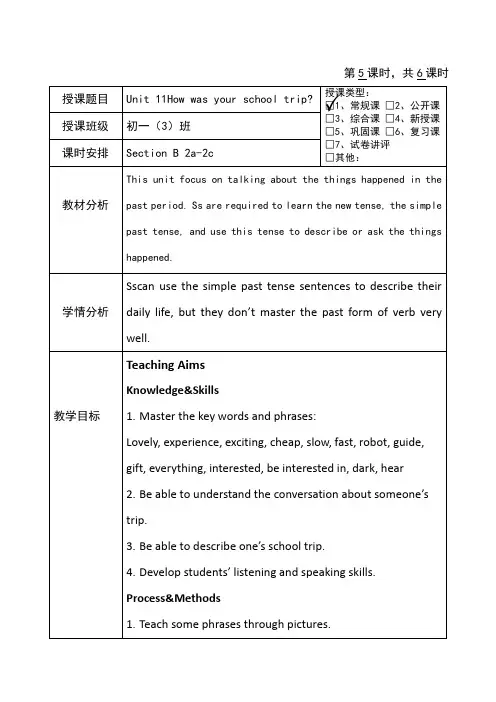
Important points
教学重点和 难点
1. Master the key words. 2. Be able to understand the conversation about someone’s trip. 3. Be able to describe one’s school trip. 4. Develop students’ listening and speaking skills.
Difficult points
1. Develop students’ listening and speaking skills.
教学思路设计
内容与方法选择:Situational Communicative 教学工具的说明和使用:multi-media
Approach, Task-based Approach, Multimedia Display Approach, Team Cooperation Approach
Step 5:Homework 1. Copy the new words. 2. Make up a new dialogue about description after the
model dialogue in1d. 3. Recite 2b and copy the verbs.
阅读两篇日记, 然后回答问题及 完成 2c 的表格, 为了让学生能更 好的落实所学的 形容词,同时达 到巩固写日记的 目的
教材分析 past period. Ss are required to learn the new tense, the simple
past tense, and use this tense to describe or ask the things
初中英语人教版七年级下册Unit11 SectionB 2a-2c教案
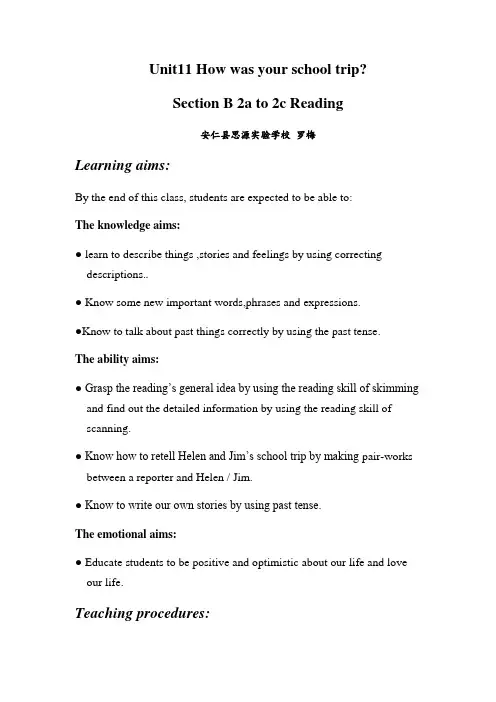
Unit11 How was your school trip?Section B 2a to 2c Reading安仁县思源实验学校罗梅Learning aims:By the end of this class, students are expected to be able to:The knowledge aims:● learn to describe things ,stories and feelings by using correcting descriptions..● Know some new important words,phrases and expressions.●Know to talk about past things correctly by using the past tense.The ability aims:●Grasp the reading’s general idea by using the reading skill of skimming and find out the detailed information by using the reading skill of scanning.●Know how to retell Helen and Jim’s school trip by making pair-works between a reporter and Helen / Jim.● Know to write our own stories by using past tense.The emotional aims:● Educate students to be positive and optimistic about our life and love our life.Teaching procedures:Step Ⅰ Guide-reading1. Greeting and warming up.2. Divide the students into two groups and bring some competitions between them.Tell them if they can answer my questions positively and correctly,then they will get some gifts for their group.3. Talk about two stories about myself.One is a good story about visiting the Rice Field Park in Anren which is very beautiful and popular to all of the people in Anren . The other story is a bad and stupid story to me about taking out the trash. I will use some description words to describe my feelings.For example, I use sunny/windy/lovely/beautiful/interesting/exciting to describe the good story and I use terrible/stupid to describe the bad story.Then Lead in more description words in 2a.4. Review,read and translate the words by using some activities.5. Ask students if the following words describe good things or bad things. Put a√ for good and an ×for bad. Leave a blank if they can mean both.6. Check the answers and read the words.Step Ⅱ Pre-reading1. Learn some new phrases(went on a school trip, science museum ,along the way,play chess,all in all,be interested in ,not at all / not… at all )2. Organize some competitions between Group1 and Group2 to make them remember these phrases.Step Ⅲ While-readingTask 1skimming/Fast-reading (Read the stories quickly and answer the questions in 2b.)1. Did Helen and Jim go on the same trip?2. How do they feel about the trip?Task 2Scanning/Careful-readingplete the chart. How do Helen and Jim describe these things?(Read the stories carefully and answer the questions and find the detailed information.)2. Check the answersStep ⅣAfter reading1. Making pair-works between a reporter and Helen / Jim like this﹕Reporter﹕Hello, I am a reporter. Can I ask you some questions?.Helen/Jim﹕Sure/Of course/Yes,please.Reporter﹕How was your last school trip?Helen/Jim﹕It was …Reporter﹕Where / when did you go?Helen/Jim﹕…Reporter﹕Who did you go with?Helen/Jim﹕…Reporter﹕How did you go there?Helen/Jim﹕…Reporter﹕What did you do?Helen/Jim﹕…Reporter﹕Did you buy any gifts?…Helen/Jim﹕…Reporter﹕Thank you.Helen/Jim﹕You are welcome.2. Ask some students to show their pair-works.3. Conclude and educate students to be positive and optimistic about our life and love our life.StepⅤHomeworkWrite a diary entry for your own trip. Explain if you liked it or didn’t like it and why.。
人教版七年级英语下册Unit11_SectionB(2a-2c)名师教案
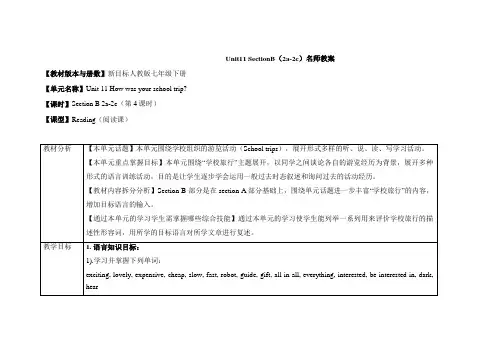
Unit11 SectionB(2a-2c)名师教案【教材版本与册数】新目标人教版七年级下册【单元名称】Unit 11 How was your school trip?【课时】Section B 2a-2c(第4课时)【课型】Reading(阅读课)设计读后活动任务,先模仿再迁移总结,读后设置任务提升学生语言运用能力教学流程(详见教学活动设计)教学评价 1.本课时的目标设计清晰可操作,活动的设计紧扣目标要求并与目标达成一致。
2.读中的活动设计遵循语言规律,由易到难逐层递进,充分体现语言输入到语言输出的完整过程。
3.读后的活动设计体现对文本内容的深度挖掘和文本再构,体现了对学生思维品格的训练与培养。
附:教学活动设计【本课时教学设计】步骤过程措施(教师活动与学生活动)目的持续性评价1预备与激活先期知识Step 1Warming-uprevision &Pre1. Greet the Ss as usual. Check the homework.2. T: Boys and girls, do you like a school trip?S:Yes!T: Let’s talk about something about Tony ’s trip. He went on aschool trip last weekend.1. 通过复习描述性形容词,检查学生掌握情况。
2. 通过学生两人对话,检查学生学习掌握情况。
T: What did Tony do last weekend?S1: He climbed a mountain .学生是否能用已经学过的词汇回答问题。
reading T: What did Tony do last weekend?S1: He went to an art museum .T:What did he think of it?S1: He thought it was great .T: What else did Tony do last weekend?S1 : He saw some paintings, drew pictures3.T: In fact I think you can think up more adjectives to describegood or bad things. Now let’s come to 2a, and here are alsosome adjectives.S:Look at these adjectives, read them and put a√ before it if youthink it is good. Put an × before it if you think it is bad. Leave ablank if they can mean both.T: Check the answers. T:What did he think of it? S1: He thought it was great .2获取新知Step 2Whilereading1. Task 1 Fast reading (Scanning)S: Students scan what kind of article it is.Scan the dates of the diary entriesScan the first two sentences and the last sentences. Predict themeaning of the diary entries.Task 2 Careful readingS: Answer the questions1、Did Helen and Jim go on the same trip?2、How did they feel about the school trip ?Keys: 1.Yes.2.Helen thought the trip was great, but Jim didn’t like the trip at1.第一遍要求学生快读通读全文确立文章类型并了解语篇大意。
人教版七年级下册英语Unit11 SectionB (2a-2c)优质教学设计(含教学反思)

Unit 11How was your school trip?第四课时Section B (2a-2c)Target Navigation【目标导航】Key words and phrases:exciting,lovely,expensive,cheap,slow,fast,robot,guide,gift,everything,interested,dark,hear,all in all,be interested in…Key sentences:(1)We visited the science museum and it was really interesting.(2)After that,I went to the gift shop and bought some lovely gifts for my parents.Skills:学会对自己的旅行进行描述。
Emotion:交流旅行心得,了解他人。
The guidance of learning methods【学法指导】让学生围绕着课堂任务在小组中分工合作,在活动中相互探讨、相互交流、相互合作。
Learning important and difficult points【学习重难点】根据文章找寻关键信息,提高阅读能力。
Teaching Steps【教学过程】Autonomous Learning Scheme【自主学习方案】预习指导与检测(一)预习指导1.根据图片和文章标题等,预测新课内容。
2.根据音标拼读单词并牢记。
3.自学短文,勾画出重点和疑难点。
(二)预习检测翻译下列单词及词组。
1.exciting________ 2.可爱的________3.慢的(快的)________ 4.昂贵的(便宜的)________5.下棋________ 6.坐火车________7.model robot________ 8.对……感兴趣________9.总的说来________ 10.not…at all________Keys:1.激动人心的,2.lovely,3.slow(fast),4.expensive (cheap),5.play chess,6.by train,7.模型机器人,8.be interested in,9.all in all,10.根本不,一点也不Classroom Learning Guidance Scheme 【课堂导学案】【探究一】Brainstorming:T:We often use adjectives to describe things.Some describe good things and some describe bad things.Can you think of some adjectives?Finish 2a.Put a “√” for good and an “×” for bad.【探究二】1.Read the diary entries about the school trip and answer the two questions.2.Read again and complete the chart in 2c.3.Group work:read the diary entries again,try to find the key points.Then say them out one by one.eg:(1)by train =take the train(2)after that(3)…【探究三】Read the key points and the article together.【探究四】Group work:分析总结阅读技巧,并尝试根据2c中的表格复述文章。
Unit11Section2a-2c 教学设计 人教版英语七年级下册
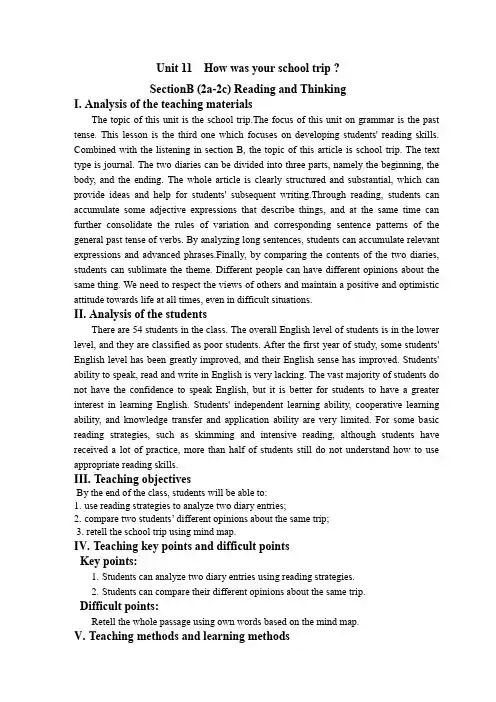
Unit 11 How was your school trip ?SectionB (2a-2c) Reading and ThinkingI.Analysis of the teaching materialsThe topic of this unit is the school trip.The focus of this unit on grammar is the past tense. This lesson is the third one which focuses on developing students' reading skills. Combined with the listening in section B, the topic of this article is school trip. The text type is journal. The two diaries can be divided into three parts, namely the beginning, the body, and the ending. The whole article is clearly structured and substantial, which can provide ideas and help for students' subsequent writing.Through reading, students can accumulate some adjective expressions that describe things, and at the same time can further consolidate the rules of variation and corresponding sentence patterns of the general past tense of verbs. By analyzing long sentences, students can accumulate relevant expressions and advanced phrases.Finally, by comparing the contents of the two diaries, students can sublimate the theme. Different people can have different opinions about the same thing. We need to respect the views of others and maintain a positive and optimistic attitude towards life at all times, even in difficult situations.II.Analysis of the studentsThere are 54 students in the class. The overall English level of students is in the lower level, and they are classified as poor students. After the first year of study, some students' English level has been greatly improved, and their English sense has improved. Students' ability to speak, read and write in English is very lacking. The vast majority of students do not have the confidence to speak English, but it is better for students to have a greater interest in learning English. Students' independent learning ability, cooperative learning ability, and knowledge transfer and application ability are very limited. For some basic reading strategies, such as skimming and intensive reading, although students have received a lot of practice, more than half of students still do not understand how to use appropriate reading skills.III.Teaching objectivesBy the end of the class, students will be able to:e reading strategies to analyze two diary entries;pare two students’ different opinions about the same trip;3. retell the school trip using mind map.IV.Teaching key points and difficult pointsKey points:1.Students can analyze two diary entries using reading strategies.2.Students can compare their different opinions about the same trip.Difficult points:Retell the whole passage using own words based on the mind map.V.Teaching methods and learning methodsTeaching methods: TBLT; PWP; CLTLearning methods: Group cooperation;Self-learning;Communicative methods VI.Teaching aids:blackboard; powerpoint。
人教版英语七年级下册Unit11Section2a2c教学设计
此外,学生在小组合作和互动交流方面已具备一定的基础,但部分学生可能在学习过程中表现出害羞、紧张等情绪,影响课堂参与度。因此,教师需要关注这部分学生的情感需求,创造更多的机会让他们参与到课堂活动中,提高自信心。
(四)课堂练习
1.教学内容:设计一系列练习题,巩固学生对运动类词汇和一般现在时态的掌握。
2.教学方法:采用个人练习和小组竞赛的形式,激发学生的学习积极性,提高课堂参与度。
3.教学实施:教师发放练习题,让学生个人完成,然后组织小组竞赛,评选出最佳表现小组。
(五)总结归纳
1.教学内容:对本节课学习的运动类词汇和一般现在时态进行总结归纳。
2.教学方法:教师引导学生回顾本节课所学内容,让学生自主总结,提高归纳能力。
3.教学实施:教师邀请学生分享自己的学习心得,对运动类词汇和一般现在时态的用法进行总结,教师给予补充和点评。
五、作业布置
为了巩固本章节所学内容,确保学生对运动类词汇和一般现在时态的掌握,特布置以下作业:
1.写作练习:请学生运用本节课所学的运动类词汇和一般现在时态,写一段话描述自己最喜欢的运动项目以及参与该运动的频率。要求至少使用5个新学的运动词汇和3个一般现在时的句子。
人教版英语七年级下册Unit11Section2a2c教学设计
一、教学目标
(一)知识与技能
1.掌握本章节的核心词汇和短语,如:baseball, basketball, soccer, tennis, ping-pong, play, team, often, game, competition等,并能熟练运用这些词汇进行日常交流。
Unit 11 Section B 第2课时示范公开课教案【英语人教新目标七下】
Unit 11 How was your school trip?Section B (2a—2c)教学设计一、教学目标1. 熟练掌握本课重点词汇和短语:exciting, lovely, expensive, cheap, slow, fast, robot, guide, gift, everything, interested, dark, hear, all in all, be interested in2. 熟练掌握本课重点句型:(1) Then the guide taught us how to make a model robot.(2) After that, I went to the gift shop and bought some lovely gifts for my parents.(3) All in all, it was an exciting day.(4) Everything was about robots and I’m not interested in that.(5) There were also too many people and I couldn’t really see or hear the guide.3. 能够读懂关于描述学校旅行经历的语篇内容。
4. 能够在阅读学校旅行日记的活动中掌握获取文章大意和关键信息的能力。
5. 通过阅读两篇日记,掌握与旅行有关的描述性的形容词,能够分辨这些词在不同表达中蕴含的褒义和贬义。
同时通过对比,了解不同的人对待同一旅行经历具有不同的态度。
二、教学重点及难点重点:1. 能够读懂关于描述学校旅行经历的语篇内容。
2. 能够在阅读学校旅行日记的活动中掌握获取文章大意和关键信息的能力。
难点:能够在阅读学校旅行日记的活动中掌握获取文章大意和关键信息的能力。
三、教学过程四、板书设计Unit 11 How was your school trip?第4课时Section B (2a—2c)Key words and phrases: exciting, lovely, expensive, cheap, slow, fast, robot, guide, gift, everything, interested, dark, hear, all in all, be interested inKey sentences:(1) Then the guide taught us how to make a model robot.(2) After that, I went to the gift shop and bought some lovely gifts for my parents.(3) All in all, it was an exciting day.(4) Everything was about robots and I’m not interested in that.(5) There were also too many people and I couldn’t really see or hear the guide.。
七年级下册 英语第 十一单元 unit11 SectionB 2a-2c教学设计
3.Listen and repeat.
4.讲解文中的language points。
设计意图:听读活动,可纠正语音语调,同时感受重点知识的运用。ቤተ መጻሕፍቲ ባይዱ过讲解,再次强化重点知识。
5.通过题组练习和巩固本节课知识。
6.Written work.围绕本单元主题“school trip”进行写作小训练。
设计意图:通过体提问,让学生发散思维,既能体会学校旅行的意义,又能体会不同人看待同一事物有不同的观点,而兴趣是最好的老师。如果将英语学习比作一段旅行,我希望同学们都能有一个乐观积极的态度,让这列快车载满知识和快乐,通往成功。
Step5. Homework
1. Watch the whole video of Peppa and find: How was her school trip?
并进一步展开猜想,写下答案:How was her school trip?
设计意图:从学生感兴趣的动画入手,提高学生的积极性,让学生有话可说。同时,引出school trip的话题,并通过猜想写形容词,为2a做准备。
Step2. Pre-reading
1.通过汇总和补充同学们的答案,得到2a的词汇,并领读。
text book; power point; a video clip; listening recording
Teaching Procedure
Step 1. Lead in.
同学们通过观看小视频,回答两个问题:
1.What did Peppa do last weekend?
2.Where did they go?
Unit 11 Section B(2a----2c)教学设计
教学设计教学内容:新目标七年级英语下Unit 11 Section B(2a----2c) 课标要求与分析:课标要求提高学生的综合语言运用能力,因此从听,说,读,写几方面入手,听和说是理解的技能,读和写是表达的技能,因此我从听,说,读三个方面入手,将写留为作业。
7年级应该达到3级目标,因此我本课也是按照3级标准来进行的教材分析:本部分是阅读课,阅读课重在提高学生的阅读能力,能够根据文章进行写作教材处理:既然是阅读课,那么重在读,本课我采取了三次阅读的方式,一次的难度比一次大,目的在于由浅入深,层层深入的方式让学生既增加对文章的理解,同时也提高了学生的综合语言运用能力,为写作打下基础。
学情分析:七年级的学生已经偏大,不是很活跃,本课又是阅读课,要想让他们张开嘴说必须有适当的方法,因此在三读课文之后采取小组合作的学习方式,目的是让大家全员参与,也应了课标的要求,面向全体学生。
教法:采用师生互动及生生互动,小组合作方法学法:合理利用图片,多媒体及录音有效的辅助工具,共同促进学习效率的提高,根据课标中的教学建议(四)合理利用各种教学资源,提高学生的学习效率。
“三读文章”促进学习效率的提高教学重点:动词的过去式及形容词的使用教学难点:文章的写作形式和特点,会仿写情感态度及价值观:通过Helen’s school trip 和Jim’s school trip的学习,教育学生有好的心态来面对生活,外出郊游要注意安全。
学习目标:1.学会使用动词的过去式和形容词的使用方法,用来描述事物2.理解文章大意,能根据文章完成任务并复述3.能根据所学内容写作教学方法:互动法小组合作教学准备:多媒体设备教学流程:Step 1 GreetingsStep 2 Lead—in.T:Listen to me carefully, please take out of which words are adjective words. OK?S: Sure.T: Last weekend, I took the train to the school trip. I think it was interesting and exciting. The weather was very hot. I ate some ice—cream. It was delicious. And I bought a gift for my friends. It was not expensive. And it was very beautiful and cute.Afterthat, I visited visitors’ center. It was kind of boring. But it was very large and great.Then I went to the zoo and saw some pandas. They were very lovely. I took some photos to them. All in all, it was an exciting day. I was very happy.(这些重黑体形容词教师边说,学生边回答,教师并将几个关联词如after that, then, all in all 等板书上,为学习新课文做准备)S: Answer the questions.Step 3 learn new lessons.T: Today we will learn Helen’s and Jim’s school trip. Open your books and turn to page 65. Look at part 2b, read the text by yourselves. Circle the words you don’t know and underline the verb’s past tense and adjective words. After a while, I will call some students to read it. Listen to the tape and correct your pronunciation. ( 听一遍录音,纠正学生的错误发音)S: OK.T: A few minutes later, find some students answer some questions.(读课文,让学生挑出动词的过去式和形容词,并圈出你不认识的单词,为理解文章打基础)如果没人提问题,教师问学生,along, model, not… at all的用法T: After reading, please answer the questions, 大屏幕展示问题,学生回答yes/no.(这样做的目的是先让学生初读课文,解决生词和大概意思,因此我设置了几个较为简单的yes/no问题,目的就是先让学生了解文章大意)S: Answer the questions.T: Look at the screen, please everyone read it again and answer the questions (带着问题再次读课文,回答课前的两个问题,这样做的目的是让学生对课文再次了解) A few minutes later, check the answers.T: Look at the screen again, work in pairs and please everyone read it aloud and answer the questions. (带着问题大声读文章,回答大屏幕上的题,这次的题目较上次的难,目的是层层深入,让学生由浅变难,深层次的理解文章大意,因此采取小组合作的形式,由组长负责教组员进行这个过程)T: Close your books. Finish the Part , complete the chart and answer some questions. eg: How was Helen’s trip? How was Jim’s trip? How did they get there? How did they feel about the train? How did they feel about the museum? How did they feel about the gift shop and gifts?(读完了三遍文章,学生对此语段有了更深的理解,因此这个时候合上书,独自完成表格的问题,这样起到了检测的效果)Step 4 巩固练习T: Please take out of the paper, fill in the blanks. 找两名学生上黑板写,几分钟后,找学生批改。
人教版英语七年级下册Unit11SectionB2a2c教学设计
1.关注学生的一般过去时运用能力,引导他们通过具体实例,逐步掌握该时态的用法。
2.针对学生词汇量不足的问题,教师应提前准备相关词汇卡片,帮助学生拓展词汇。
2.各小组展示自己的对话,其他小组进行评价,教师给予反馈和指导。
(四)课堂练习
1.教师设计一系列练习题,包括填空、选择、改写句子等,让学生巩固一般过去时的用法。
2.学生进行听力练习,听懂并准确回答关于过去活动的相关问题。
3.教师邀请学生上台进行角色扮演,模拟真实场景,运用一般过去时进行交流。
(五)总结归纳
3.听力练习:完成课后听力练习,包括一般过去பைடு நூலகம்的对话和短文。学生需在听懂的基础上,完成相关练习题,提高听力理解能力。
4.词汇拓展:学生查阅课外资料,搜集与过去活动相关的词汇,并进行分类整理。要求每个类别至少包含5个词汇,以拓展学生的词汇量。
5.课堂笔记整理:学生整理本节课的课堂笔记,包括一般过去时的用法、重点词汇和句型等。要求条理清晰,便于复习和巩固。
1.学生能够听懂并准确说出关于过去活动的词汇和句型。
2.学生能够使用一般过去时来描述过去发生的事情。
3.学生能够通过听力练习,提高英语听力技巧,获取关键信息。
(二)过程与方法
在本章节的教学过程中,教师采用任务型教学法,以学生为主体,引导他们积极参与课堂活动。通过小组讨论、角色扮演、听力训练等多种教学方法,激发学生的学习兴趣,培养他们的合作意识和自主学习能力。
3.合作学习:鼓励学生进行小组合作,共同完成课堂任务。通过讨论、交流,学生可以互相借鉴、学习,提高口语表达能力。