
初中英语人教版七年级下册《Unit 4 Don’t eat in class 》课件PPT
on time
hallway 上课迟到
戴帽子 在课堂上
在外面 听音乐
arrive late for class
食堂
Revisio Sentences n
Don’t fight.
School Rules
Don’t listen to music in class.
Don’t eat in the classroom.
music players to
school. Make sentences:We must...
We can't...
Task Listen and repeat. 4
John: Hi, my name’s John. It’s my first day at school. Alice: Hi, John. I’m Alice. This is a great school, but there are a lot of rules. John: Really? What are some of the rules? Alice: Well, don’t be late for the class. This is very important. John: OK, so we must be on time. Can we bring music players to school? Alice: No, we can’t. And we always have to wear the school uniform. John: I see. Alice: Oh, and we also have to be quiet in the library.
Don’t run in the hallways. Don’t arrive/be late for class.
Revisio Choose and
n
make up new sentences.
No,we can't.We can't...
Can we…?
➢ We must... ➢ But we can...
_______________ rules. John: Really?W_h__a_t_a__re__ some of the rules?
Alice: Welld, o__n_’__t__b_e__l_a_t_e_fcolrass. This is very important.
John: OK, so wme u__s_t_b__e__o_n__t_i_m_.e_C__a_n__ we bring music players to
Task Read again and complete the chart.
3
What are some of the rules?
Dos
Don’ts
Wear the
Don’t be
school
late for
Buneiqfourimet. in the
Dsocnh’oot lb. ring
library.
3. Are there many rules at school?
Y__e_s_,_t_h__e_r_e__a_r_e.
4. Can he bring music players to school?
_N__o_,__h_e________
5. Dcaont’het.y have to always wear the school uniform? _Y_e_s_,__t_h_e_y__d__o_._
Task Listen and fill in the blanks.
1 John: Hi, my name’s John. It’fsirsmt yda_y_______ at school.
Alice: Hi, John. I’m Alice. This is a great schoothl,ebreuatre a lot of
PART 02
新知导入
Lead-in
When you go to a new school, you must know about the school rules.
Joh It’ns his first day at
school.
Alic Hee wears the
school uniform(校 服).
Unit4 Don’t eat in class.
Section A(2d-3c) 语法:【祈使句】
人教版初中英语七年级下册课件
复习巩固
目
新知导入
录
教学重点
拓展练习
PART 01
复习巩固
Revisio Words and phrase
n
走廊,过道
outside
打架
在教室里Βιβλιοθήκη dining hallCan we bring music players to school?
bring 意为“带来”。 ➢ bring: 从别处拿/带某物到说话者所在的地方 ➢ take: 从说话者所在的地方拿/ 带某物到别处 “bring”和“take”两个词都与某物的运动有关,但“bring” 意味着随身携带来某物,而“take”则意味着带走某物。
Task Read and answer the following
2
questions.
1. How many rules does Alice mention?
_F_o__u_r__r_u_l_e_s_.__
2. Is John new at school?
Y_e__s_,_h__e__is_._
school? Alice: No, wec_a_n__’__t_. And we alwahyasve__t_o___ wear the school
uniform.
John: I see.
have to
Alice: Oh, and we also ________ be quiet in the library.
Unit4 Don't eat in class. Section B 课件人教版英语七年级下册

play the piano. I never have fun. What __ca_n___ I do? Zhao Pei 弹钢琴
aslekarfnotor do... 学he习lp做∙∙∙∙∙∙
3b Complete the chart with the rules in your home and school. Put an× for the rules that you think are unfair.
(5)洗餐具 ___d_o__t_h_e__d_i_s_h_e_s (6)整理床铺 m_a_k_e__t_h_e__b_e_d____ (7)保持安静 k_e_e_p__q_u_i_e_t______ (8)对某人要求严格__b_e__s_t_r_i_c_t__w_i_t_h sb. (9)看朋友 __s_e_e__f_r_i_e_n_d_s___ (10)做作业 _d_o__h_o_m_e_w_o_r_k____
must, can or can’t.
topic
Dear Dr. Know,
sentence
__C_a_n__ you help me? I’m not happy because there are too
many rules at home. Every morning, I _h_a_v_e_to_/_m__u_st_get up at six
Things I have to do
Things I can’t do
( ) Do my homework after school ( ×) Practice the piano ( ) Wear a uniform at school
Stay up late Be noisy in the library Arrive late for class
人教版七年级英语下册 Unit4 Don't eat in class SectionB 教案

Unit 4 Don’t eat in class.SectionB (1a-2c)知识目标:熟练掌握重点词汇以及重点句型:dirty, kitchen, more, noisy,make one’s bed, be strict with sb. follow the rulesThere are too many rules …I can…; I can’t…;I must…; I have to …; I…技能目标:1.能根据文章特点和活动要求使用寻读策略。
2. 能和朋友谈论校规和家规。
情感目标:能读懂一些英语的规则制度,能用英语表达和制定一些简单的规则,理解没有规矩不成方圆;无论是在学校时还是在家庭中以及以后走上社会都应当遵守规则,按规则办事。
1. 教学重点:1) 学习本课时出现的新词汇及表达方式。
2) 通过进行听力训练,让学生们能听懂本节课时所出现的新的表达方式。
3) 通过进行阅读练习来进一步学习运用本课时的新语言知识。
2. 教学难点1)阅读训练。
2)理解must, have to/ can/can't的用法三、学习过程Ⅰ. Warming- up and revision1. Greet the Ss.2. Check the homework. Let some Ss read their home rules.3.通过图片提问Do you know these signs in a city?What do they mean?4.再通过运用思维导图进行引导How many rules do you know?Ⅱ. Presentation1. Show some pictures on the big screen and let Ss learn the new words and expressions.2. 学生看着1a部分的图片___ go out___ see friends___ do his homework___ practice the guitar___ do the dishes___ watch TV___ help his mom make breakfast___ clean his room进行FREE TALKWhat can you do at home ?What can’t you do ?Can you go out on school nights?Ss: No, we can’t.T: Yes, in China, the students can’t go out on school nights.So please don’t go out on school nights.Ⅲ. Listening1. Tell Ss they'll listen to the recording about Dave's house rules. Listen and put an× for things Dave can't do and a √for things he has to do.2. Play the recording for the Ss to listen and check.3. Play the recording again for the Ss to check the answers.Ⅳ. Listening1. Now let's work on 1c. Now first, let's read the phrases aloud together.help his mom makebreakfastclean his roomWhat are the rules at your home?Can you go out on school nights?Do you have to do your homework first?Lead-inWhen you are unhappy about something, who do you like to talk to ?Task 1.Skimming (速读--默读)1. What’s Molly’s problem?2. Does she have rules in school?3. What does Molly think of the rules?Read 2b quickly and find the main idea. The main idea of the two letters is that___. A: there are many rules for MollyB: Dr. Know wants to help MollyC: Molly asks Dr. Know for some help and Dr. Know gives her some help.Task2. ScanningRead the letters again and complete the timeline (再读信,并且完成时间轴. )Task3.Detailed readingA).Read the first paragraph and fill in the blanks.B)Read the second paragraph and fill the rule made by her dad.C) Dr. Know's advice: We have to _____________.观察与思考求助信的写作格式:1)2)3)2c Read the letters again. Complete the sentences with have to/must, can or can’t.1. Molly _____ play basketball on school days, but she ____ play it on weekends.2. Molly _____ do her homework first when she gets home.3. Molly _____ read a book after dinner before she _____ watch TV.4. At school, Molly ____ be noisy or eat in class.5. Parents and schools make rules to help students. So students ______ follow the rules.Group worke.g.:At school/home/the library, we have to(must) ...We can't...(巩固)Language points1. _________ the guitar 练习吉他practice v.意为“练习”后面可跟名词、代词或动名词。
人教版英语七年级下册Unit 4 Dont eat in class 教案学案

Unit4. Don't eat in class 教案学案Section A 1a—2d(听说课)【学习目标】一、知识目标:1. 掌握本课单词: rule, arrive, hallway, hall, listen, fight, sorry, outside, wear, important, bring, uniform, quiet.2. 重点短语:dining hall, arrive late for school, (be) on time, listen to music, go out, follow/breakthe rules, in class, be/ keep quiet, a lot of, bring …to…,wear a hat, have to, musicplayers3. 重点句型:能正确使用否定祈使句陈述规章要求,对别人的劝告,警告作出礼貌回应——Don't run in the hallways. / Don't fight.——Sorry, Ms Clark;正确使用情态动词can, can't——Can we wear a hat in school?——Yes, we can./No, we can't.能正确使用have to 和must 谈论规章制度We must be on time/ We also have to be quiet in the library.;正确使用情态动词和祈使句谈论规章制度。
“can, can't”二. 能力目标:听清三. 情感目标:了解校规,规范在校行为。
【重点、难点】重点单词,短语。
1.2. 重点句型及听力口语训练。
【自主探究】一.请默写下列单词。
P1231.规则 ________2.到达 ________3.走廊________4.大厅________5.餐厅 ________6.倾听________7.打架 ________8.抱歉的 ________二.请默写下列短语。
七年级英语下册 Unit 4 Don’t eat in class短语、句型、作文汇总 (新版)人教新目标版
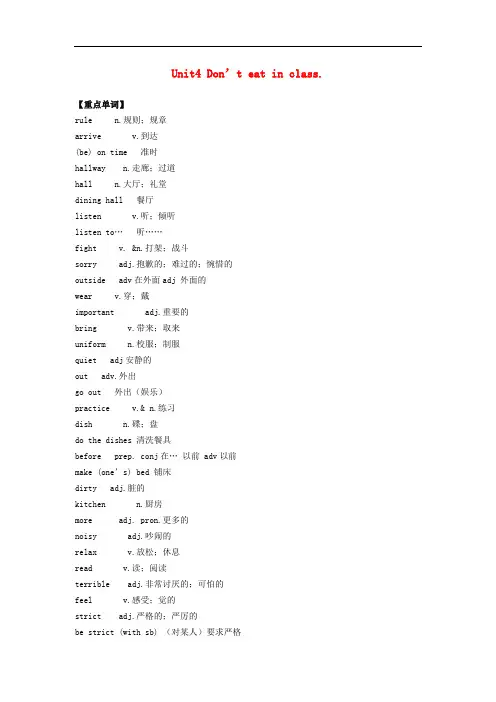
Unit4 Don’t eat in class.【重点单词】rule n.规则;规章arrive v.到达(be) on time 准时hallway n.走廊;过道hall n.大厅;礼堂dining hall 餐厅listen v.听;倾听listen to…听……fight v. &n.打架;战斗sorry adj.抱歉的;难过的;惋惜的outside adv在外面adj 外面的wear v.穿;戴important adj.重要的bring v.带来;取来uniform n.校服;制服quiet adj安静的out adv.外出go out 外出(娱乐)practice v.& n.练习dish n.碟;盘do the dishes 清洗餐具before prep. conj在…以前 adv以前make (one’s) bed 铺床dirty adj.脏的kitchen n.厨房more adj. pron.更多的noisy adj.吵闹的relax v.放松;休息read v.读;阅读terrible adj.非常讨厌的;可怕的feel v.感受;觉的strict adj.严格的;严厉的be strict (with sb) (对某人)要求严格remember v.记住;记起follow v.遵循;跟随follow the rules 遵守规则luck n.幸运;运气keep v.保持;保留hair n.头发;毛发learn v. 学习;学会【重点短语】1. Don’t eat in class 在课堂上2. arrive late for class 上课迟到3. be on time 准时4.in the hallways 在走廊里5.in the dining hall 在餐厅6. listen to music 听音乐7 fight with…与某人打架8.Don’t eat in class. 不要在课堂上吃东西。
新版(人教版)七年级(下)英语Unit4课文详解
Unit 4 Don’t eat in class.Section A 2a—2d ( P20 )* 教师寄语:No rules, no standards. 没有规矩,不成方圆。
【学习目标】【学习重点】:1、学习掌握本节课的生词和短语;2、巩固祈使句的用法;3、学习情态动词can表示许可的肯定句、否定句、一般疑问句及肯定、否定回答。
4、提高学生的听说能力。
【体验学习】:I、预习交流1. 根据音标拼读单词并牢记;2. 自学课文,勾画出重点和疑惑。
II、翻译官1. eat outside ________________2. wear a hat ___________________3. a lot of ___________________4. be late for class_______________5. 不得不__________________6. 穿校服_____________________7. 保持安静________________【课堂导学】:I、新课呈现Step1 RevisionReview the school rules at P19.Step2 PresentationPresent key sentences in this period.This is a great school, but there are a lot of rules.Can we bring music players to school?And we always have to wear the school uniform.And we also have to be quiet in the library.Step3 ListeningListen and finish 2a and 2b. Check the answers.Step4 Pair workTalk about the rules in 2a.Step5 Role-playRole-play the conversation in 2d.II、合作交流Group work: 分析总结情态动词can的用法,并练习造句。
初中英语人教版七年级下册Unit 4 Don’t eat in class知识点整理
七年级英语下册Unit4知识点【Useful expressions】1.No talking 不许讲话 (No+动词ing,禁止......)2.the school rules 校规3.eat in class 上课吃东西4.run in the hallways 在过道上追逐打闹5.in the dining hall 在食堂6.fight with sb.=have a fight with sb.和某人打架7.go out on school nights 在上学期间的晚上外出8.on school days 在上学的日子9.arrive late for class= be late for class 上课迟到了10.wear a/the uniform 穿制服11.have to 不得不;必须12.eat outside 外面吃东西13.practice doing sth.练习做某事14.help mom make breakfast 帮助妈妈做早饭17.too many 太多(+可数复数)18.too much 太多(+不可数)19.so many 如此,这么多的(+可数名词复数)20.so much 如此,这么多的(+不可数名词)21.library rules 图书馆规则22.be strict with sb.in sth.在某方面对某人严格23.be quiet 安静24.be noisy 吵闹25.make the teacher unhappy 惹老师不高兴26.make a noise/make noises 制造噪音27.do the dishes 洗碗28.stay at home呆在家里29.on time 准时30.in time 及时31.learn to do sth.学习做某事32.learn from sb.向某人学习33.follow / keep /obey the rules 遵守规定34.break the rules 破坏规则35.make rules 制定规则36.keep one’s hair short 留短发37.think about 考虑38.make one’s bed 铺床39.in your home 在你家40.at home 在家41.Good luck to you! 祝你好运42.remember doing sth.记得做过某事43.remember to do sth 记得去做某事44.listen to sb.听某人说【Target sentences】1.--What are the rules?--Well, you must be on time for class.Don't fight with your classmates.2.We can’t listen to music in the classroom or hallways.3.--Can we bring music players to school?--Yes, we can./No, we can’t.4.And we always have to wear the school uniform.5.--Does he have to wear a uniform at school?--Yes, he does./No, he doesn't.6.--What do you have to do?--We have to be quiet in the library.7.Don't leave the dirty dishes in the kitchen.8.My dad says I can’t play basketball after school because I must do my homework.9.After dinner, I can’t relax,either.I must read a book before I can watch TV.10.I know how you feel.11.There are a lot of things you can do.12.Parents and schools are sometimes strict but remember, they make rules to help us.13.I think it’s best to follow the rules.14.I can’t go out on school nights.15.I have to do my homework after school.16.I must practice the guitar before dinner.【Language points】1.Don’t arrive late for class.(1)arrive v.到达;是不及物动词,若接地点名词,要加介词in或at。
人教版英语七年级下册-Unit-4-Don't-eat-in-class-语法解析
2021/2/4
1
6
疑问句: must 提前,回答时注意一二人称的互换。肯定用 must, 否定用needn’t. e.g. --Must I go home now?
-- Yes, you must. -- No, you needn’t.
B: And I must clean my room every Saturday. =?
A: Wow, you do have a lot of rules!
2021Dr. Know, There are too many rules! At 6:00 a.m. my mom says, “Get up now and make your bed!”
too many rules “太多的规定”, 其中too many 用来 修饰可数名词复数rules。 e.g. He has too many friends to meet.
修饰不可数名词时, 要用too much e.g. We have too much work to do.
much too 太……much 用来增强语气。后接形容 词或副词。
What can I do. Dr. Know? Molly Brown, New York
表“看”的单词?
either 也。用于否定句和疑问句中。肯定句中用too 表也。
watch,see,look r,read
2021/2/4
1
13
Dear Molly, I know how you feel. People always tell us, “ Don’t do this!” or “You can’t do that!” But think about it, Molly. There are a lot of things you can do. You can play basketball on weekends. You can watch TV after you read a book. Parents and schools are sometimes strict,
人教版英语七年级下册Unit4 Don't eat in class全单元教案
T||ask 2Show Ss some pictures,||then let Ss talk about them with “W||e can‟t…../Don‟t……/We can……?” S1: W||e can‟t arrive late for class. /Don‟t ar||rive late for class. S2: We ca||n‟t run in the hallways. /Don‟t run in||the hallways.
3、语言结构:
①情态动词must与have to的用法②情态动词ca||n表示许可的用法
教学难点:1、用英语制定有关规定
2、情态动词must与have t||o的用法
教学用具:多媒体
教学方法:Li||stening and speaking \writing methods.||Pair work
教学过程:
教学用具:多媒体
教学方法:Listening and spea||king \writing methods. Pa||ir work
教学过程:
Step1.Show the studying aims
Step2. Free Talk.
Have a free talk wi||th the students. Talk||about “Can we eat in class?”
Task 1通过师生问答的方式复习祈使句||,引出情态动词,呈现本课的教学难点。T: L||et‟s say the school rul||es using can ,can‟t, mus||t, have to . S1: We can‟t||arrive late for class. /Don‟t arri||ve late for class. S2: We can‟t r||un in the hallways. /Don‟||t run in the hallways.Task 2||操练句型直至学生熟练的掌握Step5.Consolad||ation.
人教版七年级英语下册Unit4 要点详解3
Don’t eat in class. 要点详解1. Don’t run in the hallways. 不要在走廊内乱跑。
此句是祈使句的否定式,表示命令别人不要做某事。
祈使句表示请求、命令、建议、劝告或征求对方意见等,其否定形式是在前面加上don’t构成,肯定形式是以动词原形开头。
在句首或句尾加上please,使语气变得委婉,如果在句尾加please,要用逗号隔开。
e.g. Sit down, please. 请坐。
Please don’t sit down. 请别坐下。
Don’t swim in the river. 别在河里游泳。
2. Which rules are these students breaking? 这些学生在违反哪些规章制度?此句中break为动词,意思为“违背,违反,不依从,不服从,不遵守”,后常接法律、规则、诺言等做宾语。
e.g. He always breaks the rules of school. 他总是违反校规。
He broke his words. 他失言了。
Don’t break the law! 别犯法!3. What else do you have to do? 你还有别的不得不做的事吗?else做副词,表示“另外,其他”,放在something,someone,somebody等复合代词或者what,who, where,when等疑问代词或副词之后,e.g. Would you like anything else? 你还要点别的东西吗?Where else do you want to go? 你还想去别的什么地方吗?4. John, you have to wear sports shoes for gym class. 约翰,体育课你得穿运动鞋。
have to do “不得不做某事”侧重于客观上的“必须,不得不”解,和其他情态动词的区别在于它具有人称的变化。
初中英语七年级下册Unit4don'teatinclass.sectionA(1a-2d)说课稿
初中英语七年级下册Unit4 don’t eat in class.sectionA(1a-2d)说课稿一. 教材分析《初中英语七年级下册Unit4 Don’t Eat in Class》是新人教版初中英语教科书的一部分。
本单元主要围绕学校规则展开,让学生学会用英语表达各种规则,并能够就规则进行简单的讨论。
通过本单元的学习,学生能够掌握一般现在时的用法,以及情态动词“must”和“have to”的用法。
此外,本单元还引入了一些新的词汇和短语,如“library, silence, break time”等。
二. 学情分析七年级的学生已经掌握了基本的英语语法和词汇,具备一定的英语听说读写能力。
但是,学生在语言表达方面还存在一定的问题,如词汇量不足,语法运用不熟练等。
此外,学生的学习兴趣和学习动机也是影响教学效果的重要因素。
因此,在教学过程中,教师需要关注学生的个体差异,充分调动学生的学习积极性。
三. 说教学目标根据新课程标准和新教材的要求,本节课的教学目标如下:1.知识目标:学生能够掌握本节课的重点词汇和短语,如“library,silenc e, break time”等;学生能够理解并运用一般现在时和情态动词“must”、“have to”表达规则。
2.能力目标:学生能够用英语进行简单的交流,如询问和描述学校的规则;学生能够阅读并理解简单的英语文章。
3.情感目标:通过本节课的学习,学生能够培养良好的学习习惯和遵守规则的意识。
四. 说教学重难点本节课的重难点如下:1.重点:学生能够掌握本节课的重点词汇和短语,如“library, silence,break time”等;学生能够理解并运用一般现在时和情态动词“must”、“have to”表达规则。
2.难点:学生能够正确运用情态动词“must”和“have to”表达规则,并能够区分它们的用法。
五. 说教学方法与手段为了提高教学效果,本节课将采用以下教学方法和手段:1.任务型教学法:通过设计各种任务,让学生在实践中学习和运用英语。