
人教新目标(Go for it)版初中英语八年级上册review of Units 9-10 复习课
Task 4 当下检测
1. I’mg_l_a_d _to__he_a_r_ the good news.听到这个好消息,我很高兴。
2. 你愿意带任何东西来参加派对吗? Would you like met_o_b_r_i_n_ganything __to___ the party?
3. Please reply to my e-mail _b_y____Friday.(截止于周五)
aJ_va_ak_i_ela_cb_a_lne.'Ht icsofmame tiloytihsetapkairntgy.aB9e.c_tar_ui_ps_e_hteoiWs nuohta8n. to visit his aunt and uncle. However, he is glad to help to10._p_r_e_p_a_r_e something.
Please reply in writing to it by Friday the 21st. Hope you can
make it.
Frank
Invitation
Make
Can you… Would you like to … Do you want to …
Accept
Sure, I’d love to. Of course, I’d like to.
Task 2
reasons 原因
1.准备考试 2.去看医生 3.得流感 4.帮助我的父母 5.见我的朋友 6.有太多作业 7.和表弟骑自行车 8.和朋友闲逛 9.照顾
prepare for an exam go to the doctor have the flu help my parents meet my friend have too much homework go bike riding with my cousin hang out with friends look after/take care of
the party pprreepparattiioonns. Can you think of some games ftoor play?
Can you invite any of our other friends? If more friends come,
the partywisll bme ore eexxcciittiendg. I look forward to hheeaarringfrom you.
Sorry, I can’t. I must… I’d love to. But I have to… I’m afraid not. I might have to… Sorry, I am not available. I have…
calendar
Sun. Dec. 22nd
Mon. 23rd
1.Is Frank angry with me?
No, he isn’t.
2. What problems does Frank have?
He has problems with his parents.
4. 他刚刚收到了他笔友的来信。He _h_e_ard__fr_omhis pen pal just now. 5. You can see a park _a_t_ _t_h_e __e_nd___o_f_the road.(在路的尽头)
6. The teacher speaks loudly_s_o__th__a_t_the students can hear her clearly.(以便于) 7. I ’m looking forward to _se__e_in_g_(see) you again. 8. Th teacher left without _s_a_y_i_n(sgay) a word.
Dear Lisa,
My family are pplalannningg a birthday party for me oin Sunday
the
23rd
in
my
home.
I’d
like to
ininvviittieng you to come because
you are my best friend. I hope you can help out with some of
st fall 2.not… until… 3.take a trip to Wuhan 4.catch you on Monday! 5.the opening of the library 6. so that 7.during the daytime 8. hear from sb. 9.at the end of this month 10. be glad to do sth. 11.without telling her 12.look forward to doing 13. help out with some preparations 14.would like to do sth. 15.in writing 16.reply to 17.the best way to do sth.
9. The best way t_o__l_e_a_r_n_(learn) English is reading. 10. Could you help out with any of the meeting _p_r_e_p_a__r_a_t_io_n__s(prepare)
11.We _d_i_d_n_’_t go home _u_n_t_il__we sent the old man to the hospital yesterday.(直到…才)
Revision of Unit9-Unit10
Task 1
I got an e-mail from my friend Frank who is poor in English yesterday, read it and correct the mistakes in it.
My mailbox
Task 2
Can you help me to turn down the invitation because I am so busy these days.
Dear Frank, …...
Lisa
Sun. Dec. 22nd
Mon. 23rd
Tus. Wed. 24th 25th
mom is have piano Frank’s an
1.去年秋天 2.直到……才…… 3.到武汉去旅行 4.周一见 5.图书馆的开幕 6.以便于,为了 7.在白天 8.收到某人的来信 9.在本月末 10.很高兴做某事 11.没有告诉她 12.期待做某事 13.帮忙解决一些准备事项 14.愿意做某事 15.以书面形式 16.回复 17.做某事的最好方式
12.You should learn _t_o__tu_r_n__d_o_w_n___(拒绝)other’s invitation politely(礼貌地).
Task 5
Later I got Frank’s reply. He only shared his problems with me.
Read the e-mail and answer the questions below
I am sorry you can’t come to my party. Anyway we are still good friends. I just want to talk about my problems and worries these days. I have problems with my parents. I think they aren’t understanding enough, For example, I take up many hobbies like playing basketball, playing chess and I enjoy holding parties often. I believe being happy is the mProinst t important thing in life. But my parents think my hobbies and too many hobbies have nothing to do with good grades and schoolwork is more important like your parents. Last week, when I told them I wanted to hold a party every week, they got angry. So these days, this problem worries me. But I am not going to run away from the problems. I’ll try to solve them, the first step is to talk with my parents. I know they will understand a successful party is really useful. And I will keep working hard at my schoolwork. In the end, they agreed to prepare some important parties for me like my birthday. We will find the balance(平衡) between the school work and hobbies, won’t we?
Print ill
lessons party exam
人教版初二八年级英语上册 reveew of 7-12 PPT课件

Across
pour the milk into the 7. _____ blender.
peel a banana 9. You have to ______ before you can eat it. 11. You have a cold. You should honey drink hot tea with ______.
Down 18. It lives in the sea and it can eat people! shark
20. We saw many animals ________ the zoo. at
Across
1. One ____. foot Two feet. 4. Did you go out on Saturday night? No, I stayed at _______. home
A: It’s a very large fruit. B: Is it a watermelon? A: Yes, it is.
1. It’s a very large fruit. (watermelon)
3a
Listen to the four conversations. Match the conversations with the correct pictures.
√ √ √ √ √
see Tom Cruise go to Central Park
Listen and check (√) the correct restaurant.
French Deli Nick’s Diner Curry House
most expensive best service
6. DJs work at _____ radio stations.
八年级英语上册 review of units 1--3 人教新目标版
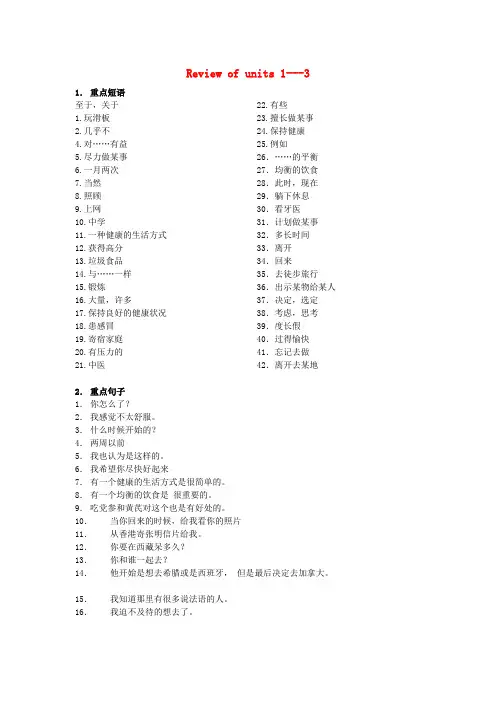
Review of units 1---3 1.重点短语至于,关于1.玩滑板2.几乎不4.对……有益5.尽力做某事6.一月两次7.当然8.照顾9.上网10.中学11.一种健康的生活方式12.获得高分13.垃圾食品14.与……一样15.锻炼16.大量,许多17.保持良好的健康状况18.患感冒19.寄宿家庭20.有压力的21.中医22.有些23.擅长做某事24.保持健康25.例如26.……的平衡27.均衡的饮食28.此时,现在29.躺下休息30.看牙医31.计划做某事32.多长时间33.离开34.回来35.去徒步旅行36.出示某物给某人37.决定,选定38.考虑,思考39.度长假40.过得愉快41.忘记去做42.离开去某地2.重点句子1.你怎么了?2.我感觉不太舒服。
3.什么时候开始的?4.两周以前5.我也认为是这样的。
6.我希望你尽快好起来7.有一个健康的生活方式是很简单的。
8.有一个均衡的饮食是很重要的。
9.吃党参和黄芪对这个也是有好处的。
10.当你回来的时候,给我看你的照片11.从香港寄张明信片给我。
12.你要在西藏呆多久?13.你和谁一起去?14.他开始是想去希腊或是西班牙,但是最后决定去加拿大。
15.我知道那里有很多说法语的人。
16.我迫不及待的想去了。
3.单元基本框架。
Unit1drink milkread----How often do you go skateboarding……Every day .Twice a mothFour times a year---- ……Unit 31.---What is he doing for vacation?2.---3.---going campingrelaxing at home He/ She isThey are +I am。
八年级英语上册(人教新目标GoForIt!)Unit8第4课时SectionB(2a2e)教学设计
-在实际语境中灵活运用一般过去时和现在完成时。
-在阅读过程中,准确捕捉关键信息,概括文章主旨,推断作者意图。
-将所学知识运用到口头和书面表达中,提高综合语言运用能力。
(二)教学设想
1.课前准备:
-教师提前布置预习任务,让学生熟悉Section B 2a-2e的内容,查找并了解重点词汇。
-教师准备相关教学资源,如:图片、视频、课文音频等,以丰富课堂教学。
4.布置课后作业,巩固所学知识,为下一节课的学习做好准备。
五、作业布置
1.书面作业:
-完成课后练习题,巩固一般过去时和现在完成时的用法。
-撰写一篇短文,描述一个自己或他人的成功经历,要求运用所学词汇和语法。
-阅读一篇与单元主题相关的文章,并完成相应的阅读理解题,提高阅读能力。
2.口语作业:
-与同学进行对话练习,用英语分享自己的成功经历,锻炼口语表达能力。
- How did the experiences in the past affect the person's present life?
3.各小组汇报讨论成果,教师给予评价和指导。
(四)课堂练习
1.教师设计有针对性的练习题,帮助学生巩固所学知识。
2.练习题包括:
-填空题:运用一般过去时和现在完成时填空。
-教师提问:“What did we learn in the last lesson? Can you remember the main idea of Section B 2a-2e?”
2.利用图片、视频等资源,引出本节课的话题,激发学生的兴趣。
-教师展示一幅描绘人物成功经历的图片,提问:“Can you guess what this picture is about? What do you think the person in this picture has experienced?”
新目标八年级英语上册 Review of Units 1-6最新名师预习学习复习指导材料

Review of Units 1-6▲预习学习复习指导Section A P.37-P.401.比较下列说法a teacher一个女老师→some women(woman×) teachers一些女老师但是a girl student一个女生→some girl(girls×) students一些女生说明:一个名词作修饰语修饰另一个名词(即一个名词作定语)时的数,具体要求如下:⑴一个名词作修饰语修饰另一个名词时,一般用单数。
例:1)some apple(apples×) trees 一些苹果树2)the twin(twins×) bothers 那对双胞胎兄弟3)a shoe(shoes×) factory(工厂) 一家鞋厂4)eye(eyes×) exercises 眼操⑵woman和man俩个词作修饰语修饰另一名词时,要和所修饰的名词的数保持一致。
例:a man doctor →some men(man×) doctors但是a boy student →some boy(boys×) students⑶少数词(如sports等)作修饰语修饰另一个名词时,常只用复数形式。
例:a sports meeting 运动会2.use v. 用,使用,利用;n. 使用;用途→useful adj.有用的;useless adj.无用的——use sth. to do sth. 使用某物干某事:We use milk to make cheese.——make (good) use of …(充分)利用……:We must make good use of our time.3.比较:sick adj.“生病的”,即可作表语又可作定语。
ill作adj,“生病的”与sick同义,但只可作表语。
例:1)He is sick. =He is ill.2)He is a sick man. 不可说He is an ill man. ×4.begin的用法级与start的区别⑴begin的用法:begin(began; begun) v. 开始→biginning 可作n. 开始;开头;开端——begin doing sth. (to do sth.)开始干某事——begin with …以……开始:The word “arm” begins with the letter “a”.⑵begin与start的比较:两者作“开始”时常可通用,start doing sth./to do sth. =begin doing sth./to do s但以下几种意思只可用start :①表示“出发”,“动身”,“启程”时:We will start at 7:00 tomorrow morning.②表示“(机器)开始工作”,“(机器)运转”:The car doesn’t start.③表示“发动(机器)”,“使(机器)运转”:I can’t start the car.----------------------------------------------------------------------------------------------------------------------④表示“创办”,“开办”,“建立”:They want to start a newspaper.5.比较:exciting adj. 令人激动的/兴奋的/刺激的:The news is exciting.excited adj. (感到)激动的/兴奋的/刺激的:We are excited at/about news.——b e excited at/about …对……感到兴奋——be excited to do sth. 干某事很激动/兴奋:We are excited to see the reporter.——be excited that(从句) …. :I’m very excited (that) we are taking a vacation. 6.safe adj. 安全的→safety n. 安全。
人教版go-for-it-教材分析
人教版go-for-it-教材分析生一定的语感和良好的语音、语调基础,养成良好的学习习惯,在运用英语有目的地做事情的过程中形成初步用英语进行简单日常交流的能力。
同时,该教材注重工具性和人文性的结合,注重培养学生的观察、记忆、思维、想象和创造能力,促进学生心智和综合人文素养的发展、个性和潜能的发挥以及自主学习能力的提高;介绍中西方文化,培养学生爱国主义精神,增强世界意识,为学生的进一步学习奠定良好的基础。
The goal of Go for it! is to make language learning motivating and successful through a step-by-step progression that builds confidence and leads to open-ended activities where SS can actively relate learning to their personal lives.Go for it教材强调课程从学生的学习兴趣、生活经验和认识水平出发,倡导体验、实践、参与、合作与交流的学习方式,使语言学习的过程成为学生形成积极的情感态度,主动思维、大胆实践的过程,提高跨文化意识,发展学生的综合语言运用能力。
二、Go for it教材编写的指导思想义务教育阶段英语课程的首要目的是为学生发展综合语言运用能力打基础,为他们继续学习英语和未来职业选择创造有利条件。
该教材以《国家中长期教育改革和发展规划纲要》为指导思想,全面落实《义务教育英语课程标准》(2011年版)提出的基本理念、课程目标和课程内容,结合目前国内外英语教学改革的最新研究成果,体现“以人为本”的科学发展观,以满足人的发展需求为目标,着力培养学生的综合语言运用能力。
理念: 任务型语言教学思路: 按照“话题—功能—结构—任务”相结合的思想, 采用任务型语言教学途径,以话题为主线,任务为主导,辅以功能和结构项目,兼顾交际功能和语言知识结构的学习,以一种循序渐进的生活化的学习程序,引导学生学会运用英语有目的地做事情,有效培养学生综合运用英语的能力。
新目标八年级英语上册 Review of Units 7-12最新名师预习学习复习指导材料

八年级英语上册Review of Units 7-12【2—1】预习学习复习指导201110Review of Units 7-12▲预习学习复习指导Section A P.77-P.801.sea n. 海洋。
同音词:see——by sea 乘船(=by ship)。
类似的还有——by air 乘飞机(=by plane)——by land 乘火车(=by train)2.——at all的用法~通常用于否定句句末,意思为:一点(也不);根本(不);丝毫(不)——用以加强语气,相当于not (…) a bit。
例:1)I don’t like them at all. =I don’t like them a bit.2)I’m not tied at all. =I’m not a bit tied.【注】①not (…) at all =not (…) a bit 一点也不……其中not放于“情助be”之后,at all放于句末;而a bit修饰v.时,放于v.之后,而修饰adj. adv.时,则要放于adj. adv.之前。
②Not at all还可作Thank you答语,表示:(一点也)不用谢!3.比较:serious与seriously⑴serious是adj. ①严肃的;②认真的;③严重的例:1)a serious face2)Are you joke or serious?3)I have a cold. But it’s not serious.⑵seriously是adv. ①严肃地;②认真地;③严重地例:He spoke to us seriously.重要提示:adj.修饰说明n. pron.;而adv.是修饰说明v. adj. adv.。
又如:adj. →happy careful仔细的,细心的,认真的careless粗心的adv. →happily carefully 仔细地,粗心地,认真地carefully粗心地例:1)He is happy. He is a happy man. He lives happily.2)He is careful. He is a careful man. He works carefully.4.比较:lie—lied; lied; lying(说谎;撒谎)lie—lay; lain; lying(v. ①躺,卧;②平放;③存在,位于)lay—laid; laid; laying(v. 产<卵>,下<蛋>)例:1)Mike often _____ when he was a child . He said their hen(母鸡) _____ over 60 eggs in a month.2)Look! A letter _____ on the ground(地面)!3)He was tired. He _____ down and soon went to sleep.另外,lie还可作n.“谎话”,“谎言”——可数n.----------------------------------------------------------------------------------------------------------------------八年级英语上册Review of Units 7-12【2—2】预习学习复习指导201110——a white lie善意的谎言——tell a lie(lies) 撒谎,说谎;反义:tell the truth说出真相;说实话(这两个说法中的tell不可改用say或speak)5.note n. ①笔记:——take/make notes做笔记——make a note of …(做笔记)记下……②注释,注解:notes on the text(课文) 课文注释③短信;便条:a note of thanks =a thank-you letter 感谢信④纸币。
新目标Goforit版初中英语八年级上册全册学案
八年级英语上册学案Un it 1 How ofte n do you exercise ?Secti on A一、教师寄语A bold attempt is half success.(勇敢的尝试是成功的一半)二、学习目标知识目标:Words: always, usually , often, sometimes , hardly , ever, never., once , twice Phrases: how often three times a week every day. twice a weekSenten ces:What do you usually do on weeke nds? I sometimes go to the beach.How ofte n do you eat vegetables? Every day.Most stude nts do homework every day.能力目标:会使用频率副词及短语;能描述课余时间的活动安排;情感目标:培养学生良好的学习和生活习惯三、教学重、难点频度副词:always, usually, often, sometimes, hardly 禾口never 的应用疑问词how的用法四、学习过程1预习导学或自测I .Look at the picture (学生识图).What do you usually do on weeke nds? I sometimes go to the beach..I sometimes ______________________ 去滑板看书_________________________________ 看电视__________________________________做运动____________________________ 购物_____________________________________________n .看图写出相应的頻度副词:2. 自主学习Pairwork.How ofte n do you eat vegetables? Every day.Activities How ofena. go to the movies Every dayb. watch TV Once a weekc. shop Twice a weekd. exercise Three times a weeke.read Once a weekTwice a week3 .合作探究I .maybe / may be①.The baby is crying she is h ungry.②.The woma n a teacher .maybe是副词,意为"大概,可能,或许",一般用于句首。
go for it八年级上册Review of Unit3
第课时Review of Unit3( 总第课时) 【学习目标】:知识与能力:1)会读写本单元的单词及短语2)能了解并正确运用形容词的比较级形式.3)运用形容词的比较级对人、事进行比较过程与方法:采用Pairwork, Groupwork 等方式引导学生进行学习【学习重点】:能运用形容词的比较级对人、事进行比较【学习过程】课前预习(梳理知识)(教师寄语:Knowledge is power.)Task 1:复习Unit 3的单词,记住本单元的重点单词和短语爱交际的_______________喧闹的___________轻声的_______________工作努力的_____________比赛_____________极好的_______________清楚的_______________赢_______________尽管__________________有才能的______________真正的___________在意,关心____________短语:关心,在意______________和我做一样的事________________一个好的听众____________________让我笑_______________________Task2:复习Unit 3中的短文,熟读并记住其中的句子1.Tina 比Tara高,而且她唱的比Tara大声。
Tina is _____________Tara,and she also _____________than Tara.2.你和你妹妹一样友好吗?Are you __________________your sister?3.你喜欢昨天的歌唱比赛吗?Did you like the _______________yesterday?4.每个人都想赢. Everyone ________________________________.5.一个好的朋友对音乐很有天赋。
《Go for it! 新目标》教材分析
《新目标》英语整体分析
• 一、七年级英语上册 • 七年级英语上册共分17个单元,其中预备篇三个单元,正 式篇十二个单元,另含有两个复习单元,即Review of units 1—6,Review of units 7—12。同时还附有: Additional Material,Tapescripts , Phonetics, Grammar,Words and Expressions in each unit和 Vocabulary Index。 每个单元共分三部分,即:Section A, Section B 和Self check。 该教材对单词和词组的归 纳分两种形式:(1)以单元的形式进行归纳,并在该词 后注上第几页,而原来编的教材是在该词后注上是第几课 ,而不是第几页,并且每个单词后都注有两种音标形式, 一是K.K.(美式音标),一是IPA(国际音标)。(2) Vocabulary Index以A.B.C.D的顺序对整套书单词,词组 进行归类,词后仍以第几页的形式来进行表示。
• 本册教材的内容充分体现了时代性、趣味性和实用性。从 “英语学习”(HOW TO STUDY),“个人爱好”( PREFERENCES),“旅游文化”(VACATIONS)“古代发明 ”(INVENTIONS),到“风俗习惯”(CUSTOMS)”等。 这些教学板块都极富鲜明的时代特征,大大地激发和培养 了学生的学习兴趣,但教材的词汇量极大,学生在掌握词 汇方面有困难,在语法的综合运用上易混淆,所以教师应 该教会学生学习方法。俗话说:“授之于鱼不如授之于渔 ”。与其让学生被动地接受,不如教会他们怎样去学习, 同时加强口语联系,创设良好的语言学习情景。让学生在 听说读写等方面都有提高,并为高中阶段的学习打下良好 基础。
《Go for it! 新目标》教材分 析
新人教版英语八年级Goforit上册1-3单元(Units1-3课文翻译)
新人教版英语八年级Goforit上册1-3单元(Units1-3课文翻译)第一篇:新人教版英语八年级Go for it上册1-3单元(Units 1-3课文翻译)Unit 1Where did you go on vacation?你去哪儿度假了?Section A—1b(P1)Conversation 1(对话1)Xiang Hua: Hey, Tina.Where did you go on vacation?嘿,蒂娜。
你去哪儿度假了?Tina: I went to the mountains with my family.我和家人去爬山了。
Xiang Hua: Did everyone have a good time?大家都玩得开心吗?Tina: Oh, yes.Everything was excellent.Where did you go, Xiang Hua? 哦,是的。
一切都很棒。
你去哪儿了,项华?Xiang Hua: I went to New York City.我去了纽约市。
Conversation 2(对话2)Girl: Where did yougo on vacation, Sally? 莎莉,你去哪儿度假了?Sally: Nothing.I just stayed at home.没有,我只是呆在家里。
Girl: And did you do anything interesting, Bob?你做了什么有趣的事吗,鲍勃?Bob: Yes, I visited my uncle.We went fish ing, but we didn’t get any fish.是的,我看望了我叔叔。
我们去钓鱼了,但是没钓到鱼。
Conversation 3(对话3)Boy: Did you go anywhere on vacation, Tom? 汤姆,假期你去了什么地方吗?Tom: I went to summer camp.我去了夏令营。