
2012年6月英语六级作文真题范文
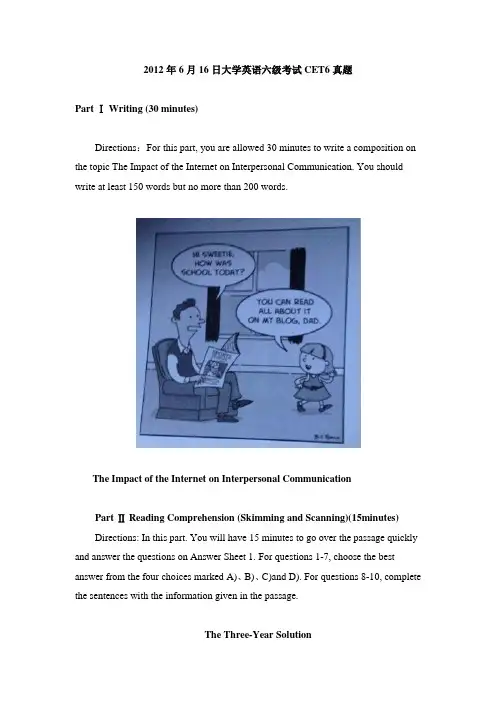
2012年6月英语六级作文真题范文题目:The impact of the Internet on interpersonal communication要求:commenting on "Dad:Hi sweetie, how was school, today? Daughter: You can read all about it on my blog, Dad"范文:In contemporary society, our life is filled with a variety of anecdotes or stories, and the following is no exception: "Dad:Hi sweetie, how was school, today? Daughter: You can read all about it on my blog, Dad." Funny as it seems, this conversation can be naturally associated with the impacts of Internet on our life: In an era of Internet, the time for interpersonal communication is impaired by online chats or blogs.Apparently, the impacts of the Internet on interpersonal communication are diverse. For one thing, as a vital invention, Internet brings great convenience to our communication, eliminates the barrier of distance, and helps humans to keep in touch wherever and whenever. For another, it is Internet that does not enables family members, friends or classmates to communicate more in a face-to-face way. One case in point is that youngsters may spend hours chatting with acquaintances through QQ or MSN, but rarely do they talk with other face to face. Unfortunately, it we let this trend to continue as it is, the interpersonal relationship will, definitely, become alienated.To my understanding, it is advisable for people to communicate more with their families, friends and acquaintances in real life instead of merely through the Internet. Do bear in mind: Internet is just a tool. (213words)he Influence of the Internet on Interpersonal CommunicationNowadays, along with the rapid development of internet, a great change appears in the daily life of everyone. We rely upon the internet more than any time before. It even becomes our necessity for communication, especially for young people.Various approaches can be used by us to surf on the internet for interpersonal communication, such as QQ, blog, MSN, email, and the like. It becomes so common to us that we cannot live without internet just as we cannot live without food and water. The influence of it can be reflected in several ways. First, internet can help us to make more friends because the communication becomes so convenient that we can connect with a friend overseas just in a few seconds. Second, internet may widen the emotional distance between people. We lose patience with the face-to-face contact with one another. A QQ message can replace everything need to be done by close contact. Third, lots of deceptious messages online captivate our eyes and make us feel confused. We lose our basic judgment about who and what can be believed.Overall, every coin has its two sides. We must recognize the benefits of internet which bring to us. At the same time, the negative part of it should also be deeply considered. There is still a long way to go to do our best to eliminate the disadvantages of it.2012年12月英语六级作文真题范文write an essay entitled Man and Computer by commenting on the saying, “The real danger is not that the computer will begin to think like man, but that man will begin to think like the computer.”Man and ComputerIt is believed that the computer is bringing the world into a brand new era. At the time the computer was invented, scientists, marveling at its calculating speed, felt that they had created a miracle. Nowadays, the function of the computer is no longer confined to calculation; it permeates people’s daily lives and has become an inseparable part of human society.People become so heavily dependent on computers that it is hard to imagine the life without computers. Therefore, some people are worried that “The real danger is not that the computer will think like man, but man will think like the computer.”Their concern does make sense. Indeed, some people spend such a long time working on computers that they have few interactions with people in real life. According to a research, too many hours in front of a computer may lead to a poker face and interpersonal isolation. This fact should arouse our attention, because unlike computers, human beings are social creatures that need emotional connections with others.Yet, it is also unnecessary for us to be overwhelmed by the negative impacts of computers. After all, we humans are intelligent and will be able to figure out better ways to make improvements.本次六级作文的题目是人与电脑,对“真正的危险不是电脑开始像人一样思考,而是人开始像电脑一样思考。
”这句话发表自己的观点。
2012年6月大学英语六级考试CET6真题及答案解析word版本
2012年6月16日大学英语六级考试CET6真题Part Ⅰ Writing (30 minutes)Directions:For this part, you are allowed 30 minutes to write a composition on the topic The Impact of the Internet on Interpersonal Communication. You should write at least 150 words but no more than 200 words.The Impact of the Internet on Interpersonal CommunicationPart Ⅱ Reading Comprehension (Skimming and Scanning)(15minutes)Directions: In this part. You will have 15 minutes to go over the passage quickly and answer the questions on Answer Sheet 1. For questions 1-7, choose the best answer from the four choices marked A)、B)、C)and D). For questions 8-10, complete the sentences with the information given in the passage.The Three-Year SolutionHartwick College, a small liberal-arts school in upstate New York, makes New York, makes this offer to well prepared students: earn your undergraduate degree in three years instead of four, and save about 543,000—the amount of one year’s tuition and fees. A number of innovative colleges are making the same offer to students anxious about saving time and money. That’s both an opportunity and a warning for the best higher-education system in the world.The United States has almost all of the world’s best universities. A recent Chinese survey ranks 35 American universities among the top 50, eight among the top 10. Our research universities have been the key to developing the competitiveadvan tages that help Americans produce 25% of all the world’s wealth. In 2007, 623,805 of the world’s brightest students were attracted to American universities.Yet, there are signs of peril (危险)within American higher education. U.S. colleges have to compete in the marketplace. Students may choose among 6,000 public, private, nonprofit, for profit, or religious institutions of higher learning. In addition, almost all of the 532 billion the federal government provides for university research is awarded competitively.But many colleges and universities are stuck in the past. For instance, the idea of the fall-to-spring“school year”hasn’t changed much since before the American Revolution, when we were a summer stretch no longer makes sense. Former George Washington University president Stephen Trachtenberg estimates that a typical college uses its facilities for academic purposes a little more than half the calendar year.“While college facilities sit idle, they continue to generate maintenance expenses that cont ribute to the high cost of running a college,” he has written.Within academic departments, tenure(终身职位),combined withage-discrimination laws, makes faculty turnover—critical for a university to remain current in changing times—difficult. Instead of protecting speech and encouraging diversity and innovative thinking, the tenure system often stifles(压制)them: younger professors must win the approval of established colleagues for tenure, encouraging like-mindedness and sometimes inhibiting the free flow of ideas.Meanwhile, tuition has soared, leaving graduating students with unprecedented loan debt. Strong campus presidents to manage these problems are becoming harder to find, and to keep. In fact, students now stay on campus almost as long as their presidents. The average amount of time students now take to complete an undergraduate degree has stretched to six years and seven months as students interrupted by work, inconvenienced by unavailable classes, or lured by one more football season find it hard to graduate.Congress has tried to help students with college costs through Pell Grants and other forms of tuition support. But some of their fixes have made the problem worse. The stack of congressional regulations governing federal student grants and loans now stands twice as tall as I do. Filling out these forms consumes 7% of every tuition dollar.For all of these reasons, some colleges like Hartwick are rethinking the old way of doing things and questioning decades-old assumptions about what a college degree means. For instance, why does it have to take four years to earn a diploma? This fall, 16 first-year students and four second-year students at Hartwick enrolled in the school’s new three year degree program. According to the college, the plan is designed for high-ability, highly motivated student who wish to save money or to move along more rapidly toward advanced degrees.By eliminating that extra year, there year degree students save 25% in costs. Instead of taking 30 credits a year, these students take 40. During January, Hartwick runs a four week course during which students may earn three to four credits on or off campus, including a number of international sites. Summer courses are not required, but a student may enroll in them—and pay extra. Three year students get first crack at course registration. There are no changes in the number of courses professors teach or in their pay.The three-year degree isn’t a new idea. Geniuses have always breezed through. Judson College, a 350-student institution in Alabama, has offered students athree-year option for 40 years. Students attend “short terms” in May and June to earnthe credits required for graduation. Bates College in Maine and Ball State University in Indiana are among other colleges offering three-year options.Changes at the high-school level are also helping to make it easier for many students to earn their undergraduate degrees in less time. One of five students arrives at college today with Advanced Placement (AP) credits amounting to a semester or more of college level work. Many universities, including large schools like the University of Texas, make it easy for these AP students to graduate faster.For students who don’t plan to stop with an undergraduate degree, the three-year plan may have an even greater appeal. Dr. John Sergent, head of Vanderbilt University Medical School’s residency (住院医生) program, enrolled in Vanderbilt’s undergraduate college in 1959. He entered medical school after only three years as did four or five of his classmates.” My first year of medical school counted as my senior year, which meant I had to take three to four labs a week to get all my sciences in. I basically skipped my senior year,” says Sergent. He still had time to be a student senator and meet his wife.There are, however, drawbacks to moving through school at such a brisk pace. For one, it deprives students of the luxury of time to roam (遨游) intellectually. Compressing everything into three years also leaves less time for growing up, engaging in extracurricular activities, and studying abroad. On crowded campuses it could mean fewer opportunities to get into a prized professor’s class. Iowa’s Waldorf College has graduated several hundred students in its three-year degree program, but it now phasing out the option. Most Waldorf students wanted the full four-year experience—academically, socially, and athletically. And faculty members will be wary of any change that threatens the core curriculum in the name of moving students into the workforce.“Most high governmental officials seem to conceive of education in this light—as a way to ensure economic competitiveness and continued economic growth,” Derek Bok, former president of Harvard, told The Washington Post. “I strongly disagree with this ap proach.” Another risk: the new campus schedules mighteventually produce less revenue for the institution and longer working hours for faculty members.Adopting a three-year option will not come easily to most school. Those that wish to tackle tradition and make American campus more cost-conscious may find it easier to take Trachtenberg’s advice: open campuses year-round.“You could run two complete colleges, with two complete faculties,”he says.“That’s without cutting the length of students’ vacations, in creasing class sizes, or requiring faculty to teach more.”Whether they experiment with three-year degrees, offer year-round classes, challenge the tenure system—or all of the above—universities are slowly realizing that to stay competitive and relevant they must adapt to a rapidly changing world.Expanding the three-year option may be difficult, but it may be less difficult than asking Congress for additional financial help, asking legislators for more state support, or asking students even higher tuition payments. Campuses willing to adopt convenient schedules along with more focused, less-expensive degrees may find that they have a competitive advantage in attracting bright, motivated students. These sorts of innovations can help American universities avoid the perils of success.注意:此部分试题请在答题卡1上作答。
2012年六月英语六级真题完整版_

2012年6月大学英语六级考试真题(附答案)2012年6月16日大学英语六级考试真题Part ⅠWriting (30 minutes)Directions:For this part, you are allowed 30 minutes to write a composition on the topic The Impact of the Internet on Interpersonal Communication. You should write at least 150 words but no more than 200 words.The Impact of the Internet on Interpersonal CommunicationPart ⅡReading Comprehension (Skimming and Scanning)(15minutes)Directions: In this part. You will have 15 minutes to go over the passage quickly and answer the questions on Answer Sheet 1. For questions 1-7, choose the best answer from the four choices marked A)、B)、C)and D). For questions 8-10, complete the sentences with the information given in the passage.The Three-Year SolutionHartwick College, a small liberal-arts school in upstate New York, makes New York, makes this offer to well prepared students: earn your undergraduate degree in three years instead of four, and save about 543,000—the amount of one year’s tuition and fees. A number of innovative colleges are making the same offer to students anxious about saving time and money. That’s both an opportunity and a warning for the besthigher-education system in the world.The United States has almost all of the world’s best universities. A recent Chinese survey ranks 35 American universities among the top 50, eight among the top 10. Our research universities have been the key to developing the competitive advantages that help Americans produce 25% of all the world’s wealth. In 2007, 623,805 of the world’s brightest students were attracted to American universities.Yet, there are signs of peril (危险)within American higher education. U.S. colleges have to compete in the marketplace. Students may choose among 6,000 public, private, nonprofit, for profit, or religious institutions of higher learning. In addition, almost all of the 532 billion the federal government provides for university research is awarded competitively.But many colleges and universities are stuck in the past. For instance, the idea of the fall-to-spring“school year”hasn’t changed much since before the American Revolution, when we were a summer stretch no longer makes sense. Former George Washington University president Stephen Trachtenberg estimates that a typical college uses its facilities for academic purposes a little more than half the calendar year.“While college facilities sit idle, they continue to generate maintenance expenses that contribute to the high cost of running a college,” he has written.Within academic departments, tenure(终身职位),combined with age-discrimination laws, makes faculty turnover—critical for a university to remain current in changing times—difficult. Instead of protecting speech and encouraging diversity and innovative thinking, the tenure system often stifles(压制)them: younger professors must win the approval of established colleagues for tenure, encouraging like-mindedness and sometimes inhibiting the free flow of ideas.Meanwhile, tuition has soared, leaving graduating students with unprecedented loan debt. Strong campus presidents to manage these problems are becoming harder to find, and to keep. In fact, students now stay on campus almost as long as their presidents. The average amount of time students now take to complete an undergraduate degree has stretched to six years and seven months as students interrupted by work, inconvenienced by unavailable classes, or lured by one more football season find it hard to graduate.Congress has tried to help students with college costs through Pell Grants and other forms of tuition support. But some of their fixes have made the problem worse. The stack of congressional regulations governing federal student grants and loans now stands twice as tall as I do. Filling out these forms consumes 7% of every tuition dollar.For all of these reasons, some colleges like Hartwick are rethinking the old way of doing things and questioning decades-old assumptions about what a college degree means. For instance, why does it have to take four years to earn a diploma? This fall, 16 first-year students and four second-year students at Hartwick enrolled in the school’s new three year degree program. According to the college, the plan is designed for high-ability, highly motivated student who wish to save money or to move along more rapidly toward advanced degrees.By eliminating that extra year, there year degree students save 25% in costs. Instead of taking 30 credits a year, these students take 40. During January, Hartwick runs a four week course during which students may earn three to four credits on or off campus, including a number of international sites. Summer courses are not required, but a student may enroll in them—and pay extra. Three year students get first crack at course registration. There are no changes in the number of courses professors teach or in their pay.The three-year degree isn’t a new idea. Geniuses have always breezed through. Judson College, a 350-student institution in Alabama, has offered students a three-yearoption for 40 years. Students attend “short terms” in May and June to earn the credits required for graduation. Bates College in Maine and Ball State University in Indiana are among other colleges offering three-year options.Changes at the high-school level are also helping to make it easier for many students to earn their undergraduate degrees in less time. One of five students arrives at college today with Advanced Placement (AP) credits amounting to a semester or more of college level work. Many universities, including large schools like the University of Texas, make it easy for these AP students to graduate faster.For students who don’t plan to stop with an undergraduate degree, the three-year plan may have an even greater appeal. Dr. John Sergent, head of Vanderbilt University Medical School’s residency (住院医生) program, enrolled in Vanderbilt’s undergraduate college in 1959. He entered medical school after only three years as did four or five of his classmates.” My first year of medical school counted as my senior year, which meant I had to take three to four labs a week to get all my sciences in. I basically skipped my senior year,” says Sergent. He still had time to be a student senator and meet his wife.There are, however, drawbacks to moving through school at such a brisk pace. For one, it deprives students of the luxury of time to roam (遨游) intellectually. Compressing everything into three years also leaves less time for growing up, engaging in extracurricular activities, and studying abroad. On crowded campuses it could mean fewer opportunities to get into a prized professor’s class. Iowa’s Waldorf College has graduated several hundred students in its three-year degree program, but it now phasing out the option. Most Waldorf students wanted the full four-year experience—academically, socially, and athletically. And faculty members will be wary of any change that threatens the core curriculum in the name of moving students into the workforce.“Most high governmental officials seem to conceive of education in this light—as a way to ensure economic competitiveness and continued economic growth,” Derek Bok, former president of Harvard, told The Washington Post. “I strongly disagree with thisapp roach.” Another risk: the new campus schedules might eventually produce less revenue for the institution and longer working hours for faculty members.Adopting a three-year option will not come easily to most school. Those that wish to tackle tradition and make American campus more cost-conscious may find it easier to take Trachtenberg’s advice: open campuses year-round.“You could run two complete colleges, with two complete faculties,”he says.“That’s without cutting the length of students’ vacations, increasing class sizes, or requiring faculty to teach more.”Whether they experiment with three-year degrees, offer year-round classes, challenge the tenure system—or all of the above—universities are slowly realizing that to stay competitive and relevant they must adapt to a rapidly changing world.Expanding the three-year option may be difficult, but it may be less difficult than asking Congress for additional financial help, asking legislators for more state support, or asking students even higher tuition payments. Campuses willing to adopt convenient schedules along with more focused, less-expensive degrees may find that they have a competitive advantage in attracting bright, motivated students. These sorts of innovations can help American universities avoid the perils of success.注意:此部分试题请在答题卡1上作答。
2012年6月英语六级考试25篇必背作文

Topic 1:Is It Better to Buy or Rent?The price of housing has kept increasing in recent years, which causes a big headache for people living in cities. A lot of people cannot afford to own a real estate property, so they choose to rent instead of buying an apartment. This group of people does not want to bear burden of mortgage so that they opt for a practical solution. Renting an apartment makes them have a place to stay and thus they can focus on work as well as personal life.Some other people, however, believe that an apartment owned by themselves makes them feel safe and relieved, so they are willing to sacrifice some other aspects of life to borrow money from the bank to buy an apartment. As far as I am concerned, to buy or to rent is all about people's personal choice. But when the price of housing is standing too high, it will be better to rent first and wait for the good timing when the price is going down to buy.Topic 2: On Job HoppingIt seems that nowadays, very few young people are willing to stay in a job position for long, let alone for the whole life. They change jobs constantly. This results from several factors. Firstly, young people like fresh things, and it is easy for them to be fed up with old routine work. So when they stay in a position for a while,the excitement will fade out. Secondly, young people are still looking for the best suitable job for themselves. They are quite realistic and not willing to waste time in a job they are not interested in. Thirdly, some young people are not satisfied with current salary, believing they deserve better pay. In my opinion, constant job hopping will not benefit young people in their career development. Every job has its own merits and young people can certainly learn something from it as long as they are patient and wise enough. Every job experience is valuable down the career path and young people shall be able to make the most of it.Topic 3: Online Social NetworkModern people will be no stranger to online social network. Facebook, Renren and Kaixin001 are probably the most populous networks among Chinese netizen. In these networks, people interact with each other, be it a stranger or a friend, and have a lot of fun in the virtual world. This phenomenon could be a result of the fast development of the Internet and people's great interest of the virtual world. I think it is a very good new platform for people to keep in touch. But it should not be overused. Firstly, some people are addicted to it, which makes them want to get online 24 hours a day. When people spend too much time on one thing, they will naturally have not enough time for study and for work. Secondly, online social network change people's behavior of interacting with others. In virtual world, you just click the mouse and type in words instead of having a face-to-face talk. This will not benefit people's long term friendship, and even harm their interpersonal relationships in real world.Topic 4: The Most Important Skills for Modern PeopleWith the development of science and technology, the skills that modern people master are also changing with it. Some old skills including cooking, sewing and gardeningare no longer be deemed as necessary skills. Then what are the most important skills for modern people? Some hold that foreign language skills and computer skills are on top of the list, whereas some others believe that communication skills are the must.As far as I am concerned, communication skills are of the greatest importance for modern people. Firstly, in a globalized world, everyone is interconnected with each other. Communication is the key in personal interaction, and good communication skills can bring people sound interpersonal relationship. Secondly, most of the work done today requires teamwork. One person alone can not finish everything. Cooperation asks for communication, and effective communication will promote cooperation. That's the reason why lots of big companies emphasize communication skills first when they are recruiting new employees.Topic 5: What Is More Important: Character or Academic Achievement?What is the criterion to judge the performance of a student? Some believe that the exam marks should be the first standard concerned. A student's first priority is to study well, and academic achievement can show the result of a student's efforts and capability. But some disagree by holding that good character should be considered first when talking about the performance of a student, as character shows that whether a student has correct basic moral value and proper behavior. As far as I am concerned, sound character is more important in judging a student's performance. Firstly, good exam marks can not be everything as that won't follow a student's whole life. But sound character will be the only thing that lasts for long. Secondly, if a student has very poor character, good marks will be meaningless. When the student has grown up, his academic achievement will probably be used for wrong purpose. I, therefore, believe that we should reform the education system and care more for students' character cultivation.Topic 6: On the Importance of Being GratefulHave you ever said "thank you" when your classmates helped you? Have you ever thought about repaying a business partner who once lent you a hand?[00:18.49]If the answer is yes, you must be a person who feels grateful. Your gratefulness makes your family more harmonious and helps you build a reliable cooperative relationship with other people, which can help you a lot in your lifetime.However, there are less and less people who feel grateful in the modern society. For one thing, people focus so much on what they can get that they never think of what to give. That is to say, they are too greedy to feel grateful. For another, some people take others' love and care for granted and know nothing about gratefulness.In my view, gratitude is important to our society and cultivating gratitude should begin from children with something small. We should teach our children how important gratitude is and ask them to do small things for others to show their gratefulness. Our society can become more harmonious and beautiful because of gratitude.Topic 7: Living with Parents after GraduationWhich will you choose to deal with your accommodation problem after graduation, living with parents or renting a room on your own? Quite a number of people prefer to rent a room on their own; however, more and more people choose to live with parents. There are several reasons for that. First, because of high housing prices, most people can't afford to buy a house after graduation. What's more, with their limited incomes, the graduates feel stressed with the high housing rent and living costs. Living with parents can save them lots of money which they may spend on housing and daily expenses. Finally, many people have been accustomed to depending on their parents and they can't take care of themselves. Personally speaking, I'd rather rent a room to live my own life, though living with my parents may help save much money.I also suggest that those who are so dependent on parents should learn to be independent as early as possible.Topic 8: More Disasters than Before?Much attention has been paid to reports about natural disasters recently. Earthquakes, droughts and floods in the West and Southwest this year resulted in many casualties and great losses, which greatly shocked us and forced us to be on alert. We can't help raising the question: are there more disasters than before?Many people probably will say "yes" to this question. There are more and more reports about disasters on TV and on the front pages of newspapers and websites.Media often cover details of disasters for days, which easily gives viewers a false image that disasters happen every day. As far as I am concerned, the great coverage of natural disasters by the media reflects the environmental awareness of human beings. We are more concerned about environmental protection now, and this is the first step to a better future of our planet.Topic 9: How to Deal with Peer Pressures?People often feel peer pressures.For example, your roommates smoke but you don't. Your classmates wear expensive clothes but you don't. In these cases, you may feel excluded if you don't do the same things as they do. Sometimes peer pressures drive people crazy, but you can only rely on yourself to deal with it.There are two ways to deal with peer pressures. First, pay attention to your own feelings and decide what you should do. Try saying "no" to peer pressures. Don't give in to pressures and do things against your will.Second, find friends who stand on your side. It's tough to deal with peer pressures alone,but it's much easier if at least one peer supports you.Make friends with those who have similar opinions or habits to yours, so that you won't feel excluded.To conclude, peer pressures can be eased if you have the courage to say "no" to it, and combat with it together with your true friends.Topic 10: Lectures and DiscussionsLectures and discussions are two main styles of teaching in universities, and each has its own advantages and disadvantages. Some students are in favor of lectures, but others enjoy discussions very much.Lecturing is the most traditional teaching method in China, because it is considered highly efficient. Students can get used to lectureseasily, for most of them have been taught in this way since primary school. Teachers play a very important role in lectures, while students seldom have chances to speak. On the contrary, discussions allow students to have chances to interact with each other. What's more, students have more freedom and initiative in class where they can express their ideas freely and ask any questions about the topic. However, the class can easily go out of control if there is no restriction.As for me, I prefer discussions to lectures because of the open atmosphere. However, teachers should take charge of the discussions to help students learn more.Topic 11: On the Importance of Mutual UnderstandingNowadays many people are so focused on their own interests that they barely consider the feelings of others. As a result, misunderstandings, or even conflicts, arise.It is important for people to understand each other during a conversation, or in the interpersonal communication. For one thing, mutual understanding makes it easy for both parties to reach an agreement on the topic they are discussing.This may help solve the most difficult issues among different cultures, countries or communities. Furthermore, for people who are friendly to each other, this mutual understanding can definitely strengthen the love and friendship between them.Both the speaker and the listener can do much to help gain mutual understanding. On the one hand, the speaker should try his best to express himself clearly, correctly, vividly and forcefully. On the other hand, the listener should also make every effort to be very attentive. Most importantly, both parties should take a friendly attitude towards the other side.]Topic 12: Book Smart or Street Smart?There is a heated debate nowadays about which is better or more useful, to be book smart or street smart. People's opinions differ greatly over this topic. Some people believe to be book smart is way better. Many important fields like science and education need a great number of book-smart people. They can apply what they learn from books to their career. Others argue that true cleverness is not about how much you have learnt, but about how you deal with what you have learnt. Street-smart people can learn much from different experiences and can solve practical problems easily. They are much useful than book-smart people to some extent. As for me, there's no clear victor in the battle between street-smart people and book-smart ones. They both have their advantages, and our society require both. As a result, it's much better if we are both book smart and street smart.Topic 13: Due Attention Should Be Given to Spoken EnglishAs we all know, spoken English plays an important part in learning English. However, more and more students pay less attention to spoken English nowadays. There are two main reasons for this phenomenon. First, students would rather pay more attention to written English than spoken English because of pressure of exams. In order to enter a better school, students take efforts to improve their grades in examinations. As for English, exams mainly focus on the written part. Therefore, written English becomesstudents' priority. Furthermore, many students lack courage to speak English. Being afraid of making mistakes and thus losing face, many students dare not speak English in public. In order to change this situation, the educational system should be reformed to keep a balance between written English and spoken English, and schools should pay more attention to the latter. And most importantly, students should be encouraged to make mistakes when speaking English. If they are self-confident, their spoken English is sure to improve.]Topic 14: V olunteering ActivitiesWith the progress of society, the volunteer spirit has spread all over the country. More and more people are willing to be volunteers and take part in volunteering activities. Getting involved in volunteer work means a lot to our society. Firstly, you show loving care to others when you are doing volunteer work. You pass love and civilization on to others with your volunteer work, and make others feel that there are always people caring about them. This makes our society more harmonious. Secondly, people whom you help may be influenced by your good deed and follow your lead. As a result, all people may help and care about each other, which makes the world a better place to live in.Since volunteer work is so meaningful, we should call on more people to take part in volunteer activities. All young people are supposed to have the volunteer spirit and be active to do volunteer work.Topic 15: Keep Connected with ParentsMany parents feel confused that, once upon a time, their kids shared everything with them, but now they don't even look at them. With the development of modern society, it seems that more and more children aren't willing to communicate with their parents. There are several reasons for this phenomenon. For one thing, many kids think that they have nothing in common with their parents. What parents chatter about is study, which makes them bored. Thus, they prefer to communicate with friends. For another, they feel that their parents don't understand them at all. What they love to do is often against their parents' will and they can't get any support. As a result, the generation gap between parents and children become wider and wider. In order to change this situation, both parents and children should work together. Parents should learn to be a good listener and respect their children's ideas,whereas children should keep connected with their parents actively.Topic 16: My View on Knowledge EconomyKnowledge economy, which emphasizes knowledge and people of talent, is gradually replacing the industrial economy and becoming the dominant economic form. It is playing a more and more important role in our economic life in recent years. Knowledge economy has fundamentally transformed our ways of work, business and education. To start with, with the development of knowledge economy, more and more people are transformed from traditional manufacturing industries to new fields such as the Internet and the computer science area. Secondly, knowledge economy has given rise to the boom of electronic commerce and online trade, so you can dobusiness anytime and anywhere. Besides, people have to keep learning something new to adapt to this explosive knowledge society. In my opinion, we should insist on developing knowledge economy and make efforts to educate the young generation, to contribute to the progress of knowledge economy.Topic 17: The Impact of the Internet on EducationAs Internet application is becoming wider and wider, the Internet has already permeated traditional education and has tremendous impact on education. As a result, more and more people tend to choose online education.There are some reasons for this phenomenon.First, online learning breaks the limits of time and space traditional education encounters and provides flexible learning opportunities for all people. Second, with the online learning, one can learn lessons from the best teachers of top schools which one can't have access to traditionally. Third, online learning gives freedom to students, so they can schedule their study according to their own pace of learning. Finally online learning enables them to discuss with others and ask questions freely without seeing each other, which is perfect for shy people. In order to develop online learning, there should be more schools providing all kinds of online lessons for people who have different needs, and more people should seize these learning opportunities to enrich their knowledge.Topic 18: On DialectsThere is a controversial issue about whether dialects should be prohibited in public. Opinions vary greatly on this issue.Some deem that dialects should be forbidden in public. There are so many people with various dialects in public that if everybody just speaks their own dialects, it can easily lead to chaos. In order to avoid this situation, we have to choose mandarin as the official language, for it can be understood by most Chinese. However, others argue that everybody has the right to speak dialects. Local dialects have been used for thousands of years,and they are valued as part of the traditional culture. Therefore they shouldn't be abandoned randomly. In addition, dialects still enjoy popularity in the daily communication among people from the same place.From my perspective, local dialects should be maintained and they can be used in public as long as they do not cause misunderstanding among the audience. Moreover, we should take responsibility to preserve endangered dialects.Topic 19: The Benefits of Job InterviewsNowadays, if you apply for a job, you usually have togo through the job interview process.A job interview is an undoubtedly vital process in the course of applying for a job. Job interviews benefit both the interviewer and the candidate. On the one hand, the interviewer is able to get more information about the candidate beyond his resume, and to know what qualifications he has by judging from the performance in the interview. After examining the ability and personality, they can decide whether he is the right person for the position. On the other hand, the candidate can decide whether he takes this job after he gets general information about it, such as the income, working conditions, etc. Moreover, he can gain precious experience by taking part ininterviews, which is good for the following interviews.Therefore, the interviewer should make efforts to improve the job interview process to select the best candidate, whereas the candidate should also get well prepared for a better job.Topic 20. My View on White LiesThe question about whether we should tell white lies in daily life has aroused an intense debate over these years. Different people have different opinions.Many believe that we need white lies. There are moments in our life when we have to tell lies. In order to avoid hurting others' feelings or to make others feel better, we often tell white lies instead of conveying the truth. White lies have magic power to give people much hope and warmth. For instance, when you tell lies to a patient who gets incurable disease, he can probably enjoy the rest of his days more peacefully. Others argued that no one should tell lies, no matter what kind of lies. A white lie is essentially a lie. Some people feel betrayed and even get more hurt once they find out the truth, which can wreck a relationship easily. As for me, whether we should tell white lies really depends. You'd better take into consideration what the occasion isand what the result may be.Topic 21: Should a Formal Distance Be Kept Between Students and Teachers?A good interpersonal relationship between teachers and students is vital for successful education.And what is a perfect teacher-student relationship like? Should there be a formal distance between them?The question has aroused much interest.For some, teachers and students should be friends, and there should be little distance between them. The teacher enjoys being treated as a friend by the student, and the student likes confiding in the teacher. Such a relationship is treasured especially by teenagers who are eager to grow up.However, others hold that there should always be a formal distance between the teacher and the student. They argue that only when the teacher keeps a distance from the student can he make fair judgments about all the students and avoid prejudice. In my opinion, the distance between the teacher and the student can best be adjusted according to the specific situation. There is no need to regulate a set distance between the two.Topic 22: Need We "Never Give Up"?When Wallace watched the spider fail six times in spinning a web and succeed at the seventh time, he realized that he should lead his Scottish people to fight against the English invaders for another time, and he, too, succeeded. Whenever we face some difficulties or suffer setbacks in our projects, we can always gain strength from the popular saying: "Never give up!"But need we never give up?Apparently there are always goals we can never achieve. However hard we tried, we could not win the top prize in every contest; whatever treatment used, we may fail to lengthen the life of someone beloved. There are always frustrations, and some are just beyond us. It is thus wise to accept the reality, i.e. to give up sometimes.As college students, we need the saying "Never give up" to keep us going. But we also need to learn to come to terms with reality. When occasionally I heard news about some college studentscommitting suicide, I said to myself, "If only they had learned to give up!"Topic 23: Work in the CountrysideMany university graduates now volunteer to work in the countryside. It is reported that once hundreds of university graduates competed with one another to work as a village leader in Beijing. Many factors have contributed to this phenomenon. First, with more and more university students graduating each year, the job market competition becomes increasingly fierce, and many graduates cannot find jobs in the cities. Working in the countryside is better than being jobless. Second, the villages that are trying to employ university graduates are generally in the rich areas of the country, which makes working there an attractive choice. Third, some university graduates, being from the countryside, are eager to go back home to contribute to the construction of their hometown. With their knowledge and enthusiasm, they will play an important role in building the new countryside.Personally, I think university graduates should go to work where they are needed most and where they can make full use of their talents. Working in the countryside can be truly an advisable choice. Topic 24: Should Old People Stay at Home or Be Placed in Nursing Homes?Should old people stay with their children or go to the nursing homes?Some hold that old people should stay at home. For one thing, the young are obliged to repay the care and love they once received from the old. For another, the old may help with some housework and gain a sense of achievement, which is important for their mental and physical health. By contrast, some argue that old people should be placed in nursing homes, where they can not only have opportunities to communicate and have fun with their peers,but also be treated by professional doctors and nurses. Furthermore, with the old staying in nursing homes, the young may have more time and energy to devote to their own careers.In my view,the decision should be made with all factors fully considered. Above all, the opinion of the old should be respected. They themselves should be the ones who make the decision, not the young.Topic 25: A Letter to Apply for a Student LoanDear Sir or Madam,I am a freshman in Peking University majoring in Civil Engineering. I am applying to your bank for a loan of 10,000 yuan.It is hard for me to make the application, but I have to. Last year both my parents were laid off, and to make matters worse, three months ago my mother was discovered to have caught a serious disease. Therefore, I could not get support for my study from my family any more. But I treasure the opportunity to go to college very much, and I have no choice but to ask for your help.If the application is approved, all the money will go to my tuition and fees for the next two years. I guarantee to repay the loan within five years, that is, one year after my graduation.Attached are documents confirming my statements. I would be greatly obliged if my application is granted. Many thanks.Yours sincerely,Li Ming。
2012年6月英语六级作文答真题及案(文都版)

2012年6⽉16⽇全国⼤学英语六级考试已结束,本次考试报考⼈数达924万⼈。
以下是英语六级作⽂范⽂(⽂都版),以供⼴⼤考⽣参考: 2012年6⽉英语六级作⽂范⽂1(⽂都版) 来源:⽂都教育 The Influence of the Internet on Interpersonal Communication Interpersonal communication refers to the activities of face-to-face information and emotion communication among people. However, with the development of science and technology, the communication forms have becoming increasingly diversified, digitalized and public-oriented in the last decade。
The wide spread of internet access and the use of QQ, MSN, E-mail, blog, micro blog and some other emerging network communication platforms have exerted fundamental influence on interpersonal communication. These network platforms are capable of helping people get information more quickly and accurately, and they can also broaden people’s interpersonal circle. However, as everyone knows, everything has two sides. There are also negative points in these new types of interpersonal communication. For example, people may write blogs about their classmates or workmates around them, and these stories may be spread, thus influencing the relationships between people in reality. What’s more, if people spend too much time and effort on blog writing, they may have no chance and spirit to have face-to-face communications. Consequently, their ability to deal with people in life may decrease。
2012年6月大学英语六级真题及答案解析
Part ⅠWriting (30 minutes)Directions:For this part, you are allowed 30 minutes to write a composition on the topic The Impact of the Internet on Interpersonal Communication. You should write at least 150 words but no more than 200 words.The Impact of the Internet on Interpersonal CommunicationPart ⅡReading Comprehension (Skimming and Scanning)(15minutes)Directions: In this part. You will have 15 minutes to go over the passage quickly and answer the questions on Answer Sheet 1. For questions 1-7, choose the best answer from the four choices marked A)、B)、C)and D). For questions 8-10, complete the sentences with the information given in the passage.The Three-Year SolutionHartwick College, a small liberal-arts school in upstate New York, makes New York, makes this offer to well prepared students: earn your undergraduate degree in three years instead of four, and save about 543,000—the amount of one year’s tuition and fees. A number of innovative colleges are making the same offer to stu dents anxious about saving time and money. That’s both an opportunity and a warning for the best higher-education system in the world.The United States has almost all of the world’s best universities. A recent Chinese survey ranks 35 American universities among the top 50, eight among the top 10. Our research universities have been the key to developing the competitive advantages that help Americans produce 25% of all the world’s wealth. In 2007, 623,805 of the world’s brightest students were attracted to American universities.Yet, there are signs of peril (危险)within American higher education. U.S. colleges have to compete in the marketplace. Students may choose among 6,000 public, private, nonprofit, for profit, or religious institutions of higher learning. In addition, almost all of the 532 billion the federal government provides for university research is awarded competitively.But many colleges and universities are stuck in the past. For instance, the idea of the fall-to-spring “school year”hasn’t changed much since before the American Revolution, when we were a summer stretch no longer makes sense. Former George Washington University president Stephen Trachtenberg estimates that a typical college uses its facilities for academic purposes a little more than half the calendar year.“While college facilities sit idle, they continue to generate maintenance expenses that contribute to the high cost of running a college,” he has written.Within academic departments, tenure(终身职位),combined with age-discrimination laws, makes faculty turnover—critical for a university to remain current in changing times—difficult. Instead of protecting speech and encouraging diversity and innovative thinking, the tenure system often stifles(压制)them: younger professors must win the approval of established colleagues for tenure, encouraging like-mindedness and sometimes inhibiting the free flow of ideas.Meanwhile, tuition has soared, leaving graduating students with unprecedented loan debt. Strong campus presidents to manage these problems are becoming harder to find, and to keep. In fact, students now stay on campus almost as long as their presidents. The average amount of time students now take to complete an undergraduate degree has stretched to six years and seven months as students interrupted by work, inconvenienced by unavailable classes, or lured by one more football season find it hard to graduate.Congress has tried to help students with college costs through Pell Grants and other forms of tuition support. But some of their fixes have made the problem worse. The stack of congressional regulations governing federal student grants and loans now stands twice as tall as I do. Filling out these forms consumes 7% of every tuition dollar.For all of these reasons, some colleges like Hartwick are rethinking the old way of doing things and questioning decades-old assumptions about what a college degree means. For instance, why does it have to take four years to earn a diploma? This fall, 16 first-year students and four second-year students at Hartwick enrolled in the school’s new three year degree program. According to the college, the plan is designed for high-ability, highly motivated student who wish to save money or to move along more rapidly toward advanced degrees.By eliminating that extra year, there year degree students save 25% in costs. Instead of taking 30 credits a year, these students take 40. During January, Hartwick runs a four week course during which students may earn three to four credits on or off campus, including a number of international sites. Summer courses are not required, but a student may enroll in them—and pay extra. Three year students get first crack at course registration. There are no changes in the number of courses professors teach or in their pay.The three-year degree isn’t a new idea. Geniuses have always breezed through. Judson College, a 350-student institution in Alabama, has offered students a three-year option for 40 years. Students attend “short terms”in May and June to earn the credits required for graduation. Bates College in Maine and Ball State University in Indiana are among other colleges offering three-year options.Changes at the high-school level are also helping to make it easier for many students to earn their undergraduate degrees in less time. One of five students arrives at college today with Advanced Placement (AP) credits amounting to a semester or more of college level work. Many universities, including large schools like the University of Texas, make it easy for these AP students to graduate faster.For students who don’t plan to stop with an undergraduate degree, the three-year plan may have an even greater appeal. Dr. John Sergent, head of V anderbilt University Medical School’s residency (住院医生) program, enrolled in Vanderbilt’s undergraduate college in 1959. He entered medical school after only three years as did four or five of his classmates.” My first year of medical school counted as my senior year, which meant I had to take three to four labs a week to get all my sciences in. I basically skipp ed my senior year,” says Sergent. He still had time to be a student senator and meet his wife.There are, however, drawbacks to moving through school at such a brisk pace. For one, it deprives students of the luxury of time to roam (遨游) intellectually. Compressing everything into three years also leaves less time for growing up, engaging in extracurricular activities, and studying abroad. On crowded campuses it could mean fewer opportunities to get into a prized professor’s class. Iowa’s Waldorf College has graduated several hundred students in its three-year degree program, but it now phasing out the option. Most Waldorf students wanted the full four-year experience—academically, socially, and athletically. And faculty members will be wary of any change that threatens the core curriculum in the name of moving students into the workforce.“Most high governmental officials seem to conceive of education in this light—as a way to ensure economic competitiveness and continued economic growth,”Derek Bok, former president of Harvard, told The Washington Post. “I strongly disagree with this app roach.” Another risk: the new campus schedules might eventually produce less revenue for the institution and longer working hours for faculty members.Adopting a three-year option will not come easily to most school. Those that wish to tackle tradition and make American campus more cost-conscious may find it easier to take Trachtenberg’s advice: open campuses year-round.“You could run two complete coll eges, with two complete faculties,”he says.“That’s without cutting the length of students’ vacations, increasing class sizes, or requiring faculty to teach more.”Whether they experiment with three-year degrees, offer year-round classes, challenge the tenure system—or all of the above—universities are slowly realizing that to stay competitive and relevant they must adapt to a rapidly changing world.Expanding the three-year option may be difficult, but it may be less difficult than asking Congress for additional financial help, asking legislators for more state support, or asking students even higher tuition payments. Campuses willing to adopt convenient schedules along with more focused, less-expensive degrees may find that they have a competitive advantage in attracting bright, motivated students. These sorts of innovations can help American universities avoid the perils of success.注意:此部分试题请在答题卡1上作答。
2012.6六级作文

题目:The impact of the Internet on interpersonal communication要求:commenting on "Dad:Hi sweetie, how was school, today? Daughter: You can read all about it on my blog, Dad"写作点评:还是引语评论作文!只不过,引语不是名人名言,也不是谚语俗语,而是dialog,也一样。
评论对话的表面含义,然后挖掘深层内涵-internet对人际沟通的影贤;论说网络重要性,结尾我们应该充分利用网络,但也不能忽略面对面沟通。
得分要点提示:根据去年官方的评分标准解释:该作文类型既考表达,又考理解。
即:1)The impact of the Internet on interpersonal communication;2)对于对话的评论:"Dad:Hi sweetie, how was school, today? Daughter: You can read all about it on my blog, Dad"如果只写网络对于人际交流的影响,而没有提到要求评论内容的评论。
作文评分时,会受到很到影响。
范文(双语):In contemporary society, our life is filled with a variety of anecdotes or stories, and the following is no exception: "Dad:Hi sweetie, how was school, today? Daughter: You can read all about it on my blog, Dad." This conversation can be naturally associated with the impacts of Internet on our life: In an era of Internet, the time for interpersonal communication is impaired by online chats or blogs.当今社会,生活中有很多轶事或故事,下面的对话便是其中之一:"爸爸:'亲爱的,今天上学怎么样?'女儿:'都在博客上,自己看吧!老爸'"。
2012年6月英语六级真题与答案解析.doc
2012年6月16日大学英语六级考试真题Part ⅠWriting (30 minutes)Directions:For this part, you are allowed 30 minutes to write a composition on the topic The Impact of the Internet on Interpersonal Communication. You should write at least 150 words but no more than 200 words.The Impact of the Internet on Interpersonal CommunicationPart ⅡReading Comprehension (Skimming and Scanning)(15minutes)Directions: In this part. You will have 15 minutes to go over the passage quickly and answer the questions on Answer Sheet 1. For questions 1-7, choose the best answer from the four choices marked A)、B)、C)and D). For questions 8-10, complete the sentences with the information given in the passage.The Three-Year SolutionHartwick College, a small liberal-arts school in upstate New York, makes New York, makes this offer to well prepared students: earn your undergraduate degree in three years instead of four, and save about 543,000—the amount of one year’s tuition and fees. A number of innovative colleges are making the same offer to students anxious about saving time and money. That’s both an opportunity and a warning for the best higher-education system in the world.The United States has almost all of the world’s best universities. A recent Chinese survey ranks 35 American universities among the top 50, eight among the top 10. Our research universities have been the key to developing the competitive advantages that help Americans produce 25% of all the world’s wealth. In 2007, 623,805 of the world’s brightest students were attracted to American universities.Yet, there are signs of peril (危险)within American higher education. U.S. colleges have to compete in the marketplace. Students may choose among 6,000 public, private, nonprofit, for profit, or religious institutions of higher learning. In addition, almost all of the 532 billion the federal government provides for university research is awarded competitively.But many colleges and universities are stuck in the past. For instance, the idea of the fall-to-spring“school year”hasn’t changed much since before the American Revolution, when we were a summer stretch no longer makes sense. Former George Washington University president Stephen Trachtenberg estimates that a typical college uses its facilities for academic purposes a little more than half the calendar year.“While collegefacilities sit idle, they continue to generate maintenance expenses that contribute to the high cost of running a college,” he has written.Within academic departments, tenure(终身职位),combined with age-discrimination laws, makes faculty turnover—critical for a university to remain current in changing times—difficult. Instead of protecting speech and encouraging diversity and innovative thinking, the tenure system often stifles(压制)them: younger professors must win the approval of established colleagues for tenure, encouraging like-mindedness and sometimes inhibiting the free flow of ideas.Meanwhile, tuition has soared, leaving graduating students with unprecedented loan debt. Strong campus presidents to manage these problems are becoming harder to find, and to keep. In fact, students now stay on campus almost as long as their presidents. The average amount of time students now take to complete an undergraduate degree has stretched to six years and seven months as students interrupted by work, inconvenienced by unavailable classes, or lured by one more football season find it hard to graduate.Congress has tried to help students with college costs through Pell Grants and other forms of tuition support. But some of their fixes have made the problem worse. The stack of congressional regulations governing federal student grants and loans now stands twice as tall as I do. Filling out these forms consumes 7% of every tuition dollar.For all of these reasons, some colleges like Hartwick are rethinking the old way of doing things and questioning decades-old assumptions about what a college degree means. For instance, why does it have to take four years to earn a diploma? This fall, 16 first-year students and four second-year students at Hartwick enrolled in the school’s new three year degree program. According to the college, the plan is designed for high-ability,highly motivated student who wish to save money or to move along more rapidly toward advanced degrees.By eliminating that extra year, there year degree students save 25% in costs. Instead of taking 30 credits a year, these students take 40. During January, Hartwick runs a four week course during which students may earn three to four credits on or off campus, including a number of international sites. Summer courses are not required, but a student may enroll in them—and pay extra. Three year students get first crack at course registration. There are no changes in the number of courses professors teach or in their pay.The three-year degree isn’t a new idea. Geniuses have always breezed through. Judson College, a 350-student institution in Alabama, has offered students a three-year option for 40 years. Students attend “short terms” in May and June to earn the credits required for graduation. Bates College in Maine and Ball State University in Indiana are among other colleges offering three-year options.Changes at the high-school level are also helping to make it easier for many students to earn their undergraduate degrees in less time. One of five students arrives at college today with Advanced Placement (AP) credits amounting to a semester or more of college level work. Many universities, including large schools like the University of Texas, make it easy for these AP students to graduate faster.For students who don’t plan to stop with an undergraduate degree, the three-year plan may have an even greater appeal. Dr. John Sergent, head of Vanderbilt University Medical School’s residency (住院医生) program, enrolled in Vanderbilt’s undergraduate college in 1959. He entered medical school after only three years as did four or five of hisclassmates.” My first year of medical school counted as my senior year, which meant I had to take three to four labs a week to get all my sciences in. I basically skipped my senior year,” says Sergent. He still had time to be a student senator and meet his wife.There are, however, drawbacks to moving through school at such a brisk pace. For one, it deprives students of the luxury of time to roam (遨游) intellectually. Compressing everything into three years also leaves less time for growing up, engaging in extracurricular activities, and studying abroad. On crowded campuses it could mean fewer opportunities to get into a prized professor’s class. Iowa’s Waldorf College has graduated several hundred students in its three-year degree program, but it now phasing out the option. Most Waldorf students wanted the full four-year experience—academically, socially, and athletically. And faculty members will be wary of any change that threatens the core curriculum in the name of moving students into the workforce.“Most high governmental officials seem to conceive of education in this light—as a way to ensure economic competitiveness and continued economic growth,” Derek Bok, former president of Harvard, told The Washington Post. “I strongly disagree with this approach.” Another risk: the new campus schedules might eventually produce less revenue for the institution and longer working hours for faculty members.Adopting a three-year option will not come easily to most school. Those that wish to tackle tradition and make American campus more cost-conscious may find it easier to take Trachtenberg’s advice: open campuses year-round.“You could run two complete colleges, with two complete faculties,”he says.“That’s without cutting the length of students’vacations, increasing class sizes, or requiring faculty to teach more.”Whether they experiment with three-year degrees, offer year-round classes, challenge the tenure system—or all of the above—universities are slowly realizing that to stay competitive and relevant they must adapt to a rapidly changing world.Expanding the three-year option may be difficult, but it may be less difficult than asking Congress for additional financial help, asking legislators for more state support, or asking students even higher tuition payments. Campuses willing to adopt convenient schedules along with more focused, less-expensive degrees may find that they have a competitive advantage in attracting bright, motivated students. These sorts of innovations can help American universities avoid the perils of success.注意:此部分试题请在答题卡1上作答。
-2012历年英语六级作文真题及范文复习课程
2005 年-2012 年六级作文真题及范文2012 年6 月英语六级作文题题目:The impact of the Internet on interpersonal communication要求:commenting on "Dad:Hi sweetie, how was school, today? Daughter: You can read all about it on my blog, Dad"The impact of the Internet on interpersonal communicationIn contemporary society, our life is filled with a variety of anecdotes or stories, and the following is no exception: "Dad:Hi sweetie, how was school, today? Daughter: You can read all about it on my blog, Dad." Funny as it seems, this conversation can be naturally associated with the impacts of Internet on our life: In an era of Internet, the time for interpersonal communication is impaired by online chats or blogs.Apparently, the impacts of the Internet on interpersonal communication are diverse. For one thing, as a vital invention, Internet brings great convenience to our communication, eliminates the barrier of distance, and helps humans to keep in touch wherever and whenever. For another, it is Internet that does not enables family members, friends or classmates to communicate more in a face-to-face way. One case in point is that youngsters may spend hours chatting with acquaintances through QQ or MSN, but rarely do they talk with other face to face. Unfortunately, it we let this trend to continue as it is, the interpersonal relationship will, definitely, become alienated.To my understanding, it is advisable for people to communicate more with their families, friends and acquaintances in real life instead of merely through the Internet. Do bear in mind: Internet is just a tool.2011 年12 月英语六级作文题Directions: For this part, you are allowed 30 minutes to write a short essay entitled The Way to Success by commenting on Abraham Lincoln s famous remark, "Give me six hours to chop down a tree, and I will spend, the first four sharpening the axe." You should write at least 150 words but no more than 200 words.The Way to SuccessWhat is success? In fact, success is a positive feeling, it is a state of confidence after we achieve our ideals So all of us will try our best to get success."If A is a success in life, then A equals x plus y plus z..Hardworking is x; y is good methods and z is stop talking and get down to work."It is said by Einstein, who is used to be a winner of the Nobel Prize. According to this Wisdom, we known that if we want to do everything successful, we must follow these ways.When we begin to study, our parents and teachers always told us to study hard. Hardworking, which is an useful way to success, is necessary for us. Hardworking, which means we should try our best to do the things. Besides, if you want to get success, we not only need hardworking, but also have some useful methods. If you have some useful methods, you will feel that it is easier to achieve your goals. What ' s more, we must stop talking and get down to work. Success is base on the actions. Actions, may not let we get success. But if we not action, it can never be successful. Regardless of the dream is big or small, the goal is high or low, from now on, swing it into action.In my opinion, if you follow these important ways to do every things, you will get success at last.2011 年6 月英语六级作文题1.现在许多人热衷于各类证书考试2.其目的各不相同3.我的看法The Certificate CrazeAlmost no one in China has failed to notice the phenomenon that a growing number of people areenthusiastic about pursuing various kinds of certificates. Taking a look around, one can find numerous examples with ease. A common case in point is that students spend a great deal of time and energy attending a great variety of certificate-oriented training courses to ensure a better score。
2012年6月英语六级真题答案(完整版+解析)
2012年6月英语六级答案(完整版)Part Ⅰ Writing (30 minutes)Directions: For this part, you are allowed 30 minutes to write a short essay entitled The Impact of the Internet on Interpersonal Communication. Your essay should start with a brief description of the picture. You should write at least 150 words but no more than 200 words.作文标准版The Impact of the Internet on Interpersonal CommunicationAs is described in the picture, a father asks her daughter how her school today goes on. Instead of answering directly, the daughter tells her father to read her blog. It is common that youngsters nowadays incline to communicate with others on internet increasingly, and lack communication with people around them. With the development of Internet, it has influenced our society to a large extent, especially interpersonal communication.To begin with, we can communicate with others anytime via internet. Otherwise, we would have to arrange our schedules strictly in advance. Also, interpersonal communication through the internet is not restricted by space. For example, in most multinational corporations, instant messages and video conferences help colleagues solve problems timely and efficiently. Last but not least, the internet can greatly speed up our interpersonal communication. Whereas, there are also disadvantages that the internet brings to us. More and more people complained that they have lost face-to-face communicating skills. As a result, people become more and more indifferent to each other in real life. Some netizens who are immersed in virtual world even have difficulty in making friends in reality.In conclusion, communication through the internet could bring us both convenience and inconvenience. We should strike a balance between them and make the best of the internet.【解析】这次的六级写作是请考生谈谈网络对人际交流的影响。
2012年6月大学英语六级考试真题及答案解析__word版本[1]
2012年6月16日大学英语六级考试真题附答案Part Ⅰ Writing (30 minutes)Directions:For this part,you are allowed 30 minutes to write a composition on the topic The Impact of the Internet on Interpersonal Communication. You should write at least 150 words but no more than 200 words.The Impact of the Internet on Interpersonal CommunicationPart Ⅱ Reading Comprehension (Skimming and Scanning)(15minutes)Directions: In this part. You will have 15 minutes to go over the passage quickly and answer the questions on Answer Sheet 1。
For questions 1-7,choose the best answer from the four choices marked A)、B)、C)and D). For questions 8—10,complete the sentences with the information given in the passage。
The Three—Year SolutionHartwick College, a small liberal-arts school in upstate New York, makes New York, makes this offer to well prepared students:earn your undergraduate degree in three years instead of four,and save about 543,000—the amount of one year's tuition and fees。