
达芬奇简介(英语)
He was not just a great painter, he was also an inventor [in'ventə ]、writer and singer, too. He was a prefect ['pri:fekt] man. In 1517 ,he moved to France, a few moths before he died , he finished his most famous painting —《Monalisa》.
/leʌ'nɑːdəu di sə pi'erəu də vintʃi:/
Leonardo Di Ser Piero Da Vinci
/leʌ'nɑːdəu di sə pi'erəu də vintʃi:/
He was one of the greatest men in renaissance [rə'neisəns] .He Born in April 15, 1452 . He died in May 2, 1519 . He was a genius ['dʒi:njəs]. He was born in repubblica [res'pʌblikə] Fiorentina (佛罗伦 萨) ,Italy. He drew so many beautiful paintings, like 《Monalisa》、《Last Supper》 and 《Maria in Rocks》.
Inventor n. 发明家, 创造者 例句: He is no more an inventor than an engineer. n. 他是工程师,不, 地方首长, 学生长
1 .Where is he born in? In Repubblica Fiorentina ,Italy 2.When did he birth and death? He Born in April 15, 1452 and He died in May 2, 1519 . 3.What is he job He was an inventor 、painter 、writer and singer
renaissance n. 文艺复兴, 再生 例句:Her book captures the quintessence of Renaissance humanism. 她的书抓住了文 艺复兴时期人文主义的精髓。 genius n.天才, 天赋 例句:He makes much account of her musical genius. 他重视她的音乐天才 respublica [拉]国家;联邦共和国
达芬奇英语简介
达芬奇英语简介Leonardo di Piero da Vinci Italian name: Leonardo di ser Piero da Vinci, Julian calendar April 15, 1452 Gregorian calendar April 23 - May 2, 1519 , At the age of 67, the Italian scholar,the artist.European Renaissance genius scientist, inventor, painter. Modern scholars call him the "perfect representative of the Renaissance", is the uniquehistory of human history, his greatestachievement is painting, his masterpiece "Mona Lisa", "the last dinner", "rock Our Lady "and other works, embodies his superb artistic attainments. He believes that the most beautiful naturalobject of study is the human body, the human body is the wonderful works of nature, the painter should be the core of the object of painting.He is a deep thinking, knowledgeable, versatile painter, astronomer, inventor, construction engineer. He is also good at sculpture, music, invention, architecture, familiar with mathematics,physics, physics, astronomy, geology and other disciplines, both versatile, and hard work, save the manuscript about 6000 pages. All his research results are kept in his manuscript, Einsteinbelieves that Leonardo da Vinci's scientific research if published at the time, then the technology can be 30-50 years ahead of time.Da Vinci juvenile has been revealed artistic talent, about 15 years old to Florence apprentice learning, grow into a scientific literacy painter, sculptor. And became a military engineer andarchitect in 1482 after graduation to Milan graduated from the Italian Institute of Technology to become a famous Italian architect, artist, in the aristocratic palace in the creation andresearch activities, since 1513 drifted in Rome and Florence and other places. 1516 living in France, May 15, 1519 died. Asteroid 3000 was named "Leonardo". The most famous work is "Mona Lisa"is now one of the three treasures of the Louvre in Paris.On April 15 of 1452 the Julian calendar, Leonardo da Vinci was born three hours later in the night "near the valleys of the Tuscan hills of the Finch, near the valleys flowing through theArno River, The family of the Republic of Florence under the reign of the Dodge family, the father of Leonardo da Vinci, called Pierre Pierre DaVinci, is the legal notary of Florence and is sorich in his mother. • Finch is their illegitimate son. Da Vinci does not have a real name, his full name "Lionardo di ser Piero da Vinci" means: "Vinci town Moses Piero son - Leo Naduo. "Hisname" ser "only shows that his father is a gentleman.We know very little about Leonardo da Vinci's childhood. He lived with his mother in the village of Finch before the age of five, and after 1457 and his father, grandparents, uncle Francescolived in the town of Finch. His father and the 16-year-old girl named Albiera got married. She loves da Vinci, but dies early Leonardo da Vinci was sixteen years old when his father married thetwo-year-old Francesca Lanfredini. Until his third and fourth marriage, Leonardo da Vinci's father had a legitimate heir.Da Vinci did not formally learn Latin, geometric and math.Later, Da Vinci recorded his childhood two small accidents. Once there was a bird hovering over his cradle, its tail's feathers swept his face. Another time, he found a cave in the mountainsto explore, although the fear will be hidden inside the monster, but in the curiosity of the final drive or go to find out. TheLeonardo da Vinci's childhood has become a historical problem. In the sixteenth century, the Renaissance biographer and painter Joel Qiao Vasari, described a local farmer who had made ashield, and asked Leonardo da Vinci's father, Pierre, to paint on the shield. Son Da Vinci painted a monster that spit on the flames. This painting is lifelike, it is very scary, Piero put itto the Florentine art intermediary, art intermediary and the painting sold to the Duke of Milan. Then Piero was using the transfer of the painting to make money to the farmer to buy a newshield, painted above a red arrows through the arrow.We are more familiar with the image of Da Vinci basically from his famous self-portrait, so a mention of Leonardo, we always think of a philosopher-like wise elders. In fact, Leonardo daVinci young age, but Italy, Florence, famous man! But because he was not interested in women, so then he was gay rumors flying!His teacher Verroeo sculpture of the handsome extraordinary bronze Davidis said to be the young Da Vinci as a model. Da Vinci's artistic career developed most smoothly in the period 1482 -1499 Milan. Leonardo da Vinci's lyre played well, he first appeared as a musician rather than a painter or inventor in Milan. During this period of his paintings are not many, but itsunparalleled talent is very popular with Milan Grand Duchess of Dovico Svolza.1499 years to avoid the war Da Vinci in Mantua and Venice and other places to travel and conduct some scientific research.In 1500 Leonardo da Vinci returned to Florence and began to create "Mona Lisa". "Mona Lisa" using a perspective method and other painting methods.After that, Leonardo da Vinci went to Milanand continued to serve the Milan court.1513 moved to Rome, Rome for Leonardo is not very pleasant place. Where he made a short stay, saw Michelangelo and other artists at the time in Rome, but did not reveal any of his artisticgenius. Where he is basically studying some similar to the magic of the trick, so that the Romans when he is a shaman class of people.In 1516 Da Vinci went to France and finally settled in Amboise.In his later years rarely painting, devote themselves to scientific research, leaving a lot of notes handed down manuscripts, content from physics, mathematics to biological anatomy, almostall-encompassing. There are not many works of his life, but pieces are immortal. His works have a distinct personal style and are good at combiningart creation with scientific inquiry, whichis unique in the history of world art. The academic community generally divides its creative activities into two stages of early and peak.Renaissance humanism Renaissance humanism between science and art is not mutually exclusive extreme phenomenon. Da Vinci studied science andengineering as his artwork was memorable andoutstanding. About 13,000 pages of notes and paintings in the manuscript are all records of mixed art and science. These records are Da Vinci in the European journey through the observation ofthe surrounding and continue to create.He wrote his mirror all his life. For the left hand writer, the quill penis pulled from right to left to write than from left to right to write easy to write, and will not just write theword paste. So his diary is a mirror word.In science, Da Vinci is a huge observer, can be a very fine description of the way that a phenomenon. But not through the theory and experiment to verify. Because of the lack of formaleducation in Latin and mathematics, most of the scholars at the sametime did not notice Da Vinci in the field of science. And Da Vinci rely onself-learning to understand Latin. It has alsobeen said that Leonardo da Vinci intends to publish a series of papers containing various subjects, but never achieved.The rhombicuboctahedron, painted by Leonardo da Vinci, appeared in the "Divina Proportione" of Luca Pacioli in 1509.Leonardo da Vinci began to understand human anatomy when he studied with Andrea del Verrocchio. At that time Verrochio insisted that all discipleslearn anatomy. When Da Vinci became asuccessful artist, he was given permission to dissect the human body at the hospital Santa Maria Nuova hospital in Florence. After which he worked at the hospital Maggiore and the hospital ofSanto Spirito the first Italian local hospital. In 1510 to 1511, he worked with Doctor Marcantonio della Torre; 1481 - 1511. Within 30 years, Da Vinci dissected a total of 30 different sexesof the human body. When working with Dr. Thor, Da Vinci was ready to publish anatomical works and painted more than 200 paintings.However, his book until the 1680 AD died in 161 years to "painting" in the name of the publication. In addition to the human body, Leonardo da Vinci also dissected cattle, poultry, monkeys,bears, frogs as anatomical structure.Leonardo da Vinci painted many human skeletal iliacs, and he was also the first person to describe the spine double S type. He also studied the pelvic and sacral inclination as well asemphasizing the sacral not only a single form, but also the five vertebrae. Leonardo da Vinci is also able to show the shape of the skull andthe cross-section of the brain cross section,longitudinal section, tangent plane. He painted many maps including thelungs, mesenteric, urinary tracts, sexual organs and even sexual intercourse. He is the first to draw the fetus in thewomb he wants to understand the "birth miracle" is also the first todraw the abdominal cavity in the appendix. In addition Da Vinci often depicts the muscles and tendons of the neck andshoulders. In 2021, Leonardo da Vinci's paintings inspired a Britishheart surgeon to develop a new way to repair damaged hearts.He can be said that the local anatomy of the master, not only the study of human anatomy outstanding performance, but also in the study of other animal anatomy when the same outstandingperformance. Leonardo da Vinci not only concerned with the body structure, but also concerned about the physiological function, which makeshim become anatomists and physiologists. He activelylooks for the appearance of obvious physical defects as a model in order to draw a funny painting highlights the significance of physiological function. It is worth mentioning that Da Vinci canwrite one hand at the same time.Based on human anatomical research also makes Da Vinci design the first robot in history. This design, called Leonardo's robot, may have beencompleted in 1495, but it was not until the1950s. I wonder if this design is to be made into an entity.感谢您的阅读,祝您生活愉快。
介绍达芬奇的英语作文
Leonardo da Vinci,born on April15,1452,in Vinci,Italy,stands as one of the most renowned figures in the history of art and science.His multifaceted genius spanned various fields,including painting,sculpture,architecture,science,music,mathematics, engineering,literature,anatomy,geology,astronomy,botany,writing,history,and cartography.Early Life and EducationLeonardo was born out of wedlock to a notary,Piero da Vinci,and a peasant woman, Caterina.His illegitimate status did not hinder his education,as he was raised by his fathers family and received a wellrounded education.His talent for drawing and painting was evident from a young age,leading to his apprenticeship under the master painter Andrea del Verrocchio in Florence.Artistic AchievementsAs an artist,Leonardo is best known for his iconic paintings such as the Mona Lisa and The Last Supper.His innovative techniques,including sfumato and chiaroscuro, revolutionized the way artists approached their work.Leonardos attention to detail and his ability to capture the subtleties of human emotion and expression have made his paintings timeless masterpieces.Scientific and Engineering PursuitsBeyond his artistic contributions,Leonardo was a prolific inventor and scientist.His notebooks,filled with sketches and musings,reveal a deep curiosity about the natural world.He studied the flight of birds,leading to designs for an ornithopter,a machine that mimics the flapping flight of birds.His anatomical studies,such as the famous Vitruvian Man,showcased his understanding of human proportions and the workings of the body. Influence on the RenaissanceLeonardos work had a profound impact on the Renaissance period,embodying the eras spirit of inquiry and innovation.His interdisciplinary approach to knowledge inspired a new way of thinking,where art,science,and technology were not separate but interconnected disciplines.LegacyToday,Leonardo da Vinci is celebrated not only for his artistic achievements but also for his contributions to science and engineering.His life serves as a testament to the power of curiosity and the importance of a holistic approach to learning.His legacy continues to inspire artists,scientists,and thinkers around the world.In conclusion,Leonardo da Vinci was more than a painter he was a polymath whosework transcended boundaries and continues to influence our understanding of the world. His life and work are a reminder of the limitless potential of the human mind and the importance of nurturing creativity and innovation.。
达芬奇英语简介

达芬奇英语简介达芬奇,意大利学者、艺术家。
也是欧洲文艺复兴时期的著名人物,现代学者称他为“文艺复兴时期最完美的代表”,下面是店铺给大家整理的达芬奇英语简介,供大家参阅!达芬奇简介Leonardo di Piero da Vinci (Italian name: Leonardo di ser Piero da Vinci, Julian calendar April 15, 1452 (Gregorian calendar April 23) - May 2, 1519 , At the age of 67), the Italian scholar, the artist.European Renaissance genius scientist, inventor, painter. Modern scholars call him the "perfect representative of the Renaissance", is the unique history of human history, his greatest achievement is painting, his masterpiece "Mona Lisa", "the last dinner", "rock Our Lady "and other works, embodies his superb artistic attainments. He believes that the most beautiful natural object of study is the human body, the human body is the wonderful works of nature, the painter should be the core of the object of painting.He is a deep thinking, knowledgeable, versatile painter, astronomer, inventor, construction engineer. He is also good at sculpture, music, invention, architecture, familiar with mathematics, physics, physics, astronomy, geology and other disciplines, both versatile, and hard work, save the manuscript about 6000 pages. All his research results are kept in his manuscript, Einstein believes that Leonardo da Vinci's scientific research if published at the time, then the technology can be 30-50 years ahead of time.Da Vinci juvenile has been revealed artistic talent, about 15 years old to Florence apprentice learning, grow into a scientificliteracy painter, sculptor. And became a military engineer and architect in 1482 after graduation to Milan graduated from the Italian Institute of Technology to become a famous Italian architect, artist, in the aristocratic palace in the creation and research activities, since 1513 drifted in Rome and Florence and other places. 1516 living in France, May 15, 1519 died. Asteroid 3000 was named "Leonardo". The most famous work is "Mona Lisa" is now one of the three treasures of the Louvre in Paris.达芬奇人物生平On April 15 of 1452 (the Julian calendar), Leonardo da Vinci was born three hours later in the night "near the valleys of the Tuscan hills of the Finch, near the valleys flowing through the Arno River, The family of the Republic of Florence under the reign of the Dodge family, the father of Leonardo da Vinci, called Pierre Pierre Da Vinci, is the legal notary of Florence and is so rich in his mother. • Finch is their illegit imate son. Da Vinci does not have a real name, his full name "Lionardo di ser Piero da Vinci" means: "Vinci town Moses Piero son - Leo Naduo. "His name" ser "only shows that his father is a gentleman.We know very little about Leonardo da Vinci's childhood. He lived with his mother in the village of Finch before the age of five, and after 1457 and his father, grandparents, uncle Francesco lived in the town of Finch. His father and the 16-year-old girl named Albiera got married. She loves da Vinci, but dies early Leonardo da Vinci was sixteen years old when his father married the two-year-old Francesca Lanfredini. Until his third and fourth marriage, Leonardo da Vinci's father had a legitimate heir.Da Vinci did not formally learn Latin, geometric and math.Later, Da Vinci recorded his childhood two small accidents. Once there was a bird hovering over his cradle, its tail's feathersswept his face. Another time, he found a cave in the mountains to explore, although the fear will be hidden inside the monster, but in the curiosity of the final drive or go to find out. The Leonardo da Vinci's childhood has become a historical problem. In the sixteenth century, the Renaissance biographer and painter Joel Qiao Vasari, described a local farmer who had made a shield, and asked Leonardo da Vinci's father, Pierre, to paint on the shield. Son Da Vinci painted a monster that spit on the flames. This painting is lifelike, it is very scary, Piero put it to the Florentine art intermediary, art intermediary and the painting sold to the Duke of Milan. Then Piero was using the transfer of the painting to make money to the farmer to buy a new shield, painted above a red arrows through the arrow.We are more familiar with the image of Da Vinci basically from his famous self-portrait, so a mention of Leonardo, we always think of a philosopher-like wise elders. In fact, Leonardo da Vinci young age, but Italy, Florence, famous man! (But because he was not interested in women, so then he was gay rumors flying)!His teacher Verroeo sculpture of the handsome extraordinary bronze David is said to be the young Da Vinci as a model. Da Vinci's artistic career developed most smoothly in the period 1482 - 1499 Milan. Leonardo da Vinci's lyre played well, he first appeared as a musician rather than a painter or inventor in Milan. During this period of his paintings are not many, but its unparalleled talent is very popular with Milan Grand Duchess of Dovico Svolza.1499 years to avoid the war Da Vinci in Mantua and Venice and other places to travel and conduct some scientific research.In 1500 Leonardo da Vinci returned to Florence and beganto create "Mona Lisa". "Mona Lisa" using a perspective method and other painting methods. After that, Leonardo da Vinci went to Milan and continued to serve the Milan court.1513 moved to Rome, Rome for Leonardo is not very pleasant place. Where he made a short stay, saw Michelangelo and other artists at the time in Rome, but did not reveal any of his artistic genius. Where he is basically studying some similar to the magic of the trick, so that the Romans when he is a shaman class of people.In 1516 Da Vinci went to France and finally settled in Amboise.In his later years rarely painting, devote themselves to scientific research, leaving a lot of notes handed down manuscripts, content from physics, mathematics to biological anatomy, almost all-encompassing. There are not many works of his life, but pieces are immortal. His works have a distinct personal style and are good at combining art creation with scientific inquiry, which is unique in the history of world art. The academic community generally divides its creative activities into two stages of early and peak.达芬奇科学Renaissance humanism (Renaissance humanism) between science and art is not mutually exclusive extreme phenomenon. Da Vinci studied science and engineering as his artwork was memorable and outstanding. About 13,000 pages of notes and paintings in the manuscript are all records of mixed art and science. These records are Da Vinci in the European journey through the observation of the surrounding and continue to create.He wrote his mirror all his life. For the left hand writer, thequill pen is pulled from right to left to write than from left to right to write easy to write, and will not just write the word paste. So his diary is a mirror word.In science, Da Vinci is a huge observer, can be a very fine description of the way that a phenomenon. But not through the theory and experiment to verify. Because of the lack of formal education in Latin and mathematics, most of the scholars at the same time did not notice Da Vinci in the field of science. And Da Vinci rely on self-learning to understand Latin. It has also been said that Leonardo da Vinci intends to publish a series of papers containing various subjects, but never achieved.The rhombicuboctahedron, painted by Leonardo da Vinci, appeared in the "Divina Proportione" of Luca Pacioli in 1509.Leonardo da Vinci began to understand human anatomy when he studied with Andrea del Verrocchio. At that time Verrochio insisted that all disciples learn anatomy. When Da Vinci became a successful artist, he was given permission to dissect the human body at the hospital Santa Maria Nuova hospital in Florence. After which he worked at the hospital Maggiore and the hospital of Santo Spirito (the first Italian local hospital). In 1510 to 1511, he worked with Doctor Marcantonio della Torre; 1481 - 1511). Within 30 years, Da Vinci dissected a total of 30 different sexes of the human body. When working with Dr. Thor, Da Vinci was ready to publish anatomical works and painted more than 200 paintings.However, his book until the 1680 AD (died in 161 years) to "painting" in the name of the publication. In addition to the human body, Leonardo da Vinci also dissected cattle, poultry, monkeys, bears, frogs as anatomical structure.Leonardo da Vinci painted many human skeletal iliacs, andhe was also the first person to describe the spine double S type. He also studied the pelvic and sacral inclination as well as emphasizing the sacral not only a single form, but also the five vertebrae. Leonardo da Vinci is also able to show the shape of the skull and the cross-section of the brain (cross section, longitudinal section, tangent plane). He painted many maps including the lungs, mesenteric, urinary tracts, sexual organs and even sexual intercourse. He is the first to draw the fetus in the womb (he wants to understand the "birth miracle") is also the first to draw the abdominal cavity in the appendix. In addition Da Vinci often depicts the muscles and tendons of the neck and shoulders. In 2005, Leonardo da Vinci's paintings inspired a British heart surgeon to develop a new way to repair damaged hearts.He can be said that the local anatomy of the master, not only the study of human anatomy outstanding performance, but also in the study of other animal anatomy when the same outstanding performance. Leonardo da Vinci not only concerned with the body structure, but also concerned about the physiological function, which makes him become anatomists and physiologists. He actively looks for the appearance of obvious physical defects as a model in order to draw a funny painting highlights the significance of physiological function. It is worth mentioning that Da Vinci can write one hand at the same time.Based on human anatomical research also makes Da Vinci design the first robot in history. This design, called Leonardo's robot, may have been completed in 1495, but it was not until the 1950s. I wonder if this design is to be made into an entity.。
达芬奇简介(英语)
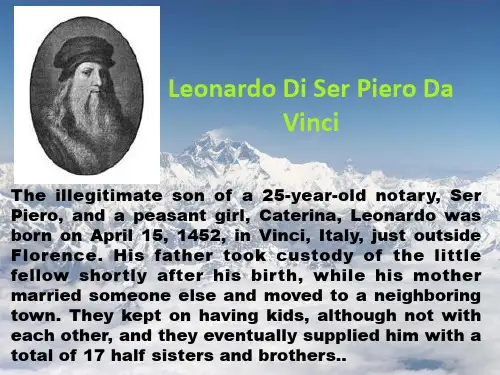
Leonardo Di Ser Piero DaVinciThe illegitimate son of a25-year-old notary,Ser Piero,and a peasant girl,Caterina,Leonardo was born on April15,1452,in Vinci,Italy,just outside Florence.His father took custody of the little fellow shortly after his birth,while his mother married someone else and moved to a neighboring town.They kept on having kids,although not with each other,and they eventually supplied him with a total of17half sisters and brothers..Born April15,1452Anchiano,Florence, Italy Died May2,1519Amboise,Indre-et-Loire,France Residence Italy,France National Italian Field Geometry,anatomy, math em atic s,ph y sic s,visual a rts, dynamics Known for Engineering, architecture,astronomy Religion Roman Catholic Church Leonardo di ser Piero da Vinci(April15,1452–May2,1519)was a talented Italian Renaissance Romanity Catholic[1]polymath:architect,anatomist, sculptor,engineer,inventor,geometer, scientist,mathematician,musician,and painter.He has been described as the archetype of the "Renaissance man",a man infinitely curious and equally inventive.He is widely considered to be one of the greatest painters of all time and a universal genius. Leonardo is famous for his realistic paintings,such as the Mona Lisa and The Last Supper,as well as for influential drawings such as the Vitruvian Man.He conceived of ideas vastly ahead of his own time,notably conceptually inventing the helicopter,a tank,the use of concentrated solar power,the calculator, a rudimentary theory of plate tectonics, the double hull, and manyothers.Relatively few of his designs were constructed or were feasible during his lifetime; modern scientific approaches to metallurgy and engineering were only in their infancy during the Renaissance. In addition, he greatly advanced the state of knowledge in the fields of anatomy, astronomy, civil engineering, optics, and the study of water (hydrodynamics).famous painting —Monalisa The Mona Lisa prototype is the duchess of Venice.The duke of Venice requested Leonardo to have a portrait for her,but when the painting was finished,Leonardo packed it and fled with his minion at that night because he was too love it to gave ti to another people.What is more,Mona Lisa's right hand is called"the most beautiful hand in art history".famous painting—The Last Supper Da Vinci's Last Supper has become one of the most widely appreciated masterpieces in the world.It began to acquire its unique reputation immediately after it was finished in 1498and its prestige has never diminished. Despite the many changes in tastes,artistic styles,and rapid physical deterioration of the painting itself,the painting's status as an extraordinary creation has never been questioned nor doubted.OTHER WORKSother sujects-------Astronomical Leonardo wasn't agree to the traditional view "the center of the earth said" . He thought that the earthis just a planets that move around the sun, but is not the center of the solar system, what's more is not the center of the universe. He also thought that the sun itself is not move. In addition Leonardo thought the moon itself does not shine, and it merely reflects the light of the sun. His points is earlier than Copernicus "heliocentrism". Even at the time,Leonardo waslikely to fancy the use of solar energy.other sujects-------Medical •Leonardo also making great achievement in physiological anatomy , is considered to be thefather of modern physical anatomy. He is the first person to perform internal structure of the human brain by wax , also the first idea to produce heart and eyes with glass and ceramics .•He found that the blood function.He thought that blood plays metabolism, and the effect of the blood is continuously circulation. Leonardo took research of the heart, then he found that the heart has four cavity and draw a heart valve. In order to that, he thought the cause of elthers' death is one ofatherosclerosis. Later, the English scientist Harvey confirmed and developed Leonardo' physiological anatomy results.•组员:李小玉任晓杰史广西李瑞月刘利平林楚红。
介绍达芬奇的英语作文一分钟
介绍达芬奇的英语作文一分钟English:Leonardo da Vinci, often referred to simply as Da Vinci, was one of the most versatile and talented individuals in history. Born on April 15, 1452, in Vinci, Italy, he was not only a painter but also a scientist, mathematician, engineer, inventor, anatomist, sculptor, architect, botanist, musician, and writer. His most famous works include the Mona Lisa and The Last Supper, both of which showcase his mastery of painting techniques and his keen understanding of human anatomy and emotion. However, Da Vinci's genius extended far beyond art; he made groundbreaking discoveries in various fields, including anatomy, engineering, and optics. His notebooks are filled with sketches and ideas that were far ahead of his time, ranging from flying machines and armored vehicles to designs for urban planning and waterways. Da Vinci's insatiable curiosity and relentless pursuit of knowledge have left an indelible mark on the world, inspiring generations of artists, scientists, and innovators.Translated content:莱昂纳多·达·芬奇,通常简称为达·芬奇,是历史上最多才多艺、才华横溢的人之一。
介绍达芬奇英文作文

介绍达芬奇英文作文英文:As a virtual assistant, I am happy to introduce Leonardo da Vinci, one of the most famous artists and inventors in history. Da Vinci was born in 1452 in Italy and is known for his incredible skills in painting, sculpture, architecture, and engineering. He was a true Renaissance man, with a curious mind that led him to explore many different fields.Da Vinci's most famous painting is the Mona Lisa, which is known for its enigmatic smile and realistic portrayal of the human form. He also created The Last Supper, a painting of Jesus and his disciples that is considered a masterpiece of Renaissance art.In addition to his artistic talents, da Vinci was also an inventor and engineer. He designed flying machines, military weapons, and even a robot. He was fascinated bythe workings of the human body and made many anatomical drawings that were ahead of their time.Da Vinci's legacy continues to inspire people today.His curiosity, creativity, and dedication to learning are qualities that we can all strive to emulate.中文:作为一名虚拟助手,我很高兴向大家介绍列奥纳多·达·芬奇,历史上最著名的艺术家和发明家之一。
介绍达芬奇的英语作文
介绍达芬奇的英语作文Leonardo da Vinci, an extraordinary polymath of the Renaissance era, remains one of the most renowned figures in history. His multifaceted talents encompassed art, science, engineering, and anatomy, among other fields. In this essay, we delve into the life, achievements, and enduring legacy of this iconic figure.Born on April 15, 1452, in Vinci, Italy, Leonardo da Vinci exhibited remarkable curiosity and intellect from a young age. His insatiable thirst for knowledge led him to explore various disciplines, laying the groundwork for his later groundbreaking contributions.Leonardo's artistic genius is perhaps his most celebrated aspect. His masterpieces, including the iconic "Mona Lisa" and "The Last Supper," showcase not only his technical prowess but also his ability to infuse emotion and depth into his works. His mastery of techniques such as sfumato, chiaroscuro, and perspective revolutionized theart world and set a new standard for realism and expression.Beyond his artistic endeavors, Leonardo was also a visionary inventor and engineer. His sketches and designs encompassed a wide array of concepts, ranging from flying machines and armored vehicles to hydraulic systems and architectural innovations. While many of his inventionswere not realized during his lifetime, they laid the foundation for subsequent developments in science and technology.Leonardo's scientific inquiries were equally groundbreaking. His meticulous observations and anatomical studies, documented in his notebooks, advanced our understanding of the human body and laid the groundwork for modern medical science. His fascination with natural phenomena, such as water flow and geological formations,also contributed to advancements in fields such as geology and hydrodynamics.Furthermore, Leonardo's interdisciplinary approach to knowledge exemplifies the Renaissance ideal of the"Renaissance Man" or "universal genius." He seamlessly integrated art, science, and philosophy, recognizing the interconnectedness of these disciplines long before it became commonplace. His holistic perspective continues to inspire interdisciplinary collaboration and innovation in the modern world.Despite his immense contributions, Leonardo's life was marked by a sense of restlessness and perpetual curiosity. He constantly sought to push the boundaries of knowledge and explore the mysteries of the natural world. His notebooks, filled with sketches, observations, and musings, serve as a testament to his insatiable thirst for understanding.Leonardo da Vinci's legacy endures to this day, transcending the boundaries of time and culture. His influence can be seen in every facet of human endeavor, from art and science to engineering and philosophy. His relentless pursuit of knowledge and innovation serves as a timeless reminder of the boundless potential of the human mind.In conclusion, Leonardo da Vinci's impact on the world cannot be overstated. His artistic genius, scientific curiosity, and visionary inventions have left an indelible mark on history, inspiring generations of thinkers, creators, and innovators. As we continue to explore the frontiers of knowledge, we would do well to heed the example of Leonardo da Vinci, the quintessential Renaissance Man.。
达芬奇介绍【英文版】
He is also famous for inventing things .For example,he invented a helicopter and a tank. He designed a beautiful bridge in 1502. The bridge was finally made in 2001, almost 500 years later! 他也是著名的发明的东西。例如,他发 明了一种直升机和坦克。他在1502年 设计了一个美丽的桥。这座桥是终于 在2001年,将近500年后!
Leonardo Da Vinci
Leonardo Da Vinci was born in 1452 .He is famous for his paintings.We can only see 15 of his paintings today. The Mona LISA is one of the most famous paintings in the word. 达芬奇生于1452年。他以他的作品而 闻名。今天我们只能看到15他的画作。 《蒙娜丽莎》是最著名的作品之一。
Many people say that he was the cleverest person in the history of the word. Do you agree? 许多人认为他是历史上最聪 明
介绍达芬奇的英语作文六年级50词
介绍达芬奇的英语作文六年级50词全文共6篇示例,供读者参考篇1Leonardo da Vinci - The Ultimate Renaissance ManHave you ever heard of Leonardo da Vinci? He was one of the most amazing people who ever lived! Leonardo was born in 1452 in a small town called Vinci, near Florence in Italy. Even as a kid, he was incredibly curious about the world around him. Leonardo would spend hours watching birds fly, sketching their wings and observing how they moved through the air. Little did he know that his childhood fascination would one day lead him to design the first concepts for flying machines!Leonardo had a mind like no other. He was interested in absolutely everything – art, science, engineering, anatomy, architecture, you name it! People during his time referred to him as a "Renaissance Man" because of his expertise across so many different subjects. The Renaissance was a period of great learning and creativity in Europe that lasted from the 14th to the 17th century.As an artist, Leonardo painted some of the most famous artworks in the world. Have you seen the Mona Lisa? That's his painting! With her mysterious smile and incredibly realistic human features, the Mona Lisa is Leonardo's most celebrated masterpiece. He worked on perfecting this portrait for years and years. Another renowned painting by Leonardo is The Last Supper, which shows Jesus having his final meal with his disciples before being crucified. Leonardo was a true master at creating lifelike human forms and facial expressions through his artwork.But Leonardo wasn't just a regular painter - he studied all kinds of artistic techniques. He was an expert sculptor, inventor, architect, scientist, mathematician, engineer, and so much more! As a scientist, he studied subjects like anatomy, geology, botany, aerodynamics and hydraulics. Have you ever watched water swirling around in a whirlpool or seen how tree branches split into smaller and smaller stems? Leonardo carefully observed and recorded details about the natural world like these, filling notebooks with his drawings and notes.Speaking of notebooks, Leonardo kept highly detailed journals throughout his life, writing in mirror script that could only be read using a mirror! How cool is that? His notebooks contained his thoughts, observations, inventions and futuristicdesigns - everything from flying machines and weapons of war, to musical instruments and devices to walk on water. Way ahead of his time, many of Leonardo's inventions wouldn't become a reality until hundreds of years later. For example, his design for a tank was kind of like an early concept for modern battle tanks!I could go on forever about the incredible life of Leonardo da Vinci. But I'll leave you with this - Leonardo once said "Learning never exhausts the mind." How inspiring that even as one of the greatest geniuses who ever walked the earth, he still believed there was an infinite amount to learn and discover. If a kid like me tries to approach life with even a fraction of Leonardo's curiosity and passion for knowledge, who knows what amazing things await? The Renaissance man shows us that we should never stop questioning, experimenting, and exploring the wonders of our world.篇2Leonardo da Vinci - The Ultimate Renaissance ManHave you ever heard of someone being called a "Renaissance man"? It means a person who is extremely talented in many different areas. Well, the original Renaissance man was Leonardo da Vinci! He was one of the greatest artists, inventors,and thinkers who ever lived. Let me tell you all about this amazing man from a long time ago.Leonardo was born in 1452 in the town of Vinci, near Florence in Italy. Even as a young boy, he was incredibly curious about the world around him. He loved to explore nature, observing plants, animals, and how things moved and worked. Leonardo also had an amazing artistic talent from a very early age. He could draw anything he saw with perfect detail and realism.As Leonardo grew up, he moved to Florence and became an apprentice to a famous artist and sculptor. He quickly mastered all the artistic techniques of painting, sculpting, architecture, and more. Some of his earliest works included the beautiful Adoration of the Magi and the famous Vitruvian Man drawing showing the ideal human body proportions.But art was just the beginning for da Vinci's incredible mind. He was endlessly curious about how the world worked. He studied anatomy, physics, engineering, botany, geology, cartography (mapmaking), and just about every other area of science you could imagine! Leonardo had an incredible visual mind and memory. He filled thousands of pages of notebookswith detailed drawings, diagrams, thoughts, and theories about his studies.As an inventor, Leonardo conceived ideas that were far ahead of his time. He drew up designs and plans for things like a helicopter, a tank, concentrated solar power, a robot, and even something like a theoretical car powered by a spring mechanism. It's amazing that 500 years ago he could dream up machines that seem ultra-modern to us!One of Leonardo's most famous inventions was the ability to paint with an oil-based technique that allowed incredible detail and quality never seen before. This was a major advance in painting that led to the timeless masterpieces he is most known for.In the latter part of his life, Leonardo created two of the most famous and renowned artworks in the entire world - the Mona Lisa and The Last Supper. The Mona Lisa, with her mysterious smile, sfumato technique, and incredible realism, became one of the most studied and admired portraits ever. The massive mural of The Last Supper, painted on a church wall in Milan, showed breathtaking skill in lighting, composition, and capturing human emotion and expression.Leonardo da Vinci truly did live during a "Renaissance" era, where there was a reawakening of art, science, and learning across Europe. And Leonardo embodied all of the varied talents of that new age of innovation and wonder about the world. He had a famously curious mind, exploring any area of study that interested him through first-hand observation and experimentation.Though he unfortunately passed away in 1519, Leonardo left behind hundreds of notebooks, drawings, plans, artworks and inventions that influenced future generations of innovators, artists and scientists. Even today, nearly 500 years later, his work and ideas continue to inspire people to be creative, thoughtful, and inquisitive. We could all take a page from Leonardo's book - using our talents, following our curiosities, and always striving to see the world through new eyes of wonder. Now that's a true Renaissance man!篇3Leonardo da Vinci - The Ultimate Renaissance ManLeonardo da Vinci was one of the greatest minds that ever lived. He was a true "Renaissance man" which means he was asuper talented guy who was great at all kinds of different things - art, science, invention, you name it!Leonardo was born in 1452 in a small town called Vinci near Florence, Italy. Even as a kid, he was super curious about how things worked. He loved exploring nature and took a keen interest in pretty much everything around him. Little did he know, that curiosity would one day make him famous all over the world!As Leonardo grew up, he moved to the city and became an apprentice to one of the best artists of the time. Leonardo was an art genius, too! He could paint and sculpt and draw all kinds of beautiful masterpieces. Some of his most famous artworks are the Mona Lisa painting and The Last Supper mural.But art was just the beginning for this super smart guy. Leonardo had a incredible mind for science and invention as well. He studied subjects like anatomy, geology, botany, aerodynamics, and more. He came up with ideas that were way ahead of his time, like flying machines, submarines, concentrated solar power, and even tanks! Can you imagine how amazing it would have been to meet Leonardo back then?One of Leonardo's talents was his ability to look at the world in a different way than others. This unique perspective allowedhim to make new connections that led to all kinds of inventions and discoveries. He liked to combine art and science by making extremely detailed drawings of his observations in nature. These drawings helped him understand how things like muscles, plants, birds, and the human body itself worked.For example, Leonardo studied how birds fly and made designs for some of the earliest flying machines and parachutes. He may have been the first person to truly understand aerodynamics and air flow! Unfortunately, the technology at the time wasn't advanced enough to actually build his inventions successfully. But many of his designs were amazing previews of what would come hundreds of years later.In addition to all his scientific studies, Leonardo was also a talented engineer, inventor, architect, writer, and even a vegetarian chef! Is there anything this guy couldn't do? His incredible range of knowledge and skills shows why he is considered one of the most diversely talented people in human history.Despite all of his amazing accomplishments, Leonardo had a bit of an unlucky life in some ways. He struggled to finish projects on time and jumped from task to task frequently. Some people even considered him a bit of a weird loner! But that didn'tstop him from making discoveries that still influence our modern world centuries later.To sum it up, Leonardo da Vinci was the ultimate Renaissance man. He had curiosity and creativity that couldn't be matched. By studying and combining so many different subjects, he expanded human knowledge tremendously during his lifetime. Though he lived over 500 years ago, Leonardo's ideas, artwork, and innovations continue to inspire people all over the world today.So next time you look at the Mona Lisa's smile or see one of Leonardo's futuristic invention designs, remember - this guy was a true game changer! His endless talents and vision helped shape our understanding of so much, from art to science to the amazing mechanics of life itself. Not bad for a kid from a small Italian town who never lost his sense of wonder about the world around him!篇4Leonardo da Vinci - The Ultimate Renaissance ManHave you ever heard of someone being called a "Renaissance man"? It means a person who is really good at lots of different things - like art, science, invention, and more. Well,Leonardo da Vinci was the ultimate Renaissance man. He was born in 1452 in the town of Vinci, near Florence in Italy. Even as a kid, Leonardo showed he was super smart and talented in so many ways.Leonardo loved to explore nature and study how things worked. He was curious about everything - how birds fly, why water swirls in certain patterns, how shadows and light hit objects. He was always observing, questioning, and experimenting. Leonardo filled notebook after notebook with his observations, theories, inventions, and amazing drawings.Speaking of drawings, Leonardo was an incredible artist from a very young age. His realistic paintings captured every tiny detail. Two of his most famous works are the Mona Lisa and The Last Supper. The Mona Lisa is a small portrait of a woman with a mysterious smile. The Last Supper is a giant mural painting showing Jesus' last meal with his disciples. Leonardo's artworks are renowned for their life-like quality and emotional depth.But Leonardo didn't just make art - he studied so much more! He was greatly interested in anatomy, which is the study of the human body. At a time when cutting into human bodies was illegal, Leonardo found creative ways to learn about anatomy. He would dissect animals and make incredibly accurate drawings ofmuscles, bones, and organs. His notes on anatomy were centuries ahead of their time.Leonardo's inquisitive mind also led him to experiment with inventions and engineering. He designed flying machines, weapons, concentrated solar power, and even a Renaissance version of a tank! Many of his inventions couldn't actually be built until modern times due to lack of materials and technology back then. But his ideas and designs were pure genius.In addition to art, science, and invention, Leonardo also pursued architecture, sculpting, cartography (mapmaking), geology, botany, and more. He was truly a person of limitless talents and curiosities. Some say Leonardo had a "mind like a sponge" - he just soaked up every bit of knowledge around him.Even his handwriting was unique and strange, going from right to left in a kind of mirror script. Was this to keep his ideas secret, or did Leonardo's amazing brain just work differently than everyone else's? We may never know for sure.What we do know is that Leonardo da Vinci left an incredible legacy. His detailed notebooks reveal his brilliant thoughts and theories on so many topics. His breathtaking artwork like the Mona Lisa has captivated people for over 500 years. And many of the inventions he designed on paper eventually became realitiesthat changed the world, even if Leonardo himself never built them in his lifetime.So if you ever feel frustrated that you struggle in just one subject like math or English, remember the ultimate Renaissance man, Leonardo da Vinci. He was a master of numerous trades and intellectual pursuits. Leonardo embraced his curiosity about the world and never stopped learning, observing, creating, and thinking. And that immense passion resulted in a lifetime of amazing achievements that still influence us today.Truly, Leonardo da Vinci was the original "Jack of all trades, master of all." The ultimate Renaissance man!篇5Leonardo da Vinci - The Ultimate Renaissance ManHave you ever heard of someone being called a "Renaissance man"? It means a person who is really good at lots of different things. Well, Leonardo da Vinci was the ultimate Renaissance man! He was an artist, a scientist, an inventor, and so much more. Let me tell you all about this amazing guy who lived a long time ago.Leonardo was born in 1452 in a small town called Vinci in Italy. Even as a little kid, he was super curious about the world around him. He loved exploring nature and took notes on everything he saw - how birds flew, how water moved, how plants grew. His mind was always working!When he got older, Leonardo became a brilliant artist. He could paint amazingly realistic people and scenes. Two of his most famous paintings are the Mona Lisa and The Last Supper. The Mona Lisa is that cool painting of a woman with a mysterious smile. The Last Supper shows Jesus having his last meal with his disciples. Leonardo spent years perfecting these masterpieces.But Leonardo wasn't just a regular old artist. He made so many discoveries in science and invention too! He studied human anatomy by dissecting dead bodies. He drew designs for crazy inventions that were way ahead of their time, like a helicopter, a tank, concentrated solar power, and even something kind of like a calculator.One of Leonardo's biggest passions was the study of flight. He was fascinated by how birds could soar through the sky. He designed this weird flying machine based on how a bat's wings worked. Of course, it never actually flew with a person inside. Buthis ideas and sketches helped lay the foundation for aeronautics and the invention of airplanes much later on.Here are some other amazing facts about Leonardo da Vinci:He was left-handed and wrote backwards! His notebooks had to be read with a mirror.He was a vegetarian who loved animals and never killed them.He had an awesome memory and could remember everything he studied.He excelled at so many things - painting, sculpture, architecture, science, math, engineering, invention, and more!With all his talents, da Vinci was way ahead of his time. People in the 1500s didn't really understand this genius guy. It wasn't until many years after his death in 1519 that the world truly appreciated how brilliant and ground-breaking he was.Leonardo da Vinci was the definition of a "Renaissance man." He had a crazy curiosity and passion for learning about everything. His artwork is some of the most famous ever. And his scientific studies and inventions paved the way for new discoveries for centuries to come. Leonardo da Vinci truly was one of the greatest minds in human history!篇6Leonardo da Vinci: The Ultimate Renaissance ManHave you ever heard of someone who was a great artist, scientist, inventor, and philosopher all at the same time? Well, Leonardo da Vinci was exactly that – a true genius whose incredible talents stretched across many different fields. Let me tell you about this amazing man from a long time ago.Leonardo was born in 1452 in a small town called Vinci near Florence, Italy. Even as a young boy, he was always curious about the world around him and loved to explore nature. He would spend hours watching birds fly, water flow in rivers, and plants sway in the wind.As he grew older, Leonardo's talents began to shine. He was an extremely gifted artist who created some of the most famous paintings in the world, like the Mona Lisa and The Last Supper. But Leonardo didn't just paint beautiful pictures – he studied everything, from human anatomy to mechanics and engineering.One of Leonardo's greatest skills was his ability to observe the world closely and make incredibly detailed drawings of what he saw. His notebooks are filled with amazingly accuratesketches of human bodies, animals, plants, inventions, and more. He drew things from so many different angles and perspectives.But Leonardo didn't just draw – he was also a brilliant inventor way ahead of his time. Can you believe he designed things like a helicopter, a tank, concentrated solar power, and a robotic knight hundreds of years before they actually became a reality? His endless curiosity and imagination amazed everyone.Not only was Leonardo an artist and inventor, but he was also a scientist who studied subjects like anatomy, geology, botany, aeronautics, and so much more. He dissected bodies to learn about human anatomy. He closely examined rocks and fossils. He thought deeply about concepts like friction, gravity, and why the sky is blue.One of the coolest things about Leonardo is that he kept tiny notebooks where he wrote down all his thoughts and ideas in mirror-writing from right to left. These included his drawings, scientific diagrams, and notes on his inventions and observations about life. It's incredible that someone from so long ago could be an expert in so many different fields.Although Leonardo da Vinci lived over 500 years ago between 1452 and 1519, he truly was a man who was way ahead of his time. His curiosity, creativity, and powers of observationwere unlike anything the world had ever seen before. He had a deep fascination with understanding everything around him.Not only was Leonardo a genius with his hands with painting and drawing, but also with his brilliant mind. He made discoveries and hypotheses that were centuries before their time. Many ideas and inventions that we thought were modern were actually first dreamed up by Leonardo long ago.Today, Leonardo da Vinci is remembered as one of the greatest Renaissance figures and geniuses of all time. He inspired others to explore, learn, invent, and push the boundaries of what is possible. Leonardo showed that humans are capable of incredible achievements when they combine art, science, and intellect together.So whenever you look at the Mona Lisa's smile or designs for flying machines and robots, remember the amazing mind of Leonardo da Vinci. He was a true Renaissance Man who was talented in so many ways. Leonardo proved that with curiosity, observation, and creativity, one person can make groundbreaking contributions across many different fields. Perhaps you too can become a modern-day Renaissance man or woman!。
介绍达芬奇英语作文
介绍达芬奇英语作文Leonardo da Vinci, a polymath of the Italian Renaissance, is renowned for his remarkable contributions to various fields, including art, science, engineering, and anatomy. His genius and creativity continue to inspire generations worldwide.Firstly, da Vinci's artistic legacy is unparalleled. He is most famous for his masterpiece, the "Mona Lisa," which showcases his mastery of techniques such as sfumato and chiaroscuro. Additionally, his iconic fresco "The Last Supper" is celebrated for its composition and emotional depth. Da Vinci's artistry transcends mere representation; it embodies a profound understanding of human expression and the natural world.Moreover, da Vinci's scientific inquiriesrevolutionized the understanding of anatomy, physics, and engineering. Through meticulous dissections, he produced detailed anatomical drawings that significantly advancedmedical knowledge. His studies of anatomy paved the way for future breakthroughs in medicine and surgery. Furthermore, da Vinci's investigations into the principles of physics and mechanics laid the groundwork for inventions such as the parachute, helicopter, and armored tank, showcasing his visionary approach to engineering.In addition to his artistic and scientific endeavors, da Vinci was a visionary thinker who explored diversefields of study. His notebooks, filled with sketches, diagrams, and musings, reveal his insatiable curiosity and interdisciplinary approach to learning. From the study of fossils to the design of urban planning, da Vinci's wide-ranging interests anticipated many developments in fields as varied as paleontology, botany, and architecture.Furthermore, da Vinci's contributions to the understanding of light, optics, and perspective were groundbreaking. His experiments with light and shadow informed his paintings, imbuing them with a sense of realism and depth unparalleled in his time. Moreover, his treatises on perspective laid the foundation for modernprinciples of artistic representation, influencing generations of artists and architects.In conclusion, Leonardo da Vinci's legacy as avisionary artist, scientist, and thinker endures to this day. His insatiable curiosity, boundless creativity, and interdisciplinary approach to knowledge continue to inspire and influence individuals across the globe. From his iconic artworks to his pioneering scientific investigations, da Vinci's contributions have left an indelible mark on human history and continue to shape our understanding of the world.。