
(外研版)六年级英语下册课件 Module8 Unit2(3)
Reading Time:Who is he\she?
Yao Ming
Tai Lihua Confucuis
Yang Liwei
Homework
1. Write a simple story about Louis Braille.
2. Use ”When, What, Where, How” to interview your Preview Module 9Unit 1.
•
Paragraph 3
He was China’s first man in space. He is from Liaoning.He was born in 1965.First he became a polit,then he became a taikonaut.In 2003,Shenzhou V flew into space with him.All Chinese people are proud of him. What is his name?______________________.
Ask and answer
What was his name? When was he born? Where was he born? What happened to him? What did he learn to do? His name was Louis Braille. He was born in 1809. He was born in France. He became blind in 1812. He learned to read.
•
Paragraph 4
He was born in a poor family in the year 551 B.C.(公元前) and he was born in the state of Lu(鲁国).When he was 3 years old,his father died(死). He learned by himself.At last he became a great educator(教育家). He lived to be 73. What was his name?______________________.
请用你自己的语言,描述Louis Braille 的一生。
Task 3: Talk about a person and guess.
请一个同学介绍自己熟悉或崇拜的人。
其他同学根据他所描述的特点,猜猜这 个人是谁。
Paragraph 1
He was born in Shanghai in 1980.He is 226cm tall.He is a China’s favourite basketball star.And he is also a well-know basketball player in the NBA.He is a model for all the basketball players and for you and me. Who is he?_________________.
Module 8 Unit 2 His name was Louis Braille.
Born: 1981 City: Fuzhou In 1983:
could walk and speak,
couldn’t run fast and
speak English
Louis Braille(路 易斯· 布莱叶,1809 年1月4日-1852年1 月6日)是世界通用 的盲人及视觉障碍 者使用的文字系统 布莱叶点字法的发 明者。布莱叶点字 法是一种通过阅读 者用手指触摸由突 起的点组成的文字 进行阅读的方法。 这种系统已经适用 于几乎所有的已知 语言。
Why is he famous?
He made first letters in Braille.
Task 1: Interview your partners about Louis Braille.
请用课本第二部分的六个问题,
相互采访有关Louis Braille的经历。
Task 2: Describe Louis Braille’s life.
•
Paragraph 2
She is very beautiful,but she can’t see and she can’t speak. As a small child,she became deaf.She likes dancing very much.When she was 15 years old,she learned to dance.In 2005,she danced in Spring Festival Evening.Now she is a very famous dancer. Who is she?____________________.
外研版-英语-六年级下册-6B Module8 Unit2教案
Module8 BiographiesUnit2 His name was Louis Braille.一、教学内容:学习Module8 Unit2 His name was Louis Braille.二、教材分析本课主要学习如何简要讲述某人一生的经历。
三、教学目标(Teaching objectives)1.知识目标(knowledge goals):学习目标语句(Sentences):What was his name?When was he born?Where was he born?What happened to him?What did he learn to do?Why is he famous?学习目标词汇:was, born学习一首韵诗:Humpty Dumpty2.能力目标(Ability goals):能读懂描述Louis Braille的句子,学习并能口头运用When was he born? He was born in 1809.这类语句来询问并回答你想知道的人物信息,能以作文形式描述一个人的经历。
识别并会书写单词was, born。
3.情感目标:了解英雄人物的事迹,学会面对困难。
四、教学重、难点1、重点(Teaching focus):能听懂并能口头运用目标语句来询问并回答你想知道的人物信息,能以作文形式描述一个人的经历。
识别、书写目标词汇,掌握动词过去式的变化形式。
2、难点(Teaching difficulties):目标语句的准确理解和运用。
五、教学准备(Teaching preparation)Helen Keller的图片,课前上网下载一些有关“布莱叶盲文”的资料,如:“布莱叶文字母表”,六、教学过程(Teaching procedures)Step 1 Warm up1.老师与学生互致问候。
老师出示Helen Keller的图片,并就SB Unit1 中的故事自由提问,请个别学生回答。
外研版六年级英语下册全册教案

新标准英语三年级起点第八册教案一、教学内容本教学知识点源于外语教学研究出版社,小学英语(供三年级起始用)第八册Module 1第一单元。
本教学知识点围绕“在快餐店点餐”展开教学的。
学习“hamburger、cola、dollar、cent、enjoy”等单词及“What do you want?/I want a hotdog,please./Howmuch is it?/It is thirteen dollars and twenty-five cents.”重点句型展开教学使学生在情景中掌握教学内容,培养学生自主学习英语的能力和运用英语分析、解决问题的能力,以及交流和合作的能力。
二、教学目标1、知识目标(1)四会单词:hamburger、cola、dollar、cent、enjoy(2)能灵活运用重点句型,并清楚其运用的场合和语言:What do you want?/I want a hot dog,pleas e./How muchis it?/It is thirteen dollars and twenty-five cents.2、能力目标(1)通过情景交际活动,营造探究的学习氛围,引导学生自我探究,培养学生的听、说、读、写等综合能力及英语进行交际的能力。
(2)通过会话表演、小组比赛、游戏等活动多角度激发学生自主探究学习的积极性,培养学生学习英语的兴趣。
3、情感目标(1)根据学生的心理特点及实际情况设计有意义的教学活动,激发学生的积极性,使学生懂得如何在西式快餐店用英语点餐。
(2)使学生能利用所学的知识与别人合作、交流获得成功的喜悦。
三、教学重、难点1、教学重点:What do you want? I want a hot dog,please.How much is it? It is thirteen dollars and twenty-fivecents.2、教学难点:使学生懂得如何在西式快餐店用英语点餐。
Module8 Unit2 课文翻译外研(三起)小学英语六年级上册
Module8 Unit2Module8 Unit2 (1)1Listen and chant.部分翻译 (1)2Listen and read.部分翻译 (1)3Listen and read.部分翻译 (3)4Listen and learn to say.部分翻译 (4)5Listen and say.Then chant.部分翻译 (4)6Ask and answer.部分翻译 (5)7Read and do.部分翻译 (6)1Listen and chant.部分翻译Listen and chant.听一听并说唱。
I'm always here.我总是在这里。
I never go.我从不走。
You're sometimes here.你有时在这里。
You often go.你经常走。
2Listen and read.部分翻译Listen and read.听一听,读一读。
Simon西蒙I always ride my bike to school. I never go by bus.我总是骑我的自行车去学校。
我从不乘公共汽车去。
Jack杰克I often eat with a knife and fork. But I like chopsticks.我经常用一副刀叉吃(饭)。
但是我喜欢筷子。
Sam萨姆I often go swimming. I like swimming in the sea.我经常去游泳。
我喜欢在大海里游泳。
Xiaoyu小宇I love English.I 0ften read English books.我喜欢英语。
我经常读英语书。
Heping和平I like writing stories.Sometimes,I write stories in English.我喜欢写故事。
有时,我用英语写故事。
Lili丽丽I sometimes clean the blackboard for my teacher.我有时为我的老师擦黑板。
2023六年级英语上册Module8Unit2Ioftengoswimming教案外研版(三起)
1.通过例句和练习,让学生反复练习频率副词的用法,加深对频率副词用法的理解。
2.创设情境,让学生在实际情境中练习描述日常活动,并正确运用频率副词。
3.提供反馈和纠正,引导学生注意频率副词பைடு நூலகம்位置和使用场合。
4.鼓励学生多开口说英语,通过互动交流,提高语言运用能力。
教学资源准备
1.教材:确保每位学生都有外研版六年级英语上册Module 8 Unit 2的教材,以便学生能够跟随教学进度进行学习和复习。
8.教学反馈表:为学生准备教学反馈表,用于收集学生对课堂教学的反馈意见。这可以帮助教师了解学生的学习需求和教学效果,从而进行相应的调整和改进。
9.教学指导手册:教师需要准备教学指导手册,其中包含本节课的教学计划、教学步骤、教学资源等详细信息。教学指导手册可以帮助教师更好地组织和实施课堂教学。
10.教学评估工具:准备一些评估工具,如测验、考试等,用于评估学生对频率副词用法和日常活动表达方式的理解和掌握程度。这些评估工具可以帮助教师及时了解学生的学习进度,并根据需要进行教学调整。
5.鼓励学生继续努力,并提出他们在学习频率副词和日常活动描述方面可能遇到的任何问题。
课后拓展
1.拓展内容:
-阅读材料:选择与频率副词和日常活动相关的英语阅读材料,如短文、故事等。
-视频资源:查找与频率副词和日常活动相关的英语视频,如短片、动画等。
2.拓展要求:
-鼓励学生利用课后时间自主阅读和观看拓展内容,以加深对频率副词和日常活动的理解和运用。
教材分析
《2023六年级英语上册Module 8 Unit 2 I often go swimming教案外研版(三起)》是对话课教学设计。本节课主要围绕频率副词和日常活动进行教学。教材内容通过描述日常活动和频率副词,帮助学生掌握频率副词的用法,并能够运用所学知识进行真实情境下的语言交流。本节课的内容与学生的日常生活紧密相关,有利于激发学生的学习兴趣和积极性。通过本节课的学习,学生能够进一步巩固和拓展已学的英语知识,提高他们的语言运用能力。
外研版小学英语六年级下册 Module 8 Unit 2 教学课件PPT
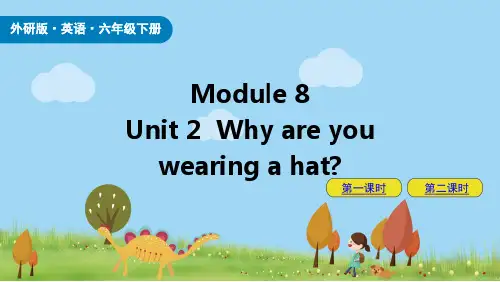
Look and say.
A: Why are you wearing a __h_at___ ?
B: Because it’s going to __b_e___h_ot____.
Look and say.
A: Why are you wearing a _T_-_s_h_ir_t ?
B: Because I’m going to __p_la_y_b_a_s_k_e_t_b_al_l __.
Homework
1. 熟记本节课所学的单词、短语和句 型,必须会听、说、读、写。
2. 将Listen and read.朗读流利。
第二课时
Read and write.
is she laughing she is happy
Listen and say. Then sing.
Find tቤተ መጻሕፍቲ ባይዱe answer to the riddles.
Pratise.
( B ) —________ are you tired? —Because I worked on the farm with my grandpa. A. When B. Why C. Where
Listen and read.
Amy: Why are you wearing a
—Because there is a big plane. 3. —Why __d_id__ you ___g_o_(go) to school on foot yesterday?
—Because it was raining.
Pratise.
用why, because, but, so, first, then来填空。
六年级上册英语教案 Module 8 Unit 2 I often . 外研版(三起)
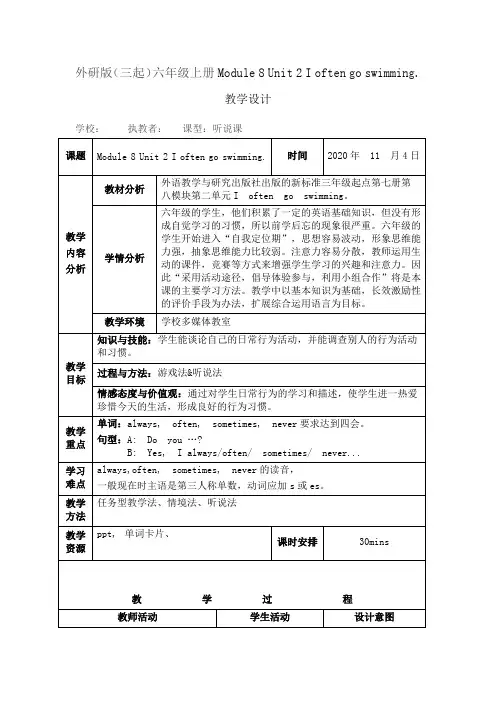
She/He always/often/sometimes/never... . /No, never.
1) Talkabout the chart with teacher.
2)Learn“always, often, sometimes, never”.
Listen and answer
Ss: Yes , I do. I always read books.
s: I often clean my room.
Q: Do you always read books?
Sometimes, I clean my room on Sunday、Monday、Thursday andFriday. soI often clean my room. T shows word card and teach the pronunciation of often.
Open the book, turn to page 47.
Ss read and mimic the tape.
The whole class read together.
Ss chant always, should clap their hands.When they chant never,stand up. When they chant sometimes, clap their hands again.When they chant often, they have to sit down.
5.Listen and repeat,and use the third person singular to describe the pupils.
外研版八年级英语下册Module8 Unit3 课件(29张)
1 When do you come to the photo club? On Thursday evening.
2 What can you do on Tuesday night? Watch the photo club! 2 Dance to the music of the world! 3 Film night
3 I _w_o_k_e__u_p_ in the middle of the night and could not fall asleep again.
4 The town is _f_a_m_o_u_s__fo_r_ its cheese.
air, along, bird, clear, climb, cross, quiet, shout
Language practice
1. I can _h_a_r_d_ly_ believe we’re in the city centre.
2. I don’t think they _a_ll_o_w_ people to swim in the lake.
3. We thought _s_o_m_e_b_o_d_y_ was moving about. 4. Lingling’s uncle said that it was wrong to
It was early in the morning. The park was very (1) q_u__ie_t_ and the only sound was the (2) b__ir_d_s_ singing. There was no one (3) _sh_o_u__ti_n_g_ nor were any dogs barking.
(外研版三起)六年级英语上册Module8第二课时Unit2教案
(外研版三起)六年级英语上册Module 8 第二课时 Unit 2 教案教学内容本课为外研版六年级英语上册Module 8 第二课时 Unit 2。
课程内容主要围绕“假期活动”这一主题展开,通过听力、口语、阅读和写作等多种形式,让学生掌握描述假期活动的英语表达方式,同时提高学生的英语听说读写能力。
教学目标1. 知识目标:学生能够理解并运用本课的关键词汇和句型,如“go camping”, “visit”, “have a picnic”等,描述假期活动。
2. 技能目标:学生能够通过听力练习,提高理解英语口语的能力;通过口语练习,提高英语口语表达能力;通过阅读练习,提高阅读理解能力;通过写作练习,提高英语写作能力。
3. 情感目标:培养学生对英语学习的兴趣,提高合作学习的意识。
教学难点1. 听力理解:学生对英语口语的理解能力,特别是对描述假期活动的英语口语的理解。
2. 口语表达:学生能够用英语流利地描述自己的假期活动。
3. 阅读理解:学生对英语阅读材料的理解能力,特别是对描述假期活动的英语阅读材料的理解。
4. 写作表达:学生能够用英语写作描述假期活动。
教具学具准备1. 教具:录音机、投影仪、PPT。
2. 学具:教科书、练习册、笔记本、彩色笔。
教学过程1. 导入:通过展示一些假期活动的图片,引起学生的兴趣,让学生猜测这些活动是什么。
2. 听力练习:播放录音,让学生听描述假期活动的英语口语,并完成相应的练习。
3. 口语练习:让学生分组讨论,用英语描述自己的假期活动,然后每组选一个代表进行汇报。
4. 阅读练习:让学生阅读描述假期活动的英语阅读材料,并完成相应的练习。
5. 写作练习:让学生用英语写作描述自己的假期活动,并进行小组互评。
板书设计1. Module 8 Unit 2 Holiday Activities2. 重点词汇:go camping, visit, have a picnic3. 重点句型:I went camping during the holiday. We visited the Great Wall. They had a picnic in the park.作业设计1. 听力练习:完成练习册上的听力练习。
外研版(三起)-英语-六年级下册--外研版三起Module 8 Unit 1教材同步讲解
例句:I like to play baseball.我喜欢玩棒球。
④smile/smal/v.(动词)微笑;挖.(名词)微笑
短语:wear a smile面带笑容big smile热情的微笑
例句:They all smiled at the good news.听到这个好消息,他们都喜笑颜开。
是连词,作“因为”讲,其后要接一个句子来陈述原因、理由。例如:
-Why do they want to go to China?他们为什么想去中国?
-Because they want to learn Chinese.因为他们想学习汉语。
【即学即用】
do you like eating fish? -Because it's delicious.
He smiled at her.他对她微笑。
⑤mistakes /mɪ'stek/n.(名词)错误
同义词:error错误,过失
短语:bad mistake严重的错误(过失)sad mistake惨痛的错误(过失)
例句:We all make mistakes,我们都会犯错误。
I made a mistake about the time.我把时间搞错了。
they put the cups on their heads and laughed more.
大明告诉了他这个故事。他们打算玩一个棒球游戏。埃米让玲玲为这个游戏拿来一些帽
子。但是玲玲拿来了一些杯子。他们都笑了。然后他们把这些杯子放在他们的头上并
大笑。
Sam smiled.④ "It's easy to make mistakes⑤with⑥ English words," he said. "I make lots of mistakes with Chinese words too. Now look what's in my bag! "Sam opened his bag.There were baseball caps " Hooray!"everyone shouted. They put the caps on Then they went to the playground and played baseball together.
外研版三年级起点六年级上册英语《Module 8 Unit 2 I often go swimming》(一等奖课件) (5)
MORE PRACTICE
( ) A. swim B. read C. always
( ) A. bus
B. clean C. bike
( ) A. often
B. sometimes C. write
( ) A. English B. doll
C. football
( ) A. never
B. for
• 3.My family
has a big dinner.
• 4.I will______s_ormeemtimeesmber that day.
always
GROUP WORK
Six students in one group, write a short passage about your habits.
Module 8
Unit 2 I often go swimming.
授课人:闫云飞
MY HABITS
M on.
Tu e.
We d.
Thu.
Fri.
Sat.
Su n.
read books
I always read books.
MY HABITS
go swimming
M on.
Tu e.
We d.
sometimes,you should watch
some films to relax,and you
should never be disappointed to
your life,just be always happy!
THANK YOU!
Maoma
o Heping
Lili
Xiaoy u
Sam