
牛津中考英语第一轮复习八年级下册unit1-2词汇释义完形语法填空阅读理解综合练习(含答案)
牛津沪教深圳版七年级上册Unit 3-4综合练习一.从下面每小题的ABCD四个选项中选出可以替换画线部分的最佳选项.【】1.Our teacher reminded us that we would have an English test tomorrow.A、felt sorryB、was angryC、helped us forgetD、made us remember 【】2.He is working hard to improve his oral English.A、practiceB、changeC、make…worseD、make…better【】3.A well-dressed lady entered the travel agency and wanted to know some information about traveling.A、Lady who is beautifulB、A lady who is wearing nice clothingC、A lady who has sweet smileD、A lady who is serious【】4.I won’t l et you down.A、make……happyB、make……disappointedC、make……angryD、make……excited 【】5.I won’t go to the BBQ, but my sister will go instead of me.A、in front ofB、in place ofC、in danger ofD、in need of【】6. John decided to cook for his mum on Mother’s Day.A、wanted toB、in order toC、made a decision toD、make up his mind to 【】7. A lady entered the office and walked over to Debbie.A、took outB、went outC、made upD、went into【】8. You have a good chanc e to go abroad.A、opportunityB、wayC、studyD、school【】9.She makes eye contact with the customers.A、keeps in touch with eyes.B、gets in touch with eyesC、communicates with eyesD、communicates by eyes【】10.The deaf man can only communicate by gestures.A、with greetingsB、by speakingC、with a startD、by body language 【】11.Please give your brother my regards when you see him.A、greetingB、happinessC、pleasureD、gifts【】12.“What’s up?”I ask when I saw the little girl outside the window.A、How is it goingB、What are you doingC、What does it likeD、What’s the matter 【】13.She is well-dressed.A、can dress herselfB、dosen’t wear nice clothesC、puts on her clothesD、wears nice clothes【】14.The teacher came in and asked what was up.A、what’s wrongB、what was the matterC、what the matter wasD、what was happened 【】15.I kept contact with my foreign friends by MSN.A、got in touchB、talked toC、kept in touch withD、had a word with 【】16.Disabled children have difficulty walking or moving.A、The children who are able to walk or move easily.B、The children who are different from.C、The children who can walk or move easily.D、The children who are not able to walk or move easily.【】17.After his wife died, he lived alone.A、unhappilyB、by himselfC、lonelyD、badly【】18.He raised his hand to ask a question.A、put upB、keptC、rose【】19.Tim fell off the bike and hurt his legs in an accident.A、injuredB、madeC、expressed【】20.They have offered me a large sum of money to go away.A、refused to giveB、provideC、been willing to give 【】21.You must ask permission if you want to leave early.A、disagreementB、questionsC、agreement【】22.Salter shouted with joy when she knew she won the first.A、happinessB、illnessC、surprise【】23..Many western countries raise a large number of beef cattle.A、put upB、move…higherC、take off【】24..You only need to payfor breakfast and dinner.A、spend money onB、costC、take【】25.If you are in high spirits, you have a good feeling.A、abilityB、senseC、pain二.用单词的适当形式填空。
1.In order___________ (learn) Japanese, he went to Japan.2.Daming has great difficulty___________ (speak) English.3.___________ (help) others makes me___________ (happily)4.Do you know the girl___________ (name) Mary?5.Shenzhen has a population of over ten___________ (million).6.My mother often teaches me___________ (play) the piano.7.Some photos___________ (take) by the children of Yushu are really great.8.The house needs___________ (clean).9.She needs___________ (buy) some food.10.After a short rest, She continues___________ (read) the book.11.How does he___________ (communication) with his friends?12.Tom doesn’t care about his___________ (appear) at all.13.We will go to the beach on the___________ (three) day.14.Amy enjoys___________ (work) in the company.15.The children are happy and___________ (cheer).16.Do you know the___________ (mean) of this new word?17.I will come back___________ (late). Please don’t leave.18.Please remember___________ (close) the door when you are away.19.Which one do you___________ (choice)?20.You must learn how to ___________ (expression) yourself. D、savedD、stayedD、helpedD、organization D、difficulty D、keepD、organize D、peace三. 语法填空Maybe everyone has trouble in 1. _______________ (learn) new words. It is not easy to remember and use them 2._______________ (correct). The following 3. _______________ (suggest) will help you a lot. It can be a good idea to divide(划分) the new words into groups according to the meanings. Thinking about the connections(联系) between 4._________________ (word) may help you to remember them. The more you practice, the 5._____________ (well) you will use them. You can also write a list of some new words. 6. ______________ (expression) your ideas with them and discuss the uses of these words as much as 7. ______________ (possibly). However, there is one more thing you should pay attention 8. _______________. Don't try to learn too many words at one time. Choose several important 9._______________ (one) to you. Repeat their pronunciations, spellings as well 10. _______________their meanings in your mind. Learn a little every day and you will learn a lot in a few years. It is the skills that can make you learn new words easily. It is the skills that can help you know more words quickly.四.完形填空It was Tom’s first visit to England, and he was looking forward to his first journey on London’s Underground Railway. Against the advice of his friends, he was determined to travel alone.He __1__ the station shortly after five o’clock in the afternoon. This is a bad time to travel in London, because crowds of people go home from work at this hour. He had to join a long __2__ of people who were waiting for tickets. When at last his __3_ came, he had some difficulty in making himself understood by the man selling tickets. However, he got the right ticket in the end and, by asking people the way, he also found the right platform. It was packed tight with people. He did not __4__ to get on the first train, but he was able to move nearer the edge of the platform so as to be in a better __5__ to get on the next one. When this train came in, Tom was forced forward on to the train by the push of people from behind. The doors closed and the train __6__ off. He was unable to see the names of the stations where the train stopped, but he knew that the station he wanted was the sixth __7__ along the line. When the train reached the sixth station, Tom __8__ feeling glad that his journey had been so easy. But he suddenly __9__ that he had come to a station he had never heard of. He explained his difficulty to a man who was standing on the platform. With a smile on his face, the man __10__ Tom that he had caught a train going in the opposite direction.【】1、A、arrived B、entered C、reached【】2、A、queue B、group C、team【】3、A、time B、turn C、term【】4、A、manage B、succeed C、fail【】5、A、state B、position C、way【】6、A、began B、ran C、drove【】7、A、stop B、place C、rest【】8、A、pushed off B、put off C、got off【】9、A、followed B、realized C、thought【】10、A、told B、said C、advised五.阅读理解ALife in the future will be different from life today. Between then and now many changes will happen. but whatwill the changes be?The population (人口) is growing fast. There will be many people in the world and most of them will livelonger than people live now.Computers will be much smaller and more useful, and there will be at least (至少) one in every room. And computer studies will be one of the important subjects in schools then. People will work fewer hours than they do nowand they will have more free time for sports, watching TV and travel. Traveling will be much cheaper and easier. And many more people will go to other countries for holidays.There will be changes in our food, too. More land will be used for building new towns and houses for all the people. Then there will be less room for cows and sheep, so meat will be more expensive. Maybe no one will eat it every day. Instead they will eat more fruit and vegetables. Maybe people will be healthier. Work in the future will be different, too. Robots will do dangerous and hard work. Because of this, many people will not have enough work to do. This will be a problem.【】1.In the future there will be _______.A、much more fruitB、more peopleC、less vegetablesD、less people【】2.Every family will have at least a _____________ in the future.A、robotB、cowC、TV setD、computer【】3.In the future people don’t have to __________.A、work long hoursB、work fastC、walk on footD、eat meat【】4.People may not eat _________ as much as they do today.A、fruitB、fishC、meatD、rice【】5.One big problem in the future is that ___________.A、many people don’t have to workB、many people will not be able to find workC、people have to work fastD、all the work will be done by robotsBAll schools have their own rules The rules change from one school to another. Some schools are muchstricter than others. There are also some rules that are strange or funny to us. Here are some funny school rules:Strict Japanese ruleMost schools ask students to wear uniforms, such as sports suits or skirts. But Japanese schools even have rules about the colour of underwear! They also need that girls' socks should be folded(折叠) in a certain way and boys' heads should be shaved(剃). Other Japanese schools tell students that they can't go to the movies after sunset.Different shoes in the USAAt some American schools, students have to change their shoes when they go into the schools every day. This makes sure students won't fall over on the floors and keeps the schools clean.No strange hair in the UKStudents can’t have strange hairstyles in some British schools. But they can wear certain hairstyles during the World Cup years. There were two students who had special hairstyles during the 2002 World Cup. After the World Cup, their teachers asked them to go to the barber's at once.【】1.How many strange or funny school rules are mentioned(提到) in this passage?A、Three.B、Four.C、Five.D、Six.【】2.Students in Japanese schools should wear_______.A、uniformsB、indoor shoesC、shirtsD、strange hairstyles【】3.Why do students in the USA have to wear indoor shoes?A、Because in that way they won't hurt if they fight.B、Because in that way they will feel comfortable.C、Because in that way they won't fall and can keep the schools clean.D、Because in that way they won't make any noise when walking.【】4.Which country's schools have rules about students' hair?A、Schools in Japan only.B、Schools in the USA and the UK.C、Schools in Japan and the UK.D、Schools in the UK only.【】5.What's the best title of the passage?A、Different school uniformsB、Different hairstylesC、Different shoesD、Different school rules参考答案一.1-5 DDBBB 6-10 CDABD11-15 ADDBC 16-20 DBAAC 21-25CABAB二.1.to learn 2.speaking 3.Helping d lion6.to play7.taken8.cleaning9.to buy 10.readingmunicate12.appearance 13.third 14.working 15.cheerful16.meaning ter 18.to close 19.choose 20.express三.1.learning 2.correctly 3.suggestions 4.words 5.better6.express7.possible8.to9.ones 10.as四.1-5 BABAB 6-10 BACBA五.BDACB AACCD。
深圳牛津八年级下unit1知识点归纳和练习
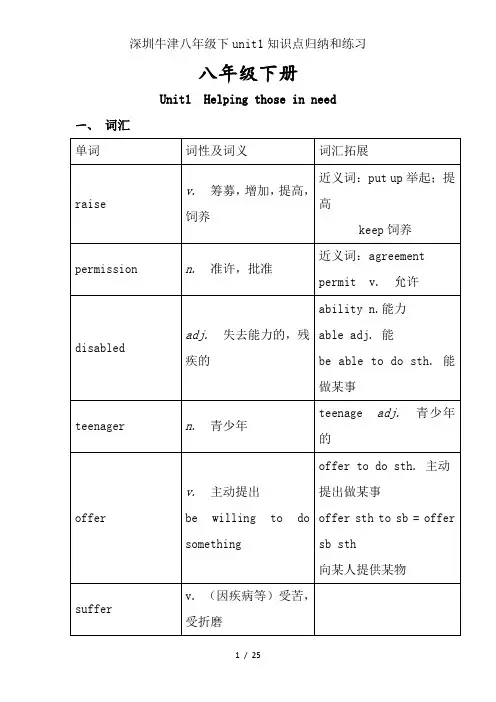
八年级下册Unit1 Helping those in need 一、词汇二、词组三、句型1. We spent time with a girl called Vivien 我们和一个叫维维恩的女孩在一起。
此句中,spend time with sb意为“和某人一起度过”。
例如:Some young people don't want to spend time with the old.一些年轻人不想和老人在一起。
I met a girl called Cindy.called 被叫做 =named 名为The girl called Lucy is one of the best students in our school. 那个被叫做Lucy的女孩是我们学校最好的学生之一2. I went there and took some photos of it.take photos/pictures of 表示“给……拍照”take pictures/photos 意为“拍照”They took many photos of the winner. 他们拍了许多获胜者的照片。
Although I love holidays, I hate to take photos. 尽管我喜欢度假,但我却讨厌照相。
3.This helps them express their feelings.help sb (to )do sth.意为“帮助某人做某事”,help 后做宾补的不定代词可以带to ,也可以不带to ,本结构及help sb. with sth .意思相同。
拓展:help oneself to sth. 随便吃某物 Help yourself to the fish.express 及物动词,意为“表露,表达”Bill is not afraid to express his opinions.拓展:expression 名词,意为“表达,表示;表情”Her expression suggested anger. 她露出愤怒的表情。
中考英语一轮复习八下Unit1-2基础知识 语法知识牛津版

中考英语一轮复习八下Unit1-2基础知识+语法知识牛津版Objectives: To master the words, phrases and sentences of the units.Procedures:Activity One : Check the words , phrases and sentences .1. Words:1. marry v. → ________ (adj.) 已婚的2. communicate v. → ______________ (n.)3. north n. → ________ (adj.)4. wife n. → ________ (复数)5. interview v. → ____________ (n.) 采访者6.recent adj. → ________ (adv.)7. exact adj. → ________ (adv.)8.pollute v. → ________ (n.)9.意识到 10. 形势 11. 不可能12. 采访 13. 环境 14. 条件15.到国外 16. 正是,没错II. phrases:1. 过去常常做某事2. 在小镇的北部3. 在某些方面4. 和以前一样频繁5. 感到有点孤单6. 和他父母出国7.彼此保持联系 8. 使交流更加容易III. Sentences:1. 等下一班车需要很长时间。
It us a long timethe next bus.2. 这个小镇在过去的几年中变化很多吗?H the to wn changed a lot?3. 后来政府意识到这个问题并采取措施改善它。
Later the the problem and took actionthe situation.4. 在某种程度上,生活比以前好多了。
但是,像以前一样频繁见面不可能了。
, the life is than before. H, it has become for them to see each other before.5. 在这种状况下你们如何保持联系的?我们主要考发邮件联系。
最新中考复习八年级下册1单元知识点汇总及测试附答案(牛津版)
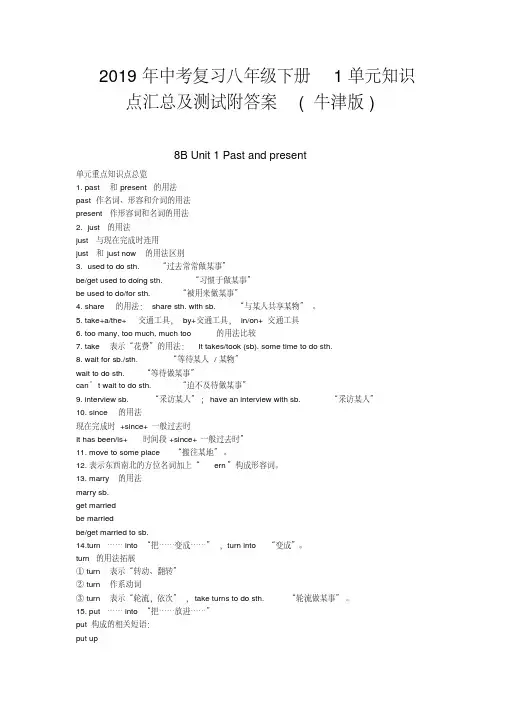
2019年中考复习八年级下册1单元知识点汇总及测试附答案 (牛津版)8B Unit 1 Past and present单元重点知识点总览1. past和present的用法past作名词、形容和介词的用法present作形容词和名词的用法2.just的用法just与现在完成时连用just和just now的用法区别ed to do sth. “过去常常做某事”be/get used to doing sth. “习惯于做某事”be used to do/for sth. “被用来做某事”4. share 的用法:share sth. with sb.“与某人共享某物”。
5. take+a/the+交通工具,by+交通工具,in/on+交通工具6. too many, too much, much too的用法比较7. take表示“花费”的用法:It takes/took (sb). some time to do sth.8. wait for sb./sth. “等待某人/某物”wait to do sth.“等待做某事”can’t wait to do sth. “迫不及待做某事”9. interview sb. “采访某人”;have an interview with sb. “采访某人”10. since的用法现在完成时+since+一般过去时It has been/is+时间段+since+一般过去时”11. move to some place“搬往某地”。
12.表示东西南北的方位名词加上“ern”构成形容词。
13. marry的用法marry sb.get marriedbe marriedbe/get married to sb.14.turn……into“把……变成……”,turn into“变成”。
turn的用法拓展① turn表示“转动、翻转”② turn作系动词③ turn表示“轮流,依次”,take turns to do sth.“轮流做某事”。
牛津译林版英语八年级下册Unit1第1-2课时知识总结-(共34张ppt)

动词:marry 结婚(及物动词) 用法:marry sb. 和某人结婚 marry sb. to… 把某人嫁给…
我下个月要和Tim结婚了。 I'm going to marry Tim next month.
名词:marriage 婚礼,婚姻
9. turn...into... 把…变成…
1.past
n. 过去 in the past 在过去 There was a cinema in this area in the past. 过去这儿有一个电影院。
adj. 过去的 在过去的两年中(用于完成时) in the past two years 过去的两年中我的家乡发生了巨大的变化。 Great changes have taken place in my hometown in the past two years. prep. 经过 walk past a school= pass a school 经过一个学校
2. present
n. 现在,目前 常见词组:at present = at the moment = now 用于现在进行时态 The students __a_re__h_a_v_i_n_g_(have) a meeting at the moment.
n. 礼物 present = gift 给她买礼物(两种表达): buy her a present = buy a present for her
关于way的其他常见搭配 on one’s way home 在…回家的路上 on one’s way to school 在…去学校的路上 by the way 顺便问一下 the way of doing sth 做…的方式 in the way/in one’s way 妨碍,挡路
2024年中考英语牛津译林版英语八年级下册u1-u8核心知识点考点汇总
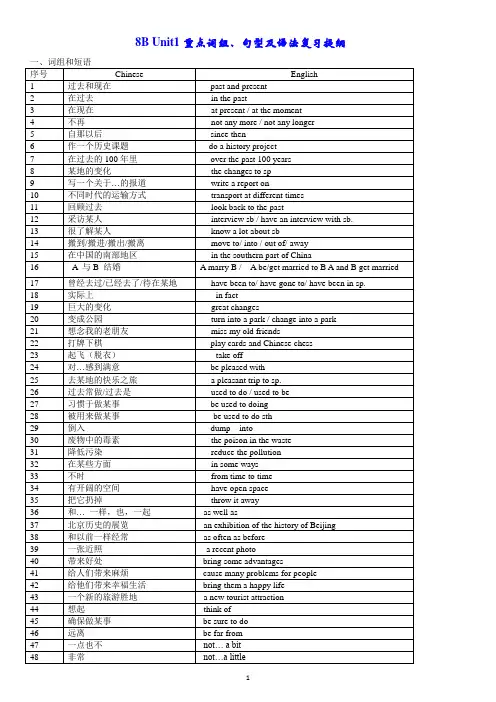
8B Unit1重点词组、句型及语法复习提纲49 周围的青山绿水green hills and rivers around50 把某物落在某地leave sth sp51 和某人一起拍照take photos with sb52 拍某人的照片take photos of sb53 处于使用中be in service / be in use54 乘… 去某地take … to sp / go to sp by….55 靠近next to56 更少的发展less development57 放学后在学校和朋友聊天stay after school to chat with friends58 同意某人的观点agree with sb59 同意做某事agree to do60 有更多的时间放松自己have more time to relax oneself61 在小学in primary school62 有同感have the same feeling63 自然美景natural beauty64 顺便问一下by the way二、重点句子及句型:1. ----Eddie,have you seen my food ? ----Yes. I’ve just eaten it.2.The factory used to dump its waste into the river.(didn’t use to do/used not to do)3.I have known the place since I was very young.4.We lived together till 1965 when I got married.5.China has changed a lot. = Great changes have happened to China.= There have been great changes in China.6.Many of them have moved to other areas and I feel a bit lonely from time to time.7.They cannot see their friends as often as before.8.The government realized it was a very serious problem and took action to reduce the pollution.9.Eddie has lived with Millie since he was born./last year/3years ago.10.They have gone to the cinema already. John has been to the USA a few times.11.I come to school by bus on my own12.He thinks he is unlucky enough to see the changes to Sunshine Town.13.I will stay there for a whole week to enjoy the sun and the beach.14.I wish you a happy holiday. = I wish you will have a happy holiday.15.The changes to Moonlight Town have brought many benefits but they have also caused many problems for people.16. Some animals and plants have lost their living areas because of these changes.17. It no longer provides a good environment for wildlife. = It does n’t provide a good environment for wildlife any longer.18.Now, let me show you how to get to the train station.三、语法:1.现在完成时用法一:表示过去发生的动作对现在产生影响。
2024八下第1-2单元 知识点梳理 中考复习
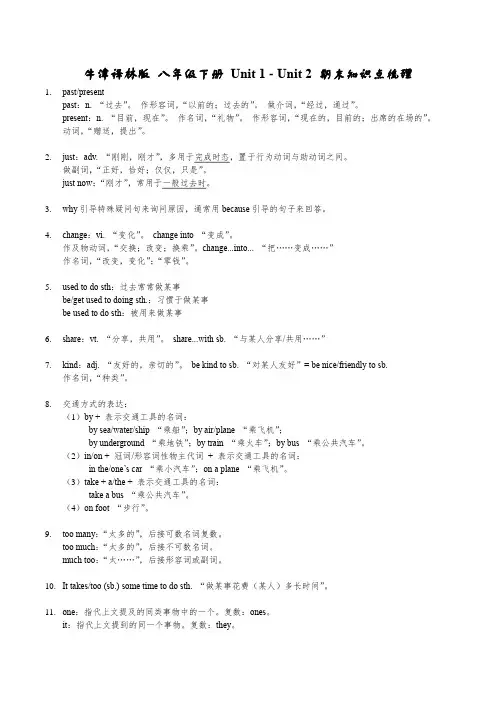
牛津译林版八年级下册Unit 1 - Unit 2 期末知识点梳理1.past/presentpast:n. “过去”。
作形容词,“以前的;过去的”。
做介词,“经过,通过”。
present:n. “目前,现在”。
作名词,“礼物”。
作形容词,“现在的,目前的;出席的在场的”。
动词,“赠送,提出”。
2.just:adv. “刚刚,刚才”,多用于完成时态,置于行为动词与助动词之间。
做副词,“正好,恰好;仅仅,只是”。
just now:“刚才”,常用于一般过去时。
3.why引导特殊疑问句来询问原因,通常用because引导的句子来回答。
4.change:vi. “变化”。
change into “变成”。
作及物动词,“交换;改变;换乘”。
change...into... “把……变成……”作名词,“改变,变化”;“零钱”。
ed to do sth:过去常常做某事be/get used to doing sth.:习惯于做某事be used to do sth:被用来做某事6.share:vt. “分享,共用”。
share...with sb. “与某人分享/共用……”7.kind:adj. “友好的,亲切的”。
be kind to sb. “对某人友好”= be nice/friendly to sb.作名词,“种类”。
8.交通方式的表达:(1)by + 表示交通工具的名词:by sea/water/ship “乘船”;by air/plane “乘飞机”;by underground “乘地铁”;by train “乘火车”;by bus “乘公共汽车”。
(2)in/on + 冠词/形容词性物主代词+ 表示交通工具的名词:in the/one’s car “乘小汽车”;on a plane “乘飞机”。
(3)take + a/the + 表示交通工具的名词:take a bus “乘公共汽车”。
(4)on foot “步行”。
2016牛津版中考英语一轮复习八下 Unit 1 Past and present(含答案)
8B Unit 1 Past and present复习目标:1、学会用英语介绍自己家乡的变化。
2、归纳8B Unit 1 中的四会、重点单词、短语和句型。
3、理解现在完成时的各种形式,掌握否定句、疑问句及其肯定和否定回答的基本用法。
4、理解现在完成时中时间状语的用法。
复习过程:Task 1 Words2、Do exercises. (完成随堂检测第一题)Task 2 Important phrases and senteces.2、重点句子(1).I don’t want to play with you any more.(2). Now, the government has turned the place into a park.(3). The pollution was terrible then because the factory used to dump its waste into the river.(4). I feel a bit lonely from time to time.(5). There have been many changes to the place.= The place has changed a lot .3、Do exercises. (完成随堂检测第二题)4、Tell the differences between them (discuss in your group)(1)alone 与 lonely【讲解】lonely 是指“孤独的,寂寞的”, alone是指“独自一人”【练习】()1、Grandma Wang lives ____________ , but she doesn’t feel ____________.A. alone, aloneB. lonely , lonelyC. lonely , aloneD. alone , lonely(2) used to do sth, be used to doing sth 与be used to do sth【讲解】 used to do sth 表示“过去常常做某事” be used to doing sth 表示“习惯于做某事”be used to do sth 表示“被用来做某事”(还可以换成 be used for doing sth)【练习】1、刀是用来切东西的。
2022年牛津译林版英语中考一轮复习八年级下册Unit1课件
Sheyang’s past and present
At present…
In the past…
话题
变迁 Changes
要点: 1. 我对阳光镇很了解。部,几年后,我们搬到镇中心
的另一座公寓。 3. 现在阳光镇已经发生了很大变化,看起来就像
Back
Exercises:
1.At p__re_s_e_n_t_(现在,目前),we can fly to Beijing from Dafeng.
2.My home is two __b_lo_c_k_s_ (街区) away. 3.We should be brave enough to face all kinds of
have a try.
4.Beijing is a big city in the _n_o_r_th_e_r_n_(北方的) part of China.
5.When I was at_p__ri_m__a_r_y_(初级的) school, my mum took me to school.
6.We try to go _a_b_r_o_a_d_(到国外) at least once a year. 7.My parents have lived in their hometown since
serious _s_i_tu_a_t_i_o_n_s_ (情况). 4.There are fewer _f_a_c_to_r_i_e_s (工厂) in my
hometown now.
5.The _w_i_v_e_s_ (妻子) of the policemen usually do lots of housework at home.
2019-2020年广州深圳牛津版中考总复习第一轮 第十三讲 八年级下Unit1-2
第十三讲八年级(下)Unit 1 - Unit 2基础知识即时训练一、根据所给的中文写出正确的重、难点单词。
1. 准许________2. 青少年________3. (因疾病等)受苦_______4. 痛苦________5. 友情________6. 困难________7. 勇气________ 8. 社区________9. 语言________ 10. 交流________11. 手势________ 12. 信息________13. 怎么了________ 14. 表情________15. 外貌________ 16. 印象________17. 筹募________ 18. 组织________19. 表达________ 20. (使)疼痛________21. 接受________ 22. 提醒________23. 使交叉______ 24. (与某人)握手______25. 有残疾的______ 26. 严重的______27. 孤独的______ 28. 厌倦的______29. 向;朝______ 30. 使保持(在某位置) _____二、根据下列句子及所给单词的首字母写出所缺单词。
1. John is kind. He often o______ to help others.2. They try to r ______ money to help the children in poor areas.3. In my opinion, he is making a s ______ mistake.4. In war times, everyone wants to live in p ______.5. Tom is careless, so he h ______ his legs when he was riding his bike.6. Will you a______ her invitation?7. Mr White is out. Would you like to leave a m_____?8. The house faces t___________ the south.9. The two boys are studying n______ and neck.10. Cindy, what’s the m______? You don’t seem happy.三、根据所给的汉语内容,用英语完成下列句子。
牛津英语八年级下册单元知识点归纳
牛津英语八年级下册单元知识点归纳Unit 1: Routines and HabitsIn this unit, we learned about different daily routines and habits. We discussed how to talk about regular activities using the present simple tense, adverbs of frequency, and time expressions. We also learned how to give opinions and talk about preferences. Furthermore, we practiced asking and answering questions to gather information about others' routines and habits.Unit 2: Leisure ActivitiesDuring this unit, we explored various leisure activities and hobbies. We learned vocabulary related to different sports, games, and pastimes. Additionally, we studied how to express likes, dislikes, and preferences for certainactivities using the present simple and present continuoustenses. We also discovered the importance of stayingphysically fit and engaged in recreational activities.Unit 3: CommunicationThis unit focused on improving our communication skills. We learned about different types of communication such asbody language, gestures, and facial expressions. Additionally, we studied how to engage in effective conversations,including expressing opinions, agreeing, disagreeing, interrupting politely, and giving reasons. We also practiced writing formal and informal letters.Unit 4: Environment and NatureDuring this unit, we explored our environment and the importance of taking care of nature. We studied vocabulary related to environmental issues, such as pollution, deforestation, and climate change. We learned about theimpact of human activities on the planet and discussed waysto become environmentally friendly. Additionally, wediscussed environmental problems at a global level and explored potential solutions.Unit 5: TechnologyIn this unit, we delved into the world of technology. We learned vocabulary related to different types of technology, including computers, smartphones, and social media. We discussed the advantages and disadvantages of technology in our lives, as well as the impact it has on society. We also studied how to express opinions and give reasons regarding technology usage.Unit 6: Travel and AdventureDuring this unit, we explored various aspects of travel and adventure. We learned vocabulary related to transportation, accommodation, and tourist attractions. We practiced asking and answering questions about travel experiences and discussing destinations. Additionally, westudied how to talk about past events using the past simple tense.Unit 7: Media and EntertainmentThis unit focused on media and different forms of entertainment. We explored types of media such as television, movies, music, and books. We learned vocabulary related to these topics and discussed our preferences and opinions. We also studied how to write a film or book review, expressing our thoughts and recommendations.Unit 8: Health and Well-beingIn the final unit of this book, we explored the importance of health and well-being. We learned vocabulary related to health, diet, exercise, and lifestyle choices. We discussed the benefits of a balanced diet and an active lifestyle. Additionally, we studied how to give advice and discuss healthy habits.Overall, the eighth-grade English book covered a wide range of topics, helping us expand our vocabulary, improve our communication skills, and enhance our understanding of various aspects of daily life.。