
最新冀教版六年级英语下册Lesson 7 Always Have breakfast教案
Lesson 9 Always Have breakfast!
一、教学目标:
(一)知识:
1. 巩固内容:
always, sometimes, usually, never等表示频度的词汇。
2. 掌握四会词汇和句型:
①healthy, strong, weak, week
②—How often do you ____?
—____ times a ____.
(二)能力:
学生能用所学词汇句型说出有关健康的句子。
(三)情感:
帮助学生明白早餐的重要性,培养学生关注健康、关心他人的品质。
二、教学重点、难点:
重点:四会词汇和句型
难点:—How often do you ____? —____ times a ____.句型的理解和运用。
三、教具、学具:
图片、录音机、
四、教学过程:
Class Opening and Review
Greeting.
Play a game: Never, Never
Key Concepts
①healthy, strong, weak, week
②—How often do you ____?
—____ times a ____.
Introduce
Use puppets to role-play “healthy”, “strong”,” weak”and “sick”.
P1: (Sad, coughing.) I feel sick. Sick. Say it, please, class.
C: Sick.
P2: (Happy, energetic.) I don’t feel sick. I feel healthy! Healthy. Say it, please.
C: Healthy.
P1: I am weak. Look! ( Try to carry a chair, but can’t.) This chair is too heavy. I am weak. Weak. Say it, please.
C: Weak.
P2: Not me. I am strong. (To Puppet 1.) May I help you with that chair? ( Carry it.) There! The chair is heavy, but I am strong. Strong. Say it, please.
C: Strong.
Show the pictures and introduce these words.
Write “healthy”, “strong”,” weak”and “sick”on the blackboard. Ask the students try to translate them.
Drill
Ask the students to say who is strong/ healthy/ weak/ sick.
Student book No.1
Introduce
T: Everyone wants to be strong and healthy. Do you? Let’s learn what to do. First, always eat breakfast. Because it’s good for you! Do you always eat breakfast? Let’s look. Here is a chart.This is a week. There are seven days in a week. What are they? (Say Monday, Tuesday……)
Introduce How often did you eat breakfast last week? Once/ Twice/ Three times/…… a week.
Student book and audiotape
Play the audiotape and answer the questions:
How often did Danny/ Kim/ Li Ming eat breakfast last week?
Practice
T: We can say other things. For example: How often do you play ping-pong?
Ask the students to say some sentences.
Ask the students to make up appropriate sentences about how often and make up a chart.
Ask the students to introduce their charts.
Activity book.
Class closing.。
2020冀教版六年级英语下册电子课本课件【全册】
Lesson 2:At the sports shop
2020冀教版六年级英语下册电子课 本课件【全册】
Lesson 3:Let's try!
2020冀教版六年级英语下册电子课 本课件【全册】
Lesson 4:Did you have fun?
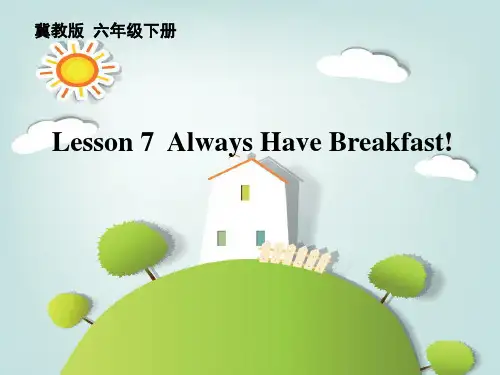
Lesson 7:Always have breakfast!
2020冀教版六年级英语下册电子课 本课件【全册】
Lesson 8:Always brush your teeth!
2020冀教版六年级英语下册电子课 本课件【全册】
2020冀教版六年级英语下册电子课 本课件【全册】
Review:Again,please!
2020冀教版六年级英语下册电子课 本课件【全册】
Unit 2:Good to you!
2020冀教版六年级英语下册电子课 本课件【全册】
2020冀教版六年级英语下册电子课 本课件【全册】
Lesson 5:A basketball game
2020冀教版六年级英语下册电子课 本课件【全册】
Lesson 6:A famous football player
2020冀教版六年级英语下册电子 课本课件【全册】目录
0002页 0032页 0071页 0121页 0188页 0218页 0233页 0279页 0306页 0350页 0411页 0436页 0455页 0471页 0497页 0524页 0542页
课文目录与封面 Lesson 1:Ping-pong and basketball Lesson 3:Let's try! Lesson 5:A basketball game Review:Again,please! Lesson 7:Always have breakfast! Lesson 9:Eat more vegetables and fruit! Lesson 11:Work hard! Review:Again,please! Lesson 13:Summer is coming! Lesson 15:Jenny's summer holiday Lesson 17:Danny's summer holiday Review:Again,please! Lesson 19:Buying gifts Lesson 21:A party for Li Ming Lesson 23:Good-bye! Review:Again,please!
新冀教版六年级英语下册《Unit 2 Good Health to You. Lesson 7 Always Have Breakfast.》课件_20
4.How can we be healthy and strong .(回答)
Always have breakfast,play sports every day and eat more vegetables and fruit.
6.You should have breakfast every day. (翻译句子)
How often did you have breakfast last week? I had breakfast six times last week.
Байду номын сангаас
Name
have breakfast eat fruit
Kim
six times four times
Li Ming Jenny Wang Hong
Does everyone want to be healthy and strong?
2.Danny had breakfast once last week.(就划线部分提问)
How often did Danny have breakfast?
3.I always have breakfast. (改为一般疑问句)
一、按要求写单词
1.health(形容词) h_e_a_l_t_h_y 2.always(反义词) n__e_v_er
3.once= one time
4.twice= two times
二、翻译下列短语:
1. three times 三次
2. six times 六次
3. how often 多久一次 4. once a day一天一次
冀教2011版六年级英语下册《Lesson7AlwaysHaveBreakfast》教案及教学反思
冀教2011版六年级英语下册《Lesson7AlwaysHaveBreakfast》教案及教学反思教学目标1.学生能够理解单词:always, breakfast, lunch,dinner。
2.学生能够听懂、会说和会读短语:always havebreakfast, have lunch, have dinner。
3.能够掌握以下句式的用法:I always havebreakfast at seven o’clock. She has lunch attwelve o’clock. He has dinner at six o’clock.4.提高学生的英语口语表达能力。
教学重点1.单词及短语的掌握。
2.句式的运用。
教学难点1.句式的构建与表达。
2.口语交流的提升。
教学准备1.教师准备PPT教案。
2.学生课本、练习册、录音笔。
教学过程Step 1. Warm up1.与学生进行简单的英语问答,如问候和问今天的天气等。
2.让学生使用已学过的英语单词及短语进行交流,包括问候及日常用语。
3.检查学生对上节课学习内容的掌握情况。
Step 2. Presentation1.引入新单词及短语:always, breakfast, lunch, dinner, always have breakfast, have lunch, have dinner。
2.用图片展示每个单词的意思及意象。
3.通过朗读单词和让学生跟读巩固单词及短语的掌握。
Step 3. Practice1.学生使用新学单词及短语进行对话和问答,并使用句式I always have breakfast at seven o’clock. She has lunch at twelve o’clock. He has dinner at six o’cl ock.进行练习。
2.通过情景模拟练习,让学生能够自如地运用所学知识。
3.以小组为单位,让学生互相讲述自己的饮食习惯,即早中晚餐的时间和内容。
小学六年级下册G卷英语第一单元期中试卷(答案和解释)
小学六年级下册英语第一单元期中试卷(答案和解释)英语试题一、综合题(本题有50小题,每小题2分,共100分.每小题不选、错误,均不给分)1.I always ______ (go) to the library after school. I ______ (like) to read books about animals and science. My best friend, Sarah, ______ (join) me sometimes. We ______ (sit) in a quiet corner and ______ (read) together. After we finish reading, we ______ (talk) about the books we ______ (read). It ______ (be) a fun way to spend time.2.This summer, we are going to the __ to enjoy the warm weather. I plan to bring my__, a towel, and some __. I also want to take a swim in the __. My family will have a great time together.3.Which of these is a pet?A. CatB. LionC. TigerD. Elephant4.We ______ (not/finish) our homework last night because it ______ (be) too difficult. This morning, I ______ (ask) my friend for help, and he ______ (explain) everything to me. Now I ______ (understand) the lesson.5.Which of these is used to play music?A. GuitarB. TableC. KnifeD. Chair6.How many days are there in a week?A. SevenB. FiveC. SixD. Four7.What is the opposite of "fast"?A. SlowB. SmallC. TallD. Heavy8.My mother is very __________. She always helps me with my __________ and makes my favorite __________. I like to spend time with her because she is always__________ and kind. Sometimes, we go to the __________ together, and she teaches me how to __________. I love my mother because she is __________ and always makes me feel __________.9.Which one is used to cut paper?A. ScissorsB. RulerC. PenD. Eraser10.Which of these is a season?A. MondayB. WinterC. PizzaD. October11.I _______ a new pencil case.12.What is the opposite of "fast"?A. SlowB. HeavyC. TallD. Light13.This morning, I __________ (1) my favorite book. It __________ (2) a story abouta brave knight. I __________ (3) the book before school, and I __________ (4) to finish it after school.st Saturday, we ________ (have) a picnic in the park. We ________ (bring) sandwiches, fruit, and juice. We ________ (sit) on the grass and ________ (talk) for hours. It ________ (be) a relaxing day.15.Which of the following is a shape?A. CircleB. DogC. CarD. Book16.Jack is at the playground with his friends. They are playing on the __________, climbing on the __________, and swinging on the __________. Jack loves playing outside because it is fun and he gets to exercise while having fun with his friends.17.What do we use to brush our teeth?A. PenB. BrushC. ToothbrushD. Spoon18.They ________ (run/runs) fast in the race.19.We _______ (take) a break at 10 o’clock.20.Which of these is not a fruit?A. BananaB. OrangeC. CarrotD. Apple21.What do you use to clean your teeth?A. SpoonB. ForkC. KnifeD. Toothbrush22.We __________ (1) to the zoo last Sunday. It __________ (2) a great day, and we __________ (3) to see many animals. My brother __________ (4) the monkeys, and I __________ (5) the elephants. We __________ (6) a lot of fun.23.Which of these is a tool?A. SpoonB. PlateC. HammerD. Chair24.Which animal is known for its long neck?A. GiraffeB. ElephantC. CatD. Dog25.Which animal can fly?A. ElephantB. CatC. BirdD. Tiger26.Which of these is a number?A. ThreeB. SpoonC. ChairD. Plate27.What do we wear on our head?A. HatB. GlovesC. ShoesD. Scarf28.My sister _______ a toy car.29.Tom and his friends _______ (play) soccer every Saturday afternoon. They enjoy the game a lot, and sometimes they even have a small competition between themselves.30.What do we wear on our feet?A. GlovesB. ShoesC. HatD. Jacketst holiday, I ______ (spend) two weeks in the mountains. I ______ (go) hiking every day, and I ______ (take) many pictures of the beautiful views.32.Which of these is a day of the week?A. JanuaryB. MorningC. SundayD. Summer33.I __________ (1) a trip to the zoo last month. It __________ (2) a wonderful experience. I __________ (3) many animals, including lions, tigers, and elephants. The monkeys __________ (4) funny, and the giraffes __________ (5) tall. We __________ (6) to the zoo by car and __________ (7) lunch there. It __________ (8) a great day.34.Which of these is a color?A. CatB. GreenC. TableD. Spoon35.Which of these is an insect?A. AntB. DogC. ElephantD. Cat36.Which word means "大"?A. SmallB. TallC. BigD. Thin37.Which one is a shape?A. SquareB. PlateC. ChairD. Table38.David and his family are going camping this weekend. They will set up a__________ in the forest and spend the night there. They will cook __________ over a campfire and tell stories. During the day, David and his sister will go __________ in the lake, and they will explore the nearby __________.39.Which of these is a color?A. TableB. BlueC. BookD. Chair40.Which of these is a school subject?A. BedB. MathC. ChairD. Spoon41.What is the opposite of "early"?A. LateB. SoonC. FastD. Slow42.I ______ (not like) to eat vegetables, but my mom always ______ (ask) me to eat them. Yesterday, she ______ (cook) a big bowl of soup, and I ______ (have) to eat some. It ______ (taste) good, and I ______ (feel) proud of myself.43.Every day, I __________ (1) my homework before dinner. It __________ (2) about 30 minutes. After that, I __________ (3) TV or __________ (4) games with my brother.44.What do you use to tell time?A. RulerB. ClockC. EraserD. Scissors45.James is at the swimming pool. He is learning how to swim. His coach tells him to practice __________ with his arms and legs. At first, James feels a little __________, but soon he gets the hang of it. After a while, he can swim across the pool without stopping. His coach says James is becoming a very __________ swimmer.46.My father _______ a newspaper every morning.47.My best friend and I _______ (share) a love for reading books. We _______ (read) books together every weekend. Last weekend, we _______ (read) a mystery novel, and we _______ (talk) about it for hours.48.Which of these is a vegetable?A. TomatoB. BananaC. CarrotD. Orange49.I ______ (usually/go) to school by bus, but today I ______ (decide) to walk because the weather ______ (be) so nice. When I ______ (arrive) at school, I ______ (meet) my friend, Tom, and we ______ (walk) to our classroom together. The first class ______ (start) at 8:00 a.m., and we ______ (have) math. I ______ (like) math because it ______ (be) very interesting.50.What do you use to brush your teeth?A. CombB. ToothbrushC. KnifeD. Spoon(答案及解释)。
冀教版 六年级下册英语-Unit 2 Lesson7 Always Have Breakfast
冀教版六年级下册英语-Unit 2 Lesson7 Always HaveBreakfast一、词汇和短语本课中出现的一些重要单词和短语:1.always:一直,总是2.have:有,吃3.breakfast:早餐4.egg:鸡蛋5.toast:烤面包片6.juice:果汁k:牛奶8.Orange juice:橙汁9.bread:面包二、故事梗概本课讲述的是一个爱吃早餐的小男孩Jack,他总是吃鸡蛋、烤面包片和橙汁。
有一天,他的朋友Brian来问他为什么总是吃早餐,Jack告诉他吃早餐可以让人健康和有更好的表现。
接着,他们一起去跑步,可是Brian因为没吃早餐而感到身体不适,Jack告诉他下次一定要吃早餐。
三、语法准则在本课的故事中,我们可以清晰地看到一些英语语法的使用。
下面是几个值得学习和注意的语法准则:1. 一般现在时态本课中使用了一般现在时态,用于表达经常性的动作和行为。
比如:•He always has breakfast.(他总是吃早餐。
)•I often play basketball.(我经常打篮球。
)•They usually go shopping on weekends.(他们通常在周末去购物。
)注意:为了在句子中表达经常性的动作和行为,我们通常使用“always”、“often”、“usually”这样的副词来修饰动词。
2. 肯定句和否定句本课中使用了肯定句和否定句来表达不同的含义。
比如:•I always have breakfast.(我总是吃早餐。
)•I never skip breakfast.(我从不不吃早餐。
)注意:在英语中,我们通常使用“always”、“never”这样的副词来表达时间或频率的意思。
3. 一般疑问句在本课中,Jack的朋友Brian询问他为什么总是吃早餐。
这是一个疑问句,用于询问事实和情况。
比如:•Do you always have breakfast?(你总是吃早餐吗?)•Does he like sports?(他喜欢运动吗?)•Are you from America?(你来自美国吗?)注意:在英语中,我们通常使用“do/does”、“are/am/is”这样的助动词来构成一般疑问句。
冀教版英语六年级下册 Lesson 7 Always Have Breakfast 教案
Lesson7 Always Have Breakfast!教案一、教学目标:1.知识目标:使学生能够听懂、会说、认读并书写单词:healthy, strong, weak,week.使学生能够听懂、会说、运用句型:--How often do you have breakfast?-- Once/twice/six times…a week.2.能力目标:使学生能够表达出保持健康的句子,并能与他人进行对话。
3.情感目标:帮助学生认识到早餐的重要性,鼓励学生养成每天都吃早餐的习惯。
二、教学重点:使学生能够听懂、会说、认读并书写单词:healthy, strong, weak,week.使学生能够听懂、会说、运用句型:--How often do you have breakfast?-- Once/twice/six times…a week.三、教学难点:使学生能够表达出保持健康的句子,并能与他人进行对话。
四、教学用具:多媒体课件、单词卡。
五、教学步骤和建议(一)Warming-up师生问好:T: Good morning class.S: Good morning teacher.T: How are you?S: We are fine.教师出示PPT 3 Let’s enjoy the video .老师提问:Do you enjoy it?学生回答:…(二)Presentation1.PPT4-PPT11学习本课的第1部分的内容。
(1)PPT4-5展现课文内容,首先听课文录音,学习课文第一部分.(2) PPT6 Read and answer the questions.① How often did Danny eat breakfast ?② When did Kim have breakfast ?(3) PPT7讲解课文知识点,举例紧跟。
⑴句型:主语+ want/wants to be + 形容词.……想成为……样的。
冀教版六年级下册英语全册同步练习课时练(一课一练)
新冀教版六年级下册小学英语全册课时练(同步练习一课一练课后作业)Unit 1 SportsLesson 1 Ping-pong and Basketball一、选出不同类的一项。
() 1. A. football B. basketball C. sport() 2. A. teach B. best C. buy() 3. A. too B. some C. any() 4. A. they B. we C. my() 5. A. skirts B. Tshirts C. clothes二、选择正确答案。
() 1. Pingpong and basketball are ________.A. toysB. sportsC. food () 2. Can you teach ________ to play basketball?A. myB. IC. me () 3. —What sports do you like ________?—Football. It's my favourite.A. goodB. bestC. better () 4. The boys are playing ________.A. a footballB. the footballC. football () 5. I can learn ________ pingpong.A. to playB. playsC. playing三、选择正确的答语。
() 1. What sports do you play?() 2. Do you have any pingpong balls?() 3. Can you teach me?() 4. What do you wear to play basketball?() 5. What clothes do you like best?A. I wear my shorts to play basketball.B. Yes, I do.C. I like T-shirts best.D. Sure.E. I play football and basketball.答案:一、1. C 2. B 3. A 4. C 5. C二、1. B 2. C 3. B 4. C 5. A三、1. E 2. B 3. D 4. A 5. CLesson 2 At the Sports Shop一、英汉互译。
冀教版六年级英语下册全册知识点总结
冀教版六年级英语下册全册知识点总结Basketball。
ping-pong。
sport。
runners。
shorts。
T-shirt。
need。
any。
or。
light。
heavy。
catch。
hit。
throw。
player。
team。
game。
win。
lose.词汇变换:do (过去式) - didwatch (过去式) - watchedplay (过去式) - playedwin (过去式) - wonlose (过去式) - lostare (过去式) - weream。
is (过去式) - wasbuy (过去式) - boughtteach (过去式) - taughtthink (过去式) - thoughteasy (反义词) - hardcatch (反义词) - throwlight (反义词) - heavywin (反义词) - lose重点句:1.你打什么运动?What sports do you play?2.你能教我打篮球吗?Can you teach me to play basketball?3.你有乒乓球吗?Do you have any ping-pong balls?4.你喜欢这些运动鞋还是那些运动鞋?Do you like these runners or those runners?5.我要买那些运动鞋。
I am going to buy those runners.6.你准备好研究打篮球了吗?Are you ready to learn basketball?7.我正在投篮球。
I'm throwing the basketball.8.我正在把球打向珍妮。
I am hitting the ball to Jenny.9.你能把球打向珍妮吗?Can you hit the ball to Jenny?10.今天玩得开心吗?Did you have fun today?11.今天去了哪里?Where did you go today?删除问题段落。
冀教版六年级英语下册期中测试卷(含听力材料+答案)
冀教版六年级英语下册期中测试卷一、听录音,按1—5给图片排序。
每小题听一遍。
(10分)二、听录音,选择正确的应答语。
每小题听两遍。
(10分)( )1. A. At about 7:30 in the morning.B. At about 7:30 in the afternoon.C. At about 7:30 in the evening.( )2. A. Two days. B. Once a week. C. Five days.( )3. A. Because I want to have breakfast.B. Because I want to wash my hands.C. Because I want strong, healthy teeth.( )4. A. Riding a bike. B. Walking. C. Apples.( )5. A. Yes, I am. B. Yes, I do. C. Yes, I did.三、听短文,判断正(T)误(F)。
短文听两遍。
(10分)( )1. She never washes her face and brushes her teeth.( )2. She has breakfast every morning.( )3. She walks to school.( )4. She doesn't like playing sports.( )5. She's healthy and strong.四、选出下列单词中不同类的一项。
(5分)( )1. A. often B. sometimes C. hour( )2. A. breakfast B. difficult C. football( )3. A. bad B. for C. good( )4. A. week B. minutes C. days( )5. A. game B. catch C. Throw五、选择正确的单词,并用其适当的形式填空。
新冀教版英语六年级下重点总结
六年级下册重难点归纳1.反义词或对应词heavy –light before –after easy –difficult open-close last-next early—late ask---answer high---low teach—learn forget-remember good-bad always-never catch-throw right-wrong healthy—ill strong—weak same –different2.不规则过去式buy---bought think—thought bring—brought teach---taught swim-swam go-went do-did find-found get-got fly-flew see-saw say-said hit-hit hurt-hurt can-could win-won is(am)-wasare-were动词过去式用于一般过去时态,过去时提问,过去时回答did或didn’t后加动词原形:如:Did you have a good trip? Yes, I did. No, I didn’t.I didn’t play ping-pong yesterday.3.现在分词或ing形式hit-hitting sit-sitting run-running swim-swimming get-getting begin-beginning put-putting get-getting shop-shoppingcome- coming make-making take-taking dance-dancing write-writing drive-driving arrive-arriving注意:am/is /are +doing 表示正在做(进行时) doing提问,也要用动词ing答;will 或be going to +动词原形表示将来时,将来时提问,也要用将来时作答。