
人教版八年级下册英语 Unit 3 Period 4 Section B (2a-2e) 课后习题重点练习课件
be, which is wel来自 known.【2019•曲靖】
A. The stronger; the happier
B. The more strong; the more happy
【C解. 析Th】e 句str意on为ge“r; 我th们e h国ap家py变得越强大,人民就越 幸D福. T,he这st是ro众ng所; t周he知ha的pp道ie理r ”。the+比较级,the
9.做家务杂活教会他们怎样照顾自己。 __D_o_i_n_g__ __ch__o_re_s__ __te_a_c_h_e_s_ them how to look after themselves.
10.孩子们越早学会独立, 对他们的将来会越有好处。 ___T_h__e__ __e_a_r_li_e_r_ kids learn to be independent, ___t_h_e___ __b_e_t_t_er__ it is for their future
6.Do you think good restaurants always ____D____ better service? A. prove B. protect C. help D. provide
7.____A____ our country gets, ____A____ the people will
D. being late
【解析】句意为“为了比赛不迟到,我的姐姐强迫她自己今
天早上很早就起床了”。in order to 意为“为了”,其否定
形式为:in order not to do sth.意为“为了不做某事”。
2.为了实现中国梦,我们必须努力学习和工作。 【2018•宜宾】
____I_n___ __o_r_d_e_r__ to achieve our Chinese Dream, we must study hard and work hard.
Unit 3 Could you please clean your room?
Period 4 Section B (2a-2e)
一、根据汉语提示完成句子, 并背记相应英语词汇
1.Things can easily go wrong when people are under __s_t_re_s_s__ (压力).
+比较级,“越……,越……”,根据语境可知选A。
8.___C_____ the mountain is, ___C_____ the air is. 【2018•益阳】
A. The highest; the thinnest B. Higher; thinner C. The higher; the thinner
【解析】句意为“你练习得越多,你的数学将会 越好”。the +比较级,the+比较级,表示 “越……,越……”。故选A。
8.Do you mind _o_p_e_n_i_n_g_ (open) the windows? 9.I don't have enough money _t_o__b_u_y__ (buy) clothes
for myself. 10.Parents should spend much time __ta_l_k_in__g_ (talk)
13.Listening to tapes ____C____ me a lot in my
English study.
A. help
B. to help
C. helps
D. helping
【解析】用语法判断法。动名词(短语)作主语, 谓语动词用单三形式。故选C。
14.Many tourists prefer five-star hotels because they think
expensive hotels always ____D____ guests with better
service.
【2018•泰州】
A. prevent B. protect C. present D. provide
【解析】句意为“许多游客更喜欢五星级旅馆,因 为他们认为昂贵的旅馆总是为客人提供更好的服 务”。表示“为某人提供某物”,应用“provide sb. with sth.”或“provide sth. for sb.”。故选D。
4.Too much stress can make us feel nervous. 5.The T-shirt is a little expensive and anyway I don't
like its color.
二、用括号内所给动词的适当形式填空 st year he usually felt bored with his study and his grades _d_r_o_p_p_e_d_ (drop). 7.__D_o_i_n_g__ (do) some chores is helpful to both us teenagers and our parents.
3.He gets up early in order to get to school on time. (同义句转换) He gets up early___s_o____ ___t_h_a_t __ he can get to school on time.
4.The hospital always__p_r_o_v_i_d_e_s__(提供) the best medical service for us. 【2018•德阳】
helps children to_d_e_v_e_l_o_p_(发展) their independence. 5.The old man _d_r_o_p_p_e_d_(掉下) his glass on the ground
and it broke into pieces.
二、根据汉语意思完成句子,并背记英语句子 6.他们应该花费时间在学业上, 以便取得好成 绩并且进入好大学。 They should _s_p_e_n_d___ their time __o_n_____ schoolwork ____i_n___ __o_r_d_e_r__ ___t_o____ get good grades and get into a good university.
2.Don't __w__a_st_e__ (浪费) your time or money on him because he is not interested in it at all.
3.Our school _p_r_o_v_i_d_e_s (提供) free hot water for us. 4.My_n_e_ig_h_b_o_r_(邻居) thinks doing some housework
7.他们没有必要现在就做它。 ___T_h_e_r_e_ ____is____ ___n__o___ ___n_e_ed___ ___f_o_r___ them to do it now.
8.我认为对孩子们来说学会怎样做杂务和帮父母做家务 很重要。 I think ____i_t___ ___i_s____ _i_m_p__o_rt_a_n_t_ ___f_o_r___ children ___t_o___ ___l_ea_r_n__ __h__o_w__ ___t_o___ ___d_o___ chores and help their parents with housework.
12.Good grades ____B____ your hard work.
A. decide on
B. depend on
C. decide with
D. depend with
【解析】C、D两项搭配错误, decide on意为“决 定”; depend on意为“依靠; 依赖”。由句意 “好的成绩依靠你的努力学习。”可知B项正确。
5.In the world, more than 30% of the schools do not
provide safe drinking water ___B_____ about 570
million children.
【2019•临沂】
A. with
B. for
C. towards
【解析】句意为“在世界上,超过30%的学校没有为 大约5.7亿儿童提供安全的饮用水”。固定搭配 provide sth. for sb. 意为“为某人提供某物”。故选B。
with their kids.
三、单项选择
11.—Mom, could you please bring me ___A_____ snacks?
—Sure.
A. some
B. any
C. a little
D. little
【解析】a little和little修饰不可数名词, 而snacks是可 数名词复数, 故应排除C、D两项。 Could you please…是表示请求的疑问句, 应用some, 故选A。
15.____A____ you practice, ____A____ you will be at
math.
【2018•黔南】
A. The more; the better
B. The more; the best
C. The most; the better
D. The most; the best
1.In order ____A____ for the competition, my sister
forced herself to get up early this morning.
【2018•天水】
A. not to be late
B. not being late
Unit 3 Period 4 Writing(Section B 3a-3b) 人教版英语九年级

B.Not to D.Don't B.that D.how B.Because D.Though
( B )7.A.warm B.warmly
C.warmer D.more warmly
( C )8.A.fail
B.failed
C.fails
D.will fail
Can/Could you tell me when she will arrive?
4.我不肯定 Mary 会不会来参加聚会。 I'm not sure if/whether Mary will come to the
party.
5.我想知道我们下一步去哪里。
I wonder where we should/to go next.
( A )9.A.are playing B.will play
C.play
D.have played
( A )10.A.to pend B.spend
C.spending D.spent
二、翻译下列句子。
1.你知道我在哪里可以买到药吗? Do you know where I can/to buy some medicine? 2.你能告诉我怎样去邮局吗? Can/Could you tell me how I can/ to get to the post office? 3.你能不能告诉我她什么时候到?
for? It's used to ask permission for something.
4.When do Americans usuato repeat himself.
5.How many apologetic terms does the passage
人教版八年级下册英语 unit3 Period 5 Section B (2a-2e)
woarkft.er
Theymustfeelhappyifwecanhelpthemcleanthefloororcoo
ksupper.
Thirdly,
wecanfinditveriyn_te_r_e_s_ti_n_g____9(interest)
todohousework.
I'msureyoumustbegladtoseethedishesbrightandtherooms
2 fairness
7 stress
3 provide 8 neighbors 3 learned
8 tolearn
4 depends 9 fair
4 independent 9 taking
5 waste 10 anyway 5 dropped 10 keeping
基础巩固·过关练
答案呈现
三
四
1 noneed; tobuy
( A )5. A. with B. asC. forD. by
( )6. A. likesB. findsC. hatesD. helps C
D
Theytaketurns ( 轮 流 ) inwashingthe_____7eachweek. Theboysalsocleantheirstudytables, maketheirbedsand_____8foodfromthemarketonSundaym ornings. ( B )7. A. handsB. dishesC. fruitD. clothes ( C )8. A. borrowB. cook C. buyD. sell
8 after
4 torelax
9 interesting
人教版八年级英语unit3教案
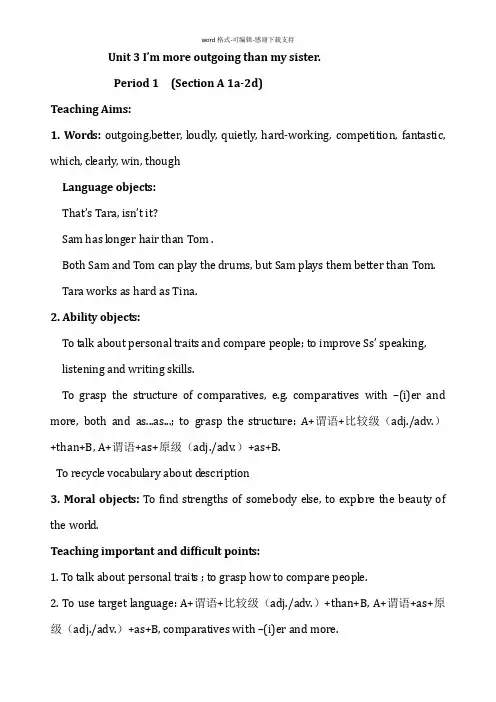
Unit 3 I’m more outgoing than my sister.Period 1 (Section A 1a-2d)Teaching Aims:1. Words:outgoing,better, loudly, quietly, hard-working, competition, fantastic, which, clearly, win, thoughLanguage objects:That’s Tara, isn’t it?Sam has longer hair than Tom .Both Sam and Tom can play the drums, but Sam plays them better than Tom. Tara works as hard as Tina.2. Ability objects:To talk about personal traits and compare people; to improve Ss’ speaking, listening and writing skills.To grasp the structure of comparatives, e.g. comparatives with –(i)er and more, both and as...as...; to grasp the structure: A+谓语+比较级(adj./adv.)+than+B, A+谓语+as+原级(adj./adv.)+as+B.To recycl e vocabulary about description3. Moral objects: To find strengths of somebody else, to explore the beauty of the world.Teaching important and difficult points:1. To talk about personal traits ; to grasp how to compare people.2. To use target language: A+谓语+比较级(adj./adv.)+than+B, A+谓语+as+原级(adj./adv.)+as+B, comparatives with –(i)er and more.3. To improve the students’ listening, speaking and writing skills; to develop their communicative competence.Teaching Procedures:Step 1 Leading-in.To show some pictures to recycle adj. based on some types, and learn some new words.Step 2 1a1. Learn new words:outgoing,better loudly quietly which competition fantastic hard-working clearly win funny friendly smart lazy2 . Look at the picture in 1a and make a list of the adjectives.Purpose: to make the students recall some adjectives they have learned before;3. To make the students compare two persons or two things with the above adjectives and adverbs; to summarize the pattern of comparative degree.“A+谓语+比较级(adj./adv.)+than+B”4. To show the map of Anhui Province to guide the students to compare Fuyang and Wuhu in size, climate, slight spots and so on.Purpose: to practice comparatives; to show the structure of “A+谓语+as+原级(adj./adv.)+as+B” and compl ete emotional aims.Step 4.Listen and write .1b Listen again for the students to listen and fill in the chart.Check the answers with the classStep 3 Practice.1c. Pair work: Compare two persons.Purpose: to make the stud ents practice the patterns of comparative degree. Step 4. Listening1. 2a Listen and change the adjectives into comparatives by -er/-ier/or more.2. 2b Listen again. Match the activities with how often Cheng Tao does them. Step 5. Pair work:2c Fill in the chart first and then make conversations in pairs.Step 6. Role-play the conversations2d Let the students read the chart and find out the differences between Sam and Tom.Explain the comparatives of the adjectives1) smart-smarter2) funny-funnier3) hardworking-more hardworking3.Let the students h ave five minutes for the students to recite the statements.4.Role-play the conversation in pairs.Step 7 To sum up.To make the students summarize what they have learned in this class.Step 8. Homework.1. Preview 2d2. Writing: The person I respect.Blackboard designUnit 3 I’m more outgoin g than my sister.Unit 3 I’m more outgoing t han my sister.Period 2 (Grammar Focus-3c) Teaching Aims:1.Key structure:Is Tom smarter than Sam?Is Tina more outgoing than Tina?Are you as friendly as your sister?Does Tina work as hard as Tara?Who’s more hard-working at school?2. Ability aims:Students can use the Comparison of adjectives to compare different persons. 3. Emotional aims:Everyone may has own opinion, different people have different ideas. Teaching important points:(1)To learn how to add –er/-ier/more … after adjectives/adverbs.(2)To learn : S + be + adj./adv.比较级+than+被比较对象S + have/has +adj./adv.比较级+n.+ than+被比较对象(3)To learn: Who+be+adj. 比较级+…?Teaching difficult points:(1) To learn Which/who sentences.The students can und erstand and write a short passage between two persons. Teaching procedures:Step1 Revision写出下面形容词的比较级形式white young funny red west cloudygreen windy happy blue curly busyyellow straight sorry big tall scarysmall hot w arm short cold strictlong coo c heap terrible fantastic colorfulsuccessful unfriendly t ired surpriseddelicious relaxed international expensive sunnyStep 2 Grammar FocusLet the students read the sentences in the box and make sure they und erstandthem. Pay attention to the use of the foll owing sentences:Is Tom smarter than Sam?Is Tina more outgoing than Tina?Are you as friendly as your sister?Does Tina work as hard as Tara?Who’s more hard-working at school?要点总结形容词在句中常作表语和定语,也可补充说明宾语;副词的句中主要作状语。
人教版初二八年级英语下册 unit 4 he said i was hard-workingPPT课件

Alfar said He was better at dancing than playing the guitar.
I do well in singing .
Alfar said He did well in singing.
I am too busy .
Alfar said
She was too busy.
I will practice dancing.
Alfar said He would practice dancing.
I am playing the trumpet.
Alfar said He was playing the trumpet.
I will study English.
Alfar said
was good at speaking.
. ?
Dad: What did your history teacher say
How about
Mother: That’s nice.
Boy: And Mr. Ricardo said I was hard- working. Dad: What does he teach again? Boy: He’s my
Period 4 Section B 1a - 2c
I am good at ห้องสมุดไป่ตู้laying the guitar.
Alfar said
He was good at playing the guitar.
I am better at dancing than playing the guitar.
2a Listen and fill in the speech bubbles.
Unit4SectionB训练课件人教版八年级英语下册
Unit 4 What’s the best movie theater
Period 2 Section B (1a-1e)
1. 【2021·扬州改编】I can’t believe you made the life-like
cat out of paper. How ____B____ you are!
on top of her real nose.
13. A. beautiful B. simple C. different D. happy 【解析】由上文可知,苏珊不愿与人相同,因此她想 让自己看起来不一样。beautiful漂亮的;simple简单 的;different不同的;happy开心的。故选C。
A. slim B. creative C. helpful D. beautiful 【解析】考查形容词辨析。句意为“我不敢相信你用纸做 了这只栩栩如生的猫。你多么有创造力呀!”slim苗条的; creative有创造力的;helpful有帮助的;beautiful漂亮的。 根据I can’t believe you made the lifelike cat out of paper.可知, 感叹对方很有创造力,故选B。
She wore clown (小丑) clothes to school and stuck leaves on
3. My brother wants to be a famous p erformer . 4. I think the math teacher’s p erformance is pretty good. 5. Nancy p erforms a housewife in the play.
he became f amous overnight (一夜之间). 5. Many people say the singer is popular and talented, but
Unit 3 第四课时 Section B(1a-1e) 课件【大单元教学】人教版八年级英语下册

能理解听力中的相关表达,提高综合听说能力。英语学习过程 中培养学生抓住关键信息的能力及熟练运用英语从事对外交际 活动的能力。
1.掌握单词及短语:snack, go to the store, invite sb. to do sth.等。 2.掌握有关礼貌的请求和许可的句型.
思维品质
培养学生勤动手,会礼貌地提出请求,向别人征求许可,会与人交 流的能力。
teenagers 5. go to the store
teenagers 6. use your CD player
parents
7. take out the rubbish
parents
8. make your bed
1b Use the phrases in 1a to make conversations.
invite my friends to our home prepare some wonderful music
cook delicious food
buy some drinks and snacks
Weekends are coming. Some students may invite your friends to your home to have a party. List the things you and your parents need do for the party.
8 Exercises
一、根据句意及首字母提示写出单词。 1.Could you help me buy some __s_n_ac_k_s__ (点心)? 2.Sam hates to do __c_h_o_re_s__ (家务). 3.Betty __in_v_i_te_d__ (邀请) her friends to her birthday party yesterday. 4.I left my pen at home. May I __u_s_e__ (使用) yours? 5.As a __te_e_n_a_g_e_r (青少年), we should work hard at school.
人教版八年级英语下册Unit3Couldyoupleasecleanyourroom全单元教案
Unit 3 Could you please clean your room?Period 1 Section A (1a - 2c)Teaching aims:1.Words and expressions:Rubbish; fold; sweep; floor ;mess; throw; neither; shirt; pass; mess; do the dishes, make the bed, take out the rubbish, fold the clothes, sweep the floor, clean the living room2.Sentences:①--Could you please take out the rubbish?. --Sure. / Sorry, I can ’ t. I have to finish homework first.②. Could I use your computer?Sorry. I'm going to work on it now.③. Well, could I watch TV?Yes, you can. But first you have to clean your room.Ability object:1.Make polite requests and ask for permission.2.improve speaking and listening skills.Moral objects:Learn to be polite, love doing housework and make requests and ask for permission politely. Teaching Important :Words and expressions, and sentences:Make polite requests and ask for permission.Teaching difficult points:Make polite requests and ask for permission.Teaching procedures:Step 1 Warming-upSing the song and dance to the musicStep 2 Preparation test.1.Watch the photos and talk about them “ Whatdoes he do every day? ’ and learn these phrases: dochores, do the dishes, make the bed, take out the rubbish, fold the clothes, do the laundry, clean the living room.2.M emory challenge. Let students know: Love your parents. Help do the chores.Step 3 work on 1a.1.Look at 1a , Do you do these chores at home?Discuss them with your partner.2.How do we make a request(要求)?Sweep the floor , Peter!Can you sweep the floor, Peter?Could you please sweep the floor?Which is the most polite(礼貌) ?3.Make polite requestsStep 4 Work on 1b.3.1 b Listen. Who will do these chores? Ch eck ( v^Peter ' s mother or Peter.2. Check the answers.Step 5 Group work .Group work: Family drama( 家庭短剧)1.Each group is a family.2.We need to clean the house.3.To make a similar conversation of listening material.Example:Mom : We need to clean the house. We are going to have a party.Dad : Could you please sweep the floor?Peter: No problem.Grandpa: Well, could you please do them? I ’ m going to clean the living room.Step 6 Listening 2a&2b1.Peter asks his father if he can do four thing s. What does his father say? Check ( V) yes ” or“ no” . Listen again. Draw lines to the reasons.2.Check the answers .Step 6 Pair work.Make conversations using the information in 2a and 2bA:Could I use your computer?B:Sorry. I ’ m going to work on it now.A: Well, could I watch TV?C:Yes, you can. But first you have to clean your room?Period 2 Section A (2d , grammar )Teaching aims:1.Words :Mess; borrow, invite, disagree, snack, teenager2.Sentences:Yes, because Mom will be back from shopping any minute now. And she won she sees this mess.t be happy if But the house is already pretty clean and tidy!Could you buy some drinks and snacks?Could I invite my friends to a party?Could I go out for dinner with my friends?OK/ Sure, that should be OK.No, you can ’ t. You have a basketball game tomorrow.Ability object:1.Make polite requests and ask for permission.2.improve speaking and reading skills.3.Master the structures of could .Moral objects:Learn to be polite, love doing housework and make requests and ask for permission politely.Teaching Important :Words and expressions, and sentences:Make polite requests and ask for permission.Teaching difficult points:Make polite requests and ask for permission.Teaching procedures:Step 1 Warming-up .1.Watch a video and answer:Who is the girl in the movie?Is the house clean or dirty?What did she do?2.Do some exercises.Step 2 Work on 2d.1.2d Read the conversation and answer:What chores will Tony have to do?2.2d Role - play the conversation.Step 3 Presentation.1.Read ,think the knowledge.2.Give some explainationsStep 4 Work on 4a.1.Write R for requests and P for permissions. Then match each one with the correct response.2.Check the answers.Step 5 Work on 4b.1.4b Fill in the blanks in the conversation.2.check the answers.Step 6 Work on 4c.4c Make a list of things your group needs to do for a camping trip. Then discuss who will do bring a tent them and complete the chart.Example:A:Could you please bring Liu Chang?B:Sure. And could you please •••?C:Sorry, I can ' t. I have to …Step 7 Homework.Period 3 Section A (3a-3c )Teaching aims:1.Words and expressions:throw, neither, shirt, all the time, as soon as.2.Sentences:①. He wanted a walk, but I was too tired. I threw down my bag and I went to the living room.②. “ No! ” she replied angrily. h TV“ayllothuewtaimtce and never help out around thehouse!I can ’ t work all day and do housework all evening. ”③. “ well, I work all day at school, too! I ’ m just as tired as yaocuka. re! ” I shouted b Ability object:1.Make polite requests and ask for permission.2.improve speaking and reading skills.Moral objects:Learn to be polite, love doing housework and make requests and ask for permission politely.Teaching Important :Words and expressions, and sentences:Make polite requests and ask for permission.Teaching difficult points:Make polite requests and ask for permission.Teaching procedures:Step 1 Warming-upStep 1 Lead in.1.T: We have leaned the phrases about chores. Look at the picture, what are they doing?Do you often do chores at home ?Show the title.Step 2 2b Reading.2.Look at the picture and answer :Does Nancy often do any housework?3.Read the passage carefully and answer.How does Nancy ’ s and her mother’ s feelings change?4.Read the sentences.5.Read the passage and answer the following questions.①Why was Nancy ' s mom angry with Nancy?② Did they solve the problem? How?③ Can you infer what Nancy ’ s mother will feel ?6.What do you learn from the message?We need to share the housework to have a clean and comfortable home .Can you infer what Nancy will do at home?Step 3 Work on 3b.Read the story again and read the sentences below. Underline the sentences from the readingthat mean the same thing.1.Neither of us did any housework for a week.2.My mom came over as soon as I sat down in front of the TV.3.You ’ re tired, but I ’ m tired, too.Step 4 Work on 3c.. Decide whether the underlined words in the sentences are verbs or nouns. Then write another sentence using the underlined word in the other form.1.Could you take the dog for a walk? (noun)2.Could I watch one show first?3.I can ’ t work all day.4.You watch TV all the time.5.“ What happened? ” she asked in surprise.Step 5 Homework.Period 4 Section B (1a-1e )Teaching aims:New words: snack teenager borrow invitePhrases: buy some drinks and snacks; borrow some money; invite sb. to a party/to do sth. Sentences :--Could you please clean your room?--Yes, sure. / Sorry, I can ' t. I have to do my homework.-- Could I invite my friends to aparty?--Of course/ Yes, you can /No, you can Ability object: t. You have to1.Make polite requests and ask for permission.2.improve speaking and listening skills.Moral objects:Learn to be polite, make requests and ask for permission politely; and love parents. Teaching Important :Words and expressions, and sentences:Make polite requests and ask for permission.Teaching difficult points:Make polite requests and ask for permission.Teaching procedures:Step 1 lead-in.1. Show the title.2. DiscussionQ: Do you help your parents do the chores at home?Q: Do your parents ask you to do a lot of things forthem?What do your parents ask you to do?What do you ask your parents Step 2 Work on 1a.1.What do teenagers ask their parents 'permission for?' permission for? What do parents ask their teenagers todo? Write parents or teenagers next to each phrase.2. Check the answers.Step 3 Finish 1b.Use the phrases in 1a to makeconversations.Example :Parents : Could you clean your room ?Child : Yes, I can.Child : Could I invite my friend to aparty ?Parents : No, you can't .Useful language:1.Parents: Could you please …?Child: Yes, sure. / Sorry, I can ' 2.Child: Could I •••? t. I have to ...Parents: Yes, you can. / No, you can t.You ...Step 4 Finish 1c and 1d.1.Listen to a conversation between Sandy and her mom. Check ( V ) Oh wdhings in 1a thhear.2.Listen again. Fill in the chart.Step 5 Finish 1e.You are having a party. Invite your partner to come your party and ask for help withthese things. So, talk about the following things with your partner.e.g. A: Would like to come to my birthday party?B: Yes, I ' d love to./Sorry, I can ' t. I have to …A:Could you please take out the rubbish?B:Yes, sure./No, I can ' t. I have to do …Step 6 Homework.Period 5 Section B (2a-2e)Teaching aims:1.Learn and review some important phrases and target languages.2.Review how to make polite requests how to ask permissions politely3.Read the letters carefully and surf the Internet, try to find out more reasons to supportyour idea, and then write a letter to th e person that you don ’ t agree with.Ability object:1.Learn how to debate and show your own opinions.2.Practice speaking, reading and writing skills.3.Interview your friends, your teachers or your parents about their opinions about kids doingchores and take notes.Moral objects:Discuss with your partners and show your own opinions.Teaching Important :Learn and review some important phrases and target languages.Teaching difficult points:1.Interview your friends, your teachers or your parents about their opinions about kids doingchores and take notes.2.Read the letters carefully and surf the Internet, try to find out more reasons to supportyour idea, and then write a letter to the person that you don ’ t agree with.Teaching procedures:Step 1 Warming-up1.Review.Step 2. 2a. pre-reading.2.Discuss the questions with your partner① What do you often do to help your parents at home?② Do you think kids should help out with chores at home?3.New words learning.Step 3. While reading1.What ’s “ Skimming “2.2b. The Sunday Mail magazine invited parents to write about whether they think young peopleshould do chores at home. Skim the following letters. Which one agrees and which onedisagrees?3.Reading.①. Read the examples, and guess the meanings of “ pro” and “ con” .②2c. According to Mr. Smith and Ms. Miller, what are the pros and cons about kids doingchoresStep 4 Post reading.1.Be a good debater. Let ’s have a debate.2.2d. Write one sentence with each phrase from the letters.3.2e Discuss the questions with a partner.Step 5 Homework.Period 6 Section B (3a-self check )Teaching aims:1. WordsFair; unfairnguage:help with housework and chores at home have enough stress from schoolspend the time on school work in order toThere is no need for them to …It is important for sb. to do sth.It ' s not enough to … develop children ' s independence The more •••, the more …Ability object:1.Learn how to show your own opinions.2.Practice speaking, and writing skills.Moral objects:Discuss with your partners and show your own opinions. Teaching Important :1.Learn how to show your own opinions.2.Practice speaking, and writing skills.Teaching difficult points:1.Learn how to show your own opinions.2.Practice speaking, and writing skills.Teaching procedures:Step 1 Warming-upSection B 2 (3a —Self check)Step 1 RevisionDiscuss the questions with a partner. And take notes.Do you think children should do some chores at home? Why or why not?1.信头:发信人地址和日期。
Unit1Period4SectionB(2a2e)习题课件人教版英语八年级下册(2)
8. 【2021·营口】—Look! The kids are playing on the playground.
【—点_拨__】_C_用__语_ g法re判at t断im法e 。the句y a意re为ha“vi—ng—! 看! 孩子们正在操 场A上. W玩h。at ——他B们. 玩Ho得w多开心啊C!. W”感ha叹t a句的句式D结. H构ow为a: What+(a/an+) 形容词+ 名词+ 主语+ 谓语+ 其他; How + 形 容词或副词+ 主语+ 谓语。此处符合感叹句的结构为: What+(a/an+) 形容词+ 名词+ 主语+ 谓语+ 其他! 句子中心 词是time, 短语have a great time 为固定搭配, 应用what a 引 导感叹句, 故选C。
7. 【2021·绥化】She can’t sleep well ____B____ too much noise next door.
A. because
B. because of
C. since
【点拨】句意为“她没能睡好, 因为隔壁太吵了”。 because“因为” , 后接原因状语从句; because of“因 为” , 后接单词或短语; since“由于; 既然” , 引导原因 状语从句。空格后noise 为名词, 故选B。
意为“好像”, It seems that + 句子, 结合句子主语可知B 项
错误; feel like 意为“给……的感觉”, 结合句意可知正确;
sound like 意为“听起来像”结合句意可知错误。
9. They decided ____B____ a house in the city after discussing
人教版八年级英语下册unit3
Yes, you can.
No, you can’t.
Peter
go to the movies
-- Could I go to the movies? -- Yes/sure, you can.
play computer games
(I’m going to work on it.) 从事,忙于
Look and say
Could you please ...?
get up early
sweep the floor
cook for us
Could you please not ...?
look out of the window play soccer here
play the computer games
Different ways of saying. Can you find the difference? Which is the most polite expression?
I can say
1. Open the window! 2. Can you open the window? 3. Could you please open the window?
Ok, but I want to…first. Sorry. I can’t. I have to…
1
turn off the light
3
2
close the window
4
not play basketball here cook for me
Do you do these chores at home? Discuss them with your partner. (1a)
人教版八年级上册英语 unit 4 Section B (1a-2e)
五、完形填空【2019·自贡】 MynameisPaul. Iwasa________21Cboy. 21. A. 16yearsold B. 16-years-old C. 16-year-old
17. 海里有各种各样的鱼。 Thereare______________fishesinthesea.
allkindsof
18. 微信支付变得越来越受欢迎。
WeChatPayisbecoming_______m_o_r_e_a_n_d_____ ________.
morepopular
19. 学校在教育中起着最为重要的作用。
_______________. aremadeup
10. 如果你对这些节目不太较真的话, 它们还 是有看头的。
Ifyoudon't_______theseshows_______________ ___, theyarefutnatkoewtaotoch. seriously
1. 南北方的菜肴有共同之处。【2019·铁岭】
答案呈现
11 talented 12 performer 13 winner 14 magician 15 beautifully
课后巩固
16 thebest; enjoy; quietly 21 C
17 allkindsof
22 B
18 moreandmorepopular 19 play; rolein 20 cometrue
Everyoneshould_________________________thee playapartin/playarolein
nvironmentalprotection.
6. 赫本在《罗马假日》中扮演一位公主, 堪 称经典。【2019·无锡】