
译林版六上Unit 3 语法与练习
六上Unit 3 讲义歌曲:《How is the weather?》How is the weather? It's a fine day.How is the weather? It's a cloudy day.How is the weather? It's raining.How is the weather? It's snowing.词组:holiday fun假期乐趣come back to school回到学校the National Day holiday国庆节假期at home回家go to Shanghai去上海visit my aunt拜访我的姑姑go to the Bund 去外滩visit the Shanghai Musuem参观上海博物馆many interesting things许多有趣的事our family我们的家人Star Lake星星湖pick some oranges摘一些橘子go fishing去钓鱼catch a big fish抓一条大鱼call me打电话给我;travel experiences 旅游经历want an orange想要一个橘子three main school holidays 三个主要的学校假期Easter holiday复活节假期(春假)the summer holiday暑假the Christmas holiday圣诞节假期(寒假)come home late回家晚in the park载公园里a fashion show一个时装展示beautiful clothes美丽的衣服be excited about激动于That’s cool.酷毙了What great fun!多开心啊a paper T-shirt一件纸体血衫a lot of bottles许多瓶子heavy rain大雨too bad太糟糕the Car Museum汽车博物馆cool cars酷车a birthday party一个生日聚会his cousin Jim他的表兄吉姆falling intonation降调句型:What did you do for the holiday?假期你做什么了?I visited the Shanghai Museum.我参观了上海博物馆。
Did you go fishing?你钓鱼了吗?No, I didn’t.不,没有。
语法:1、特殊疑问词:What?什么Where?在哪(回答:介词+地点)When?何时(回答:介词+时间)Who?谁Why?为什么(Because 开头回答)How?怎样How old?多少岁How many?多少个How much?多少钱What about?怎么样What day?问星期What date?问日期2、一句中一个过去式(除非用and连接),句子中有助动词do和情态动词,过去式加在它们身上,后面的动词用原型。
3、It’s time for+名词。
It’s time to+动词。
4、excite兴奋(动)人用ed(excited人兴奋), 物用ing(exciting 令人兴奋的)例子:Tom was very excited this morning. This is an exciting book.5、不规则过去式:wear(wore)catch(caught)一、英汉互译。
大雨一场精彩时装表演假期乐趣打电话给她问我关于山姆许多瓶子国庆节假期摘苹果天安门广场穿纸衣服二、选出划线部分读音与所给单词相同的一项。
A.B.C.()1. national A. want B. day C. palace()2. fish A. like B. lion C. give()3. take A. cake B. tap C. cat()4. tree A. see B. bed C. lesson()5. holiday A. go B. hot C. zoo三、用所给词的适当形式填空。
1. Su Yang (call) me every Sunday.2. Mary (eat) lots of nice food last night.3. (do) you have a party last National Day?4. I’d like (wear) the paper clothes.5. There is a lot of (rain) here in summer.6. Where did you (go) for the weekend.7. We (catch) a big fish last week.8. It (be) sunny yesterday.9. My father likes (fish) very much.10. Mary is (exciting) about the fashion show.11. Bobby (wear) a T-shirt at that time.12. How (be) your last summer holiday?13. Mike usually (go) (fish) with his family.14. I want to (give) you some (apple).15. I (go) to Beijing and (visit) the Great Wall last year.四、根据中文提示完成下列句子。
1、你的家人在假期做了什么?What your family the ?2、你去农场摘橙子了吗?you oranges the ?3、你去年为什么想去北京?you go to Beijing last year?4、上周我们摘了些橙子也去钓了鱼。
We some and last week.5、你在博物馆看到了一些有趣的事吗?you interesting things in the ?6、你去哪里度假了?Where you go the ?7、我很喜欢吃鱼。
昨天我吃了很多。
I like very much. I a lot yesterday.8、“你去年参观故宫了吗?”“是的。
我看到了许多有趣的东西。
”you the Palace Museum last year?Yes. I interesting things.9、“海伦为什么打电话给你?”“她想要给我一些邮票。
”Why Helen you?She some stamps.10、“学生们上周末去了哪里?”“他们去了一个农场。
”“他们在那里做了什么?”“他们摘了橙子也钓了鱼。
”Where the go last weekend?They to a .they do there?They and .11、我去南京拜访了我的叔叔。
I to Nanjing and my .12、你的爸爸捉了一些鱼吗?your father ?13、你昨天为什么打电话给我们?you yesterday?14、今天早上我吃了许多面包。
I morning.15、国庆节假期后学生们都会到学校。
The students school after the National Day .五、完形填空。
A French student went to London for his holiday. He thought, “I konw just 1English. But I think people can understand me.”One day he went 2 a restaurant and sat down at a table. He wanted to 3a cup of tea and some eggs. Soon the waiter came up to him and asked, “Can I help you?”“A cup of tea...” He could not remember the 4 word for egg. He looked 5 , but nobody was eating eggs. Then he saw an 6 book on the table next to him. There was a picture of 7 on its cover. He 8 the picture to the waiter, “What’s this in English?”“A cock,” answered the waiter. “What do you call a cock’s wife?”he asked again. “A hen.”“And what do you call their children?”“Chicks.”“And what do you call chicks 9 they are born?”“Eggs.”“Bring me two 10 and a cup of tea, please, ” said the French student happily.( )1. A. much B. a little C. more( )2. A. up B. into C. out( )3. A. drink B. take C. have( )4. A. French B. Chinese C. English ( )5. A. at B. around C. after ( )6. A. English B. Chinese C. history ( )7. A. a cook B. a girl C. a child ( )8. A. read B. put C. showed ( )9. A. when B. before C. where ( )10. A. hens B. chicks C. eggs。
新译林英语六年级上册语法知识+练习

六年级上册语法知识+练习Unit 1 The King’ s new clothes知识点回顾:1.一般过去时的关键词:…ago(long long ago),yesterday,just now,last…(last year),this morning,in 2008及具体语境等---I______(am)ten years old two years ago.2.一般现在时的关键词:ually,often.sometimes,never,every…(eyery day),a t weekends,on Sundays及具体语境等---当主语是三单时:She _____(go)to school on foot every day.-------------当主语不是三单时:We______(go)toschool on foot every day.3.现在进行时的关键词:now,look,listen,时间点(at seven o’cloc k in the morning)及具体语境等,构成是be+doing---Tom ____________(have)lunch with his parents now.4.can/can’t/could/couldn’t+动词原形----We could not ______(eat)our lunch.5.show sb.sth=show sth to sb---show me a new coat=_____________________________.(学过的还有:give…to sb/write…to sb/send…to sb)6.want to do sth=would like to do sth想要做某事---I want __________(swim);have to do sth不得不做某事--I have ________(go)now.can’t wait to do sth等不及去做某事I can’t wait________(watch)TV.ask sb to do sth要求某人做某事—My mother asks me_______(wash)my hands.need to do sth需要去做某事---I need _______(do)my homework.7.help sb (to)do sth帮助某人做某事---I help my mother ______(clean)the table.8.动词/介词+宾格:visit________(he)----behind_________(we).---Push______(I)写宾格I_____,we______,you______,he_______,she_______,it________,they_________小练笔:用所给词的适当形式填空。
译林版英语六年级上册Unit 3 知识梳理与练习
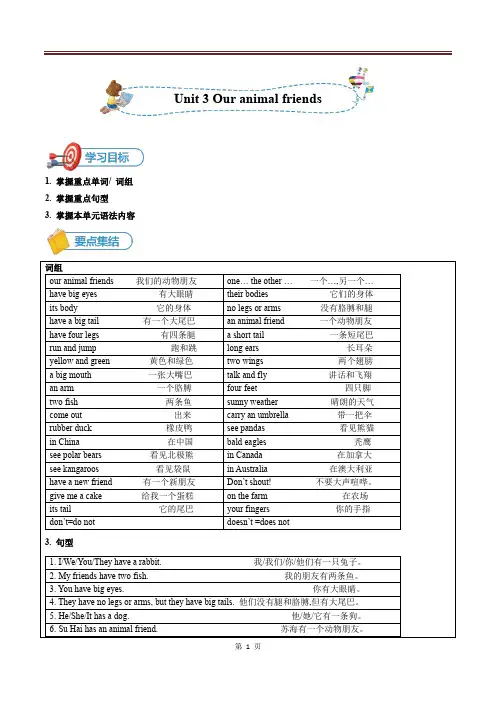
Unit 3 Our animal friends1. 掌握重点单词/ 词组2. 掌握重点句型3. 掌握本单元语法内容词组our animal friends 我们的动物朋友one… the other … 一个…,另一个…have big eyes 有大眼睛their bodies 它们的身体its body 它的身体no legs or arms 没有胳膊和腿have a big tail 有一个大尾巴an animal friend 一个动物朋友have four legs 有四条腿 a short tail 一条短尾巴run and jump 跑和跳long ears 长耳朵yellow and green 黄色和绿色two wings 两个翅膀a big mouth 一张大嘴巴talk and fly 讲话和飞翔an arm 一个胳膊four feet 四只脚two fish 两条鱼sunny weather 晴朗的天气come out 出来carry an umbrella 带一把伞rubber duck 橡皮鸭see pandas 看见熊猫in China 在中国bald eagles 秃鹰see polar bears 看见北极熊in Canada 在加拿大see kangaroos 看见袋鼠in Australia 在澳大利亚have a new friend 有一个新朋友Don’t shout! 不要大声喧哗。
give me a cake 给我一个蛋糕on the farm 在农场its tail 它的尾巴your fingers 你的手指don’t=do not doesn’t =does not3. 句型1. I/We/You/They have a rabbit. 我/我们/你/他们有一只兔子。
2. My friends have two fish. 我的朋友有两条鱼。
译林版小学六年级英语上册专项语法填空针对练习题

译林版小学六年级英语上册专项语法填空针对练习题班级:_____________ 姓名:_____________1. 根据句意,首字母或所给词提示填入所缺单词。
[1]写出与所给单词同类的单词(答案不唯一):America Canada Australi a ________[2]—Where is Qiqi?—He’s ________ the box.[3]The giraffe is so ________.(高的)[4]I’m r________(准备好).[5]I like ________ (watch) TV and playing tennis.[6]He ________ (tell) a joke. It was funny.[7]The lorry is ________ (noise) in the street.2. 用所给词的适当形式填空。
[1]She ________ (go) swimming yesterday.[2]—Did you like it? —Yes, it ________ (be) so warm.[3]He didn’t ________ (see) a film the day before yesterday.[4]John often ________ (do) his homework in the morning.3. 按照分类写单词,每类至少5个。
[1]food and drinks:[2]clothes:[3]animals:[4]school things:[5]colours:[6]classroom:4. 按要求写单词。
[1]well(比较级)[2]have(-i n g形式)[3]ride(-i n g形式)[4]go(反义词)[5]big(反义词)5. 用所给单词的适当形式填空。
[1]Five years ago, he___________ (write) letters to his friend.Now he___________ (send) emails on the Internet.[2]Ten years ago, they___________ (live)in a small house.Now they___________ (live)in a big house.[3]There___________ (is) an old building before.Now there___________ (is)a new park.6. 语法填空。
江苏译林版英语六年级上册学习知识点汇总整编全
六年级上册复习资料内含:6A各单元知识点,语法知识,易错题及适当形式填空6A Unit 1 The king’s new clothes姓名:一,单词/词组1. long long ago 很久以前2. new clothes 新衣服3. make new clothes for you 为你制作新衣服make sth for sb4. show the king his new clothes给皇帝展示新衣服show sb. sth.= show sth. to sb.5. try on 试穿try on the coat=try the coat ontry it/them on6. magic clothes 有魔力的衣服7. walk through步行穿过8. in his new clothes 穿着他的新衣服9. shout at sb. 对某人大叫 10. laugh at sb. 对某人大笑11. look at 看….12. point at 指向…13. fit well 非常适合14. an American cowboy 一个美国牛仔15. a Scottish man 一位苏格兰人16. tell a story 讲一个故事17. say a/one sentence 说一句话18. on the mountain 在山上19. the next sentence 下一句话20. live in the house 住在房子里21. tell the boy a story 给这个男孩讲一个故事tell sb. sth.22. it is one’s turn 某人的机会23. think hard 努力思考24. have to 不得不have to do sth.25. in front of 在….前面(外部)in the front of 在… 前面(内部)26. walk by 路过27. be nice to sb. 对某人好28. look after 照顾29. turn into 变成二,句型1. Long long ago, there was a king. 很久很久以前,有一位国王。
Unit3 Cartoon time (练习及解析)译林版(三起)-六年级英语上册
【精品】Unit3 Cartoon time (练习及解析)译林版(三起)-六年级英语上册一、翻译词组。
1. 举办一个时装表演___________________2. 一件纸T恤___________________3. 进展顺利___________________4. 大雨___________________5. 开始,最初___________________6. 到家___________________7. 激动地,兴奋地___________________ 8. 纸短裤___________________9. 许多瓶子___________________ 10 太糟糕___________________二、用所给词的正确形式填空。
1. He _____________ (bring) me some animal stamps three days ago.2. —Do you like ________ (fly) kites?—Yes, I _________(fly) a kite yesterday.3. They _________ (have) a fashion show last week.4. It _________ cold yesterday, but we didn’t __________ (wear) any coats.5. —Did you _________ (catch) any butterflies ?—Yes, I did.6. The party was wonderful and it ____________ (go) well.三、根据所给中文提示补全句子。
1. I visited Palace Museum last _________________ (国庆节).2. We usually go swimming on summer _______________ (假期).3. The cartoon is interesting. They are ______________ (兴奋的).4. She _________ (穿) a ____________ (纸) skirt and danced on the fashion show.5. The show went well _____________________ (起初).四、单项选择。
2024年译林版英语六年级上册全册课件【完整版】
2024年译林版英语六年级上册全册课件【完整版】一、教学内容本课件基于2024年译林版英语六年级上册全册教材,详细内容包括:1. Unit 1: Public signs (第14课时)知识点:公共场所标识的认识,祈使句的运用章节内容:第1章公共标识,第2章祈使句2. Unit 2: Western festivals (第58课时)知识点:西方节日文化,一般将来时的运用章节内容:第3章西方节日,第4章一般将来时3. Unit 3: Habitats (第912课时)知识点:动植物的栖息地,现在进行时章节内容:第5章栖息地,第6章现在进行时4. Unit 4: Keep fit (第1316课时)知识点:健康生活,一般现在时的运用章节内容:第7章健康生活,第8章一般现在时二、教学目标1. 让学生掌握基本的公共标识,学会使用祈使句进行表达。
2. 了解西方节日文化,学会运用一般将来时描述节日活动。
3. 认识动植物的栖息地,掌握现在进行时的用法。
4. 培养学生的健康意识,学会用一般现在时描述生活习惯。
三、教学难点与重点1. 教学难点:祈使句、一般将来时、现在进行时、一般现在时的运用。
2. 教学重点:公共标识、西方节日文化、动植物的栖息地、健康生活。
四、教具与学具准备1. 教具:PPT课件、卡片、挂图等。
2. 学具:教材、练习册、彩笔、剪刀、胶水等。
五、教学过程1. 实践情景引入:通过展示公共场所的标识,引导学生学习祈使句。
2. 例题讲解:讲解祈使句的构成及用法,举例说明。
3. 随堂练习:让学生练习编写祈使句,并在实际场景中运用。
4. 情景剧:分组进行角色扮演,模拟公共场合使用祈使句。
5. 节日文化介绍:通过PPT展示,介绍西方节日,学习一般将来时。
6. 例题讲解:讲解一般将来时的构成及用法,举例说明。
7. 随堂练习:让学生练习描述节日活动,运用一般将来时。
8. 栖息地学习:展示动植物的栖息地图片,引导学生学习现在进行时。
专项01 Unit 3 重点词汇精练(首字母+词的适当形式+选词填空)六年级英语寒假专项提升(译林版
Unit 3 A healthy diet单元重点词汇精练(含答案)(三大类:首字母写词+词的适当形式+选词填空)一、根据所给首字母提示填空。
1.Billy must go on a d because he's too fat.2.It takes only 20 minutes to have a meal at a f f restaurant.3.What about some f Mike? It's fresh.4.Jack sometimes eats a lot of m for lunch.5.Linda likes e ice cream.She would like to make some tomorrow.6.I can see a f apples on the table.Can I have one of them?7.--There's only a l milk in the glass.I'd like more, Mum.--OK.Here you are.8.To keep h , you should do some sports.9.There are several eggs and some pineapples in the f .10.The boy likes drinking c very much.But there's much sugar in it.11.My sister wants to buy some sweet food from the s .12.Oh,these books are too h .Can you help us?13.How much rice do you n ?14.The big bag is too h for us to carry.15.Too much fast food m you fat and unhealthy.16.Sam drank a bottle of cola just now,because he was t .17.Mike, you're so heavy. You should eat some v________ and h________ food.18.We can’t d________ so many soft d________.二、用所给词的适当形式填空。
Unit3单元语法练习--动词_ing形式作定语,状语和宾补2020-2021学年牛津译林版必修第三
译林版必修第三册unit3单元语法练习--动词ing形式作定语,状语和宾补语法感知感知以下句子,完成方框下的小题。
以上句子中加黑部分在句中分别作以下成分:1.方式状语、2.定语、3.定语、4.宾语补足语、5.时间状语。
语法精析一、动词ing形式作定语动词ing形式作定语,有以下几种情况:1.动词ing形式作定语的位置(1)单个动词ing形式作定语,常置于被修饰的名词之前。
有些ing形式已转化为形容词,表示“令人……”。
He brought us surprising news.他给我们带来了惊人的消息。
She had to accept the disappointing fact that her son didn’t work hard.她只好接受这个令人失望的事实:她的儿子学习不努力。
(2)动词ing形式短语作定语,常置于被修饰的名词之后。
The students running along the street are from No.3 Middle School.沿着街跑步的学生来自第三中学。
Tell the boys playing over there not to make any noise.告诉那些在那儿玩的男孩别制造噪声。
2.动词ing形式作定语的用法动名词和现在分词都可以作定语,但有所区别。
(1)动名词作定语表示被修饰词的某种性能或用途,相当于for引导的介词短语。
No one is allowed to speak aloud in the reading room.阅览室里不准大声说话。
(2)现在分词作定语时,它和被修饰词之间有逻辑上的主动关系,表示所修饰词进行的动作,相当于一个定语从句。
The boy playing football on the playground is my younger brother.=The boy that/who is playing football on the playground is my younger brother.在操场上踢足球的那个男孩是我的弟弟。
六年级上册英语书译林版第三单元
第一部分:主题介绍一、本单元的主题《六年级上册英语书译林版》第三单元的主题是“Hobbies”。
通过本单元的学习,学生将了解到有关爱好的英语表达,学会表达自己的兴趣爱好,并且能够和他人进行有关兴趣爱好的交流。
二、学习目标1. 掌握并能运用有关爱好的词汇和表达方式。
2. 学会用英语表达自己的爱好。
3. 能够和他人就兴趣爱好展开对话。
三、课程设置本单元的课程包括单词学习、语法学习、综合练习和听力练习。
第二部分:词汇学习一、单词本单元重点单词包括hobby、like、play、collect、stamp、coin、learn、singing、dancing等。
二、词组1. like doing sth 喜欢做某事2. play the guitar 弹吉他3. collect stamps 收集邮票4. sing and dance 唱歌跳舞5. learn English 学习英语第三部分:语法学习一、动词的ing形式在本单元中,学生将学习动词的ing形式,以及与动词ing形式连用的词组和句型。
1. I like collecting stamps.2. She likes singing and dancing.3. He is playing the piano.二、一般现在时的用法学生将学会如何用一般现在时来表达他人的爱好或习惯。
1. She collects stamps.2. He likes playing football.3. We learn English on weekends.第四部分:综合练习一、阅读理解通过阅读一些有关爱好的文章,学生能够加深对爱好的理解,同时也能够锻炼阅读能力。
二、书面表达要求学生以“My Hobby”为题写一篇短文,介绍自己的爱好,并且说明为什么喜欢这个爱好。
第五部分:听力练习通过听力练习,学生将锻炼听力,并提高对所学知识的理解和运用能力。
第六部分:课后作业老师可以布置一些课后作业,包括词汇练习、语法练习、阅读理解和听力练习等,以巩固学生对本单元知识点的掌握程度。
六年级英语上册教案Unit3Holidayfun第三课时译林版
教案:六年级英语上册Unit 3 Holiday fun第三课时译林版一、教学目标1. 知识目标(1)能够听懂、会说、会读本课时出现的关键词语:go to a farm, go to the seaside, go hiking, take photos, visit family, have a picnic, play with friends等。
(2)能够理解并在适当的情境中运用一般过去时描述自己的假期经历。
(3)能够通过图片和情景,理解课文内容,提高阅读理解能力。
2. 能力目标(1)能够运用所学知识进行简单的交流,如询问和描述假期活动。
(2)能够通过阅读提高自己的词汇量和语言运用能力。
3. 情感目标培养学生的团队协作精神,学会分享和倾听。
二、教学内容本课时的主要内容是学习一般过去时,以及相关的假期活动词汇。
通过阅读一篇关于假期生活的故事,让学生理解一般过去时的用法,并能够运用到实际情景中。
三、教学重点与难点1. 教学重点(1)掌握一般过去时的基本结构和用法。
(2)学会本课时出现的假期活动词汇,并能熟练运用。
2. 教学难点(1)一般过去时的被动语态。
(2)如何正确运用一般过去时描述假期活动。
四、教具与学具准备1. 教具:PPT、黑板、粉笔、录音机、磁带等。
2. 学具:课本、练习册、铅笔、橡皮等。
五、教学过程1. 热身(5分钟)(1)老师与学生用英语进行简单的交流,询问学生们的假期生活。
(2)学生进行小组活动,用英语分享彼此的假期经历。
2. 课堂导入(10分钟)(1)老师通过PPT展示本课时的关键词语,引导学生复习假期活动词汇。
(2)学生跟读,巩固词汇。
3. 阅读理解(15分钟)(1)老师引导学生阅读课文,理解课文内容。
(2)学生回答老师提出的问题,加深对课文的理解。
4. 语法讲解(10分钟)(1)老师讲解一般过去时的基本结构和用法。
(2)学生跟读,掌握一般过去时的发音。
5. 实践环节(10分钟)(1)学生分成小组,用一般过去时描述彼此的假期活动。