
初中英语现在完成时讲解全
-
6
总结:现在完成时
•含义 1 :__________________ •结构:肯 __________________
否___________________ 一般疑问 ___________________ 特殊疑问____________________ •标志词|:____________________
since(自从)+时间点
•I have studied English for ten years.= I have studied English since ten years ago.
注 意 : 完 成 时 不 能 单 独 和 时 间 状 语 (two hours,three days,last week,four hours ago) 连 用 , 必 须 加 上 for ,since.
-
16
• 2 标准词:so far/up to now (到目前为止) ;lately/recently(最近)
• Up to now/So far ,I haven’t been successful. • Lately/Recently,I haven’t seen my teacher.
-
17
-
18
判断正误
I bought the book five days ago.
I have bought the book. I have bought the book for five days.
I have had the book for five days. I have had the book since five days ago.
非延续性动词: buy borrow die leave begin/start come / go
finish
这些动词不能和 for …. Since……连用
与for和since连用时,要把它们变成相应的延续性动词
--------------------------------------------------------------------------------
现在完成时
-
1
•现在完成时的含义 •1.表示动作发生在过去,对现在造成的影响。
-
2
-
3
•I saw a movie. •I have seen the movie.
•Have you ever been there?(八下Unit9) •I have never பைடு நூலகம்een camping. •1.表示动作发生在过去,对现在造成的影响
Tips:buy 这个动作 从“开始发生”到 “结束/终止”, 几
乎同时或在极短的时间里(如‘几秒钟/几分钟内’)就完 成了“开始—结束”的过程,这样的动词我们叫做短暂性 动词。 所以, “我买了这块手表5年了”,在汉语中说的 通,但英语中就必须用相应的延续性动词来替换。
-
19
现在完成时中常见的非延续性动词
-
15
填空使用for和since
• I have been here_____half past three. • The car has been here ____yeaterday. • I have been in Only_____four years. • The boy has been in our class_____six week. • She has lived here ______1996.
be dead
(finish结束....)
be over
-
20
1.我买这本书三年了。Buy I have bought the book. (1) I have had the book for 3 years. (2) I have had the book since 3 years ago.
-
4
结构: have/has+过去分词 (对have /has)进行变换
have/has not+过去分词 (haven’t hasn’t) Have/Has+主语+过去分词 (Yes,……have/has.No,……haven’t/hasn’t)
特殊疑问词+have/has+主语+过去分词
Have you finished your homework? I have finished my homework. What have you finished? I haven’t finished my homework
(buy买了…)
had
(borrow借了…)
keep
(start/ begin开始 了…) be on
(leave离开了…) (come来到某地….) (go去某地….)
be away (from) be here /介词+地点 be there/介词+地点
for … since….
(die 死了…)
总结
I lived in Wuwei ten years ago. I have lived in Wuwei for ten years. I have lived in Wuwei since ten years ago.
I studied English ten years ago. I have studied English for ten years I have studied English since ten years ago.
-
7
-
8
-
9
-
10
-
11
-
12
-
13
•2.一个动作从过去开始持续到现在,并有可能继续持续 下去。
•过去时:动作过去已经结束。
•He has taught in our school for five years. •I have worked since last week.
-
14
•第二层含义的标志词: •和for 和since 连用 for+时间段(持续)
-
5
•标志词:already yet just
•already 用于肯定句中, 已经 :I have already had lunch.
•Yet
用于否定句 疑问句末
•Just:刚刚
还
已经
Have you had lunch_____? •I have ____ had lunch •I haven’t had lunch ____. •I have just had my lunch.
(完整)初中英语现在完成时详解.doc
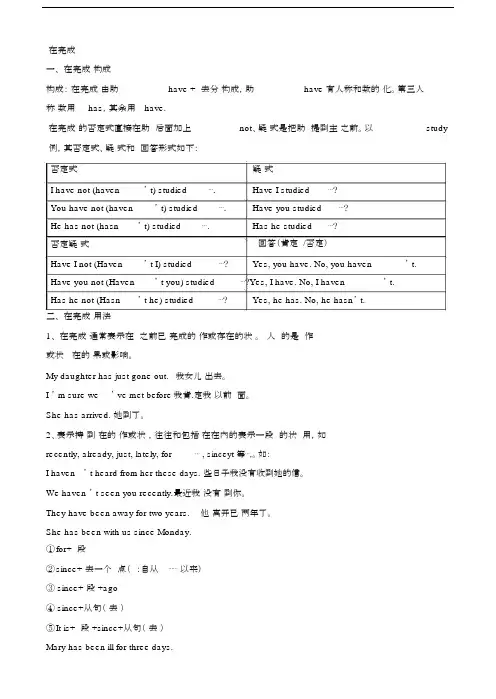
在完成一、在完成构成构成:在完成由助have + 去分构成,助have 有人称和数的化。
第三人称数用has,其余用have.在完成的否定式直接在助后面加上not、疑式是把助提到主之前。
以study 例,其否定式、疑式和回答形式如下:否定式疑式I have not (haven ’ t) studied ⋯. Have I studied ⋯?You have not (haven ’ t) studied ⋯. Have you studied ⋯?He has not (hasn ’ t) studied ⋯. Has he studied ⋯?否定疑式回答(肯定 /否定)Have I not (Haven ’ t I) studied ⋯? Yes, you have. No, you haven ’ t.Have you not (Haven ’ t you) studied ⋯?Yes, I have. No, I haven ’ t.Has he not (Hasn ’ t he) studied ⋯? Yes, he has. No, he hasn’ t.二、在完成用法1、在完成通常表示在之前已完成的作或存在的状。
人的是作或状在的果或影响。
My daughter has just gone out.我女儿出去。
I ’ m sure we’ ve met before我肯.定我以前面。
She has arrived. 她到了。
2、表示持到在的作或状,往往和包括在在内的表示一段的状用,如recently, already, just, lately, for⋯, sinceyt等⋯,。
如:I haven’ t heard from her these days.些日子我没有收到她的信。
We haven ’ t seen you recently.最近我没有到你。
They have been away for two years.他离开已两年了。
2024年中考英语语法复习+—现在完成时课件

Have you seen the doctor? 你看过医生了吗?
在现在完成时中,当主语是I/you/we/they时,助动词用 have;当主语是第三人称单数时,助动词用has。
三、现在完成时的使用
1.表示过去发生并结束的动作对现在所产生的影响
He has left the city. 他已离开了这个城市。(结果:他不在这个城市。)
一、基本构成:have/has+done
I have finished my homework. 我已完成了作业。 (这里的finished就是动词finish的 过去分词。)
二、现在完成时不同人称的用法 I have washed my car.我洗过车子了。
We have done the whole work.我们干完了所有活儿。
A.practised
B.were practising C.have been practising
C
3 . —Where is mother?
—She is in the kitchen. She ________ the
housework all morning.
A.is doing
B.was doing
B.was studying
C.studied
D.have been studying
D
15 . “I _____ as everyone expects ”, Yao Ming
said .
A.haven’t played
B.haven’t been playing
C.didn’t play
D.am not playing
现在完成时的用法详解英语

• Is your father in ?
•
No, heha__s_g__o_n__e__t_o___ to Shenzhen.
•
H__a__s___he everb_e_e__n__ there before ?
•
Yes, heh_a_s__b_e__e_n_____ there several times
ago.
A. Did…copy…did
B. Have…copied…have
C. Have…copied…did D. Did …copy…had
5. “Why _A_____ she _______ angry ?”
“Because he _____ at her just now .”
A. did…get…shouted B. has…got…shouted
A. Have…gone to B. Have…gone in
C. Have…been to D. Have …been in
3. My brother _C___college for over three years.
A. has gone to B. has been to C. has been at
但是不能和表示一段时间的状语连用。
短暂性动词变延续性动词:
• join --- be in / a
2) comeb-e-- in / at
• 3) borrow ---keep 4) buy -h-a-ve
5) arrive ---be
6) leave b--e- away (from)
7) begin --b- e on
• It has been colds_in__c_e__ two weeks ago.
初中英语现在完成时详解
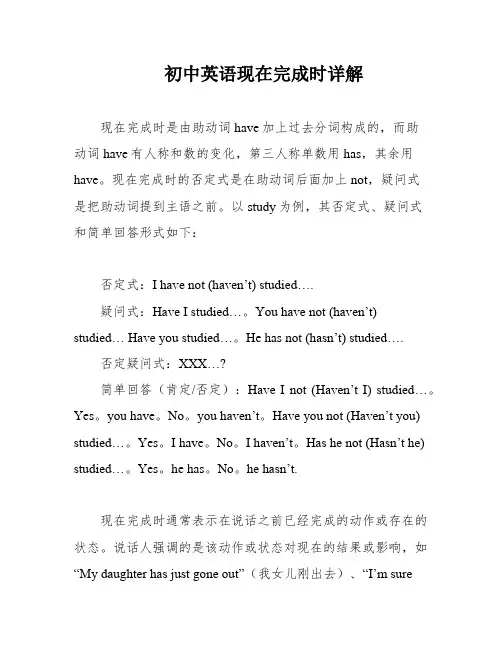
初中英语现在完成时详解现在完成时是由助动词have加上过去分词构成的,而助动词have有人称和数的变化,第三人称单数用has,其余用have。
现在完成时的否定式是在助动词后面加上not,疑问式是把助动词提到主语之前。
以study为例,其否定式、疑问式和简单回答形式如下:否定式:I have not (haven’t) studied….疑问式:Have I studied…。
You have not (haven’t) studied… Have you studied…。
He has not (hasn’t) studied….否定疑问式:XXX…?简单回答(肯定/否定):Have I not (Haven’t I) studied…。
Yes。
you have。
No。
you haven’t。
Have you not (Haven’t you) studied…。
Yes。
I have。
No。
I haven’t。
Has he not (Hasn’t he) studied…。
Yes。
he has。
No。
he hasn’t.现在完成时通常表示在说话之前已经完成的动作或存在的状态。
说话人强调的是该动作或状态对现在的结果或影响,如“My daughter has just gone out”(我女儿刚出去)、“I’m surewe’ve met before”(我肯定我们以前见过面)和“She has arrived”(她到了)等。
此外,现在完成时还可以表示持续到现在的动作或状态,往往和包括现在在内的表示一段时间的状语连用,如recently、already、just、lately、for…、since…、yet等。
例如,“I haven’t heard from her these days”(这些日子我没有收到她的信)和“XXX”(最近我们没有见到你)等。
还有一些表示时间的短语也可以和现在完成时连用,如:①for+时段②since+过去一个时间点(译为:自从……以来)③since+时段+ago④since+从句(过去时)Mary has been ill for three days。
现在完成时详解
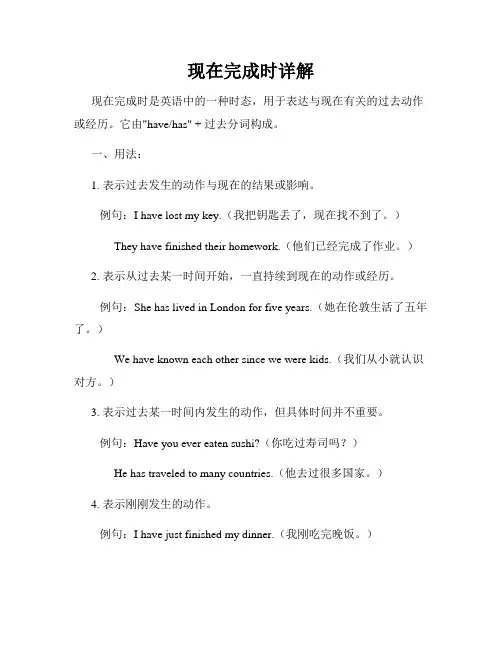
现在完成时详解现在完成时是英语中的一种时态,用于表达与现在有关的过去动作或经历。
它由"have/has" + 过去分词构成。
一、用法:1. 表示过去发生的动作与现在的结果或影响。
例句:I have lost my key.(我把钥匙丢了,现在找不到了。
)They have finished their homework.(他们已经完成了作业。
)2. 表示从过去某一时间开始,一直持续到现在的动作或经历。
例句:She has lived in London for five years.(她在伦敦生活了五年了。
)We have known each other since we were kids.(我们从小就认识对方。
)3. 表示过去某一时间内发生的动作,但具体时间并不重要。
例句:Have you ever eaten sushi?(你吃过寿司吗?)He has traveled to many countries.(他去过很多国家。
)4. 表示刚刚发生的动作。
例句:I have just finished my dinner.(我刚吃完晚饭。
)Sorry, I have already booked the tickets.(抱歉,我已经订好票了。
)二、构成:现在完成时的构成是由助动词"have/has"加上过去分词形式构成的。
根据主语的人称和数的不同,使用不同的助动词形式。
1. 当主语为第一人称单数(I)或第三人称单数(he/she/it)时,使用"has"。
例句:She has studied English for two years.(她学习英语已经两年了。
)I have visited the museum.(我参观过博物馆。
)2. 当主语为第二人称单数(you)或任何人称的复数形式时,使用"have"。
例句:You have seen this movie before, haven't you?(你以前看过这部电影,是吗?)They have finished their work.(他们已经完成了工作。
初中现在完成时讲解ppt

since
for
since
for
since
练习题: 1.It's a long time since we ____ (meet) last, isn't it? 2.--I know you ___________ (choose) a picture book among these. --Yes,Have a look at it, please. 3.So far, spaceships without people ___________ (reach) the moon and some other parts of the universe. 4.My father____ home for nearly three weeks. A.has gone away from B.has left C.has been away from D.went away 5.Mr. and Mrs. Green have_____in China for a week. A.been B.got C.arrived D.reached
eg.--- I’ve lived here for 15 years. eg.--- I’ve lived here since 15 years ago(1990)
选用for和since填空: 1.We haven’t seen each other ______ a long time. 2.His father has been in the factory ______ 10 years ago. 3.The film has been on ______ 20 minutes. 4.Mr Green has worked here ______ he came to China. 5.His grandparents have been dead ______ several years. 6. It’s five years _______ we met last time
初中现在完成时讲解完整版
1.—Where is your brother? —He ____________ the shop. He’ll be back soon.
2. — ______ you ever _________ to America? —Yes, I ___________ New York twice.
(3)、以“辅音字母 + y ”结尾的动词,将 “y” 变为 “i”, 再加“ ed ”。 study--studied--studied cry—cried--cried (4)、重读闭音节结尾,末尾只有一个辅音字母,先双写该辅音 字母,再加“ ed ”。
stop--stopped--stopped drop--dropped--dropped
区别havehas的用法主语若是第三人称单数助动词用has1regularverbs规则变化过去分词与过去时变化规则一样1一般动词在词尾直接加edworkworkedworkedvisitvisitedvisitedlivelived3以辅音字母studystudiedstudiedcrycriedcried4重读闭音节结尾末尾只有一个辅音字母先双写该辅音字母再加edstopstoppedstoppeddropdroppeddropped2irregularverbs不规则变化abbhavehadhadspendspentspentmakemademadesaysaidsaidfindfoundfoundhearheardheard3不规则变化abctaketooktakenspeakspokespokensingsangsungdrivedrovedrivenbewaswerebeengowentgone104不规则变化aaacutcutcutputputputletletletreadreadread不规则变化abacomecamecomebecomebecamebecome表示到现在为止已经完成或刚刚完成的动作
初中英语现在完成时讲解全(共24张PPT)
I studied English ten years ago.
(come来到某地….
left the team
has been on C.
表示动作发生在过去,对现在造成的影响。
)
be over
went to bed
填空使用for和since
Tom ___for several hours.
表示动作发生在过去,对现在造成的影响。
• She has lived here ______1996.
• 2 标准词:so far/up to now (到目前为止) ;lately/recently(最近)
• Up to now/So far ,I haven’t been successful.
• Lately/Recently,I haven’t seen my teacher.
3. He bought the motorbike a month ago.
---He ____ ____ the motorbike for a month. 4. He arrived here three days ago.
--- He ____ ____ here since three days ago. 5. They turned off the light 2 hours ago.
(finish结束....)
be over
1.我买这本书三年了。Buy I have bought the book.
(1) I have had the book for 3 years. (2) I have had the book since 3 years ago.
了borrow He has borrow the book. (1)He has kept the book for 2 months . (2) He has kept the book since 2 months ago.
现在完成时知识点详解初中
现在完成时知识点详解初中现在完成时(Present Perfect Tense)是英语中的一种时态,用来表示与过去时间点有关的动作或情况,特点是强调对现在的影响或结果。
现在完成时由助动词 "have/has" 加上动词的过去分词构成。
一、构成:1. 肯定句结构:主语 + have/has + 过去分词 + 其他成分2. 否定句结构:主语 + have/has + not + 过去分词 + 其他成分3. 疑问句结构:Have/Has + 主语 + 过去分词 + 其他成分?二、用法:1.表示过去发生的动作对现在产生的影响或结果。
如:- He has finished his homework.(他完成了作业,结果是现在他可以去玩。
)2.表示过去开始并一直延续到现在的动作或情况。
如:- They have lived here for 10 years.(他们在这里住了10年了,强调他们一直住在这里)- she has studied English since she was young.(她从小就学英语,一直到现在都在学)3.表示一个过去经历或发生过的事件,时间不明确。
如:- Have you ever been to Paris?(你去过巴黎吗?)- I have seen that movie before.(我以前看过那部电影。
)4.表示以前曾经做过的经历或动作。
如:- Have you ever tried sushi?(你试过寿司吗?)三、注意事项:1. 标志词:already(已经)、yet(还),常与现在完成时连用。
2.与一般过去时的区别:4. 主要使用have的情况:- 我们一般用have作为第一人称(I、we)和第二人称(you)的助动词,用has作为第三人称(he、she、it)的助动词。
如:- I have seen the movie.- He has read the book.- 固定搭配中使用have:- have breakfast/lunch/dinner(吃早饭/午饭/晚饭)- have a shower/bath(洗澡)- have a look(看一看)- have a rest(休息)。
现在完成时讲解
现在完成时讲解如何使用现在完成时同学们我们已经研究了现在进行时、一般现在时、一般过去时、一般将来时这4种时态的用法,但这4种时态还不能满足我们表达的需要。
比如:表示“某人过去曾经做过某事”或者“某人做某事多久”,以上五种时态就派不上用场了。
这时,我们可以用一种新的时态——现在完成时表示。
一、现在完成时的构成(一)肯定式主语+助动词have/has+过去分词+其它说明:这里的have/has是助动词,没有什么具体意义。
当主语是第三人称单数时助动词用has,其余人称一律用have。
has,have的缩略式分别为's或've。
规则动词过去分词的构成与过去式的构成方式一样,不规则动词可参看不规则动词表。
实例:1)I've just copied all the new words.我刚抄写了所有的生词。
(表示不要再抄了)2)She has lost her XXX.她丧失了她的书。
(透露表现到目前为止还没有找到)(如果用过去时:XXX .则强调书是过去丢的这一动作,而不知现在有没有找到)3)We've just cleaned the classroom.我们刚好打扫了教室。
(表明现在教室是干净的)(二)否定式主语+助动词have/has+not+曩昔分词+别的申明:目前完成时组成否认句时,只需在助动词have/has背面加not就行。
have not,has not的缩略式分别为haven't,hasn't。
另外,一定句中有some,already时,改成否按时要分别改成any,yet。
实例:1)I XXX.我还没有完成我的功课。
2)XXX.她没有坐火车旅行过。
3)We have XXX foreigner.我们历来没有和外国人说过话。
注:有时not可以用never代替,表示“从来没有”的意思。
又如:4)I have never seen him before.以前我从来没有见过他。