
牛津译林版八年级英语上册课件:Unit8Welcome
catch fire
typhoon[taɪˈfuːn ] 台风
snowstorm
sandstorm
tsunami [tsuːˈnɑːmi]
海啸
caused by natural force 自然界的力量引发
地震
earthquake[ˈɜːθkweɪk]
龙卷风;飓风;
tornado [tɔːˈneɪdəʊ]
caused by people 人的因素引发
Oh,My God! I crash into a tree.
car accident [ˈæksɪdənt]
crash into 撞上
headlines 刊头
Tips: In newspaper headlines 1)The simple present tense(一般现在时) is used. 2)Words like a, an, the and the verbs be are often left out.
He saw water everywhere.
3.Why doesn’t he want to go home alone?
Because he needs Eddie to mop up the water.
language points
I was sleeping when it started to rain.
Read after the tape
1.Pay attention to the pronunciation(语 音) and intonation (语调)
2.Experience (体会)Hobo’s and
Eddie’s different feelings.
Tips How to make your dialogue interesting:
3. Car accident kills three men.
4. Coach crashes into tree.
6. Lightning starts big fire in classroom building.
7. Young boy falls from tree and hurts legs.
1. Use your body language 2. Add your own ideas 3. Show us what will happen next.
DidSWnu’threyo…?u …
NWo.CIhhWto’oIshum….esw.e.eniw.Ml.l…I.h…,y….e..n,itfh…Ie..r.?e was
Unit 8 Natural disasters
Comic strip & Welcome to the unit
Task One: talking about some common weather
What’s the weather like?
sunny
Task One: talking about some common weather
snowy
Task One: talking about some common weather
What’s the weather like?
rainy
Task One: talking about some common weather
What’s the weather like?
rainy
Eddie and Hobo
Watch a video and answer the questions:
1.What was Hobo doing when it started to rain?
He was sleeping when it started to rain.
2.What did Hobo see when he woke up?
省略
WNahticuhraolf dthiseasestaerresabout
Tick them.
natural
Adicscaisdteernst?s
1. School football team loses final.
5. Flood washes away village.
2. Earthquake kills thousands of people.
Eddie
Hobo
Task Two
Talking about the differences between natural disasters and accidents
rainstorm/storm
flood
wash away villages
thunder lightning
[ˈθʌndə(r)]n.雷 n.闪电
What’s the weather like?
cloudy
Task One: talking about some common weather
What’s the weather like?
windy
ห้องสมุดไป่ตู้
Task One: talking about some common weather
What’s the weather like?
past continuous tense --过去进行时
(表示过去某个时间正在发生的事情)
结构: was/were + doing
Zhou Xingchi _w__a_s_e_a_t_in__g when it started to snow.
PSY __w_a_s__d_a_n_c_i_n_g__ at that moment.
8. Big storm kills 20 people.
Listen to the conversation and answer the questions.
Is this fire an accident or a natural disaster? Why do you think so?
It’s a natural disaster. Because lightning hit a classroom building and it caught fire.
Call 119
Please make up a dialogue in pairs.
合集下载
牛津译林版八年级英语上册Unit 8 welcome 课件

Read and Answer
1. What happened to Vivien’s school last week?
There was a heavy storm with thunder and
lightning, and the school caught fire. 2. What caused the fire in Vivien’s school?
A: What’s the weather like? B: It’s…
Sometimefosgbgayd weather may causewdinisdaysters.
snowy
rainy
Welcome to the unit
Learning aims
➢ To get a general idea about natural disasters
It's raining.Hobo's house is all wet.
2.Why does Hobo come to Eddie’s house ?
Because he wants to ask Eddie to mop up the water .
把水拖干净
Show time!
Think
✓ Calm down(平静下来); ✓ Find cover that can protect you; ✓ Save your strength (体力); ✓Try to contact (联系) other
mop “用拖把擦干净”,其过去式mopped,现在分词mopping。
mop up“用拖把把...擦干净”,是动副结构,如果是代词做宾语,
应将其放在mop与up之间,若是名词作宾语,将其放在up前后均
牛津译林版英语八年级上册-8A-Unit6-Welcome-to-the-unit

4.Most things at that _m__a_r_k_e_t_(市场)are really
cheap.
5.The baby bird grew up under the mother bird’s
_w_i_n_g__s_(翅膀).
6. I have five __t_y_p_e_s_/_k_i_n_d_s___(种类) of books.
metres wide.
Birdwatching
构词方式
★ fly kites—— kite flying 放风筝(活动/运动)
★ collect stamps——stamp collecting集邮 (爱好)
★ pick apples——apple picking 摘苹果(活动/ 事件)
to go on a trip to the zoo.
3.Children need parents’ _p_r_o_te_c_t_io_n_(保护). 4.It’s _m__e_a_n_in__g_fu_l__(mean) to protect the wild
animals.
5.---What did she mean by saying“Ape”?
Welcome to the unit
Learning aims
揭标引学
1.通过漫画引出观鸟的话题。 2.了解几种鸟类的英文名称和基本特点。 3.学会用英语谈论鸟类。
Animals are our friends. Birds are also man’s friends in the world. There are thousands of types/kinds of colourful birds for us to study (研究).
cheap.
5.The baby bird grew up under the mother bird’s
_w_i_n_g__s_(翅膀).
6. I have five __t_y_p_e_s_/_k_i_n_d_s___(种类) of books.
metres wide.
Birdwatching
构词方式
★ fly kites—— kite flying 放风筝(活动/运动)
★ collect stamps——stamp collecting集邮 (爱好)
★ pick apples——apple picking 摘苹果(活动/ 事件)
to go on a trip to the zoo.
3.Children need parents’ _p_r_o_te_c_t_io_n_(保护). 4.It’s _m__e_a_n_in__g_fu_l__(mean) to protect the wild
animals.
5.---What did she mean by saying“Ape”?
Welcome to the unit
Learning aims
揭标引学
1.通过漫画引出观鸟的话题。 2.了解几种鸟类的英文名称和基本特点。 3.学会用英语谈论鸟类。
Animals are our friends. Birds are also man’s friends in the world. There are thousands of types/kinds of colourful birds for us to study (研究).
牛津译林版八年级英语上册:unit8welcometotheunit课件

kinds
A: Which is your favourite bird? B: I like … best. A: Why do you like …? B: Because they’re … and they
have ….What about yours? A: I like … best because …
sparrow
n. 麻雀
Part A: Match the birds with the descriptions
1. crane A. broad wings and brown feathers 2. eagle B. white feathers, long thin neck 3. sparrow C. small,பைடு நூலகம்brown and grey feathers 4. swan D. tall, long legs and long thin neck
2. What do they look like? They are tall and they have long legs and a long thin neck.
Listen to the recording again and repeat after it.
Q: How many types of cranes are there in the world?
空白演示
在此输入您的封面副标题
Unit 6 Birdwatching
Comic strip and Welcome to the unit
birdwatching go birdwatching a birdwatcher
What birds does Eddie like?
A: Which is your favourite bird? B: I like … best. A: Why do you like …? B: Because they’re … and they
have ….What about yours? A: I like … best because …
sparrow
n. 麻雀
Part A: Match the birds with the descriptions
1. crane A. broad wings and brown feathers 2. eagle B. white feathers, long thin neck 3. sparrow C. small,பைடு நூலகம்brown and grey feathers 4. swan D. tall, long legs and long thin neck
2. What do they look like? They are tall and they have long legs and a long thin neck.
Listen to the recording again and repeat after it.
Q: How many types of cranes are there in the world?
空白演示
在此输入您的封面副标题
Unit 6 Birdwatching
Comic strip and Welcome to the unit
birdwatching go birdwatching a birdwatcher
What birds does Eddie like?
牛津译林版英语八上(初二)Unit8 Welcome to the unit (共30张PPT)
1/10/2020
News Report
• Hello,everyone, welcome to our programme.I’m your new host… Here is today’s BBC news.
a) Group discussion
b) Write and revise(修改) your report
School football team loses final Car accident kills three men Coach[əu] crashes into tree Young boy falls from tree and hurts legs
CHALLENGE YOUR MEMORY
thunder and lightning
storm
[θʌndə] [ai]
[ɔ:]
Thunder, lightning and storm may lead to 1/10/2020
_n_a_t_ur_a_l_d_is_a_s_te_r_s_.[di’ za:stə]
car crash[æ ] n.
Yes . Some people were badly hurt. Moreover ,the flood in Vietnam
(越南)kills at least 65 people andw_a_s_h_e_d_ _a_w_a_y_thousands of houses. I’m sorry to hear that. And I heard of a traffic a_c_c_i_d_e_n_tin the USA two weeks ago. A school_c_o_a_c_h_ suddenly_c_r_a_s_h_e_d _in_t_o_ the tree and
News Report
• Hello,everyone, welcome to our programme.I’m your new host… Here is today’s BBC news.
a) Group discussion
b) Write and revise(修改) your report
School football team loses final Car accident kills three men Coach[əu] crashes into tree Young boy falls from tree and hurts legs
CHALLENGE YOUR MEMORY
thunder and lightning
storm
[θʌndə] [ai]
[ɔ:]
Thunder, lightning and storm may lead to 1/10/2020
_n_a_t_ur_a_l_d_is_a_s_te_r_s_.[di’ za:stə]
car crash[æ ] n.
Yes . Some people were badly hurt. Moreover ,the flood in Vietnam
(越南)kills at least 65 people andw_a_s_h_e_d_ _a_w_a_y_thousands of houses. I’m sorry to hear that. And I heard of a traffic a_c_c_i_d_e_n_tin the USA two weeks ago. A school_c_o_a_c_h_ suddenly_c_r_a_s_h_e_d _in_t_o_ the tree and
牛津译林版英语八年级上册课件:Unit8 Welcome
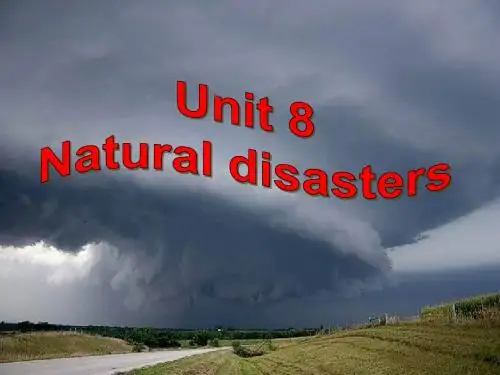
a big fire
flood cause
typhoon台风
accident事故
Some other natural disasters
drought 干旱
The earth is short of water. It is very dry.
缺水
earthquake地震
Natural disasters are caused by natural forces.
up adv.完全地 (用在某些v.之后,表示完结,用完) eat up 吃光 use up 用完
ห้องสมุดไป่ตู้
3. thousands of 成千上万的, 数以千计的 thousand, hundred, million前有数词,后不用s和of。后 有s必须用of,前不可加数词 away many villages e. g. The flood washed ________ ______ ______ and ______ killed _________ thousands ___ of people (那场洪水冲走了许多村庄,数千人丧生了). killed thousands of people = thousands of people lost their lives 4. accident 事故,意外的事 可数n. 发生一起事故 have an accident a ___ car _________ accident (一场车祸) yesterday. e.g. There was __ 5. crash into 猛撞,碰撞 crashes
Fill in the blanks.
1. There are many ________ disasters (灾害) in the
牛津译林版八年级上册英语课件8AUnit8Welcome

use up 用完 eat up 吃光
3. thousands of 成千上万的, 数以千计的 thousand, hundred, million前有数词,后不用s和of。后 有s必须用of,前不可加数词
e. g. The flood w__a_s_h_e_d__ _a_w__ay__ manyv_i_ll_a_g_e_s and _k_il_le_d__ _th_o_u_s_a_n_d_s_ _o_f_ people
2. When did it happen? It happened at night.
1. 自然灾害 2. 都湿透了 3. 开始下雨 4. 醒来 5. 把水拖干净 6. 不带你回家 7. 输了比赛 8. 使数千人丧生 9. 一场车祸 10. 撞到了树上 11. 冲走村庄 12. 引起大火
natural disasters be all wet start to rain wake up mop up the water go home without you lose final kill thousands of people a car accident crash into tree wash away village start big fire
Buildings come down. 崩塌,坍塌
storm [stɔːm] n. 风暴,暴(风)雨
Big storm may also kill people. Storm blows away many things.
They are all natural disasters.
[dɪ'zɑːstə]
5. My brother _fe_l_l (fall) off his bike just now.
3. thousands of 成千上万的, 数以千计的 thousand, hundred, million前有数词,后不用s和of。后 有s必须用of,前不可加数词
e. g. The flood w__a_s_h_e_d__ _a_w__ay__ manyv_i_ll_a_g_e_s and _k_il_le_d__ _th_o_u_s_a_n_d_s_ _o_f_ people
2. When did it happen? It happened at night.
1. 自然灾害 2. 都湿透了 3. 开始下雨 4. 醒来 5. 把水拖干净 6. 不带你回家 7. 输了比赛 8. 使数千人丧生 9. 一场车祸 10. 撞到了树上 11. 冲走村庄 12. 引起大火
natural disasters be all wet start to rain wake up mop up the water go home without you lose final kill thousands of people a car accident crash into tree wash away village start big fire
Buildings come down. 崩塌,坍塌
storm [stɔːm] n. 风暴,暴(风)雨
Big storm may also kill people. Storm blows away many things.
They are all natural disasters.
[dɪ'zɑːstə]
5. My brother _fe_l_l (fall) off his bike just now.
牛津译林版英语八年级上册(初二上学期,8A) Unit8 Task课件(共28张PPT)
Paragraph 4 After the snowstorm
Where was Sandy? She was at Millie’s home. What did she hear? She heard the noise of traffic. What did she see? She saw many people clearing the snow .
Hint 3: Huge wind
typhoon
Hint 1: 2008 Hint 2: China Hint 3: The earth shakes
eeaarrtthhqquuaakkee
Hint 1: Strong wind Hint 2: Thunder and lightning Hint 3: Heavy rain
3. What happened to them? They lost the umbrella and had to walk slowly.
4. What did she hear? She could only hear the wind.
5. What did she see? She saw many people at the bus stop and snow continued to fall.
snowstorm
Read the notes on the snowstorm.
▪ When was the snowstorm?
On Friday, 5 January.
▪ Where was Sandy when the snowstorm happened?
She was at school.
Unit 8 Natural disasters
新牛津译林版八年级英语上Unit 8 Welcome to the unit教学课件
Unit 8 Natural disasters
Welcome to the unit
Objectives To get a general idea about
natural disasters
To learn to talk about natural disasters
Lead-in
What’s the weather like today?
What happened to Hobo?
Let’s have a look.
备注:见视频 Comic strip
1. What’s the weather like? It’s raining. 2. What happened to Hobo? His house is all wet. 3. What was Hobo doing when it started to rain? He was sleeping. 4. When did Hobo hear the rain? When he woke up, he heard the rain. 5. Why does Hobo want Eddie to go home with him? He wants Eddie to mop up the water.
Natural disasters
Accidents
cause
Nature (weather) people
Natural disasters and accidents A Sandy is reading some newspaper headlines. Look at them. Which are about natural disasters? Put a tick (√) in the correct boxes.
Welcome to the unit
Objectives To get a general idea about
natural disasters
To learn to talk about natural disasters
Lead-in
What’s the weather like today?
What happened to Hobo?
Let’s have a look.
备注:见视频 Comic strip
1. What’s the weather like? It’s raining. 2. What happened to Hobo? His house is all wet. 3. What was Hobo doing when it started to rain? He was sleeping. 4. When did Hobo hear the rain? When he woke up, he heard the rain. 5. Why does Hobo want Eddie to go home with him? He wants Eddie to mop up the water.
Natural disasters
Accidents
cause
Nature (weather) people
Natural disasters and accidents A Sandy is reading some newspaper headlines. Look at them. Which are about natural disasters? Put a tick (√) in the correct boxes.
牛津译林英语 八年级上册 Unit8 Welcome (共32张PPT)
Fill in the blanks
This mo_r_n_i_n_g_, came to ’s house for h_e_lp_, because his was all we_t__. He was s_le_e_p_i_n_g at that time and didn’t h_e_a_r_ the rain. When he woke up, there was water e_ve_r_y_w_h__e_re_. wanted to go home wi_t_h_ him and help him to mo_p__ all the water up. isn’t very h_a_p_p_y_. Will he help ?
Group 3-4: talk about earthquake
Sample conversation: S1: Did you hear about …?
Show Time S2: No. What happened? S1: …(describe it) S2: Oh really?
what a flood when July 6,this year where Wuhan,Hubei Province
thousands of …成千上万的
8
earthquake ['ɜːθkweɪk]
n.地震
海啸 tsunami
滑坡 landslide
hurfrom a bike
hurt her legs
Snowstorm 暴风雪
an accident n. 事故,意外的事
we should
Calm down; Find cover that can protect us; Save our strength (体力); Try to contact (联系) other
牛津译林版8上U8 Welcome课件 (共24张PPT)
hurts legs
8. Big storm kills 20 people
1. What happened to Vivien’s school last week?
There was a heavy storm with thunder and lightning, and a classroom building at Vivien’s school caught fire.
it caused fire.
3. Was anyone hurt? No. It happened at night.
Let’s see which group does the best.
1. Role play the conversation in groups; 2. Role play the conversation in front of the class
What will the bad weather cause?
Lightning A flood can will start wash a the big village fire inaway. a house. The snowstorm can stop the traffic.
What are natural disasters?
Can you tell the differences between natural disasters and accident? Natural disasters are all caused by the force of nature (自然力).
Accidents are usually caused by people.
Work in pairs and discuss the natural disasters and accidents with your partner. Use Sandy and Millie’s conversation as a model.