
外研社版高中英语必修一至必修五各单元语法总结(带高考真题)
外研社版高中英语必修一至必修五各单元语法总结(带高考真题)必修一Module 1 My First Day at Senior High语法点:1. 一般现在时(1) —Do you know if Terry will go camping this weekend?(2008 上海)—Terry? Never! She ____ tents and fresh air.A. has hatedB. hatedC. will hateD. hates答案:D.(2). As you can see, the number of cars on our roads____ rising these days.(2006 全国一)A. was keepingB. keepC. keepsD. were keeping答案:C.(3). The machine ___. It’s hasn’t worked for years. (2006 浙江)A. didn’t workB. wasn’t workingC. doesn’t workD. isn’t working答案:C.2.以-ing和-ed结尾的形容词(1). Lucy has a great sense of humor and always keeps her colleagues ________ with her stories.A.amusedB. amusingC. to amuseD. to be amused答案:A.(2). Tom sounds very much _______ in the job, but I’m not sure whether he can manage it. (2006安徽)A.interestedB. interestingC. interestinglyD. interestedly解析:句中sounds意为“听起来”,是系动词,后接表语,要用形容词,排除C和D;又因表示“对……感兴趣”,用interested。
答案是A。
(3). Mr. Smith, ______ of the ______ speech, started to read a novel. (2003,北京)A.tired; boringB. tiring; boredC. tired; boredD. tiring; boring解析:前空是“感到累”用tired,后空是“令人厌倦的”用tiring。
答案是A。
Module 2 My New Teachers语法点:后接V-ing的动词(1). While shopping, people sometimes can't help ____ into buying something they don't really need. (96年上海卷)A. to persuadeB. persuadingC. being persuadedD. be persuaded答案:C.(2). I really appreciate ____ to relax with you on this nice island. (04年上海卷)A. to have had timeB. having timeC. to have timeD. to having time答案:B.Module 3 My First Ride on a Train语法点:动词的过去分词(1) The managers discussed the plan that they would like to see ___ the next year. (NMET 2000)A. carry outB. carrying outC. carried outD. to carry out辨析:根据固定搭配 see sb do sth / see sth done, 本题中plan是that引导的定语从句中的先行词,做see的宾语。
所以答案选C。
(2). Don't leave the water_while you brush your teeth. (04天津卷)A. runB. runningC. being runD. to run辨析:本题答案选B。
leave v-ing 表示让某物处于一种状态。
“让水一直流”在你刷牙时。
(3). After his journey from abroad, Richard Jones returned home, ____.(04春上海卷)A. being exhaustedB. exhaustedC. exhaustingD. having exhausted答案B. exhausted 感到精疲力尽的Module 4 A Social Survey-My Neighbourhood语法点:现在完成时1.(2012江西)--Look! Somebody ______ the sofa. --Well, it wasn’t me. I didn’t do it. A.is cleaning B.was cleaning C.has cleaned D.had cleaned2.(2006重庆) I _____ in London for many years,but I’ve never regretted my final decision to move back to China.A. livedB. was livingC. have livedD. had lived3. (2007辽宁) ── Has your father returned from Africa yet?──Yes, but he _____ here for only three days before his company sent him to Australia.A.wasB. has beenC. will beD. would be4.( 2007湖南)Cathy is taking notes of the grammatical rules in class at Sunshine School, where she ______ English for a year.A. studiesB. studiedC. is studyingD. has been studying5.(2008全国)If the weather had been better, we could have had a picnic. But it ____ all day.A. rainedB. rainsC. has rainedD. is raining答案1.C. 2. A 3. A 4.D 5. A解析1.句意为”看,有人已经打扫了沙发.是的,不是我,我没有做.过去发生的动作对现在造成的影响用现在完成时.2. 据move back to China.可知,现在不在伦敦,即live 未持续到现在。
3.结合提供的情景,我父亲在非洲待了三年,后来又去了澳大利亚,即现在不在非洲,动作be here 未持续到现在;4.据划线部分可知他现在仍在那所学校学习,即study 持续到现在;5.结合语境,是准备野餐那天下了一整天,下雨没有持续到现在;Module 5 A Lesson in a Lab语法点:形容词和副词的比较级(1). Mr. Smith owns _______ collection of coins than anyone else I have ever met. (2005山东).rgerB. a largerC. the largerD. a large解析:由than可知要用比较级,排除选项D;又因collection(收藏品)是可数名词,此处为单数又不是特指,要用不定冠词a。
答案是B。
(2). The number of people present at the concert was _____than expected. There were many ticket left. (2004福建)A. much smallerB. much moreC. much largerD. many more解析:因为主语是“去参加音乐会的人的数量”,而数量是讲大小,而不是多少的,排除B 和D;又由后文还“有很多票剩下,可见参加音乐会的人比原来预计的要少,所以选A。
Module 6 The Internet and Telecommunications语法点:1.合成词(1). The poor young man is ready to accept _____ help he can get.(2005 NMET)A.whicheverB. howeverC.whateverD.whenever答案:C. Whatever意为“任何...”,用作定语,后接名词。
与whichever的区别为:whichever 范围内的无论哪一个,而whatever没有范围。
(2). The old tower must be saved, ______ the cost.(2005浙江)A.howeverB. whateverC. whicheverD. WhereverB.答案:B.2.冠词(1). (08全国卷II ) It’s not _____ good idea to drive for four hours without _____ break.A. a; aB. the; aC. the; theD. a; the(2). (08重庆卷)In many places in China, bicycle is still poplar means of transportation.A. a; theB. /; aC. the; aD. the; the(3). (08辽宁卷 ) My neighbor asked me to go for ____ walk, b ut I don’t think I’ve got ____ energy.A. a; 不填B. the; theC. 不填;theD. a; the(4). (08山东卷)Students should be encouraged to use ____ Internet as ____ resource.A. 不填;aB. 不填; theC. the; theD. the; a(5). (08江苏卷) We went right round to the west coast by _____ sea instead of driving across ____ continent.A. the; theB.不填;theC. the; 不填D. 不填;不填答案:1---5,ACADB必修二Module 1 Our Body and Heathy Habits语法点:名词转化为动词Module 2 No Drugs语法点:1.不定式作状语(1). Simon made a big bamboo box ________ the little sick bird till it could fly. (2011·四川卷)A. keepB. keptC. keepingD. to keep答案与解析:选D. 句意:Simon做了一个大竹筐饲养那只生病的小鸟,直到它能飞起来。
(完整版)高中英语外研社必修一重点词汇语法总结,推荐文档
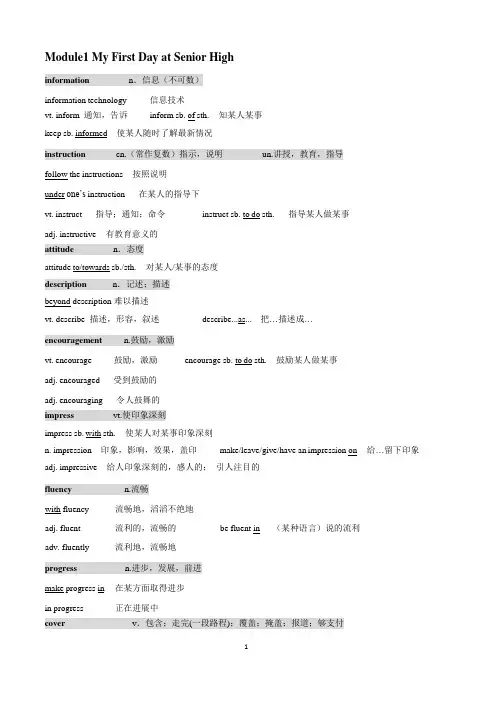
Module1 My First Day at Senior Highinformation n.信息(不可数)information technology 信息技术vt. inform 通知,告诉inform sb. of sth. 知某人某事keep sb. informed 使某人随时了解最新情况instruction cn.(常作复数)指示,说明un.讲授,教育,指导follow the instructions 按照说明under one’s instruction 在某人的指导下vt. instruct 指导;通知;命令instruct sb. to do sth. 指导某人做某事adj. instructive 有教育意义的attitude n.态度attitude to/towards sb./sth. 对某人/某事的态度description n.记述;描述beyond description 难以描述vt. describe 描述,形容,叙述describe...as... 把…描述成…encouragement n.鼓励,激励vt. encourage 鼓励,激励encourage sb. to do sth. 鼓励某人做某事adj. encouraged 受到鼓励的adj. encouraging 令人鼓舞的impress vt.使印象深刻impress sb. with sth. 使某人对某事印象深刻n. impression 印象,影响,效果,盖印make/leave/give/have an impression on 给…留下印象adj. impressive 给人印象深刻的,感人的;引人注目的fluency n.流畅with fluency 流畅地,滔滔不绝地adj. fluent 流利的,流畅的be fluent in (某种语言)说的流利adv. fluently 流利地,流畅地progress n.进步,发展,前进make progress in 在某方面取得进步in progress 正在进展中cover v.包含;走完(一段路程);覆盖;掩盖;报道;够支付similar adj.相似的,类似的be similar to 与……相似be similar in 在某方面相似adv. similarly 同样;类似地n. similarity 类似;相似点(复数similarities)disappointed adj.失望的,感到失望的(人作主语)对某人失望对某事失望adj. disappointing 令人失望的(物作主语)n. disappointment 失望,沮丧to one’s disappointment 使某人失望的是amazing adj.令人吃惊的;令人惊讶的be amazed at/by sb./sth. 对某人或某事感到吃惊vt. amaze 使惊讶,使惊愕amaze sb. 使某人吃惊adj. amazed 感到吃惊的,惊奇的n. amazement 惊愕,惊异to one’s amazement 使某人惊讶的是in amazement 惊讶地enthusiastic adj.热心的;热情的be enthusiastic about 对……热心;热衷于……n. enthusiasm 热心,热情adv. enthusiastically 热心地,热切地far from 离……远;远离by far 大大地;…得多;(修饰比较级和最高级)e.g. He is by far better than Jim.他比Jim 好的多。
高中英语外研版语法总结-必修
Unit One 复习:基本句子结构1.主谓宾2.主系表3.主谓4.主谓宾宾补5.主谓间宾直宾Unit Two 复习:构词法1.缩略法(阅读)2.转化法-词性转换(语法填空)3.派生法-前后缀(语法填空+阅读)4.合成法Unit Three 复习:五种时态一般现在时/一般过去时/一般将来时/现在进行时/现在完成时Unit Four 定语从句(1)--关系代词的用法as,that,who,whom,whose,whichUnit Five 定语从句(2)--关系副词的用法where,when,whyUnit Six 定语从句(2)--介词+关系代词Unit One 情态动词(1)--情态动词的功能Unit Two 情态动词(2)can/could;may/might;will/would;shall/should等be able to dodare do 胆敢Unit Three 非谓语—不定式作定语和结果状语Unit Four 非谓语—现在分词作状语状语:时间;地点;原因,结果,条件,让步,伴随,方式等Unit Five 非谓语—现在分词作定语Unit Six 非谓语—现在分词,不定式和过去分词作补语Unit One 非谓语—过去分词作状语(被动,完成)Unit Two 非谓语—过去分词作定语(被动,完成)Unit Three 现在完成时的被动语态have/has been doneUnit Four 现在进行时的被动语态be being doneUnit Five 过去将来时1.宾语从句2.叙述过去的事情3.非真实,虚拟语气Unit Six 省略1.and/but 并列句2.状语从句3.定语从句4.名词性从句。
新教材 外研版高中英语选择性必修第一册全册各单元知识点提炼汇总(单词短语句型语法等详解及扩展)
外研版选择性必修第一册全册知识点提炼Unit 1 Laugh out loud ............................................................................................................... - 1 - Unit 2 Onwards and upwards ................................................................................................. - 13 - Unit 3 Faster, higher, stronger ................................................................................................ - 26 - Unit 4 Meeting the muse ....................................................................................................... - 38 - Unit 5 Revealing nature .......................................................................................................... - 50 - Unit 6 Nurturing nature ......................................................................................................... - 62 -Unit 1 Laugh out l oud1.approach v.接近;靠近n.方法;途径approach to...……的方法2.curly adj.卷曲的3.the waiting area等候区4.atmosphere n.氛围;大气层5.boredom n.枯燥bored adj.感到枯燥的boring adj.令人枯燥的6.look through 浏览;看穿7.previously adv.先前地;以前地fort v.安慰comfortable adj.舒适的9.scene n.场景;现场on the scene在现场10.spot v.发现11.on-duty 值班的;当班的12.fall off从……跌落13.spend some time doing sth.花费时间做某事14.in pain在痛苦中15.chemical n.化合物16.make people feel better是“make+宾语+宾补”结构。
(完整word版)外研社高中英语必修一Module1-6所有重点归纳-推荐文档

Module 1 My First Day at Senior High1 How’s it going? = How is everything recently?2 cover: 包含, 包括●be covered with 被……覆盖3 at the end of …在……结束的时候Eg : Class 5 is at the end of the corridor.●in the end = at last 最后, 终于(一般时态)Eg: I am sure I will win in the end.●by the end of …到……为止(后用完成时态)Eg :①By the end of this term, we will have learnt two English books.②By the end of last year, we had finished our task.●end up with 以……告终4 receive 客观上收到; accept 主观上收到Eg :I received his invitation but did not accept it.5 divide: 划分, 把整体分为若干部分Eg :The world is divide into five continents.※比较separate:分隔, 把原来连在一起或靠近的分隔开来6 表参加活动的短语:take part in + 活动join the party join in the game attend + the meeting7.The teachers are very enthusiastic and friendly and the classrooms are amazing.表示“吃惊”的几个单词:◆surprise指“由于出乎意料而感到惊异或诧异”。
Eg: His coming surprised me.◆astonish指“由于出乎意料而又不能理解而感到吃惊”, 语意较强。
新教材 外研版高中英语必修第一册全册各单元知识点提炼汇总(单词短语句型语法等详解及扩展)
外研版必修第一册全册各单元知识点汇总Unit 1 A new start .................................................................................................................... - 1 - Unit 2 Exploring English ....................................................................................................... - 15 - Unit 3 Family matters ............................................................................................................ - 29 - Unit 4 Friends forever............................................................................................................ - 44 - Unit 5 Into the wild ................................................................................................................ - 57 - unit 6 At one with nature........................................................................................................ - 65 -Unit 1 A new start重点单词1.picture vt.想象;描写2.over and over again反复地3.wake up醒来wake的过去式为woke,过去分词为woken,现在分词为waking。
外研社版高中英语必修一第一单元知识点总结

My First Day at Senior High第一部分语法一时态1)一般现在时A构成(动词的变化)主语是第一,二或者复数的时候用动词的原形。
i feel very happy. We feel very happy.主语为单数第三人称的时候,动词加s 或者es(原音结尾)。
辅音+y时把y变成I 再加es.She feels very happy. She goes to school every day. Carry--- carries study---studiesB 用法4种1 表示经常性习惯性反复性发生的动作。
我们每天吃三顿饭。
We have three meals every day.妈妈每天晚上8点睡觉。
My mother goes to bed at 8every night.一般现在时常与时间状语连用,如usually, often, always, everyday, sometimes, once a month,on Mondays.2 表示客观事实或普遍真理。
太阳从东方升起。
The sun rises in the East.知识就是力量。
Knowledge is power.3 表示现在时刻发生的动作或存在的状态。
车来啦!Here comes the bus.我感觉很累。
I feel very tired .4 按照时间表,计划,规定将要发生的事。
常与动词; go, come, arrive ,leave, start, begin 等连用。
e.g.火车8点30发车,9点30到达。
The train leaves at 8:30 and arrives at 9:30.考试易错题型:e.g.如果明天是晴天,我们将去野餐。
If it will be fine tomorrow, we will go on a picnic. 错,在条件状语从句中和时间状语从句中,从句如表示将来的动作,用一般现在时代替。
(完整)外研版高一英语必修一语法.doc
必修一语法一、一般现在时2.一般现在时的基本用法(1)一般现在时常表经常发生的动作或者经常存在的状态,常与always,often,usually,everyday,sometimes等表示时间的状语连用①,有时候时间状语可以不表达出来②。
由when,while,before,after,until,as soon as等引导的时间状语从句亦可用一般现在时表示经常发生的动作或存在的状态③。
连词if引导的条件从句有时亦可用一般现在时表示经常发生的动作或存在的状态④。
①I go to school everyday.②Where do you live ?③When I come across a new word I consult the English dictionary.④If you speak slowly, I understand. If you speak quickly, I don’t understand.(2)一般现在时常用语一下情况I.表示日常行为①The boys wake up at seven o’clock, wash, dress quickly and run into thedining-room for breakfast. They wait until they hear the bell and then go to school.II.表示习惯、能力①He never wears a hat in winter.(习惯)②Do you drive, John? (能力)III.表示客观存在①The earth moves round the sun.②Time and tide wait for no man. 岁月不等人IV.报章、杂志、书籍不强调过去时间、单纯表示客观事实(即所载文字依然存在)时,亦用一般现在时①What does the newspaper say?3.一般现在时表现在(1)表说话时刻,这一时刻往往是很短暂的①。
高中外研版教材第一册(必修)语法点梳理
高中外研版教材第一册(必修)语法点梳理UNIT1:一、课本语法点1、复习现在时态一般现在时态:注意时间状语——never/ seldom/ hardly/ often/ always/ all the time考点:结合频度时间状语、结合if和when的时间状语从句、一般现在时表将来(在时间表中)、在宾语从句中的用法现在进行时态:注意表示持续时的用法,时间状语为these days,或from 时间to 时间2、以ing和ed结尾的形容词:提醒学生ing结尾的形容词可以修饰人,两者的本质是:ing说明某事物或某人的本身性质;ed说明人或动物的主观感受。
二、补充语法点:1、比较级:普通形式:er和more的形式同级比较:as… as…/ not so … as…倍数比较:倍数(注意twice)+ er/ more + than倍数(注意twice)+ as + 原级+ as倍数(注意twice)+ the + size/ weight/ length/ height/ depth of2、限制性定语从句:考点:填写关系词——代词:that/ which/ who/ whom/ whose/ as;副词:when/ where/ why 注意“分割性定语从句”:即先行词与空格横杆被副词或副词性短语分开,此时需提醒学员注意分辨先行词,可找出所有名词和代词带入从句,也可通过去掉副词成分分辨。
注意occasion/ situation/ point等先行词的特殊关系词UNIT2:一、课本语法点:1、用动名词做宾语的动词强调学生的平时积累提醒学生用动词做主语时要么用动名词形式,要么用to do不定式(俗语常用)既可以加ing做宾语又可以跟to do做宾语的动词:Regret/ forget/ remember doing sth(doing的动作已经做过了)Regret/ forget/ remember to do sth(to do的动作还未做过)Stop/ go on doing sth(doing的动作正在做)Stop/ go on to do sth(to do此时表目的)二、补充语法点:1、prefer和rather表示“宁愿”的用法Prefer to do sth rather than (to) do sth/ instead of doing sthPrefer sth to sthPrefer doing to doingPrefer sb to do sthRather do sth/ rather do sth than do sth2、非限制性定语从句注意和限制性定语从句的形态区别:逗号,先行词不再是一个词而可能是一个短语或句子注意“数词+ 介词+ which/ whom”的用法注意as的用法,一般用在句首,且有“正如”的意思✧UNIT3:一、课本语法点:1、过去分词做定语注意两种用法:不及物动词的ed形式一般表示被修饰名词已完成了该动作,如fallen leaves;及物动词的ed形式一般表示被修饰名词承受了该动作,如trained animals2、过去时的表达形式:Did/ used to do/ would do注意区别used to do/ be used to doing/ be used to do时态题目的做题步骤:辨析题型(四选项皆为时态语态变形);找时间状语(过去完成时:before+过去时间、by+过去时间、by the end of+过去时间;将来完成时:by+将来时间);找其他时态(一般时态不跳格);通过语境判断时态✧UNIT4:一、课本语法点:1、现在完成时:较难时间状语:since和for提醒学生since后面如跟从句不可再用完成时态,for+一段时间也会用于一般过去时,此时要区分动作是否已经结束,动作结束了用一般过去时,动作未结束或会继续到将来用现在完成时注意现在完成时考察影响的用法:如通过排除法在做题中排除到只剩某一时态和现在完成时态,请考虑题目对“影响”进行考察的可能性✧UNIT5:一、课本语法点:1、比较级:复习UNIT1补充语法点✧UNIT6:一、课本语法点:1、复合词:Well- known/ orange-colored/ touch-me-no/ watch-and-sit注意跟学生强调复合词不可以自造,需要结合语言文化环境在已有的用法上延伸2、定冠词和零冠词:故事记忆基本原则补充故事中不含有的原则:表类别时可数名词可用the/ a/ an或复数形式,不可数名词用零冠词,human表示人类用零冠词考试做题方法:翻译为“一…”的填写a或an,翻译为“那个”或“这个”的填写the,如翻译无效请对应故事中的特殊原则,如不在原则中,希望老师在讲解的时候尽量将特殊用法归入原则之类,以帮助学生更有效率地理解和记忆✧要点单词参考书:曲一线备考:高考考纲必考单词3500+1600✧上周课程问题及本周知识点打磨:唐玉娟:如何让课程变得更有趣?第一步首先还是要夯实干货,在有充分的以及有逻辑的干货的基础上,在例句中加入个人的风格,加入时下学生流行的话题和热点,建议在例句中加入水货,且在每次备课时,在每一个例句中加入水货备用。
外研社高一英语必修1的语法知识总结及练习题
一、一般现在时一般现在时表示经常性、习惯性的动作,或表示现在的特征、状态。
当主语是非第三人称单数时,行为动词要发生相应的变化。
一般现在时的用法及特点:1)、表示经常或者反复发生的动作. 如: 我每天吃午饭. I have lunch every day.2)、还表示现在存在的一种状态. 如:我姐姐是一位老师.My sister is a teacher.3)、客观真理,客观存在,科学事实。
例如:The earth moves around the sun.地球绕着太阳转。
4)、一般现在时态经常与often(经常)sometimes(有时)always(总是)usually(通常)等频率词连用,也经常与every day(每天), every week(每周), every month(每月), every term(每学期), every year(每年), once a week (一周一次),twice a year(一年两次)等表示时间的词连用。
5)、第三人称单数问题一般现在时中,当主语是第三人称单数时,即常在动词原形后加-s或-es。
1、当主语不是第三人称单数时,结构是:肯定句: 主语+行为动词原形+其他We speak Chinese.否定句: 主语+don’t+行为动词原形+其他We don’t speak Chinese.一般疑问句:Do+主语+行为动词原形+其他?Do you speak Chinese?肯定回答:Y es,主语+do Y es, we do.否定回答:No,主语+don’t No, we don’t.2、当主语是第三人称单数时,谓语动词不能用原形了,而是要相应的变化,其变化规则是:动词原形变第三人称单数的规则与发音规律同名词单数变复数大致相同,请认真观察。
1)、大多数动词在词尾加―S‖在清辅音后发音为[s],在浊辅音及元音后发音为[z]。
如:①stop-stops [s] ; make-makes [s]②read-reads [z] ; play-plays [z]2)、以辅音字母加―y‖结尾的,要先将―y‖变为―i‖,然后在加―es‖读[iz] 如:fly-flies [z];carry-carries [z]study-studies [z]; worry-worries3)、以―s, x, ch, sh‖结尾的,在词尾加―es‖,发音为[iz] 如:teach-teaches [iz]; watch-watches [iz]4)、以―o‖结尾的动词,加―es‖,读[z] 如:go-goes [z] do-does [z]其结构是:肯定句:主语+动词的第三人称单数+其他He speaks English.否定句:主语+doesn't+动词原形+其他He doesn't speak English.一般疑问句:Does +主语+动词原形+其他? Does he speak English?肯定回答:Y es,主语+does. Y es, he does.否定回答:No,主语+doesn't. No, he doesn't.练习题:work watch clean write teach wash play readdo fly study go drink cry have sit Swim make run carry leave arrive jump come Speak wear walk buy help pack take talktell know look love live eat want say1. He________ TV every evening. (watch)2. We always ________ to school on foot. (go)3. Tom, with his classmates, often ______ football after school. (play)4. Your shoes _______ under the bed. (be)5. ______ here and ______ by me. (come, stand)6. His uncle usually _________ to work by bus. (go)7. I always ______ up at six in the morning.(get)8. John ________ like his father. (look).布莱克太太经常在英语上帮助我们。
外研版高中英语语法汇总
高中英语语法总结(一)被动语态动词的语态主要分为两种:主动语态与被动语态主动语态指主语是谓语功作的执行者,则为主动关系。
被动语态指主语是谓语动作的承受者,则为被功关系。
i have done the job.(主动句)the job has been done.(被动句)1.被动语态根据时态的不同,可分为以下几种类型:一般现在时:am/is/are+done;一般过去时:was/were+done现在进行时:am/is/are+being done过去进行时:was/were+being done将来时:will/would+be done,be going to be done, be to be done 现在完成时:have/has +been done过去完成时:had+been done将来完成时:will+have been done2被动语态门主功语态一样具有不同时态,其时态的变化取决于时间状语,其时态的变化形式由其助动词be的事态变化形式来体现the house is being painted now.(现在进行时被动语态)eru0ugh has been said to him about it.(现在完成时被动语态)the furniture was bought last week..(过去时被动语态)you'll be punished one day.(将来时被动语态)3.被动语态的意义(1)不知道或没必要指出行为、动作的执行者(无须加buy短语)colour tv sets are sold in that shop.football is plated all over the world.(2)突出和强调行为或动作的承受着。
history is made by the people.the wounded soldiers have been saved by those people.(3)有时主语较长,可后置。