
英语六级考试真题试卷
2016年6月英语六级考试真题试卷(第3套) Section ADirections: In this section, there is a passage with ten blanks. You are requir ed to select oneword for each blank from a list of choices given in a word ban k following the passage. Read thepassage through carefully before making yo ur choices. Each choice in the bank is identified bya letter. Please mark the c orresponding letter for each item on ,Answer Street 2 with a singleline throug h the centre. You may not use any of the words in the bank more than once. Questions 26 to 35 are based on the following passage.Pursuing a career is an essential part of adolescent development."The adolescent becomesan adult when he26__________ a real job." To co gnitive researchers like Piaget, adulthoodmeant the beginning of an27_____ _____ .Piaget argued that once adolescents enter the world of work, their newly acqu ired ability to form hypotheses allows them to create representations that ar e too ideal. The28__________ ofsuch ideals, without the tempering of the rea lity of a job or profession, rapidly leadsadolescents to become29__________ of the non-idealistic world and to press for reform in acharacteristically ado lescent way. Piaget said:"True adaptation to societycomes30__________ when the adolescent refo rmer attempts to put his ideas to work."Of course, youthful idealism is often courageous, and no one likes to give u p dreams.Perhaps, taken31__________ out of context, Piaget's statement seems harsh. What hewas32__________ , however, is the way reality can m odify idealistic views. Some people referto such modification as maturity. Piaget argued that attaining and accepting a vocation isone of the best ways to modify idealized views and to mature.As careers and vocations become less available during times of33_________ _ , adolescentsmay be especially hard hit. Such difficult economic times may l eave manyadolescents34__________ about their roles in society. For this rea son, community interventions and government job programs that offer summ er and vacation work are not onlyeconomically __35__ but also help to stimu late the adolescent's sense of worth.A. automaticallyB. beneficialC. capturingD. confusedE. emphasizingF. entranceG. excitedH. existenceI. incidentallyJ. intolerantK. occupationL. promisesM. recessionN. slightlyO. undertakesSection BDirections: In this section, you are going to read a passage with ten statements attached to it. Each statement contains information given in one of the paragraphs. Identify the paragraph from which the information is derived. You may choose a paragraph more than once. Each paragraph is marked with a letter. Answer the questions by marking the corresponding letter on Answer Sheet 2.Can societies be rich and green?[A] our economies are to flourish, if global poverty is to be eliminated and if the well-being of the world's people enhanced—not just in this generation but in succeeding generations—we must make sure we take care of the natural environment and resources on which our economic activity depends." That statement comes not, as you might imagine, from a stereotypical tree-hugging, save-the-world greenie (环保主义者), but from Gordon Brown, a politician with a reputation for rigour, thoroughness and above all, caution.[B] A surprising thing for the man who runs one of the world's most powerful economies to say? Perhaps; though in the run-up to the five-year review of the Millennium (千年的)Goals, he is far from alone. The roots of his speech, given in March at the roundtable meeting of environment and energy ministers from the G20 group of nations, stretch back to 1972, and the United Nations Conference on the Human Environment in Stockholm.[C] "The protection and improvement of the human environment is a major issue which affects the well-being of peoples and economic development throughout the world," read the final declaration from this gathering, the first of a sequence which would lead to the Rio de Janeiro Earth Summit in 1992 and the World Development Summit in Johannesburg three years ago.[D] Hunt through the reports prepared by UN agencies and development groups—many for conferences such as this year's Millennium Goals review—and you will find that the linkage between environmental protection and economic progress is a common thread.[E] Managing ecosystems sustainably is more profitable than exploiting them, according to the Millennium Ecosystem Assessment. But finding hard evidence to support the thesis is not so easy. Thoughts turn first to some sort of global statistic, some indicator which would rate the wealth of nations in both economic and environmental terms and show a relationship between the two.[F] If such an indicator exists, it is well hidden. And on reflection, this is not surprising; the single word "environment" has so many dimensions, and there are so many other factors affecting wealth—such as the oil deposits—that teasing out a simple economy-environment relationship would be almost impossible.[G] The Millennium Ecosystem Assessment, a vast four-year global study which reported its initial conclusions earlier this year, found reasons to believe that managing ecosystems sustainably— working with nature rather than against it—might be less profitable in the short term, but certainly brings long-term rewards.[H] And the World Resources Institute (WRI) in its World Resources 2005 report, issued at the end of August, produced several such examples from Africa and Asia; it also demonstrated that environmental degradation affects the poor more than the rich, as poorer people derive a much higher proportion of their income directly from the natural resources around them.[I] But there are also many examples of growing wealth by trashing the environment, in rich and poor parts of the world alike, whether through unregulated mineral extraction, drastic water use for agriculture, slash-and-burn farming, or fossil-fuel-guzzling (大量消耗) transport. Of course, such growth may not persist in the long term—which is what Mr. Brown and the Stockholm declaration were both attempting to point out. Perhaps the best example of boom growth and bust decline is the Grand Banks fishery. For almost five centuries a very large supply of cod (鳕鱼) provided abundant raw material for an industry which at its peak employed about 40,000 people, sustaining entire communities in Newfoundland. Then, abruptly, the cod population collapsed. There were no longer enough fish in the sea for the stock to maintain itself, let alone an industry. More than a decade later, there was no sign of the ecosystem re-building itself. It had, apparently, been fished out of existence; and the once mighty Newfoundland fleet now gropes about frantically for crab on the sea floor.[J] There is a view that modem humans are inevitably sowing the seeds of a global Grand Banks-style disaster. The idea is that we are taking more out of what you might call the planet's environmental bank balance than it can sustain; we are living beyond our ecological means. One recent study attempted to calculate the extent of this "ecological overshoot of the human economy", and found that we are using 1.2 Earth's-worth of environmental goods and services—the implication being that at some point the debt will be called in, and all those services—the things which the planet does for us for free-will grind to a halt.[K] Whether this is right, and if so where and when the ecological axe will fall, is hard to determine with any precision—which is why governments and financial institutions are only beginning to bring such risks into their economic calculations. It is also the reason why development agencies are notunited in their view of environmental issues; while some, like the WRI, maintainthat environmental progress needs to go hand-in-hand with economic development, others argue that the priority is to build a thriving economy, and then use the wealth created to tackle environmental degradation.[L] This view assumes that rich societies will invest in environmental care. But is this right? Do things get better or worse as we get richer? Here the Stockholm declaration is ambiguous. "In the developing countries," it says, "most of the environmental problems are caused by under-development." So it is saying that economic development should make for a cleaner world? Not necessarily; "In the industrialized countries, environmental problems are generally related to industrialisation and technological development," it continues. In other words, poor and rich both over-exploit the natural world, but for different reasons. It's simply not true that economic growth will surely make our world cleaner. [M] Clearly, richer societies are able to provide environmental improvements which lie well beyond the reach of poorer communities. Citizens of wealthy nations demand national parks, clean rivers, clean air and poison-free food They also, however, use far more natural resources—fuel, water (all those baths and golf courses) and building materials.[N] A case can be made that rich nations export environmental problems, the most graphic example being climate change. As a country's wealth grows, so do its greenhouse gas emissions. The figures available will not be completely accurate. Measuring emissions is not a precise science, particularly when it comes to issues surrounding land use; not all nations have released up-to-date data, and in any case, emissions from some sectors such as aviation are not included in national statistics. But the data is exact enough for a clear trend to be easily discernible. As countries become richer, they produce more greenhouse gases; and the impact of those gases will fall primarily in poor parts of the world.[O] Wealth is not, of course, the only factor involved. The average Norwegian is better off than the average US citizen, but contributes about half as much to climate change. But could Norway keep its standard of living and yet cut its emissions to Moroccan or even Ethiopian levels? That question, repeated across a dozen environmental issues and across our diverse planet, is what will ultimately determine whether the human race is living beyond its ecological means as it pursues economic revival.注意:此部分试题请在答题卡2上作答。
2024英语六级试题及答案
2024英语六级试题及答案一、听力理解(共30分)1. A) The man is a professor.B) The man is a student.C) The man is a librarian.D) The man is a writer.答案:C2. A) The woman is looking for a job.B) The woman is looking for a house.C) The woman is looking for a book.D) The woman is looking for a restaurant.答案:A3. A) The man is late for the meeting.B) The man is early for the meeting.C) The man is on time for the meeting.D) The man is not attending the meeting.答案:A二、阅读理解(共40分)1. What is the main idea of the passage?A) The importance of teamwork.B) The benefits of working alone.C) The drawbacks of group projects.D) The challenges of managing a team.答案:A2. According to the passage, which of the following is true?A) Teamwork always leads to success.B) Teamwork can be more efficient than working alone.C) Teamwork is only beneficial in certain situations.D) Teamwork is always less efficient than working alone.答案:C3. What is the author's opinion on team dynamics?A) They are essential for success.B) They are not important in modern work environments.C) They can be detrimental to productivity.D) They are only relevant in large organizations.答案:A三、完形填空(共20分)1. A) DespiteB) AlthoughC) BecauseD) If答案:A2. A) wasB) wereC) isD) are答案:B3. A) thatB) whichC) itD) this答案:B四、翻译(共10分)1. 随着科技的发展,我们的生活变得越来越方便。
大学英语六级真题试卷-(13)精选全文完整版
可编辑修改精选全文完整版大学英语六级真题试卷Questions 31 to 35 are based on the following passage.We all have offensive breath at one time or another. In most cases, offensive breath emanates from bacteria in the mouth, although there are other more causes.Until a few years ago, the most doctors could do was to counsel patients with bad breath about oral cleanliness. Now they are finding new ways to treat the usually curable condition.Bad breath can happen whenever the normal flow of saliva (唾液) slows. Our mouths are full of bacteria feeding on protein in bits of food and shed tissue. The bacteria emit evil smelling gases, the worst of which is hydrogen sulfide (硫化物).Mouth bacteria thrive in airless conditions. Oxygen rich saliva keeps their numbers down. When we sleep, for example, the saliva stream slows, and sulfur producing bacteria gain the upper hand, producing classic “morning breath”.Alcohol hunger, too much talking, breathing through the mouth during exercise anything that dries the mouth produces bad breath. So can stress, though it’s not understood why. Some people’s breath turns sour every time they go on a job interview.Saliva flow gradually slows with age, which explains why the elderly have more bad breath trouble than younger people do. Babies, however, who make plenty of saliva and whose mouths contain relatively few bacteria have characteristically sweet breath.For most of us, the simple, dry mouth variety of bad breath is easily cured. Eating or drinking starts saliva and sweeps away many of the bacteria. Breakfast often stops morning breath.Those with chronic dry mouth find that it helps to keep gum, hard candy, or a bottle of water or juice around. Brushing the teeth wipes out dry mouth bad breath because it clears away many of the offending bacteria.Surprisingly, one thing that rarely works is mouthwash. The liquid can mask bad breath odor with its own smell, but the effect lasts no more than an hour. Some mouthwashes claim to kill the bacteria responsible for bad breath. The trouble is, they don’t necessarily reach all offending germs. Most bacteria are well protected from mouthwash under thick layers of mucus (粘液). If the mouthwash contains alcohol-as most do-it can intensify the problem by drying out the mouth.31. The phrase “emanate from”in Paragraph 1 most probably means “________”.A) thrive onB) account forC) originate fromD) descend from32. Which of the following is mentioned as one of the causes of bad breath?A) Tooth trouble.B) Sulfur rich food.C) Too much exercise.D) Mental strain.33. According to the passage, alcohol has something to do with bad breath mainly because ________.A) it keeps offending bacteria from reproducingB) its smell adds to bad breathC) it kills some helpful bacteriaD) it affects the normal flow of saliva34. Mouthwashes are not an effective cure for bad breath mainly because ________.A) they can’t mask the bad odor long enoughB) they can’t get to all the offending bacteriaC) their strong smell mixes with bad breath and makes it worseD) they can’t cover the thick layers of mucus35. We can infer from this passage that ________.A) offensive breath can’t easily be curedB) elderly people are less offended by bad breathC) heavy drinkers are less affected by bad breathD) offensive breath is less affected by alcoholQuestions 36 to 40 are based on the following passage.“Welcome to the U.S.A.! Major Credit cards accepted!”By the millions they are coming no longer the tired, the poor, the wretched mass longing for a better living. These are the wealthy. “We don’t have a budget,”says a biologist from Brazil, as she walks with two companions through New York City’s South Street. “We just use our credit cards.”The U.S. has long been one of the world’s most popular tourist destinations, but this year has been exceptional. First there was the World Cup, which drew thousands from every corner of the globe; then came the weakening of the U.S. dollar against major currencies. Now the U.S., still the world’s superpower, can also claim to be the world’s bargain basement (廉价商品部). Nobody undersells America these days on just about everything, from consumer electronics to fashion clothes to tennis rackets. Bottom retail prices-anywhere from 30% to 70% lower than those in Europe and Asia-have attracted some 47 million visitors, who are expected to leave behind $79 billion in 1994. That’s up from $74 billion the year before.True, not everyone comes just for brains. There remains an undeniable fascination in the rest of the world with all things American, nourished by Hollywood films and U.S. television series. But shopping the U.S.A. is proving irresistible. Every week thousands arrive with empty suitcases ready to be filled; some even rent an additional hotel room to hold their purchases. The buying binge (无节制) has become as important as watching Old Faithful Fountains erupt in Yellowstone Park or sunbathing on a beach in Florida.The U.S. has come at last to appreciate what other countries learned long ago: the pouring in of foreign tourists may not always be convenient, but is does put money in the bank. And with a trade deficit at about $130 billion and growing for the past 12 months, the U.S. needs all the deposits it can get. Compared with American tourists abroad, visitors to the U.S. stay longer and spend more money at each stop; an average of 12.2 night and $1624 a traveller versus the American s’four nights and $298.36. From what the Brazilian biologist says, we know that tourists like her ________.A) are reluctant to carry cash with themB) simply don’t care how much they spendC) are not good at planning their expenditureD) often spend more money than they can afford37. The reason why 1994 was exceptional is that ________.A) it saw an unusually large number of tourists to the U.S.B) it witnessed a drop in the number of tourists to the U.S.C) tourism was hardly affected by the weakening of the U.S. dollar that yearD) tourists came to the U.S. for sightseeing rather than for bargains that year38. By saying “nobody undersells America”(Line 4, Para. 3), the author means that ________.A) no other country underestimates the competitiveness of American productsB) nobody expects the Americans to cut the prices of their commoditiesC) nobody restrains the selling of American goodsD) no other country sells at a lower price that America39. Why does the author assert that all things American are fascinating to foreigners?A) Because they have gained much publicity through the American media.B) Because they represent the world’s latest fashions.C) Because they embody the most sophisticated technology.D) Because they are available at all tourist destinations.40. From the passage we can conclude that the U.S. has come to realize ________.A) the weakening if the U.S. dollar can result in trade deficitsB) the lower the retail prices, the greater the profitsC) tourism can make great contributions to its economyD) visitors to the U.S. are wealthier than U.S. tourists abroadPart III Vocabulary (20 minutes)Directions: There are 30 incomplete sentences in this part. For each sentence there are four choices marked A),B),C), and D). Choose the ONE that best completes the sentence. Then mark the corresponding letter on the Answer Sheet with a single line through the centre.41. His career was not noticeably ________ by the fact that he had never been to college.A) preventedB) preventedC) hinderedD) refrained42. When trapped in drifting sands, do not struggle, or you will be ________ in deeper.A) absorbedB) pushedD) sucked43. To ________ for his unpleasant experiences he drank a little more than was good for him.A) commenceB) compromiseC) compensateD) compliment44. All visitors are requested to ________ with the regulations.A) complyB) agreeC) assistD) consent45. The captain ________ the horizon for approaching ships.A) scannedB) scrutinizedC) exploredD) swept46. The vast majority of people in any given culture will ________ established standards of that culture.A) confineB) conformD) confirm47. Although he was on a diet, the food ________ him enormously.A) inspiredB) temptedC) overcameD) encouraged48. His argument does not suggest that mankind can ________ to be wasteful in the utilization of these resources.A) resortB) grantC) affordD) entitle49. If you want this pain killer, you’ll have to ask the doctor for a ________.A) receiptB) recipeC) subscriptionD) prescription50. Some fish have a greater ________ for acid water than others.A) toleranceB) resistanceC) dependenceD) persistence51. There was once a town in this country where all life seemed to live in ________ with its surroundings.A) coincidenceB) harmonyC) uniformD) alliance52. The court considers a financial ________ to be an appropriate way of punishing him.A) paymentB) obligationC) optionD) penalty53. It is true that ________ a wild plant into a major food crop such as wheat requires much research time.A) multiplyingB) breedingC) magnifyingD) generating54. The government has devoted a larger slice of its national ________ to agriculture than most other countries.A) resourcesB) potentialC) budgetD) economy55. In this poor country, survival is still the leading industry; all else is ________.A) luxuryB) accommodationC) entertainmentD) refreshment56. Some criminals were printing ________ dollar bills until they were arrested.A) decentB) fakeC) patentD) suspicious57. Mr. Bloom is not ________ now, but he will be famous someday.A) significantB) dominantC) magnificentD) prominent58. His body temperature has been ________ for 3 days, the highest point reaching 40.5 degree centigrade.A) uncommonB) disorderedC) abnormalD) extraordinary59. He seems to be ________ enough to climb to the mountain top in an hour.A) radiantB) conscientiousC) conspicuousD) energetic60. Although cats cannot see in complete darkness their eyes are much more ________ to light than are human eyes.A) glowingB) brilliantC) sensitiveD) gloomy61. While nuclear weapons present grave ________ dangers, the predominant crisis of overpopulation is with us today.A) inevitableB) constantC) overwhelmingD) potential62. This is the ________ piano on which the composer created some of his greatest works.A) trueB) originalC) realD) genuine63. Comparison and contrast are often used ________ in advertisements.A) intentionallyB) pertinentlyC) incidentallyD) tiresomely64. A complete investigation into the causes of the accident should lead to improved standards and should ________ new operating procedures.A) result isB) match withC) subject toD) proceed with65. ________ popular belief that classical music is too complex, itachieves a simplicity that only a genius can create.A) Subject toB) Contrary toC) Familiar toD) Similar to66. The bond of true affection had pulled us six very different men from six very different countries across Antarctica; we proved in the end that we weren’t very different ________.A) for allB) as usualC) in particularD) after all67. Though her parents ________ her musical ability, Jerrilou’s piano playing is really terrible.A) pour scorn onB) heap praise uponC) give vent toD) cast light upon68. Some children display an ________ curiosity about every new thing they encounter.A) incredibleB) infectiousC) incompatibleD) inaccessible69. Bruce Stephen gripped the ________ wheel hard as the car bounced up and down.A) stirringB) drivingC) steeringD) revolving70. Many of the scientists and engineers are judged ________ how great their achievements are.A) in spite ofB) in ways ofC) in favor ofD) in terms of。
2023年12月大学英语六级考试真题及答案(第二套)
2023年12月大学英语六级考试真题及答案(第二套)2023年12月大学英语六级考试真题及答案第二套英语六级听力第二套1.A) Spending their holidays in a novel way.2. D) He once owned a van.3. A) Generate their own electricity.4.C) Enjoying the freedom to choose where to go and work.5. C) Her job performance has worsened over the past month.6.B) Some problems at home7. B) The womans work proficiency.8. C) The woman will be off work on the next two Mondays.9. D) It can enable us to live a healthier and longer life.10.B) The spouses level of education can impact oneshealth.11.A) They had more education than their spouses.12.C) Forecasting flood risks accurately.13.D) To improve his mathematical flooding model.14.A) To forecast rapid floods in real time.15.B) They set up Internet-connected water-level sensors.16.B) To argue about the value of a college degree.17.D) The factor of wages.18.A) The sharp decline in marriage among men with no college degrees.19.C) More and more people prioritize animal welfare when buying things to wear.20.D)Avoided the use of leather and fur.21.A)Whether they can be regarded as ethical.22.D) The era we live in is the most peaceful in history.23.C) They believed the world was deteriorating.24.B) Our psychological biases.25.A) Paying attention to negative information.翻译第二篇在中国,随着老龄化社会的到来,养老受到普遍关注。
2023年12月英语六级CET6真题及答案完整版
2023年12月CET6大学英语六级考试真题及答案解析【官方完整版】Part I 写作Writing (30 minutes)Directions: Directions: For this part, you are allowed 30 minutes to write a short essay on innovation. Your essay should include the importance of innovation and measures to be taken to encourage innovation.You are required to write at least 150 words but no more than 200 words.【参照范文】It is universally acknowledged that innovation refers to being creative, unique and different. In fact, today it is impossibly difficult for us to image a 21st century without innovation.We should place a high value on innovation firstly because innovative spirit can enable an individual to ameliorate himself, so he can be equipped with capacity to see what others cannot see, be qualified for future career promotion, and be ready for meeting the forthcoming challenges. What’s more, we ought to attach importance to the role played by innovation in economic advancement. Put it another way, in this ever-changing world, innovation to economic growth is what water is to fish. To sum up, if innovation misses our attention in any possible way, we will suffer a great loss beyond imagination.In order to encourage innovation, it is wise for us to take some feasible measures. For example, mass media should greatly publicize the significance of creative spirit and encouragethe public to cultivate awareness of innovation. Besides, those who manage to innovate should be awarded generous prize. Though there is a long way ahead to go, I am firmly certain that the shared efforts will be paid off.【参照译文】众所周知创新意味着有发明力,独一无二和不一样。
2024年6月第3套英语六级真题
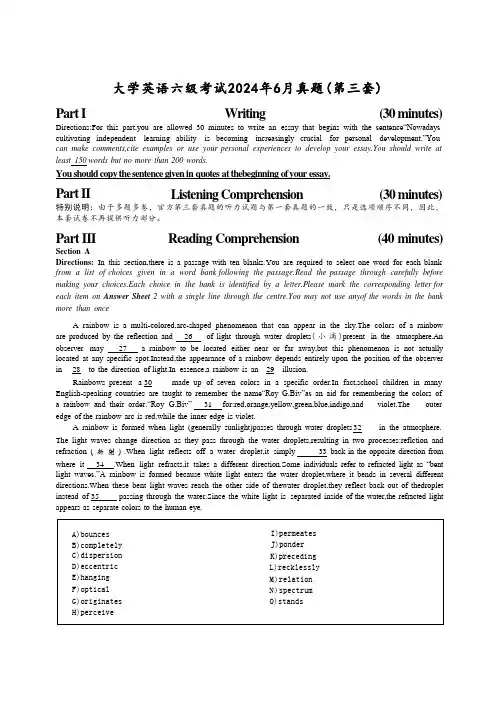
大学英语六级考试2024年6月真题(第三套)Part I Writing (30 minutes) Directions:For this part,you are allowed 30 minutes to write an essay that begins with the sentence“Nowadays cultivating independent learning ability is be coming increasingly crucial for personal development.”You can make comments,cite examples or use your personal experiences to develop your essay.You should write at least 150 words but no more than 200 words.You should copy the sentence given in quotes at thebeginning of your essay.Part II Listening Comprehension (30 minutes)特别说明:由于多题多卷,官方第三套真题的听力试题与第一套真题的一致,只是选项顺序不同,因此,本套试卷不再提供听力部分。
Part III Reading Comprehension (40 minutes) Section ADirections: In this section,there is a passage with ten blanks.You are required to select one word for each blank from a list of choices given in a word bank following the passage.Read the passage through carefully before making your choices.Each choice in the bank is identified by a letter.Please mark the corresponding letter for each item on Answer Sheet 2 with a single line through the centre.You may not use anyof the words in the bank more than onceA rainbow is a multi-colored,arc-shaped phenomenon that can appear in the sky.The colors of a rainbow are produced by the reflection and 26 _of light through water droplets( 小滴)present in the atmosphere.An observer may 27 _a rainbow to be located either near or far away,but this phenomenon is not actually located at any specific spot.Instead,the appearance of a rainbow depends entirely upon the position of the observer in 28 to the direction of light.In essence,a rainbow is an 29 illusion.Rainbows present a 30 made up of seven colors in a specific order.In fact,school children in many English-speaking countries are taught to remember the name“Roy G.Biv”as an aid for remembering the colors of a rainbow and their order.“Roy G.Biv” 31 f or:red,orange,yellow,green,blue,indigo,and violet.The outer edge of the rainbow arc is red,while the inner edge is violet.A rainbow is formed when light (generally sunlight)passes through water droplets 32 in the atmosphere. The light waves change direction as they pass through the water droplets,resulting in two processes:reflction and refraction ( 折射 ) .When light reflects off a water droplet,it simply 33_back in the opposite direction from where it 34 .When light refracts,it takes a different direction.Some individuals refer to refracted light as “bent light waves.”A rainbow is formed because white light enters the water droplet,where it bends in several different directions.When these bent light waves reach the other side of thewater droplet,they reflect back out of thedroplet instead of 35 passing through the water.Since the white light is separated inside of the water,the refracted light appears as separate colors to the human eye.Section BDirections: In this section,you are going to read a passage with ten statements attached to it.Each statement contains information given in one of theparagraphs.Identify the paragraphfrom which the information is derived.You may choose a paragraph more than once.Each paragraph is marked with a letter.Answer the questions by marking the corresponding letteronAnswer Sheet 2.Blame your worthless workdays on meeting recovery syndromeA)Phyllis Hartman knows what it's like to make one's way through the depths of office meeting hell.Managersat one of her former human resources jobs arranged so many meetings that attendees would fall asleep at the table or intentionally arrive late.With hours of her day blocked up with unnecessary meetings,she was often forced to make up herwork during overtime.“I was actually working more hoursthan I probably would have needed to get the work done,”says Hartman,who is founder and president of PGHR Consulting in Pittsburgh, PennsylvaniaB)She isn't alone in her frustration.Between 11 million and 55 million meetings are held each day in the UnitedStates,costing most organisations between 7%and 15%of their personnel budgets.Every week,employees spend about six hours in meetings,while the average manager meets for a staggering 23 hours.C)And though experts agree that traditional meetings are essential for making certain decisions and developingstrategy,some employees view them as one of the most unnecessary parts of the workday.The result is not only hundreds of billions of wasted dollars,but an annoyance of what organisational psychologists call “meeting recovery syndrome (MRS)”:time spent cooling off and regaining focus after a useless meeting.If you run to the office kitchen to get some relief with colleagues after a frustrating meeting,you're likely experiencing meeting recovery syndrome.D)Meeting recovery syndrome is a concept that should be familiar to almost anyone who has held a formaljob.It isn't ground-breaking to say workers feel fatigued after a meeting,but only in recent decades have scientists deemed the condition worthy of further investigation.With its links to organisational efficiency and employee wellbeing,MRS has atracted the attention of psychologists aware of the need to understand its precise causes and curesE)Today,in so far as researchers can hypothesise,MRS is most easily understood as a slow renewal of finitemental and physical resources.When an employee sits through an ineffective meeting their brain power is essentially being drained away.Meetings drain vitality if they last too long,fail to engage employees or turn into one-sided lectures.The conservation of resources theory,originally proposed in 1989 by Dr Stevan Hobfoll,states that psychological stress occurs when a person's resources are threatened or lost.When resources are low,a person will shift into defence to conserve their remaining supply.In the case of office meetings,where some of employees'most valuable resources are their focus,alertness and motivation,this can mean an abrupt halt in productivity as they take time to recover.F)As humans,when we transition from one task to another on the job—say from sitting in a meeting todoing normal work—it takes an effortful cognitive switch.We must detach ourselves from the previous task and expend significant mental energy to move on.If we are already drained to dangerous levels, then making the mental switch to the next thing is extra tough.It's common to see people cyber-loafing after a frustrating meeting,going and getting coffee,interrupting a colleague and telling them about the meeting,and so on.G)Each person's ability to recover from horrible meetings is different.Some can bounce back quickly,whileothers carry their fatigue until the end of the workday.Yet while no formal MRS studies are currently underway,one can loosely speculate on the length of an average employee's lag time.Switching tasks in a non-MRS condition takes about 10 to 15 minutes.With MRS,it may take as long as 45 minutes on average It's even worse when a worker has several meetings that are separated by 30 minutes.“Not enough time to transition in a non-MRS situation to get anything done,and in an MRS situation,not quite enough time torecover for the next meeting,”says researcher Joseph Allen.“Then,add the compounding of back-to-back bad meetings and we may have an epidemic on our hands.”H)In an effort to combat the side effects of MRS,Allen,along with researcher Joseph Mroz and colleagues at theUniversity of Nebraska-Omaha,published a study detailing the best ways to avoid common traps,including a concise checklist of do's and don'ts applicable to any workplace.Drawing from around 200 papers to compile their comprehensive list,Mroz and his team may now hold a remedy to the largely undefined problem of MRS.I)Mroz says a good place to startis asking ourselves ifour meetings are even necessary in the first place.If allthat's on the agenda is a quick catch-up,or some non-urgent information sharing,it may better suit the group to send around an email instead.“The second thing I would always recommend is keep the meeting as small as possible,”says Mroz.“If they don't actually have some kind ofimmediate input,then they can follow up later.They don't need to be sitting in this hour-long meeting.”Less time in meetingswould ultimately lead to more employee engagement in the meetings theydo attend,which experts agree is a proven remedy for MRS.J)Employees also feel taxed when they are invited together to meetings that don't inspire participation,says Cliff Scott,professor of organisational science.It takes precious time for them to vent their emotions, complain and try to regain focus after a pointless meeting—one of the main traps of MRS.Over time as employees find themselves tied up in more and moreunnecessary meetings—and thus dealing with increasing lag times from MRS—the waste of workday hours can feel insulting.K)Despite the relative scarcity of research behind the subject,Hartman has taught herself many of the same tricks suggested in Mroz's study,and has come a long way since her days ofbeing stuck with unnecessary meetings.The people she invites to meetings today include not just the essential employees,but also representatives from every department that might have a stake in the issue at hand.Managers like her,who seek input even from non-experts to shape their decisions,can find greater support and cooperation from their workforce,she says.L)If an organisation were to apply all 22 suggestions from Mroz and Allen's findings,the most noticeable difference would be a stark decrease in the total number of meetings on the schedule,Mroz says.Less time in meetings would ultimately lead to increased productivity,which is the ultimate objective of convening a meeting.While none of the counter-MRS ideas have been tested empirically yet,Allen says one trick with promise is for employees to identify things that quickly change their mood from negative to positive.As simple as it sounds,finding a personal happy place,going there and then coming straight back to work might be key to facilitating recovery.M)Leaders should see also themselves as “stewards of everyone else's valuable time”,adds Steven Rogelberg, author of The Surprising Science of M eetings.Having the skills to foresee potential trapsand treat employees' endurance with care allows leaders to provide effective short-term deterrents to MRS.N)Most important,however,is for organisations to awaken to the concept of meetings being flexible,says Allen.By reshaping the way they prioritise employees'time,companies can eliminate the very sources of MRS in their tracks36.Although employees are said to be fatigued by meetings,the condition has not been considered worthy offurther research until recently.37.Mroz and his team compiled a list of what to do and what not to do to remedy the problem of MRSpanies can get rid of the root cause ofMRS if they give priority to workers'time.39.If workers are exhausted to a dangerous degree,it is extremely hard for them totransition to the next task.40.Employees in America spend a lot of time attending meetings while the number of hours managers meet isseveral times more.41.Phyllis Hartman has learned by herselfmany of the ways Mroz suggested in his study and made remarkablesuccess in freeing herself from unnecessary meetings.42.When meetings continue too long or don't engage employees,they deplete vitality.43.When the time of meetings is reduced,employees will be more engaged in the meetings they do participate in.44.Some employees considermeetings one of the most dispensable parts of the workday.45.According to Mroz,if all his suggestions were applied,a very obvious change would be a steep decrease inthe number of meetings scheduled.Section CDirections: There are 2 passages in this section.Each passage is followed by some questions or unfinished statements.For each of them there are four choices marked A),B),C)and D).You should decide on the best choice and mark the corresponding letter on Answer Sheet 2 with asingle line through the centre.Passage OneQuestions 46 to 50 are based on the followingpassageSarcasm andjazzhave something surprisingly in common:You know them when you hear them.Sarcasm is mostly understood through tone of voice,which is used to portray the opposite of the literal words.For example, when someone says,“Well,tha t's exactly what I need right now,”their tone can tell you it's not what they need at all.Most frequently,sarcasm highlights an irritation or is,quite simply,meanIf you want to be happier and improve your relationships,cut out sarcasm.Why?Because sarcasm is actually hostility disguised as humor.Despite smiling outwardly,many people who receive sarcastic comments feel put down and often think the sarcastic person is rude,or contemptible.Indeed,it's not surprising that the origin of the word sarcasm derives from the Greek word“sarkazein”which literally means “to tear or strip the flesh off.”Hence,it's no wonder that sarcasm is often preceded by the word“cutting”and that it hurts.What's more,since actions strongly determine thoughts and feelings,when a person consistently acts sarcastically it may only serve to heighten their underlying hostility and insecurity.After all,when you come right down to it,sarcasm can be used as a subtle form of bullying—and most bullies are angry,insecure,or cowardly.Alternatively,when a person stops voicing negative comments,especially sarcastic ones,they may soon start to feel happier and more self-confident.Also,other people in their life benefit even more because they no longer have to hear the emotionally hurtful language of sarcasm.Now,I'm not saying all sarcasm is bad.Itmay just be betterused sparingly—like a potent spice in cooking. Too much of the spice,and the dish will be overwhelmed by it.Similarly,an occasional dash of sarcastic wit can spice up a chat and add an element ofhumor to it.But a big or steady serving of sarcasm will overwhelm the emotional flavor of any conversation and can taste very bitter to its recipient.So,tone down the sarcasm and work on clever wit instead,which is usually without any hostility and thus more appreciated by those you're communicating with.In essence,sarcasm is easy while true,harmless wit takes talent.Thus,the main difference between wit and sarcasm is that,as already stated,sarcasm is often hostility disguised as humor.It can be intended to hurt and is often bitter and biting.Witty statements are usually in response to someone's unhelpful remarks or behaviors,and the intent is to untangle and clarify the issue by emphasizing its absurdities.Sarcastic statements are expressed in a cutting manner;witty remarks are delivered with undisguised and harmless humor.46.Why does the author say sarcasm and jazz have something surprisingly in common?A)Both are recognized when heard. C)Both mean the opposite of what they appear to.B)Both have exactly the same tone. D)Both have hidden in them an evident irritation47.How do many p eople feel when they hear sarcastic comments?A)They feel hostile towards the sarcastic person. C)They feel a strong urge to retaliate.B)They feel belittled and disrespected. D)They feel incapable of disguising their irritation.48.What happens when a person consistently acts sarcastically?A)They feel their dignity greatly heightened.B)They feel increasingly insecure and hostile.C)They endure hostility under the disguise of humorD)They taste bitterness even in pleasant interactions49.What does the author say about people quitting sarcastic comments?A)It makes others happier and more self-confidentB)It restrains them from being irritating and bullying.C)It benefits not only themselves but also those around them.D)It shields them from negative comments and outright hostility.50.What is the chief difference between a speaker's wit and sarcasm?A)Their clarity. C)Their emphasis.B)Their appreciation D)Their intention.Passage TwoQuestions 51 to 55 are based on the following passage.Variability is crucially important for learning new skills.Consider learning how to serve in tennis.Should you always practise serving from the exactly same location on the court,aiming at the same spot?Although practising in more variable conditions will be slower at first,it will likely make you a better tennis player in the end.This is because variability leads to better generalisation of what is learned.This principle is found in many domains,including speech perception and learning categories.For instance, infants will struggle to learn the category“dog”if they are only exposed to Chihuahuas,instead of many different kinds of dogs“There are over ten different names for this basic principle,”says Limor Raviv,the senior investigator of a recent study.“Learning from less variable input is often fast,but may fail to generalise to new stimuli.”To identify key patterns and understand the underlying principles of variability effects,Raviv and her colleagues reviewed over 150 studies on variability and generalisation across fields,including computer science, linguistics,categorisation,visual perception and formal education.The researchers discovered that,across studies,the term variability can refer to at least four different kinds of variability,such as set size and scheduling.“The se four kinds of variability have never been directly compared—which means that we currently don't know which is most effective forlearning,”says Raviv.The impact of variability depends on whether it is relevant to the task or not.But according to the ‘Mr. Miyagiprinciple',practising seemingly unrelated skills may actuallybenefit learningof other skills.But why does variability impact learning and generalisation?One theory is that more variable input can highlight which aspects of atask are relevant and which are not.Another theory is that greater variability leads to broader generalisations.This is because variability will represent therealworld better,including atypical(非典型的)examplesA third reason has to do with the way memory works:when training is variable,learners are forced to actively reconstruct their memories“Understanding the impact of variability is important for literally every aspect ofour daily life.Beyond affecting the way we learn language,motor skills,and categories,it even has an impact on our social lives,”explains Raviv.“For example,face recognition is affected by whether people grew up in a small community or in a larger community.Exposure to fewer faces during childhood is associated with diminished face memory.”“We hope this work will spark people's curiosity and generate more work on the topi c,”concludes Raviv. “Our paper raises a lot of open questions.Can we find similar effects ofvariability beyond the brain,for instance, in the immune system?”51.What does the passage say about infants learning the category “dog”if they are exposed to Chihuahuas only?A)They will encounter some degree of difficulty.B)They will try to categorise other objects firstC)They will prefer Chihuahuas to other dog species.D)They will imagine Chihuahuas in various conditions52.What does Raviv say about the four different kinds ofvariability?A)Which of them is most relevant to the task at hand is to be confirmed.B)Why they have an impact on learning is far from being understood.C)Why they have neverbeen directly compared remains a mysteryD)Which of them is most conducive to learning is yet to be identified.53.How does one of the theories explain the importance of variability for learning new skills?A)Learners regard variable training as typical of what happens in the real world.B)Learners receiving variable training are compelled to reorganise their memories.C)Learners pay attention to the relevant aspects of a task and ignore those irrelevant.D)Learners focus on related skills instead of wasting time and effort on unrelated ones.54.What does the passage say about face recognition?A)People growing up in a small community may find it easy to remember familiar faces.B)Face recognition has a significant impact on literally every aspect of our social lives.C)People growing up in a large community can readily recognise any individual faces.D)The size of the community people grow up in impacts their face recognition ability.55.What does Raviv hope to do with their research work?A)Highlight which aspects of a task are relevant and which are not to learning a skill.B)Use the principle of variability in teaching seemingly unrelated skills in education.C)Arouse people's interest in variability and stimulate more research on the topic.D)Apply the principle of variability to such fields of study as the immune system.Part IV Translation(30 minutes) Directions: For this part,you are allowed 30 minutes to translate a passage from Chinese into English.You should write youransweron AnswerSheet 2.扇子自古以来就深受中国人喜爱,但现在已不只是消暑纳凉的工具,而更多地作为艺术品供人欣赏。
2022年6月大学英语六级真题试卷及参考答案

Part Writing (30 minutes)Ⅰno more than 200 words.<!--[endif]-->The Three-Year SolutionHartwick College, a small liberal-arts school in upstate New York, makes New York, makes this offer to well prepared students: earn your undergraduate degree in three years instead of four, and save about 543,000—the amount of one year’s tuition and fees. A number of innovativeBut many colleges and universities are stuck in the past. For instance, the idea of thefall-to-spring“schoolyear”hasn’t changed much since before the American Revolution, when we were a summer stretch no longer makes sense. Former George Washington University president Stephen Trachtenberg estimates that a typical college uses its facilities for academic purposes a little more than half the calendar year.“While college facilities sit idle, they continue to generate maintenance expenses that contribute to the high cost of running a college,” he has written.Congress has tried to help students with college costs through Pell Grants and other forms of tuition support. But some of their fixes have made the problem worse. The stack of congressional regulations governing federal student grants and loans now stands twice as tall as I do. Filling out these forms consumes 7% of every tuition dollar.For all of these reasons, some colleges like Hartwick are rethinking the old way of doing things and questioning decades-old assumptions about what a college degree means. For instance, why does it have to take four years to earn a diploma? This fall, 16 first-year students and four second-year students at Hartwick enrolled in the school’s new three year degree program.According to the college, the plan is designed for high-ability, highly motivated student who wish to save money or to move along more rapidly toward advanced degrees.By eliminating that extra year, there year degree students save 25% in costs. Instead of taking 30 credits a year, these students take 40. During January, Hartwick runs a four week course during which students may earn three to four credits on or off campus, including a number ofinternational sites. Summer courses are not required, but a student may enroll in them—and payextra. Three year students get first crack at course registration. There are no changes in the number of courses professors teach or in their pay.The three-year degree isn’t a new idea. Geniuses have always breezed through. JudsonCollege, a 350-student institution in Alabama, has offered students a three-year option for40 years. Students attend “short terms” in May and June to earn the credits required for graduation. Bates College in Maine and Ball State University in Indiana are among othercolleges offering three-year options.Advanced Placement (AP) credits amounting to a semester or more of college level work.Many universities, including large schools like the University of Texas, make it easy for these AP students to graduate faster.professor’s class. Iowa’s Waldorf College has graduated several hundred students in its three-year degree program, but it now phasing out the option. Most Waldorf students wanted the fullfour-year experience—academically, socially, and athletically. And faculty members will bewary of any change that threatens the core curriculum in the name of moving students into the workforce.Expanding the three-year option may be difficult, but it may be less difficult than asking bright, motivated students. These sorts of innovations can help American universities avoid the perils of success.注意:此部分试题请在答题卡1上作答。
2023年12月大学英语六级真题试卷及答案(三套全)
2023年12月大学英语六级真题试卷及答案(三套全) 一、听力理解第一套第一节(共5小题)1. What does the woman ask the man to do?A. Turn the television off.B. Turn the volume down.C. Turn the radio on.Answer: B2. Where does the conversation most probably take place?A. At the post office.B. At the bank.C. At the hotel.Answer: C3. What does the man imply about the woman?A. She hasn’t been to New York City.B. She needs to find a new job.C. She travels a lot for work.Answer: A4. How long has the man been waiting?A. For an hour.B. For half an hour.C. For ten minutes.Answer: B5. What is the woman doing?A. She is looking for her keys.B. She is waiting for someone to arrive.C. She is talking on the phone.Answer: C第二节(共5小题)6. What is the woman asking the man to do?A. Fix her computer.B. Help her find a job.C. Visit her tomorrow.Answer: A7. What does the man offer to do next?A. Take the woman to the restaurant.B. Prepare dinner for the woman.C. Look for a restaurant on the Internet.Answer: C8. What does the man say abo ut the woman’s computer?A. It can’t be fixed.B. It needs a software update.C. It needs a new battery.Answer: B9. What does the woman suggest doing after dinner?A. Go for a walk.B. Watch a movie at home.C. Go to a movie theater.Answer: B10. How do es the woman feel about the man’s suggestion?A. Excited.B. Indifferent.C. Annoyed.Answer: A二、阅读理解第一套An important part of a child’s development is the acquisition of social skills. Social skills help children to interact effectively with others and build healthy relationships. These skills are vital for success in school, work, and life in general.One of the best ways to help children develop social skills is through play. Play allows children to practice andmaster social, emotional, and cognitive skills in a relaxed and enjoyableenvironment. Through play, children learn valuable skills such as cooperation, sharing, problem-solving, and communication.There are different types of play that help in the development of social skills. Cooperative play is when children play and work together towards a common goal. This type of play helps children to learn teamwork and collaboration. Pretend play, on the other hand, allows children to develop empathy and understanding of others’ perspectives. They learn to take on different roles and pretend to be someone else, which helps in developing their social and emotional intelligence. Board games and group activities also promote social interaction and help children learn important skills such as taking turns, following rules, and resolving conflicts in a fair manner.Parents and educators play a crucial role in promoting social skills development. They can create opportunities for play and provide guidance and support. It is important for parents to encourage their children to engage in various types of play and provide them with age-appropriate toys and games. Educators can incorporate play-based learning activities in the classroom to foster social skills development.In conclusion, play is a valuable tool for social skills development. It allows children to practice and master important skills while having fun. Parents and educators should recognize the importance of play and provide opportunities and support for children to engage in different types of play.第二套The concept of time management is essential in today’s fast-paced world. Effective time management helps individuals to prioritize tasks, handle multiple responsibilities, and increase productivity. It allows individuals to make the most out of their time and achieve their goals efficiently.Here are some tips for effective time management:1.Set goals: Identify your long-term and short-termgoals. Break them down into smaller, manageable tasks.This will help you stay focused and motivated.2.Prioritize tasks: Determine which tasks are mostimportant and urgent. Focus on completing these tasks first.3.Create a schedule: Use a planner or online calendarto schedule your tasks and activities. Set deadlines for each task to stay organized and keep track of your progress.4.Avoid multitasking: Multitasking may seem like atime-saving technique, but it can actually decreaseproductivity. Focus on one task at a time and give it yourfull attention.5.Delegate tasks: If possible, delegate tasks to others.This will free up your time and allow you to focus on more important tasks.6.Take breaks: Schedule regular breaks to rest andrecharge. This will help you maintain focus and preventburnout.7.Avoid procrastination: Procrastination can lead tounnecessary stress and missed deadlines. Break tasks into smaller, manageable parts and tackle them one at a time.8.Learn to say no: Don’t overcommit yourself. Learn tosay no to tasks that are not essential or do not align withyour goals.e technology: Take advantage of technology toolssuch as productivity apps and time tracking apps. Thesecan help you stay organized and manage your time moreeffectively.10.Review and adjust: Regularly review your scheduleand tasks. Adjust as needed to accommodate unexpectedevents or changes in priorities.By implementing these tips, you can improve your time management skills and achieve greater success in your personal and professional life.第三套The importance of physical exercise cannot be overstated. Regular exercise has numerous health benefits and plays a crucial role in maintaining a healthy lifestyle.Physical exercise helps to strengthen the cardiovascular system, improve lung function, and increase muscle strength and endurance. It also promotes weight loss and helps to maintain a healthy body weight. Regular exercise reduces the risk of chronic diseases such as heart disease, diabetes, andcertain types of cancer. It can also improve mental health by reducing symptoms of depression and anxiety.In addition to the physical benefits, exercise is also important for cognitive function. Studies have shown that regular exercise improves memory, attention, and problem-solving skills. It can also enhance creativity and productivity.Exercise is not only beneficial for adults but also for children and adolescents. Regular physical activity in childhood and adolescence helps to develop healthy bones, muscles, and joints. It improves coordination and balance, and reduces the risk of childhood obesity. It also has a positive impact on academic performance, including improved concentration and focus.There are many different forms of exercise that individuals can choose from, including aerobic exercise, strength training, flexibility exercises, and high-intensity interval training (HIIT). It is important to find a form of exercise that you enjoy and can incorporate into your daily routine.In conclusion, regular physical exercise is essential for overall health and well-being. It has numerous physical and mental health benefits and should be a priority for individuals of all ages. Make exercise a part of your daily routine and reap the rewards of a healthy and active lifestyle.三、写作题目及答案第一套写作题目:Do you agree or disagree with the following statement:。
2024年06月大学英语六级考试真题(第1套)
2024年06月大学英语六级考试真题(第1套)Part I Writing (30 minutes) Directions: For this part, you are allowed 30 minutes to write an essay that begins with the sentence “There is a growing awareness of the importance of digital literacy and skills in today’s world.” You can make comments, cite examples or use your personal experiences to develop your essay. You should write at least 150 words but no more than 200 words.You should copy the sentence given in quotes at the beginning of your essay.PartⅡListening Comprehension (30 minutes) Section ADirections: In this section, you will hear two long conversations. At the end of each conversation, you will hear four questions. Both the conversation and the questions will be spoken only once. After you hear a question, you must choose the best answer from the four choices marked A), B), C) and D). Then mark the corresponding letter on Answer Sheet 1 witha single line through the centre.Questions 1 to 4 are based on the conversation you have just heard.1. A) Reply to the man’s last proposal within a short time.B) Sign the agreement if one small change is made to it.C) Make a sponsorship deal for her client at the meeting.D) Give the man some good news regarding the contract.2. A) They are becoming impatient. C) They are used to making alterations.B) They are afraid time is running out. D) They are concerned about the details.3. A) To prevent geographical discrimination. C) To avoid any conflict of interest.B) To tap the food and beverage market. D) To reduce unfair competition.4. A) It is a potential market for food and beverage. C) It is a negligible market for his company.B) It is very attractive for real estate developers. D) It is very different from other markets.Questions 5 to 8 are based on the conversation you have just heard.5. A) They are thrilled by a rare astronomic phenomenon.B) They are celebrating a big event on mountain tops.C) They are enthusiastic about big science-related stories.D) They are joined by astronomers all across North America.6. A) It will be the most formidable of its kind in over a century.B) It will come closest to Earth in more than one hundred years.C) It will eclipse many other such events in human history.D) It will be seen most clearly from Denver’s mountain tops.7. A) A blur. C) The edge of our galaxy.B) Stars. D) An ordinary flying object.8. A) Use professional equipment. C) Fix their eyes due north.B) Climb to the nearby heights. D) Make use of phone apps.Section BDirections:In this section, you will hear two passages. At the end of each passage, you will hear three or four questions. Both the passage and the questions will be spoken only once. After you hear a question, you must choose the best answer from the four choices marked A),B),C) and D). Then mark the corresponding letter on Answer Sheet 1 with a single line through the centre.Questions 9 to 11 are based on the passage you have just heard.9. A) Whether consumers should be warned against ultra-processed foods.B) Whether there is sufficient scientific consensus on dietary guidelines.C) Whether guidelines can form the basis for nutrition advice to consumers.D) Whether food scientists will agree on the concept of ultra-processed foods.10. A) By the labor cost for the final products. C) By the extent of chemical alteration.B) By the degree of industrial processing. D) By the convention of classification.11. A) Increased consumers’ expen ses. C) People’s misunderstanding of nutrition.B) Greater risk of chronic diseases. D) Children’s dislike for unprocessed foods.Questions 12 to 15 are based on the passage you have just heard.12. A) They begin to think of the benefits of constraints.B) They try to seek solutions from creative people.C) They try hard to maximize their mental energy.D) They begin to see the world in a different way.13. A) It is characteristic of all creative people.B) It is essential to pushing society forward.C) It is a creative p erson’s response to limitation.D) It is an impetus to socio-economic development.14. A) Scarcity or abundance of resources has little impact on people’s creativity.B) Innovative people are not constrained in connecting unrelated concepts.C) People have no incentive to use available resources in new ways.D) Creative people tend to consume more available resources.15. A) It is key to a company’s survival.B) It shapes and focuses problems.C) It is essential to meeting challenges.D) It thrives best when constrained.Section CDirections: In this section, you will hear three recordings of lectures or talks followed by three or four questions. The recordings will be played only once. After you hear a question, you must choose the best answer from the four choices marked A), B), C) and D). Then mark the corresponding letter on Answer Sheet 1 with a single line through the centre.Questions 16 to 18 are based on the recording you have just heard.16. A) Because they are learned. C) Because they have to be properly personalized.B) Because they come naturally. D) Because there can be more effective strategies.17. A) The extent of difference and of similarity between the two sides.B) The knowledge of the specific expectation the other side holds.C) The importance of one’s goals and of the relationship.D) The approaches one adopts to conflict management.18. A) The fox. C) The shark.B) The owl. D) The turtle.Questions 19 to 21 are based on the recording you have just heard.19. A) Help save species from extinction and boost human health.B) Understand how plants and animals perished over the past.C) Help gather information publicly available to researchers.D) Find out the cause of extinction of Britain’s 66,000 species.20. A) It was once dominated by dinosaurs. C) Its prospects depend on future human behaviour.B) It has entered the sixth mass extinction. D) Its climate change is aggravated by humans.21. A) It dwarfs all other efforts to conserve, protect and restore biodiversity on earth.B) It is costly to get started and requires the joint efforts of thousands of scientists.C) It can help to bring back the large numbers of plants and animals that have gone extinct.D) It is the most exciting, most relevant, most timely and most internationally inspirational.Questions 22 to 25 are based on the recording you have just heard.22. A) Cultural identity. C) The Copernican revolution.B) Social evolution. D) Human individuality.23. A) It is a delusion to be disposed of. C) It is a myth spread by John Donne’s poem.B) It is prevalent even among academics. D) It is rooted in the mindset of the 17th century.24. A) He believes in Copernican philosophical doctrines about the universe.B) He has gained ample scientific evidence at the University of Reading.C) He has found that our inner self and material self are interconnected.D) He contends most of our body cells can only live a few days or weeks.25. A) By coming to see how disruptive such problems have got to be.B) By realising that we all can do our own bit in such endeavours.C) By becoming aware that we are part of a bigger world.D) By making joint efforts resolutely and persistently.Part III Reading Comprehension (40 minutes) Section ADirections:In this section, there is a passage with ten blanks. You are required to select one word for each blank from a list of choices given in a word bank following the passage. Readthe passage through carefully before making your choices. Each choice in the bank is identifiedby a letter. Please mark the corresponding letter for each item on Answer Sheet 2 with a singleline through the centre. You may not use any of the words in the bank more than once.It’s quite remarkable how different genres of music can spark unique feelings, emotions,and memories. Studies have shown that music can reduce stress and anxiety before surgeriesand we are all attracted toward our own unique life soundtrack.If you’re lo oking to 26 stress, you might want to give classical music a try.The sounds of classical music produce a calming effect letting 27 pleasure-inducing dopamine (多巴胺) in the brain that helps control attention, learning and emotional responses. It can also turn down the body’s stress response, resulting in an overall happier mood. It turns out a pleasant mood can lead to 28 in a person’s thinking.Although there are many great 29 of classical music like Bach, Beethoven and Handel, none of these artists’ music seems to have the same health effects as Mozart’s does. According to researchers, listening to Mozart can increase brain wave activity and improve 30 function. Another study found that the distinctive features of Mozart’s music trigger parts of the brain that are responsible for high-level mental functions. Even maternity 31 use Mozart to help newborn babies adapt to life outside of the mother’s belly.It has been found that listening to classical music 32 reduces a pers on’s blood pressure. Researchers believe that the calming sounds of classical music may help your heart 33 from stress. Classical music can also be a great tool to help people who have trouble sleeping. One study found that students who had trouble sleeping slept better while they were listening to classical music.Whether classical music is something that you listen to on a regular basis or not, it wouldn’t34 to take time out of your day to listen to music that you find 35 . You will be surprised at how good it makes you feel and the potentially positive change in your health.Section BDirections:In this section, you are going to read a passage with ten statements attached to it. Each statement contains information given in one of the paragraphs. Identify the paragraph from which the information is derived. You may choose a paragraph more than once. Each paragraph is marked with a letter. Answer the questions by marking the corresponding letter on Answer Sheet 2.The Curious Case of the Tree That Owns ItselfA)In the city of Athens, Georgia, there exists a rather curious local landmark—a large whiteoak that is almost universally stated to own itself. Because of this, it is considered one of the most famous trees in the world. So how did this tree come to own itself and the land around it?B)Sometime in the 19th century a Georgian called Colonel William Jackson reportedly tooka liking to the said tree and endeavored to protect it from any danger. As to why he loved itso, the earliest documented account of this story is an anonymously written front page article in the Athens Weekly Banner published on August 12, 1890. It states, “Col. Jackson had watched the tree grow from his childhood, and grew to love it almost as he would a human. Its luxuriant leaves and sturdy limbs had often protected him from the heavy rains, and out of its highest branches he had many a time gotten the eggs of the feathered singers.He watched its growth, and when reaching a ripe old age he saw the tree standing in its magnificent proportions, he was pained to think that after his death it would fall into the hands of those who might destroy it.”C)Towards this end, Jackson transferred by means of a deed ownership of the tree and a littleland around it to the tree itself. The deed read, “W. H. Jackson for and in consideration of the great affection which he bears the said tree, and his great desire to see it protected has conveyed unto the said oak tree entire possession of itself and of all land within eight feet of it on all sides.”D)In time, the tree came to be something of a tourist attraction, known as The Tree That OwnsItself. However, in the early 20th century, the tree started showing signs of its slow death, with little that could be done about it. Father time comes for us all eventually, even our often long lived, tall and leafy fellow custodians (看管者) of Earth. Finally, on October 9, 1942, the over 30 meter tall and 200-400 year old tree fell, rumor has it, as a result of a severe windstorm and/or via having previously died and its roots rotted.E)About four years later, members of the Junior Ladies Garden Club (who’d tended to thetree before its unfortunate death) tracked down a small tree grown from a nut taken from the original tree. And so it was that on October 9, 1946, under the direction of Professor Roy Bowden of the College of Agriculture at the University of Georgia, this little tree was transplanted to the location of its ancestor. A couple of months later, an official ceremony was held featuring none other than the Mayor of Athens, Robert L McWhorter, to commemorate the occasion.F)This new tree became known as The Son of the Tree That Owns Itself and it was assumedthat, as the original tree’s heir, it naturally inherited the land it stood on. Of course, there are many dozens of other trees known to exist descending from the original, as people taking a nut from it to grow elsewhere was a certainty. That said, to date, none of the original tree’s other children have petitioned the courts for their share of the land, so it seems all good. In any event, The Son of the Tree That Owns Itself still stands today, though often referred to simply as The Tree That Owns Itself.G)This all brings us around to whether Jackson ever actually gave legal ownership of the treeto itself in the first place and whether such a deed is legally binding.H)Well, to begin with, it turns out Jackson only spent about three years of his life in Athens,starting at the age of 43 from 1829 to 1832, sort of dismissing the idea that he loved the tree from spending time under it as a child and watching it grow, and then worrying about what would happen to it after he died. Further, an extensive search of land ownership records in Athens does not seem to indicate Jackson ever owned the land the tree sits on.I)He did live on a lot of land directly next to it for those three years, but whether he ownedthat land or not isn’t clear. Whatever the case, in 1832 a four acre parcel, which included the land the tree was on and the neighboring land Jackson lived on, among others, was sold to University professor Malthus A Ward. In the transaction, Ward was required to payJackson a sum of $1,200 (about $31,000 today), either for the property itself or simply in compensation for improvements Jackson had made on the lot. In the end, whether he ever owned the neighboring lot or was simply allowed to use it while he allegedly worked at the University, he definitely never owned the lot the tree grew on, which is the most important bit for the topic at hand.J)After Professor Ward purchased the land, Jackson and his family purchased a 655 acre parcel a few miles away and moved there. Ten years later, in 1844, Jackson seemed to have come into financial difficulties and had his little plantation seized by the Clarke County Sheriff’s office and auctioned off to settle the mortgage. Thus, had he owned some land in Athens itself, including the land the tree sat on, presumably he would have sold it to raise funds or otherwise had it taken as well.K)And whatever the case there, Jackson would have known property taxes needed to be paid on the deeded land for the tree to be truly secure in its future. Yet no account or record indicates any trust or the like was set up to facilitate this.L)On top of all this, there is no hard evidence such a deed ever existed, despite the fact that deed records in Athens go back many decades before Jackson’s death in 1876 and that it was supposed to have existed in 1890 in the archives according to the original anonymous news reporter who claims to have seen it.M)As you might imagine from all of this, few give credit to this side of the story. So how did all of this come about then?N)It is speculated to have been invented by the imagination of the said anonymous author at the Athens Weekly Banner in the aforementioned 1890 front page article titled “Deeded to Itself”, which by the way contained several elements that are much more easily proved to be false. As to why the author would do this, it’s speculated perhaps it was a 19th century version of a click-bait thought exercise on whether it would be legal for someone to deed such a non-conscious living thing to itself or not.O)Whatever the case, the next known instance of the Tree That Owns Itself being mentioned wasn’t until 1901 in the Centennial Edition of that same paper, the Athens Weekly Banner.This featured another account very clearly just copying the original article published abouta decade before, only slightly reworded. The next account was in 1906, again in the AthensWeekly Banner, again very clearly copying the original account, only slightly reworded, the 19th century equivalent of re-posts when the audience has forgotten about the original.36. Jackson was said to have transferred his ownership of the oak tree to itself in order to protect it from being destroyed.37. No proof has been found from an extensive search that Jackson had ever owned the land where the oak tree grew.38. When it was raining heavily, Jackson often took shelter under a big tree that is said to own itself.39. There is no evidence that Jackson had made arrangements to pay property taxes for the land on which the oak tree sat.40. Professor Ward paid Jackson over one thousand dollars when purchasing a piece of land from him.41. It is said the tree that owned itself fell in a heavy windstorm.42. The story of the oak tree is suspected to have been invented as a thought exercise.43. Jackson’s little plantation was auctioned off to settle his debt in the mid-19th century.44. An official ceremony was held to celebrate the transplanting of a small tree to where its ancestor had stood.45. The story of the Tree That Owns Itself appeared in the local paper several times, with slight alterations in wording.Section CDirections:There are 2 passages in this section. Each passage is followed by some questions or unfinished statements. For each of them there are four choices marked A), B), C) and D). You should decide on the best choice and mark the corresponding letter on Answer Sheet 2 with a single line through the centre.Passage OneQuestions 46 to 50 are based on the following passage.It is irrefutable that employees know the difference between right and wron g. So why don’t more employees intervene when they see someone exhibiting at-risk behavior in the workplace?There are a number of factors that influence whether people intervene. First, they need to be able to see a risky situation beginning to unfold. Second, the company’s culture needs to make them feel safe to speak up. And third, they need to have the communication skills to say something effectively.This is not strictly a workplace problem; it’s a growing problem off the job too. Every day people witness things on the street and choose to stand idly by. This is known as the bystander effect—the more people who witness an event, the less likely anyone in that group is to help the victim. The psychology behind this is called diffusion of responsibility. Basically, the larger the crowd, the more people assume that someone else will take care of it—meaning no one effectively intervenes or acts in a moment of need.This crowd mentality is strong enough for people to evade their known responsibilities. But it’s not only frontline workers who don’t make safety i nterventions in the workplace. There are also instances where supervisors do not intervene either.When a group of employees sees unsafe behavior not being addressed at a leadership level it creates the precedent that this is how these situations should be addressed, thus defining the safety culture for everyone.Despite the fact that workers are encouraged to intervene when they observe unsafe operations, this happens less than half of the time. Fear is the ultimate factor in not intervening. There is a fear of penalty, a fear that they’ll have to do more work if they intervene. Unsuccessful attempts in the past are another strong contributing factor to why people don’t intervene—they tend to prefer to defer that action to someone else for all future situations.On many worksites, competent workers must be appointed. Part of their job is to intervene when workers perform a task without the proper equipment or if the conditions are unsafe. Competent workers are also required to stop work from continuing when there’s a danger.Supervisors also play a critical role. Even if a competent person isn’t required, supervisors need a broad set of skills to not only identify and alleviate workplace hazards but also build a safety climate within their team that supports intervening and open communication among them.Beyond competent workers and supervisors, it’s important to educate everyon e within the organization that they are obliged to intervene if they witness a possible unsafe act, whether you’re a designated competent person, a supervisor or a frontline worker.46. What is one of the factors contributing to failure of intervention in face of risky behavior in the workplace?A) Slack supervision style. C) Unforeseeable risk.B) Unfavorable workplace culture. D) Blocked communication.47. What does the author mean by “diffusion of responsibility” (Line 4, Para. 3)?A) The more people are around, the more they need to worry about their personal safety.B) The more people who witness an event, the less likely anyone will venture to participate.C) The more people idling around on the street, the more likely they need taking care of.D) The more people are around, the less chance someone will step forward to intervene.48. What happens when unsafe behavior at the workplace is not addressed by the leaders?A) No one will intervene when they see similar behaviors.B) Everyone will see it as the easiest way to deal with crisis.C) Workers have to take extra caution executing their duties.D) Workers are left to take care of the emergency themselves.49. What is the ultimate reason workers won’t act when they see unsafe operations?A) Preference of deferring the action to others. C) Fear of being isolated by coworkers.B) Anticipation of leadership intervention. D) Fear of having to do more work.50. What is critical to ensuring workplace safety?A) Workers be trained to operate their equipment properly.B) Workers exhibiting at-risk behavior be strictly disciplined.C) Supervisors create a safety environment for timely intervention.D) Supervisors conduct effective communication with frontline workers.Passage TwoQuestions 51 to 55 are based on the following passage.The term “environmentalist” can mean different things. It used to refer to people trying to protect wildlife and natural ecosystems. In the 21st century, the term has evolved to capture the need to combat human-made climate change.The distinction between these two strands of environmentalism is the cause of a split within the scientific community about nuclear energy.On one side are purists who believe nuclear power isn’t worth the risk and the exclusive solution to the climate crisis is renewable energy. The opposing side agrees that renewables are crucial, but says society needs an amount of power available to meet consumers’ basic demands when the sun isn’t shining and the wind isn’t blowing. Nuclear energy, being far cleaner than oil, gas and coal, is a natural option, especially where hydroelectric capacity is limited.Leon Clarke, who helped author reports for the UN’s Intergovernmental Panel on Climate Change, isn’t an uncritical supporter of nuclear energy, but says it’s a valuable option to have i f we’re serious about reaching carbon neutrality.“Core to all of this is the degree to which you think we can actually meet climate goals with 100% renewables,” he said. “If you don’t believe we can do it, and you care about the climate, you are forced to think about something like nuclear.”The achievability of universal 100% renewability is similarly contentious. Cities such as Burlington, Vermont, have been “100% renewable” for years. But these cities often have s mall populations, occasionally still rely on fossil fuel energy and have significant renewable resources at their immediate disposal. Meanwhile, countries that manage to run off renewables typically do so thanks to extraordinary hydroelectric capabilities.Germany stands as the best case study for a large, industrialized country pushing into green energy. Chancellor Angela Merkel in 2011 announced Energiewende, an energy transition that would phase out nuclear and coal while phasing in renewables. Wind and solar power generation has increased over 400% since 2010, and renewables provided 46% of the country’s electricity in 2019.But progress has halted in recent years. The instability of renewables doe sn’t just mean energy is often not produced at night, but also that solar and wind can overwhelm the grid during the day, forcing utilities to pay customers to use their electricity. Lagging grid infrastructure struggles to transport this overabundance of green energy from Germany’s north to its industrial south, meaning many factories still run on coal and gas. The political limit has also been reached in some places, with citizens meeting the construction of new wind turbines with loud protests.The result is that Germany’s greenhouse gas emissions have fallen by around 11.5% since 2010—slower than the EU average of 13.5%.51. What accounts for the divide within the scientific community about nuclear energy?A) Attention to combating human-made climate change.B) Emphasis on protecting wildlife and natural ecosystems.C) Evolution of the term ‘green energy’ over the last century.D) Adherence to different interpretations of environmentalism.52. What is the solution to energy shortage proposed by purists’ opponents?A) Relying on renewables firmly and exclusively.B) Using fossil fuel and green energy alternately.C) Opting for nuclear energy when necessary.D) Limiting people’s non-basic consumption.53. What point does the author want to make with cities like Burlington as an example?A) It is controversial whether the goal of the whole world’s exclusive dependence on renewables is attainable.B) It is contentious whether cities with large populations have renewable resources at their immediate disposal.C) It is arguable whether cities that manage to run off renewables have sustainable hydroelectric capabilities.D) It is debatable whether traditional fossil fuel energy can be done away with entirely throughout the world.54. What do we learn about Germany regarding renewable energy?A) It has increased its wind and solar power generation four times over the last two decades.B) It represents a good example of a major industrialized country promoting green energy.C) It relies on renewable energy to generate more than half of its electricity.D) It has succeeded in reaching the goal of energy transition set by Merkel.55. What may be one of the reasons for Germany’s progress having halted in recent years?A) Its grid infrastructure’s capacity has fallen behind its development of green energy.B) Its overabundance of green energy has forced power plants to suspend operation during daytime.C) Its industrial south is used to running factories on conventional energy supplies.D) Its renewable energy supplies are unstable both at night and during the day.Part IV Translation (30 minutes) Directions: For this part, you are allowed 30 minutes to translate a passage from Chinese into English. You should write your answer on Answer Sheet 2.中国的传统婚礼习俗历史悠久,从周朝开始就逐渐形成了一套完整的婚礼仪式,有些一直沿用至今。
大学英语六级真题试卷精选全文完整版
可编辑修改精选全文完整版大学英语六级真题试卷Part I Listening Comprehension (20 minutes)Section ADirections: In this section, you will hear 10 short conversations. At the end of each conversation, a question will be asked about what was said. Both the conversation and the question will be spoken only once. After each question there will be a pause. During the pause, you must read the four choices marked A), B), C) or D), and decide which is the best answer. Then mark the corresponding letter on the Answer Sheet with a single line through the centre.1. A) The foggy weather has affected Mary’s mood.B) They are puzzled about Mary’s low spirits.C) Mary is dissatisfied with her promotion.D) Mary cares too much about her looks.2. A) Go to an art exhibition.B) Attend the opening night of a play.C) Dine out with an old friend.D) See his paintings on display.3. A) Her mother was quite outstanding in academic word.B) She was not particularly interested in going to school.C) Her parents laid great emphasis on academic excellence.D) She helped upgrade the educational level of immigrants.4. A) The machines there were ill maintained.B) Tickets for its members were cheaper.C) It was filled with people all the time.D) It had a reputation for good service.5. A) Both Sarah and Tom have been awarded doctoral degrees.B) Tom has arranged to meet his bride Sarah in Hawaii.C) Tom was more excited than Sarah at the wedding.D) A double blessing has descended upon Tom.6. A) There were too many questions in the examination.B) The examination was well beyond the course content.C) The examination questions were somewhat too difficult.D) The course prepared him adequately for the examination.7. A) It’s less time consuming.B) His wife is tired of cooking.C) It’s part of his job.D) He is sick of home-cooked meals.8. A) He has just started to teach piano lessons.B) He seldom takes things seriously.C) He is very proud of his piano skills.D) He usually understates his achievements.9. A) It’s tedious.B) It’s absurd.C) It’s justifiable.D) It’s understandable.10. A) Arrange accommodation for her.B) Explain the cause of the cancellation.C) Compensate her for the inconvenience.D) Allow her to take another flight that night.Section BDirections: In this section, you will hear 3 short passages. At the end of each passage, you will hear some questions. Both the passage and the questions will be spoken only once. After you hear a question, you must choose the best answer from the four choices marked A), B), C) or D). Then mark the corresponding letter on the Answer Sheet with a single line through the centre.Passage OneQuestions 11 to 13 are based on the passage you have just heard.11. A) Producing legendary painting.B) Making a fortune from decorative arts.C) Manufacturing quality furniture.D) Setting up a special museum.12. A) To show his fascination with Asian culture.B) To tell the story of the American Revolution.C) To promote interest in American decorative arts.D) To increase the popularity of the DuPont Company.13. A) By theme of period.B) By style of design.C) By manufacturer of origin.D) By function of purpose.Passage TwoQuestions 14 to 16 are based on the passage you have just heard.14. A) People may use two or more languages.B) People will choose Chinese rather than English.C) The percentage of native speakers of English will increase.D) The number of people relying on their mother tongue will drop.15. A) The number of Spanish speakers is far greater than that of Arabic speakers.B) Arabic spoken in one Arab country may not be understood in another.C) Arabic spoken in Egypt differs from Arabic spoken in Morocco in origin.D) The number of Arabic speakers is declining because of the invasion of English.16. A) It is impossible for Arab countries to standardize their language.B) Most people in the world will learn to speak Chinese in the future.C) It is uncertain whether English will be the world language in the future.D) Spanish is very likely to become the top language of the world by 2050.Passage ThreeQuestions 17 to 20 are based on the passage you have just heard.17. A) Because they believe blind students prefer to mix with students who can see.B) Because it would cost lots of money to build such special colleges.C) Because it would constitute discrimination against blind students.D) Because they think blind people should learn to live among sighted people.18. A) By encouraging the to be more self-reliant.B) By showing them proper care and respect.C) By offering them more financial assistance.D) By providing them with free medical service.19. A) Financial aid from the American government.B) Modern technology.C) Professional support.D) Help from the National Federation of the Blind.20. A) Ask American professors to write recommendations on their behalf.B) Obtain American citizenship before they reach the age of 30.C) Turn to special institutions in their own country for assistance.D) Apply to the national federation of the Blind for scholarships.Part II Reading Comprehension (35 minutes)Directions: There are 4 passages in this part. Each passage is followed by some questions or unfinished statements. For each of them there are four choices marked A) B) C) and D).You should decide on the best choice and mark the corresponding letter on Answer Sheet with a single line through the centre.Passage OneQuestions 21 to 25 are based on the following passage.Each summer, no matter how pressing my work schedule, I take off one day exclusively for my son. We call it dad-son day. This year our third stop was the amusement park, where be discovered that he was tall enough to ride one of the fastest roller coasters (过山车) in the world. We blasted through face-stretching turns and loops for ninety seconds. Then, as we stepped off the ride, be shrugged and, in a distressingly calm voice, remarked that it was not as exciting as other rides he’d been on.As I listened, I began to sense something seriously out of balance. Throughout the season, I noticed similar events all around me. Parents seemed hard pressed to find new thrills for indifferent kids. Surrounded by ever-greater stimulation, their young faces were looking disappointed and bored.Facing their children’s complaints of “nothing to do“, parents were shelling out large numbers of dollars for various forms of entertainment. In many cases the money seemed to do little more than buy transient relief from the terrible moans of their bored children. This set me pondering the obvious question:“How can it be so hard for kids to find something to do when there’s never been such a range of stimulating entertainment available to them?”What really worries me is the intensity of the stimulation. I watch my little daughter’s face as she absorbs the powerful onslaught (冲击) of arousing visuals and bloody special effects in movies.Why do children immersed in this much excitement seem starved for more? That was, I realized, the point. I discovered during my own reckless adolescence that what creates excitement is not going fast, but going faster. Thrills have less to do with speed than changes in speed.I’m concerned about the cumulative effect of years at these levels of feverish activity. It is no mystery to me why many teenagers appear apathetic (麻木的) and burned out, with a “been there, done that”airof indifference toward much of life. As increasing numbers of friends’children are prescribed medications-stimulants to deal with inattentiveness at school or anti-depressants to help with the loss of interest and joy in their lives-I question the role of kids’boredom in some of the diagnoses.My own work is focused on the chemical imbalances and biological factors related to behavioral and emotional disorders. These are complex problems. Yet I’ve been reflecting more and more on how the pace of life and the intensity of stimulation may be contributing to the rising rates of psychiatric problems among children and adolescents in our society.21. The author tell surprised in the amusement park at fact that ________.A) his son was not as thrilled by the roller coasters ride as expectedB) his son blasted through the turns and loops with his face stretchedC) his son appeared distressed but calm while riding the roller coastersD) his son could keep his balance so well on the fast moving roller coasters22. According to the author, children are bored ________.A) unless their parents can find new thrills for themB) when they don’t have any access to stimulating fun gamesC) when they are left alone at weekends by their working parentsD) even if they are exposed to more and more kinds of entertainment23. From his own experience, the author came to the conclusion that children seem to expect ________.A) a much wider variety of sports facilitiesB) activities that require sophisticated skillsC) ever-changing thrilling forms of recreationD) physical exercises that are more challenging24. In Para 6 the author expresses his doubt about the effectiveness of trying to change children’s indifference toward much of life by ________.A) diverting their interest from electronic visual gamesB) prescribing medications for their temporary reliefC) creating more stimulating activities for themD) spending more money on their entertainment25. In order to alleviate children’s boredom, the author would probably suggest ________.A) adjusting the pace of life and intensity of stimulationB) promoting the practice of dad-son daysC) consulting a specialist in child psychologyD) balancing school work with extracurricular activitiesPassage TwoQuestions 26 to 30 are based on the following passage.It used to be that people were proud to work for the same company for the whole of their working lives. They’d get a gold watch at the end of their productive years and a dinner featuring speeches by their bosses praising their loyalty. But today’s rich capitalists have regressed (倒退) to the “survival of the fittest”ideas and their loyalty extends not to their workers or even to their stockholders but only to themselves. Instead of giving out gold watches worth a hundred or so dollars for forty or so years of word, they grab tens and even hundreds of millions of dollars as they sell for their own profit the company they may have been with for only a few years.The new rich selfishly act on their own to unfairly grab the wealth that the country as a whole has produced. The top 1 percent of the population now has wealth equal to the whole bottom 95 percent and they want more. Their selfishness is most shamelessly expressed in downsizing and outsourcing (将产品包给分公司做) because these business maneuvers don’t act to created new jobs as the founder of new industries used to do, but only out jobs while keeping the money value of what those jobs produced for themselves.To keep the money machine working smoothly the rich have bought all the politicians from the top down. The president himself is constantly leaving Washington and the business at the nation because he issummoned to “fundraising dinners”where fat cats pay a thousand or so dollars a plate to worm their way into government not through service but through donations of vast amounts of money. Once on the inside they have both political parties busily tearing up all the regulations that protect the rest of us from the greed of the rich.The middle class used to be loyal to the free enterprise system. In the past, the people of the middle class mostly thought they’d be rich themselves someday or have a good shot at becoming rich. But nowadays income is being distributed more and more unevenly and corporate loyalty is a thing of the past. The middle class may also wake up to forget its loyalty to the so-called free enterprise system altogether and the government which governs only the rest of us while letting the corporations do what they please with our jobs. As things stand, if somebody doesn’t wake up, the middle class is on a path to being downsized all the way to the bottom of society.26. It can be inferred from the first paragraph that people used to placea high value on ________.A) job securityB) bosses’praiseC) corporate loyaltyD) retirement benefits27. The author is strongly critical of today’s rich capitalists for________.A) not giving necessary assistance to laid-off workersB) maximizing their profits at the expense of workersC) not setting up long-term goals for their companiesD) rewarding only those who are considered the fittest28. The immediate consequence of the new capitalists’practice is ________.A) loss of corporate reputationB) lower pay for the employeesC) a higher rate of unemploymentD) a decline in business transactions29. The rich try to sway the policy of the government by ________.A) occupying important positions in both political partiesB) making monetary contributions to decision-makersC) pleasing the public with generous donationsD) constantly hosting fundraising dinners30. What is the author’s purpose in writing this passage?A) to call on the middle class to remain loyal to the free enterprise systemB) to warn the government of the shrinking of the American middle classC) to persuade the government to change its current economic policiesD) to urge the middle class to wake up and protect their own interests。
大学英语六级考试真题试卷及答案
大学英语六级考试真题试卷及答案2017年大学英语六级考试真题试卷及答案明确的目标是前进的动力。
只有确定了目标,才能朝着这个方向努力,下面是店铺为大家搜索整理的2017年6月大学英语六级考试真题试卷及答案,希望大家能有所收获,Part I Writing.Directions: For this part, you are allowed 30 minutes to write a short essay entitled The Civil Servant Test Craze. Your essay should start with a brief description of the picture. You should write at least 150 words but no more than 200 words.For this part, you are allowed 30 minutes to write an essay explaining why it is unwise to judge a person by their appearance. You can give examples to illustrate your point. You should write at least 150 words but no more than 200 words.Section A2、Questions2-11 are based on the following passage.Fear can be an effective way to change behavior. One study compared the effects of high, fear and low-fear appeals on changes in attitudes and behaviors related to the dental hygiene(卫生).One group of subjects was shown awful pictures of(36)_____teeth and diseased gums;another group was shown less frightening materials such as plastic teeth,charts,and graphs.Subjects who saw the frightening materials reported more anxiety and a greater(37)_____to change the way they took care of their teeth than the low-fear group did.But were these reactions actually(38)_____into better dental hygiene practices? To answer thisimportant question,subjects were called back to thelaboratory on two(39)_____(five days and six weeks after the experiment..They chewed disclosing wafers(牙疾诊断片)that give a red stain to any uncleaned areas of the teeth and thus provided a direct(40)_____of how well they were really taking care of their teeth.The result showed that the high.fear appeal did actually result in greater and more(41)_____changes in dental hygiene.That is,the subjects(42)_____to high-fear warnings brushed their teeth more(43)_____than did those who saw low-fear warnings.However, to be all effective persuasive device it is very important that the message not be too frightening and that people be given(44)_____guidelines to help them to reduce the cause of the fear.If this isn’t done,they may reduce their anxiety by denying the message or the(45)_____of the communicator.If that happens,it is unlikely that either attitude or behavior change will occur.注意:此部分试题请在答题卡2上作答。