
仁爱版,七年级英语上册语法,归纳及练习(精简版)
仁爱版七年级英语上册语法归纳及练习(精简版)一、1.英语26个字母中共有5个原音字母.Aa,Ee,Ii,Oo,Uu五个字母是原音字母,其余为辅音字母。
2.第一个单词的首字母要大写。
3.姓名中要大写。
如:Tom 汤姆4.单词I(我)5.称呼的首字母要大写。
如:Ms.Liu刘老师(刘女士)6.地点名词首字母要大写。
如:China England 二、a一个,一an一个,冠词a用于辅音音素前,一般读作[e] a book一本书。
而an则用于元音音素前,一般读做[en]。
如an apple一个苹果an ice-cream一条冰激凌,,an hour一小时an honest man一个诚实的男人练习一、a,an填空。
1.()apple, ()orange , ( )window, ()elephant ,()book, ()eye , ( )door, ()hour, ()old dog,2.This is old dog3.That is cat4.It is animal三、Be系动词(am, is , are)用法be有三种形式am, is 和are。
连系动词be是am, is, are三者的原形,一般不直接出现在句子中,而是以am, is, are的形式出现。
建议你在歌谣中熟悉连系动词be的“身影”:我(I)用am,你(you)用are,is连着他(he),她(she),它(it);遇到复数全用are练习二、am, is, are填空。
1.I ___ __a boy. ___ __you a boy? No, I___ _ not.2.The girl___ ___ Jack's sister.3. The dog _______ tall and fat.4. The man with big eyes ____ ___ a teacher.四、名词的复数形式1)一般情况下在后面加s。
如:father-fathers, book- books,apple-apples,banana- bananas2)以x, sh, ch, s, 后加es。
如:box-es, glass-es, dress-es, watch-es, wish-es,fax-es3)以辅音字母加y结尾的变y为i再加es如baby-babies,family-families,4)以元音字母加y结尾的直接加s。
如day-days, boy-boys, toy-toys, key-keys, way-ways, 5)以o结尾加es:只有: tomato-tomatoes, potato-potatoes,hero-heroes,其它的加s6)以f或fe结尾的变f变为v再加es。
如:knife-knives, wife-wives, half-halves, shelf-shelves, leaf-leaves,thief-thieves, life-lives7)单复数相同(不变的:sheep—sheep deer—deer Chinese—Chinese Japanese—Japanese people--people8)特殊形式的有:child-children小孩, man-men男人, woman-women女人, foot-feet脚,tooth-teeth牙,mouse-mice老鼠,policeman-police警察,Englishman-Englishmen英国人,goose-geese 鹅,9)不可数名词没有复数形式,如:some tea一些茶much bread许多面包练习三、写出下列各词的复数I我________him 他________this这_________her她__ _ _me我watch手表___ ____child 小孩__ _ photo 相片____ ____diary日记____ __day天_____ ___ foot脚____ ____ book书____ ___ dress连衣裙_____ tooth牙__ ___ sheep绵羊___ ___box盒子__ ____ family家庭__ ___thief小偷( ) 1.I have five .A.apples B.apple C.orange( ) 2.He has some A.meats B.bread C.apple( )4.There are four in my family A.people B.peoples C.dog( )5.How many do you have?A.bread B.books C.sheep( )6.How much do you want?k B.apples C.breads五、可数名词与不可数名词怎么区分呢?一般来说,可数名词有单、复数之分。
不可数名词没有单数和复数的区别,以下是要注意的1. 不可数名词前不能直接加数词或a (an)。
应加名词glass(杯)piece(片)cup(杯)如:a piece of meat一片面包, two cups of tea两杯茶three glasses of juice三杯果汁2. 不可数名词无单复数变化,谓语动词一般用单数形式。
如: There is(单数)some milk 一些牛奶(当作单数看)in the glass. 杯里有一些牛奶。
3. 能修饰不可数名词的词有: much许多, a little一点, little很少, , some一些, any一些, a lot of许多,lots of许多等,以此来表示不确定的数量。
如:much bread 许多面包a little milk 一点牛奶a lot of work 许多工作4. 表示具体的数量时应用单位词加of结构。
如: He ate three pieces of bread. 他吃了三片面包。
Would you like a cup of coffee? 你想喝杯咖啡吗?主格的用法:一般在句子前面或动词的前面I like her.我喜欢她I是主格,her是宾格Do you like apples?你喜欢苹果吗?you 是主格宾格的用法:一般在句子后面或动词的后面。
如:I miss you.我想念你。
I是主格,you 是宾格,miss是动词. 物主代词分为形容词性物主代词和名词性物主代词。
形容词性物主代词:my,our,your,his,her,its,their(后接名词)一般在句子中间如:This is my book.这是我的书.my是形容词性物主代词,book是名词名词性物主代词:mine,ours,yours,his,hers,its,theirs(后面无名词)一般在句子后面如:This book is mine.这本书是我的.mine名词性物主代词形容词性物主代词在句中起形容词的作用,在句中一般后面要紧接名词。
名词物主代词在句中起名词的作用,实际上名词性物主代词相当于“形容词性物主代词+名词”,因此名性物主代词后面不再接名词。
my book= mine记住for和to后面的词一般是宾语或宾格.give 和put动词后面一般是宾格(三).选择题( )1.Who’s that boy? is my brother. A.His B.He C.Him( )2.Whose toothbrush is this? A.Daming’s B.I C.Daming( )3.Is it Betty’s bag?Yes,it’s . A.he B.she C.hers( )4.Who is the woman? is my Chinese teacher. A.He B.She C.Your( )5.This long pen is .The short one is .A.his;her B.his;hers C.him;her ( )6.We can listen to in the evening.A.they B.them C.their( )7.I miss grandmother. A.my B.I C.me( )8.This is ________ pen . A.my B.mine C.I( )9.This pen is ________. A.my B.mine C.I( )10.This is my book . That book is . A.yours B.mine C.your32.This is (I)book33. That book is (I)34.That book for (he)2.指示代词:this这this is这是,that那, that is那是(单数)these这些,these are这些是those 那些those are那些是(复数)This is a book这是一本书,这些是狗Those are cats那些是猫七、名词所有的格当我们要表示某人的什么东西或人时,我们就要使用所有格形式。
构成如下:表示有生命东西的名词,所有格一般在名词后加“'s”一)单数在后面加’s。
如:brother’s,哥哥的Mike’s,麦克的teacher’s老师的单数表示:Daming’s books大明的书Amy’s pens艾米的钢笔二)复数以s结尾的直接在s后加’,如:Teachers’ Day教师节,classmates’同学们的复数表示:①teachers’books老师们的书.students’classroom学生们的教师三)如果不是以s结尾的复数与单数一样处理。
如:Children’s Day六一节,Women’s Day三八节men’s男人们的②men’s coats男人们的大衣.women’s skirts 女人们的裙.children’s dolls孩子们的玩具.1.大明的狗2.老师的书3.孩子们的钢笔4.男人们的球5.学生们的书包6.司机们的车八、英语时间表达法英语时间通常用以下两种方法表达:若表示的时间不够准确,可在时间前加上介词about。
如:about eight (大约八点)等。
在时间前面应用介词at 来表示在的意思。
如:at nine 在九点钟,练习:9:00 8:30 7:156:25 5:45九、have /has 用法have是英语中一个非常重要的动词,被戏称为“灵魂动词”或“魔鬼动词”。
因其在不同的词组中,具有不同的含义,语法上称这类词为兼类词。
现一、表示“有” “拥有”的意思时,强调“所属关系”。
其主语常为“人或物”。
如:My father has many new books.我爸爸有许多新书。
仁爱版七年级上册英语期中复习|语法 知识点总结及练习题(含答案)
仁爱版七年级上册英语期中复习|语法知识点总结及练习题(含答案)1.动词be的用法I use "am"。
you use "are"。
"is" connects with he。
she。
it。
Singular nouns use "is"。
plural nouns use "are".Examples:I am a handsome boy。
The cat is interesting.You are a beautiful girl。
Those cats are crazy。
She is a cute baby.2.缩写形式isn't" means "is not"。
he's" means "he is"。
what's" means "what is".3.人称代词Subject pronouns: I。
you。
he。
she。
it。
we。
they。
Object pronouns: me。
you。
him。
her。
it。
us。
them.4.物主代词Pronouns that indicate n or ownership are called possessive pronouns。
also known as possessive case。
There are two types: noun possessive pronouns and adjective possessive pronouns.Adjective possessive pronouns must be placed before the noun。
modifying and limiting the noun as an attributive。
仁爱版七年级上册英语 语法专项总结+练习(无答案)
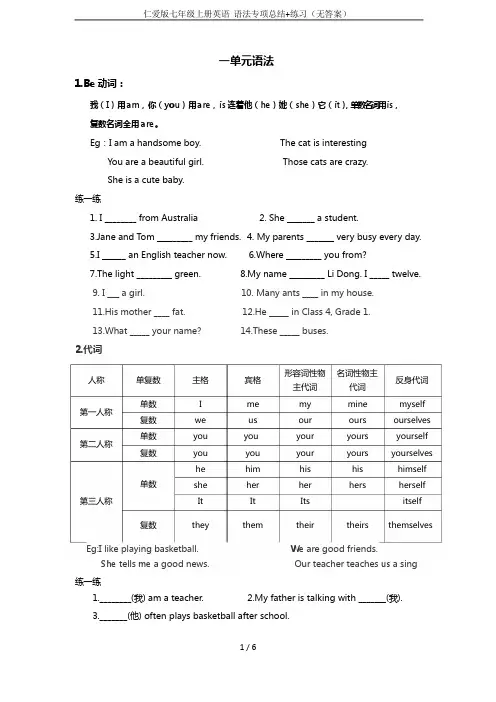
一单元语法1.Be动词:我(I)用am,你(you)用are,is连着他(he)她(she)它(it),单数名词用is,复数名词全用are。
Eg:I am a handsome boy.The cat is interestingYou are a beautiful girl.Those cats are crazy.She is a cute baby.练一练1.I________from Australia2.She_______a student.3.Jane and T om_________my friends.4.My parents_______very busy every day.5.I______an English teacher now.6.Where_________you from?7.The light_________green.8.My name_________Li Dong.I_____twelve.9.I___a girl.10.Many ants____in my house.11.His mother____fat.12.He_____in Class4,Grade1.13.What_____your name?14.These_____buses.2.代词人称单复数主格宾格形容词性物主代词名词性物主代词反身代词第一人称第二人称第三人称单数复数单数复数单数复数IweyouyouhesheIttheymeusyouyouhimherItthemmyouryouryourhisherItstheirmineoursyoursyourshisherstheirsmyselfourselvesyourselfyourselveshimselfherselfitselfthemselvesEg:I like playing basketball.We are good friends.She tells me a good news.Our teacher teaches us a sing 练一练1.________(我)am a teacher.2.My father is talking with_______(我).3._______(他)often plays basketball after school.4._______(我们)buy a pair of shoes for_______(他).5._______(他)often plays basketball after school.6._____is my friend.他是我的朋友。
Unit 1 (词块整理)(含答案)英语仁爱版(2024)七上

2024新仁爱英语七年级上册Unit1 Preparing for the Topic词块整理(含练习附答案)Listening&Speaking 词块整理1.打篮球2.喜欢阅读3.踢足球4.喜欢唱歌/远足5.我是......6.我的名字是......7.学生证号码8.喜欢做某事(3种喜欢)重点句型:(考单选/情景交际/看图写话)1.早上/下午/晚上好。
(打招呼)2.我也很高兴见到你!3.你好吗?(多次见面问候语)4.你好。
(初次见面问候语)5.请问你叫什么名字?(问名字)6.我的名字是李想。
(介绍自己)7.你喜欢什么?(问爱好)Viewing 词块整理1.这是......2.来自3.在......里面4.多少岁5.七年级(6)班重点句型:(考单选/情景交际/看图写话)1.这是晓雅。
(介绍他人)2.很高兴见到你。
(打招呼)3.你来自哪里?(问地点)4.你在哪一个班级?(问班级)5.你几岁了?(问年龄)6.我13岁了。
(表达年龄)7.再见。
(表告别)语法:1.交际用语:表问候,表自我介绍和介绍他人,表告别,表感谢2.48个音素表(分类:20个元音音素+28个辅音音素)3.26个英文字母的读音和大小写(含需要大写的几种情况和常见的英文缩写)4.人称代词主格5.一般现在时用法(一)2024新仁爱英语七年级上册Unit1 Preparing for the Topic词块整理(含练习附答案)Listening&Speaking 词块整理1.打篮球play basketball2.喜欢阅读like reading3.踢足球play football4.喜欢唱歌/远足like singing/hiking5.我是...... I am...6.我的名字是...... My name is...7.学生证号码student ID number 8.喜欢做某事(3种喜欢)like/enjoy/love doing重点句型:(考单选/情景交际/看图写话)1.早上/下午/晚上好。
完整word版,仁爱版七年级上册英语语法专项总结+练习(无答案)

1. Be 动词:我(I )用am ,你(you )用are ,is 连着他(he )她(she )它(it ),单数名词用is , 复数名词全用are 。
You are a beautiful girl.Those cats are crazy.She is a cute baby.2. 代词他)often plays basketball after school.一单元语法Eg : I am a han dsomeboy. The cat is in terest ing1. I from Australia2. She a stude nt.3.Ja ne and Tom my friends.4. My pare nts very busy every day.5.I an En glish teacher now.6.Where you from?7.The light gree n.8.My name Li Don g. I twelve.9. I __ a girl. 11.His mother fat. 13.Whatyour n ame?10. Ma ny ants in my house.12.He 14.Thesein Class 4, Grade 1. buses.1.She tells me a good news.Our teacher teachesus a sing我)am a teacher.2.My father is talking with我).3.4. _____ 我们)buy a pair of shoes for _______ ( 他).5. _____ 他)ofte n plays basketball after school.6. ___ is my friend. 他是我的朋友。
7.My dog likes _____ .我的狗喜欢她。
8.Who is there? It ' s _______ .是谁啊 是我。
仁爱版七年级上册语法知识点总结
仁爱版七年级上册语法知识点总结一、一般现在时。
1. 概念。
- 表示经常发生的动作或存在的状态。
例如:I often get up at six o'clock.(我经常在六点起床。
)- 表示客观事实或普遍真理。
例如:The earth goes around the sun.(地球绕着太阳转。
)2. 句子结构。
- 肯定句:- 主语 + be动词(am/is/are)+ 其他。
例如:He is a student.(他是一名学生。
)- 主语(非第三人称单数)+ 动词原形+ 其他。
例如:They play football every day.(他们每天踢足球。
)- 主语(第三人称单数)+ 动词第三人称单数形式+ 其他。
例如:She likes reading books.(她喜欢读书。
)- 否定句:- 主语 + be动词(am/is/are)+ not+ 其他。
例如:I am not a teacher.(我不是一名教师。
)- 主语(非第三人称单数)+ don't+ 动词原形+ 其他。
例如:They don't like apples.(他们不喜欢苹果。
)- 主语(第三人称单数)+ doesn't+ 动词原形+ 其他。
例如:He doesn't go to school on Sunday.(他星期天不去上学。
)- 一般疑问句:- Be动词(am/is/are)+ 主语 + 其他?例如:Are you a doctor?(你是一名医生吗?)- (非第三人称单数)Do+ 主语+ 动词原形+ 其他?例如:Do they play basketball?(他们打篮球吗?)- (第三人称单数)Does+ 主语+ 动词原形+ 其他?例如:Does she have a pen?(她有一支笔吗?)二、名词的单复数。
1. 规则变化。
- 一般情况加 -s。
例如:book - books,pen - pens。
最全(仁爱版)初中英语语法知识点综合归纳与练习
最全(仁爱版)初中英语语法知识点综合归纳与练习仁爱版初中英语语法知识点综合归纳与练习⼀.名词I. 名词的种类:II. 名词的数:1. 规则名词的复数形式:名词的复数形式,⼀般在单数形式后⾯加-s或-es。
现将构成⽅法与读⾳规则列表如下:2. 不规则名词复数:英语⾥有些名词的复数形式是不规则的,现归纳如下:III. 名词的所有格:名词在句中表⽰所有关系的语法形式叫做名词所有格。
所有格分两种:⼀是名词词尾加’s构成,⼆是由介词of加名词构成。
前者多表⽰有⽣命的东西,后者多表⽰⽆⽣命的东西。
1. ’s所有格的构成:2. ’s所有格的⽤法:3. of所有格的⽤法:⽤于⽆⽣命的东西:the legs of the chair, the cover of the book⽤于有⽣命的东西,尤其是有较长定语时:the classrooms of the first-year students⽤于名词化的词:the struggle of the oppressed⼆.冠词冠词分为不定冠词(a, an),定冠词(the),和零冠词。
I. 不定冠词的⽤法:II. 定冠词的⽤法:III. 零冠词的⽤法:三.代词:I. 代词可以分为以下七⼤类:II. 不定代词⽤法注意点:1. one, some与any:1) one可以泛指任何⼈,也可特指,复数为ones。
some多⽤于肯定句,any多⽤于疑问句和否定句。
One should learn to think of others.Have you any bookmarks? No, I don’t have any bookmarks.I have some questions to ask.2) some可⽤于疑问句中,表⽰盼望得到肯定的答复,或者表⽰建议,请求等。
Would you like some bananas? Could you give me some money?3) some 和any修饰可数名词单数时,some表⽰某个,any表⽰任何⼀个。
仁爱英语七年级上册知识点归纳完整版
仁爱英语七年级上册知识点归纳完整版一、短语:come from 出生于;来自in 用表达look like 看起来像give sth. to sb. 把某物给某人look at 看着help sb. with sth. 帮助某人做某事a little 一点点each other 互相a lot 非常,更加,很much 非常,更加,很have a seat 坐下,就座look after 照顾,照看next time 下一次try on 试穿good idea 好主意such as 比如,例如wait a moment 稍候,等一会儿family tree 家谱look the same 看起来一样have a picnic 去野餐go fishing 去钓鱼go shopping 去购物do shopping 购物take one's order 记下顾客点的菜fly a kite 放风筝different looks 不同的相貌have breakfast 吃早餐have lunch 吃午饭have supper 吃晚饭have dinner 吃饭all right 好的on one's way home 在某人回家的路上find one's way home 找到回家的路a glass of 一玻璃杯a bottle of 一瓶a pair of 一双have fun 玩得开心think of 认为speak to sb. 对某人说call sb. back 回拨电话给某人get up 起床eat out 下馆子,出去吃饭go home 回家go to school 去上学help oneself to sth. 随便吃喝些什么be free 有空have no time 没时间over there 在那儿think about 考虑on a farm 在农场help sb. with sth. 帮助某人某事at night 在夜晚on Sunday 在星期天go out 出去go for a picnic 去野餐on Sunday morning 在星期天早晨at six o'clock 在六点钟be from 出生于;来自go to the zoo 去动物园Welcome to China 欢迎到中国来Don't worry 别担忧 in the same grade 在同一个年级in different classes 在不同的班级telephone number 电话号码junior high school 初中You're welcome 别客气Thank you 谢谢你 Can I help you 我能帮你什么忙吗Here you are 给你Here it is 它在这Here we are 我们到了 be afraid 恐怕,害怕in different clothes 不同的衣服be in blue 蓝色衣服be in a red T-shirt 红色T恤be in black pants 黑色裤子help sb. do sth. 助某人做某事want to do sth. 要做某事like to do sth. 欢做某事would like to do sth. 要做某事Are you kidding 是开玩笑吧Thank you all the same 是要谢谢你a bag of一袋That's right没错That's all right不用谢没关系 how many多少how much多少 too heavy太重this Sunday这个星期日forget to do sth.忘记去做某事See you later再见 's up怎么啦's wrong with you你怎么啦 have to 不得不carry water提水sing a song唱歌be in在家be out在外面ask sb. to do sth.要求某人做某事want sb. to do sth.想要某人去做某事would like sb. to do sth.想要某人去做某事at my home在我家What time is it几点了half past seven七点半a quarter to eight差一刻八点It's time to do sth.该做某事的时候了; What's the time几点了thank sb. for sth.因为某事而感谢某人thank sb. for doing sth.感谢某人做了某事 at the zoo在动物园二、知识点:Unit 11、Good morning/ afternoon / evening 早上/下午/晚上好 Good night 晚安2 、glad / nice to meet / see you 见到你很高兴回答也一样3、welcome to + 地点欢迎来到答:Thank you 或者 Thanks4、let’s + V原让我们做5、 stand up 起立 sit down 坐下6、this is 这是…… 用于介绍第三者的用语7、How do you do 你好回答也是:How do you do 8、 How are you 你好吗 Fine ,thank you .and you 很好;谢谢;你呢I’m OK / I’m fine , too . 我也很好;9、 see you = see you later = see you soon = good-bye 再见10、 excuse me 打扰一下;请问11、I’m = my name is 我是……12、 be from = come from 来自13、 in English 用英语14、 Can you spell it Yes / No 你能拼写它吗能/不能15、That’s OK / That’s all right / You’re welcome / Not at all 不用谢16、…… years old ……岁17、 telephone number 电话号码number 号码 ID number 身份证18、 the same 相同的反义词是different 不同的例: We are in the same grade, but we are in different classes. 句型:19、What is your name 你的名字是什么20、Where +be + 主语 + from 某人来自于哪里回答:主语+be+地点例: Where are you fromI am from quanzhou.21、How old + be + 主语某人几岁回答:主语 + be + 数字例:How old are you I’m forteen.22、What is your telephone number 你的电话号码是多少回答:My telephone number is或者It’s 注意:读出号码的时候要逐个读出;23、What class / grade +be + 主语 + in 某人在哪一个班级/年级例:what class are you in I am in Class Five. 注意:Class 和 Five 需要大写what grade are you in I am in Grade Seven. 注意: Glass 和 Seven 需要大写 24、What’s this/ that in English 这是什么回答:It’s a/an + 单数名词. 这是…… What’ re these/ those in English 这些是什么回答:They’re + 复数名词这些是……25、How do you spell it 你怎么拼写它 E-R-A-S-E-R, eraser. 注意拼读方法Unit 2 1、 sb + has/ have an /a + adj + 五官 === sb’s 五官 is / are + adj 描述长相例:Lily has a small nose. = Lily’s nose is small. 2、 I know = I see 我明白了 3、That’s right 那是对的 4、look the same look like 看起来相像look different 看起来不同例: Jim and Lilei look the same.== Jim looks like Lilei. . 5、 look at + n 看某物 look for +n 寻找某人/某物 look after +n 照顾某人 6、 both 两者都…… all 三者或者三者以上都Both 和all 位于 be 动词或情态动词后,位于行为动词前;例: We are both students. We both have black eyes. We can both speak English. 注意: 7、 give sth to sb = give sb sth 把某物给某人;注意:如果 sth 是 it 或 them,只能用前者注意 ,只能用前者8、 have different looks == look different 有着不同的长相看起来不相像have the same look. ==look the same 有着相同的长相看起来很相像 9、over there 在那边 come in 请进 go out 出去 10、 in + 颜色或 in a/an/the +颜色 + 衣服表示穿着……颜色的衣服常常接在名词的后面,表示穿颜色衣服的…… 如 the girl in red is my sister.11、 too + adj 太……12、 pants 和shoes 做主语,谓语动词用复数;但 a pair of pants/ shoes 作主语时,谓语动词用单数形式例: His shoes are black. A pair of shoes is under the bed. 13、 in the morning/ afternoom/ evening 在早上/下午/晚上 at night 在晚上 14、 go shopping = go to the shop 去购物类似的有 go swimming go fishing go skating 等等帮助某人做某事注意:sb 用代词时必须用宾格 15、 help sb. to do sth == help sb with sth 16、 high school 中学 17、 play +球类 play the 乐器 18、 think of 认为,想 think about 考虑 I think + 从句我认为……例: I think he you are right.否定式常否定主句,但翻译时要否定后面的从句例:I don’t think he can come. 我认为他不会来了.不能说:我不认为他会来19、What do/does + 主语 + look like 询问人的长相例: What does your English teacher look like 20、What’s and ……加……是什么回答:It’s例:What’s red and yellow It’s orange. What’s two and five It’s seven. 21、Whose + 东西 + is this/ that Whose + 东西 +are these/ those 这/这些是谁的……例:Whose coat is this It is mine. Whose shoes are these They are hers.22、Who is the letter from 这封信来自于谁It’s f rom Lily. 它来自于莉莉;23、What color be + 东西回答:It’s +颜色或者They’er + 颜色例:What color is your dress It’s black.Unit 31、Could you please…… 后接动词原形你愿意做某事吗我能做某事吗 MayI …… 后接动词原形2、 the English corner 英语角3、 live in + 地点住在某地 live with + 人和某人住在一起4、 What does he say in the letter 他在信里说了些什么 What does he say on the phone 在电话里说了些什么5、 a lot = very much 放在句末,修饰动词,非常……not at all 一点也不……例: I like the boy a lot/ very much.I don’t like the boy at all.. 6、 each other 相互,彼此例: S tudents often talk to each other in class. 7、 do sth with sb 和某人一起做某事 8、 No problem 没问题9、 speak + 语言说某种语言 speak English speak Chinese 10、 the Great Wall 长城 11、 come/go to + 地点去某地但 home 、 here 、 there 这些是副词,前面不能加 to例:go home / come here / go there go to do sth 去做某事例: They go to play basketball. 12、 like doing sth 喜欢做某事 like to do sth 想要做某事 13、It’s + adj +to sb 对某人来说是……的 14、 help sb with sth =help sb to do sth 帮助某人某事 15、 be at home = be in 在家 go home 回家 get home 到家in one’s home 在某人的家里 16、 have a seat / take a seat / sit down 请坐下 17、office worker 办公室职员 cook 厨师cooker 炊具 18、 on a farm 在农场上on the sofa 在沙发上 19、 a photo of one’s family 某人的全家照 Family Tree 家谱首字母都大写 20、 in a hospital 在医院纯属地点概念 in hospital 因病住院例:He is ill in hospital. 他生病住院 He is in a hospital.他在医院里不一定是因为生病来到医院 21、 look after sb = take care of sb 照顾某人22、 teach sb sth = teach sth to sb 教某人某东西 teach sb to do sth 教某人做某事23、help oneself to sth. 请随便吃…… help yourself/ yourselves to fish24、I’d like sth = I would like sth. 我想要……25、 Would like to do sth = want to do sth 想要做某事26、 Would you like something to eat drink 你想要一些吃喝的东西吗 to eat 或 to drink 修饰 something,作为后置定语; 27、 Here you are . 给你 Here we are. 我们到了28、What about …… == Howabout …… ……怎么样后接代词或名词,还可以接动名词即What about doing sth29、 all right 好的30、a cup of tea 一杯茶 two cups of tea 两杯茶31、 milk for me 我要牛奶32、Why not ……后接动词原形 = Why don’t you …… 后接动词原形为什么不做某事呢回答:Good idea 好主意;33、 May I take your order 可以点菜了吗34、 wait a moment = just a moment 等一下,请稍侯 wait for sb 等待某人35、 Can I help you = May I help you = What can I do for you 需点什么帮忙吗36、 eat out 出去吃饭37、 let sb do sth 让某人做某事38、 have dinner/ breakfast/lunch/supper 吃正/早/午/晚餐39、 a kind of 一种…… all kinds of 各种各样的……40、be friendly/kind to sb 对某人友好41、 such as 例如例:I like fruits, such as oranges,bananas and apples42、 be glad to do sth例: I am glad to meet you, I am glad to be here.. 句型:43、What do/does + 主语+ do == What +be+ 主语. == What’s one’s job 回答:主语 + be + 职业.例如: What does your father do = What is your father = What’s your father’s job He is a teacher.Unit 41、 try on 试穿……2、 we/I will take it 我们/我买下了这里的 take 相当于 buy3、 buy sth for sb = buy sb sth给某人买某物; 4、I’m just looking 我只是看看; 5、 three hundred and sixty-five 365 百位数和十位数之间加and , 十位数和个位数之间加”-“6、 a pair of 一对/一双……7、 running shoes 跑鞋8、 Are you kidding 你开玩笑吧;9、 think about 考虑;10、 thank you all the same 仍然谢谢你;11、 Is that all 就这么多吗That’s all. 就这么多吧 I12、 I think so. 我认为是这样的. I don’t think so.我认为不是这样的. 13、当把东西给某人时可以说: Here you are 或 Here be + 东西或 Here it is.14、Don’t worry.别担心① worry about + 宾语如:Do you worry about your leesson ②Worried 烦恼的 be worried about +宾语如:She is worried about her mother.15. a few +可数名词肯定一点,一些;;few + 可数名词:否定几乎没有 alittle +不可数名词肯定一点,一些;;little + + 不可数名词:否定几乎没有16、 be free = have time 有空的;反义词:be busy = have no time Are you free tomorrow == Do you have time tomorrow17、在某一天使用介词 on , 在某个时刻用 at 如:On Sunday at a half past six 当 this 接时间,不用介词, this Sunday18、What’s up = what’s wrong = What’s the matter 什么事19、 forget to do sth. 忘记去做某事事还没做 forget doing sth 忘记曾做过某事事已做完20、 tell sb about sth. 告诉某人某事tell sb sth = tell sth to sb 把某事告诉某人 ask/tell sb to do sth 叫某人做某事 ask/tell sb not to do sth 叫某人不要做某事21、电话用语:①Who’s this 你是哪位②Is this ……你是……吗③This is ……speaking 我是…… ④May I speak to……我可以找……吗 22、go for sth = go to do sth 去做某事如: go for class = go to have class.23、It’s fun 真是有趣的事24、 call sb = give sb a call 打电话给某人 call sb back 给某人回电话25、I’m afrai d /sorry that + 从句恐怕……/ 对不起,……26、I have no time = I don’t have any time 我没有时间 no = not any27、 be not in = be not at home = be out 出去了,不在家;28、 sing a song / sing some songs 唱歌; fly a kite 放风筝;draw picture 画画 play sports 做运动; watch TV 看电视 read books 看书 read newspaper 看报纸29、 let sb do sth 后接动词原形让某人做某事30、时间读法有顺读法和逆读法:顺读法eleven thirty-six 表示 11:36 逆读法分钟数小于等于 30 分用 past , 分钟数大于 30 分用 to,如 five past ten 表示 10:05; five to ten 表示 9:55,half past six 表示 6:30 , a querter to six 表示 5:4531、 show sth to sb = show sb sth 把……拿给某人看;作为名词表示演出,表演32、祈使句的否定句,直接在句首加上Don't 就可以了33、have to ……后接动词原形不得不……34.、It’s time for sth/ doing sth It’s time to do sth 该到做……的时候了It’s time for sb to do sth 是某人做某事的时候了35、 next time 下一次 next week 下个星期 the next day 第二天;36、next to…… = near…… 在……旁边37、 get up 起床 go to bed 上床睡觉;get sb up 叫某人起床38、do one’s homework 做作业;39、 have a picnic 野餐;have class 上课 have a meeting 开会 have a party 举办聚会 have dinner/ breakfast/lunch/supper 吃正/早/午/晚餐 have +东西吃/喝……have a good time =enjoy oneself 玩得很愉快 have sb to do sth 让某人做某事 have to do sth 不得不……40、on the weekday 在周末;41、lot of = lots of = many =much 许多的,大量的42、 in the sun 在阳光下;43、sb like best = sb’s favorite + 种类is / are …… 谁最喜欢…… 44、on one’s way to 在某人去……的路上;on one’s w ay home 在某人回家的路上45、 Here we are. 我们到了46、It’s very kind of you 你真是太好了;47、 thanks / thank you for + n /v-ing 为……而感谢你;48、 in the tree 在树上外物附着 on the tree 在树上树上本身长出的东西 In the wall 在墙里如 window on the wall 在墙上49、 What do you think of = How do you like 你认为……怎么样例:What do you think of your English teacher= How do you like your English teacher 50、 How much be + 主语回答:It’s / They’re + 价钱. How much is your English book 问价格还可以用what’s the price of …… 为什么不做某事呢 51、Why not ……后接动词原形= Why don’t you …… 后接动词原形回答:Good idea 好主意;52、 What time is it == What is the time 回答:It’s +时间考点归纳:1、英文中常用的问候语及其回答:-Hello. -Hello.—Hi. —Hi—Good morning. —Good morning.—Good afternoon. —Good afternoon. —Good evening. —Good evening. —Good night. —Good night.—How do you do —How do you do—How are you —Fine, thank you.注意:对“How do you do” 和“How are you” 两句话的回答不要弄混淆; 2、sorry “对不起” 用于引出某一过错; Excuse me. “对不起” 用于引起对方的注意;例如:I’m sorry I can’t speak English. Excuse me, is this your backpack3、be late for ... 做……迟到 be late for school/ class/ work/ the meeting 上学/上课/上班/开会迟到注意: late 的副词仍为 late, 不能写成 lately.例如:请不要晚到学校; Please don’t arrive lately for school. × Please don’t arrive late for school. √ 4、见到某人很高兴的几种表达:Nice to meet you. = Happy/ Glad/ Pleased to meet you.5、What’s this in English =What’s the English for this 这个用英语怎么说用什么语言,介词用in: “in + 语言”.例如: in English 用英语 in Chinese 用汉语 in Japanese 用日语注意:用钢笔:in ink = in pen = witha pen 让我们学英语;6、Let’s learn English. 让我们学英语;L et’s = let us 让我们Let’s do sth. = Why not do sth. = What/How about doing sth.如:Let’s learn English. = Why not learn English = What/How about learning English注意:let sb. do .. 中的 sb.即使是第三人称单数后面的动词仍用原形例如:Let her sing an English song.7、learn from 向……学习 learn to do sth. 学做……例如:Let us learn fromLei Feng. Lucy learns to play the guitar.8、对颜色提问的两种方法: Whatcolor … = What’s the color of … 例如: What color is your coat = What’s the color of your coatcolor 着色 color sth. + 颜色,例如: I want to color it red.color 是可数名词例如:I don’t like these colors.9、对姓名的几种提问及回答:What’s your name = May I have/know your nameMy name is … = I’m…10、call + sb. + at + … “给某人打电话”11、感谢你:Thanks. = Thank you. √ Thank. × Thanks you. × Thanks for + sth./doing sth. 为……而感谢你;例如:Thanks for your help. =Thanks for helping me.12、take, bring, carry 和 get 的区别:1take “带走”,从近处带到远处例如:Please take these books to your home after school.2 bring “带来”,从远处带来例如:Please bring me some cakes.3c arry “带”,无方向性,指移动较重、较大的东西,有“负重”的含义例如:The bag is too heavy for me. Can you carry it for me 4 get “去拿来”,相当于 go and bring例如:Can I get you something to drink 12、need 需要1 need + V原……” 例如:She need some cakes.2 need to do sth. “需要做……”例如:She needs to speak English often.13、There be 句型在某处有什么例如: There is a clock on the wall. There be 句型的就近原则:若有两个或两个以上的主语是,谓语常与靠近它的那个主语一致;例如:There is a book, two pens and some cups on the desk.There are two pens, some cups and a book on the desk.注意:There be与 have 的区别在于:have 表示某人或某物拥有什么;而There be 表示在什么地方存在什么; 14、want to do sth. “想要做……”例如:He wants to join the reading club.15、like v. 喜欢用法:like sth. / sb. 喜欢…like doing sth. 喜欢做…like to do sth. 想做…like sb. to do sth. 想要某人做…would like to do sth.想做… be like 像…look/sound like 看/听起来像…注意:like doing sth. 喜欢做…长期的喜好,习惯like to do sth. 想做…短期的,具体的某一次活动16、构词法:在动词后面加-er 或-or,将动词变为人的名词例如: sing-singer wait-waiter work-workerteach-teacher speak-speakervisit-visitor加-r: write-writer drive-driver双写尾字母: run-runnerswim-swimmer shop-shopper注意: cook烹调— cook 厨师-cooker 厨房用具17、a lot of = lots of 可以用来修饰可数名词和不可数名词;Jim drank a lot of/lots of beer. I have a lot of/lots of things to do. a lot 作状语,表示程度、数量或频率;例如:Thanks a lot. I know a lot about it.19、for 就……而言例如:I have some bread for supper.20、have/eat + 三餐“吃早/中/晚饭” 例如:I usually have lunch at home.21、对价格提问:How much …=What’s the price of …例如: How much is this sweater = What’s the price of this sweater 22、in + 颜色例如: She is in red. = She is in a red coat.\23、on, in, at 与时间状语连用: on + 具体某一天例如:I will do some shopping on Sunday.in + 时间段例如: in the morning / afternoon / eveningat + 几点例如:Our class is at 8:00注意:如果时间状语前面有这些词:this, that, next, tomorrow等, 则不用介词;例如: See you next time.24、对年龄的提问:How old are you What’s your age May I know/have your age 答:I’m ... years old. 注意:表达年龄的几个同义句: Tom is 15. =Tom is 15 years old. =Tom isa 15-year-old boy. =Tom is a boy of 15.25、think +句子例如:I think you are right.注意: think 的否定转移例如:I don’t think it is right.26、like ... best = favorite+…最喜欢…例如:Jack likes red best. =Jack’s favorite color is red.27、too/also/either的区别:too 用于句末例如: Tom is from America. Lucy is from America, too. also 用于句中be 动词后,行为动词前例如: Tom is from America. Lucy is also from America. either 用于否定句中例如:Tom isn’t from America. Lucy isn’t from America, either.28、speak/ say/ talk/ tell 的区别:speak+语言讲某种语言例如:She can speak Chinese. I can speak a little English. say 强调说话的内容例如:Let me say “Thanks” to you. talk 强调交谈:talk to/with ….和……交谈talk about … 谈论……tell 强调“告诉”:tell sb. sth. = tell sth. to sb.注意:say 还有“写着”的意思,例如:Look There is a card. It says “CLOSED”. 29、be good to 对…… 友好= be friendly/kind to…30、help oneself 随便吃……在使用时要注意反身代词的单复数;例如:Jim, help yourself, please. Help yourselves, boys. help sb. = give sb. a hand 帮助……help sb. with sth. 帮助某人做某事例如:Can you help kids with swimming 你能帮助孩子学游泳吗31、动词+介词构成的动词短语,其宾语是名词的时候,可放在动词与介词之间,也可以放在介词的后面例如: call sb. back = call back sb. 给……回电话 try sth on. = try on sth. 试穿……注意:如果宾语是代词 it 或 them 则只能放在中间例如:try it/them on.32、allof 全部,所有三者以上; bothand 两者都……放在助动词、情态动词、be 动词之后,行为动词之前例如:We are all students, we all work hard.My parents are both office workers.= Both my father and mother are office workers.All of the girls look nice.33、be from = come from…来自…… 注意:动词的变化: She’s from China. = She comes fromChina.She isn’t from England. = She doesn’t come from England.常见的错误: Where is he come from Where does he from国籍的几种表达方法: Tom 是个美国人;Tom is American. Tom is an American. Tom is an American boy. Tom is from America. Tom comes from America.售货员招呼顾客:① May I help you ② Can I help you③ What can I do for you ④ What would you like顾客常用语: ① No, thanks. I’m just looking . ② I’m looking for ... . ③ I’d like to have/buy ... . ④ Can you show me ...⑤ Could I have a look at ...询问顾客想买东西的特征: ① What kind would you like② What color would you like ③ What color would you like顾客询问价格: ① How much is itare they②What’s the pr ice of ...顾客决定要买:I’ll take/have itthem. 付钱: Here’s the money.。
仁爱版英语七年级上册知识点归纳总结(整理版)
仁爱版英语 上学期知识点汇总 ( 七年级上册 )(包括重点句型、短语、知识点详解和重点语法 )Unit 1 Making New Friends【重点短语】1.good morning/ afternoon / evening 早上 /下午 /晚上好2.glad / nice to meet / see you 见到你很高兴3.welcome to + 地点 欢迎来到 ……4.let ’ s + v 让我们做 ……5.stand up 起立6.sit down 坐下7.this is... 这是……8.thanks = thank you 谢谢9.see you = see you later = goodbye 再见10.ID number 身份证号码11.be from=come from 来自12.in English 用英语【重要句型】1.---What’ s your name? ---My name is Sally.2.---Where are you from? ---I ’ m from China.---Where do you come from? ---I come from China.3.---Where is he/ she from? ---He/She is from Japan.4.---What’s this/ that in English? --- It ’ s a/ an …5.---What’ re these/ those in English? ---They’re …6.---How do you spell it? ---E-R-A-S-E-R, eraser.7.---Can you spell it? ---Yes, M-A-P, map.8.—How old are you/ is he/ are they?— I ’ m/ He is/ They are eleven.9.—What’s your telephone number?— It ’ s 4567967.10.— What class / grade are you in?— I ’m in Class Ten, Grade Seven.(注意大小写)11.Good morning/ afternoon/ evening.12.— Hello!/Hi! —Hello!/Hi!13.— Nice/Glad to see/meet you. — Nice/Glad to see/meet you, too.14.— Welcome to China/my home. —Thanks.15.— How do you do? —How do you do?16.— How are you? — Fine, thank you. And you? — I ’m OK.17.— See you then/ later. —See you.18.— Goodbye. —Bye.19.— Thank you. —You’rewelcome. / That ’ s OK./Not at all.【重点语法】1.元音字母: Aa Ee Ii Oo Uu包含有以下元音的字母:[e] Aa Hh Jj Kk[i:] Ee Bb Cc Dd Gg Pp Tt Vv[aI] Ii Yy[ju:] Uu Qq Ww[e] Ff Ll Mm Nn Ss Xx Zz2.大小写句首字母,人名,地名,称呼语,专有名词,星期的首字母要大写,引人注意。
仁爱版英语七年级上册知识点归纳
【仁爱版英语七年级上册知识点归纳】一、词汇与语法1. 介词 in、on、under 的用法介词in 表示在……里面,在某个大区域内,表示年、月、季节、部分、城镇或院系的里面;on 表示在……的表面上,上面,表示星期、日期、节日、街道、楼层的正上面;under 表示在……下面,下方,表示建筑物、地板的下部分,使用在地点、方位位置和状态表示的空间用语中。
例如:in the box, on the desk, under the table.2. 情态动词 can、can’t 的用法情态动词 can 表示能力,会,可以,表示某人有某个能力或者有可能做某事;can’t 表示不会,不可能。
例如:I can swim. I can’t play the piano.3. 复数名词的变化英文名词的构成变化,例如以辅音字母+y的词变复数时,y变i + es 等。
例如:baby 变为 babies.4. 数词的构成和用法基数词和序数词的用法和构成规则。
例如:twenty-first, twenty-second, twenty-third.5. 题型选择题、判断题、填空题、连线题等。
例如:--张三是不是美国人?--是的,他是。
二、阅读与表达1. 阅读准确度和理解能力能够根据所学知识,对文章、短文、图表等材料做准确、完整的理解和解读;能够运用所学的语言知识做出判断和解释。
例如:学习阅读文章,抓住信息点。
2. 表达和概括的能力学会用简洁的语言准确表达意思,总结概括文章中的重点信息。
例如:根据所学的语言知识,用简单易懂的语言总结文章内容。
3. 文章结构的认识和理解能够理解文章中的主体、开头、结尾;了解各种文章中表达的意思和结构。
例如:明白文章的开头、中间和结尾分别表达的意思及其结构。
三、写作与口语表达1. 完整的句子构成能力能够构成简单的句子,正确地使用句子成分和语序。
例如:主语+谓语+宾语的基本句型。
2. 简单句和复合句的使用能力能够灵活使用简单句和复合句表达自己的意思。
仁爱版七年级英语上册语法归纳及练习
仁爱版七年级英语上册语法归纳及练习Ren'ai n of Grade 7 English Grammar Summary and Exercises (Simplified n)1.There are 5 vowels in the 26 letters of the English alphabet: Aa。
Ee。
Ii。
Oo。
Uu。
The rest are consonants.2.The first letter of the first word in a XXX.s should be capitalized。
such as Tom.4.The word "I" should be capitalized.5.The first letter of a title should be capitalized。
such as Ms。
Liu.6.Place names should be capitalized。
such as China and England.7.Proper nouns should be capitalized。
such as Class 3 and Grade 1.2."A" is used before a consonant sound and is pronounced as[e]。
such as "a book." "An" is used before a vowel sound and is pronounced as [en]。
such as "an apple."Exercise 1: Fill in the blanks with "a" or "an."1._____ apple。
_____ orange。