
英语中法语借词的演变研究
最新英语专业全英原创毕业论文,都是近期写作1 等值理论视阈下的英汉广告翻译2 从文化差异角度谈国际商务谈判中的语言技巧3 从合作原则违反角度分析《破产姐妹》中的幽默话语4 哈金小说《等待》中的女性悲剧分析5 愉快教学法在初中英语教学中的应用6 功能对等理论视角下英语言语幽默的翻译—以《老友记》为例7 英汉语篇中的省略衔接手段对比及其翻译方法——以《雪》译文为例8 浅谈金融危机对中国汽车产业影响9 浅议公示语的语言特点及其翻译策略10 文化适应性原则在食品商标翻译中的应用11 文档所公布均英语专业全英原创毕业论文。
原创Q 799 75 79 3812 情态人际意义的跨文化研究13 The Symbolic Meanings of Letter “A” in The Scarlet Letter14 语言中性别歧视词汇的语用分析15 浅议英语情态动词“can”和汉语能愿动词“能”—以类型学为视角16 认识、寻找和实现自我价值——剖析《飘》中的人生价值17 卡森•麦卡勒斯《心是孤独的猎手》福柯式解读18 基于学习共同体的自主学习模式研究19 福克纳《我弥留之际》中达尔形象解析20 An Analysis of the Cultural Identity in Amy Tan’s The Joy Luck Club21 On the Translation of Tourism Advertisements22 《了不起的盖茨比》中象征主义的研究23 从无知到成熟:论爱玛的成长历程24 从功能对等理论看儿童翻译——以《夏洛的网》两个中译本为例25 论《傲慢与偏见》中的女性形象26 On Promotion of Rural Middle School Stud ents’ Oral English27 论《麦田里的守望者》中的象征体系及霍尔顿的精神世界28 The Application of Corpus in Teaching English Reading29 论英语新闻中的模糊语言30 八十年代以来汉语中英语外来语及翻译31 浅析《墓园挽歌》中意象的变化32 从巴斯奈特文化翻译观谈汉语新词的英译33 关于支架式教育与创新教育的讨论34 《加里波利的坟墓》的反讽与对话35 《傲慢与偏见》中英语反语的语用分析36 析《小妇人》中的超验主义37 多媒体网络教学和传统教学对大学生情感的影响38 以姚木兰和斯嘉丽为例看东西方女性意识差异39 环境、性格、命运--评《远大前程》主人公皮普40 英汉委婉语对比研究41 A Research of Translation of English Songs into Chinese by Poetic Norms42 浅析儿童自然英语教学法的心理学优势43 战争、归乡、爱情—《冷山》的多元主题研究44 从《推销员之死》看消费主义时代美国梦的破灭45 外语教学中文化教学的问题46 从跨文化交际的角度看广告翻译47 中外酒文化差异分析48 批评与重新解读《日瓦戈医生》49 海斯特白兰的反叛主义50 论男权主义在圣经语言中的体现51 An Analysis on Cultural Differences in Translation52 从引进好莱坞大片看中国意识形态转型: 从集体主义到个人主义53 路易斯——现实世界在非现实世界的投影——解读《夜访吸血鬼》的现代性54 论童话《小王子》的象征创作55 《榆树下的欲望》和《雷雨》中悲剧性的差异56 宗教对传统:犹太新年与中国新年的对比研究57 充满爱与美的唯美世界——王尔德童话中的唯美主张研究58 从动态对等角度论英语俚语的翻译59 从心理学角度试析简爱性格的对立性60 以超验主义视角对瓦尔登湖中寂寞观的分析61 从任务型教学角度浅谈计算机辅助教学在中学英语阅读教学中的应用—以The Story of Xi Wang为例62 王尔德童话中的毁灭与拯救63 从《大卫科波菲尔》中看狄更斯的道德观64 爱伦坡短片小说“美女之死”主题研究65 国际货物销售合同的文体特征及翻译66 从《消失的地平线》看儒家中庸之道的积极含义67 从功能对等角度看信用证英语的翻译68 《红与黑》中司汤达的爱情观69 海明威“冰山原理”在《永别了,武器》中的应用及对写作的指导意义70 从解构主义视角分析迈克尔•翁达杰《英国病人》中小说中心的消失71 浅析英语外加状语的语用功能72 语用策略在英语商务信函中的应用73 《献给艾米丽的玫瑰》中艾米丽的命运分析74 不同的阅读任务对高中生英语词汇附带习得的影响75 水文化对中西方文化影响的比较研究76 看《一间自己的屋子》中弗吉尼亚伍尔夫的女性主义思想77 目的论视角下的儿童文学翻译:《爱丽丝梦游仙境》译本对比78 工业化进程下人的主体性的追问——梭罗的《瓦尔登湖》79 A Contrastive Study on the Religious Constituents of Chinese and Western Christians80 The Death of Willy Loman and the destruction of the American Dream81 On Mother-daughter Relationship in The Thorn Birds82 对《愤怒的葡萄》中圣经原型的分析83 Growing Pains: An Analysis of the Hero in Catcher in the Rye84 尤金·奥尼尔《进入黑夜的漫长旅程》中人物刻画的反讽手法85 斯佳丽性格的自我超越和升华86 论密西西比河对马克•吐温和《哈克贝利•费恩历险记》的影响87 维多利亚时期文学作品中的女性意识88 A Comparison of the English Color Terms89 A Magic World: A Study of Magic Agents in Harry Potter90 关联理论视角下《生活大爆炸》中言语幽默的汉译91 Psychological Analysis of Stuttering in The King’s Speech92 从生态女性主义角度分析纳撒尼尔•霍桑《红字》93 《圣经》对英语习语的影响94 《秀拉》中女主人公秀拉的女权主义解读95 从《紫色》中的意象看黑人女性身份的自我重塑96 《老人与海》中马洛林形象的不可或缺性97 意象美,声响美,节奏美--评济慈《希腊古瓮颂》98 A Comparison of the English Color Terms99 情态人际意义的跨文化研究100 An Analysis of Fagin in Oliver Twist101 论盖茨比悲剧的必然性102 游戏在小学低年级英语教学中的应用103 中西方文化差异对英汉互译的影响104 Functional Equivalence in Chapter Title Translation of A Dream of Red Mansions 105 《汤姆·索亚历险记》中所反映的社会问题106 外国品牌中译的创新翻译研究107 浅析汉英动物词的文化内涵及其翻译108 浅析《小妇人》中乔的女性意识及其成长过程109 从凯特肖邦的“觉醒”中映射出的女性自由110 论英语写作中中式英语的成因及解决策略111 中西丧葬礼俗的对比研究112 浅析英语粘着词素及其在词汇教学中的实用价值113 如何运用情景教学法进行初中英语词汇教学的探讨114 政论文的英译特点115 论英汉植物词语的文化附加义116 关于初中英语课堂中教师体态语的研究117 英汉称谓语中的文化差异118 商标的特征及其翻译的分析119 浅析《傲慢与偏见》中女性人物的认知局限120 Study of Themes of George Bernard Shaw’s Social Problem Plays121 Problems Occured in the Process of the Chinese Learning English and Its Possible Solution122 年世博会吉祥物所体现的中国元素123 《红字》中对自由的求索124 试析杰克伦敦的《野性的呼唤》中的自然主义125 从《红字》看霍桑的道德思想观126 一位《飘》不去的女性—《飘》中斯佳丽的女性主义性格特点成长分析127 女性主义视角下《傲慢与偏见》的情态意义解读128 追求“美与真”:莎士比亚十四行诗中的玫瑰意象研究129 从莎士比亚女性主义意识浅析《驯悍记》主角凯瑟琳娜130 从麦琪的礼物中折射出欧亨利对已故妻子的爱131 A Brief Discussion on Creative Treason in Poetry Translation—Based on the Chinese Versions of The Isles of Greece132 辩证论视域下神似与形似的相互关系研究133 Angel’s Face, Devil’s Heart—The Degeneration of Dorian Gray in The Picture of Dorian Gray134 从许渊冲的“三美论”看唐诗中的典故翻译135 论“迷惘的一代”--以海明威为个案136 中美学生对待教师的礼貌言行的对比分析137 论杰克伦敦的个人经历和信仰对《野性的呼唤》主人公巴克命运的影响138 分析《红字》中的孤独感139 浅析跨映射视角下的歇后语意义构建140 关联理论视角下的科技产品广告翻译141 英汉成语特点对比研究142 《喜福会》中的文化身份分析143 圣诞节对大学生的影响的调查研究144 诸神形象折射中西方价值观不同145 对比分析在英语语音教学中的应用146 从《红字》看霍桑对清教主义的批判与妥协147 An Analysis of American and Chinese Culture in Kung Fu Panda148 论《飘》中斯嘉丽的进步女性主义思想149 体态语在英语课堂教学中的运用研究150 歇斯底里的舞台自语者——《寻找格林先生》主题解读151 马斯洛需要层次理论下的《奥兰多》152 分析年龄因素对英语学习的影响153 中西方丧葬文化的对比研究154 Inheritance and Development of Gothic Literary Tradition in Jane Eyre155 《汤姆叔叔的小屋》中汤姆的性格分析156 中美大学创业教育的比较和启示157 The Influences of Electronic Commerce on International Trade158 母语在小学英语学习中的正迁移159 透过《德伯家的苔丝》看哈代托马斯的宗教观160 从谈判风格看中美文化差异161 On English Film Title Translation from the Perspective of Skopostheorie162 浅析华兹华斯诗歌中的自然观163 考琳•麦卡洛《荆棘鸟》中麦琪悲剧命运的成因164 “适者生存”在《野性的呼唤》中的释义165 论中美两国的现代中年女性观念之差——以美剧《欲望都市》为例166 新课改下初中英语作业设计的探索167 浅析《哈克贝利•费恩历险记》中的人物性格成因168 英汉幽默语的对比研究及其翻译169 顺应论视角中电影字幕汉英翻译研究——以李安电影作品字幕翻译为例170 浅析英汉语言中颜色词的运用171 东西方文化中团队意识的差别172 英语中的汉语词汇173 英汉“去除”类运动事件表达异同的对比研究174 浅析莎士比亚《辛白林》中的女性形象175 自救或被救: 小说《红字》分析176 《了不起的盖茨比》中女性形象分析177 从《道连•格雷的画像》谈唯美主义艺术观178 How Chinese Culture Affects the Translation of the Terms Of Martial Arts179 由王尔德的《莎乐美》探究法国象征主义对其唯美主义的影响180 论黑暗中的光明在《八月之光》中的体现181 The Theme of Absurdity in The Scarlet Letter182 Hawthorne’s Feminism Conscious ness in The Scarlet Letter183 从关联理论角度看英语广告语的修辞184 从《印度之行》看福斯特的人文主义思想观185 论哥特式手法在《呼啸山庄》中的应用186 英语环境公示语翻译中的问题以及解决方法187 从韦恩•布斯的修辞理论角度分析《爱玛》中的修辞手法188 《我的安东妮娅》中的文化冲突研究189190 浅谈中式菜名英译方法191 以马斯洛需求理论分析《夜访吸血鬼》中路易的行为活动192 浅析焦虑对英语专业学生英语口语的影响193 亲属称谓:英汉社会文化差异194 Influences of Encouraging Words on Students In High School Classes195 从文化角度分析《穿普拉达的恶魔》所反映的职业观196 对中西方传统节日之文化差异的研究197 A Brief Analysis of the Auspicious Culture in the Wedding Custom Between China and Western Countries198 空间介词在英汉时间表达中的隐喻性用法对比研究199 跨文化交际下中西饮食文化的比较研究200 弗吉尼亚•伍尔夫《海浪》的叙事技巧分析。
英语发展史(16):中世纪英语从法语和拉丁语借了多少词?

英语发展史(16):中世纪英语从法语和拉丁语借了多少词?词汇方面的变化(2)还有法语单词加古英语后缀构成新词的情况,如gently和beautiful。
在现代英语中,以古英语后缀-ly和-ful结尾的单词很多。
这两个后缀不表示词义,只表示词性。
除了friendly,lovely,scholarly,slovenly(邋遢的)等,以-ly结尾的基本都是副词,而以-ful结尾的都是形容词。
-ly副词举例:actually、absolutely、badly、basically、bitterly、blindly、bluntly(直言地)、boldly、bravely、briefly、broadly、 busily、calmly、carefully、casually-ful形容词举例:awful、careful、cheerful、colorful、delightful、dreadful、faithful、forgetful、grateful、helpful、hopeful、painful、peaceful、powerful、respectful常见的古英语后缀还包括-some,相关单词如awesome,cumbersome(大而笨重的,累赘的),fearsome,gruesome (令人厌恶的,恐怖的),tiresome,troublesome,wholesome,还有-dom等,相关单词如boredom,freedom,kingdom,wisdom。
古英语后缀-en的功能也是用来改变单词的词性,它可以将形容词或名词变为动词。
如:awaken、blacken、brighten、dampen、deepen、enlighten、enliven、fasten、fatten、frighten、harden、heighten、lengthen、lessen、lighten、loosen、quicken、sharpen、sicken、soften、straighten、sunken、sweeten、thicken、threaten、tighten、weaken、whiten、widen、worsen等等。
法英双语主要构词方法对比与分析

2302019年31期总第471期ENGLISH ON CAMPUS法英双语主要构词方法对比与分析文/张雨晴一、引言在世界语言谱系中,法语和英语同属印欧语系。
构成法语基础的三种语言分别是高卢语、拉丁语和法兰克语。
英语在其形成与发展过程中,同样受到了多种语言的影响,主要有拉丁语、希腊语、法语和斯堪的纳维亚语。
从语言发展角度来看,法语和英语都直接或间接地影响着彼此。
此外,法国和英国地理位置上的毗邻,以及双方在政治、经济、军事、文化、科技等方面的交流都促进了法英双语的相通性。
二、法语和英语构词法比较和分析1.派生构词法(derivation)。
派生构词法,是指在已有的单词上添加词缀来改变词义的方法,也叫加词缀法。
由这种方法得到的词为派生词。
根据法国词典学家迪布瓦的研究,法语词典中的派生词占70%。
而在英语中,派生词的比例也高达30%-40%。
这里介绍两种常用类型:(1)加前缀派生。
前缀一般只有语义功能,而没有语法功能,加前缀派生通常只引起词义的改变,不引起词性改变。
名词加前缀还是名词,形容词加前缀还是形容词。
比如,法语中的normal(正常的)→anormal(反常的),英语normal(正常的) →abnormal(反常的)。
在阅读中,通过掌握前缀的含义来推测派生词的含义是十分有效的技巧。
另外,法英双语中很多前缀的形式和含义都是相近的。
比如anti-在法语和英语中均有“反对”“反抗”的含义,extra-均表示“超越”“非常”,co-均表示“共同”。
(2)加后缀派生。
与前缀不同,后缀同时具备语义和语法功能,可以改变词的语法属性。
比如,法语中collecte(名词,募捐)→collecter(动词,收集),英语有collect(动词,收集) →collection(名词,收藏品)。
但实际上,后缀的语义功能相对语法功能来讲并不那么突出,很多时候只是进一步修饰词的中心含义。
比如,法语中agréable(愉快的)→agréablement(愉快地),英语中happly(快乐的)→happily(快乐地)。
英语词汇体系中法语借词探究

英语词汇体系中法语借词探究作者:张凤佳来源:《中国民族博览》2017年第07期【摘要】在当代,英语是一种全球通用的语言,它具有巨大且丰富的词汇。
在如此庞大的词汇储备的背后,英语词汇体系对其他语言词汇的借用对英语的发展起了非常重要的作用。
其中,特定的历史背景和文化因素使得英语大量借鉴了法语词汇,同时,一些借入词进行相应调整来适应变化,这些都促进了英法两国的友好交流。
【关键词】法语借词;英语词汇;法语词汇;文化交流【中图分类号】H315.9 【文献标识码】A引言英语和法语两种语言有着千丝万缕的联系,在英语的学习中,学习者常常会遇到一些如salade 一类的单词,在接触了法语相关的知识后,更加清晰地了解这些词是英语对法语的借词。
正如美国语言学家萨佩尔在《语言论-言语研究导论》中说:“语言同文化一样,很少是自给自足的。
”英语属于印欧语系中的日耳曼语族,法语属印欧语系中的罗曼语族。
虽然英语和法语分属两个不同的语族,但这并不妨碍他们之间的交流和借用。
在现代英语最常用的的一千个词汇中,有一百多个词汇来自法语,在其他常用的四千个词汇中,大约有46%来自法语。
在英语不断借入法语词汇的同时,法国的一些文化也随着借入的法语进入到英国的文化中,给英语世界注入了新鲜的文化血液。
一种语言进入另一种语言的过程是渐进的、持续的、缓慢的,就好像生物物种的进化一般地渐进。
同时,不适应的借入语会被新的借入语覆盖,适应的借入词则与英语中的词汇或覆盖,或同义。
在某种程度上,这与达尔文的进化论有很多相似之处。
一种语言不断吸收新的词汇,以一种类似自我变革的方式来保持生机和活力,不断进化、不断前进。
在漫长的英语借入法语词汇的过程中,借入词的开端是诺曼征服。
公元1066年法国的诺曼底公爵征服者威廉侵入英国,并且加冕为英格兰国王。
这不仅是政治军事上的一场大事件,同时也是文化史上的大事件。
在诺曼征服发生的时候,当时的法国正处在发达的封建文明中,但英国当时刚刚出现封建庄园。
常用法语借词
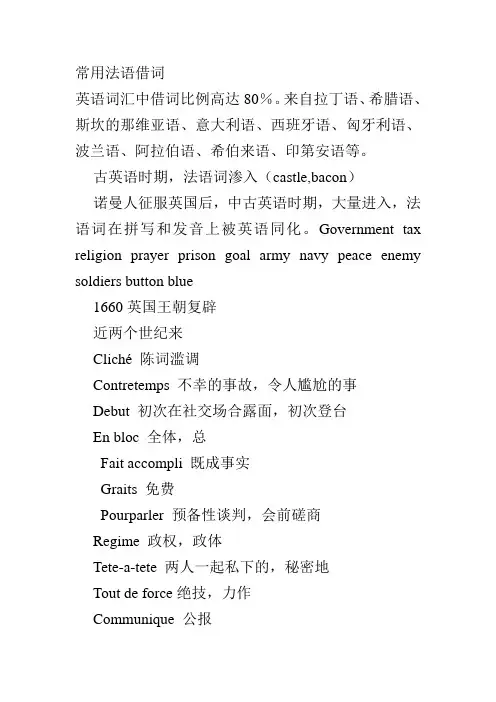
常用法语借词英语词汇中借词比例高达80%。
来自拉丁语、希腊语、斯坎的那维亚语、意大利语、西班牙语、匈牙利语、波兰语、阿拉伯语、希伯来语、印第安语等。
古英语时期,法语词渗入(castle,bacon)诺曼人征服英国后,中古英语时期,大量进入,法语词在拼写和发音上被英语同化。
Government tax religion prayer prison goal army navy peace enemy soldiers button blue1660英国王朝复辟近两个世纪来Cliché陈词滥调Contretemps 不幸的事故,令人尴尬的事Debut 初次在社交场合露面,初次登台En bloc 全体,总Fait accompli 既成事实Graits 免费Pourparler 预备性谈判,会前磋商Regime 政权,政体Tete-a-tete 两人一起私下的,秘密地Tout de force绝技,力作Communique 公报Coup d’etat 军事政变De luxe 华美的,华丽的En musse 全体地一齐地Esprit de corps 团体精神Faux pas 失言、失礼Laissez faire 放任政策,不干涉主义Rapprochement 亲善,和睦Rendezvous 约会,集合Tout a coup 突然地Tout de suite 立即连续的新闻英语的借代(metonymy)Wall StreetMadison AvenueCapitol hill/ the hillThe white houseThe bearThe barThe pressDowning streetThe fleet streetDonkeyElephantThe pentagonIvanJohnUncle SamUncle Tom (slavish person) Scotland YardFoggy BottomDice cityApple cityTar heelThe cityWhite HallMotor cityQuai d’OrsayLionJohn bull主要情报机构Big brotherCompanyInvisible government LanglyMI5MI6时代常用俚语BuckBuddyBingeBustGoofKneejerkJack upRoadhogProfProNukeGo bananasCloutTurfHypeUptightDownscalePoshPoor-mouthTurn onJawboneQuick fix Rubberneck MuckrakerSavvyLowdownSob-stuffNabEgo tripFence-straddler HippiesYuppiesYellow dog contract BugRight on。
浅谈法语和英语中的互借词
浅谈法语和英语中的互借词作者:何怡来源:《校园英语·中旬》2016年第07期【摘要】由于英法两国地理位置毗邻,两国间有着频繁的政治和经济往来。
在此过程中,英语和法语也相互影响,两种语言间不可避免的出现了互借词汇的现象,但语言的借出方和借入方是因时而异的。
本文将结合英法两国发展的历史背景来分析不同时期英法两种语言间所出现的互相借用词汇的现象。
【关键词】英语法语借词语言是一个民族或国家社会和文化生活的反映,两种不同的语言间产生借词现象的前提是两个国家或民族在政治、经济、军事和文化等方面的接触。
正如程倚荣所言:在借词这种语言现象中,非语言因素起很大作用。
从一种语言向另一种语言借用了什么词,可以看出讲这一种语言的民族向另一个民族学习了什么。
英法两国地理位置毗邻,历史上两国交战频繁,而两国王室贵族通婚时有发生,两个民族在各领域的频繁接触导致英法两种语言中出现大量的相互借词现象。
本文拟从历史原因来浅析英法两种语言中的互借词现象。
一、英语向法语借词回顾英语发展的历史,在其发展过程中曾受到法语、拉丁语、意大利语等语言的影响,并向其它语言借入了大量词汇。
在英语的借词中,与其它来源的借词相比,从法语借入的词汇对英语词汇影响巨大,在英语的形成和发展过程中发挥了重要作用。
在英语发展史上,法语词汇的大量借入主要在中古英语时期及18世纪启蒙运动时期。
1.中古英语时期法语词汇的借入。
1066年法国诺曼底的威廉公爵打败英格兰国王,成为英国国王。
此后几百年间,法国人统治着英国,诺曼人占据了教会和政府的一切重要职务。
法语成为英国的官方语言,而且英国上层社会也使用法语。
当时,会讲法语是一种社会地位及个人素养的标志。
在普通民众中,出于职业或生活上的需要,很多人都会讲法语和英语。
这一时期,由于法语的绝对优势地位,大量法语词汇进入到英语中,涉及到政治和社会生活的各个领域,如:government(政府),prince(王子),noble(高尚的),court(法庭),justice(审判),combat(战斗),army(军队)等。
汉语_法语中英语借词之比较
摘要英语作为一种强势语言进入到汉语和法语中,两种借入语本身的差异决定了对英语借词的接受也会有所不同,本文从不同角度对英语借词的借入进行比较研究。
关键词英语借词法语汉语The Comarison Loanword from English in Chinese and French//Xue Jing,Chen JiayinAbstract As a dominant language,English has been borrowed by Chinese and French.The diffrences between these two languages decide the diffrent acception of loanwords from English.For this reason,we compared and analysed the loanwor-ds of Chinese and French from divers points of view.Key words loanword from English;French;ChineseFirst-author's address School of Foreign Languages,Heibei University of Technology,300130,Tianjin,China1引言借词,又称外来词,是从其他语言引进的词汇。
任何一种语言多多少少都会吸收其他语言的词,成为借入语言;反之任何一种语言也会借出其他的词,成为借出语言。
在众多语言中,英语作为一种强势语言进入到其他语言,然而由于接受语言的特点和语言文化背景的不同,英语借词进入的情况也千差万别。
本文着重比较汉语和法语这两种语言对英语借词的接受状况。
2英语借词在汉语和法语中的出现时间由于地域差异,一些英语词出现在汉语中是在明末清初的时候,西方传教士把西方的文化传入中国,英语词也随之而来。
英语中的法语借词
英语中的法语借词摘要:词汇学,作为语言学的一个分支,比过去起着更加重要的作用。
长期以来,英语和法语互相影响,不断从对方假借和吸收词汇,以丰富本语语言。
目前,随着英语在全球的广泛使用,它对法语的影响仍然在不断增强。
但是,有关法语词汇的英语著作很少,而有关法语中的英语外来词的著作更少。
本文主要研究英、法两种语言之间的借用的历史和所依附的社会背景以及一般借用方式和法语教学中的英语借词,帮助以法语为第二外语的英语学习者利用已有英语知识扩大法语词汇量和提高阅读速度。
这篇论文不仅有利于法语学习者和教学者,而且也为进一步研究法语中的英语借词开拓了新的领域。
关键词:英语;法语;借词;借用On English Loan Words in FrenchMAI HuameiAbstract: Lexicology,as a branch of linguistics, is becoming even more important than in the past. English and French have influenced each other in terms of their mutual word borrowing and enrichment over history. At present, as English is widely used all over the world, its influence on French is still on the rise. Nevertheless, there are few English works about French vocabulary, let alone those about English loan words in French. This paper focuses on the history, social background, general methods of word borrowing by French from English, and the learning and teaching of English loan words in French in an attempt to help English learners who take French as their second foreign language to make full use of English vocabulary to enlarge their French vocabulary and improve their reading skill. The research has opened a new area for the further study of English loan words in French and will be helpful to both the learners and the teachers.Key words: English; French; loan words; borrowing1. Introduction1.1 Significance of the studyAt present, an increasing number of English learners are taking French as their second foreign language. However, due to the similarities and differences between English and French, the English knowledge they have learned will inevitably exert both positive and negative influences on their French learning in which vocabulary plays a significant role. The value of the study is vividly indicated in the following remark by Wallace (1982: 9; cited in Zhang 2004: preface), “… there is a sense in which learning a foreign language is basically a matter of learning the vocabulary of that language. Not being able to find the words you need to express yourself is the most frustrating experience in speaking another language”. Just as a building can not be constructed without the building materials, no language is conceivable without vocabulary. As vocabulary plays such an important role in language, it is important to have some knowledge of it.As English and French have influenced each other in terms of their mutual word borrowing and enrichment over history, English loans play a very important role in French. Moreover, lexicology, a branch of linguistics concerned with the vocabulary of the language with respect to words and word equivalents (an idiom or a set phrase), is becoming even more important than in the past. This paper focuses on the social backgrounds and general methods of English loans in French in an attempt to facilitate the learning of French language. Hopefully, the English learners who take French as their second foreign language can take advantage of English vocabulary to enlarge their French vocabulary and improve their reading speed and skills.1.2 Literature reviewIn French, lexicology as “a new science” occurred in the 1960s. Since then, this science has fulfilled great achievements in France, and there are a large number of works about vocabulary in French (Cheng 2002: 9). Nevertheless, there are few Chinese studies on French vocabulary, and English works less. Worse still, among those few works, the researches the authors have done are superficial and lack of supporting and guiding theories. That is, those papers are simply the accumulations of some English loans in French in certain fields, but few suggestions are given to the learning of English loans in French, though they have covered the social backgrounds, the causes and the uses ofEnglish loans in French.1.3 Structure of the paperThis paper is divided into four parts. Part 1 is an overview of the loan words in French. Part 2 focuses on the causes of English loans in French, which include the communication between English and French and the influences from England as well as America. Part 3 discusses the methods of borrowing based on the relevant theories. Part 4 discusses the English loans in French language learning. Part 5 makes some suggestions and concludes the thesis.2. History of English loan words in French2.1 Two definitionsBefore a further discussion on the topic, it is important to have a clear understanding of the following definitions.2.1.1 Definition of Loan WordsLoan words are words adopted by the speakers of one language from a different language (the source language). A loan word can also be called a borrowing. The abstract noun borrowing refers to the process of speakers adopting words from a source language into their native language. "Loan" and "borrowing" are of course metaphors, because there is no literal lending process. There is no transfer from one language to another, and no "returning" words to the source language. The words simply come to be used by a speech community that speaks a different language from the one they originated in (Kemmer 2001-2007).2.1.2 Definition of borrowingBorrowing is a consequence of cultural contact between two language communities. Borrowing of words can go in both directions between the two languages in contact, but often there is an asymmetry, such that more words go from one side to the other. In this case the source language community has some advantage of power, prestige and/or wealth that makes the objects and ideas it brings desirable and useful to the borrowing language community (Kemmer 2001-2007).2.2 Loan words in other aspectsTo have a better understanding of loan words, it is of vital importance to get some knowledge of the origin of French language and loan words from other languages.2.2.1 The origin of French languageIt is generally believed that the French language was established in the 9th century with the publication of Strasbourg Declaration which is the first document to be written in French. The French language originally consisted of Crow, Celtic, and French words. Hence, some words, such as boilean, fauteuil, etc, originated from Celtic, can not be taken as loan words, and the year 842 AD is the dividing line of those words and loan words.2.2.2 Loan Words from other languagesFrench has adopted words from a great number of languages, the major ones being Latin, Old Greek, Italian, Arabic, Portuguese, Spanish, German, English and Eastern languages. Throughout its history, the French language has adopted a vast number of words from various sources.From Latin (Latin on the left, French on the right): corium ~ cuir (leather), præfati ~ preface (preface), fabrica ~ fabrique (factories);From Greek (Greek on the left, French on the right): oikonomia ~ économie (economy), polus+glôtta~polyglott (multilingual), mêkanê ~ mécanique(mechnical);From Italian (the italic words are Italian ) : un maestro (master), à cordes (string), des confettis.From Arabic (the italic words are Arabic ) : smala (families, portable property).le souk (the market)From Spanish (the italic words are Spanish) : sieste(nap), sierra(mountains), picarnos (comedies)From German (the italic words are German) : bocks (beer), kitsch (drama), schuss (straightforward).2.2.3 Stages of borrowing by FrenchThere are three climaxes of loan words in the course of French historical development.The first one is the Renaissance, during which French borrowed a substantial number of words from Latin, Greek and Italian.The second climax is the Enlightenment (period in the 18th century in Europe when some thinkers and writers believed that reason and science, not religion, would advance human progress). At that time, French people were attracted by English monarchy and extremely admired the bourgeois political reforms and industrial revolution. Therefore, the French language imported a large number of English words.The third climax is the 20th century, especially after World War I, when French borrowed a considerable amount of vovabulary from English, especially American English.2.3 Significance of loan words from English2.3.1 English in Modern FrenchEnglish has shown the greatest influence on contemporary French, and English vocabulary accounts for the largest proportion of all loan words in French. According to French lexicographer Jean Dubois, about 50% of the loan words in Modern French Dictionary are from English (Cheng 2002: 92). Nevertheless, V oir, who teaches French lexicology in Grenoble Literary University, holds that 50% is a little conservative, and that English loan words take up 80% to 90% of the loan words in French. Obviously, their estimations are quite different, but there is something in common: English loan words are of vital importance in modern French, and it is necessary to do some research on them.2.3.2 Large numbers of English loan words in FrenchHow many English loan words have actually been adopted by modern French? Until now, there is no exact statistics to show it. Because different lexicographers have different standards for loan words, it is very difficult to count the number of English loan words which have been adopted by dictionaries.Someone did a survey in 1959, and found that French borrowed 369 English words from 1900 to 1939 (Cheng 2002: 94).A linguist named Strikla had a research on the Americanization of the language of French commercials from 1910 to 1961, and estimated that the frequently used English words in French were as many as 1300 (Cheng 1982: 32).Based on the French lexicographer Louis Guilb ert’s estimation, in 1949 to 1960, LePetit Larousse Dictionary adopted 191 loan words, of which 105 derived from English (about 55%) (Cheng 2002: 94).In fact, as long as one pays attention, he will find English loan words almost everywhere in France, such as in the newspapers, magazines, broadcasts, fictions and so forth, especially in news, commercials and scientific publications.The issue of Le Nouvel Observateur (a newspaper named Observer) published on August, 1, 1980, was read and about twenty English loan words appeared in less than ten pages. Besides, the new commercial center called La Grande Place (the large market) in Grenoble city was surveyed on the names of its shops. Among the 50 new shops, English names were used in 17 of them. All these show that English plays an important impact on the language of French commercial advertisements.J. Thevenot once mentioned that, “Due to self-defect and going after fashion, French people speak, write and draft advertisements in English even more than in the past” (Cheng 1982: 31-36). Those examples are related to daily life. Actually, English words are even more common in the fields of science and technology, especially in the fields which Americans get the upper hand. For instance, most of the technical terminology in oil industry is from English, and almost all the French sport vocabulary comes from English :match,tennis,software,sonar,boxing ~boxe,packet-boat ~ paquebot, detective ~ detective (English on the left, French on the right), etc.3. Causes for loan words in French3.1 Communication between French and English in historyThe study of the historical development of the French vocabulary should not be treated in isolation from the growth of the French language itself. The development of science, the rapid changes in society, the receptive and flexible nature of French with regard to the influence of other cultures and languages -- all these have resulted in a dramatic increase in vocabulary, a growth which in turn contributes to the richness and resourcefulness of the French language. Just as Paul Lafargue who had done research on the French language during the French Revo lutionary in 1789, said that, “In order to look for the cause of linguistic phenomenon, it is essential to know and understand the social and political phenomena. Linguistic change is simply the result of social and political changes” (Cheng 2002: 92-99). Historically, the English language and the French language have borrowed a considerable number of words from each other.The French language began to have an effect on the English language in the 11th century. Under William of Normandy (known as William the Conqueror), Norman invaders from north France crossed the English channel in 1066, and defeated the English army. William took the English throne, controlled all the lands, churches and power of England, and the English language was looked down upon. Since the French-peaking Normans were the ruling class, French was used for all state affairs and for most social and cultural matters, and became the official language. According to the statistics, about ten thousand French words were imported into English in the whole medieval century (1100-1400) (Zhao 1999: 47).In the early Middle English period (from 1066 to 1250), the French loans in English were principally from the Norman dialect in Northern France, concerning with governmental administration, military, religions, laws and chivalry.In the late Middle English period (from 1250 to 1400), the French loan words directly came from the central region of France. Because of the trade exchange and the war between England and France for about more than one hundred year (from 1337 to 1453), the two peoples had a closer contact with each other, so French loans were found in every section of English vocabulary.During the Renaissance (from 14th to 16th centuries), English borrowed a lot of French words used in ar t and fashion. In the 1640s, Charles I’s attempt to overrule parliament led to a civil war, and he was executed. In 1660, Charles I’s son who escaped to France for more than ten years was restored to the throne as Charles II. He brought the popularity of the French language and even the Gallicizing Movement in both language and thinking.3.2 Influences from EnglandAt the end of the 17th century, a revolution broke out and a constitutional monarchy was established in England. Marx regarded the revolution as the emergence of a new political system in European society as well as the victory of the fight against feudalism. Under such historical background, French imported a considerable number of English words which were related to parliament and political life.In the 1760s, the Industrial Revolution first broke out in England. At that time, the economy and the politics of England were strengthened, so the English language occupied a dominant place in French. As the Industrial Revolution enhanced the crazy growth ofEnglish loans in French, many words imported were related to industry, sports, fashions, and so on. For instance: vote, bill, rifle, tank, raid, jeep, automation, festival, etc.3.3 Influences from AmericaAt the end of the 19th century and at the beginning of the 20th century, England lost its dominant place in industry, while America ranked the first in the field of electricity, automobile, petrol, chemistry, and rubber.Since World War II, the United States has become literally the leader of the western world and one of the superpowers contending for world hegemony. At the same time, it is involved in endless political, economic, and military strives. At home the country has seen rapid progress in science and technology, and startling alterations in modes of life, while social problems have kept cropping up. As a result, thousands of new expressions and new meanings for existing words have come into existence (Zhang 2004:215).Especially, when America carried out the Marshall Plan in France, some French industries and companies were attached to American financial groups, and the French market was full of American products and works of art. In this case, the “English Craze” occurred at the beginning of the 20th century was much more widely spread, and English loans occurred in every field.Moreover, many people in European countries admired and were looking forward to the American life style. As the American life style became popular in France, many words expressing the life style were also introduced to French, such as snack-bar, fruit, bar, banquet, job, etc. French linguist P. Guiraud said that, “The Americanization of our language is the result of our following Americanization.” The status of a language depends on the status and influence of the language-speaking country in the international politics, economy, culture, science and technology, etc, not only related to the language itself. American linguist Bloomfield had analyzed this phenomenon, and pointed out that, “The cultural loan words tell us what one nation learns from another nation” (Cheng, 2002: 92-99).4. Methods of borrowingThe French vocabulary consists of different kinds of loan words, which may be classified by different criteria: by the degree of adoption, the necessity of borrowing, the ways of borrowing. In this section we will concentrate on the ways of borrowing, such asdirect borrowing, semantic translation, and borrowed word-formation.The English loan words have to adjust to French rules after they are adopted. That is, they have also experienced the course of Francisation. Some loan words change their pronunciations or spellings, while others borrow the meanings or word-formation.4.1 Direct borrowing4.1.1 English spellings with French pronunciationAt the beginning, most English loan words were directly introduced into French through newspapers, books, broadcast, and television. As for these words, French people made no change in the spellings, but would pronounce them in the French way. The examples are as follows (English pronunciation on the left, French pronunciation on the right):computer[kɔmpju:tə] ~ [kɔp yte], log[lɔg] ~ [lɔʒ] , budget[bʌdʒit] ~ [bydʒε], commercial [kəmə:ʃəl] ~ [kɔmεrsjal], album [ælbəm] ~ [albɔm], etc.4.1.2 English pronunciation, but spellings modified to FrenchThere are some words borrowed from English with little modification in spellings, but their pronunciations are also similar to English pronunciations. The examples are illustrated as follows (English on the left, French on the right): committee[kəmiti] ~ comité[kɔmite], journalist[dʒə:nəlist] ~journaliste[ʒurnalist], beef-steak[bi:fsteik]~ bifteck[biftεk], roast-beef [rəustbi:f] ~ rosbif[rɔzbif], cheque[tʃek] ~chèque[ʃεk], bowling-green[bəu liŋgri:n] ~boulingrin[bu lεg rε], boule-dogue[buldɔg] ~ bulldog [buldɔg].4.2 Semantic translationSometimes, French borrows neither English pronunciations nor spellings, but just its meanings. There are three ways to borrow the meanings.4.2.1 Semantic extensionFirstly, French people endow the original French words with new meanings borrowed from English. For instance, French word réaliser which originally only meant “to know” borrowed the meaning of “realize” from the English word realize (Cheng 1982:34); French valable originally only had the meaning of “acceptable”, but later it borrowed the meaning of “valuable” from English (Zhang 1992:41); contrôle only meant “to examine”in French, but now it has the meaning of “to control” from the loans of control in English (Zhao 1999: 50).4.2.2 New words for new conceptsSecondly, some English loan words are introduced into French directly in case of emergency, but later they are replaced by new French words created according to English meanings. The people who insist on the purification of the French language highly recommend this way to resist the direct borrowing from English. These newly created words and their corresponding English words appear at the same time in the dictionaries. For instance (English on the left, French on the right) (Zhao 1999: 50):(1) Industry: trimmer ~ garnisseur/ajusteur/dégrossieur, pipeline ~ oléoduc,padding ~ rembourrear, bull-dozer ~ excavatrice, pick-up ~ capteur,lash ~ nouvelle-brève/nouvelle-éclair, pressing ~ repassage/nettoyage, etc.(2) People: supporter ~ partisan, gangster ~ bandit, brain trust état-major,leader ~ chef, staff ~ service d’état-major, etc.(3) Action: score ~ cote, kidnapping ~ rapt, standing ~ niveau de vie,shopping ~ emplette, strip-tease ~ déshabillage, club ~ cercle,planning ~ programme/ plan, etc.4.2.3. Borrowing both meanings and inner structuresWith the French materials, the French language borrows both meanings and the inner structures from English. For instance (English on the left, French on the right): parking~ parcage, skyscraper~ gratte-ciel, businessman~ homme d’affaires, honermoon~ lune de miel, brain washing~ lavage de cerveall,birth-control~ contrôle des naissances, cover-girl ~ fille-couverture, man in the street ~ homme de rue, table tennis ~ tennis de table, and so forth.By this means, the French Science and Technology Association organized the French Research Center of Terminology to coin a large number of these words as follows (English on the left, French on the right):marker~ marqueur, reforming~ reformage, tracking rader~ rader depoursuite, check coil ~ bobine d’étouffement, jet-plane ~ avion à réaction, data processing ~traitement de données, launching base ~ base de lancement, etc.4.3 Borrowed word-formation4.3.1 Borrowed suffixesAs English loan words occupy a great percentage of loans in French, the rules of word-formation, which define the scope and methods whereby speakers of a language may create new words, also permeate the system of the French language. Consequently, the English methods of word-formation were also borrowed. For example, French coined words with English characteristics through borrowing the suffix -ing. Based on the survey done by Micro Roper Dictionary and Small Hu Rafah Dictionary(Zhang 1992: 42)published in 1972 and other magazines, there were 160 English loan words with the suffix -ing concerning daily life, industry, agriculture, medical care, teaching: baby-sitting, briefing, punching-ball, starting-block, dumpling, marketing, quick-freezing, dry-farming, water flooding, recording, landing, etc.Those loan words with the suffix of -ing usually indicate that an action is in progress, or it can not be finished until a series of procedures, or it is the result of an action or the name of a machine(Zhang 1992: 42). Nevertheless, as time goes by, the English suffix -ing was given new meanings by French, as in pressing, camping, dancing, parking, sleeping which also mean the places where those actions take place. Besides, some words which do not exist in English are coined with the English suffix -ing, for example, caravaning (travel trailing), footing (walking), training (clothing for training), and so forth (Zhao 1999: 50).4.3.2 Borrowed word order of compound wordsGenerally, French compound words are in the order of the main word followed by the restrictive constitutes. For example,porte-plume,salle àmanger, maison de campagne. However, English compound words are in the order of the restrictive constitutes followed by the center word. Just take the English words corresponding to the above French words as an example, pen holder, dining-room, country house. However, as French compound words are influenced more or less by their English counterparts that permeate French in a considerable number, some fashionable compound words with English word order appeared, such as, auto-école(school of automobiles), autoroute (express way), Paris-Transport (Paris Transport Company), etc (Zhang 1992: 42).5. English loans in French language learning5.1 Attitude of French governmentAs more and more English loan words are introduced into French, some people in France are against their use. An organization called l’Academie Française (French Academy) was set up in 1635 to protect the purification of the French language. In the 18th century, those who insisted on the purification of French were against the English craze. Until the 20th century, some French scholars still opposed the invasion of English loan words, and attacked American linguistic imperialism. Among their activities, the most influential one was Parlez-vous franglais (Do you say Anglicisms?) written by famous French linguist Rene Etiemble on January 4th, 1976.Under the pressure from those who insisted on the purification of French, the French Parliament enacted a law “to defend the French language”, which definitely set the following rule: French must be used in the naming of shops, job-interviews, the instructions of products, written or oral advertisements. Since the ordinance No.72-19 had already approved some terminologies to enrich the French language on January 7th, 1972, loan words must not be used any more. The rule is in force to all except the programs and commentaries intended for the foreigners on the TV, radio broadcast, or some special products with the household name, which must be called by loan words (Zhang 1992: 39).Out of national self-esteem and the maintenance of the French purification, the rule was decreed. It played some role in stopping the use of English loan words, but it could not prevent the fusion of French and loan words. Moreover, in the French society which carried out the policy of national independence, the French language would not be assimilated by the large number of English borrowings. Just as Stalin put it “Th e fusion of language can not be taken as a result from a fatal activity, but it is the long-time process which extended for several hundred years” (Zhang 1992: 39-40).5.2 Inevitable use of English words in FrenchIndeed, the interference with language from the government or official administration is often in vain, because language simply follows its own rules. For example, although the official administration once suggested to use restauration rapide to take place of fast-food, telecopie for fax, parquage or parc de stationnement for parking, camprisme for camping, pressage for pressing, etc, the efforts were in vain,because manypeople prefer to use the latter words from English. Borrowing is a very normal phenomenon, and it must follow its own rules. Although other non-language factors may play an important role on borrowing, the administrative measures can not control the fate of loan words. In addition, nowadays, as English is widely used all over the world, its influence to French is still on the rise.5.3 English loans in French learning5.3.1 English loans in learning French vocabularyBecause both English and French belong to the Indo-European Family and borrow from each other, their vocabularies are similar in spellings and meanings. Hence, their similarities provide a favorable condition for Chinese learners to enlarge their French vocabulary. Many books on French vocabulary also take advantage of the English loan words to facilitate the learning of French words. Take these two books Vocabularie de Tef AccéléréSurhumainement and Vocabulaire de Français Universitaire Niveau I-IV AccéléréSurhumainement as examples, they offer the shortcut to help learners to remember French words by means of their similarities to English.Moreover, as for some French words borrowed from English without any change in spellings and meanings, one can consult an English dictionary and understand them in the English way, such as the words used in high technology which may not be found in a French dictionary.5.3.2 English loans in improving readingBesides vocabulary, making full use of English loan words can also be of great use to learner’s reading. With their imagination and the association of English vocabulary, they can easily guess the meaning of French new words. This training of vocabulary comparison can not only activate learner’s interest and improves their reading speed as well as study efficiency, but also enlarges their vocabulary and scope of knowledge.6. Suggestions and conclusionAccording to the recent study done by French linguist Henriette Walter in his book L’Aventure des mots français venus d’ailleurs, “Among th e 60,000 words in French vocabulary 8,600 are loan words. If the number of words is cut in 35,000, then there are。
英语中的法语借词研究
英语中的法语借词研究英语与法语有着密切的历史和文化,这种在语言上也有所体现。
英语从法语中借用了许多词汇,这些借词在英语中广泛使用,为英语词汇库增添了丰富的色彩。
本文将对英语中的法语借词进行深入研究,探究其特点、来源及历史背景。
一、英语中的法语借词特点1、拼写变化英语中的法语借词在拼写上往往发生了变化。
例如,法语中的“beau”在英语中变成了“beautiful”,法语中的“rendezvous”在英语中变成了“reunion”。
这些变化使得这些借词在英语中看起来更像英语词汇,但它们仍然保留了法语的发音和意义。
2、常用词汇英语中的法语借词多为常用词汇,如“delicieux”(美味的)、“premi ère”(第一的)等。
这些词汇在英语中广泛使用,已经成为英语不可或缺的一部分。
3、涉及领域广泛英语中的法语借词涉及领域广泛,包括政治、军事、文化、艺术、食品、时尚等多个领域。
这些借词为英语提供了更多精确和生动的表达方式。
二、英语中的法语借词来源1、诺曼底征服1066年,诺曼底公爵威廉征服英格兰,将法语作为官方语言。
这一历史事件使得大量法语词汇进入英语,丰富了英语词汇库。
2、贸易和外交贸易和外交也是英语中的法语借词的重要来源。
在国际贸易和外交交流中,英语往往需要借鉴其他语言来表达某些概念或思想。
3、文化和艺术英语中的法语借词还来源于文化和艺术领域。
例如,英文中的“ballet”就源自法语中的“ballet”。
三、英语中的法语借词历史背景法语对英语的影响可以追溯到公元1066年,诺曼底公爵威廉征服英格兰,将法语作为官方语言。
这一历史事件使得大量法语词汇进入英语。
在此之后,随着贸易、文化和外交交流的不断发展,英语中的法语借词也不断增加。
四、结论英语中的法语借词历史悠久,涉及领域广泛,为英语词汇库增添了新的元素。
这些借词在英语中经过本土化改造,已经成为了英语不可或缺的一部分。
通过深入研究英语中的法语借词,我们可以更好地理解英语的发展历程和法国文化对英国文化的影响。
法语中借词的大概情况 (中法对译)
讲解:第6组全体人员 Lydie
什么叫借词(emprunt lexical):
借词,又称外来词, 指从外国语言和本 国其他民族语言中连音带义吸收来的词语。
match 竞赛 (英语,1827) longane 龙眼 (汉语,20世纪初) tomate 番茄 (西班牙语,1598)
法语中借词的发展史
借词的作用
• 是法语词汇的重要组成部分:法语中大量 的音乐美术词汇来自意大利语,几乎全部 体育词汇来自英语; • 丰富和发展词汇的重要手段之一; • 影响法语的纯洁性与规范性;(Eliètte) • 与本国社会生活的关系。
• 历史上, 法语曾先后受到拉丁语、古希腊语、 意大利语、阿拉伯语、葡萄牙语、西班牙 语、德语、英语及东方语言的影响, 在现代 法语中存在着大量的来自这些语言的借词, 其中也包括借自汉语的词汇。 • 借词的法语化——Blandine • 来自拉丁语和希腊语的借词以及除英语汉 语外的借词——Lydiane • 来自英语的借词——Gislaine • 来自汉语的借词——Mathilda
Il y a le phé nomè de la coexistence et de ne la concurrence entre les deux mots.
la fonction de l’emprunt
• Une partie importante du vocabulaire franç ais: de nombreux mots musicaux et artistiques sont originaire de l’italien, et presque tous les mots sportifs sont de l’anglais. • L'un des moyens les plus importants pour enrichir et développer le vocabulaire;; • Influencer sur la purété et la normativité de la langue franç aise; • La relation avec leur vie sociale.
共用和互借视域下的英语词汇与法语词汇
共用和互借视域下的英语词汇与法语词汇摘要:由于英法两国的位置距离较近,并且两国之间有频繁的政治、经济往来,两国的语言文化也存在一定的相似、共用之处。
英语和法语词汇的共用和借用现象给具有英语基础的学生学习法语提供较大的便捷,但是词汇的借入方和借出方的使用是根据实际情况变化的,鉴于此,本文对英法词汇的使用做详细的剖析。
从词汇共用和词汇互借的现象入手,从多方面分析法语和英语词汇的共用和互借现象。
关键词:共用、互借、英语词汇,法语词汇前言:语言是一个国家或者一个民族的文化结晶,是对其文化和生活的反映,两种不同的语言在使用方面存在共用、互借的现象,证明两国的地理位置较近,文化生活等方面存在相似之处。
英语是目前学习人数最多的语言,法语曾经是世界上第一语言,在二战以后两国的语言方面存在一定的交融和互通,根据词汇的构成来看,二者之间存在较多的关联现象,从英、法两国出版的书籍、报刊等情况均能找到异曲同工之处。
,部分词汇不仅词意相同,而且拼写方法也一样,部分词汇的读音相差也不大,这就造成英法词汇的互借共用现象。
一、词汇共用和互借的现象1、词汇的共用现象外来同源词汇的共用指的是,外来语的词源的词汇在英语和法语中的向同性的借词构成,例如,共同产生于古拉丁语的flame(火焰)、视像(vision)、domain(主导)等词语;共同产生于zigzag(曲折)、exercise(练习)等词汇;共同产生于汉语的Japan、Korea等词汇,这些词汇都表明部分外来语言的词汇在英语以及法语的使用中以相同的形式被借用。
英语和法语词汇中有部分共用词汇是按照各自的语言拼写体系呈现出相同的表达意思,这些词汇在英语和法语中按照各自词汇的构成形成具有规律性的后缀,形成相对规范的方式[1]。
鉴于此,掌握越多关于两种语言的构成规律对语言的学习有积极的促进作用。
例如在-er,-ir等词汇的结尾是法语的动词标志,但是英语的动词结尾没有清晰明显的规律,掌握这方面的知识能够促使学者将英语和法语共用的词汇自由的切换。