
【范文】7B Unit 3Finding your way(Main Task) 学案
7B Unit 3Finding your way(Main Task)
学案
预习学案7BUnit3(mainTask)
一﹑预习要求:
.
掌握下列单词音﹑形﹑义:farewell,barbecue,picnic,invite,exit,everybody,c omplete,note,page,yoursfaithfully,monitor,signature.
2.
认真阅读课本P51页thequestionnaireandtheresults。
找出其中有用的表达式。
3.
认真阅读P52aninvitationletter,掌握大意,填出缺失的信息。
基本能背诵。
找出其中有用表达式。
4.
尝试根据课文写一封邀请信邀请你的朋友来参加你组织的英语晚会。
二﹑预习测试:
(一)翻译下列词组:
﹑组织一次欢送会___________________2﹑吃烧烤______________________________
3﹑野餐_____________________________4﹑吃快餐
______________________________
5﹑一半的学生_______________________6﹑中国银行____________________________
7﹑完成这封信_______________________8﹑缺失的信息__________________________
9﹑很高兴做---_____________________10﹑邀请你参加欢送会____________________
1﹑在公园门口集合_________________12﹑带他们自己的饮料____________________
3﹑玩不同的球类游戏_______________14﹑在下一页上__________________________
5﹑怎样到阳光公园_________________16﹑四班班长____________________________
7﹑去上海的路线___________________18﹑乘地铁______________________________
9﹑在A出口出来___________________20﹑向左拐______________________________
21﹑横穿中山街_____________________22﹑在拐角处____________________________
23﹑径直往前走_____________________24﹑走过中国银行大厦____________________
25﹑参加欢送会_____________________26﹑划掉
________________________________
(二)根据P52页邀请信回答下列问题:
.
wherewill
theyholdtheparty?
2.
onwhichdaytoholdtheparty?
Andwhatdayisit?
3.
wherewilltheparents,teachersorclassmatesmeet?
4.
whatwouldtheparents,teachersorclassmatesliketobring?
5.
whatwilltheparents,teachersorclassmatesdointhepark?
6.
whatshouldtheparents,teachersorclassmatesdoiftheyca ncometotheparty?
7.
whatdoesthemapshow?
8.
whatdoesthestudentshope?
9.
whowrotetheletter?
0.
Howcantheteachers,parentsandclassmatesgettotheSunsh inePark?
(三)注意下列句型结构的理解:
A:wearehappytodosth.
我们很高兴做-----
.
在这儿我们感到很高兴。
2.和你一起去爬山我感到很高兴。
互动学案7BUnit3
一、用所给动词的正确形式填空:
.
wouldyoupleasefollowme____________________intothepa rk?
2.
I__________________youwhenIgettoBeijing.
3.
Hisfather________________ushometheday
beforeyesterday.
4.
Hefailed___________________therebefore5o’clock.
5.
Iamtootired,
I’dliketostop_______________abreak.
6.
He_____________________thebusbecauseitrainedheavily.
7.
when____________we______________?Idon’tknow.Theteacherwillletusknowitsoon.
8.
Theboywasverysurprised__________________hisfatherat theoffice.
9.
whynot______________________ourEnglishteachertothep arty?
0.
He________________offthewallandpushedthedooratonce.
二、完成下列句子:
.大家到齐了吗?______________
_______________
_________________?
2.一半的学生更喜欢吃野餐,而不喜欢吃烧烤。
_______
_______thestudents_______
_________
apicnicto________abarbecue.
3.你要来点喝的吗?wouldyoulike_______________________
________________?
4.你能告诉我如何到公共汽车站吗?
canyoutellme__________
______________
___________thebusstop?
5.我不认得去故宫的路。
⑴Idon’t_________
___________
__________
___________thePalacemuseum.
⑵Idon’t_________
___________
_____________________atthePalacemuseum. 6.请完成下一页上的表格(table)
Please____________thetable__________
______
________
_________
7.要去长城这个孩子很高兴。
Theboyisveryhappy________
_________to___________
_________
_________。
英语7 B Unit 3 Finding your way Welcome to the unit and comic strip(一等奖)
If you have lots of money and time, would you like to go there?
On the top of the hill.
Go down here! Is she afraid? 害怕 Can you go after her? follow
north-east
west
east
south-west
south
south-east
outh . In autumn, birds will fly to the s____
In spring, birds will fly back to orth . the n____
The sun goes up in the e____ ast .
The sun goes down in the w____ est .
A: Where is our school? B: It is south-east of the City Sitting Room. N
W
E
S
The Sunnyside Garden
the Zoo
The Lake Park
4
On the map, we will also see the signs of the transport(交通).
The Sunnyside Garden
the Zoo
the KFC
The Theatre
The Lake Park
A: Let’s go to the zoo. B: OK. We can go by bus.
江苏地区牛津初中英语学科7B Unit 3 Finding your way 教案 江苏教育版
“south” and so on. Step 2. Presentation Ask Ss some questions about the article. 1. What did Kitty and Simon do at lunchtime? 2. Who are the two boys? Let Ss read the title and the first Para., and then answer the questions. Play the tape from Line 1-15. Let them find what the boy did and who is their friend. Check the answers and then read after the tape. Step 3. Find the clue words. Let students go through the text as quickly as they can. For 1 minute then ask them to close the books. What word flashes on their mind, and make them speak out. e.g. robbers, uniform, police, green van, knife, building, etc. Write down these words on the Bb, and let Ss imagine
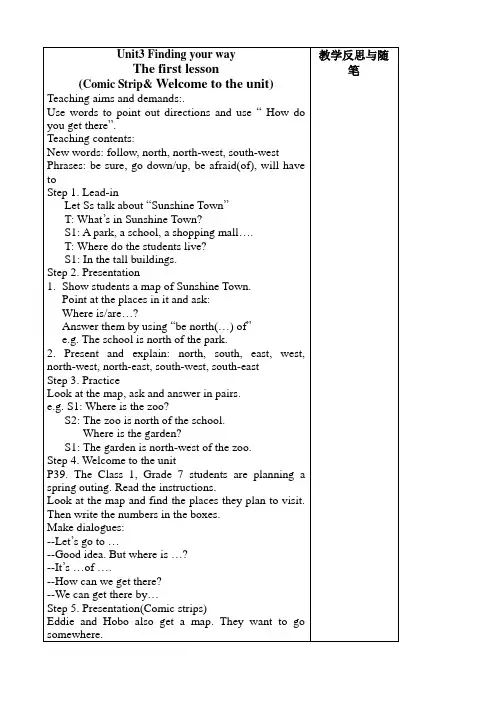
Let Ss talk about “Sunshine Town” T: What’s in Sunshine Town? S1: A park, a school, a shopping mall…. T: Where do the students live? S1: In the tall buildings. Step 2. Presentation 1. Show students a map of Sunshine Town. Point at the places in it and ask: Where is/are…? Answer them by using “be north(…) of” e.g. The school is north of the park. 2. Present and explain: north, south, east, west, north-west, north-east, south-west, south-east Step 3. Practice Look at the map, ask and answer in pairs. e.g. S1: Where is the zoo? S2: The zoo is north of the school.
(整理版)7B Unit 3 Finding your way

7B Unit 3 Finding your way一、根底词汇名词(n.)1. 北方_______________2. 西北方_____________3. 西南方____________4. 通话_______________5. 抢劫者_____________6. 警察______________7. 制服_______________ 8. 小刀〔复〕__________ 9. 路线______________10. 交通______________ 11. 灯,灯光___________ 12. 十字路口 ________13. 拐角______________ 14. 道路_______________ 15. 饭店_____________16. 火车______________ 17. 楼梯_______________ 18. 南方_____________19. 台阶______________ 20. 侧,边_____________ 21. 桥_______________22. 拐弯处____________ 23. 纸_________________ 24. 便条,注解________25. 页码_______________ 26. 班长_______________ 27. 明星片___________动词(v.)1. 跟随________________2. 驾驶_______________3. 推________________4. 失败________________5. 使用_______________6. 起作用,奏效_______7. 停止________________ 8. 跳,蹦_____________ 9. 抓住,捕获_________10. 穿过_______________ 11. 参加______________ 12. 赢_______________形容词(adj.)1. 另一个,别的 ________2. 吃惊的______________副词(adv.)1. 迅速地______________2. 向远处,离开________3. 往右 ___________4. 后来,以后_________5. 突然________________6. 径直____________介词(prep.)1. 沿着________________2. 穿过_________________3. 从…离开_________4. 到…之上____________代词(pron.)1. 每人___________二、重点词组1. 警察局_______________________2. 接到一个 ____________________3. 住在附近_____________________4. 开车去…〔2〕___________________5. 三个穿警察制服的人___________6. 走不同的路线____________________7. 向左拐进 ____________________ 8. 在交通灯处停下__________________9. 迅速逃跑_____________________ 10. 停止讲话_______________________11. 惊讶得看见 _________________ 12. 最后〔2〕______________________三、句型结构1. Justin stopped talking. (stop 的用法)e.g. 1) 昨天一辆卡车在我面前停了下来。
牛津7BUnit3Findingyourway(译林牛津版七年级英语下册教案教学设计)

牛津7B Unit 3 Finding your way(译林牛津版七年级英语下册教案教学设计)Welcome to the unitTeaching aims and demands:New words: follow, north, north-west, south-westTeaching methods: task-based approachTeaching task: 1. To introduce the topic of places and transport.2. To talk about visits and means of transport using model sentences.Teaching aids: tape recorderTeaching procedures:Ⅰ. Warm-up (presentation)Ask the students on duty to give us a short report about the Sunshine Town.Ⅱ. ListeningListen to the tape, answer my question, “Did Hobo, in fact, know the way?” Help the Ss to answer.Listen again, Ss read after the tape recorder, then do some True or False exercises. Check the answers with the whole class.Language points:1. follow me2. go up and downe.g. Let’s go down the hill together.3. Don’t be afraid.e.g. (1) Don’t be late for school.(2) Don’t play in the street. It’s too dangerous.be afraid to do. be afraid of sth.. I’m afraid that+从句e.g. (1) The little girl is afraid to go out in the evening.(2) Little T om is afraid of dogs.(3) I’m afraid that I can’t go with you. I have a lot of work to do.Ⅲ. Main taskIntroduce the topic of place and transport.Ⅳ. Discussion (task)Talk about visits and means of transport using the model sentence ‘---Let’s go to the zoo.---OK. We can go by bus.Language points:1. The zoo is north of Beijing Sunshine Secondary School.north ofsouth, west, north-west, south-weste.g. The library is south of the classroom.The playground is west of the classroom.2. ---How do we get there?---We can go by bus.by air/bus/car/bike/undergroundⅤ.Sum-upGo through the new words and the language points during this lesson.Ⅵ. Homework.Review the contents of this lesson.教后记:7B Unit3 Finding your wayReadingTeaching aims and demands:New words: call, robber, drive, quickly, at once, police, uniform, just, push, van, away, fail, use, knife, work, police station, route, along, right, another, stop, traffic, light, jump, later,suddenly, surprised, catch, in the end, crossroadsTeaching methods: task-based approachTeaching task: 1. Prepositions of movement..2. Simple future tense with “shall” “will”Teaching aids: tape recorder, tapes, slide projector, slidesTeaching procedures:Ⅰ. Warm-upAsk the Ss to give a free talk. .Ⅱ.ListeningNow, list en to the text, please answer the question “Did the robbers run away finally?”Listen again, Ss read after the tape, and do some exercises.Ⅲ. ReadingSs read the articles by yourselves. Do the Exx on Page41and 42. Check the answers with the whole class.Language points:1.nearby=not far awaye.g. I live nearby in the building.2. robber(n.) rob(v.)e.g. The two robbers ran away from the back quickly.3. quickly=fast (adj.) quick (adj.)e.g. She walked quickly away.4. fail失败e.g. Tom failed in his math examination.5. work起作用e.g. Something is wrong with my watch. It doesn’t work..6. route路线take different routee.g. There’s another route you can take to get to the cinema.7. suddenly突然地.e.g. Suddenly I found a big tiger standing in front of me.8.surprised adj. 惊讶地e.g. We are surprised to hear him sing.9.in the end =at laste.g. He passed the exam in the end.10.turn right/left into 7th Streete.g. Don’t tell a lie any more . It’s not good for you.Ⅴ.Discussion (task)Have a discussion about the story.Ⅵ.Sum-upGo through the new words and the language points learnt during this lesson.Ⅶ. HomeworkReview the contents of this lesson.教后记:Unit3 Finding your wayVocabulary ﹠ GrammarTeaching aims and demands:New words: straight, zebra crossing, entrance, correct, corner, road, hotel, cross, across, round, off, onto, train, tunnel, stair, railway, south, step, side, bridge, join, win, cloudy, paper, campfire Teaching difficulties: 1.prepositions of movement2. simple future tense with “will” and “shall”Teaching methods: task-based approachTeaching task: 1.T o learn and know about the directions2.To prepositions of movement to give directions3.To recognize the use of “will” and “shall” and be going to talk about the futureTeaching aids: tape recorderTeaching procedures:Ⅰ. Warm-upHelp the Ss retell the story “A lucky escape”.Ⅱ. Vocabulary1.Ask the students what road signs they know, and list the names of the signs: e.g. turn left, traffic light, turn right, straight on ,crossroads.2. Ask the students to write the names under the pictures.3. Ask them how to read a map and circle the letters of the correct maps.Language points:turn right/left, cross the road, go straight along the road.Ⅲ.Grammar1.Prepostitions of movementWe use prepositions of movement to express movements. Prepositions of movement: across, along, down, from, into, off, onto, out of, over, round, through, to, upe.g. The bus goes to the airport.Simon is swimming across the pool.A train is going through a tunnel.Millie is walking along the road.Kitty is climbing up the hill.Hobo is walking round the table.Work out the rule: We use prepositions of movement after the verbs.Finish off the exercise on Page45.2. Simple future tense with “will” and “shall”We use “will” or “shall” when we talk about: things that will happen, plans that we are making now.e.g. She will be late for the party.We will take the dog to the park tomorrow.We make negative sentences like this:I/We will not/shall not goHe/She/It/You/They will not goWe ask questions using the simple future tense like:Will/shall I/We like go?Will He/She/It/You/They like go?We answer questions like this:Yes, I/we will/shall. Yes, he/she/it/you/they will.No, I/we will not/shall not. No, he/she/it/you/they will not.We can use “be going to” when we talk about:Fixed plans for a certain time in near future.e.g. I’m going to take another route.Things that will probably happen.e.g. It’s so cloudy. I think it is going to rain.We ask and answer questions with “be going to” like this.Am IAre you/we/they going to see the doctor tomorrow?Is he/she/itI am. I am not.Yes, you/we/they are. No, you/we/they are not.he/she/it is. he/she/it is not.Ⅳ. Discussion (task)Have a discussion and find out the differences between the simple future tense and simple present tense.Ⅴ.Homework1. Review the contents of this lesson.2. Do the Exx of the workbook.教后记:Unit3 Finding your wayIntegrated skills and Study skillsTeaching aims and demands:Key points: Cross the bridge and turn rightTake the second turning on the right.Cross the road at the traffic light.Walk past the police station.Teaching methods: task-based approachTeaching task: 1.To recognize key expressions about directions.2.To use key information given instruction and undentify the specific order of them from listening.3. To produce formulatic responses to specific instruction.Teaching aids: tape recorder, tapes, slide projector, slidesTeaching procedures:Ⅰ. Warm-upAsk the student on duty to give a short talk.Integrated skillsⅡ.Finding treasure1.Ask the Ss to study the pictures in Part 1 carefully. Put a tick in the correct boxes. Check the answers and explain.2.Listen to the tape and tell the Ss to do the Exx on Page48and 49. Listen again if necessary. Check the answers with the whole class.Ⅲ. Speak up1.Listen to the tape recording and read after it.2.Ask the Ss to work in pairs to make up a new conversation for giving direction using the conversation in Part B as a model. Ask a few pairs to present their conversations to the whole class.Ⅶ. Study skills ( Making a grammar pattern book)Take the Ss through the text of this page. Have a discussion about the Internet. What does WWW stands for? Do you know any common browser name, some search engines. T alk aboutother key aspects about the Internet.Language points:1.Cross the bridge and turn right2.Take the second turning on the right.3.Walk along a path.Ⅷ. Sum-upGo through the new words and the language points learnt during this lesson.Ⅸ. Homework1. Review the contents of this lesson.2. Do the Exx of the workbook.教后记:Unit3 Finding your wayMain task & CheckoutTeaching aims and demands:New words: farewell, barbecue, picnic, invite, exit, everybody, complete, note, page, yours faithfully, monitor, signature, postcard, footbridgeTeaching methods: task-based approachTeaching task: 1. T o express direction and information in the contest of writing a letter of invitation.2.To check the use of prepositions of movement, the use of “will” and “be going to” to talk about the future giving of direction.Teaching aids: tape recorder, tapes, slide projector, slidesTeaching procedures:Ⅰ. Warm-upAsk the student on duty to give a free talk.Ⅱ. Main taskAsk the Ss to read the questionnaire, then complete it withstudents’ own information.Ask the Ss to read the letter on their own and complete it with information from the questionnaire results on Page51.Ask the Ss some questions to check them.Ⅲ. Writing (task)Ask the students to write an invitation letter f or your class’s farewell party at your school. Draw a map and send it with your letter with the help of B2.Ⅳ. Checkout: Sending postcardsAsk the Ss to fill in the blanks with the correct forms of verbs and prepositions. Check the prepositions of movement and simple future tense.Ⅴ. WordsAsk the Ss to look at the picture and write the correct words to describe each picture.Language points:1. be + adj. + to doe.g. He is sad to fail in the exam.2.invite sb. to do sth.e.g. invite us to her homeLily invited us to have dinner at her home yesterday.3. yours faithfully4. send the postcard to my parents.Ⅷ. Sum-upGo through the new words and the language points learnt during this lesson.Ⅸ. Homework1. Review the contents of this lesson.2. Do the Exx of the workbook.教后记:。
7BUnit3Finding your way

try to
fail work Paul tries to open the door but fails. He uses a knife and tries again. It works.
Justin and Paul took different routes after they escaped from the van . Can you tell me the different routes ? Using the words like these : go along (down ) … turn right into …turn left into …
where
At Justin and Paul’s home
What happens
The telephone rings _________. Their friend, Susan is shouting for help ___________________. drive to The twins __________ Hill Building quickly. get out of They _________ their car_______. at once Three men in police uniform _______________ are running out of ________________ the building.
Go along the road. Turn ... when you come to the crossroads. Walk straight on. You can turn...at the corner of the road. It's far from here. You can take a bus. ...is between ...and...(next to,on the left of...) Go down the road, and turn ...at the second crossing. .... ....
七年级英语下册 Unit 3 Finding your way Reading 精

__________________________________________________________________
__________________________________________________________________
重点_________________________________
3.Where does Justin and Paul’s friend live?______________________________
重点_________________________________
4.How do they go toHillBuilding? ___________________________________
1.What’________________________
重点_________________________________
2.Who are the robbers? _____________________________________
课堂达标检测
一、单项选择
1. ( ) We try to turn on the computer but it doesn’t ______.
A. do B. does C. work D. works
2. ( ) Let’s stop ______ and sit down. I’m too tired.
9. Why does Paul stop talking? ______________________________________
说课稿7B Unit 3 Finding your way
7B Unit 3 Finding your way 说课稿Comic strip and Welcome to the unit教学目标分析:本节课是的内容是通过学习一则对话,引入有关地点和交通的话题;通过学习方位词,借助图片准确辨别方向和描述方向;通过运用方向词和交通方式进行综合对话和交流。
知识目标:1.学习对话。
2.学习方位词和交通方式词。
能力目标:1、用“be+ directions(方位词)+of +place”谈论相对的地理位置;2、能用方向词和交通方式词进行对话和交流。
情感目标:教会学生在陌生地能通过看地图时来辨别和描述方位,选择合适的交通工具,以培养学生的自立能力;当遇到陌生人问路时,能主动帮助,发扬品质;同时通过pair work培养学生的合作意识,提高人际交往能力。
现在的学生对旅游很感兴趣,本课的话题对他们而言,很有吸引力;本课时不仅仅是简单地教学英语,它还考查了同学们的地理学科的知识;通过学习本课时的内容,学生能学会用英语表达方位和交通方式,以增强他们外出旅游的信息和能力。
教学资源:本课时书本内容很少,如果单单学习问路会很枯燥,但结合旅游的话题,能比较吸引学生,因此通过网络收集旅游景点的图片,能开阔学生的眼界,激发学生的英语学习兴趣。
通过图片搜索,查找家乡的名胜图片,并运用英语交流,加强学生的爱乡之情。
教学方法:一、教学过程采用两人一组,四人一组,男生、女生组,让学生有充分展示个人和团体水平的机会,学会合作,增强竞争意识和创新意识。
二、为了刺激学生发挥想象力和模仿力,调动气氛,激发兴趣,教学过程中采用模仿表演,chant,编和课文相关的情景剧,设置超级模仿秀,方向达人,最佳编剧奖。
三、在综合运用语言的环节中,提供平等的表现机会和竞争机会,让学生能更积极地运用所学知识,进行巩固性练习。
教学过程:一.Revision.1. 请一个学生谈论自己的家乡,引入旅游的话题,激发学习本课的兴趣2. 师生通过图片自由谈论季节、名胜,导入对旅游地的讨论。
七年级英语下册 Unit 3 Finding your way Main Task 牛津版
……………………………………………………
……………………………………………………
……………………………………
Yours faithfully xxx
落款署名
结束语客气
Questions:
1.Why does Daniel add a map to the letter? 2.Can you read the map and tell the routes to
You may take No.3,No15 or No.105 bus. Get off at Yangzhou Road then turn left and along Yuquan Road. You will find the school on your right. We hope you will e to our activity. We are looking forward to Seeing you.
Unit 3 Finding your way
Main Task
Leading-in:
Discussion: When will you have a birthday party? Where will you have the party? Who will you invite to the party? Are you going to write invitation letters?
Friends?
Parents?
plete the questionnaire on P55. 2.Read the results and guess Simon and
3.Daniel’s choices. 4.Check and read aloud. 5.Explain two phrases: most students = most of the students half of the students = half the students most of us / half of us
七年级英语Unit 3 Finding Your Way (Ⅲ) 译林版知识精讲
初一英语Unit 3 Finding Your Way (Ⅲ)译林版【本讲教育信息】一. 教学内容:Unit 3 Finding Your Way(Ⅲ)★Integrated skills &Main Task[教学目标]1. 识别有关方向的表达方式。
2. 学会使用指示语中的关键信息,并能在听力材料中获取相关信息的特定顺序。
3. 听指示并画出路线图,培养精听技能。
4. 帮助学生了解因特网,懂得利用因特网查找信息。
5. 了解邀请函的写作格式。
6. 能在写邀请函的语境中组织信息并指明路线。
7. 巩固方位及行走路线的表述方法[重点句型与语法点点拨]1. walk past the wooden house 走过木屋(1)past prep. (介词) 经过,时间过几点eg: He walked past the post office.试一试:他一声不吭地从我身旁走过。
__________________________________________________________________ ( He walked past me without saying a word. )eg: Stay here until half past five.It’s ten past ten.(2)past adv. 经过eg: She hurried past.试一试:一位妇女走过的时候,看到了事情的发生。
__________________________________________________________________( When a woman walked past, she saw a lot of things happen.)(3)past adj. 过去的n. 过去,昔日eg: Is he a past president of the USA?We can’t change the past.They knew nothing about my past.2. When you are at the big tree, turn left and walk towards the bridge.towards prep. 往……去,朝……方向,含有一个动作的方向。
七年级英语Unit 3 Finding your way牛津版
7B Unit three Finding your way【课文讲解】1. They read a story about robbers in a city in the USA.他们看了一个关于美国一座城市里的盗贼的故事。
tell a story 讲故事 a story about …一个关于……的故事robber n. 强盗rob v. 抢thief n. 小偷steal v. 偷rob sb. of sth. 抢了某人某物steal sth. from sb. 偷了某人某物The robbers robbed me of my wallet. 那些强盗抢了我的钱包。
The thieves stole the money from Susan. 那些小偷偷了Susan的钱。
2. One day they got a call. 一天他们接到了一个。
one day 一天(常用过去式,不可说a day,可以用the other day)get a call 接到一个answer the phone 接3. Help! 救命!help sb. with sth. 在某方面帮助某人get help from sb. 从某人那儿获得帮助want / need help with sth. 在某方面需要帮助help sb. (to) do sth. 帮助某人干某事ask (sb.) for help (向某人)求助with the help of sb. / with one’s help 在某人的帮助下help oneself to sth. 随便吃点什么help sb. to sth. 拿(食物、酒、菜等)给某人Uncle Wang often helps others with their work. 王叔叔经常在工作上帮助别人。
Who can I get help from when I’m in trouble? 当我身处困境时我能向谁求助呢?Peter told me that he needed / wanted some help with his study.Peter告诉我他在学习方面需要些帮助。