
沪教牛津版三年级英语下册教案
三年级英语下册教学计划
2015-2016学年第二学期一、学情分析
通过上个学期的学习,学生们对英语已经有了一定的了解,并掌握了一些日常对话用语和一定量的词汇。
但是仍然有一部分学生对学习英语有一定的困难,需要本学期来加强学习英语的能力,同时本学期应该在课堂上加强学生的英语口头表达能力。
二、教材分析
(一)教学内容
本册教材由内容独立但具有内在联系的四个模块构成。
四个模块分别是Using my five senses( 使用我的五种器官)、My favourite thing (我最喜爱的东西)、My colourful life(我的多彩生活)、Things we enjoy(我们喜欢的事)。
每个模块包含三个单元,每单元四页,由5-6个栏目组成。
所有栏目分成核心学习栏目和辅助学习栏目,前者为新语言知识的呈现部分,学生通过插图了解单词词义,通过插图、录音和文字所提供的简单语境感知新语言(Listen andsay Look and learn 栏目);后者为语言活动部分,学生通过听、说、读、写、玩、演、唱等多种方式巩固与拓展语言知识和技能并运用语言( Say and act / Sing a song / learn the sounds/enjoy a story等栏目)。
在每个模块后还安排一个复习模块和一个课题,对该模块所学语言知识进行回顾和总结。
(二)教学目标
1、逐渐形成学习英语的兴趣和爱好,形成在真实环境中使用英语进行活动的积极性。
2、能运用英语在日常生活和课堂情景中与老师和同学进行初步交际,如问候他人,家庭和朋友的简单消息。
3、能参加运用英语组织和开展的日常课堂教学和生活游戏,及其它课内外活动。
4.能听懂简单的指令并作出适当的反应,能读懂简单的配图小故事,进行口头描述,唱一些英语歌曲,背一些小诗和歌谣。
5、养成良好的学习英语的基本方法;形成英语学习的自觉性,和通过英语学习,获得更多知识的求知欲。
6.养成良好的文明行为习惯,掌握基本的英语交际礼貌策略,全面提高综合素质。
7.乐于了解英语国家儿童的兴趣爱好,以及外国人的一般风俗习惯。
三、教学措施:
1、认真备课,钻研教材,抓紧课堂教学,做到当堂内容当堂掌握。
2、运用各种不同的肢体语言来辅助教学。
3、在课堂上多开展一些有趣的活动、游戏让学生在活动中学习英语,在生活中学习英语。
4、多为学生营造一引起学习氛围,如:创设英语角等等。
5、要求学生在课余时间尽量的运用已经学习的英语进行对话。
6、多看英语画报,多读英语故事,多看英语书籍。
7、多与学生交流,进行口语交际训练。
三年级英语下册 MODULE3 unit3 Lesson2教案 沪教牛津版
(沪教牛津版)三年级英语下册教案Module3Unit 3 The seasonsThe second period一、主要新授内容(New contents)Vocabulary: autumn, winter, wind, blow, scarves, gloves Structures: It is ____. It’s not____.In autumn/winter, we can see……二、学习目标(Learning objectives)1. 通过介绍秋冬两季的特征,培养学生一定的观察能力和表述能力。
2.学习.autumn, winter, wind, blow, scarves, gloves的正确发音。
三、教学建议(Teaching Suggestion)1、任务前期准备阶段(Pre-task preparation section)Activity 1 (Warming-up)1.教学辅助:录音机图片2.活动过程(Process)Activity 2 ( Daily talk )1.教学辅助:图片2.活动过程(Process)2.任务中期实施阶段(While-task procedure section)Activity 1 (Introduction)1、教学辅助(Aids) 图片2、活动过程(Process)Activity 2 (Read and spell)1、教学辅助(Aids) 多媒体2、活动过程(Process)Activity 3 (Introduction)1、教学辅助(Aids) 录音机或媒体2、活动过程(Process)Activity 4 (Read and spell)1、教学辅助(Aids) 多媒体2、活动过程(Process)Activity 5 (Game)1、教学辅助(Aids) 图片2.活动过程(Process)3. 任务后期完成阶段(Post-task activity section)Activity 1( Read the text)1、教学辅助(Aids) 图片书本2.活动过程(Process)Activity 2 (Game)1、教学辅助(Aids) 图片2.活动过程(Process)Activity 3 (Story)1、教学辅助(Aids) 多媒体2.活动过程(Process)Activity 4(Assignment)1、教学辅助(Aids):2.活动过程(Process)内容总结。
三年级英语下册 MODULE3 unit1 Lesson2教案 沪教牛津
(沪教牛津版)三年级英语下册教案Module3Unit 1 ColoursThe second period一、主要新授内容(New contents)1. Vocabulary: mountain, sea, swallow, willow(拓展单词)2. Structures: What colour is/are the…? It’s/They’re…二、学习目标(Learning objectives)1. 在特定的语境中学习“mountain, sea, swallow, willow”四个新授单词,理解词义,会拼写。
2. 通过What colour is/are the…?的询问来了解周围自然景物的颜色,培养学生一定的观察能力和表述能力。
三、教学建议1、任务前期准备阶段(Pre-task preparation section)这个环节主要让学生获得对新语言材料的第一次感知,也包括复习以前的课程,但是,更主要的目的在于创设情景,给学生以引入新授知识的内容框架。
同时,也要使学生熟悉学习任务及其本身所需要使用的语言,如词汇,句型,功能表达等。
Activity 1 (Sing a song)1、教学辅助(Aids)1) 电脑2)录音机2.活动过程(Process)Activity 2 Play a memory game1、教学辅助(Aids)1) 电脑2.活动过程(Process)2、任务中期实施阶段(While-task procedure section)While-task Procedure,这是指语言技能的习得过程。
其中分为机械性操练和意义性操练两部分。
机械性操练可以让学生准确地模仿、复说新授的语言,让他们经过从模仿到识记的过程,使新知识由感知、理解、模仿直到储存。
Activity 1 Ask and Answer1、教学辅助(Aids)1) 电脑2)卡片2.活动过程(Process)Activity 2 (Read and spell)1、教学辅助(Aids)1) 电脑2)单词卡片2.活动过程(Process)Activity 3 (Ask and Answer)1、教学辅助(Aids)1) 图片2)电脑3)录音机2.活动过程(Process)Activity 4 (Play a game: Find friends)1、教学辅助(Aids)1) 卡片2)录音机2.活动过程(Process)Activity 5 (Look and match)1、教学辅助(Aids)1)图片2.活动过程(Process)3、任务后期完成阶段(Post-task activity section)Post-task Activity,这是指经过机械性操练和意义性操练,引导学生运用他们所获得的知识与技能来完成一个交际性的任务“task”,也就是语言的输出:output。
(完整版)上海牛津版三年级英语下册全册教案
Module 1 Using my five sensesGrammar:1.Modal verbs ‘can/can’t: I can/can’t ---2.Wh-questions: What can you see /hear? What colour is it? What is it?3.Yes/No question: Is this your --- /Is it--- Yes, it is./ No, it isn’t.4.Possessive adjectives: your, my, her5.Imperatives: Listen to--- Touch --- Taste ---/Smell---/ Close ---6.Verb ‘to be’: It’s --- /It’s a/anV ocabulary:Mirror, can, hair, brown, eye, mouth, can’t, grey, listen to, street, roof, her, cage, aeroplane, bus, car, boat, drill, telephone, hear, soft, hard, rough, smooth, touch, how, does, feel, toy, pineapple, hat, cold, lemon, sweet, sour, taste, strawberry, lime, smell, nice, fish, prawnSounds: a ( Jane, make, aeroplane)a (fat, man, jam)e (she, see, these, tree, street)e (Eddie, ten, red, peg)Daily Expressions:Hello, this is --- (on the phone)How are you? I’m fine, thank you.How does it feel? Can I help you?Unit 1 Looking and seeingLanguage functions: Talking about abilityIdentifying and describing objects in terms of colourAsking and answering questions about possessionsSaying the sound ‘a’ in its open syllable form Language skills:Use modeled phrases and sentences to communicate with teachers and other learner.Pronounce correctly a series of words in a sentence withthe vowel sound ‘a’ in its open syllable formMain points: Can use the sentences: What can you see?/What colour is it? Difficult points: Yes/No questions: Is this your ---?Teaching beach:Using the old words and sentences to learn the new words and sentences. Using the things and pictures to learn the words.Teaching times: Five periodsThe First PeriodLanguage focus:Using nouns to identify different parts of the bodyUsing modal verb ‘can/can’t’ to talk about abilityLanguage skills:Use modeled phrases and sentences to communicate with teacher and other learners.Open an interaction by asking questionsMain points: Can use the sentence “What can you see? I can see---.”Difficult Points: Can spell the words and using the sentence.Materials: a mirror , a mask , a tape, Book 3BThe Second PeriodLanguage focus: Using nouns to identify thingsUsing predicative adjectives of colour to describe thingsUsing modal verb ‘can’ to talk about abilityLanguage skills: Using modeled phrases and sentences to communicate with teacher and other learnersMaintain an interaction by replying to questionsMain points: Can spell the words and using the sentences.Difficult points: Can recite the words and write the sentences. Materials: some colour pencils, rulers, rubbers ---The Third PeriodLanguage focus: Asking ‘Wh-‘ questions to find out various col ours students see.Using modal verb ‘can’ to talk about abilityLanguage skills: Identify a series of words in a sentence with the vowel sound ‘a’ in its open syllable formUsing modeled phrases and sentences to communicate with teacher and other learners.Main points: Can say the sentences. Pronounce correctly a series of words in a sentence with the vowel sound ‘a’ in its open syllable form.Difficult point: Can use the sentences.The Fourth PeriodLanguage focus: Using possessive adjectives to show possession. Language skills: Use modeled phrases and sentences to communicate with teacher and other learners.Close an interaction by using appropriate formulaic.Main points: Can use possessive adjectives to show possession.Can ask and answer the sentences.Difficult points: Can contract my/your. Can copy the sentences. Materials: Cassette 3B and a cassette player Workbook 3B P3The Fifth Period (Exercises)Language focus: Asking and answering questions about possessions Talking about ability.Language skills: Use modeled phrases and sentences to communicate with teachers and other learners.Pronounce correctly a series of words in a sentence with the vowel soundLanguage functions: Identifying objects by their soundsResponding to simple instructionsUsing telephone formulaeSaying the sound ‘a’ in its closes syllable form.Language skills: Open an interaction by eliciting a responseMaintain an interaction by using phrases to replyMain points: Can use imperatives to give instructions and directions. Can use the sentences to ask and answer.Difficult points: Can say and write the phrases .Teaching times: Five periodsThe First PeriodLanguage focus: Using imperatives to give instructions and directions Using nouns to identify things.Language skills: identify key words in an utterance by recognizing stress. Main point: Can spell and read the words.Can use imperatives to give instructions and directions.Difficult point: Can use the phrases .The Second PeriodLanguage focus: Using imperatives to give instructions and directions Using nouns to identify things.Language skills: identify key words in an utterance by recognizing stress. Main point: Can make a new rhyme. Can say and recite the words. Difficult point: Can make a new phyme.The Third PeriodLanguage focus: Using modal verb ‘can’ to talk about abilities.Asking ‘Wh-‘ questions to find out various kinds of specific information about a person.Language skills: Open an interaction by asking a question.Pronounce correctly a series of words in a sentence with the vowel sound ‘a’ in its closed syllable form.Main point: Can use modal verb ‘can’ to talk about abilities.Difficult point: Can ask ‘Wh-’ questions to find out various kinds of specific information about a person.Materials: Cassette 3B ,Workbook P5, Wallpictures 3BThe Fourth PeriodLanguage focus: Using formulaic expressions to start a telephone conversation.Using formulaic expressions to greet people and respond to greetings. Using imperatives to give instructionsLanguage skills:Using modeled phrases or sentences to communicate with other learners Maintain an interaction by replying to a question.Main point: Can use imperatives to give instructions.Difficult point: Use imperatives to give instructions.Materials: Cassette 3B and a cassette playerLanguage focus:Using modal verb ‘can’ to talk about abilities.Asking ‘yes/no’ questions using modal verb ‘can’ .Language skills:Use modeled phrases or sentences to communicate with other learners. Open an interaction by asking a question.Main point: Can use the sentences to ask and answer.Difficult point: Asking questions using modal verb ‘can’. Materials:Unit 3 Touching and feelingLanguage functions:Identifying objects by touchAsking questions about and describing the way things feelIdentifying letters of the alphabet shapesResponding to simple instructionsSaying the sound ‘e’ in its open syllable f ormLanguage skills:Use modeled sentences to communicate with other learnersOpen an interaction by eliciting a responseProduce simple sentences involving listsPronounce correctly a series of words in a sentence with the vowel sounds ‘e’ in its open syl lable formTeaching times: Five periodsThe First PeriodLanguage focus:Using adjectives to describe things.Using imperatives to give instructionsAsking ‘How’ questions to find out the texture of a thing.Asking ‘Wh-’ questions to find out a specific th ing.Language skills:Maintain an interaction by replying to a question.The Second Period Language focus:Using adjectives to describe thingsUsing imperatives to give instructionsAsking ‘How’ questions to find out the texture of a thing Language skills:Locate specific information in response to simple questions Open an interaction by asking a questionMaintain an interaction by replying to a questionMain point:Can use the question to find out the texture of a thing Difficult point:Can use two adjectives to describe thingsMaterials:A soft toy, a bag, a balloon, an apple and a pineappleCassette 3B, Photocopiable P6,7The Third PeriodLanguage focus:Asking ‘How’ questions to find out the texture of a thingAsking ‘yes/no’ questions to obtain simple responsesLanguage skills:Locate specific information in response to simple questionsOpen an interaction by asking a questionMaintain an interaction by replying to a questionPronounce correctly a series of words in a sentence with the vowel sound ‘e’ in its open syllable formMaterials:Cassette 3B Wallpictures 3B Workbook P7Module 1 Unit 4 Tasting and smelling Language functions:Indentifying objects by taste and smell.Asking questions about and describing the taste and smell of objects Responding to simple instructionsSaying the sound ‘e’ in its closed syllable formLanguage skills:Use modeled sentences to communicate with teachers and other learners Open an interaction by eliciting a responsePronounce correctly a series of words in a sentence with the vowel sound ‘e’ in its closed syllable formTeaching breach: Use the fruits and the food to learn the words.Act and practice the sentences.Teaching times: Five timesThe First PeriodLanguage focus :Using nouns to identify thingsUsing adjectives to describe thingsUsing imperatives to give instructionsAsking ‘Wh-’ questions to find out a specific thingsLanguage skills:Open an interaction by asking a questionMaintain an interaction by replying to a questionMain point: Using adjectives to describe thingsTeaching beach: Using the fruits and food to taste and try to say.The Second PeriodTeaching aims: Have the students to ask and answer the questions.Have the students to read the words and sentences.Language focus: Using nouns to identify thingsUsing adjectives to describe thingsAsking ‘W h-’ questions to find out a specific thingTeaching breach: Using the things and practice.Materials: Cassette some ap0ples , some oranges , a lemon, a banana, a strawberry, a limeThe Third PeriodTeaching aims: Have the pupils to pronounce the words and vowel ‘e’ in closed syllable correctly.Have the pupils to ask the feelings.Language focus: Using nouns to identify thingsUsing adjectives to describe thingsDifficult point: Can pronounce correctly a series of words in a sentence with the vowel sound ‘e’ in its closed syllable formMain Point: Can pronounce correctly a series of words in a sentence with the vowel sound ‘e’ in its closed syllable formMaterials: a pineapple, a prawn, a dried prawn, sweets, cakes , different kinds of fruit.The Fourth Period Teaching aims: Have the pupils to act out the dialogue.Language focus: Using formulaic expressions to start a conversation Using formulaic expressions to request somethingDifficult point: Using formulaic expressions to start a conversation Main Point: Can make a small dialogue about shopping Materials: some fruits cassetteModule 2 My favourite thingsUnit 1 Animals I likeLanguage focus: 1.Wh-questions: What are they?2. Yes/No question: Do you like…?3. Verb “to be”: They are…4. Countable nouns(plual)Skills:Speaking e modelled phrases and senyences to communicate with a teacher and other learns2.Open an interaction by eliciting a response3. Maintain an interaction by providing information to factual /yes/no questions4.Pronounce correctly a series of words in a sentence with the vowel sound “i” inits open syllable formListening 1 Identify key words in an utterance by recognizing the stress2. Locate specific information in response to simple questions3. Identify a series of words in a sentence with the vowel sound”i” in its opensyllable from.Writing Develop written text by repr oducing sentences from teacher’s writing.Diffcult points 1.Wh-questions: What are they?2. Yes/No question: Do you like…?3. Verb “to be”: They are…4. Pronounce correctly a series of words in a series of words in a sentence withthe vowel sound “i” in its open syllable formTeaching aids: Pictures,tapeTeaching times fourFirst period: Look and learn, Look and say, Ask and answerSecond period: Look,red and say . Ask and answerThird period: Read and guess. Learn the soundFourth period: ReviewFirst PeriodContents: words: cats , dogs, rabbits, lizards, snakes, birdsSentences: Do you like cats? Yes, I like … No, I don’t like …I like… Language focus: Using nouns to identify different animals. E g. snakesUsing simple present tense to express interests and preferences.Ask yes/ no questions to obtain simple responses.Contents: words: lions, tigers, zebras, elephants, giraffes, pandassentences: Do you like…? Yes, I like … No, I don’t like …Language focus: Using nouns to identify different animals.eg. pandasUsing simple present tense to express interests and preferences.Ask yes/ no questions to obtain simple responses.Third PeriodContents: sentences:They’re tall/big/black/…What are they? They’re____s.Lan guage focus: Using adjectives to describe animals. eg. They’re tall.Ask “wh”questions to find out about animals. eg. What are they?Contents: Review Unit1Difficult points: Do you like…? Yes,I like… No,I don’t like…What are they? They are…Module 2 My favourite thingsUnit 2 Toys I like: Language focus: 1 .Wh-questions: What do you like?2. demonstratives: these, this3. pronoun: weSkills:Speaking e modelled phrases and senyences to communicate with a teacher and other learns2.Open an interaction by eliciting a response3. Maintain an interaction by providing information to factual /yes/no questions4.Pronounce correctly a series of words in a sentence with the vowel sound “i” inits closed syllable formListening 1 Identify key words by recognizing the stress2. Locate specific information in response to simple questions3. Identify a series of words in a sentence with the vowel sound”i” in its closedsyllable from.Wri ting Develop written text by reproducing sentences from teacher’s writing.Diffcult points 1.Wh-questions: : What do you like?2. demonstratives: these, this3.Pronounce correctly a series of words in a sentence with the vowel sound “i”in its closed syllable formTeaching aids: Pictures,tapeTeaching times fourFirst period: Look and say, Ask and answerSecond period: Read a story .Third period: Make a robotFourth period: Look and say, Do a survey,Learn the soundFidth period: ReviewFirst PeriodContents: words: super, beautiful, these, bicycle,dollSentences: Do you like these bicycles ? Yes, I like …No, I don’t like…These bicycles are super. I like this bear.Language focus: Using demonstratives to refer to people or things.eg:These bicycles are super.Using simple present tense to express interests and preferences.Eg: I like this bicycle.Second PeriodContents: words: skateboard(s), robot(s)sentences: like … I don’t like …Language focus:Using simple present tense to express likes and dislikes.eg: like s kateboards. I don’t like robots.Contents: words: foil, glue, button, stick,sentences: Stick the foil / boxes / buttons.My name’s Ben. I’m Ron the robot.Language focus: Using nouns to identify things. Eg. Boxes, foilUsing imperatives to give instructions. Eg: Stick the foilAsk “wh”questions to find out about animals. Eg. What are they? Materials: some boxes, glue, some buttons, foil, recorderContents: sentences: Do you like …? Yes,we like …No, we don’t like…sound: i--- / I /Language focus:Ask ‘yes/no’ questions to obtain simple responses. Eg: Do you like balls?Ask ‘Wh-’ questions to find out various kinds of specific informationabout a person. Eg. What do you like?Using simple present tense to express likes and dislikes.eg. we like …wedon’t like…Contents: Review Unit2Difficult points: Do you like…? Yes,we like… No,we don’t like…What do you like? I like…/ We like…Materials: recorderModule 2 My favourite thingsUnit 3 People I like: Language focus: 1.Wh-questions: Who’s she? Who’s that?Where’s…? What’s in your hand?What do you like?2. Possesive adjectives : his3. verb “to have”: I have…4. How question: How are you?How is Ben?5. Demonstratives: this / thatSkills:Speaking e modelled phrases and senyences to communicate with a teacher and otherlearns2.Open an interaction by introducing oneself.3. Pronounce correctly a series of words in a sentence with the vowel sound “o” inits open syllable formListening 1 Identify main ideas2. Locate specific information in response to simple questions3. Iden tify a series of words in a sentence with the vowel sound”o” in its opensyllable from.Writing Add personal ideas and information to writing when a framework is provided. Diffcult points 1. Wh-questions: What do you like?2. How question: How are you?3. Possesive adjectives : hisTeaching aids: Pictures,tapeTeaching times SevenFirst period: Say and act, Ask and answerSecond period: Look and say, Draw and write .Third period: Read and act a storyFourth period: Read and act a storyFifth period: Say and act,Sixth period: Review soundSeventh period TestFirst PeriodContents: sentences:How old are you? How old is she / he/ Ben /…What’s your / his / her/ your brother’s /your sister’s name? Language focus:Usingformulaic expressions to instroduce oneself and others.Asking ‘Wh’ questions to find out a person’s identity.eg.Who’s she?Asking ‘How’ questions to find out their age. eg.How old are you?Difficult points: What’s your / his / her/ your brother’s /your sister’s name?Contents: sentences: How old is she / he/ Ben /…What’s his / her nam e?I have two friends.Language focus: Using adjectives to describe people.eg: Ben is tall and thin.Asking ‘Wh’ questions to find out a person’s identity.Asking ‘How’ questions to find out a person’s age.Using connectives to link information.eg. I have two friends. Difficult points: Using adjectives to describe people.eg: Ben is tall and thin.Contents: sentences: Take this to Grandma,little Lucy.Your… are… Go to bed.Are you all right? I don’t know.Language focus: Using imperatives to give instructions. eg.Take this to Grandma,Little Lucy.Asking ‘Wh-’questions to find out a person’s identity.Using adjectives to describle things. eg. Your eyes are big.Using nouns to identify things. eg. Your teeth are big.Diffiuclt Points: 1.Take this to Grandma,Little Lucy. 2.Act the story.Contents: sentences: Take this to Grandma,little Lucy.Your… are… Go to bed.Are you all right? I don’t know.Language focus: Using imperatives to give instructions. eg.Take this to Grandma,Little Lucy.Asking ‘Wh-’questions to find out a person’s identity.Using adjectives to describle things. eg. Your eyes are big.Using nouns to identify things. eg. Your teeth are big.Contents: sentences: May I come? Come in,please.What’s in your hand?What do you like? I / We like…I / We don’t like… They’re…Language focus: Using formulaic expressions to ask for permission.eg. May I come in?Asking ‘wh’questions to find out various of specific informationabout a person.eg. What do you like?Diffiuclt Points: Using formulaic expressions to ask for permission.eg.May I come in?Contents: 1. Learn the sound2.Review Unit 3Language focus: Pronounce correctly a series of words in a sentence w ith the vowel sound “o” in its open syllable formDiffiuclt Points: What’s his/ her name? What do you like? I/ We like…Module 3 Things around usUnit 1 ColoursLanguage focus: 1.Wh-questions:What colour is / are…?Who is she / he?2. Verb “to have”: She/ He has…Skills:Speaking e modelled phrases and sentences to communicate with a teacher and other learners2. Use appropriate intonation in questions and statements3..Open an interaction by eliciting a response. E.g. what’s that house?4.. Pronounce correctly a series of words in a sentence with the vowelsound “u” in its open syllable formListening 1 Identify key words in an utterance by recognizing stress2. Recognizing rhyming and onomatopoeic words3. Identify a series of words in a sentence with the vowel sound “u” inits open syllable from.Diffi cult points : What colour is / are…?Verb “to have”: She/ He has…Teaching aids: Pictures, tapeTeaching times: Four PeriodsFirst period: Sing a song, Look and tickSecond period: Look and say, Ask and answerThird period: Look and learn, Read and guessFourth period: Review, Learn the soundFirst PeriodContents: Sing a song “The rainbow”Words and express: rainbow, violet, in the sky, Look at the ... Language focus:Using predicative adjectives of colour to describe things. E.g. purpleUsing prepositions to indicate position/place/direction. E.g. Look at the rainbow. Difficult points:Pronounce the words correctly.Teaching breach: Using the song to learn the words.Materials: pictures, recorder。
沪教牛津版英语三年级下《M3U9 第1课时》教案
Unit9 A day on the farm 第1课时教学设计【内容来源】三年级下册Module3 Unit9【主题】Listen and say, Look and learn, Sing a song【课时】第1课时一、教学目标(Teaching aims)1. 帮助学生学习核心词汇。
2. 帮助学生学习句型Don’t litter.二、教学重难点(Teaching points and difficulties)1. 词汇:cow, horse, pig, sheep, farm, great, litter, stone, throw2. 句型;Don’t litter.3. 日常用语:Great!三、教学准备(Teaching preparation)课件、音频。
四、教学过程(Teaching process)Pre-task preparations1. 播放Sing a song 的歌曲Old MacDonald has a farm的录音,要求学生仔细听歌曲,说一说里面提到了多少种动物。
2. 学生根据听到的歌曲,看图回答问题:(1)Is this a park? (No, it isn’t.)(2)Is it a farm?(教师可以自己回答Yes, it is. It’s Old MacDonald’s farm.)(3)How many kinds of farm animals can you hear in the song? (Five.)(4)What are they? (Ducks, cows, pigs, sheep and horses.)(5)How many cows/ducks/sheep/horses/pigs can you see? Two cows./Fiveducks./Three sheep./ Four horses./Six pigs.根据学生的回答进行小结,从而引出farm和Mr MacDonald。
沪教牛津版三年级英语教案

导
学
过
程
温故互查:
听写单词candy, ice cream ,lemon。
自学感悟:
听录音,学习课本第8页,读句子,结合图片进一步理解句子的意思。
听录音,吟唱歌曲《Apple tree》 。
设问导读:
1、同桌之间运用Taste it,What is it?It’s…句型进行询问。
学习准备
单词卡片,录音机,英语磁带。
导
学
过
程
自学感悟:
1、听录音,认读单词bear、elephant、lion、monkey、panda和tiger。
2、听录音,自学课本第18页(教材18页Listen and say),认读句子。
设问导读:
1、自己尝试认读单词bear、lion、elephant、monkey、panda和tiger。
自学感悟:
Say and act(课本第4页)。
听录音,读句子,结合图片,理解句子的意思,尝试进行翻译。
听录音,吟唱歌曲《The rainbow》。
设问导读:
1、复习26个英文字母,同桌之间互相听写。
2、小组合作,创设英语情境。
两位同学分别扮演Joe和Miss Fang用所学句子进行情境对话。
小组交流,集体评价,选出最佳表演组。
学习准备
单词卡片,录音机,英语磁带。
导
学
过
程
自学感悟:
1、听录音,认读单词bike,bus,
plane,ship,car和train。
2、听录音,自学课本第10页Listen
and say,认读句子。
设问导读:
1、出示单词卡片bike,bus,plane,ship, car和train。同桌互相认读检查。
(沪教牛津版)三年级英语下册教案MODULE2unit1Lesson1
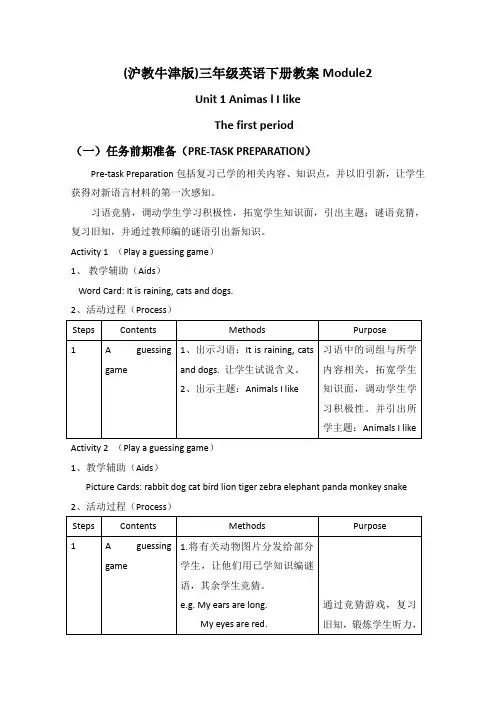
(沪教牛津版)三年级英语下册教案Module2Unit 1 Animas l I likeThe first period(一)任务前期准备(PRE-TASK PREPARATION)Pre-task Preparation包括复习已学的相关内容、知识点,并以旧引新,让学生获得对新语言材料的第一次感知。
习语竞猜,调动学生学习积极性,拓宽学生知识面,引出主题;谜语竞猜,复习旧知,并通过教师编的谜语引出新知识。
Activity 1 (Play a guessing game)1、教学辅助(Aids)Word Card: It is raining, cats and dogs.2、活动过程(Process)Activity 2 (Play a guessing game)1、教学辅助(Aids)Picture Cards: rabbit dog cat bird lion tiger zebra elephant panda monkey snake 2、活动过程(Process)(二)任务实施过程(WHILE-TASK PROCEDURE)While-task Procedure,这是指语言技能的习得过程。
其中分为机械性操练和意义性操练两部分。
机械性操练可以让学生准确地模仿、复说新授的语言,让他们经过从模仿到识记的过程,使新知识由感知、理解、模仿直到储存。
1、新知识的引入(PRESETATION)Activity 1 (Describe the snakes)1、教学辅助(Aids)实物投影,蛇年邮票2、活动过程(Process)Activity 2 (Describe the lizards)1、教学辅助(Aids)实物投影,水彩笔,画画纸,磁铁2、活动过程(Process)Activity 3(Practice the sentences)1、教学辅助(Aids)Small picture cards of animals2、活动过程(Process)(三)任务后期活动(POST-TASK ACTIVITY)Post-task Activity,这是指经过机械性操练和意义性操练,引导学生运用他们所获得的知识与技能来完成一个交际性的任务“task”,也就是语言的输出:output。
三年级英语下册MODULE1unit3Lesson3教案沪教牛津版
( 沪教牛津版 ) 三年级英语下册教课设计Module1Unit 3 Touching and feelingThe third period(一)任务先期准备(PRE-TASK PREPARATION)Activity 1(Quick response)1、教课协助(Aids )实物、卡片2、活动过程(Process )Steps Contents Methods Purpose1Words老师出示单词卡片,学生认读。
让学生在迅速反响中复习单词的音、形,加强知识的掌握。
2抽学生认读让他们把自己所学反应出来,便于教师检查上节课所学知识。
Activity 2(Make the phrase)1、教课协助(Aids )卡片2、活动过程(Process )Steps Contents Methods Purpose1Words老师出示卡片,学生说出它的特征。
让学生谈谈物体的特征,旨在检查学生对单词的掌握程度。
2Check师生共同查对检查掌握状况(二)任求实行过程(WHILE-TASK PROCEDURE)经过形容词的学习,旨在让学生掌握单词,便于学生更好的进行演练。
1、新知识的引入(PRESETATION)Activity 1(Chant)1、教课协助(Aids )磁带2、活动过程(Process )Steps Contents Methods Purpose1Chant老师播放 Chant 。
让学生听 chant ,观察学生的听力水平。
2Touch the学生学说 Chant学生在熟习的基础上,学How does it说 Chant 相对来说就简单feel?上口。
It ’ sActivity 2(Practicing)1、教课协助(Aids )1)磁带2、活动过程(Process )Steps Contents Methods Purpose1Hot cold经过说唱引出新单词进行教课。
在说唱练习中,复习了旧知,引出了要学的内容。
(沪教牛津版)三年级英语下册教案Module1Unit2Lesson4(1)
1. Let’s play a guessing game.
What can he/she hear?
Eg: P: What can he hear?(卡片)
P: Can he hear a bus?
P: Yes, he can hear a bus
What can Ming hear?
T: Who’s he?
He’s Ming.
Ming is a cat.
T: Listen and guess. What can Ming hear? (狗的声音)
P: Ming can hear a dog.
T: What can Ming hear? (drill)
(沪教牛津版)三年级英语下册教案
Module 1 Using my five sensesUnit 2 Listening and hearing
Lesson 4
教学内容
Teaching Contents
功能目标
Function Targets
语言目标
Language Targets
情感目标
Emotional Targets
Play the game in the group.
课后作业
Assignments
板书设计
1. Copy the words.
2. Do exercises.
What can Ming hear?
Ming can hear an aeroplane.
M1U2
Look and tick
What can Ming t hear,
1. Using modal verb can to talk about abilities.
上海牛津版三年级英语下册全册教案.docx
上海牛津版三年级英语下册全册教案Grammar:1.Modal verbs ‘can/can ’t: I can/can---’t2.Wh-questions: What can you see /hear? What colour is it? What is it?3.Yes/No question: Is this your --- /Is it--- Yes, it is./ No, it isn’t.4.Possessive adjectives: your, my, her5.Imperatives: Listen to--- Touch --- Taste ---/Smell---/ Close ---6.Verb ‘to be ’---: It/It ’ss a/anVocabulary:Mirror, can, hair, brown, eye, mouth, can ’t, grey, listen to, street, roof, her, cage, aeroplane, bus, car, boat, drill, telephone, hear, soft, hard, rough, smooth, touch, how, does, feel, toy, pineapple, hat, cold, lemon, sweet,sour, taste, strawberry, lime, smell, nice, fish, prawnSounds: a ( Jane, make, aeroplane)a(fat, man, jam)e(she, see, these, tree, street)e (Eddie, ten, red, peg)Daily Expressions:Hello, this is --- (on the phone)How are you? I’m fine, thank you.How does it feel?Can I help you?Unit 1 Looking and seeingLanguage functions: Talking about abilityIdentifying and describing objects in terms of colourAsking and answering questions about possessionsSaying the sound‘ a’ in its open syllable formPronounce correctly a series of words in a sentence withthe vowel sound ‘ a’ in its open syllable form Main points:Can use the sentences: What can you see?/What colour is it? Difficultpoints: Yes/No questions: Is this your ---? Teaching beach:Using the old words and sentences to learn the new words and sentences.Using the things and pictures to learn the words.Teaching times:Five periodsThe First PeriodLanguage focus:Using nouns to identify different parts of the bodyUsing modal verb‘ can/can’ t’ to talk about abilityLanguage skills:Open an interaction by asking questionsMain points: Can use the sentence“ What can youesee?---.”I can se Difficult Points: Can spell the words and using the sentence.Materials: a mirror , a mask , a tape, Book 3BProcedure Contents Methods Purpose Warming Sing an English Sing together.歌曲引入,使–up:song.学生轻松进入英语学习氛围。
(沪教牛津版)三年级英语下册教案MODULE3unit3Lesson1
(沪教牛津版)三年级英语下册教案Module3Unit 3 The seasonsThe first period一、主要新授内容(New contents)1.Vocabulary:, spring, summer, warm-cool, wet-dry, shell, nest, grow, shine2.Structures: Structures: It is ______.It’s not_____.In spring/summer, we can see……二、学习目标(Learning objectives)1. 通过介绍春夏两季的特征,培养学生一定的观察能力和表述能力。
2.学习spring, summer, warm-cool, wet-dry, shell, nest, grow, shine这些单词的正确发音及拼写。
三、教学建议(Teaching Suggestion)1、任务前期准备阶段(Pre-task preparation section)Activity 1 (Song)1.教学辅助:录音机图片2.活动过程(Process)Activity 2 ( Daily talk )1.教学辅助:图片或媒体2.活动过程(Process)2.任务中期实施阶段(While-task procedure section)Activity 1 (Introduction)1、教学辅助(Aids) 图片或媒体2、活动过程(Process)Activity 2 (Read and say)1、教学辅助(Aids) 图片或媒体2、活动过程(Process)Activity 3 (Read and spell)1、教学辅助(Aids) 图片或媒体2、活动过程(Process)Activity 4(Chant)1、教学辅助(Aids) 节奏音乐,媒体2、活动过程(Process)Activity 5(Introduction)1、教学辅助(Aids) 图片或媒体2、活动过程(Process)Activity 6 (Read and say)1、教学辅助(Aids) 图片或媒体2、活动过程(Process)Activity 7 (Read and spell)1、教学辅助(Aids) 图片或媒体2、活动过程(Process)Activity 8 (Spell and play)1、教学辅助(Aids) 图片或媒体2、活动过程(Process)Activity 9 (Ask and answer )1、教学辅助(Aids) 图片或媒体2.活动过程(Process)3. 任务后期完成阶段(Post-task activity section)Activity 1(Listen and repeat )1、教学辅助(Aids) :录音机挂图2.活动过程(Process)Activity 2(Hand work)1、教学辅助(Aids):活页纸2.活动过程(Process)Activity 3(Assignment)1、教学辅助(Aids):练习册2.活动过程(Process)。