
人教版七年级英语上Unit 6 重点短语和句型
Section B 7.向一个问题 ask a question 8.体育明星 sports star 9.吃得好 eat well 10.询问某人某事 ask sb. about sth. 11.饮食习惯 eating habit
12.就早/午/晚餐而言 for br Nhomakorabeaakfast/lunch/dinner 13.晚餐后 after dinner 14.想要做某事 want to do sth. 15.健康食物 healthy food
谢谢您的观看与聆听
二、重点句型 1.你喜欢香蕉吗? Do you like bananas? 2.她喜欢马铃薯吗?Does she like potatoes? 3.让我们想想(吃什么)。Let’s think about the food.
4.Mary 不喜欢沙拉。Mary doesn’t like salad. 5.吃水果怎么样?What about the fruit? 6.David 询问排球明星关于她的饮食习惯。David asks the
附录1:Unit 6 重点短语和句型
一、重点短语 Section A 1.生日聚餐 birthday dinner 2.下周 next week 3.思考;考虑 think about 4.听起来不错 sounds good
5.喜欢做某事 like doing sth. 6.吃早餐/午餐/晚餐 have breakfast/lunch/dinner
volleyball star about her eating habits.
7.你早餐吃什么?What do you have for breakfast? 8.我认为水果很健康。I think fruit is very healthy. 9.你晚餐喜欢汉堡包吗?Do you like hamburgers for dinner? 10.我不想长胖。I don’t want to be fat.
2024年新人教版英语七上Unit 6A day in the life重点短语和句型
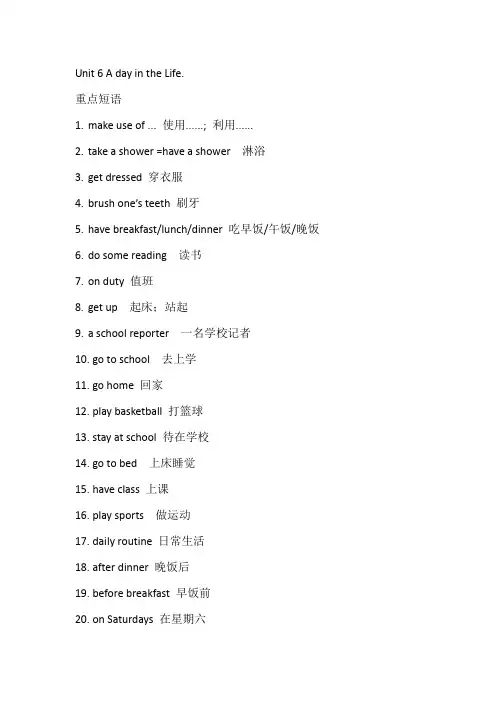
Unit 6 A day in the Life.重点短语1.make use of ... 使用......; 利用......2.take a shower =have a shower 淋浴3.get dressed 穿衣服4.brush one’s teeth 刷牙5.have breakfast/lunch/dinner 吃早饭/午饭/晚饭6.do some reading 读书7.on duty 值班8.get up 起床;站起9.a school reporter 一名学校记者10.go to school 去上学11.go home 回家12.play basketball 打篮球13.stay at school 待在学校14.go to bed 上床睡觉15.have class 上课16.play sports 做运动17.daily routine 日常生活18.after dinner 晚饭后19.before breakfast 早饭前20.on Saturdays 在星期六21.in the afternoon 在下午22.help sb. with housework 帮某人做家务23.watch a film 看电影24.for a while 一段时间25.at weekends 在周末26.a 10-minute walk 步行十分钟27.45 minutes long 四十五分钟长28.a break between lessons 课间休息29.home economics lessons 家政课30.ice hockey 冰球运动;冰上曲棍球31.prepare sth. for... 为......把某物准备好32.go to work 去上班33.get off work 下班重点句子1.How can you make good use of your time ?你怎样利用好你的时间?2.——What time do you usually get up ?你通常几点起床?——I usually get up at ... 我通常在...起床。
【2024秋季】最新版人教版七年级上册英语第六单元UNIT 6《单词+短语+句子默写》专项练习
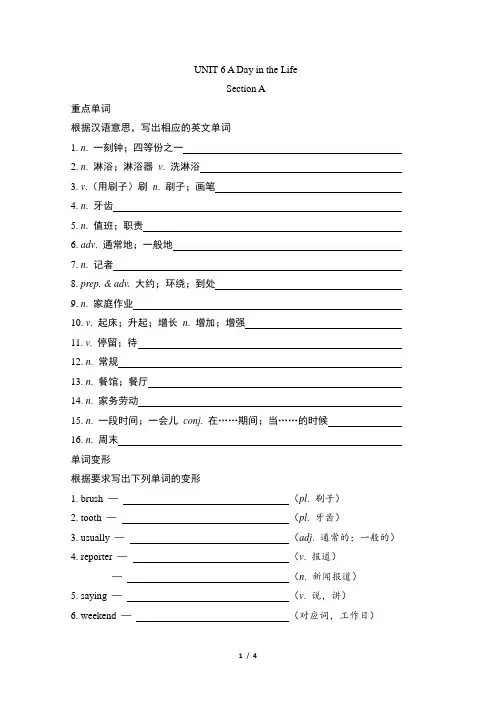
UNIT 6 A Day in the LifeSection A重点单词根据汉语意思,写出相应的英文单词1. n. 一刻钟;四等份之一2. n. 淋浴;淋浴器v. 洗淋浴3. v.(用刷子)刷n. 刷子;画笔4. n. 牙齿5. n. 值班;职责6. adv. 通常地;一般地7. n. 记者8. prep. & adv.大约;环绕;到处9. n. 家庭作业10. v. 起床;升起;增长n. 增加;增强11. v. 停留;待12. n. 常规13. n. 餐馆;餐厅14. n. 家务劳动15. n. 一段时间;一会儿conj. 在……期间;当……的时候16. n. 周末单词变形根据要求写出下列单词的变形1. brush —(pl. 刷子)2. tooth —(pl. 牙齿)3. usually —(adj. 通常的;一般的)4. reporter —(v. 报道)—(n. 新闻报道)5. saying —(v. 说,讲)6. weekend —(对应词,工作日)重点短语根据汉语意思,写出相应的英文短语1. 使用……;利用……2. 淋浴3. 穿衣服4. 刷牙5. 值班6. 起床;站起7. 做作业8. 上床睡觉重点句型根据汉语意思完成句子或对话1. ——你什么时候洗淋浴?——我通常在晚上洗淋浴。
—__________ do you __________ __________ __________?—I usually __________ __________ __________ at night.2. 嗯,你知道有句谚语叫做“早睡早起”!Well, you know the saying, “__________ __________ __________, __________ __________ __________!”3. 汤姆在学校待多长时间?__________ __________ does Tom stay at school?4. ——你晚饭后做什么?——我有时候读书或做作业。
人教版初一英语七年级全册(上下册)重点短语和句型
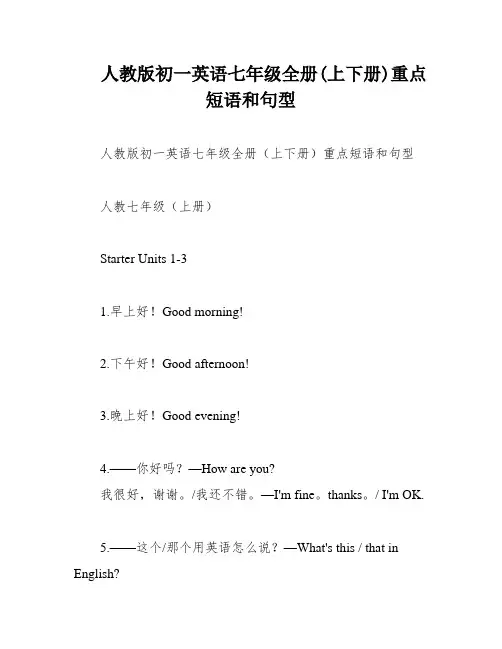
人教版初一英语七年级全册(上下册)重点短语和句型人教版初一英语七年级全册(上下册)重点短语和句型人教七年级(上册)Starter Units 1-31.早上好!Good morning!2.下午好!Good afternoon!3.晚上好!Good evening!4.——你好吗?—How are you?我很好,谢谢。
/我还不错。
—I'm fine。
thanks。
/ I'm OK.5.——这个/那个用英语怎么说?—What's this / that in English?是……—It's a / an。
6.请拼写它。
Spell it。
please.7.——它是什么颜色的?—What color is it? 它是……色的。
—It's。
Unit 1n A1.我是……I'm。
2.你是……吗?Are you。
3.他/她是……He / She is。
4.——见到你很高兴。
—Nice to meet you.见到你我也很高兴。
—Nice to meet you。
too.5.——你/他/她叫什么名字?—What's your / his / her name?我/他/她叫……—My / His / Her name is。
n B1.名字first name2.姓last name3.在中国in China4.学生卡ID card5.这是你的号码吗?Is this your number?6.——你的电话号码是多少?—What's your telephone / phone number?是……—It's。
Unit 2n A1.家庭照片family photos2.这是/那是/这些是/那些是……This is / That is / These are / Those are。
3.她/他是谁?Who's she / he?4.他们是谁?Who are they?5.祝你过得愉快!Have a good day!6.我知道了。
人教版七年级英语各单元知识点
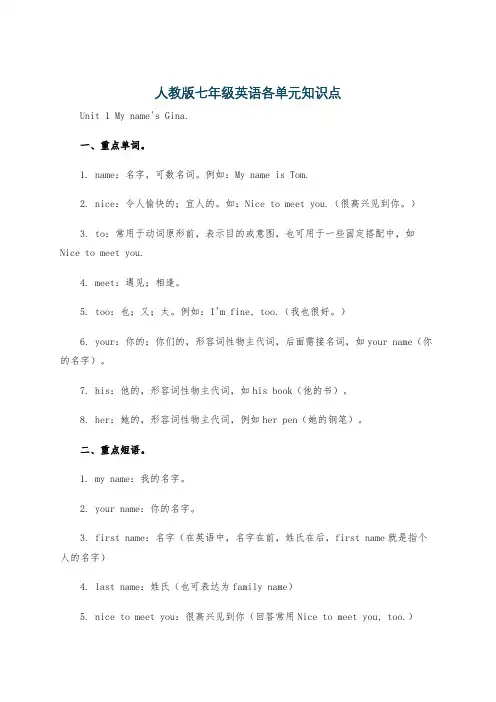
人教版七年级英语各单元知识点Unit 1 My name's Gina.一、重点单词。
1. name:名字,可数名词。
例如:My name is Tom.2. nice:令人愉快的;宜人的。
如:Nice to meet you.(很高兴见到你。
)3. to:常用于动词原形前,表示目的或意图,也可用于一些固定搭配中,如Nice to meet you.4. meet:遇见;相逢。
5. too:也;又;太。
例如:I'm fine, too.(我也很好。
)6. your:你的;你们的,形容词性物主代词,后面需接名词,如your name(你的名字)。
7. his:他的,形容词性物主代词,如his book(他的书)。
8. her:她的,形容词性物主代词,例如her pen(她的钢笔)。
二、重点短语。
1. my name:我的名字。
2. your name:你的名字。
3. first name:名字(在英语中,名字在前,姓氏在后,first name就是指个人的名字)4. last name:姓氏(也可表达为family name)5. nice to meet you:很高兴见到你(回答常用Nice to meet you, too.)三、重点句型。
1. —What's your name?(你叫什么名字?)—My name's Gina.(我的名字是吉娜。
)2. —Nice to meet you.(很高兴见到你。
)—Nice to meet you, too.(我也很高兴见到你。
)3. —What's his name?(他叫什么名字?)—His name's Tom.(他的名字是汤姆。
)4. —What's her name?(她叫什么名字?)—Her name's Mary.(她的名字是玛丽。
)Unit 2 This is my sister.一、重点单词。
人教版七年级上册英语知识点全第六单元unit6知识点
人教版七年级上册英语知识点全第六单元unit6知识点Unit6谈论对食物的喜恶;1、重点词汇:banana,hamburger,tomato,ice-cream,alad,trawberry,pear,milk,bread,birthday,dinner,week,burger ,vegetable,fruit,right,apple,then,egg,carrot,chicken,breakfat,lu nch,tar,eat,well,habit,healthy,really,quetion,want,be,fat2、可数名词和不可数名词:1)foodn.仅仅指“食物,食品”时,是不可数名词;强调食物的种类时就是可数名词。
e.g.I’mhungry.Ineedomefood.(不可数)/Thereareallkingoffoodonthetable.(可数)2)fruitn.水果。
表示水果总称时,无复数形式,但表示种类时有复数形式。
Doyouhavemuchfruit/Therearemanyfruitinthebaket.3)ice-cream,alad,chicken这几个名词,当表示物质的时候是不可数名词,但当表示个体的时候是可数的。
e.g.Let’haveomeice-cream.中ice-cream是泛指,强调“冰激凌”这类物质,而非它的数量。
Howmanyice-creamdoyouwant中是要询问对方想要的数量,即几份。
可以回答anice-cream或twoice-cream.3、短语归纳:John’birthdaydinner约翰的生日晚餐ne某tweek下周thinkabout思考,考虑howabout怎么样omefruit一些水果hibirthday他的生日porttar体育明星eatinghabit饮食习惯forbreakfat作为早餐fordinner作为晚餐onelatquetion最后一个问题healthyfood健康的食品3、tomato可数n.“西红柿”复数形式:tomatoe人教版七上2022知识点总结全类似的以o结尾的名词,需加–e构成复数形式的单词还有potato,hero但photo等词而是以加—构成复数形式的。
Unit6+单元重点知识总结+2024-2025学年人教版英语七年级上册+

新人教版七上Unit6一、短语默写充分利用时间在你的空闲时间一点四十五分穿好衣服刷牙读点书值日/值班课前一名学校记者大约五点上床睡觉在九点半上课她上学日的日常在上学日帮他妈妈做家务看电影一会儿二、句型1. I live with my parents in … 我和父母一起住在……2. After breakfast, I walk to school. 早饭后,我步行去学校。
3. Each lesson is 45 minutes long, and there is a break between lessons. 每节课时长45分钟,课与课之间有一段休息时间。
4. At 9:30, it’s time for me to go to bed. 在9:30,我该去睡觉了。
5. Then I prepare my schoolbag for the next day. 然后我为第二天准备我的书包。
三、单元重点知识总结1. dress动词,意为“穿衣服”。
dress表示“穿,戴”时,宾语是人(通常是人称代词或反身代词),而不是衣服wear表示“穿着,戴着”的状态put on表示“穿,戴”的动作2.sometimes、sometime、some time和some timessometimes有时=at times用于一般现在时和一般过去时中sometime某时(时间点)用于一般将来时或一般过去时中some time一段时间可用于多种时态(指时间段)some times几次,几倍表示次数或倍数3.ask sb. about sth. 表示"询问某人某事",ask sb. for sth. 表示"向某人要某物"。
4.prepare 意思为“准备;把......预备好”prepare for... 为......做准备prepare to do sth. 准备去做某事5.work/jobwork作名词,意为“工作”,泛指从事的体力或脑力劳动,指代各种工作,是不可数名词。
人教版七年级上册英语 Unit 6 词汇与语法基础(解析版)
be /bi:/ v.变成
fat /fæt/ adj.肥的;肥胖的
二、重点词汇
1. strawberry noun /ˈstrɔːbər.i/
a small juicy red fruit that has small brown seeds on its surface, or the plant with white flowers on which this fruit grows草莓
B.tomatoes; photos
C.tomatos; photos
D.tomatoes; photoes
例1.2.2词的适当形式填空
There are a lot of new _________ (factory) in our city.
随练1.1---_________ Dale like bananas?
我的膝盖开始疼痛,因此我停下来不再跑了。
I was lost so I bought a street map.
我迷路了,所以买了一张街道地图。
5. healthy adjective /ˈhelθi/
1). strong and well强壮的;健康的
例句:
She’s a nor词汇
banana /bə'na:nə/ n.香蕉
hamburger /'hæmbə:gə/ n.汉堡包
tomato /tə'ma:təu/ n.西红柿
ice-cream /ais'kri:m/ n.冰激凌
salad /'sæləd/ n.沙拉
strawberry /'strɔ:bəri/ n.草莓
七年级上册英语第六单元总结
七年级上册英语第六单元总结一、重点词汇在本单元中,我们学习了许多新的词汇,包括但不限于:购物 (shopping)商场 (mall)商店 (store)商品 (item)打折 (discount)便宜 (cheap)贵 (expensive)花费 (cost)计算器 (calculator)鞋 (shoes)衣服 (clothes)玩具 (toys)礼物 (gifts)电脑 (computer)手机 (cellphone)电视 (TV)微波炉 (microwave)电饭煲 (rice cooker)二、主要句型在第六单元中,我们学习了以下主要的句型:1. "How much does it cost?" - "It costs $XX."2. "How much does it cost to buy a TV?" - "It costs $XX."3. "I need to buy a new pair of shoes." - "There are several stores in the mall that sell shoes."4. "This pair of shoes is too expensive." - "You might want to try another store."5. "I can't find the calculator I was looking for." - "You might want to try another store."6. "Do you have any discounts?" - "Yes, we do. XX% off for students."7. "Do you want to buy this pair of shoes?" - "Yes, I do." / "No, Idon't."8. "How much are these clothes?" - "They are $XX each."9. "I want to buy a gift for my friend." - "There are some nice toys in this store."10. "Do you want to come with me to the mall?" - "Yes, I do." / "No, I don't."三、语法重点在本单元中,我们重点学习了询问物品价格和进行购物对话的常用表达方式。
人教版七年级英语上册教案(RJ) Unit 6 Do you like bananas
Unit 6Do you like bananas?第一课时Section A(1a-1c)1.重点单词:banana,hamburger,tomato,icecream,salad,strawberry,pear,milk,bread2.重点句式:—Do you like bananas?—Yes,I do.—Do you like salad?—No,I don't.1.用like来谈论喜好2.可数名词的单复数1.用like来谈论喜好2.可数名词的单复数一、预习课本P31新单词并背诵,完成下面的汉译英。
1.香蕉____________ 2.汉堡____________3.西红柿____________ 4.冰激凌__________5.沙拉____________ 6.草莓____________7.梨____________ 8.牛奶____________9.面包____________二、认真预习1a,1b,1c,找出下列句型。
1.—你喜欢香蕉吗?—是的,我喜欢。
________________________________________________________________________ 2.—你喜欢沙拉吗?—不,我不喜欢。
________________________________________________________________________Step 1情景导入Teacher:There are many different kinds of fruits and vegetables in the world,and different people like different food.Everyone has its own taste.What kind of food do you like?What kind of food do you dislike?Today let's talk about the food we like and we dislike in Unit 6.环节说明:由学生感兴趣的话题导入新课,简洁明了,激起学生的学习兴趣。
Unit6讲义人教版英语七年级上册
Unit 6 Do you like bananas?1.salad n. 沙拉当salad 为不可数名词时,通常指整体的食物概念,例如:He likes eating salad.“一盘沙拉”时,是可数名词,复数形式为salads。
当salad的含义为“一份色拉”、k n.牛奶a glass of milk 一杯牛奶two glasses of milk 两杯牛奶3.bread n.面包a piece of bread 一片面包4.birthday n. 生日Happy birthday to you! 祝你生日快乐!5.dinner n.正餐have dinner 吃晚餐birthday dinner 生日晚宴6.week n. 周;星期(adj./adv.)weekly 每周的next week 下周7.★think about 思考;思索(强调思考的过程)★think of 认为;想起(强调思考的结果)Eg:Let’s think about the food.I like this song,but I can’t think of its name.8.food n. 食物指“食物,食品”时,是不可数名词;强调食物的种类时,是可数名词。
9.right adj. 正确的;—(反义词)wrong 错误的adj. 右边的;—(反义词)left 左边的★All right!用作对方建议或劝告的应答语。
Eg:—Let’s go and ask him.让我们去问他。
—All right. 好的。
10.star n. 星星;明星a volleyball star 一个排球明星11.eat v. 吃★eating habits 饮食习惯12.well adv. 好;令人满意地(adj.)good 好的Eg:Sports Star Eats Well.I have good eating habits.13.question n. 问题one last qusetion 最后一个问题14.healthy adj. 健康的(n.)health 健康★keep healthy 保持健康15.want v. 想要want sth. 想要某物want to do sth. 想要做某事want sb. to do sth. 想要某人做某事Eg:I don’t want to be fat.16.—What do you like for breakfast?—I like ........【语法】名词的单复数有些名词既可作可数名词又可作不可数名词,但意义不同,要注意区分.①glass cn.杯子un.玻璃orange cn橘子un.橘汁①还有表示动物类的名词,表示动物时是可数名词,表示为菜肴时是不可数名词. chicken cn.小鸡un.鸡肉fish cn鱼un鱼肉①salad, icecream, food, fruit 作总称讲是不可数名词,作种类讲是可数名词【即学即练】一、请写出下列词的复数形式city _____ _zoo ______country _____ tooth ____mouse _________ boy____________ broom ___________car ____tree ______horse ______ bus______________ fox _____branch ____ baby _____ family _____ dish _____radio _____ photo _____ piano _____ knife _____leaf _____ life _____ thief _____ _man _____woman _____ child ___ foot______this _____________ watch___________ diary____________ day____________ book____________dress____________ sheep___________ tea_____________ box___________ strawberry_________ peach__________ sandwich__________ paper_________ juice__________ water____________ milk___________ rice__________people ______CD________ ox___________deer____________ fish___________二、选择填空.( )1. They e from different ______A. countryB. countriesC. a countryD. countrys( )2. How many ______ do you see in the picture?A. tomatosB. tomatoesC. tomatoD. the tomato( )3. They are______.A . woman teachers B. women teachersC. women teacherD. woman teacher( )4. Would you like _______ ,please?A. two glass of waterB. two glasses of waterC. two glass of watersD. two glasses of waters( )5. Most of ______ live in _______.A. Germans, GermanB. German, GermenC. Germen, GermanyD. Germans, Germany( )6. There are some ______ in these _______.A. knifes pencilboxesB. knives pencilsboxC. knives pencilboxD. knives pencilsboxes( )7. ______ like ______ by air.A. Greens, travellingB. The Green, travelingC. The Greens, travelD. The Greens, traveling( )8. I wonder why ______ are interested in action films(武打片).A. the peopleB. peopleC. peoplesD. the peoples( )9. There is no ______ in the plate.A. applesB. orangesC. riceD. eggs( )10.My uncle has three _______.A.childB.childsC.childrenD.childrens四.填入所给名词的正确形式。