
(外研版)四年级英语下册课件 MODULE10 unit1(1)
四年级下册Module10 Unit1 Did you fall off your bike 外研版三起(含答案及解析)
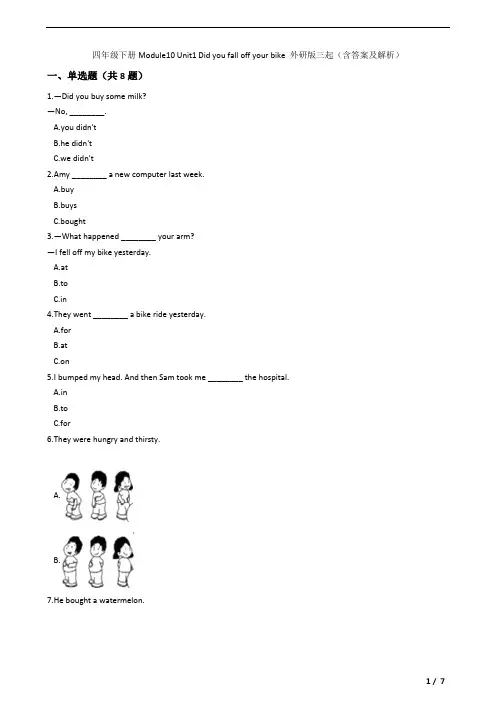
四年级下册Module10 Unit1 Did you fall off your bike 外研版三起(含答案及解析)一、单选题(共8题)1.—Did you buy some milk?—No, ________.A.you didn'tB.he didn'tC.we didn't2.Amy ________ a new computer last week.A.buyB.buysC.bought3.—What happened ________ your arm?—I fell off my bike yesterday.A.atB.toC.in4.They went ________ a bike ride yesterday.A.forB.atC.on5.I bumped my head. And then Sam took me ________ the hospital.A.inB.toC.for6.They were hungry and thirsty.A.B.7.He bought a watermelon.A.B.8.She went for a bike ride.A.B.二、填空题(共1题)9.给下列单词找到它们的过去式A. B. C.D. E.(1)fall ________(2)find ________(3)buy ________(4)come ________(5)go ________三、翻译(共1题)10.英汉互译。
(1)胃疼(2)头疼(3)发烧四、选词填空(词汇运用)(共5题)11.Did you (fell,fall) off your bike?12.We (find,found) a town yesterday.13.Then we (are,were) hungry and thirsty.14.He carried the watermelon (on,in) the bike.15.Did you buy (some,any) water?五、单词拼写(词汇运用)(共5题)16. f________ll17. w________term________lon18. w________t________r19. r________d________20. h________sp________t________l答案部分第 1 题:【答案】C【考点】疑问句【解析】【分析】句意: —你买了一些牛奶吗? —不,...... 这是一般疑问句, 疑问句的主语是第二人称you, 回答用第一人称we. 根据选项, 只有C合适。
外研版(一起)四年级英语下册教案教案Module10Unit1教案

外研版(一起)四年级英语下册教案教案Module10Unit1教案Module 10 Unit 1I’ll send you a postcard.教学模式介绍探究式教学模式是指在教学过程中,要求学生在教师指导下,通过以“自主、探究、合作”为特征的学习方式对当前教学内容中的主要知识点进行自主学习、深入探究并进行小组合作交流,从而较好地达到课程标准中关于认知目标与情感目标要求的一种教学模式。
其中认知目标涉及与学科相关知识、概念、原理与能力的掌握;情感目标则涉及思想感情与道德品质的培养。
探究式课堂教学模式的教学环节:创设情境——启发思考——自主(或小组)探究——协作交流——总结提高设计思路说明【创设情境】在这一部分里面,学生将会看到一段关于I send postcard 的视频。
这一视频旨在帮助学生快速进入本课的教学场景。
【启发思考】本部分中,老师和学生将一起讨论他们暑假要去哪里,导入be going to do这一句型表示将来的打算。
通过这一部分也可以帮助学生积累主要国家的名称。
【自主或小组探究】此部分将主要学习本课的对话,聚焦be going to do 表达已成型的将来打算。
在对话学习完成之后,学生将操练be going to do。
【协作交流】本部分中,学生将首先对对话进行角色扮演,继续熟悉并巩固已学的知识,然后小组合作调查成员在暑假的打算。
【总结提高】本部分的意义在于总结本课所学到的知识,补充学生需要的新知识。
就本课而言,主要是表达将来的几种句型。
教材分析本课是新标准小学英语一年级起点第八册的内容。
本节课主要是运用will和going to的一般将来时展开多种教学活动的,目的是让学生能正确表达即将做的事或计划做的事。
设计这节课旨在增加学生学习英语的兴趣,养成良好的语感和发音基础,发挥他们的想象力,能综合运用英语思维表达自己的情感。
教学目标【知识与能力目标】1.能够掌握单词及短语:postcard send a postcard go back to plan2.能够掌握句型:I will send you a postcard. I’m going to speak English every day.【能力目标】1.能够掌握will 在英语中的需用;并能与be going to 进行类比训练。
四年级英语Module10unit1Wehaveabigfamilydinner(第1课时)教案

主备教师
审核教师
课 题
Modபைடு நூலகம்le10
unit1 We have a big family dinner
课 型
新授课
课 时
1
教学目标
知识与技能
能听、说、认读与春节有关的词:peanut、sweets、the spring festival
收集中国节日的图片及材料,并了解其风俗。
板书设计
Unit 1 We have a big family dinner
At the Spring Festival ,we have…….
能运用At the Spring Festival, we have…等句型谈论与春节有关的话题。
过程与方法
表达节日问候以及描述过节时的风俗习惯。
情感态度价值观
提高对我国传统节日的认识,培养爱国、爱家的意识
教材分析
教学重点
掌握有关春节的相关词汇及交际用语,并能在实际生活中表达节日问候,介绍中国传统节日.
教学难点
灵活的介绍春节的主要活动和风俗习惯。
学 具
录音机,磁带,单词卡片
教 学 过 程
环节
教 师 活 动
学 生 活 动
效果反思
导
入
新
课
1、热身活动
放英文歌“Happy New Year”
2、教授新单词“Spring Festival"等.
1、听录音,读单词或词组,并写出中文意思。
2、跟读单词。
自
主
学
小
组
合
作
老师继续提出问题:WhatdowesayatSpringFestival?WhatdowehaveatSpring?
Module10Unit1Wehaveabigfamilydinner.(教学设计)外研版英语四年级

Module10 Unit1 We have a big family dinner.第一课时一、单元教材分析:本单元是?新标准英语?〔三班级起点〕第三册第十模块第一单元的内容,课文情景是快放寒假了,Daming送给Sam一本介绍中国春节的书,进而争论春节的相关习俗。
课文运用At the Spring Festival,we have a.......的句型来描述春节习俗。
依据?学校英语新课程标准?提出的目标,激发和培育学校生学习英语的爱好,使同学树立自信念,开展自主学习的力量和合作精神。
本节课在培育同学学习英语自信念的同时,让其学会初步运用简洁英语描述节日习俗。
二、同学分析:四班级同学已经接触了一年的英语,对连续学习英语有爱好,能用简洁的英语互致问候,交换有关个人,家庭和伴侣的简洁信息,并能对日常生活话题做出简短的表达。
能在图片的关心下听懂,读懂并叙述简洁的故事,演唱简洁的英语歌曲和歌谣,。
能依据图片、词语、或例句提示,做出简短的描述。
在学习中乐于参加、乐观合作、主动请教、初步形成对英语感知力量和良好的学习习惯。
同学已经学过I have..的句型,对We的表达也有肯定的了解,这也为本模块的学习做好了学问上的铺垫。
三、教学目标:1.学问目标:〔1〕通过本课学习,同学能够听懂、说准、认读单词:family、dinner、the Spring Festival、Chinese、peanut、New Year。
〔2〕同学能够听懂、会说、认读句型:At the Spring Festival, we have a big family dinner. We say,〞Happy New Year!〞2.力量目标:同学能在生活情境中运用At the Spring Festival , we have.....Happy New Year.等句型来谈论与春节有关的话题。
3.情感态度目标:同学能提高对我国传统节目的熟识,培育爱国、爱家的意识。
四年级下册英语教案-Module10 Unit1 Did you fall off your bik

四年级下册英语教案-Module10 Unit1 Did you fall off yourbike 外研版三起教材分析本单元的主题是“我摔了一跤(Did you fall off your bike)”,学生将学到如何表述过去发生的事情;了解有关骑自行车的安全知识;并且能够更加自信地表述自己在过去所发生的事情,增强表述能力。
该单元的语言应用领域涵盖交通出行、事故发生。
学习目标的达成需要借助于口语表述、听力与阅读理解等多个方面的技能。
教学目标1.能够听懂、会说、会读本课的新词汇、短语和句型;2.能够理解本单元对话的大意,并能背诵对话;3.能够熟练使用本单元重点词汇进行口头表述;4.能够阅读与本单元主题相关的文章并理解对话内容;5.提高学生英语表述能力,训练学生口语表达、听力和阅读技能。
教学重点1.熟练掌握本单元的生词、短语及句型;2.能够理解并背诵本单元的对话,并自然地掌握语音语调;3.提高学生口语表述能力。
教学难点1.提高听力和阅读能力;2.学生能通过自己的阅读和口语表述来增加课程中生词、短语及句型的灵活运用。
教学过程1.Warm up通过游戏让学生熟悉单元主题,并自然地学会本单元的相关单词、短语和句型:Who's the fastest? - 快速读出牌面上的单词(或图片),然后比赛哪个学生说得最快。
2.Presentation在教师的引导下轮流唤起一些学生,让他们讲述自己的故事:Did you fall off your bike?Yes, I did / No, I didn't.When did it happen?How did it happen?3.Practice这是一个练习重点语言的环节,学生将通过阅读教材及表述口语的方式使用所学的语言进行交际。
第一步:让学生跟读课文,并背诵对话的口语(播放英文原音频):A: Did you fall off your bike, Gilly?B: Yes, I did.A: Oh, no! Are you OK?B: Yes, I am. Thank you.A: When did it happen?B: Yesterday afternoon.A: How did it happen?B: I was cycling to my friend's house. I didn't see the hole on the road.I fell off.第二步:让有孩子分享他们与坠车有关的故事。
外研版小学英语(一年级起点)四年级下册Module10 Unit1 课件
Lingling: We’ll send you a postcard from the UK.
Daming: And I’ll send you a postcard from China.
Amy: Will you send us a postcard, too, Tweet-tweet?
All: Ha ha ...
Daming: And I’ll send you a postcard from China.
Amy: Will you send us a postcard, too, Tweet-tweet?
All: Ha ha ...
I’ll = I will We’ll = We will
Warm-up
点击小喇叭或文本框都可以播放音频
Warm-up
Listen, point and find “will, be going to”.
Read it by yourselves for two minutes. 自己读对话两分钟。
Tips: 当你自己朗读时,遇到不会读或不明白 意思的单词或句子,可以把它圈起来, 请教同学或老师!
Amy will go back to the UK this summer.
Warm-up
Watch and answer
Listen, point and find “will, be going to”.
Who will go to the UK, too?
Lingling.
What is Lingling going to do in the UK every day? She’s going to speak English every day.
外研(三起)英语四年级下Module10 Unit1课件
What happened to his head?
What did they do yesterday?
buy—bought
We were hungry and thirsty. we bought a watermelon.
Lan yangyang wash_u__n_g__ry yesterday. He bought some cakes.
Homework
读十五分钟英语,内容为P67 第十单元 的单词,签字签在单词后面; 读课本 P56-P57的课文,签字签在课文标题上。
都二
能分
运浇
用灌
好,
“八
二分
八等
定待
律;
”二
,分
我管
们教
一,
起八
,分
静放
待手
花;
开二
。分
成
➢ Pure of heart, life is full of sweet and joy!
New words
• fall 掉下,落下;摔倒 • fall off 跌落 • fell(fall的过去式)掉下,落下;摔倒 • fall down 摔倒,跌倒;坍塌 • found(find的过去式)发现,找到 • town 城镇,市镇 • happen 发生
ride 骑车 then 然后 thirsty (口)渴的 water 水 bought(buy的过去式)买 watermelon西瓜 carried(carry的过去式)拿,搬 bump撞伤 hospital医院
He was t_h__ir_s_t_y_. He bought some water.
Sam carried the watermelon on the bike.
2023外研社小学英语课件(一起点)Module 10 Unit 1 Go to bed early
一、通过分音节记单词、拼读、造句练习,能认读、翻译、拼写,并能在语境中正确使用以下词汇:
1.单词:
听说读写四会单词:early every take exercise healthy juice before after toilet
听说认读三会单词:during computer game medicine a lot of
潍坊高新区小学英语模块备课设计
学校____大观学校_年级___四年级_主备人审核人备课时间
模块
Module10
主题
Health
内容
简析
一.话题分析:本模块主要内容是针对身体健康提建议。unit1话题情景是Sam去看病,医生问他怎么了,Sam说他感冒了。医生又问他昨天做了什么,Sam说他打电脑游戏了,很晚才睡觉。医生给开了药,告诉他除了吃药,还要多喝水,早睡觉,并注意锻炼身体。Unit2的话题情景是大明这一组的同学在向全班做健康建议报告,大明建议每天多吃蔬菜和水果,Amy建议多喝果汁,Sam建议每天锻炼身体,走路、跑步、游泳或打球都可以,玲玲建议饭前便后要洗手。
2.短语:
get up 起床 every moring 每天早上/上午
during the day 在白天期间 At the Doctor’s 在医务室
come in 进来 have got a cold 得了感冒
play the computer games 玩电脑游戏 go to bed 去睡觉
①根据自然拼读和分音节记单词的策略。
②归纳旧知识,联系新知识,以旧带新的策略。
③小组合作探究的策略。
2.困难、障碍(重难点)及突破措施:
大部分学生没有根据课文内容,主动查找课外资源,拓展知识面的习惯,要引导他们通过网络查找资源、通过与同学交流获取信息,补充相关保持身体健康的常识,对比汉语和英语祈使句的结构和用法,进一步注意中外文化的异同。
Module10完整(课件)英语四年级下册(1)
Presentation
Look and learn
found 发现;找到
Presentation
Watch and think
What happened to Daming
Presentation
Listen and answer
1. What happened to Daming Daming bumped his head. 2. Did Daming buy a watermelon Yes, he did. 3. Did Daming fall off his bike No, Sam fell off his bike.
Free talk
Warm-up
1. Did they go to the Great Wall 2. Did they have a nice holiday
Presentation
Look and think
What did Jack and Jill do
Presentation
Listen and chant
Module 10
Unit 1 Did you fall off your bike
Let’s sing
Warm-up
We visited England and we went to London zoo. We saw lots of people and some funny animals too. Oh, we love holidays, holidays, hooray! We want to visit China. We want to see Beijing. We’ll meet the Chinese children. We’ll talk and play and sing. Oh, we love holidays, holidays, hooray!
四年级英语下册 MODULE10 unit1教案 外研版
(外研版)四年级英语下册教案Module10Unit 1 Sam fell off his bike.Teaching aims:Sam and I went for a bike ride yesterday.and then...?Teaching importance:Describing an accidentTeaching difficulities:Using the simple past tense of irregular and regular verbs to talk about past activities.Teaching Tools:RecorderTeaching Steps:Step one : Warm upsing a song.Step two:listen and point1. Ask questions about the pictures in Chinese,e.g. What was Daming thinking about in Picture 1? What was he thinking about in picture2?What was Daming thinking about in picture3? How did Sam carry the watermelon in picture4? What happened to Daming in the last picture? What did the girls do in the last picture?2. Write the words'then','and' and'so'on the board.Explain that these words link sentences or clauses together.Say that 'so'indicates result,e.g. I went to bed at 11p.m., so I was late for school.Point out that 'and' means 'following this' Show the example in Pictures5and 6,i.e.Then Sam fell off his bike!And the watermelon bumped my head! The adverb'then'means'after that'.We often use 'then'when we are giving a sequence of instructions. Step three:Tell the story1)Write the following on the board:I ate ten nangoes,so...I didn't do my homework,so...I cleaned my teeth and then I...I fell over and...2)Have the students work in pairs and complete the sentences.Explain that there is no one correct answer for this exercise,however,the sentences must be grammatically corret and they must make sense.Example Answers:I ate ten mangoes, so I was sick/went to bed/went to the doctor.I didn't do my homework, so my mother was angry/the teacher was angry.I cleaned my teeth and then I went to bed/watched TV/read a book.I fell over and hurt my knee/I cried.Step four: HomeworkReview Module( Unit 1)Teaching aims:ReviewTeaching importance:ReviewTeaching difficulities:ReviewTeaching Tools:RecorderTeaching Steps:Step one : Warm upsing a song.Step two:Look at the map and say.1)Tell the students to imagine that the top of their desk (the flat part that they write on )is like a map with north at the top(this is the ide of the desk farthest away from the students),south at the bottom (this is the side closest to the students),west to the left and east to the right.2)Have the students get out their coloured pencils.3)Explain to the students that you are going to give instructions on where to place the pencils and they have to follow those instructions.e.g.put a red pencil in the south,please.Put a blue pencil in the north ,please.Do a lot of examples with the students.Step three:What will they do?1)Tell the students that you are going to choose a student and then say a day. The student has to say what he or she will do on that day.e.g.T:Sunday.S:I will visit my grandmother.T:Tuesday.S:I will play football.2)Do a lot of examples.Then have the students continue the activity in pairs. They should take turns to say the days.3)Point out that they can make up what they will do ; it doesn't have to be true.Step four: Homework。