
外研版高中英语选修七Module 5Ethnic CultureGrammar语法学案2
班级:______ 组别:______ 姓名:_______ 组内评价:_____ 教师评价:_______Learning aims:To help Ss learn and master V-ed form as adverbials.Module 5《Ethnic Culture》GrammarSelf-study 动词的过去分词作状语Grammar (动词的过去分词作状语)过去分词作状语可以表示时间、原因、条件、让步、方式或伴随情况等。
表示时间、原因、条件、让步的过去分词相当于相对应的状语从句。
其逻辑主语一般应与句子的主语一致,过去分词与逻辑主语一般是被动关系。
1.作时间状语.When heated, water can be changed into steam.水加热后可以变成蒸汽.注意:作时间状语时,过去分词如果同时表被动和动作完成,常可换用现在分词的被动完成式;过去分词如果只表被动,不表完成,则不可与现在分词的被动完成式换用.如:Discussed(Having been discussed) many times, the problems were settled at last.在讨论了多次之后,问题终于解决了. (过去分词既表被动又表完成)Seen from the hill, the park looks very beautiful.从山上看这个公园非常漂亮. (过去分词只表被动)相当于when引导的状语从句.如果两个动作同时发生,可在分词前用when, while等使其时间意义更明确2.作原因状语:Given advice by the famous detective, the young lady was no longer afraid. (Since/ As she was given by the famous detective...)有了著名的侦探的指点,姑娘不再害怕了.Frightened by the noise in the night, the girl didn't dare to sleep in her room. (Because she was frightened by the noise...)姑娘被夜里的响声吓坏了,不敢在自己的屋里睡觉了.Done in a hurry, his homework was full of mistakes.他匆忙做的作业错误百出.相当于as, since, because引导的从句,这类状语多放在句子前半部分3.作条件和假设状语.Given more attention(If they had been given more attention), the cabbages could have grown better.如果再精心一些,这些大白菜还可以长得更好.Compared with you, we still have a long way to go.和你相比,我们还有很大的差距.相当于if, unless引导的从句.4. 作让步状语:Beaten by the opposite team, the players were not discouraged.(Though they were beaten by the opposite team, the players were not discouraged.)相当于though, although引导的从句5.作方式或伴随情况状语.The hunter left his house , followed by his dog.猎人离开了屋子,后面跟着他的狗.She sat by the window, lost in thought.她坐在窗前,陷于沉思.作状语表示方式或伴随情况时,过去分词可用并列句代替.如:The hunter left his house, followed by his dog. (= He was followed by the dog. )注意:1. 过去分词作状语表示被动的和完成的动作.(1) Written in a hurry, this article was not so good! 因为写得匆忙,这篇文章不是很好.【注意】written 为过去分词作状语,表示这篇文章是被写的,而且已经被写. 值得注意的是,有些过去分词因来源于系表结构,作状语时不表被动而表主动.这样的过去分词及短语常见的有: lost (迷路); seated (坐); hidden (躲); stationed (驻扎); lost / absorbed in (沉溺于); born (出身于); dressed in (穿着); tired of (厌烦).(2) Lost / Absorbed in deep thought, he didn't hear the sound.因为沉溺于思考之中,所以他没听到那个声音.2. 过去分词作状语时其逻辑主语为主句的主语,此时应注意人称一致.(1) Given another hour, I can also work out this problem.再给我一个小时,我也能解这道题.(given 为过去分词作状语,它的逻辑主语为主句主语I ,即I 被再给一个小时.)(2) Seen from the top of the hill, the city looks more beautiful to us.从山顶看城市,城市显得更漂亮.(seen 为过去分词作状语,表"被看",由语境可知,它的逻辑主语必须是城市,而不是"我们",因为"我们"应主动看城市.)【注意】如果过去分词作状语时,前面再加逻辑主语,主句的主语就不再是分词的逻辑主语,这种带逻辑主语的过去分词结构实际上属于独立主格结构.(1) The signal given, the bus started. 信号一发出,汽车就开动了.(the signal 是given 的逻辑主语,因此主句主语the bus 就不是given 的逻辑主语. )(2) Her head held high, she went by. 她把头昂得高高地从这儿走了过去.(her head 是held high 的逻辑主语,因此主句主语she 就不再是held high 的逻辑主语.)3. 过去分词作状语来源于状语从句.(1) Caught in a heavy rain, he was all wet. 因为淋了一场大雨,所以他全身湿透了. (caught in a heavy rain 为过去分词短语作原因状语,它来源于原因状语从句(2)Grown in rich soil, these seeds can grow fast. 如果种在肥沃的土壤里,这些种子能长得很快.( grown in rich soil 为过去分词作条件状语,它来源于条件状语从句【注意】状语从句改成过去分词作状语时有时还可保留连词,构成"连词+过去分词"结构作状语.When given a medical examination, you should keep calm. 当你做体格检查时要保持镇定.4. 过去分词作状语的位置过去分词可放在主句前作句首状语,后面有逗号与主句隔开;也可放在主句后面,前面有逗号与主句隔开.He stood there silently, moved to tears. = Moved to tears, he stood there silently.他静静地站在那里,被感动得热泪盈眶.Self-testExercises for V-ed form1.The managers discussed the plan that they would like to see ______ the next year.A. carry outB. carrying outC. carried outD. to carry out2. The research is so designed that once ______, nothing can be done to change it.A. beginsB. having begunC. beginningD. begun3. The first textbooks _______ for teaching English as a foreign language came out in the 16th century.A. having writtenB. to be writtenC. being writtenD. written4. The Olympic Games, _______ in 776 BC, did not include women players until 1912.A. first holdingB. to be first heldC. first heldD. to be first holding5. Prices of daily goods _______ through a computer can be lower than store prices.A. are boughtB. boughtC. been boughtD. buying6. Don't use words, expressions or phrases ______ only to people with specificA. being knownB. having been knownC. to be knownD. known7. ___ in thought, he almost ran into the car in front of him.A. LosingB. Having lostC. LostD. To lose8. If ___ the same treatment again, he’s sure to get well.A. givingB. giveC. givenD. being given9. _____ in 1636, Harvard is one of the most famous universities in the United States.A. Being foundedB. It was foundedC. FoundedD. Founding10. _____ with the size of the whole earth, the biggest ocean doesn’t seem big at all.A. CompareB. When comparingC. ComparingD. When compared11. ___ time, he’ll mak e a first-class tennis player.A. Having givenB. To giveC. GivingD. Given12. ___ in a white uniform, he looks more like a cook than a doctor.A. DressedB. To dressC. DressingD. Having dressed13. Unless ___ to speak, you should remain silent at the conference.A. invitedB. invitingC. being invitedD. having invited14. When _____, the museum will be open to the public next year.A. completedB. completingC. being completedD. to be completed15. The research is so designed that once _____ nothing can be done to change it.A. beginsB. having begunC. beginningD. begunCrazy EnglishIt is impossible to defeat a person who never gives up!打败一个永不放弃的人是不可能的!I sincerely hope that our friendship will last forever.我真诚地希望我们的友谊天行地久。
高中英语Module5EthnicCultureSectionⅢGrammar—过去分词作状语短语动词教案(含解析)外研版选修7
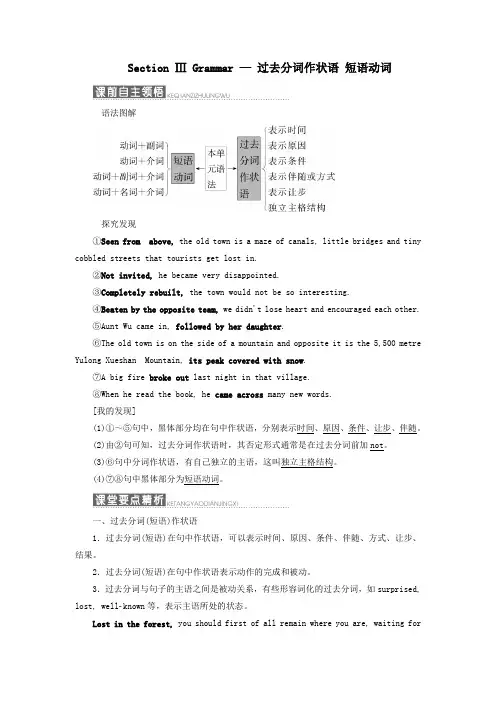
Section Ⅲ Grammar —过去分词作状语短语动词语法图解探究发现①Seen from above, the old town is a maze of canals, little bridges and tiny cobbled streets that tourists get lost in.②Not invited, he became very disappointed.③Completely rebuilt, the town would not be so interesting.④Beaten by the opposite team, we didn't lose heart and encouraged each other.⑤Aunt Wu came in, followed by her daughter.⑥The old town is on the side of a mountain and opposite it is the 5,500 metre Yulong Xueshan Mountain, its peak covered with snow.⑦A big fire broke out last night in that village.⑧When he read the book, he came across many new words.[我的发现](1)①~⑤句中,黑体部分均在句中作状语,分别表示时间、原因、条件、让步、伴随。
(2)由②句可知,过去分词作状语时,其否定形式通常是在过去分词前加not。
(3)⑥句中分词作状语,有自己独立的主语,这叫独立主格结构。
(4)⑦⑧句中黑体部分为短语动词。
一、过去分词(短语)作状语1.过去分词(短语)在句中作状语,可以表示时间、原因、条件、伴随、方式、让步、结果。
2.过去分词(短语)在句中作状语表示动作的完成和被动。
外研版高中英语选修7教学课件 Module5 Ethnic Culture
19
3.In what way are Naxi women unusual?
______________________________________ ___________
答案: They are unusual because they run Naxi society.It is usually the men who run societies.
2023/5/4
17
Step Three:Careful reading
Ⅰ.Read the text (P58-59) and match each paragraph with the main idea.
Paragraph 1
A.The Naxi
music
Paragraph 2
B.The Naxi ethnic
4.What is unusual about the Naxi language?
______________________________________
2023/5/4
___________
20
Ⅲ.True (T) or False (F).
1.Simon is studying in a university in
The Luoba language has no writing system,so most Luoba speakers use Tibetan characters.The legends of the Luoba have been passed on orally.
2023/5/4
4
The Luoba people believe that the world is filled with spirits which dominate their lives, control nature,cause disasters and give happiness.They pray to the spirits,seeking blessings and believe that shamans (萨满教 巫医) have the power to control them.
外研版选修七module 5《ethnic culture》优秀教案(重点资料).doc
Module 5 Ethnic CultureI.教学内容分析本模块以少数民族的文化为话题,介绍了我国云南省境内纳西族和白族的风情文化以及北美和澳大利亚的土著文化。
通过本模块学习,学生要学会写介绍有关少数民族的文章。
Introduction部分通过学习和复习一些描述少数民族风情、服装和地理位置等信息的词汇,学会简介云南省及其境内少数民族的概况,为本模块的学习奠定基础。
Reading and Vocabulary(1)部分选取了西蒙•韦克菲尔德的四则英文日记,通过一位外国朋友在云南旅游的所见所闻,介绍了丽江古城以及纳西族的风情文化。
让学生完成相关词汇的练习;学会归纳文章的主旨大意;并围绕文章内容,进行听、说、读、写等各项活动。
Grammar(1)部分通过观察课文中的例句,要求学生掌握过去分词短语作状语及其与状语从句的转换。
Speaking部分是阅读课文后所展开的一项活动,要求学生总结从阅读课文汲取的有关丽江和纳西族人的信息,展开讨论,在口头表达中熟练运用虚拟语气。
Listening and Vocabulary部分听取一段关于西双版纳、泼水节的对话,培养学生准确获取有效信息、完成相关练习的能力。
Grammar(2)部分的短语来自Listening and Vocabulary,让学生通过回顾录音内容,正确理解短语的意义,然后通过练习进一步巩固。
Everyday English部分选取听力材料中和主题文段相关的常见的和典型的英语习惯用语组成对话,通过补全对话的形式使学生熟练掌握这几个表达。
Speaking and Function 部分通过复习听力材料中的短语,要求学生正确运用常见的表示询问更多信息的口语表达法。
Reading and Vocabulary(2)部分是一篇介绍白族文化的文章,通过快速阅读,培养学生捕捉重点信息,把握细节信息的能力,并为本模块的写作做好铺垫。
Writing部分通过阅读课文中提供的有关信息,模仿Reading and Vocabulary(2)有关描写白族文化的写作结构,写一篇介绍少数民族—基诺族的文章。
2014-2015英语外研版选修7同步课件:Module 5 Ethnic Culture第2课时
1.1.1 集合的概念
Module 5 Ethnic Culture
Module 5
第二课时 Grammar & Everyday English & Reading Practice
1.1.1 集合的概念
Module 5 Ethnic Culture
1 课前预习新知
Module 5 第二课时
课内要点探究
Module 5 第二课时
1.apparently adv. 看起来,显然 She turned to face him, her anger apparently gone. 她转过身面向他,她的怒气显然消失了。 知识拓展 it is apparent(that) 很显然…… it is apparent from sth. that 从……可以明显看出 it is apparent to sb. that... 在某人看来很明显……
Module 5 第二课时
(4)Deeply ________(move), Tom thanked them again and again.
(5)________ (write) in a hurry, this article was not so good. 答 案 : (1)followed (2)Built (3)Born (4)moved (5)Written
Module 5 第二课时
2.resemble v.相似,类似 resemble sb./sth. in 在某方面与某人(物)相似 ①She resembles her mother in the way she moves her hands when she talks. 她说话时打手势的动作像她妈妈。 ②After the earthquake, the city resembled a battlefield. 地震过后,这座城市就像战场一样。 注意:(1)resemble不能用于进行时,也无被动语态。 (2)resemble是及物动词,本身已含有“与……”的意思, 故不与with连用。
外研版高中英语选修7 Module 5《Ethnic Culture》练习题
Module 5 Ethnic Culture—GrammarPeriod 4 Grammar (2) —- phrasal verbs■Goals●To learn the usage of some phrasal verbs■ProceduresStep 1: General introductionThe grammar items in this unit focus on phrasal verbs、 You will learn that a phrasal verb is made up of a verb plus an adverb or a preposition、 You will also learn some rules to use phrasal verbs、 You are expected to apply what you have learnt to practical use by finishing a conversation and a word game、Step 2: Explanation:1、 Look at the following sentences、 Compare them and tell the part of speech of each underlined word、He looked around and saw nothing、She is looking after the old lady carefully、In the two sentences, around is an adverb while after is a preposition、She was so ill that it seemed unlikely that she would pull through、He has gone through a difficult time recently、Here the first through is an adverb while the second through is a preposition、So we know an adverb or a preposition is used to make up a phrasal verb、2、 Try to understand the meaning of the phrasal verb ‘make out’、 Many phrasal verbs have more than one meaning、 Do you know the meanings of the phrasal verbs in the following sentences?1) His accent gives him away as a southerner、2) He gave away most of his money to charity、3) They gave away their last chance of winning the match、4) The mayor gave away the prizes at the school sports day、5) She took me in completely with her story、6) He was homeless, so we took him in、7) Fish take in oxygen through their gills、8) I hope you’re taking in what I’m saying、9) S he pays the bills by taking in washing、Step 3: Match the phrasal verbs with their meanings1、 I didn’t come across any tigers…、2、…、the Dai people make up one third of the population、3、 Oh, yes, the Dai people,I’ve heard of them、4、 So go on about your trip、5、 A Dai family put us up in their home for a week、6、 I really fell for the place、7、I’ll think it over、(a) fall in love with(b) meet or find, when you are not expecting it(c) continue(d) let someone stay in your home(e) consider(f) be a certain part of somethingStep 4: Complete the sentences with the phrasal verbs in Activity 11、 If you _____ a good book on Yunnan when you're in the bookshop, can you buy it for me?2、I’ll ____ your suggestions but I’m not sure I agree with them、3、 A friend of mine went to Yunnan and ____ a Dai woman、 They’re married now、4、 I know a lot about the Dai people but I’ve never _____ that custom、5、 An old man offered to ___ us ____ in his house、6、 Non-Han people ____ nearly 30% of Yunnan’s population、7、I’m so interested in what you’re saying、 Please _____、。
外研版高中英语选修7 Module 5《Ethnic Culture》试题精选g
Module 5 Ethnic Culture Section Ⅲ Grammar & WritingⅠ、用所给单词的适当形式填空1。
________ (dress) in a white uniform, he looks more like a cook than a doctor、2。
________ (put) into use in April 2000, the hotline was meant for residents reporting water and heating supply breakdown、3。
________ (attract) by the beauty of nature, the girl decided to spend another two weeks on the farm、4.________ (look) out of the window, I saw some children playing hide。
and.seek、5.He went to bed ________ (drink), and when he woke up, he found he still had his shoes on、6.He had an accident ________ (drive) to work yesterday、7。
________ (build) in Tang Dynasty, the temple is one of the famous places of interest in the city、8。
________ (bear) in a poor family, he had only two years of schooling、9。
Deeply ________ (move), Tom thanked them again and again、10。
外研版选修七Module5EthnicCultureWords课件
• fasten sth.__t_o_ sth. 把某物固定/贴/钉在另一物上
• fasten one's eyes __on__
凝视,盯着
• fasten one's attention on 集中注意力于;认真地考虑
• A.介、副词填空
• ①Let me fasten __u_p___the shoelace and walk a few
areas with food and clothing.
• ②The Indian army has been _e_q_u_ip_p_e_d_with
more advanced weapons.
• ③The house was _f_u_rn_is_h_e_d__with some old
tables, a blackboard, and an old stove.
• ③Tears ran down her cheeks as she told us about her
sufferings.
___流_淌____
• ④The buses run every five minutes.___行__驶__
• ⑤The shirt runs easily.___褪__色__ • ⑥He is a man who runs ahead of the time.___奔__跑_
• _m_a_k_e__ (full/good/) use of (充分)利用
• come into use
开始使用
• bring/put ...into use 启用…,把…使用起来
• It is no use doing sth.
做……是没用的
2019_2020学年高中英语Module5EthnicCultureSectionⅡGrammar课件外研版选修7
beautiful. 答案:When the park is seen from the top of the hill
新知导学
答疑解惑
随堂练习
(2)过去分词(短语)作条件状语,可转化为if,once或unless等引导的
条件状语从句。
同义句转换。
④Given another hour,I can also work out this problem.
新知导学
答疑解惑
随堂练习
★考点二 使用过去分词(短语)作状语时容易出错的两种情况。 1.忽视了分词作状语时其逻辑主语必须是主句主语。 如果分词的逻辑主语与主句的主语不一致,则可以用下列方法来 修正: (1)给分词添加自己的主语,构成独立主格结构; (2)把分词改变语态(现在分词与过去分词转换); (3)改为相应的状语从句来表达; (4)用with的复合结构。
答案:on
③你挑选了哪一本书给海伦呢?
Which book did you pick
to send to Helen?
答案:out
④站得太久了,坐下来休息真是一件愉快的事。
After standing for so long,it was a pleasure to sit 答案:down
and rest.
After the children finished their homewor,kthey went out to play football.(相应的状语从句)
With their homework finished,the children went out to play football.(with的复合结构)
,this article is not so good. 答案:Written in a hurry
最新外研版高中英语选修7《module 5 ethnic culture》grammar2教案.doc
Module 5 Ethnic Culture-GrammarPeriod 4 Grammar (2) -- phrasal verbs■Goals●To learn the usage of some phrasal verbs■ProceduresStep 1: General introductionThe grammar items in this unit focus on phrasal verbs. You will learn that a phrasal verb is made up of a verb plus an adverb or a preposition. You will also learn some rules to use phrasal verbs. You are expected to apply what you have learnt to practical use by finishing a conversation and a word game. Step 2: Explanation:1. Look at the following sentences. Compare them and tell the part of speech of each underlined word.He looked around and saw nothing.She is looking after the old lady carefully.In the two sentences, around is an adverb while after is a preposition.She was so ill that it seemed unlikely that she would pull through.He has gone through a difficult time recently.Here the first through is an adverb while the second through is a preposition. So we know an adverb or a preposition is used to make up a phrasal verb.2. Try to understand the meaning of the phrasal verb ‘make out’. Many phrasal verbs have more than one meaning. Do you know the meanings of the phrasal verbs in the following sentences?1) His accent gives him away as a southerner.2) He gave away most of his money to charity.3) They gave away their last chance of winning the match.4) The mayor gave away the prizes at the school sports day.5) She took me in completely with her story.6) He was homeless, so we took him in.7) Fish take in oxygen through their gills.8) I hope you’re taking in what I’m saying.9) S he pays the bills by taking in washing.Step 3: Match the phrasal verbs with their meanings1. I didn’t come across any tigers….2. ….the Dai people make up one third of the population.3. Oh, yes, the Dai people, I’ve heard of them.4. So go on about your trip.5. A Dai family put us up in their home for a week.6. I really fell for the place.7. I’ll think it over.(a) fall in love with(b) meet or find, when you are not expecting it(c) continue(d) let someone stay in your home(e) consider(f) be a certain part of something(g) know aboutStep 4: Complete the sentences with the phrasal verbs in Activity 11. If you _____ a good book on Yunnan when you’re in the bookshop, can you buy it for me?2. I’ll ____ your suggestions but I’m not sure I agree with them.3. A friend of mine went to Yunnan and ____ a Dai woman. They’re married now.4. I know a lot about the Dai people but I’ve never _____ that custom.5. An old man offered to ___ us ____ in his house.6. Non-Han people ____ nearly 30% of Yunnan’s population.7. I’m so interested in what you’re saying. Please _____.。
外研版高中英语选修七Module5EthnicCulture[TY]课件
DaliBeauty
DaliBeauty
Testyourself
• 1.Thelifehe________tohaschangedcompletely.
√ • A.adjustedB.suitedC.adjustedhimselfD.adopted.
• 2.Thesunshineissofaintthatwehavetowatchthepictur e_______.
• 9.,whereInvsehroarmt anlives,hebelongstothesociet y.
• 10.Hehastriedtosetuphisowncompany,butitw as________i_n_v_ai_n.
DaliBeauty
DaliBeauty
DaliBeauty
• 2.Afterawholeday’slongwalk,_____in_th_e_etnhdey reachedthesmallvillagebeforedusk.
• 3.Thepursehasbeenreturnedtotheoriginalow nerwiththehelpofitnhneoptoimliecemen.
• 6.Heleft,withoutsayingaword. • 7.Thefiremeninruahshurerdyintothehousetorescuethe
littlegirltheheavysmoke.
inspiteof
• 8.Themassofanobjectismultipliedbythespeed oflightsquared,,thespeedoinfloitghhetriwsmordusltipliedb yitself.