
语言学论文规范论文格式
语言学论文规范论文格式
1、封面
封面是学位论文的外表面,对论文起装潢和保护作用,并提供相关的信息。
博士学位论文、硕士学位论文、专业博士学位论文、专业硕士学位论文使用不同封面。
学校代码:xxxxx
学号或申请号:全日制研究生填写学号,在职申请学位人员填写申请号。
密级:非涉密(公开)论文不需标注密级,涉密论文须标注论文的密级(内部、秘密、或机密),同时还应注明相应的保密年限。
培养院系:填写所属院(系)的全名。
导师姓名:填写导师的姓名、职称(教授、研究员等)完成时间:填写论文成文打印日期。
格式:例2010年6月
2、英文封面
3、学位论文原创性声明
本部分内容直接下载,提交时学位论文作者须亲笔签名。
4、学位论文使用授权声明
本部分内容直接下载,提交时学位论文作者须亲笔签名。
5、摘要
应概括地反映出本论文的主要内容,具有独立性和自含性,包括研究工作目的、方法、结果和结论,要突出本论文的创造性成果。
摘要力求语言精炼准确,硕士学位论文建议1000 字以内,博士学位论文建议2000 字以内。
部分学生用外文撰写学位论文时,博士学位
论文的摘要应不少于5000 汉字,硕士应不少于3000 汉字。
摘要中
不可出现图片、图表、表格或其他插图材料。
6、Abstract
Abstract 内容与中文摘要相对应,应注意外文大小写、正斜体书写符合有关要求。
7、目录
目录应将文内的章节标题依次排列。
8、图和附表清单
图表较多时使用。
图的清单应有序号、图题和页码。
表的清单应有序号、表题和页码。
9、符号说明
如果论文中使用了大量的符号、标志、缩略词、首字母缩写、专门计量单位、自定义名词和术语等,应编写成注释说明汇集表。
若上述符号使用数量不多,可以不设此部分,但必须在论文中出现时加以说明。
10、正文
正文是学位论文的主体和核心部分,每一章一级标题应另起页,一般包括以下几个方面:
(1) 引言(第1章) :包括研究的目的和意义,问题的提出,选题的背景,文献综述,研究方法,论文结构安排等。
(2) 各具体章节:本部分是论文作者的研究内容,是论文的核心。
各章之间互相关联,符合逻辑顺序。
11、注释
12、参考文献
参考文献表是文中引用的有具体文字来源的文献集合。
为了反映论文的科学依据和作者尊重他人研究成果的严肃态度以及向读者提
供有关信息的出处,应列出参考文献表。
参考文献表中列出的一般应
限于作者直接阅读过的、最主要的、发表在正式出版物上的文献。
私人通信和未公开发表的资料,一般不宜列入参考文献,可紧跟在引用的内容之后在文中编号,用“脚注”的方式标注在当页的下方。
正文中引用参考文献的部位,须用上标标注[参考文献序号]。
参考文献应按文中引用出现的顺序排列。
13、附录
有些材料编入文章主体会有损于编排的条理性和逻辑性,或有碍于文章结构的紧凑和突出主题思想等,可将这些材料作为附录编排于全文的末尾。
附录的序号用A, B, C…系列,如附录A,附录B…。
附录中的公式、图和表的编号分别用A1, A2…系列;图A1,图A2…系列;表A1,表A2…系列。
每个附录应有标题。
个人简历包括出生年月日、获得学士、硕士学位的学校、时间等学术论文研究成果按发表的时间顺序列出;研究成果可以是在学期间
参加的研究项目、申请的专利或获奖情况等。
15、致谢
致谢是作者对该论文的形成作过贡献的组织或个人及参考文献的作者予以感谢的文字记载,语言要诚恳、恰当、简短。
汉语言文学本科毕业论文格式要求

汉语言文学本科毕业论文格式要求
在写汉语言文学本科毕业论文时,一般需要遵循以下格式要求:
一、封面部分:
1.论文题目:居中,字号一般为三号加粗。
3.专业名称、学院、指导教师姓名:靠下方居中,字号一般为小四
4.提交日期:靠下方居中,字号一般为小四
二、目录部分:
1.目录页标题:居中放置,字号一般为三号加粗。
2.目录内容:根据论文结构和章节安排,包括引言、正文、结论等,编号与标题之间用点线相连。
三、引言部分:
1.引言标题:居中放置,字号一般为三号加粗。
2.引言内容:简要介绍研究课题的背景、目的、意义等,可以包括相关理论、实践和前人研究成果的综述。
四、正文部分:
1.正文标题:居中放置,字号一般为三号加粗。
2.正文内容:根据论文的主题和研究内容展开论述,要结构清晰、条理清楚,论证严密、语言精练。
五、结论部分:
1.结论标题:居中放置,字号一般为三号加粗。
2.结论内容:总结与归纳研究成果,对研究课题的价值和不足进行评价,提出展望和建议。
语言学常用论文格式(APA.format)
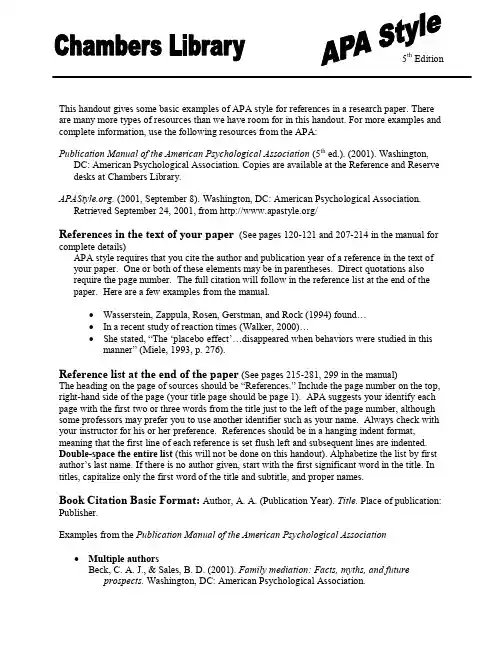
This handout gives some basic examples of APA style for references in a research paper. There are many more types of resources than we have room for in this handout. For more examples and complete information, use the following resources from the APA:Publication Manual of the American Psychological Association (5 th ed.). (2001). Washington,DC: American Psychological Association. Copies are available at the Reference and Reserve desks at Chambers Library..(2001,September 8). Washington, DC: American Psychological Association.Retrieved September 24, 2001, from /References in the text of your paper (See pages 120121 and 207214 in the manual for complete details)APA style requires that you cite the author and publication year of a reference in the text of your paper. One or both of these elements may be in parentheses. Direct quotations also require the page number. The full citation will follow in the reference list at the end of the paper. Here are a few examples from the manual.· Wasserstein, Zappula, Rosen, Gerstman, and Rock (1994) found…· In a recent study of reaction times (Walker, 2000)…· She stated, “The ‘placebo effect’…disappeared when behaviors were studied in thismanner” (Miele, 1993, p. 276).Reference list at the end of the paper (See pages 215281, 299 in the manual)The heading on the page of sources should be “References.” Include the page number on the top, righthand side of the page (your title page should be page 1). APA suggests your identify each page with the first two or three words from the title just to the left of the page number, although some professors may prefer you to use another identifier such as your name. Always check with your instructor for his or her preference. References should be in a hanging indent format, meaning that the first line of each reference is set flush left and subsequent lines are indented. Doublespace the entire list (this will not be done on this handout). Alphabetize the list by first author’s last name. If there is no author given, start with the first significant word in the title. In titles, capitalize only the first word of the title and subtitle, and proper names.Book Citation Basic Format: Author, A. A.(Publication Year). Title.Place of publication: Publisher.Examples from the Publication Manual of the American Psychological Association· Multiple authorsBeck, C. A. J., & Sales, B. D. (2001). Family mediation: Facts, myths, and futureprospects.Washington, DC: American Psychological Association.5 th Edition· Edited bookGibbs, J. T., & Huang, L. N. (Eds.). (1991).Children of color: Psychological interventions with minority youth. San Francisco: JosseyBass.· Article or chapter in an edited bookMassaro, D. (1992). Broadening the domain of the fuzzy logical model of perception. InH.L. Pick Jr., P. van den Broek, & D. C. Knill (Eds.), Cognition: Conceptual andmethodological issues (pp. 5184). Washington, DC: American PsychologicalAssociation.· Entry in an encyclopediaBergmann, P. G. (1993). Relativity. In The new encyclopaedia Britannica (Vol. 26, pp.501508). Chicago: Encyclopaedia Britannica.· Book, no author or editorMerriamWebster’s collegiate dictionary (10 th ed.). (1993). Springfield, MA: Merriam Webster.· Book, group author (government agency) as publisherAustralian Bureau of Statistics. (1991).Estimated resident population by age and sex in statistical local areas, New South Wales, June 1990 (No. 3209.1). Canberra,Australian Capital Territory: Author.Periodical Article Citation Basic Format: Author, A. A., Author, B. B., & Author, C. C. (Publication Year). Article title. Periodical Title, volume, pages.Examples from the Publication Manual of the American Psychological Association · Journal article, one author, paginated by volumeMellers, B. A. (2000). Choice and the relative pleasure of consequences. Psychological Bulletin, 126, 910924.· Journal article, journal paginated by issue, two authorsKlimoski, R., & Palmer, S. (1993). The ADA and the hiring process in organizations.Consulting Psychology Journal: Practice and Research, 45(2), 1036.· Journal article, three to six authors (list each author name individually) Saywitz, K. J., Mannarino, A. P., Berliner, L., & Cohen, J. A. (2000). Treatment for sexually abused children and adolescents. American Psychologist, 55, 10401049.· Journal article, more than six authors (list up to six authors, then “et al.”?) Wolchik, S. A., West, S. G., Sandler, I. N., Tein, J., Coatsworth, D., Lengua, L., et al.(2000). An experimental evaluation of theorybased mother and motherchildprograms for children of divorce. Journal of Consulting and Clinical Psychology, 68,843856.· Magazine article (for date, give month for monthly publications, month and day for weeklies)Kandel, E. R., & Squire, L. R. (2000, November 10). Neuroscience: Breaking down scientific barriers to the study of brain and mind. Science, 290, 11131120.· Newspaper article, no authorNew drug appears to sharply cut risk of death from heart failure. (1993, July 15). The Washington Post, p. A12.· Newspaper article, discontinuous pagesSchwartz, J. (1993, September 30). Obesity affects economic, social status. The Washington Post, pp. A1, A4.Other Forms· ERIC Document (Give ERIC document number in parentheses at the end or the entry) Mead, J. V. (1992).Looking at old photographs: Investigating the teacher tales that novice teachers bring with them (Report No. NCRTLRR924). East Lansing, MI:National Center for Research on Teacher Learning. (ERIC Document ReproductionService No. ED 346082)· For other forms, for example technical reports, papers presented at meetings, translated works, volumes in a series, citations of works discussed in a secondary source, andothers, see the Publication Manual of the American Psychological Association. Internet Site Basic Format: (See pages 231 and 268281 in the manual)A reference to an Internet source should include at least a document title or description, a date (either the date of publication or update or the date of retrieval), and an Internet address, or URL. Whenever possible, it should also include the author. Whenever possible, readers should be directed to specific documents rather than home pages. When a publication date is not available, use n.d. (no date).If a URL is too long for a single line, break it after a slash or before a period.· Multipage document created by a private organization, no dateGreater New Milford (Ct) Area Healthy Community 2000, Task Force on Teen and Adolescent Issues. (n.d.). Who has time for a family meal? You do!Retrieved October5, 2000 from · Chapter or section in an Internet documentBenton Foundation. (1998, July 7). Barriers to closing the gap. In Losing ground bit by bit: Lowincome communities in the information age (chap. 2). Retrieved August 18,2001 from /Library/LowIncome/two.html· Standalone document, no author identified, no dateGVU’s 8 th WWW user survey. (n.d.). Retrieved August 8, 2000, from/gvu/user_surveys/survey199710/· U.S. government report on government agency Web site, no publication date givenUnited States Sentencing Commission. (n.d.).1997 sourcebook of federal sentencing statistics. Retrieved December 8, 1999, from /annrpt/1997/sbtoc97.htm· Internet article based on a print sourceVandenBos, G., Knapp, S., & Doe, J. (2001). Role of reference elements in the selection of resources by psychology undergraduates [Electronic version]. Journal ofBibliographic Research, 5,117123.If the format is an exact duplicate of the print version, use the same basic journal reference format, with the addition of [Electronic version] after the article title. If you believe it may differ from the print version, add the retrieval date and URL: Retrieved October 13, 2001, from /articles.html· Article in an Internetonly journalFredrickson, B. L. (2000, March 7). Cultivating positive emotions to optimize health and wellbeing. Prevention & Treatment, 3, Article 0001a. Retrieved November 20, 2000,from /prevention/volume3/pre0030001a.html · Article from an aggregated database (An item or accession number may be added (in parentheses at the end of the retrieval statement) but is not required.)Borman, W. C., Hanson, M. A., Oppler, S. H., Pulakos, E. D., & White. L. A. (1993).Role of early supervisory experience in supervisor performance. Journal of AppliedPsychology, 78, 443449. Retrieved October 23, 2000 from PsycARTICLESdatabase.Web Citations in TextFollow the author/date format as for written sources (see pages 120121 and 207214 in the Publication Manual). For electronic sources that do not provide page numbers, use the paragraph number, if available, preceded by the ¶ symbol or the abbreviation “para.” If neither page nor paragraph numbers are visible, cite the heading and the number of the paragraph following it to direct the reader to the location of the material.(Myers, 2000, ¶ 5)(Beutler, 2000, Conclusion section, para. 1)Additional Sources for Citation and Style HelpLipson, C. (2006).Cite right: a quick guide to citation styles. Chicago: U of Chicago Press. Troyka, L. & Hesse, D. (2005).Simon & Schuster handbook for writers (7th ed). Upper Saddle River, NJ: Pearson Prentice Hall.APA Title PageYour title page should have the following:· In the upper right header, it should have the page header and page number. The page header is usually the first two or three words of the title. Put about 5 spaces or .25inch between your page header and your page number.· On the top left below the header, it should have the “Running head” or abbreviated title, which should not exceed 50 characters, including spaces and punctuation. The running head is typed in ALL UPPERCASE.· Beginning in the upper half of the page, it should have the title of your paper, centered. On the next line, it should have your name (the author). If the paper was a joint project, all contributors should be listed here. The next line has your university affiliation. All lines should be doublespaced.See pages 296298 in the manual for complete details.*Simon & Schuster Handbook for Writers (7 th ed) recommends the following in place of your university affiliation: where you would have typed your university affiliation, type your course title and section. On the following line, type the professor’s name. On the last line, type the date. It also does not mention using the running head on the title page. See pages 643658 for formatting instructions and examples. Always check with your instructor for his or her preferences.Example from Simon & Schuster Handbook for Writers (not to scale), Example from the Publication Manual of the American Psychological Association (not to scale)Biological Clocks 1Biological Clocks:The Body’s Internal TimepiecesCarlos VelezIntroduction to Psychology 115, Section P1Professor Robert SchmittNovember 17,2003Individual Differences 1 Running head: INDIVIDUAL DIFFERENCES IN BIMODAL PROCESSESIndividual Differences inBimodal Processing and Text RecallBruce R. Dunn and Kate I. RushUniversity of West Florida杭州印刷厂/。
外国语学院硕士学位论文格式规范细则
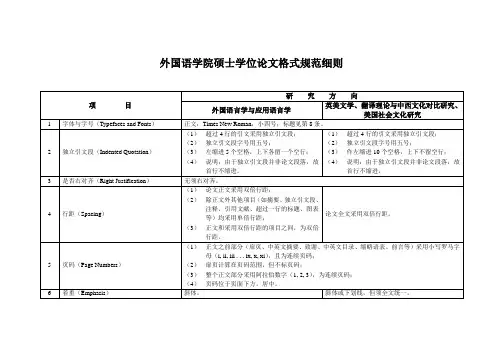
(9)引用同一作者同一年发表的不同文献时,按照“参考文献”中相关文献排列顺序,在文献发表年后加小写字母,例如:Research by Berndt (1981a) illustrated that...(p. 11).
(3)一般情况:A.如正文已出现作者,则夹注分两部分,文献出版年用圆括号,附于作者名后,在引文后用圆括号标注文献页码,例如Varonis (1984) found that the most important element in comprehending non-native speech is familiarity with the topic(p. 23).B.如正文未出现作者,则在引文后用圆括号提供文献作者、文献出版年及文献页码,例如Interactive fiction permits readers to move freely through a text and to participate in its authorship (Bolter, 2001, p. 45).;夹注中出现的文献须在“参考文献”(References)中提供详细的出版信息。
无须右对齐。
4
行距(Spacing)
(1)论文正文采用双倍行距;
(2)除正文外其他项目(如摘要、独立引文段、注释、引用文献、超过一行的标题、图表等)均采用单倍行距;
(3)正文和采用双倍行距的项目之间,为双倍行距。
语言学类毕业论文格式

外国语学院本科生英语专业毕业论文装订顺序(APA格式)(注:此格式用于文学、文化和翻译方向之外的所有论文)1.毕业论文封面(汉语)2.毕业论文首页(英语)3.致(英文)4.毕业论文英文摘要及关键词5.毕业论文中文摘要及关键词6.目录7.正文8.尾注(可选)9.参考文献(英语文献在前,汉语文献在后)10.附录(可选)附:论文模板(模板容仅供参考,毕业生可根据实际情况填写)其它不明事项请查看大学外国语学院英语专业本科生学位论文格式规定分类号:H0单位代码:10452大学毕业论文(设计)中国大学英语学习者连接副词使用情况调查姓名学号年级专业英语系(院)外国语学院指导教师三2012年 4 月 20 日The Use of Linking Adverbials by Chinese College English LearnersA Thesis Submittedto Foreign Languages School ofLinyi Universityin Partial Fulfillment of the Requirementsfor the Degree of Bachelor of ArtsByXXXXXXSupervisor:XXXXXXApril 20, 2012would like to thank all those who have given me their generous helps, commitment and enthusiasm, to complete the current paper. …The aim of this research is, through a general comparison between learners ’ corpora and NSs’ corpora, to probe into the characteristics of Chinese EFL learners with regard to their use of linking adverbials in writing and speaking, and give an impersonal description about the non-nativeness that the learners demonstrate in the use of linking adverbials. It is found that Chinese EFL learners have shown an overall overusing tendency in using linking adverbials linking adverbials are multifold, such as Key Words: Linking Adverbials; Chinese EFL learners; Use; TeachingTimes New Roman 小四号 粗体无论在口语还是在写作中,中国大学英语学习者在连接副词的使用上都有过多使用的倾向。
2011级语言学课程论文格式要求
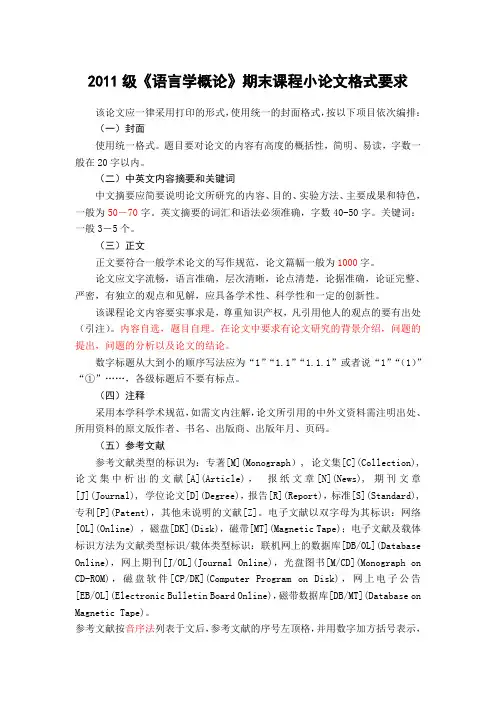
2011级《语言学概论》期末课程小论文格式要求该论文应一律采用打印的形式,使用统一的封面格式,按以下项目依次编排:(一)封面使用统一格式。
题目要对论文的内容有高度的概括性,简明、易读,字数一般在20字以内。
(二)中英文内容摘要和关键词中文摘要应简要说明论文所研究的内容、目的、实验方法、主要成果和特色,一般为50-70字。
英文摘要的词汇和语法必须准确,字数40-50字。
关键词:一般3-5个。
(三)正文正文要符合一般学术论文的写作规范,论文篇幅一般为1000字。
论文应文字流畅,语言准确,层次清晰,论点清楚,论据准确,论证完整、严密,有独立的观点和见解,应具备学术性、科学性和一定的创新性。
该课程论文内容要实事求是,尊重知识产权,凡引用他人的观点的要有出处(引注)。
内容自选,题目自理。
在论文中要求有论文研究的背景介绍,问题的提出,问题的分析以及论文的结论。
数字标题从大到小的顺序写法应为“1”“1.1”“1.1.1”或者说“1”“(1)”“①”……,各级标题后不要有标点。
(四)注释采用本学科学术规范,如需文内注解,论文所引用的中外文资料需注明出处、所用资料的原文版作者、书名、出版商、出版年月、页码。
(五)参考文献参考文献类型的标识为:专著[M](Monograph), 论文集[C](Collection), 论文集中析出的文献[A](Article),报纸文章[N](News), 期刊文章[J](Journal), 学位论文[D](Degree),报告[R](Report),标准[S](Standard),专利[P](Patent),其他未说明的文献[Z]。
电子文献以双字母为其标识:网络[OL](Online) ,磁盘[DK](Disk),磁带[MT](Magnetic Tape);电子文献及载体标识方法为文献类型标识/载体类型标识:联机网上的数据库[DB/OL](Database Online),网上期刊[J/OL](Journal Online),光盘图书[M/CD](Monograph on CD-ROM),磁盘软件[CP/DK](Computer Program on Disk),网上电子公告[EB/OL](Electronic Bulletin Board Online),磁带数据库[DB/MT](Database on Magnetic Tape)。
复旦大学英语语言专业学位论文规范格式
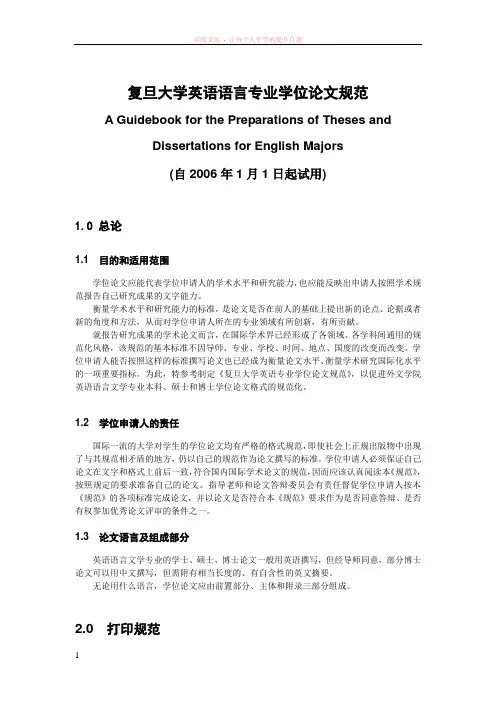
复旦大学英语语言专业学位论文规范A Guidebook for the Preparations of Theses andDissertations for English Majors(自2006年1月1日起试用)1.0 总论1.1 目的和适用范围学位论文应能代表学位申请人的学术水平和研究能力,也应能反映出申请人按照学术规范报告自己研究成果的文字能力。
衡量学术水平和研究能力的标准,是论文是否在前人的基础上提出新的论点、论据或者新的角度和方法,从而对学位申请人所在的专业领域有所创新,有所贡献。
就报告研究成果的学术论文而言,在国际学术界已经形成了各领域、各学科间通用的规范化风格,该规范的基本标准不因导师、专业、学校、时间、地点、国度的改变而改变。
学位申请人能否按照这样的标准撰写论文也已经成为衡量论文水平、衡量学术研究国际化水平的一项重要指标。
为此,特参考制定《复旦大学英语专业学位论文规范》,以促进外文学院英语语言文学专业本科、硕士和博士学位论文格式的规范化。
1.2 学位申请人的责任国际一流的大学对学生的学位论文均有严格的格式规范,即使社会上正规出版物中出现了与其规范相矛盾的地方,仍以自己的规范作为论文撰写的标准。
学位申请人必须保证自己论文在文字和格式上前后一致,符合国内国际学术论文的规范,因而应该认真阅读本《规范》,按照规定的要求准备自己的论文。
指导老师和论文答辩委员会有责任督促学位申请人按本《规范》的各项标准完成论文,并以论文是否符合本《规范》要求作为是否同意答辩、是否有权参加优秀论文评审的条件之一。
1.3 论文语言及组成部分英语语言文学专业的学士、硕士、博士论文一般用英语撰写,但经导师同意,部分博士论文可以用中文撰写,但需附有相当长度的、有自含性的英文摘要。
无论用什么语言,学位论文应由前置部分、主体和附录三部分组成。
2.0 打印规范2.1.1 纸张和打印打印:标准A4 白纸,根据论文的篇幅,可选择单面或双面打印。
大外硕士论文格式规范(英语语言学)
大连外国语大学英语语言文学(所有其它类论文)/ 外国语言学及应用语言学硕士学位论文格式规范论文基本结构和要求:除封皮、校内外评阅人与导师签字页、中文摘要、授权书四部分外,论文其余部分一律用英文撰写,论文的文献引用格式严格遵循APA规范,中文文献遵循本格式规范规定的格式。
1.封皮:由研究生部统一提供。
2.扉页:1) 所在大学名称;2) 论文题目;3) 学位专业培养院/系/申请答辩学位;4) 论文作者姓名;5) 毕业年月(格式见附页1)。
3.校内外评阅人、导师签字页:研究生部网上主页下载(需要校外评阅人、校内评阅人、指导教师、答辩委员会主席签字)。
4.英文摘要:约350个单词(控制在1页之内),包括:1)ABSTRACT(大写);2)摘要内容;3)3-5个关键词(排在摘要内容的左下方,关键词之间用“逗号”隔开。
e.g. Key Words:Halliday, frame theory, dynamic context)。
5.中文摘要:将英文摘要译成中文(控制在1页之内),包括:1)摘要;2)论文题目;3)作者姓名;4)摘要内容;5)3-5个关键词(排在摘要内容的左下方,关键词之间用“分号”隔开。
例如:关键词:韩礼德;框架理论;动态语境)。
6.致谢:ACKNOWLEDGMENTS (大写)。
7.目录:CONTENTS(大写)(格式见附页2)。
8.正文:长度为约25,000英语单词(A4纸约60页)。
9.正文内引注格式说明:(1) 英语文内引注方法采用APA格式。
(2) 汉语文内引注方法:(作者的姓逗号出版年逗号页码)。
注意:一页之内页码用“p. ”,多页页码用“pp. ”表示,中文作者用姓氏的汉语拼音,例如:(Xu, 1999, p.87)。
如果引用同一个作者的多部作品,可在年后加a,b等,例如:(Xu, 1999a, pp. 88-90)。
如果引用文献中有重姓的作者,应在标注时使用作者的全名,例如:(Xu Shirong, 1999, p. 87)。
汉语言文学毕业论文格式和规范要求
汉语⾔⽂学毕业论⽂格式和规范要求汉语⾔⽂学毕业论⽂格式和规范要求 论⽂⼀般由题名、作者、摘要、关键词、正⽂、参考⽂献和附录等部分组成,其中部分组成(例如附录)可有可⽆。
论⽂各组成的排序为:题名、作者、摘要、关键词、英⽂题名、英⽂摘要、英⽂关键词、正⽂、参考⽂献、附录和致谢。
论⽂格式就是指进⾏论⽂写作时的样式要求,以及写作标准。
直观的说,论⽂格式就是论⽂达到可公之于众的标准样式和内容要求。
下⾯推荐汉语⾔⽂学的毕业论⽂格式要求。
⼀、基本要求: 1.毕业论⽂应由学⽣本⼈在专业教师的指导下独⽴完成,不得抄袭和剽窃他⼈成果。
3.毕业论⽂选题原则上⼀⼈⼀题。
4.毕业论⽂应当具备学术⽂体的⼀般特征。
调查报告、⼯作总结及⽂学作品等各类⾮学术⽂体的⽂章不能作为毕业论⽂。
5.毕业论⽂字数要求:正⽂字数本科6000字以上,专科3000字以上(指论⽂主体部分,不包括前置部分和附录部分)。
⼆、进程计划 1、7⽉布置论⽂写作进程。
2、9⽉15⽇前,学⽣完成毕业论⽂初稿,将初稿交⾄班主任。
3、10⽉15⽇前,指导教师通知学⽣修改,学⽣应在指导教师的指导下修改⼆稿,并做修改记录; 4、11⽉15⽇前,在教师的指导下,学⽣完成论⽂的三稿。
5、12⽉1⽇前最终定稿。
6、12⽉中旬本科学⽣参加论⽂答辩。
(具体时间再另⾏通知) 三、注意事项 1、每周主动和指导教师联系⼀次,汇报进展,听取指导教师意见,中期将书⾯报告材料交指导教师。
2、独⽴完成任务,杜绝抄袭、⽹上下载、请⼈代笔等弄虚作假的⾏为。
3、若不能按进程要求完成的,指导教师将取消学⽣本学期毕业论⽂写作资格。
4、论⽂字数、论⽂格式严格按有关要求执⾏。
1.引⾔ 1.1制定本标准的⽬的是为了统⼀规范我省电⼤汉语⾔⽂学类本科毕业论⽂的格式,保证毕业论⽂质量。
1.2毕业论⽂应采⽤最新颁布的汉语简化⽂字,符合《出版物汉字使⽤管理规定》,由作者在计算机上输⼊、编排与打印完成。
语言学论文撰写规范与发表
语言学论文撰写规范与发表在学术研究领域,撰写一篇规范并成功发表的语言学论文对于学者们而言至关重要。
本文旨在介绍语言学论文撰写的规范要求以及发表的一般步骤,希望能够为学者们提供一些建议和指导。
一、引言引言是论文的开篇部分,主要包括研究背景、研究问题的提出以及研究目的等内容。
在撰写引言时,需要明确论文的研究目标,并简要介绍相关研究领域的现状和研究重点,引起读者对论文主题的兴趣。
二、文献综述在论文的文献综述部分,需要对相关领域的研究成果进行综述和分析。
文献综述要全面、客观地介绍已有研究的理论框架和方法,并指出当前研究存在的问题和不足之处。
通过文献综述,可以归纳出自己研究的切入点和创新之处。
三、方法与材料论文的方法与材料部分需要详细描述研究所采用的方法和研究材料。
包括研究设计、实验步骤、数据采集方式等等。
在描述方法时,要准确明确地叙述研究过程,并提供足够的信息便于他人复现研究。
四、结果与讨论在结果与讨论部分,需要系统地呈现研究的结果,并对结果进行全面深入的分析和解读。
要注意对结果的客观描述,并结合相关理论和文献对结果进行合理的解释。
此外,可以提出自己的观点和假设,并与其他研究进行比较和讨论。
五、结论与展望结论部分包括对研究结果的总结和归纳,以及对进一步研究方向的展望。
结论要简明扼要,概括研究的主要发现,并强调对相关领域的学术价值和实际意义。
展望部分可以提出对未来研究的建议和期望,拓宽该领域的研究视野。
六、参考文献参考文献是论文的重要组成部分,需要列举出所有在论文中引用的文献资料。
在列举文献时,应按照一定的格式规范进行排版,包括作者姓名、文章标题、期刊名称等信息。
参考文献的引用要准确、规范,避免出现任何错误。
七、发表步骤成功发表语言学论文需要经过以下步骤:首先,选择合适的期刊或会议,确保其与研究方向相符。
其次,按照期刊或会议的投稿要求,准备好完整的论文稿件。
然后,提交论文并等待审稿结果。
一般来说,审稿过程包括初审、专家评审、修改答辩等环节。
语言学方向 文献格式
语言学方向学位论文文献格式文献引用和参考文献格式:语言学方向使用APA格式文献引用是在一篇文章的段落或文字之中“参考来源”的标注。
APA格式的引用格式:通常来说,一个引用包含了作者名和发表日期,以括号夹注(有时会加上页数),放在引用文字或句子之后。
详细的引用或参考资料则放在位于文章最后的“参考文献”或“Reference”部分。
APA格式明确的定义“参考文献”只放入文章内容引用的来源。
1. 文献引用作者名字如果是英文,文中引用时都仅引其姓。
比如引用语言学家Rod Ellis 于1996年的专著,可用:Ellis (1996) .. ..转述某作者或某文献的基本或主题观点或仅提及该作者或该文献,只需给出文献的出版年,如:陈前瑞(2003)认为,汉语的基本情状体分为四类,即状态、活动、结束、成就。
直接或间接引述某一具体观点,须给出文献的页码,格式是“出版年:页码”,如:吕叔湘(2002:117)认为,。
如作者的名字不是正文语句的一个成分,可将之连同出版年、页码一起置于圆括号内,如:这是社交语用迁移的影响,即“外语学习者在使用目的语时套用母语文化中的语用规则及语用参数的判断”(何兆熊2000:265)。
圆括号内的参引如果不止一条,一般按照出版年排序。
同一作者的两条参引之间用逗号隔开,如:Dahl (1985, 2000a, 2000b );不同作者的参引之间用分号隔开。
文献作者如果是两个人,参引时引两个人的名字。
中文的格式是在两个名字之间加顿号,如“吕叔湘、朱德熙(1952)”;英文的格式是在两个姓之间加&号,表示“和”,如(Li & Thompson 1981)。
文献作者如果是三人或三人以上,参引时仅引第一作者的名字。
中文的格式是在第1作者名字之后加等字,如“何兆熊等(2000)”;英文的格式是在第一作者的姓之后加拉丁缩略语“et al.”,如“Quirk et al.(1985)”,et al.为斜体。