
英语六级2014年12月真题及答案(第二套)
2014年12月大学英语六级考试真题(二)Part Ⅱ Listening Comprehension (30 minutes)Section A注意:此部分试题请在答题卡1上作答。
1.A. In a parking lot.B.At a grocery.C. At a fast food restaurant.D. In a car showroom.2.A. Change her position now and then.B.Stretch her legs before standing up.C. Have a little nap after lunch.D. Get up and take a short walk.3.A. The students should practice long-distance running.B.The students' physical condition is not desirable.C. He doesn't quite believe what the woman says.D. He thinks the race is too hard for the students.4.A. They will get their degrees in two years.B.They are both pursuing graduate studies.C. They cannot afford to get married right now.D. They do not want to have a baby at present.5.A. He must have been mistaken for Jack.B.Twins usually have a lot in common.C. Jack is certainly not as healthy as he is.D. He has not seen Jack for quite a few days.6.A. The woman will attend the opening of the museum.B.The woman is asking the way at the crossroads.C. The man knows where the museum is located.D. The man will take the woman to the museurn.7.A. They cannot ask the guy to leave.B.The guy has been coming in for years.C. The guy must be feeling extremely lonely.D. They should not look down upon the guy.8.A. Collect timepieces.B.Become time-conscious.C. Learn to mend clocks.D. Keep track of his daily activities.Questions 9 to 11 are based on the conversation you have just heard.9.A. It is eating into its banks.B.It winds its way to the sea.C. It is wide and deep.D. It is quickly rising.10.A. Try to speed up the operation by any means.B.Take the equipment apart before being ferried.C. Reduce the transport cost as much as possible.D. Get the trucks over to the Other side of the river.11.A. Find as many boats as possible.B.Cut trees and build rowing boats.C. Halt the operation until fu.rther orders.D. Ask the commander to send a helicopter.Questions 12 to 15 are based on the conversation you have just heard.12.A. Talk about his climbing experiences.B.Help him join an Indian expedition.C. Give up mountain climbing altogether.D. Save money to buy climbing equipment.13.A. He was the first to conquer Mr. Qomolangma.B.He had an unusual religious background.C. He climbed mountains to earn a living.D. He was very strict with his children.14.A. They are to be conquered.B.They are to be protected.C. They are sacred places.D. They are like humans.15.A. It was his father's training that pulled him through.B.It was a milestone in his mountain climbing career.C. It helped him understand the Sherpa view of mountains.D. It was his father who gave him the strength to succeed.Section BDirections: In this section, you will hear 3 short passages. At the end of each passage, you will.hear somequestions. Both the passage and the questions will be spoken only once. After you hear a question, youmust choose the best answer from the four choices marked A ), B ), C ) and D ). Then mark thecorresponding letter on ,Answer Sheet 1 with a single line through the centre. 注意:此部分试题请在答题卡1上作答。
Passage OneQuestions 16 to 19 are based on the passage you have just heard.16.A. By showing a memorandum's structure.B.By analyzing the organization of a letter.C. By comparing memorandums with letters.D. By reviewing what he has said previously.17.A. They ignored many of the memorandums they received. B.They placed emphasis on the format of memorandums.C. They seldom read a memorandum through to the end;D. They spent a lot of time writing memorandums.18.A. Style and wording.B.Directness and clarity.C. Structure and length.D. Simplicity and accuracy.19.A. Inclusion of appropriate humor.B.Direct statement of purpose.C. Professional look.D. Accurate dating.Passage TwoQuestions 20 to 22 are based on the passage you have just heard.20.A. They give top priority to their work efficiency.B.They make an effort to lighten their workload.C. They try hard to make the best use of their time.D. They never change work habits unless forced to.21.A. Sense of duty.B.Self-confidence.C. Work efficiency.D. Passion for work.22.A. They find no pleasure in the work they do.B.They try to avoid work whenever possible.C. They are addicted to playing online games.D. They simply have no sense of responsibility.Passage Three Questions 23 to 25 are based on the passage you have just heard.23.A. He lost all his property.B.He was sold to a circus.C. He ran away from his family.D. He was forced into slavery.24.A. A carpenter.B.A master of his.C. A businessman.D. A black drummer.25.A. It named its town hall after Solomon Northup,B.It freed all blacks in the town from slavery.C. It declared July 24 Solomon Northup Day.D. It hosted a reunion for the Northup family.Section CDirections: In this section, you will hear a passage three times. When the passage is read for the firs~ time,you should listen carefully for its general idea .. When the passage is read for the second time, you arerequired to fill in the blanks with the exact words you have just heard. Finally, when the passage is read forthe third time, you should check what you have written.注意:此部分试题请在答题卡1上作答。
2014年12月大学英语六级真题试卷(二)(题后含答案及解析)
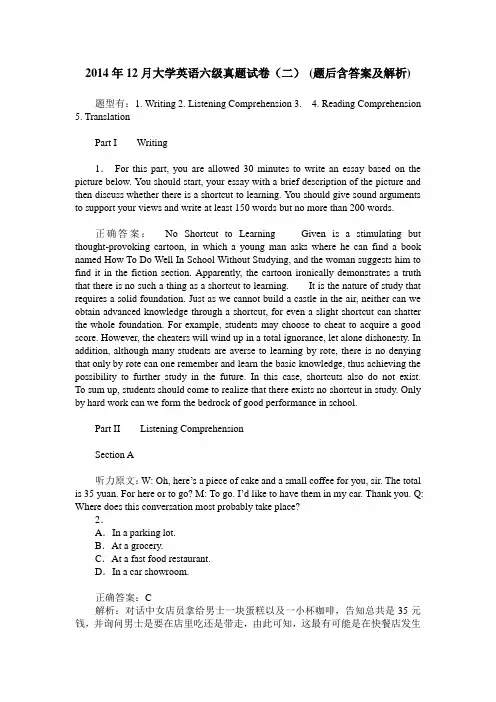
2014年12月大学英语六级真题试卷(二)(题后含答案及解析)题型有:1. Writing 2. Listening Comprehension 3. 4. Reading Comprehension 5. TranslationPart I Writing1.For this part, you are allowed 30 minutes to write an essay based on the picture below. You should start, your essay with a brief description of the picture and then discuss whether there is a shortcut to learning. You should give sound arguments to support your views and write at least 150 words but no more than 200 words.正确答案:No Shortcut to Learning Given is a stimulating but thought-provoking cartoon, in which a young man asks where he can find a book named How To Do Well In School Without Studying, and the woman suggests him to find it in the fiction section. Apparently, the cartoon ironically demonstrates a truth that there is no such a thing as a shortcut to learning. It is the nature of study that requires a solid foundation. Just as we cannot build a castle in the air, neither can we obtain advanced knowledge through a shortcut, for even a slight shortcut can shatter the whole foundation. For example, students may choose to cheat to acquire a good score. However, the cheaters will wind up in a total ignorance, let alone dishonesty. In addition, although many students are averse to learning by rote, there is no denying that only by rote can one remember and learn the basic knowledge, thus achieving the possibility to further study in the future. In this case, shortcuts also do not exist. To sum up, students should come to realize that there exists no shortcut in study. Only by hard work can we form the bedrock of good performance in school.Part II Listening ComprehensionSection A听力原文:W: Oh, here’s a piece of cake and a small coffee for you, sir. The total is 35 yuan. For here or to go? M: To go. I’d like to have them in my car. Thank you. Q: Where does this conversation most probably take place?2.A.In a parking lot.B.At a grocery.C.At a fast food restaurant.D.In a car showroom.正确答案:C解析:对话中女店员拿给男士一块蛋糕以及一小杯咖啡,告知总共是35元钱,并询问男士是要在店里吃还是带走,由此可知,这最有可能是在快餐店发生的对话,故答案为C)。
2014年12月全国大学英语六级考试真题及答案(第二套)
Section AHis future subjects have not always treated the Prince of Wales with the respect o ne XXXX expect. They laughed aloud in 1986 when the heir to the British(36)_____ t old a TV reporter that he talked to his plants at his country house, Highgrove, to stimu late their growth. The Prince was being humorous- “My sense of humor will get me in to trouble one day”, he said to his aids(随从)-but listening to Charles Windsor can ind eed prove stimulating. The royal(37)_____ has been promoting radical ideas for most of his adult life. Some of his(38)_____, which once sounded a bit weird, were simply ahead of their time. Now, finally, the world seems to be catching up with him. Take hi s views on farming. Prince Charles’ Duchy Home Farm went(39)_____ back in 1986. When most shoppers cared only about the low price tag on suspiciously blemish-free (无瑕疵的) vegetables and(40)_____ large chickens piled high in supermarkets.His warnings on climate change proved farsighted,too.Charles began(41)_____ a ction in warming in 1990 and says he has been worried about the(42)_____ of man on the environment same be was a teenger.Although he was gradually gained international(43)_____ as one of the world's l ending conservationists,many British people still think of him as an(44)_____ person who talks to plants.This year,as it happens,South Korean scientists proved that plants really do(45)_____ to round.So Charles was ahead of the game there,too.A.conformB.eccentricC.environmentalistD.expeditionsE.impactF.notion sanic H.originally I.recognition J.respond K.subordinate L.suppressi ng M.throne N.unnaturally O.urgingSection BDirections: In this section,you are going to read a passage with ten statements a ttached to it. Each statement contains information given in one of the paragraphs. Iden tify the paragraph from which the information is derived. You may choose a paragrap h more than once. Each paragraph is marked with a letter. Answer the questions by marking the corresponding letter on Answer Sheet 2. High School Sports Aren’t Killing AcademicsA)In this month’s Atlantic cover article, “The Case Against High-School Sports,” Amanda Ripley argues that school-sponsored sports programs should be seriously cut. She writes that, unlike most countries that outperform the United States on internatio nal assessments, American schools put too much of an emphasis on athletics, “ Sports are embedded in American schools in a way they are not almost anywhere e lse,” she writes, “Yet this difference hardly ever comes up in domestic debates about America’s international mediocrity(平庸)in education.”B)American student-athletes reap many benefits from participating in sports, but the costs to the schools could outweigh their benefits, she argues, In particular, Ripley contends that sports crowd out the academic missions of schools: America should lea rn from South Korea and Finland and every other country at the top level of internatio nal test scores, all of whom emph asize athletics far less in school. ”Even in eighth gra de, American kids spend more than twice the time Korean kids spend playing sports,” she writes, citing a 2010 study published in the Journal of Advanced Academics.C)It might well be true that sports are far more rooted in American high schools t han in other countries. But our reading of international test scores finds no support for the argument against school athletics. Indeed, our own research and that of others lea d us to make the opposite case. School-sponsored sports appear to provide benefits tha t seem to increase, not detract(减少)from, academic success.D)Ripley indulges a popular obsession(痴迷)with international test score compar isons, which show wide and frightening gaps between the United States and other cou ntries. She ignores, however, the fact that states vary at least as much in test scores as do developed countries. A 2011 report from Harvard University shows that Massachu setts produces math scores comparable to South Korea and Finland, while Mississippi scores are closer to Trinidad and Tobago. Ripley’s thesis about sports falls apart in li ght of this fact. Schools in Massachusetts provide sports programs while schools in Fi nland do not. Schools in Mississippi may love football while in Tobago interscholastic sports are nowhere near as prominent. Sports cannot explain these similarities in per formance. They can’t explain international differences either.E)If it is true that sports undermine the academic mission of American schools, we would expect to see a negative relationship between the commitment to athletics a nd academic achievement. However, the University of Arkansas’s Daniel Bowen and Jay Greene actually find the opposite. They examine this relationship by analyzing sc hools’ sports wi nning percentages as well as student-athletic participation rates compa red to graduation rates and standardized test score achievement over a five-year perio d for all public high schools in Ohio. Controlling for student poverty levels, demograp hics(人口统计状况), and district financial resources, both measures of a school’s com mitment to athletics are significantly and positively related to lower dropout rates as well as higher test scores.F)On-the-field success and high participation in sports is not random-it requires f ocus and dedication to athletics. One might think this would lead schools obsessed wit h winning to deemphasize academics. Bowen and Greene’s results contradict that arg ument. A likely explanation for this seemingly counterintuitive(与直觉相反的)result is that success in sports programs actually facilitates or reflects greater social capital within a school’s community.G)Ripley cites the writings of renowned sociologist James Coleman, whose resea rch in education was groundbreaking. Coleman in his early work held athletics in cont empt, arguing that they crowded out schools’ academic missions. Ripley quotes his 19 61 study, The Adolescent Society, where Coleman writes, “Altogether, the trophy(奖品)case would suggest to the innocent visitor that he was entering an athletic club, not an educational institution.”H)However, in later research Coleman would show how the success of schools is highly dependent on what he termed social capital, “the social networks, and the relat ionships between adults and children th at are of value for the child’s growing up.”I)According to a 2013 evaluation conducted by the Crime Lab at the University o f Chicago, a program called Becoming a Man-Sports Edition creates lasting improvements in the boys’ study habits and grade point ave rages. During the first year of the p rogram, students were founds to be less likely to transfer schools or be engaged in viol ent crime. A year after the program, participants were less likely to have had an encou nter with the juvenile justice system.J)If school-sponsored sports were completely eliminated tomorrow, many Ameri can students would still have opportunities to participate in organized athletics elsewh ere, much like they do in countries such as Finland, Germany, and South Korea. The s ame is not certain when it comes to students from more disadvantaged backgrounds. I n an overview of the research on non-schoolbased after-school programs, researchers find that disadvantaged children partici pate in these programs at significantly lower rates. They find that low-income student s have less access due to challenges with regard to transportation, non-nominal fees, a nd off-campus safety. Therefore, reducing or eliminating these opportunities would m ost likely deprive disadvantaged students of the benefits from athletic participation, no t least of which is the opportunity to interact with positive role models outside of regu lar school hours.K)Another unfounded criticism that Ripley makes is bringing up the stereotype t hat athletic XX are typically lousy(蹩脚的)c lassroom teachers. “American principals, unlike the XX XX of principals around the world, make many hiring decisions with th eir sports teams in mind, which does not always end well for students,” she writes. Ed ucators who seek employment at schools primarily for the purpose of coaching are lik ely to shirk(推卸)teaching responsibilities, the argument goes. Moreover, even in the cases where the employee is a teacher first and athletic coach second, the additional re sponsibilities that come with coaching likely comes at the expense of time otherwise s pent on planning, grading, and communicating with parents and guardians.L)The data, however, do not seem to confirm this stereotype. In the most rigorou s study on the classroom results of high school coaches, the Un iversity of Arkansas’s Anna Egalite finds that athletic coaches in Florida mostly tend to perform just as well as their non-coaching counterparts, with respect to raising student test scores. We do n ot doubt that teachers who also coach face serious tradeoffs that likely come at the expense of time they could dedicate to their academic obligations. However, as with spo rting events, athletic coaches gain additional opportunities for communicating and ser ving as mentors(导师)that potentially help students succeed and make up for the costs of coaching commitments.M)If schools allow student-athletes to regularly miss out on instructional time for the sake of traveling to athletic competitions, that’s bad. However, such issues would be better addressed by changing school and state policies with regard to the schedulin g of sporting events as opposed to total elimination. If the empirical evidence points t o anything, it points towards school sponsored sports providing assets that are well wo rth the costs.N)Despite n egative stereotypes about sports culture and Ripley’s presumption th at academics and athletics are at odds with one another, we believe that the greater bo dy of evidence shows that school-sponsored sports programs appear to benefit student s. Successes on the playing field can carry over to the classroom and vice versa(反之亦然). More importantly, finding ways to increase school communities’ social capital is imperative to the success of the school as whole, not just the athletes.46.Stunets from low-income families have less access to off-campus sports progr ams.47.Amanda Ripley argues that America should learn from other countries that ra nk high in international tests and lay less emphasis on athletics.48.According to the author,Amanda Ripley fails to note that stunents'performance in exams varies from state to state.49.Amanda Ripley thinks that athletic coaches are poor at classroom instruction.50.James Coleman's later resrarch make an argument for a school's social capital.51.Reaearchers find that there is a ppsitive relationship between a school's comm itment toathletics and academic achievements.52.Aa rigorous study finds that athletic coaches also do well in raising students'te st scores.53.According to an evaluation,spograms contribute to students's academic prefor mance and character building.54.Amanda Ripley believes the emphasis on school sports shuold be brought up when trying to understand why Aamerican students are mediocre.55.James Coleman suggests in his earlier writings that school athletics would un dermine a school's image.Section CDirections: There are 2 passages in this section. Each passage is followed by som e questions or unfinished statements. For each of them there are four choices marked A, B, C and D. . You should decide on the best choice and mark the corresponding let ter on Answer Sheet 2 with a single line through the centre.Passage oneIt is easy to miss amid the day-to-day headlines of global economic recession, bu t there is a less conspicuous kind of social upheaval(剧变)underway that is fast alterin g both the face of the planet and the way human beings live. That change is the rapid acceleration of urbanization. In 2008, for the first time in human history, more than ha lf the world’s population was living in towns and cities. And as a recently published p aper shows, the process of urbanization will only accelerate in the decades to come—with an enormous impact on biodiversity and potentially on climate change.As Karen Seto, the led author of the paper, points out, the wave of urbanization i sn’t just about the migration of people into urban environments, but about the environ ments themselves becoming bigger to accommodate all those people. The rapid expansion of urban areas will have a huge impact on biodiversity hotspots and on carbon e missions in those urban areas.Humans are the ultimate invasive species—when the move into new territory, the often displace the wildlife that was already living there. And as land is cleared for tho se new cities—especially in the dense tropical forests—carbon will be released into th e atmosphere as well. It’s true that as people in developing nations move from the cou ntryside to the city, the shift may reduce the pressure on land, which could in turn be good for the environment. This is especially so in desperately poor countries, where re sidents in the countryside slash and burn forests each growing season to clear space fo r farming. But the real difference is that in developing nations, the move from rural ar eas to cities often leads to an accompanying increase in income — and that increase le ads to an increase in the consumption of food and energy, which in turn causes a rise i n carbon emissions. Getting enough to eat and enjoying the safety and comfort of livi ng fully on the grid is certainly a good thing — but it does carry an environmental pri ce. The urbanization wave can’t be stopped —and it shouldn’t be. But Seto’s paper d oes underscore the importance of managing that transition. If we do it the right way, we can reduce urbanization’s impact on the environment. “There’s an enormous oppo rtunity here, and a lot of pressure and responsibility to think about how we urbanize,” says Seto. “One thing that’s clear is that we can’t build cities the way we have over th e last couple of hundred years. The s cale of this transition won’t allow that.” We’re he aded towards an urban planet no matter what, but whether it becomes heaven or hell is up to us.56. What issue does the author try to draw people’s attention to?A. The shrinking biodiversity worldwide.B. The rapid increase of world population.C. The ongoing global economic recession.D. The impact of accelerating urbanization.57. In what sense are humans the ultimate invasive species?A. They are much greedier than other species.B. They are a unique species born to conquer.C. They force other species out of their territories.D. They have an urge to expand their living space.58. In what way is urbanization in poor countries good for the environment?A. More land will be preserved for wildlife.B. The pressure on farmland will be lessened.C. Carbon emissions will be considerably reduced.D. Natural resources will be used more effectively.59. What does the author say about living comfortably in the city?A. It incurs a high environmental price.B. It brings poverty and insecurity to an end.C. It causes a big change in people’s lifestyle.D. It narrows the gap between city and country.60. What can be done to minimize the negative impact of urbanization according to Seto?A. Slowing down the speed of transition.B. Innovative use of advanced technology.C. Appropriate management of the process.D. Enhancing people’s sense of responsibility.Passage TwoWhen Harvard student Mark Zuckerberg launched in Feb. 2004, even he could not imagine the forces it would let loose. His intent was to connect coll ege students. Facebook, which is what this website rapidly evolved into, ended up con necting the world.To the children of this connected era, the world is one giant social network. They are not bound — as were previous generations of humans — by what they were taugh t. They are only limited by their curiosity and ambition. During my childhood, all kno wledge was local. You learned everything you knew from your parents, teachers, prea chers, and friends.With the high-quality and timely information at their fingertips, today’s children are rising normally tame middle class is speaking up against social ills. Silicon Valley executives are being shamed into adding women to their boards. Political leaders are marshalling the energy of millions for elections and political causes. All of this is bein g done with social media technologies that Facebook and its competitors set free.As does every advancing technology, social media has created many new proble ms. It is commonly addictive and creates risks for younger users. Social media is used by extremists in the Middle East and elsewhere to seek and brainwash recruits. And it exposes us and our friends to disagreeable spying. We may leave our lights on in the house when we are on vacation, but through social media we tell criminals exactly wh ere we are, when we plan to return home, and howtoblackmail(敲诈)us.;Governmen tsdon’tneedinfo;Themarketersarealsoseein;Regardlessofwhatsocialme;61.Whatw asthepurposeofFa;A.Tohelpstudentsconnectw;B.Tobringuniversitystude;C.Tohel phow to blackmail(敲诈)us.Governments don’t need informers any more. Social media allows government a gencies to spy on their own citizens. We record our thoughts, emotions, likes and dislikes on Facebook; we share our political views, social preferences, and plans. We post intimate photographs of ourselves. No spy agency or criminal organization could activ ely gather the type of data that we voluntarily post for them.The marketers are also seeing big opportunities. Amazon is trying to predict wha t we will order. Google is trying to judge our needs and wants based on our social-me dia profiles. We need to be aware of the risks and keep working to alleviate the dange rs.Regardless of what social media people use, one thing is certain: we are in a peri od of accelerating change. The next decade will be even more amazing and unpredicta ble than the last. Just as no one could predict what would happen with social media in the last decade, no one can accurately predict where this technology will take us. I am optimistic, however, that a connected humanity will find a way to uplift itself.61. What was the purpose of Facebook when it was first created?A. To help students connect with the outside world.B. To bring university students into closer contact.C. To help students learn to live in a connected era.D. To combine the world into an integral whole.62. What difference does social media make to learning?A. Local knowledge and global knowledge will merge.B. Student will become more curious and ambitious.C. People are able to learn wherever they travel.D. Sources of information are greatly expanded.63. What is the author’s greatest concern with social media technology?A. Individuals and organizations may use it for evil purposes.B. Government will find it hard to protect classified information.C. People may disclose their friends’ information unintentionally.D. People’s attention will be easily distractedfrom their work in hand.64. What do businesses use social media for?A. Creating a good corporate image.B. Conducting large-scale market surveys.C. Anticipating the needs of customers.D. Minimizing possible risks and dangers.65. What does the author think of social media as a whole?A. It will enable human society to advance at a faster pace.B. It will pose a grave threat to our traditional ways of life.C. It is bound to bring about another information revolution.D. It breaks down the final barriers in human communication.Part IV Translation (30 minutes)Directions: For this part, you are allowed 30 minutes to translate a passage from Chinese into English. You should write your answer on Answer Sheet 2.翻译题一:自从1978年启动改革以来,中国已从计划经济转为以市场为基础的经济,经历了经济和社会的快速发展。
2014年12月英语六级真题及答案详解
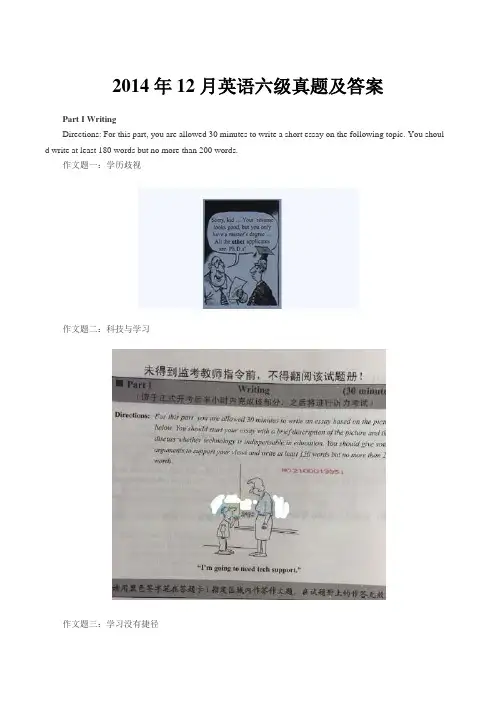
2014年12月英语六级真题及答案Part I WritingDirections: For this part, you are allowed 30 minutes to write a short essay on the following topic. You shoul d write at least 180 words but no more than 200 words.作文题一:学历歧视作文题二:科技与学习作文题三:学习没有捷径Part II ListeningSection ADirections:In this section,you will hear 8 short conversations and 2 long conversations. At the end of each conversation, one or more questions will be asked about what was said. Both the conversation an d the questions will be spoken only once. After each question there will be a pause. During the pause, y ou must read the four choices marked A) , B) , C) and D),and decide which is the best answer. Then mark the corresponding letter on Answer Sheet I with a single line through the centre.Question 1A.At a groceryB.In a parking lotC.In a car showroomD.At a fast food restaurantQuestion 2A.Have a little nap after lunchB.Get up and take a short walkC.Change her position now and thenD.Stretch legs before standing upQuestion 3A.The students should practice long-distance runningB.He doesn’t quite believe what the woman saysC.The students’ physical condition is not desirableD.He thinks the race is too hard for the studentsQuestion 4A.They do not want to have a baby at presentB.They cannot afford to get married right nowC.They are both pursuing graduate studiesD.They will get their degrees in two yearsQuestion 5A.Twins usually have a lot in commonB.He must have been mistaken for JackC.Jack is certainly not as healthy as he isD.He has not seen Jack for quite a few daysQuestion 6A.The man will take the woman wo the museumB.The man knows where the museum is locatedC.The woman is asking the way at the crossroadsD.The woman will attend the opening of the museumQuestion 7A.They cannot ask the guy to leaveB.The guy has been coming in for yearsC.They should not look down upon the guyD.The guy must be feeling extremely lonelyQuestion 8A.Collect timepiecesB.Become time-consciousC.Learn to mend locksD.Keep track of his daily activitiesQuestions 9 to 11 are based on the conversation you have just heard. Question 9A.It winds its way to the seaB.It is quickly risingC.It is eating into its banksD.It is wide and deepQuestion 10A.Get the trucks over to the other side of the riverB.Take the equipment apart before being ferriedC.Reduce the transport cost as much as possibleD.Try to speed up the operation by any meansQuestion 11A.Ask the commander to send a helicopterB.Halt the operation until further ordersC.Cut trees and build rowing boatsD.Find as many coats as possibleQuestions 12 to 15 are based on the conversation you have just heard.Question 12A.Help him join an Indian expeditionB.Talk about his climbing experiencesC.Give up mountain climbing altogetherD.Save money to buy climbing equipmentQuestion 13A.He was very strict with his childrenB.He climbed mountains to earn a livingC.He had an unusual religious backgroundD.He was the first to conquer Mt. QomolangmaQuestion 14A.They are like humansB.They are sacred placesC.They are to be protectedD.They are to be conqueredQuestion 15A.It was his father’s training that pilled him throughB.It was a milestone in his mountain climbing careerC.It was his father who gave him the strength to succeedD.It helped him understand the Sherpa view of mountainsSection BDirections:In this section,you will hear 3 short passages. At the end of each passage,you will he ar some questions. Both the passage and the questions will be spoken only once. After you hear a questi on, you must choose the best answer from the four choices marked A), B), C)and D). Then mark the cor responding letter on Answer Sheet I with a single line through the centrePassage OneQuestion 16A. By reviewing what he has said previouslyB.By comparing memorandums with lettersC.By showing a memorandum’ s structureD.By analyzing the organization of a letterQuestion 17A.They spent a lot of time writing memorandumsB.They seldom read a memorandum through to the endC.They placed emphasis on the format of memorandumsD.They ignored many of the memorandums they received Question 18A.Style and wordingB.Structure and lengthC.Directness and clarityD.Simplicity and accuracyPassage TwoQuestions 19 to 22 are based on the passage you have just heard. Question 19A.Accurate datingB.Professional lookC.Direct statement of purposeD.Inclusion of appropriate humorQuestion 20A.They give top priority to their work efficiencyB.They make an effort to lighten their workloadC.They never change work habits unless forced toD.They try hard to make the best use of their timeQuestion 21A.Self-confidenceB.Sense of dutyC.Work efficiencyD.Passion for workQuestion 22A.They are addicted to playing online gamesB.They try to avoid work whenever possibleC.They find to pleasure in the work they doD.They simply have no sense of responsibilityPassage ThreeQuestions 23 to 25 are based on the passage you have just heard. Question 23A.He lost all his propertyB.He was sold to a circusC.He was forced into slaveryD.He ran away from his familyQuestion 24A.A carpenterB.A businessmanC.A master of hisD.A black drummerQuestion 25A.It named its town hall after Solomon NorthupB.It declared July 24 Solomon Northup DayC.It freedom all blacks in the town from slaveryD.It hosted a reunion for the Northup familySection CDirections:In this section, you will hear a passage three times. When the passage is read for the fir st time, you should listen carefully for its general idea. When the passage is read for the second time, yo u are required to fill in the blanks with the exact words you have just heard. Finally, when the passage i s read for the third time, you should check what you have written.Section CIntolerance is the art of ignoring any views that differ from your own. It(26)_____ itself a hatred. St ereotypes, prejudice, and(27)_____.Once it intensifies in people, intolerance is nearly impossible to overco me. But why would anyone want to be labeled intolerant. Why would people want to be (28)_____about the world around them? Why would one want to be part of the problem in America, instead of the soluti on?There are many explanations for intolerant attitudes, some (29)_____ childhood. It is likely that intole rant folks grew up (30)_____ intolerant parents and the cycle of prejudice has simply continued for (31)_ ____. Perhaps intolerant people are so set in their ways that they find it easier to ignore anything that mi ght not (32)_____ their limited view of life. Or maybe intolerant students have simply never been (33)__ ___ to anyone different form themselves. But none of these reason is an excuse for allpwing the intoleran ce to continue.Intolerance should not be confused with disagreement.It is,of course,possible as diasgree with an opini on without being intolerant of it.If you understand a belief but still don't believe in that specific belief,tha t's fine.You are (34)_____ your opinion.As a matter of fact.(35)_____ disseniers(持异议者)are important fo r any belief.If we all believed the same things.we would never grow,and we would never learn about theworld around us,does not stem frim disagreement.It stems from fear,And fear stems from fear.And fear s tems from ignorance.Part III Reading Comprehension (40 minutes)Section AHis future subjects have not always treated the Prince of Wales with the respect one XXXX expect. They laughed aloud in 1986 when the heir to the British(36)_____ told a TV reporter that he talked to h is plants at his country house, Highgrove, to stimulate their growth. The Prince was being humorous- “M y sense of humor will get me into trouble one day”, he said to his aids(随从)-but listening to Charles W indsor can indeed prove stimulating. The royal(37)_____ has been promoting radical ideas for most of his adult life. Some of his(38)_____, which once sounded a bit weird, were simply ahead of their time. No w, finally, the world seems to be catching up with him.Take hi s views on farming. Prince Charles’ Duchy Home Farm went(39)_____ back in 1986. When most shoppers cared only about the low price tag on suspiciously blemish-free(无瑕疵的) vegetables and(4 0)_____ large chickens piled high in supermarkets.His warnings on climate change proved farsighted,too.Charles began(41)_____ action in warming in 1 990 and says he has been worried about the(42)_____ of man on the environment same be was a teenger.Although he was gradually gained international(43)_____ as one of the world's lending conservationist s,many British people still think of him as an(34)_____ person who talks to plants.This year,as it happens, South Korean scientists proved that plants really do(45)_____ to round.So Charles was ahead of the game there,too.A.conformB.eccentricC.environmentalistD.expeditionsE.impactF.notionsanicH.originallyI.recognitionJ.respondK.subordinateL.suppressingM.throneN.unnaturallyO.urgingSection BDirections: In this section,you are going to read a passage with ten statements attached to it. Each s tatement contains information given in one of the paragraphs. Identify the paragraph from which the infor mation is derived. You may choose a paragraph more than once. Each paragraph is marked with a letter. Answer the questions by marking the corresponding letter on Answer Sheet 2.High School Sports Are n’t Killing AcademicsA)In this month’s Atlantic cover article, “The Case Against High-School Sports,” Amanda Ripley arg ues that school-sponsored sports programs should be seriously cut. She writes that, unlike most countries t hat outperform the United States on international assessments, American schools put too much of an emph asis on athletics, “ Sports are embedded in American schools in a way they are not almost anywhere els e,” she writes, “Yet this difference hardly ever comes up in domestic debates about America’s internation al mediocrity(平庸)in education.”B)American student-athletes reap many benefits from participating in sports, but the costs to the scho ols could outweigh their benefits, she argues, In particular, Ripley contends that sports crowd out the acad emic missions of schools: America should learn from South Korea and Finland and every other country at the top level of international test scores, all of whom emphasize athletics far less in school. ”Even in ei ghth grade, American kids spend more than twice the time Korean kids spe nd playing sports,” she writes, citing a 2010 study published in the Journal of Advanced Academics.C)It might well be true that sports are far more rooted in American high schools than in other count ries. But our reading of international test scores finds no support for the argument against school athletics. Indeed, our own research and that of others lead us to make the opposite case. School-sponsored sports appear to provide benefits that seem to increase, not detract(减少)from, academic success.D)Ripley indulges a popular obsession(痴迷)with international test score comparisons, which show wid e and frightening gaps between the United States and other countries. She ignores, however, the fact that states vary at least as much in test scores as do developed countries. A 2011 report from Harvard Univer sity shows that Massachusetts produces math scores comparable to South Korea and Finland, while Missis sippi scores are closer to Trinidad and Tobago. Ripley’s thesis about sports falls apart in light of this fact. Schools in Massachusetts provide sports programs while schools in Finland do not. Schools in Mississipp i may love football while in Tobago interscholastic sports are nowhere near as prominent. Sports cannot e xplain these similarities in performance. They can’t explain international differences either.E)If it is true that sports undermine the academic mission of American schools, we would expect to see a negative relationship between the commitment to athletics and academic achievement. However, the University of Arkansas’s Daniel Bowen and Jay Greene actually find the opposite. They examine this r ela tionship by analyzing schools’ sports winning percentages as well as student-athletic participation rates compared to graduation rates and standardized test score achievement over a five-year period for all public high schools in Ohio. Controlling for student poverty levels, demographics(人口统计状况), and district fin ancial resources, both measures of a school’s commitment to athletics are significantly and positively relat ed to lower dropout rates as well as higher test scores.F)On-the-field success and high participation in sports is not random-it requires focus and dedication to athletics. One might think this would lead schools obsessed with winning to deemphasize academics. B owen and Greene’s results contradict that argument. A likely explanation for t his seemingly counterintuitiv e(与直觉相反的)result is that success in sports programs actually facilitates or reflects greater social capita l within a school’s community.G)Ripley cites the writings of renowned sociologist James Coleman, whose research in education was groundbreaking. Coleman in his early work held athletics in contempt, arguing that they crowded out sch ools’ academic missions. Ripley quotes his 1961 study, The Adolescent Society, where Coleman writes, “Altogether, the trophy(奖品)case would suggest to the innocent visitor that he was entering an athletic cl ub, not an educational institution.”H)However, in later research Coleman would show how the success of schools is highly dependent o n what he termed social capital, “the social networks, and the relationships between adul ts and children th at are of value for the child’s growing up.”I)According to a 2013 evaluation conducted by the Crime Lab at the University of Chicago, a progra m called Becoming a Man-Sports Edition creates lasting improvements in the boys’ study habits and grad e point averages. During the first year of the program, students were founds to be less likely to transfer schools or be engaged in violent crime. A year after the program, participants were less likely to have ha d an encounter with the juvenile justice system.J)If school-sponsored sports were completely eliminated tomorrow, many American students would stil l have opportunities to participate in organized athletics elsewhere, much like they do in countries such as Finland, Germany, and South Korea. The same is not certain when it comes to students from more disa dvantaged backgrounds. In an overview of the research on non-school based after-school programs, researc hers find that disadvantaged children participate in these programs at significantly lower rates. They find t hat low-income students have less access due to challenges with regard to transportation, non-nominal fees, and off-campus safety. Therefore, reducing or eliminating these opportunities would most likely deprive d isadvantaged students of the benefits from athletic participation, not least of which is the opportunity to in teract with positive role models outside of regular school hours.K)Another unfounded criticism that Ripley makes is bringing up the stereotype that athletic XX are t ypically lousy(蹩脚的)classroom teachers. “American principals, unlike the XX XX of principals around the world, make many hiring decisions with their sports teams in mind, which does not always end well fo r students,” she writes. Educators who seek employment at school s primarily for the purpose of coaching are likely to shirk(推卸)teaching responsibilities, the argument goes. Moreover, even in the cases where th e employee is a teacher first and athletic coach second, the additional responsibilities that come with coac hing likely comes at the expense of time otherwise spent on planning, grading, and communicating with p arents and guardians.L)The data, however, do not seem to confirm this stereotype. In the most rigorous study on the class room results of high school coac hes, the University of Arkansas’s Anna Egalite finds that athletic coaches in Florida mostly tend to perform just as well as their non-coaching counterparts, with respect to raising student test scores. We do not doubt that teachers who also coach face serious tradeoffs that likely come at the expense of time they could dedicate to their academic obligations. However, as with sporting even ts, athletic coaches gain additional opportunities for communicating and serving as mentors(导师)that poten tially help students succeed and make up for the costs of coaching commitments.M)If schools allow student-athletes to regularly miss out on instructional time for the sake of travelin g to athletic competitions, that’s bad. However, such iss ues would be better addressed by changing school and state policies with regard to the scheduling of sporting events as opposed to total elimination. If the empirical evidence points to anything, it points towards school sponsored sports providing assets that are well worth the costs.N)Despite negative stereotypes about sports culture and Ripley’s presumption that academics and athle tics are at odds with one another, we believe that the greater body of evidence shows that school-sponsor ed sports programs appear to benefit students. Successes on the playing field can carry over to the classro om and vice versa(反之亦然). More importantly, finding ways to increase school communities’ social capit al is imperative to the success of the school as whole, not just the athletes.46.Stunets from low-income families have less access to off-campus sports programs.47.Amanda Ripley argues that America should learn from other countries that rank high in international te sts and lay less emphasis on athletics.48.According to the author,Amanda Ripley fails to note that stunents'performance in exams varies from sta te to state.49.Amanda Ripley thinks that athletic coaches are poor at classroom instruction.50.James Coleman's later resrarch make an argument for a school's social capital.51.Reaearchers find that there is a ppsitive relationship between a school's commitment to athletics and ac ademic achievements.52.Aa rigorous study finds that athletic coaches also do well in raising students'test scores.53.According to an evaluation,spograms contribute to students's academic preformance and character building.54.Amanda Ripley believes the emphasis on school sports shuold be brought up when trying to understand why Aamerican students are mediocre.55.James Coleman suggests in his earlier writings that school athletics would undermine a school's image.Section CDirections: There are 2 passages in this section. Each passage is followed by some questions or unfi nished statements. For each of them there are four choices marked A, B, C and D. . You should decide on the best choice and mark the corresponding letter on Answer Sheet 2 with a single line through the c entre.Passage oneIt is easy to miss amid the day-to-day headlines of global economic recession, but there is a less co nspicuous kind of social upheaval(剧变)underway that is fast altering both the face of the planet and the way human beings live. That change is the rapid acceleration of urbanization. In 2008, for the first time i n human history, more than half the world’s population was living in towns and cities. And as a recently published paper shows, the process of urbanization will only accelerate in the decades to come—with an enormous impact on biodiversity and potentially on climate change.As Karen Seto, the led author of the paper, po ints out, the wave of urbanization isn’t just about the migration of people into urban environments, but about the environments themselves becoming bigger to a ccommodate all those people. The rapid expansion of urban areas will have a huge impact on biodiversity hotspots and on carbon emissions in those urban areas.Humans are the ultimate invasive species—when the move into new territory, the often displace the wildlife that was already living there. And as land is cleared for those new cities—especially in the dense tropical forests—carbon will be released into the atmosphere as well. It’s true that as people in developi ng nations move from the countryside to the city, the shift may reduce the pressure on land, which could in turn be good for the environment. This is especially so in desperately poor countries, where residents in the countryside slash and burn forests each growing season to clear space for farming. But the real di fference is that in developing nations, the move from rural areas to cities often leads to an accompanying increase in income —and that increase leads to an increase in the consumption of food and energy, wh ich in turn causes a rise in carbon emissions. Getting enough to eat and enjoying the safety and comfort of living fully on the grid is certainly a good thing —but it does carry an environmental price.The urbanization wave can’t be stopped —and it shouldn’t be. But Seto’s paper does underscore the importance of managing that transition. If we do it the right way, we can reduce urbanization’s impact o n the environment. “There’s an enormous opportunity here, and a lot of pressure and responsibility to thin k about how we urbanize,” says Seto. “One thing that’s clear is that we can’t build cities the way we ha ve over the last couple of hundred years. The scale of this transition won’t allow that.” We’re headed to wards an urban planet no matter what, but whether it becomes heaven or hell is up to us.56. What issue does the author try to draw people’s attention to?A. The shrinking biodiversity worldwide.B. The rapid increase of world population.C. The ongoing global economic recession.D. The impact of accelerating urbanization.57. In what sense are humans the ultimate invasive species?A. They are much greedier than other species.B. They are a unique species born to conquer.C. They force other species out of their territories.D. They have an urge to expand their living space.58. In what way is urbanization in poor countries good for the environment?A. More land will be preserved for wildlife.B. The pressure on farmland will be lessened.C. Carbon emissions will be considerably reduced.D. Natural resources will be used more effectively.59. What does the author say about living comfortably in the city?A. It incurs a high environmental price.B. It brings poverty and insecurity to an end.C. It causes a big change in people’s lifestyle.D. It narrows the gap between city and country.60. What can be done to minimize the negative impact of urbanization according to Seto?A. Slowing down the speed of transition.B. Innovative use of advanced technology.C. Appropriate management of the process.D. Enhancing people’s sense of responsibility.Passage TwoWhen Harvard student Mark Zuckerberg launched in Feb. 2004, even he could not i magine the forces it would let loose. His intent was to connect college students. Facebook, which is what this website rapidly evolved into, ended up connecting the world.To the children of this connected era, the world is one giant social network. They are not bound —as were previous generations of humans —by what they were taught. They are only limited by their cu riosity and ambition. During my childhood, all knowledge was local. You learned everything you knew fr om your parents, teachers, preachers, and friends.With the high-quality and timely information at their fingertips, today’s children are rising normally t ame middle class is speaking up against social ills. Silicon Valley executives are being shamed into addin g women to their boards. Political leaders are marshalling the energy of millions for elections and political causes. All of this is being done with social media technologies that Facebook and its competitors set fr ee.As does every advancing technology, social media has created many new problems. It is commonly a ddictive and creates risks for younger users. Social media is used by extremists in the Middle East and el sewhere to seek and brainwash recruits. And it exposes us and our friends to disagreeable spying. We ma y leave our lights on in the house when we are on vacation, but through social media we tell criminals exactly where we are, when we plan to return home, and how to blackmail(敲诈)us.Governments don’t need informers a ny more. Social media allows government agencies to spy on the ir own citizens. We record our thoughts, emotions, likes and dislikes on Facebook; we share our political views, social preferences, and plans. We post intimate photographs of ourselves. No spy agency or crimi nal organization could actively gather the type of data that we voluntarily post for them.The marketers are also seeing big opportunities. Amazon is trying to predict what we will order. Go ogle is trying to judge our needs and wants based on our social-media profiles. We need to be aware of the risks and keep working to alleviate the dangers.Regardless of what social media people use, one thing is certain: we are in a period of accelerating chan ge. The next decade will be even more amazing and unpredictable than the last. Just as no one could pre dict what would happen with social media in the last decade, no one can accurately predict where this te chnology will take us. I am optimistic, however, that a connected humanity will find a way to uplift itsel f.61. What was the purpose of Facebook when it was first created?A. To help students connect with the outside world.B. To bring university students into closer contact.C. To help students learn to live in a connected era.D. To combine the world into an integral whole.62. What difference does social media make to learning?A. Local knowledge and global knowledge will merge.B. Student will become more curious and ambitious.C. People are able to learn wherever they travel.D. Sources of information are greatly expanded.63. What is the author’s greatest concern with social media technology?A. Individuals and organizations may use it for evil purposes.B. Government will find it hard to protect classified information.C. Peopl e may disclose their friends’ information unintentionally.D. People’s attention will be easily distractedfrom their work in hand.64. What do businesses use social media for?A. Creating a good corporate image.B. Conducting large-scale market surveys.C. Anticipating the needs of customers.D. Minimizing possible risks and dangers.65. What does the author think of social media as a whole?A. It will enable human society to advance at a faster pace.B. It will pose a grave threat to our traditional ways of life.C. It is bound to bring about another information revolution.D. It breaks down the final barriers in human communication.Part IV TranslationDirections: For this part, you are allowed 30 minutes to translate a passage from Chinese into Englis h. You should write your answer on Answer Sheet 2.翻译题一:自从1978年启动改革以来,中国已从计划经济转为以市场为基础的经济,经历了经济和社会的快速发展。
2014年12月英语六级真题及答案详解
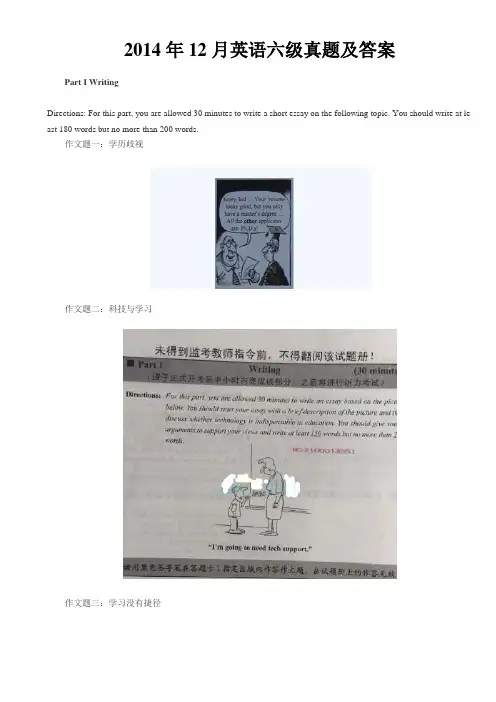
2014年12月英语六级真题及答案Part I WritingDirections: For this part, you are allowed 30 minutes to write a short essay on the following topic. You should write at le ast 180 words but no more than 200 words.作文题一:学历歧视作文题二:科技与学习作文题三:学习没有捷径Part II ListeningSection ADirections:In this section,you will hear 8 short conversations and 2 long conversations. At the end of each conversation, one or more questions will be asked about what was said. Both the conversation and the questions will be spoken only once. After each question there will be a pause. During the pause, you must read the four choices marked A) , B) , C) and D),and decide which is the best answer. Then mark the corresponding letter on Answer Sheet I with a single line through the centre.Question 1A.At a groceryB.In a parking lotC.In a car showroomD.At a fast food restaurantQuestion 2A.Have a little nap after lunchB.Get up and take a short walkC.Change her position now and thenD.Stretch legs before standing upQuestion 3A.The students should practice long-distance runningB.He doesn’t quite believe what the woman saysC.The students’ physical condition is not desirableD.He thinks the race is too hard for the studentsQuestion 4A.They do not want to have a baby at presentB.They cannot afford to get married right nowC.They are both pursuing graduate studiesD.They will get their degrees in two yearsQuestion 5A.Twins usually have a lot in commonB.He must have been mistaken for JackC.Jack is certainly not as healthy as he isD.He has not seen Jack for quite a few daysQuestion 6A.The man will take the woman wo the museumB.The man knows where the museum is locatedC.The woman is asking the way at the crossroadsD.The woman will attend the opening of the museumQuestion 7A.They cannot ask the guy to leaveB.The guy has been coming in for yearsC.They should not look down upon the guyD.The guy must be feeling extremely lonelyQuestion 8A.Collect timepiecesB.Become time-consciousC.Learn to mend locksD.Keep track of his daily activitiesQuestions 9 to 11 are based on the conversation you have just heard. Question 9A.It winds its way to the seaB.It is quickly risingC.It is eating into its banksD.It is wide and deepQuestion 10A.Get the trucks over to the other side of the riverB.Take the equipment apart before being ferriedC.Reduce the transport cost as much as possibleD.Try to speed up the operation by any meansQuestion 11A.Ask the commander to send a helicopterB.Halt the operation until further ordersC.Cut trees and build rowing boatsD.Find as many coats as possibleQuestions 12 to 15 are based on the conversation you have just heard. Question 12A.Help him join an Indian expeditionB.Talk about his climbing experiencesC.Give up mountain climbing altogetherD.Save money to buy climbing equipmentQuestion 13A.He was very strict with his childrenB.He climbed mountains to earn a livingC.He had an unusual religious backgroundD.He was the first to conquer Mt. QomolangmaQuestion 14A.They are like humansB.They are sacred placesC.They are to be protectedD.They are to be conqueredQuestion 15A.It was his father’s training that pilled him throughB.It was a milestone in his mountain climbing careerC.It was his father who gave him the strength to succeedD.It helped him understand the Sherpa view of mountainsSection BDirections:In this section,you will hear 3 short passages. At the end of each passage,you will hear some questions. Both the passage and the questions will be spoken only once. After you hear a question, you must choose the best answer from the four choices marked A), B), C)and D). Then mark the corresponding letter on Answer Sheet I with a single line through the centrePassage OneQuestion 16A. By reviewing what he has said previouslyB.By comparing memorandums with lettersC.By showing a memorandum’ s structureD.By analyzing the organization of a letterQuestion 17A.They spent a lot of time writing memorandumsB.They seldom read a memorandum through to the endC.They placed emphasis on the format of memorandumsD.They ignored many of the memorandums they receivedQuestion 18A.Style and wordingB.Structure and lengthC.Directness and clarityD.Simplicity and accuracyPassage TwoQuestions 19 to 22 are based on the passage you have just heard.Question 19A.Accurate datingB.Professional lookC.Direct statement of purposeD.Inclusion of appropriate humorQuestion 20A.They give top priority to their work efficiencyB.They make an effort to lighten their workloadC.They never change work habits unless forced toD.They try hard to make the best use of their timeQuestion 21A.Self-confidenceB.Sense of dutyC.Work efficiencyD.Passion for workQuestion 22A.They are addicted to playing online gamesB.They try to avoid work whenever possibleC.They find to pleasure in the work they doD.They simply have no sense of responsibilityPassage ThreeQuestions 23 to 25 are based on the passage you have just heard.Question 23A.He lost all his propertyB.He was sold to a circusC.He was forced into slaveryD.He ran away from his familyQuestion 24A.A carpenterB.A businessmanC.A master of hisD.A black drummerQuestion 25A.It named its town hall after Solomon NorthupB.It declared July 24 Solomon Northup DayC.It freedom all blacks in the town from slaveryD.It hosted a reunion for the Northup familySection CDirections:In this section, you will hear a passage three times. When the passage is read for the first time, you should listen carefully for its general idea. When the passage is read for the second time, you are required to fill in the blanks with the exact words you have just heard. Finally, when the passage is read for the third time, you should checkwhat you have written.Section CIntolerance is the art of ignoring any views that differ from your own. It(26)_____ itself a hatred. Stereotypes, prejudice, and(27)_____.Once it intensifies in people, intolerance is nearly impossible to overcome. But why would anyone want to be labeled intolerant. Why would people want to be (28)_____about the world around them? Why would one want to be part of the problem in America, instead of the solution?There are many explanations for intolerant attitudes, some (29)_____ childhood. It is likely that intolerant folks grew up (30)_____ intolerant parents and the cycle of prejudice has simply continued for (31)_____. Perhaps intolerant people are so set in their ways that they find it easier to ignore anything that might not (32)_____ their limited view of life. Or maybe intolerant students have simply never been (33)_____ to anyone different form themselves. But none of these reason is an excuse for allowing the intolerance to continue.Intolerance should not be confused with disagreement. It is, of course, possible as disagree with an opinion without being intolerant of it. If you understand a belief but still don't believe in that specific belief, that’s fine. You are(34)_____ your opinion. As a matter of fact.(35)_____ dissenters(持异议者)are important for any belief. If we all believed the same things. We would never grow, and we would never learn about the world around us, does not stem frim disagreement. It stems from fear, And fear stems from fear. And fear stems from ignorance.Part III Reading Comprehension (40 minutes)Section AHis future subjects have not always treated the Prince of Wales with the respect one XXXX expect. They laughed aloud in 1986 when the heir to the British(36)_____ told a TV reporter that he talked to his plants at his country house, High grove, to stimulate their growth. The Prince was being humorous- “My sense of humor will get me into trouble one day”, he said to his aids(随从)-but listening to Charles Windsor can indeed prove stimulating. The royal(37)_____ has been promoting radical ideas for most of his adult life. Some of his(38)_____, which once sounded a bit weird, were simply ahead of their time. Now, finally, the world seems to be catching up with him.Ta ke his views on farming. Prince Charles’ Duchy Home Farm went(39)_____ back in 1986. When most shoppers cared only about the low price tag on suspiciously blemish-free(无瑕疵的) vegetables and(40)_____ large chickens piled high in supermarkets.His warnings on climate change proved farsighted, too. Charles began(41)_____ action in warming in 1990 and says he has been worried about the(42)_____ of man on the environment same be was a teenager.Although he was gradually gained international(43)_____ as one of the world's lending conservationists, many British people still think of him as an(34)_____ person who talks to plants. This year, as it happens, South Korean scientists proved that plants really do(45)_____ to round. So Charles was ahead of the game there, too.A. conformB. eccentricC. environmentalistD. expeditionsE. impactF. notionsG. organicH. originallyI. recognitionJ. respondK. subordinateL. suppressingM. throneN. unnaturallyO. urgingSection BDirections: In this section,you are going to read a passage with ten statements attached to it. Each statement contains information given in one of the paragraphs. Identify the paragraph from which the information is derived. You may choose a paragraph more than once. Each paragraph is marked with a letter. Answer the questions by marking the corresponding letter on Answer Sheet 2.High School Sports Aren’t Killing AcademicsA)In this month’s Atlantic cover article, “The Case Against High-School Sports,” Amanda Ripley argues that school-sponsored sports programs should be seriously cut. She writes that, unlike most countries that outperform the United States on international assessments, American schools put too much of an emphasis on athletics, “ Sports are embedded in Ameri can schools in a way they are not almost anywhere else,” she writes, “Yet this difference hardly ever comes up in domestic debates about America’s international mediocrity(平庸)in education.”B)American student-athletes reap many benefits from participating in sports, but the costs to the schools could outweigh their benefits, she argues, In particular, Ripley contends that sports crowd out the academic missions of schools: America should learn from South Korea and Finland and every other country at the top level of international test scores, all of whom emphasize athletics far less in school. ”Even in eighth grade, American kids spend more than twice the time Korean kids spend playing sports,” she writes, citing a 2010 study published in the Journal of Adva nced Academics.C)It might well be true that sports are far more rooted in American high schools than in other countries. But our reading of international test scores finds no support for the argument against school athletics. Indeed, our own research and that of others lead us to make the opposite case. School-sponsored sports appear to provide benefits that seem to increase, not detract(减少)from, academic success.D)Ripley indulges a popular obsession(痴迷)with international test score comparisons, which show wide and frightening gaps between the United States and other countries. She ignores, however, the fact that states vary at least as much in test scores as do developed countries. A 2011 report from Harvard University shows that Massachusetts produces math scores comparable to South Korea and Finland, while Mississippi scores are closer to Trinidad and Tobago. Ripley’s thesis about sports falls apart in light of this fact. Schools in Massachusetts provide sports programs while schools in Finland do not. Schools in Mississippi may love football while in Tobago interscholastic sports are nowhere near as prominent. Sports cannot explain these similarities in performance. They can’t explain international differences either.E)If it is true that sports undermine the academic mission of American schools, we would expect to see a negative relationship between the commitment to athletics and academic achievement. However, the University of Arkansas’s Daniel Bowen and Jay Greene actually find the opposite. T hey examine this relationship by analyzing schools’ sports winning percentages as well as student-athletic participation rates compared to graduation rates and standardized testscore achievement over a five-year period for all public high schools in Ohio. Controlling for student poverty levels, demographics(人口统计状况), and district financial resources, both measures of a school’s commitment to athletics are significantly and positively related to lower dropout rates as well as higher test scores.F)On-the-field success and high participation in sports is not random-it requires focus and dedication to athletics. One might think this would lead schools obsessed with winning to deemphasize academics. Bowen and Greene’s results contradict that argument. A likely explanation for this seemingly counterintuitive(与直觉相反的)result is that success in sports programs actually facilitates or reflects greater social capital within a school’s community.G)Ripley cites the writings of renowned sociologist James Coleman, whose research in education was groundbreaking. Coleman in his early work held athletics in contempt, arguing that they crowded out schools’ academic missions. Ripley quotes his 1961 study, The Adolescent Society, where Coleman writes, “Altogether, the trophy(奖品)case would suggest to the innocent visitor that he was entering an athletic club, not an educational institution.”H)However, in later research Coleman would show how the success of schools is highly dependent on what he termed social capital, “the so cial networks, and the relationships between adults and children that are of value for the child’s growing up.”I)According to a 2013 evaluation conducted by the Crime Lab at the University of Chicago, a program called Becoming a Man-Sports Edition creat es lasting improvements in the boys’ study habits and grade point averages. During the first year of the program, students were founds to be less likely to transfer schools or be engaged in violent crime. A year after the program, participants were less likely to have had an encounter with the juvenile justice system.J)If school-sponsored sports were completely eliminated tomorrow, many American students would still have opportunities to participate in organized athletics elsewhere, much like they do in countries such as Finland, Germany, and South Korea. The same is not certain when it comes to students from more disadvantaged backgrounds. In an overview of the research on non-school based after-school programs, researchers find that disadvantaged children participate in these programs at significantly lower rates. They find that low-income students have less access due to challenges with regard to transportation, non-nominal fees, and off-campus safety. Therefore, reducing or eliminating these opportunities would most likely deprive disadvantaged students of the benefits from athletic participation, not least of which is the opportunity to interact with positive role models outside of regular school hours.K)Another unfounded criticism that Ripley makes is bringing up the stereotype that athletic XX are typically lousy(蹩脚的)classroom teachers. “American principals, unlike the XX XX of principals around the world, make many hiring decisions with their sports teams in mind, which does not always end well fo r students,” she writes. Educators who seek employment at schools primarily for the purpose of coaching are likely to shirk(推卸)teaching responsibilities, the argument goes. Moreover, even in the cases where the employee is a teacher first and athletic coach second, the additional responsibilities that come with coaching likely comes at the expense of time otherwise spent on planning, grading, and communicating with parents and guardians.L)The data, however, do not seem to confirm this stereotype. In the most rigorous study on the classroom results of high school coaches, the University of Arkansas’s Anna Egalite finds that athletic coaches in Florida mostly tend to perform just as well as their non-coaching counterparts, with respect to raising student test scores. We do not doubt that teachers who also coach face serious tradeoffs that likely come at the expense of time they could dedicate to theiracademic obligations. However, as with sporting events, athletic coaches gain additional opportunities for communicating and serving as mentors(导师)that potentially help students succeed and make up for the costs of coaching commitments.M)If schools allow student-athletes to regularly miss out on instructional time for the sake of traveling to athletic competi tions, that’s bad. However, such issues would be better addressed by changing school and state policies with regard to the scheduling of sporting events as opposed to total elimination. If the empirical evidence points to anything, it points towards school sponsored sports providing assets that are well worth the costs.N)Despite negative stereotypes about sports culture and Ripley’s presumption that academics and athletics are at odds with one another, we believe that the greater body of evidence shows that school-sponsored sports programs appear to benefit students. Successes on the playing field can carry over to the classroom and vice versa(反之亦然). More importantly, finding ways to increase school communities’ social capital is imperative to the success of the school as whole, not just the athletes.46.Stunets from low-income families have less access to off-campus sports programs.47.Amanda Ripley argues that America should learn from other countries that rank high in international tests and lay less emphasis on athletics.48.According to the author,Amanda Ripley fails to note that stunents'performance in exams varies from state to state.49.Amanda Ripley thinks that athletic coaches are poor at classroom instruction.50.James Coleman's later resrarch make an argument for a school's social capital.51.Reaearchers find that there is a ppsitive relationship between a school's commitment to athletics and academic achievements.52.Aa rigorous study finds that athletic coaches also do well in raising students'test scores.53.According to an evaluation,spograms contribute to students's academic preformance and character building.54.Amanda Ripley believes the emphasis on school sports shuold be brought up when trying to understand why Aamerican students are mediocre.55.James Coleman suggests in his earlier writings that school athletics would undermine a school's image.Section CDirections: There are 2 passages in this section. Each passage is followed by some questions or unfinished statements. For each of them there are four choices marked A, B, C and D. . You should decide on the best choice and mark the corresponding letter on Answer Sheet 2 with a single line through the centre.Passage oneIt is easy to miss amid the day-to-day headlines of global economic recession, but there is a less conspicuous kind of social upheaval(剧变)underway that is fast altering both the face of the planet and the way human beings live. That change is the rapid acceleration of urbanization. In 2008, for the first time in human history, more than half the world’s population was living in towns and cities. And as a recently published paper shows, the process of urbanization will only accelerate in the decades to come—with an enormous impact on biodiversity and potentially on climate change.As Karen Seto, the led author of the paper, points out, the wave of urbanization isn’t just about the migration of people into urban environments, but about the environments themselves becoming bigger to accommodate all those people. The rapid expansion of urban areas will have a huge impact on biodiversity hotspots and on carbon emissions inthose urban areas.Humans are the ultimate invasive species—when the move into new territory, the often displace the wildlife that was already living there. And as land is cleared for those new cities—especially in the dense tropical forests—carbon will be released into the atmosphere as well. It’s true that as people in developing nations move from the countryside to the city, the shift may reduce the pressure on land, which could in turn be good for the environment. This is especially so in desperately poor countries, where residents in the countryside slash and burn forests each growing season to clear space for farming. But the real difference is that in developing nations, the move from rural areas to cities often leads to an accompanying increase in income — and that increase leads to an increase in the consumption of food and energy, which in turn causes a rise in carbon emissions. Getting enough to eat and enjoying the safety and comfort of living fully on the grid is certainly a good thing — but it does carry an environmental price.The urbanization wave can’t be stopped —and it shouldn’t be. But Seto’s paper does underscore the importan ce of managing that transition. If we do it the right way, we can reduce urbanization’s impact on the environment. “There’s an enormous opportunity here, and a lot of pressure and responsibility to think about how we urbanize,” says Seto. “One thing that’s clear is that we can’t build cities the way we have over the last couple of hundred years. The scale of this transition won’t allow that.” We’re headed towards an urban planet no matter what, but whether it becomes heaven or hell is up to us.56. What is sue does the author try to draw people’s attention to?A. The shrinking biodiversity worldwide.B. The rapid increase of world population.C. The ongoing global economic recession.D. The impact of accelerating urbanization.57. In what sense are humans the ultimate invasive species?A. They are much greedier than other species.B. They are a unique species born to conquer.C. They force other species out of their territories.D. They have an urge to expand their living space.58. In what way is urbanization in poor countries good for the environment?A. More land will be preserved for wildlife.B. The pressure on farmland will be lessened.C. Carbon emissions will be considerably reduced.D. Natural resources will be used more effectively.59. What does the author say about living comfortably in the city?A. It incurs a high environmental price.B. It brings poverty and insecurity to an end.C. It causes a big change in people’s lifestyle.D. It narrows the gap between city and country.60. What can be done to minimize the negative impact of urbanization according to Seto?A. Slowing down the speed of transition.B. Innovative use of advanced technology.C. Appropriate management of the process.D. Enhancing people’s sense of responsibilit y.Passage TwoWhen Harvard student Mark Zuckerberg launched in Feb. 2004, even he could not imagine the forces it would let loose. His intent was to connect college students. Facebook, which is what this website rapidly evolved into, ended up connecting the world.To the children of this connected era, the world is one giant social network. They are not bound — as were previous generations of humans — by what they were taught. They are only limited by their curiosity and ambition. During my childhood, all knowledge was local. You learned everything you knew from your parents, teachers, preachers, and friends.With the high-quality and timely information at their fingertips, today’s children are rising normally tame middle class is speaking up against social ills. Silicon Valley executives are being shamed into adding women to their boards. Political leaders are marshalling the energy of millions for elections and political causes. All of this is being done with social media technologies that Facebook and its competitors set free.As does every advancing technology, social media has created many new problems. It is commonly addictive and creates risks for younger users. Social media is used by extremists in the Middle East and elsewhere to seek and brainwash recruits. And it exposes us and our friends to disagreeable spying. We may leave our lights on in the house when we are on vacation, but through social media we tell criminals exactly where we are, when we plan to return home, and how to blackmail(敲诈)us.Governments don’t need informers any more. Social media allows government agencies to spy on their own citizens. We record our thoughts, emotions, likes and dislikes on Facebook; we share our political views, social preferences, and plans. We post intimate photographs of ourselves. No spy agency or criminal organization could actively gather the type of data that we voluntarily post for them.The marketers are also seeing big opportunities. Amazon is trying to predict what we will order. Google is trying to judge our needs and wants based on our social-media profiles. We need to be aware of the risks and keep working to alleviate the dangers.Regardless of what social media people use, one thing is certain: we are in a period of accelerating change. The next decade will be even more amazing and unpredictable than the last. Just as no one could predict what would happen with social media in the last decade, no one can accurately predict where this technology will take us. I am optimistic, however, that a connected humanity will find a way to uplift itself.61. What was the purpose of Facebook when it was first created?A. To help students connect with the outside world.B. To bring university students into closer contact.C. To help students learn to live in a connected era.D. To combine the world into an integral whole.62. What difference does social media make to learning?A. Local knowledge and global knowledge will merge.B. Student will become more curious and ambitious.C. People are able to learn wherever they travel.D. Sources of information are greatly expanded.63. What is the author’s greatest concern with social media technology?A. Individuals and organizations may use it for evil purposes.B. Government will find it hard to protect classified information.C. People may disclose their friends’ information unintentionally.D. People’s attention will be easily distractedfrom their work in hand.64. What do businesses use social media for?A. Creating a good corporate image.B. Conducting large-scale market surveys.C. Anticipating the needs of customers.D. Minimizing possible risks and dangers.65. What does the author think of social media as a whole?A. It will enable human society to advance at a faster pace.B. It will pose a grave threat to our traditional ways of life.C. It is bound to bring about another information revolution.D. It breaks down the final barriers in human communication.Part IV TranslationDirections: For this part, you are allowed 30 minutes to translate a passage from Chinese into English. You should write your answer on Answer Sheet 2.翻译题一:自从1978年启动改革以来,中国已从计划经济转为以市场为基础的经济,经历了经济和社会的快速发展。
2014年12月英语六级cet6真题及答案详解
2014年12月英语六级真题及答案(文字版)Part I WritingDirections: For this part, you are allowed 30 minutes to write a short essay on the following topic. You should write at least 180 words but no more than 200 words.作文题一:学历歧视作文题二:科技与学习作文题三:学习没有捷径Part II ListeningSection ADirections:In this section,you will hear 8 short conversations and 2 long conversations. At the end of each conversation, one or more questions will be asked about what was said. Both the conversation and the questions will be spoken only once. After each question there will be a pause. During the pause, you must read the four choices marked A) , B) , C) and D),and decide which is the best answer. Then mark the corresponding letter on Answer Sheet I with a single line through the centre.Question 1A.At a groceryB.In a parking lotC.In a car showroomD.At a fast food restaurantQuestion 2A.Have a little nap after lunchB.Get up and take a short walkC.Change her position now and thenD.Stretch legs before standing upQuestion 3A.The students should practice long-distance runningB.He doesn’t quite believe what the woman saysC.The students’physical condition is not desirableD.He thinks the race is too hard for the studentsQuestion 4A.They do not want to have a baby at presentB.They cannot afford to get married right nowC.They are both pursuing graduate studiesD.They will get their degrees in two yearsQuestion 5A.Twins usually have a lot in commonB.He must have been mistaken for JackC.Jack is certainly not as healthy as he isD.He has not seen Jack for quite a few daysQuestion 6A.The man will take the woman wo the museumB.The man knows where the museum is locatedC.The woman is asking the way at the crossroadsD.The woman will attend the opening of the museumQuestion 7A.They cannot ask the guy to leaveB.The guy has been coming in for yearsC.They should not look down upon the guyD.The guy must be feeling extremely lonelyQuestion 8A.Collect timepiecesB.Become time-consciousC.Learn to mend locksD.Keep track of his daily activitiesQuestions 9 to 11 are based on the conversation you have just heard. Question 9A.It winds its way to the seaB.It is quickly risingC.It is eating into its banksD.It is wide and deepQuestion 10A.Get the trucks over to the other side of the riverB.Take the equipment apart before being ferriedC.Reduce the transport cost as much as possibleD.Try to speed up the operation by any meansQuestion 11A.Ask the commander to send a helicopterB.Halt the operation until further ordersC.Cut trees and build rowing boatsD.Find as many coats as possibleQuestions 12 to 15 are based on the conversation you have just heard. Question 12A.Help him join an Indian expeditionB.Talk about his climbing experiencesC.Give up mountain climbing altogetherD.Save money to buy climbing equipmentQuestion 13A.He was very strict with his childrenB.He climbed mountains to earn a livingC.He had an unusual religious backgroundD.He was the first to conquer Mt. QomolangmaQuestion 14A.They are like humansB.They are sacred placesC.They are to be protectedD.They are to be conqueredQuestion 15A.It was his father’s training that pilled him throughB.It was a milestone in his mountain climbing careerC.It was his father who gave him the strength to succeedD.It helped him understand the Sherpa view of mountainsSection BDirections:In this section,you will hear 3 short passages. At the end of each passage,you will hear some questions. Both the passage and the questions will be spoken only once. After you hear a question, you must choose the best answer from the four choices marked A), B), C)and D). Then mark the corresponding letter on Answer Sheet I with a single line through the centre Passage OneQuestion 16A. By reviewing what he has said previouslyB.By comparing memorandums with lettersC.By showing a memorandum’s structureD.By analyzing the organization of a letterQuestion 17A.They spent a lot of time writing memorandumsB.They seldom read a memorandum through to the endC.They placed emphasis on the format of memorandumsD.They ignored many of the memorandums they receivedQuestion 18A.Style and wordingB.Structure and lengthC.Directness and clarityD.Simplicity and accuracyPassage TwoQuestions 19 to 22 are based on the passage you have just heard.Question 19A.Accurate datingB.Professional lookC.Direct statement of purposeD.Inclusion of appropriate humorQuestion 20A.They give top priority to their work efficiencyB.They make an effort to lighten their workloadC.They never change work habits unless forced toD.They try hard to make the best use of their timeQuestion 21A.Self-confidenceB.Sense of dutyC.Work efficiencyD.Passion for workQuestion 22A.They are addicted to playing online gamesB.They try to avoid work whenever possibleC.They find to pleasure in the work they doD.They simply have no sense of responsibilityPassage ThreeQuestions 23 to 25 are based on the passage you have just heard.Question 23A.He lost all his propertyB.He was sold to a circusC.He was forced into slaveryD.He ran away from his familyQuestion 24A.A carpenterB.A businessmanC.A master of hisD.A black drummerQuestion 25A.It named its town hall after Solomon NorthupB.It declared July 24 Solomon Northup DayC.It freedom all blacks in the town from slaveryD.It hosted a reunion for the Northup familySection CDirections:In this section, you will hear a passage three times. When the passage is read for the first time, you should listen carefully for its general idea. When the passage is read for the second time, you are required to fill in the blanks with the exact words you have just heard. Finally, when the passage is read for the third time, you should check what you have written.Section CIntolerance is the art of ignoring any views that differ from your own. It(26)_____ itself a hatred. Stereotypes, prejudice, and(27)_____.Once it intensifies in people, intolerance is nearly impossible to overcome. But why would anyone want to be labeled intolerant. Why would people want to be (28)_____about the world around them? Why would one want to be part of the problem in America, instead of the solution?There are many explanations for intolerant attitudes, some (29)_____ childhood. It is likely that intolerant folks grew up (30)_____ intolerant parents and the cycle of prejudice has simply continued for (31)_____. Perhaps intolerant people are so set in their ways that they find it easier to ignore anything that might not (32)_____ their limited view of life. Or maybe intolerant students have simply never been (33)_____ to anyone different form themselves. But none of these reason is an excuse for allpwing the intolerance to continue.Intolerance should not be confused with disagreement.It is,of course,possible as diasgree withan opinion without being intolerant of it.If you understand a belief but still don't believe in that specific belief,that's fine.You are (34)_____ your opinion.As a matter of fact.(35)_____ disseniers(持异议者)are important for any belief.If we all believed the same things.we would never grow,and we would never learn about the world around us,does not stem frim disagreement.It stems from fear,And fear stems from fear.And fear stems from ignorance.Part III Reading Comprehension (40 minutes)Section AHis future subjects have not always treated the Prince of Wales with the respect one XXXX expect. They laughed aloud in 1986 when the heir to the British(36)_____ told a TV reporter that he talked to his plants at his country house, Highgrove, to stimulate their growth. The Prince was being humorous- “My sense of humor will get me into trouble one day”, he said to his aids(随从)-but listening to Charles Windsor can indeed prove stimulating. The royal(37)_____ has been promoting radical ideas for most of his adult life. Some of his(38)_____, which once sounded a bit weird, were simply ahead of their time. Now, finally, the world seems to be catching up with him.Take his views on farming. Prince Charles’Duchy Home Farm went(39)_____ back in 1986. When most shoppers cared only about the low price tag on suspiciously blemish-free(无瑕疵的) vegetables and(40)_____ large chickens piled high in supermarkets.His warnings on climate change proved farsighted,too.Charles began(41)_____ action in warming in 1990 and says he has been worried about the(42)_____ of man on the environment same be was a teenger.Although he was gradually gained international(43)_____ as one of the world's lending conservationists,many British people still think of him as an(34)_____ person who talks to plants.This year,as it happens,South Korean scientists proved that plants really do(45)_____ to round.So Charles was ahead of the game there,too.A.conformB.eccentricC.environmentalistD.expeditionsE.impactF.notionsanicH.originallyI.recognitionJ.respondK.subordinateL.suppressingM.throneN.unnaturallyO.urgingSection BDirections: In this section,you are going to read a passage with ten statements attached to it. Each statement contains information given in one of the paragraphs. Identify the paragraph from which the information is derived. You may choose a paragraph more than once. Each paragraph is marked with a letter. Answer the questions by marking the corresponding letter on Answer Sheet 2.High School Sports Aren’t Killing AcademicsA)In this month’s Atlantic cover article, “The Case Against High-School Sports,”Amanda Ripley argues that school-sponsored sports programs should be seriously cut. She writes that, unlike most countries that outperform the United States on international assessments, American schools put too much of an emphasis on athletics, “Sports are embedded in American schools in a way they are not almost anywhere else,”she writes, “Yet this difference hardly ever comes up in domestic debates about America’s international mediocrity(平庸)in education.”B)American student-athletes reap many benefits from participating in sports, but the costs to the schools could outweigh their benefits, she argues, In particular, Ripley contends that sports crowd out the academic missions of schools: America should learn from South Korea and Finland and every other country at the top level of international test scores, all of whom emphasize athletics far less in school. ”Even in eighth grade, American kids spend more than twice the time Korean kids spend playing sports,”she writes, citing a 2010 study published in the Journal of Advanced Academics.C)It might well be true that sports are far more rooted in American high schools than in other countries. But our reading of international test scores finds no support for the argument against school athletics. Indeed, our own research and that of others lead us to make the opposite case. School-sponsored sports appear to provide benefits that seem to increase, not detract(减少)from, academic success.D)Ripley indulges a popular obsession(痴迷)with international test score comparisons, which show wide and frightening gaps between the United States and other countries. She ignores, however, the fact that states vary at least as much in test scores as do developed countries. A 2011 report from Harvard University shows that Massachusetts produces math scores comparable to South Korea and Finland, while Mississippi scores are closer to Trinidad and Tobago. Ripley’s thesis about sports falls apart in light of this fact. Schools in Massachusetts provide sports programs while schools in Finland do not. Schools in Mississippi may love football while in Tobago interscholastic sports are nowhere near as prominent. Sports cannot explain these similarities in performance. They can’t explain international differences either.E)If it is true that sports undermine the academic mission of American schools, we would expect to see a negative relationship between the commitment to athletics and academic achievement. However, the University of Arkansas’s Daniel Bowen and Jay Greene actually find the opposite. They examine this relationship by analyzing schools’sports winning percentages as well as student-athletic participation rates compared to graduation rates and standardized test score achievement over a five-year period for all public high schools in Ohio. Controlling for student poverty levels, demographics(人口统计状况), and district financial resources, both measures of a school’s commitment to athletics are significantly and positively related to lower dropout rates as well as higher test scores.F)On-the-field success and high participation in sports is not random-it requires focus and dedication to athletics. One might think this would lead schools obsessed with winning to deemphasize academics. Bowen and Greene’s results contradict that argument. A likely explanation for this seemingly counterintuitive(与直觉相反的)result is that success in sports programs actually facilitates or reflects greater social capital within a school’s community.G)Ripley cites the writings of renowned sociologist James Coleman, whose research in education was groundbreaking. Coleman in his early work held athletics in contempt, arguing thatthey crowded out schools’academic missions. Ripley quotes his 1961 study, The Adolescent Society, where Coleman writes, “Altogether, the trophy(奖品)case would suggest to the innocent visitor that he was entering an athletic club, not an educational institution.”H)However, in later research Coleman would show how the success of schools is highly dependent on what he termed social capital, “the social networks, and the relationships between adults and children that are of value for the child’s growing up.”I)According to a 2013 evaluation conducted by the Crime Lab at the University of Chicago, a program called Becoming a Man-Sports Edition creates lasting improvements in the boys’study habits and grade point averages. During the first year of the program, students were founds to be less likely to transfer schools or be engaged in violent crime. A year after the program, participants were less likely to have had an encounter with the juvenile justice system.J)If school-sponsored sports were completely eliminated tomorrow, many American students would still have opportunities to participate in organized athletics elsewhere, much like they do in countries such as Finland, Germany, and South Korea. The same is not certain when it comes to students from more disadvantaged backgrounds. In an overview of the research on non-school based after-school programs, researchers find that disadvantaged children participate in these programs at significantly lower rates. They find that low-income students have less access due to challenges with regard to transportation, non-nominal fees, and off-campus safety. Therefore, reducing or eliminating these opportunities would most likely deprive disadvantaged students of the benefits from athletic participation, not least of which is the opportunity to interact with positive role models outside of regular school hours.K)Another unfounded criticism that Ripley makes is bringing up the stereotype that athletic XX are typically lousy(蹩脚的)classroom teachers. “American principals, unlike the XX XX of principals around the world, make many hiring decisions with their sports teams in mind, which does not always end well for students,”she writes. Educators who seek employment at schools primarily for the purpose of coaching are likely to shirk(推卸)teaching responsibilities, the argument goes. Moreover, even in the cases where the employee is a teacher first and athletic coach second, the additional responsibilities that come with coaching likely comes at the expense of time otherwise spent on planning, grading, and communicating with parents and guardians.L)The data, however, do not seem to confirm this stereotype. In the most rigorous study on the classroom results of high school coaches, the University of Arkansas’s Anna Egalite finds that athletic coaches in Florida mostly tend to perform just as well as their non-coaching counterparts, with respect to raising student test scores. We do not doubt that teachers who also coach face serious tradeoffs that likely come at the expense of time they could dedicate to their academic obligations. However, as with sporting events, athletic coaches gain additional opportunities for communicating and serving as mentors(导师)that potentially help students succeed and make up for the costs of coaching commitments.M)If schools allow student-athletes to regularly miss out on instructional time for the sake of traveling to athletic competitions, that’s bad. However, such issues would be better addressed by changing school and state policies with regard to the scheduling of sporting events as opposed to total elimination. If the empirical evidence points to anything, it points towards school sponsored sports providing assets that are well worth the costs.N)Despite negative stereotypes about sports culture and Ripley’s presumption that academics and athletics are at odds with one another, we believe that the greater body of evidence shows thatschool-sponsored sports programs appear to benefit students. Successes on the playing field can carry over to the classroom and vice versa(反之亦然). More importantly, finding ways to increase school communities’social capital is imperative to the success of the school as whole, not just the athletes.46.Stunets from low-income families have less access to off-campus sports programs.47.Amanda Ripley argues that America should learn from other countries that rank high in international tests and lay less emphasis on athletics.48.According to the author,Amanda Ripley fails to note that stunents'performance in exams varies from state to state.49.Amanda Ripley thinks that athletic coaches are poor at classroom instruction.50.James Coleman's later resrarch make an argument for a school's social capital.51.Reaearchers find that there is a ppsitive relationship between a school's commitment to athletics and academic achievements.52.Aa rigorous study finds that athletic coaches also do well in raising students'test scores.53.According to an evaluation,spograms contribute to students's academic preformance and character building.54.Amanda Ripley believes the emphasis on school sports shuold be brought up when trying to understand why Aamerican students are mediocre.55.James Coleman suggests in his earlier writings that school athletics would undermine a school's image.Section CDirections: There are 2 passages in this section. Each passage is followed by some questions or unfinished statements. For each of them there are four choices marked A, B, C and D. . You should decide on the best choice and mark the corresponding letter on Answer Sheet 2 with a single line through the centre.Passage oneIt is easy to miss amid the day-to-day headlines of global economic recession, but there is a less conspicuous kind of social upheaval(剧变)underway that is fast altering both the face of the planet and the way human beings live. That change is the rapid acceleration of urbanization. In 2008, for the first time in human history, more than half the world’s population was living in towns and cities. And as a recently published paper shows, the process of urbanization will only accelerate in the decades to come—with an enormous impact on biodiversity and potentially on climate change.As Karen Seto, the led author of the paper, points out, the wave of urbanization isn’t just about the migration of people into urban environments, but about the environments themselves becoming bigger to accommodate all those people. The rapid expansion of urban areas will have a huge impact on biodiversity hotspots and on carbon emissions in those urban areas.Humans are the ultimate invasive species—when the move into new territory, the often displace the wildlife that was already living there. And as land is cleared for those new cities—especially in the dense tropical forests—carbon will be released into the atmosphere as well. It’s true that as people in developing nations move from the countryside to the city, the shift may reduce the pressure on land, which could in turn be good for the environment. This is especially so in desperately poor countries, where residents in the countryside slash and burn forests each growing season to clear space for farming. But the real difference is that in developing nations, themove from rural areas to cities often leads to an accompanying increase in income —and that increase leads to an increase in the consumption of food and energy, which in turn causes a rise in carbon emissions. Getting enough to eat and enjoying the safety and comfort of living fully on the grid is certainly a good thing —but it does carry an environmental price.The urbanization wave can’t be stopped —and it shouldn’t be. But Seto’s paper does underscore the importance of managing that transition. If we do it the right way, we can reduce urbanization’s impact on the environment. “There’s an enormous opportunity here, and a lot of pressure and responsibility to think about how we urbanize,”says Seto. “One thing that’s clear is that we can’t build cities the way we have over the last couple of hundred years. The scale of this transition won’t allow that.”We’re headed towards an urban planet no matter what, but whether it becomes heaven or hell is up to us.56. What issue does the author try to draw people’s attention to?A. The shrinking biodiversity worldwide.B. The rapid increase of world population.C. The ongoing global economic recession.D. The impact of accelerating urbanization.57. In what sense are humans the ultimate invasive species?A. They are much greedier than other species.B. They are a unique species born to conquer.C. They force other species out of their territories.D. They have an urge to expand their living space.58. In what way is urbanization in poor countries good for the environment?A. More land will be preserved for wildlife.B. The pressure on farmland will be lessened.C. Carbon emissions will be considerably reduced.D. Natural resources will be used more effectively.59. What does the author say about living comfortably in the city?A. It incurs a high environmental price.B. It brings poverty and insecurity to an end.C. It causes a big change in people’s lifestyle.D. It narrows the gap between city and country.60. What can be done to minimize the negative impact of urbanization according to Seto?A. Slowing down the speed of transition.B. Innovative use of advanced technology.C. Appropriate management of the process.D. Enhancing people’s sense of responsibility.Passage TwoWhen Harvard student Mark Zuckerberg launched in Feb. 2004, even he could not imagine the forces it would let loose. His intent was to connect college students. Facebook, which is what this website rapidly evolved into, ended up connecting the world.To the children of this connected era, the world is one giant social network. They are not bound —as were previous generations of humans —by what they were taught. They are only limited by their curiosity and ambition. During my childhood, all knowledge was local. You learned everything you knew from your parents, teachers, preachers, and friends.With the high-quality and timely information at their fingertips, today’s children are rising normally tame middle class is speaking up against social ills. Silicon Valley executives are being shamed into adding women to their boards. Political leaders are marshalling the energy of millions for elections and political causes. All of this is being done with social media technologies that Facebook and its competitors set free.As does every advancing technology, social media has created many new problems. It is commonly addictive and creates risks for younger users. Social media is used by extremists in the Middle East and elsewhere to seek and brainwash recruits. And it exposes us and our friends to disagreeable spying. We may leave our lights on in the house when we are on vacation, but through social media we tell criminals exactly where we are, when we plan to return home, and how to blackmail(敲诈)us.Governments don’t need informers any more. Social media allows government agencies to spy on their own citizens. We record our thoughts, emotions, likes and dislikes on Facebook; we share our political views, social preferences, and plans. We post intimate photographs of ourselves. No spy agency or criminal organization could actively gather the type of data that we voluntarily post for them.The marketers are also seeing big opportunities. Amazon is trying to predict what we will order. Google is trying to judge our needs and wants based on our social-media profiles. We need to be aware of the risks and keep working to alleviate the dangers.Regardless of what social media people use, one thing is certain: we are in a period of accelerating change. The next decade will be even more amazing and unpredictable than the last. Just as no one could predict what would happen with social media in the last decade, no one can accurately predict where this technology will take us. I am optimistic, however, that a connected humanity will find a way to uplift itself.61. What was the purpose of Facebook when it was first created?A. To help students connect with the outside world.B. To bring university students into closer contact.C. To help students learn to live in a connected era.D. To combine the world into an integral whole.62. What difference does social media make to learning?A. Local knowledge and global knowledge will merge.B. Student will become more curious and ambitious.C. People are able to learn wherever they travel.D. Sources of information are greatly expanded.63. What is the author’s greatest concern with social media technology?A. Individuals and organizations may use it for evil purposes.B. Government will find it hard to protect classified information.C. People may disclose their friends’information unintentionally.D. People’s attention will be easily distractedfrom their work in hand.64. What do businesses use social media for?A. Creating a good corporate image.B. Conducting large-scale market surveys.C. Anticipating the needs of customers.D. Minimizing possible risks and dangers.65. What does the author think of social media as a whole?A. It will enable human society to advance at a faster pace.B. It will pose a grave threat to our traditional ways of life.C. It is bound to bring about another information revolution.D. It breaks down the final barriers in human communication.Part IV TranslationDirections: For this part, you are allowed 30 minutes to translate a passage from Chinese into English. You should write your answer on Answer Sheet 2.翻译题一:自从1978年启动改革以来,中国已从计划经济转为以市场为基础的经济,经历了经济和社会的快速发展。
2014年12月大学英语六级真题及详解(第二套)【圣才出品】

2014年12月大学英语六级真题及详解(第二套)Part I Writing(30minutes)Directions:For this part,you are allowed30minutes to write an essay based on the picture below.You should start your essay with a brief description of thepicture and then discuss whether there is a shortcut to learning.Youshould give sound arguments to support your views and write at least150words but no more than200words.“‘How To Do Well in School WithoutStudying’is over there in the fiction section.”【审题构思】本题要求讨论学习是否存在捷径。
从图片上可以看到,一位图书管理员对来借书的学生说到:“不学习就能学习好”这本书在那边放小说的书架上。
在这里考生必须理解“小说”的深层次含义,即“虚构的,幻想的”,也就是说关于学习的捷径这种想法根本就不存在。
写作时,考生首先必须把图片上隐含的这层意思表达清楚,从而提出自己的观点,学习没有捷径。
【参考范文】There is No Shortcut to Learning(1)In the cartoon,the student wants to borrow a book named How To Do Well In School Without Studying and then the librarian answers(2)ironically that the book is in the fiction section.The word“fiction”means something unreal,and the librarian is trying to warn the student that(3)there is no such thing as shortcut to learning.For this point,I cannot agree with the librarian more.(4)For one thing,learning is to understand the knowledge and to acquire the skills to solve the related problems.Only when you really spend time on learning, can you really master the knowledge.Some students may think that they can learn something or finish their study tasks(5)by so-called“shortcut”,like plagiarism or learning by rote,but the fact is that the knowledge is not really grasped by them and they still don’t know how to solve the problem next time.(6)For another, knowledge that one possesses is accumulated step by step and to learn more complicated things usually need a solid foundation of other knowledge.Thus,if you want to learn something by shortcut,then in the future,you will meet problems to obtain advanced knowledge and you will(7)wind up in failure to make progress.(8)To sum up,If you really want to perform well in school and really want to learn something,there exists no shortcut.Success in study needs your diligence.【行文点评】(1)通过分析图片中隐含的信息,指出学习没有捷径。
2014年12月英语六级真题(二)
2014年12月大学英语六级考试真题(二)Part I WritingDirections: For this part, you are allowed 30 minutes to write a short essay on the following topic. You should write at least 150 words but no more than 200 words.作文题:Part II ListeningSection ADirections:In this section,you will hear 8 short conversations and 2 long conversations. At the end of each conversation, one or more questions will be asked about what was said. Both the conversation and the questions will be spoken only once. After each question there will be a pause. During the pause, you must read the four choices marked A) , B) , C) and D),and decide which is the best answer. Then mark the corresponding letter on Answer Sheet I with a single line through the centre.Question 1A.At a groceryB.In a parking lotC.In a car showroomD.At a fast food restaurantQuestion 2A.Have a little nap after lunchB.Get up and take a short walkC.Change her position now and thenD.Stretch legs before standing upQuestion 3A.The students should practice long-distance runningB.He doesn’t quite believe what the woman saysC.The students’ physical condition is not desirableD.He thinks the race is too hard for the studentsQuestion 4A.They do not want to have a baby at presentB.They cannot afford to get married right nowC.They are both pursuing graduate studiesD.They will get their degrees in two yearsQuestion 5A.Twins usually have a lot in commonB.He must have been mistaken for JackC.Jack is certainly not as healthy as he isD.He has not seen Jack for quite a few daysQuestion 6A.The man will take the woman wo the museumB.The man knows where the museum is locatedC.The woman is asking the way at the crossroadsD.The woman will attend the opening of the museum Question 7A.They cannot ask the guy to leaveB.The guy has been coming in for yearsC.They should not look down upon the guyD.The guy must be feeling extremely lonelyQuestion 8A.Collect timepiecesB.Become time-consciousC.Learn to mend locksD.Keep track of his daily activities Questions 9 to 11 are based on the conversation you have just heard.Question 9A.It winds its way to the seaB.It is quickly risingC.It is eating into its banksD.It is wide and deep Question 10A.Get the trucks over to the other side of the riverB.Take the equipment apart before being ferriedC.Reduce the transport cost as much as possibleD.Try to speed up the operation by any meansQuestion 11A.Ask the commander to send a helicopterB.Halt the operation until further ordersC.Cut trees and build rowing boatsD.Find as many coats as possibleQuestions 12 to 15 are based on the conversation you have just heard.Question 12A.Help him join an Indian expeditionB.Talk about his climbing experiencesC.Give up mountain climbing altogetherD.Save money to buy climbing equipmentQuestion 13A.He was very strict with his childrenB.He climbed mountains to earn a livingC.He had an unusual religious backgroundD.He was the first to conquer Mt. QomolangmaQuestion 14A.They are like humansB.They are sacred placesC.They are to be protectedD.They are to be conqueredQuestion 15A.It was his father’s training that pilled him throughB.It was a milestone in his mountain climbing careerC.It was his father who gave him the strength to succeedD.It helped him understand the Sherpa view of mountainsSection BDirections:In this section,you will hear 3 short passages. At the end of each passage,you will hear some questions. Both the passage and the questions will be spoken only once. After you hear a question, you must choose the best answer from the four choices marked A), B), C)and D). Then mark the corresponding letter on Answer Sheet I with a single line through the centrePassage OneQuestion 16A. By reviewing what he has said previouslyB.By comparing memorandums with lettersC.By showing a memorandum’ s structureD.By analyzing the organization of a lett erQuestion 17A.They spent a lot of time writing memorandumsB.They seldom read a memorandum through to the endC.They placed emphasis on the format of memorandumsD.They ignored many of the memorandums they receivedQuestion 18A.Style and wordingB.Structure and lengthC.Directness and clarityD.Simplicity and accuracyPassage TwoQuestions 19 to 22 are based on the passage you have just heard.Question 19A.Accurate datingB.Professional lookC.Direct statement of purposeD.Inclusion of appropriate humorQuestion 20A.They give top priority to their work efficiencyB.They make an effort to lighten their workloadC.They never change work habits unless forced toD.They try hard to make the best use of their timeQuestion 21A.Self-confidenceB.Sense of dutyC.Work efficiencyD.Passion for workQuestion 22A.They are addicted to playing online gamesB.They try to avoid work whenever possibleC.They find to pleasure in the work they doD.They simply have no sense of responsibilityPassage ThreeQuestions 23 to 25 are based on the passage you have just heard.Question 23A.He lost all his propertyB.He was sold to a circusC.He was forced into slaveryD.He ran away from his familyQuestion 24A.A carpenterB.A businessmanC.A master of hisD.A black drummerQuestion 25A.It named its town hall after Solomon NorthupB.It declared July 24 Solomon Northup DayC.It freedom all blacks in the town from slaveryD.It hosted a reunion for the Northup familySection CDirections:In this section, you will hear a passage three times. When the passage is read for the first time, you should listen carefully for its general idea. When the passage is read for the second time, you are required to fill in the blanks with the exact words you have just heard. Finally, when the passage is read for the third time, you should check what you have written. Section CIntolerance is the art of ignoring any views that differ from your own. It(26)_____ itself a hatred. Stereotypes, prejudice, and(27)_____.Once it intensifies in people, intolerance is nearly impossible to overcome. But why would anyone want to be labeled intolerant. Why would people want to be (28)_____about the world around them? Why would one want to be part of the problem in America, instead of the solution?There are many explanations for intolerant attitudes, some (29)_____ childhood. It is likely that intolerant folks grew up (30)_____ intolerant parents and the cycle of prejudice has simply continued for (31)_____. Perhaps intolerant people are so set in their ways that they find it easier to ignore anything that might not (32)_____ their limited view of life. Or maybe intolerant students have simply never been (33)_____ to anyone different form themselves. But none of these reason is an excuse for allpwing the intolerance to continue.Intolerance should not be confused with disagreement.It is,of course,possible as diasgree with an opinion without being intolerant of it.If you understand a belief but still don't believe in that specific belief,that's fine.You are (34)_____ your opinion.As a matter of fact.(35)_____ disseniers(持异议者)are important for any belief.If we all believed the same things.we would never grow,and we would never learn about the world around us,does not stem frim disagreement.It stems from fear,And fear stems from fear.And fear stems from ignorance.Part III Reading Comprehension (40 minutes)Section AHis future subjects have not always treated the Prince of Wales with the respect one XXXX expect. They laughed aloud in 1986 when the heir to the British(36)_ throne _ told a TV reporter that he talked to his plants at his country house, Highgrove, to stimulate their growth. The Prince was being humorous- “My sense of humor will get me into trouble one day”, he said to his aids(随从)-but listening to Charles Windsor can indeed prove stimulating. The royal(37) environmentalist _ has been promoting radical ideas for most of his adult life. Some of his(38)_ notions ____, which once sounded a bit weird, were simply ahead of their time. Now, finally, the world seems to be catching up with him.Take his views on farming. Prince Charles’ Duchy Home Farm went(39)_ originally ____ back in 1986. When most shoppers cared only about the low price tag on suspiciously blemish-free(无瑕疵的) vegetables and(40) unnaturally _____ large chickens piled high in supermarkets.His warnings on climate change proved farsighted,too.Charles began(41) urging _____ action in warming in 1990 and says he has been worried about the(42) impact _____ of man on the environment same be was a teenger.Although he was gradually gained international(43) recognition _____ as one of the world's lending conservationists,many British people still think of him as an(34) eccentric _____ person who talks to plants.This year,as it happens,South Korean scientists proved that plants really do(45) respond _____ to round.So Charles was ahead of the game there,too.A.conformB.eccentricC.environmentalistD.expeditionsE.impactF.notionsanicH.originallyI.recognitionJ.respondK.subordinateL.suppressingM.throneN.unnaturallyO.urgingSection BDirections: In this section,you are going to read a passage with ten statements attached to it. Each statement contains information given in one of the paragraphs. Identify the paragraph from which the information is derived. You may choose a paragraph more than once. Each paragraph is marked with a letter. Answer the questions by marking the corresponding letter on Answer Sheet 2.High School Sports Aren’t Killing AcademicsA)In this month’s Atlantic cover article, “The Case Against High-School Sports,” Amanda Ripley argues thatschool-sponsored sports programs should be seriously cut. She writes that, unlike most countries that outperform the United States on international assessments, American schools put too much of an emphasis on athletics, “ Sports are embedded in American schools in a way they are not almost anywhere else,” she writes, “Yet this difference hardly ever comes up in domestic debates about America’s international mediocrity(平庸)in education.”B)American student-athletes reap many benefits from participating in sports, but the costs to the schools could outweigh their benefits, she argues, In particular, Ripley contends that sports crowd out the academic missions of schools: America should learn from South Korea and Finland and every other country at the top level of international test scores, all of whom emphasize at hletics far less in school. ”Even in eighth grade, American kids spend more than twice the time Korean kids spend playing sports,” she writes, citing a 2010 study published in the Journal of Advanced Academics.C)It might well be true that sports are far more rooted in American high schools than in other countries. But our reading of international test scores finds no support for the argument against school athletics. Indeed, our own research and that of others lead us to make the opposite case. School-sponsored sports appear to provide benefits that seem to increase, not detract(减少)from, academic success.D)Ripley indulges a popular obsession(痴迷)with international test score comparisons, which show wide and frightening gaps between the United States and other countries. She ignores, however, the fact that states vary at least as much in test scores as do developed countries. A 2011 report from Harvard University shows that Massachusetts produces math scores comparable to South Korea and Finland, while Mi ssissippi scores are closer to Trinidad and Tobago. Ripley’s thesis about sports falls apart in light of this fact. Schools in Massachusetts provide sports programs while schools in Finland do not. Schools in Mississippi may love football while in Tobago interscholastic sports are nowhere near as prominent. Sports cannot explain these similarities in performance. They can’t explain international differences either.E)If it is true that sports undermine the academic mission of American schools, we would expect to see a negative relationship between the commitment to athletics and academic achievement. However, the University of Arkansas’s Daniel Bowen and Jay Greene actually find the opposite. They examine this relationship by analyzing schools’ sports winn ing percentages as well as student-athletic participation rates compared to graduation rates and standardized test score achievement over a five-year period for all public high schools in Ohio. Controlling for student poverty levels, demographics(人口统计状况), and district financial resources, both measures of a school’s commitment to athletics are significantly and positively relate d to lower dropout rates as well as higher test scores.F)On-the-field success and high participation in sports is not random-it requires focus and dedication to athletics. One might think this would lead schools obsessed with winning to deemphasize academics. Bowen and Greene’s results contradict that argument. A likely explanation for this seemingly counterintuitive(与直觉相反的)result is that success in sports programs actually facilitates or reflects greater social capital within a school’s community.G)Ripley cites the writings of renowned sociologist James Coleman, whose research in education was groundbreaking. Coleman in his earl y work held athletics in contempt, arguing that they crowded out schools’ academic missions. Ripley quotes his 1961 study, The Adolescent Society, where Coleman writes, “Altogether, the trophy(奖品)case would suggest to the innocent visitor that he was enter ing an athletic club, not an educational institution.”H)However, in later research Coleman would show how the success of schools is highly dependent on what he termed social capital, “the social networks, and the relationships between adults and children that are of value for the child’s growing up.”I)According to a 2013 evaluation conducted by the Crime Lab at the University of Chicago, a program called Becoming a Man-Sports Edition creates lasting improvements in the boys’ study habits and grade poi nt averages. During the first year of the program, students were founds to be less likely to transfer schools or be engaged in violent crime. A year after the program, participants were less likely to have had an encounter with the juvenile justice system.J)If school-sponsored sports were completely eliminated tomorrow, many American students would still have opportunities to participate in organized athletics elsewhere, much like they do in countries such as Finland, Germany, and South Korea. The same is not certain when it comes to students from more disadvantaged backgrounds. In an overview of the research onnon-school based after-school programs, researchers find that disadvantaged children participate in these programs at significantly lower rates. They find that low-income students have less access due to challenges with regard to transportation, non-nominal fees, and off-campus safety. Therefore, reducing or eliminating these opportunities would most likely deprive disadvantaged students of the benefits from athletic participation, not least of which is the opportunity to interact with positive role models outside of regular school hours.K)Another unfounded criticism that Ripley makes is bringing up the stereotype that athletic XX are typically lousy(蹩脚的)classroom teachers. “American principals, unlike the XX XX of principals around the world, make many hiring decisions with their sports teams in mind, which does not always end well for students,” she writes. Educators who seek employment at schools primarily for the purpose of coaching are likely to shirk(推卸)teaching responsibilities, the argument goes. Moreover, even in the cases where the employee is a teacher first and athletic coach second, the additional responsibilities that come with coaching likely comes at the expense of time otherwise spent on planning, grading, and communicating with parents and guardians.L)The data, however, do not seem to confirm this stereotype. In the most rigorous study on the classroom results of high school coa ches, the University of Arkansas’s Anna Egalite finds that athletic coaches in Florida mostly tend to perform just as well as their non-coaching counterparts, with respect to raising student test scores. We do not doubt that teachers who also coach face serious tradeoffs that likely come at the expense of time they could dedicate to their academic obligations. However, as with sporting events, athletic coaches gain additional opportunities for communicating and serving as mentors(导师)that potentially help students succeed and make up for the costs of coaching commitments.M)If schools allow student-athletes to regularly miss out on instructional time for the sake of traveling to athletic competitions, that’s bad. However, such issues would be better address ed by changing school and state policies with regard to the scheduling of sporting events as opposed to total elimination. If the empirical evidence points to anything, it points towards school sponsored sports providing assets that are well worth the costs.N)Despite negative stereotypes about sports culture and Ripley’s presumption that academics and athletics are at odds with one another, we believe that the greater body of evidence shows that school-sponsored sports programs appear to benefit students. Successes on the playing field can carry over to the classroom and vice versa(反之亦然). More importantly, finding ways to increase school communities’ social capital is imperative to the success of the school as whole, not just the athlete s.46.Students from low-income families have less access to off-campus sports programs.47.Amanda Ripley argues that America should learn from other countries that rank high in international tests and lay less emphasis on athletics.48.According to the author,Amanda Ripley fails to note that students' performance in exams varies from state to state.49.Amanda Ripley thinks that athletic coaches are poor at classroom instruction.50.James Coleman's later research make an argument for a school's social capital.51.Researchers find that there is a positive relationship between a school's commitment to athletics and academic achievements.52.A rigorous study finds that athletic coaches also do well in raising students' test scores.53.According to an evaluation,sports grams contribute to students' academic performance and character building.54.Amanda Ripley believes the emphasis on school sports should be brought up when trying to understand why American students are mediocre.55.James Coleman suggests in his earlier writings that school athletics would undermine a school's imageSection CDirections: There are 2 passages in this section. Each passage is followed by some questions or unfinished statements. For each of them there are four choices marked A, B, C and D. . You should decide on the best choice and mark the corresponding letter on Answer Sheet 2 with a single line through the centre.Passage oneIt is easy to miss amid the day-to-day headlines of global economic recession, but there is a less conspicuous kind of social upheaval(剧变)underway that is fast altering both the face of the planet and the way human beings live. That change is the rapid acceleration of urbanization. In 2008, for the first time in human history, more than half the world’s population was liv ing in towns and cities. And as a recently published paper shows, the process of urbanization will only accelerate in the decades to come—with an enormous impact on biodiversity and potentially on climate change.As Karen Seto, the led author of the pap er, points out, the wave of urbanization isn’t just about the migration of people into urban environments, but about the environments themselves becoming bigger to accommodate all those people. The rapid expansion of urban areas will have a huge impact on biodiversity hotspots and on carbon emissions in those urban areas.Humans are the ultimate invasive species—when the move into new territory, the often displace the wildlife that was already living there. And as land is cleared for those new cities—especially in the dense tropical forests—carbon will be released into the atmosphere as well. It’s true that as people in developing nations move from the countryside to the city, t he shift may reduce the pressure on land, which could in turn be good for the environment. This is especially so in desperately poor countries, where residents in the countryside slash and burn forests each growing season to clear space for farming. But the real difference is that in developing nations, the move from rural areas to cities often leads to an accompanying increase in income — and that increase leads to an increase in the consumption of food and energy, which in turn causes a rise in carbon emissions. Getting enough to eat and enjoying the safety and comfort of living fully on the grid is certainly a good thing — but it does carry an environmental price.The urbanization wave can’t be stopped —and it shouldn’t be. But Seto’s paper does underscore the importance of managing that transition. If we do it the right way, w e can reduce urbanization’s impact on the environment. “There’s an enormous opportunity here, and a lot of pressure and responsibility to think about how we urbanize,” says Seto. “One thing that’s clear is that we can’t build cities the way we have over the last couple of hundred years. The scale of this transition won’t allow that.” We’re headed towards an urban planet no matter what, but whether it becomes heaven or hell is up to us.56. What issue does the author try to draw people’s attention to?A. The shrinking biodiversity worldwide.B. The rapid increase of world population.C. The ongoing global economic recession.D. The impact of accelerating urbanization.57. In what sense are humans the ultimate invasive species?A. They are much greedier than other species.B. They are a unique species born to conquer.C. They force other species out of their territories.D. They have an urge to expand their living space.58. In what way is urbanization in poor countries good for the environment?A. More land will be preserved for wildlife.B. The pressure on farmland will be lessened.C. Carbon emissions will be considerably reduced.D. Natural resources will be used more effectively.59. What does the author say about living comfortably in the city?A. It incurs a high environmental price.B. It brings poverty and insecurity to an end.C. It causes a big change in people’s lifestyle.D. It narrows the gap between city and country.60. What can be done to minimize the negative impact of urbanization according to Seto?A. Slowing down the speed of transition.B. Innovative use of advanced technology.C. Appropriate management of the process.D. Enhancing people’s sense of responsibility.Passage TwoWhen Harvard student Mark Zuckerberg launched in Feb. 2004, even he could not imagine the forces it would let loose. His intent was to connect college students. Facebook, which is what this website rapidly evolved into, ended up connecting the world.To the children of this connected era, the world is one giant social network. They are not bound — as were previous generations of humans — by what they were taught. They are only limited by their curiosity and ambition. During my childhood, all knowledge was local. You learned everything you knew from your parents, teachers, preachers, and friends.With the high-quality and timely information at their fingertips, today’s children are rising normally tame middle class is speaking up against social ills. Silicon Valley executives are being shamed into adding women to their boards. Political leaders are marshalling the energy of millions for elections and political causes. All of this is being done with social media technologies that Facebook and its competitors set free.As does every advancing technology, social media has created many new problems. It is commonly addictive and creates risks for younger users. Social media is used by extremists in the Middle East and elsewhere to seek and brainwash recruits. And it exposes us and our friends to disagreeable spying. We may leave our lights on in the house when we are on vacation, but through social media we tell criminals exactly where we are, when we plan to return home, and how to blackmail(敲诈)us.Governments don’t need informers any m ore. Social media allows government agencies to spy on their own citizens. We record our thoughts, emotions, likes and dislikes on Facebook; we share our political views, social preferences, and plans. We post intimate photographs of ourselves. No spy agency or criminal organization could actively gather the type of data that we voluntarily post for them.The marketers are also seeing big opportunities. Amazon is trying to predict what we will order. Google is trying to judge our needs and wants based on our social-media profiles. We need to be aware of the risks and keep working to alleviate thedangers.Regardless of what social media people use, one thing is certain: we are in a period of accelerating change. The next decade will be even more amazing and unpredictable than the last. Just as no one could predict what would happen with social media in the last decade, no one can accurately predict where this technology will take us. I am optimistic, however, that a connected humanity will find a way to uplift itself.61. What was the purpose of Facebook when it was first created?A. To help students connect with the outside world.B. To bring university students into closer contact.C. To help students learn to live in a connected era.D. To combine the world into an integral whole.62. What difference does social media make to learning?A. Local knowledge and global knowledge will merge.B. Student will become more curious and ambitious.C. People are able to learn wherever they travel.D. Sources of information are greatly expanded.63. What is the author’s greatest concern with social media technology?A. Individuals and organizations may use it for evil purposes.B. Government will find it hard to protect classified information.C. People may dis close their friends’ information unintentionally.D. People’s attention will be easily distracted from their work in hand.64. What do businesses use social media for?A. Creating a good corporate image.B. Conducting large-scale market surveys.C. Anticipating the needs of customers.D. Minimizing possible risks and dangers.65. What does the author think of social media as a whole?A. It will enable human society to advance at a faster pace.B. It will pose a grave threat to our traditional ways of life.C. It is bound to bring about another information revolution.D. It breaks down the final barriers in human communication.Part IV TranslationDirections: For this part, you are allowed 30 minutes to translate a passage from Chinese into English. You should write your answer on Answer Sheet 2.翻译题:自从1978年启动改革以来,中国已从计划经济转为以市场为基础的经济,经历了经济和社会的快速发展。
2014年12月英语六级真题及答案(word版).doc
2014年12月英语六级真题及答案(文字版)Part I WritingDirections: For this part, you are allowed 30 minutes to write a short essay on the following topic. You shoul d write at least 180 words but no more than 200 words.作文题一:学历歧视作文题二:科技与学习作文题三:学习没有捷径Part II ListeningSection ADirections:In this section,you will hear 8 short conversations and 2 long conversations. At the end of each conversation, one or more questions will be asked about what was said. Both the conversation an d the questions will be spoken only once. After each question there will be a pause. During the pause, y ou must read the four choices marked A) , B) , C) and D),and decide which is the best answer. Then mark the corresponding letter on Answer Sheet I with a single line through the centre.Question 1A.At a groceryB.In a parking lotC.In a car showroomD.At a fast food restaurantQuestion 2A.Have a little nap after lunchB.Get up and take a short walkC.Change her position now and thenD.Stretch legs before standing upQuestion 3A.The students should practice long-distance runningB.He doesn’t quite believe what the woman saysC.The students’ physical condition is not desirableD.He thinks the race is too hard for the studentsQuestion 4A.They do not want to have a baby at presentB.They cannot afford to get married right nowC.They are both pursuing graduate studiesD.They will get their degrees in two yearsQuestion 5A.Twins usually have a lot in commonB.He must have been mistaken for JackC.Jack is certainly not as healthy as he isD.He has not seen Jack for quite a few daysQuestion 6A.The man will take the woman wo the museumB.The man knows where the museum is locatedC.The woman is asking the way at the crossroadsD.The woman will attend the opening of the museumQuestion 7A.They cannot ask the guy to leaveB.The guy has been coming in for yearsC.They should not look down upon the guyD.The guy must be feeling extremely lonelyQuestion 8A.Collect timepiecesB.Become time-consciousC.Learn to mend locksD.Keep track of his daily activitiesQuestions 9 to 11 are based on the conversation you have just heard. Question 9A.It winds its way to the seaB.It is quickly risingC.It is eating into its banksD.It is wide and deepQuestion 10A.Get the trucks over to the other side of the riverB.Take the equipment apart before being ferriedC.Reduce the transport cost as much as possibleD.Try to speed up the operation by any meansQuestion 11A.Ask the commander to send a helicopterB.Halt the operation until further ordersC.Cut trees and build rowing boatsD.Find as many coats as possibleQuestions 12 to 15 are based on the conversation you have just heard.Question 12A.Help him join an Indian expeditionB.Talk about his climbing experiencesC.Give up mountain climbing altogetherD.Save money to buy climbing equipmentQuestion 13A.He was very strict with his childrenB.He climbed mountains to earn a livingC.He had an unusual religious backgroundD.He was the first to conquer Mt. QomolangmaQuestion 14A.They are like humansB.They are sacred placesC.They are to be protectedD.They are to be conqueredQuestion 15A.It was his father’s training that pilled him throughB.It was a milestone in his mountain climbing careerC.It was his father who gave him the strength to succeedD.It helped him understand the Sherpa view of mountainsSection BDirections:In this section,you will hear 3 short passages. At the end of each passage,you will he ar some questions. Both the passage and the questions will be spoken only once. After you hear a questi on, you must choose the best answer from the four choices marked A), B), C)and D). Then mark the cor responding letter on Answer Sheet I with a single line through the centrePassage OneQuestion 16A. By reviewing what he has said previouslyB.By comparing memorandums with lettersC.By showing a memorandum’ s structureD.By analyzing the organization of a letterQuestion 17A.They spent a lot of time writing memorandumsB.They seldom read a memorandum through to the endC.They placed emphasis on the format of memorandumsD.They ignored many of the memorandums they received Question 18A.Style and wordingB.Structure and lengthC.Directness and clarityD.Simplicity and accuracyPassage TwoQuestions 19 to 22 are based on the passage you have just heard. Question 19A.Accurate datingB.Professional lookC.Direct statement of purposeD.Inclusion of appropriate humorQuestion 20A.They give top priority to their work efficiencyB.They make an effort to lighten their workloadC.They never change work habits unless forced toD.They try hard to make the best use of their timeQuestion 21A.Self-confidenceB.Sense of dutyC.Work efficiencyD.Passion for workQuestion 22A.They are addicted to playing online gamesB.They try to avoid work whenever possibleC.They find to pleasure in the work they doD.They simply have no sense of responsibilityPassage ThreeQuestions 23 to 25 are based on the passage you have just heard.Question 23A.He lost all his propertyB.He was sold to a circusC.He was forced into slaveryD.He ran away from his familyQuestion 24A.A carpenterB.A businessmanC.A master of hisD.A black drummerQuestion 25A.It named its town hall after Solomon NorthupB.It declared July 24 Solomon Northup DayC.It freedom all blacks in the town from slaveryD.It hosted a reunion for the Northup familySection CDirections:In this section, you will hear a passage three times. When the passage is read for the fir st time, you should listen carefully for its general idea. When the passage is read for the second time, yo u are required to fill in the blanks with the exact words you have just heard. Finally, when the passage i s read for the third time, you should check what you have written.Section CIntolerance is the art of ignoring any views that differ from your own. It(26)_____ itself a hatred. St ereotypes, prejudice, and(27)_____.Once it intensifies in people, intolerance is nearly impossible to overco me. But why would anyone want to be labeled intolerant. Why would people want to be (28)_____about the world around them? Why would one want to be part of the problem in America, instead of the soluti on?There are many explanations for intolerant attitudes, some (29)_____ childhood. It is likely that intole rant folks grew up (30)_____ intolerant parents and the cycle of prejudice has simply continued for (31)_ ____. Perhaps intolerant people are so set in their ways that they find it easier to ignore anything that mi ght not (32)_____ their limited view of life. Or maybe intolerant students have simply never been (33)__ ___ to anyone different form themselves. But none of these reason is an excuse for allpwing the intoleran ce to continue.Intolerance should not be confused with disagreement.It is,of course,possible as diasgree with an opini on without being intolerant of it.If you understand a belief but still don't believe in that specific belief,tha t's fine.You are (34)_____ your opinion.As a matter of fact.(35)_____ disseniers(持异议者)are important for any belief.If we all believed the same things.we would never grow,and we would never learn about the world around us,does not stem frim disagreement.It stems from fear,And fear stems from fear.And fear s tems from ignorance.Part III Reading Comprehension (40 minutes)Section AHis future subjects have not always treated the Prince of Wales with the respect one XXXX expect. They laughed aloud in 1986 when the heir to the British(36)_____ told a TV reporter that he talked to h is plants at his country house, Highgrove, to stimulate their growth. The Prince was being humorous- “M y sense of humor will get me into trouble one day”, he said to his aids(随从)-but listening to Charles W indsor can indeed prove stimulating. The royal(37)_____ has been promoting radical ideas for most of his adult life. Some of his(38)_____, which once sounded a bit weird, were simply ahead of their time. No w, finally, the world seems to be catching up with him.Take his views on farming. Prince Charles’ Duchy Home Farm went(39)_____ back in 1986. When most shoppers cared only about the low price tag on suspiciously blemish-free(无瑕疵的) vegetables and(4 0)_____ large chickens piled high in supermarkets.His warnings on climate change proved farsighted,too.Charles began(41)_____ action in warming in 1 990 and says he has been worried about the(42)_____ of man on the environment same be was a teenger.Although he was gradually gained international(43)_____ as one of the world's lending conservationist s,many British people still think of him as an(34)_____ person who talks to plants.This year,as it happens, South Korean scientists proved that plants really do(45)_____ to round.So Charles was ahead of the game there,too.A.conformB.eccentricC.environmentalistD.expeditionsE.impactF.notionsanicH.originallyI.recognitionJ.respondK.subordinateL.suppressingM.throneN.unnaturallyO.urgingSection BDirections: In this section,you are going to read a passage with ten statements attached to it. Each s tatement contains information given in one of the paragraphs. Identify the paragraph from which the infor mation is derived. You may choose a paragraph more than once. Each paragraph is marked with a letter. Answer the questions by marking the corresponding letter on Answer Sheet 2.High School Sports Are n’t Killing AcademicsA)In this month’s Atlantic cover article, “The Case Against High-School Sports,” Amanda Riple y arg ues that school-sponsored sports programs should be seriously cut. She writes that, unlike most countries t hat outperform the United States on international assessments, American schools put too much of an emph asis on athletics, “ Sports are embedded in American schools in a way they are not almost anywhere els e,” she writes, “Yet this difference hardly ever comes up in domestic debates about America’s internation al mediocrity(平庸)in education.”B)American student-athletes reap many benefits from participating in sports, but the costs to the scho ols could outweigh their benefits, she argues, In particular, Ripley contends that sports crowd out the acad emic missions of schools: America should learn from South Korea and Finland and every other country at the top level of international test scores, all of whom emphasize athletics far less in school. ”Even in ei ghth grade, American kids spend more than twice the time Korean kids spend playing sports,” she writes, citing a 2010 study published in the Journal of Advanced Academics.C)It might well be true that sports are far more rooted in American high schools than in other count ries. But our reading of international test scores finds no support for the argument against school athletics. Indeed, our own research and that of others lead us to make the opposite case. School-sponsored sports appear to provide benefits that seem to increase, not detract(减少)from, academic success.D)Ripley indulges a popular obsession(痴迷)with international test score comparisons, which show wid e and frightening gaps between the United States and other countries. She ignores, however, the fact that states vary at least as much in test scores as do developed countries. A 2011 report from Harvard Univer sity shows that Massachusetts produces math scores comparable to South Korea and Finland, while Missis sippi scores are closer to Trinidad and Tobago. Ripley’s thesis about sports falls apart in light of this fact. Schools in Massachusetts provide sports programs while schools in Finland do not. Schools in Mississipp i may love football while in Tobago interscholastic sports are nowhere near as prominent. Sports cannot e xplain these similarities in performance. They can’t explain international differences either.E)If it is true that sports undermine the academic mission of American schools, we would expect to see a negative relationship between the commitment to athletics and academic achievement. However, the University of Arkansas’s Daniel Bowen and Jay Greene actually find the oppos ite. They examine this rela tionship by analyzing schools’ sports winning percentages as well as student-athletic participation rates co mpared to graduation rates and standardized test score achievement over a five-year period for all public high schools in Ohio. Controlling for student poverty levels, demographics(人口统计状况), and district fin ancial resources, both measures of a school’s commitment to athletics are significantly and positively relat ed to lower dropout rates as well as higher test scores.F)On-the-field success and high participation in sports is not random-it requires focus and dedication to athletics. One might think this would lead schools obsessed with winning to deemphasize academics. B owen and Greene’s results contradict that argument. A likely explanation for this seemingly counterintuitiv e(与直觉相反的)result is that success in sports programs actually facilitates or reflects greater social capita l within a school’s community.G)Ripley cites the writings of renowned sociologist James Coleman, whose research in education was groundbreaking. Coleman in his early work held athletics in contempt, arguing that they crowded out sch ools’ academic missions. Ripley quotes his 1961 study, The Adolescent Society, where Coleman writes, “Altogether, the t rophy(奖品)case would suggest to the innocent visitor that he was entering an athletic cl ub, not an educational institution.”H)However, in later research Coleman would show how the success of schools is highly dependent o n what he termed social capital, “the social networks, and the relationships between adults and children th at are of value for the child’s growing up.”I)According to a 2013 evaluation conducted by the Crime Lab at the University of Chicago, a progra m called Becoming a Man-Sports Edition creates lasting improvements in the boys’ study habits and grad e point averages. During the first year of the program, students were founds to be less likely to transfer schools or be engaged in violent crime. A year after the program, participants were less likely to have ha d an encounter with the juvenile justice system.J)If school-sponsored sports were completely eliminated tomorrow, many American students would stil l have opportunities to participate in organized athletics elsewhere, much like they do in countries such as Finland, Germany, and South Korea. The same is not certain when it comes to students from more disa dvantaged backgrounds. In an overview of the research on non-school based after-school programs, researc hers find that disadvantaged children participate in these programs at significantly lower rates. They find t hat low-income students have less access due to challenges with regard to transportation, non-nominal fees, and off-campus safety. Therefore, reducing or eliminating these opportunities would most likely deprive disadvantaged students of the benefits from athletic participation, not least of which is the opportunity to in teract with positive role models outside of regular school hours.K)Another unfounded criticism that Ripley makes is bringing up the stereotype that athletic XX are t ypically lousy(蹩脚的)classroom teachers. “American principals, unlike the XX XX of principals around th e world, make many hiring decisions with their sports teams in mind, which does not always end well fo r students,” she writes. Educators who seek employment at schools primarily for the purpose of coaching are likely to shirk(推卸)teaching responsibilities, the argument goes. Moreover, even in the cases where th e employee is a teacher first and athletic coach second, the additional responsibilities that come with coac hing likely comes at the expense of time otherwise spent on planning, grading, and communicating with p arents and guardians.L)The data, however, do not seem to confirm this stereotype. In the most rigorous study on the class room results of high school coaches, the University of Arkansas’s Anna Egalite finds that athletic coaches in Florida mostly tend to perform just as well as their non-coaching counterparts, with respect to raising student test scores. We do not doubt that teachers who also coach face serious tradeoffs that likely come at the expense of time they could dedicate to their academic obligations. However, as with sporting even ts, athletic coaches gain additional opportunities for communicating and serving as mentors(导师)that poten tially help students succeed and make up for the costs of coaching commitments.M)If schools allow student-athletes to regularly miss out on instructional time for the sake of travelin g to athletic c ompetitions, that’s bad. However, such issues would be better addressed by changing school and state policies with regard to the scheduling of sporting events as opposed to total elimination. If the empirical evidence points to anything, it points towards school sponsored sports providing assets that are well worth the costs.N)Despite negative stereotypes about sports culture and Ripley’s presumption that academics and athle tics are at odds with one another, we believe that the greater body of evidence shows that school-sponsor ed sports programs appear to benefit students. Successes on the playing field can carry over to the classro om and vice versa(反之亦然). More importantly, finding ways to increase school communities’ social capit al is imperative to the success of the school as whole, not just the athletes.46.Stunets from low-income families have less access to off-campus sports programs.47.Amanda Ripley argues that America should learn from other countries that rank high in international te sts and lay less emphasis on athletics.48.According to the author,Amanda Ripley fails to note that stunents'performance in exams varies from sta te to state.49.Amanda Ripley thinks that athletic coaches are poor at classroom instruction.50.James Coleman's later resrarch make an argument for a school's social capital.51.Reaearchers find that there is a ppsitive relationship between a school's commitment to athletics and ac ademic achievements.52.Aa rigorous study finds that athletic coaches also do well in raising students'test scores.53.According to an evaluation,spograms contribute to students's academic preformance and character building.54.Amanda Ripley believes the emphasis on school sports shuold be brought up when trying to understand why Aamerican students are mediocre.55.James Coleman suggests in his earlier writings that school athletics would undermine a school's image.Section CDirections: There are 2 passages in this section. Each passage is followed by some questions or unfi nished statements. For each of them there are four choices marked A, B, C and D. . You should decide on the best choice and mark the corresponding letter on Answer Sheet 2 with a single line through the c entre.Passage oneIt is easy to miss amid the day-to-day headlines of global economic recession, but there is a less co nspicuous kind of social upheaval(剧变)underway that is fast altering both the face of the planet and the way human beings live. That change is the rapid acceleration of urbanization. In 2008, for the first time i n human history, more than half the world’s population was living in towns and cities. And as a recently published paper shows, the process of urbanization will only accelerate in the decades to come—with an enormous impact on biodiversity and potentially on climate change.As Karen Seto, the led author of the paper, points out, the wave of urbanization isn’t just about the migration of people into urban environments, but about the environments themselves becoming bigger to a ccommodate all those people. The rapid expansion of urban areas will have a huge impact on biodiversity hotspots and on carbon emissions in those urban areas.Humans are the ultimate invasive species—when the move into new territory, the often displace the wildlife that was already living there. And as land is cleared for those new cities—especially in the dense tropical forests—carbon will be released into the atmosphere as well. It’s true that as people in developi ng nations move from the countryside to the city, the shift may reduce the pressure on land, which could in turn be good for the environment. This is especially so in desperately poor countries, where residents in the countryside slash and burn forests each growing season to clear space for farming. But the real di fference is that in developing nations, the move from rural areas to cities often leads to an accompanying increase in income —and that increase leads to an increase in the consumption of food and energy, wh ich in turn causes a rise in carbon emissions. Getting enough to eat and enjoying the safety and comfort of living fully on the grid is certainly a good thing —but it does carry an environmental price.The urbanization wave can’t be stopped —and it shouldn’t be. But Seto’s paper does underscore the im portance of managing that transition. If we do it the right way, we can reduce urbanization’s impact on the environment. “There’s an enormous opportunity here, and a lot of pressure and responsibility to thin k about how we urbanize,” says Seto. “One thing that’s clear is that we can’t build cities the way we ha ve over the last couple of hundred years. The scale of this transition won’t allow that.” We’re headed to wards an urban planet no matter what, but whether it becomes heaven or hell is up to us.56. W hat issue does the author try to draw people’s attention to?A. The shrinking biodiversity worldwide.B. The rapid increase of world population.C. The ongoing global economic recession.D. The impact of accelerating urbanization.57. In what sense are humans the ultimate invasive species?A. They are much greedier than other species.B. They are a unique species born to conquer.C. They force other species out of their territories.D. They have an urge to expand their living space.58. In what way is urbanization in poor countries good for the environment?A. More land will be preserved for wildlife.B. The pressure on farmland will be lessened.C. Carbon emissions will be considerably reduced.D. Natural resources will be used more effectively.59. What does the author say about living comfortably in the city?A. It incurs a high environmental price.B. It brings poverty and insecurity to an end.C. It causes a big change in people’s lifestyle.D. It narrows the gap between city and country.60. What can be done to minimize the negative impact of urbanization according to Seto?A. Slowing down the speed of transition.B. Innovative use of advanced technology.C. Appropriate management of the process.D. Enhancing people’s sense of respons ibility.Passage TwoWhen Harvard student Mark Zuckerberg launched in Feb. 2004, even he could not i magine the forces it would let loose. His intent was to connect college students. Facebook, which is what this website rapidly evolved into, ended up connecting the world.To the children of this connected era, the world is one giant social network. They are not bound —as were previous generations of humans —by what they were taught. They are only limited by their cu riosity and ambition. During my childhood, all knowledge was local. You learned everything you knew from your parents, teachers, preachers, and friends.With the high-quality and timely information at their fingertips, today’s children are rising normally t ame middle class is speaking up against social ills. Silicon Valley executives are being shamed into addin g women to their boards. Political leaders are marshalling the energy of millions for elections and politica l causes. All of this is being done with social media technologies that Facebook and its competitors set fr ee.As does every advancing technology, social media has created many new problems. It is commonly a ddictive and creates risks for younger users. Social media is used by extremists in the Middle East and el sewhere to seek and brainwash recruits. And it exposes us and our friends to disagreeable spying. We ma y leave our lights on in the house when we are on vacation, but through social media we tell criminals exactly where we are, when we plan to return home, and how to blackmail(敲诈)us.Governments don’t need informers any more. Social media allows government agencies to spy on the ir own citizens. We record our thoughts, emotions, likes and dislikes on Facebook; we share our political views, social preferences, and plans. We post intimate photographs of ourselves. No spy agency or crimi nal organization could actively gather the type of data that we voluntarily post for them.The marketers are also seeing big opportunities. Amazon is trying to predict what we will order. Go ogle is trying to judge our needs and wants based on our social-media profiles. We need to be aware of the risks and keep working to alleviate the dangers.Regardless of what social media people use, one thing is certain: we are in a period of accelerating chan ge. The next decade will be even more amazing and unpredictable than the last. Just as no one could pre dict what would happen with social media in the last decade, no one can accurately predict where this te chnology will take us. I am optimistic, however, that a connected humanity will find a way to uplift itsel f.61. What was the purpose of Facebook when it was first created?A. To help students connect with the outside world.B. To bring university students into closer contact.C. To help students learn to live in a connected era.D. To combine the world into an integral whole.62. What difference does social media make to learning?A. Local knowledge and global knowledge will merge.B. Student will become more curious and ambitious.C. People are able to learn wherever they travel.D. Sources of information are greatly expanded.63. What is the author’s greatest concern with social media technology?A. Individuals and organizations may use it for evil purposes.B. Government will find it hard to protect classified information.C. People may disclose their friends’ information unintentionally.D. People’s attention will be easily distractedfrom their work in hand.64. What do businesses use social media for?A. Creating a good corporate image.B. Conducting large-scale market surveys.C. Anticipating the needs of customers.D. Minimizing possible risks and dangers.65. What does the author think of social media as a whole?A. It will enable human society to advance at a faster pace.B. It will pose a grave threat to our traditional ways of life.C. It is bound to bring about another information revolution.D. It breaks down the final barriers in human communication.Part IV TranslationDirections: For this part, you are allowed 30 minutes to translate a passage from Chinese into Englis h. You should write your answer on Answer Sheet 2.翻译题一:自从1978年启动改革以来,中国已从计划经济转为以市场为基础的经济,经历了经济和社会的快速发展。
2014年12月英语六级真题及答案解析(第二套)
2014年12月英语六级考试真题及答案解析(第二套)Part I Listening ComprehensionPart II Reading ComprehensionPart III TranslationPart IV WritingSection ADirections:In this section,you will hear8short conversations and2long conversations.At theend of each conversation,one or more questions will be asked about what was said.Both the conversationand the questions will be spoken only once.After each question there will be a pause.During thepause,you must read the four choices marked A),B),C)and D),and decide which is the best answer.Then mark the corresponding letter on Answer Sheet1with a single line through the centre.1.M:Before we play again,I’m going to buy a good tennis racket.W:Your shoes aren’t in a very good shape,either.Q:What does the woman mean?2.M:Barbara,I’d like you could assist me in the lab demonstration,but aren’t you supposed togo to Dr Smith’s lecture today?W:I ask Cathy to take notes for me.Q:What do we learn from the conversation?3.W:Steve invited me to the dinner party on Sunday evening.Have you received your invitation yet?M:Yes,he phoned me this morning and told me he wanted all his old classmates to come to thereunion.Q:What do we learn from the conversation?4.W:I’m afraid I’m a little bit seasick.I feel dizzy.M:Close your eyes and relax.You’ll be all right as soon as we come at shore.Q:Where does the conversation most probably take place?5.W:I wonder what’s happened to our train.It should’ve been here20minutes ago according tothe timetable.But it’s already9:30.M:There’s no need to get nervous.The announcement says it’s40minutes late.Q:When is the train arriving?6.M:John is handsome and wealthy.Believe it or not,he is still a bachelor.W:He is a notorious guy in many girls’eyes.I’m sick of hearing his name.Q:What does the woman mean?7.M:Cars had lined up bumper to bumper.And I’ve been held up on the express way for an entirehour.W:Really?It must be a pain in the neck.But be patient,anyway,you can do nothing but wait.Q:What do we learn about the man?8.W:Yesterday I was surprised to see Mary using that washing machine you’re going to throw away.M:Yes,it’s quite old and in very poor condition.Frankly speaking,that she got it workingamazes me a lot.Q:What does the man imply about Mary?1.A.The man’s tennis racket is good enough.B.The man should get a pair of new shoes.C.She can wait for the man for a little while.D.Physical exercise helps her stay in shape.【答案】B【解析】B)。
2014年12月全国大学英语六级考试真题及答案(第二套)
Part II Listening(30 minutes) Section A Directions:In this section,you will hear 8 short conversations and 2 long conversations. At the end of each conversation, one or more questions will be asked about what was said. Both the conversation and the questions will be spoken only once. After each question there will be a pause. During the pause, you must read the four choices marked A) , B) , C) and D), and decide which is the best answer. Then mark the corresponding letter on Answer Sheet I with a single line through the centre. Question 1 A.At a grocery B.In a parking lot C.In a car showroom D.At a fast food restaurant 2、A.Have a little nap after lunch B.Get up and take a short walk C.Change her position now and then D.Stretch legs before standing up Question 3 A.The students should practice long-distance running B.He doesn’t quite believe what the woman says C.The students’ physical condition is not desirable D.He thinks the race is too hard for the students Question 4 A.They do not want to have a baby at present B.They cannot afford to get married right now C.They are both pursuing graduate studies D.They will get their degrees in two years Question 5 A.Twins usually have a lot in common B.He must have been mistaken for Jack C.Jack is certainly not as healthy as he is D.He has not seen Jack for quite a few days Question 6 A.The man will take the woman wo the museum B.The man knows where the museum is located C.The woman is asking the way at the crossroads D.The woman will attend the opening of the museum Question 7 A.They cannot ask the guy to leave B.The guy has been coming in for years C.They should not look down upon the guy D.The guy must be feeling extremely lonely Question 8 A.Collect timepieces B.Become time-conscious C.Learn to mend locks D.Keep track of his daily activities Questions 9 to 11 are based on the conversation you have just heard. Question 9 A.It winds its way to the sea B.It is quickly rising C.It is eating into its banks D.It is wide and deep Question 10 A.Get the trucks over to the other side of the river B.Take the equipment apart before being ferried C.Reduce the transport cost as much as possible. D.Try to speed up the operation by any means Question 11 A.Ask the commander to send a helicopter B.Halt the operation until further orders C.Cut trees and build rowing boats D.Find as many coats as possible Questions 12 to 15 are based on the conversation you have just heard. Question 12 A.Help him join an Indian expedition B.Talk about his climbing experiences C.Give up mountain climbing altogether D.Save money to buy climbing equipment Question 13 A.He was very strict with his children B.He climbed mountains to earn a living C.He had an unusual religious background D.He was the first to conquer Mt. Qomolangma Question 14 A.They are like humans B.They are sacred places C.They are to be protected D.They are to be conquered Question 15 A.It was his father’s training that pilled him through B.It was a milestone in his mountain climbing career C.It was his father who gave him the strength to succeed D.It helped him understand the Sherpa view of mountains Section B Directions:In this section,you will hear 3 short passages. At the end of each passage,you will hear some questions. Both the passage and the questions will be spoken only once. After you hear a question, you must choose the best answer from the four choices marked A), B), C)and D). Then mark the corresponding letter on Answer Sheet I with a single line through the centre Passage One Question 16 A. By reviewing what he has said previously B.By comparing memorandums with letters C.By showing a memorandum’ s structureD.By analyzing the organization of a letter Question 17 A.They spent a lot of time writing memorandums B.They seldom read a memorandum through to the end C.They placed emphasis on the format of memorandums D.They ignored many of the memorandums they received. Question 18 A.Style and wording B.Structure and length C.Directness and clarity D.Simplicity and accuracy Passage Two Questions 19 to 22 are based on the passage you have just heard. Question 19 A.Accurate dating B.Professional look C.Direct statement of purpose D.Inclusion of appropriate humor Question 20 A.They give top priority to their work efficiency B.They make an effort to lighten their workload C.They never change work habits unless forced to D.They try hard to make the best use of their time Question 21 A.Self-confidence B.Sense of duty C.Work efficiency D.Passion for work Question 22 A.They are addicted to playing online games B.They try to avoid work whenever possible C.They find to pleasure in the work they do D.They simply have no sense of responsibility Passage Three Questions 23 to 25 are based on the passage you have just heard. Question 23 A.He lost all his property B.He was sold to a circus C.He was forced into slavery D.He ran away from his family Question 24 A.A carpenter B.A businessman C.A master of his D.A black drummer Question 25 A.It named its town hall after Solomon Northup B.It declared July 24 Solomon Northup Day C.It freedom all blacks in the town from slavery D.It hosted a reunion for the Northup family Section C Directions:In this section, you will hear a passage three times. When the passage is read for the first time, you should listen carefully for its general idea. When the passage is read for the second time, you are required to fill in the blanks with the exact words you have just heard. Finally, when the passage is read for the third time, you should check what you have written. Section C Intolerance is the art of ignoring any views that differ from your own. It(26)_____ itself a hatred. Stereotypes, prejudice, and(27)_____.Once it intensifies in people, intolerance is nearly impossible to overcome. But why would anyone want to be labeled intolerant. Why would people want to be (28)_____about the world around them? Why would one want to be part of the problem in America, instead of the solution? There are many explanations for intolerant attitudes, some (29)_____ childhood. It is likely that intolerant folks grew up (30)_____ intolerant parents and the cycle of prejudice has simply continued for (31)_____. Perhaps intolerant people are so set in their ways that they find it easier to ignore anything that might not (32)_____ their limited view of life. Or maybe intolerant students have simply never been (33)_____ to anyone different form themselves. But none of these reason is an excuse for allowing the intolerance to continue. Intolerance should not be confused with disagreement. It is, of course, possible as disagree with an opinion without being intolerant of it. If you understand a belief but still don't believe in that specific belief, that's fine. You are (34)_____ your opinion. As a matter of fact.(35)_____ dissenters(持异议者)are important for any belief. If we all believed the same things. we would never grow, and we would never learn about the world around us, does not stem firm disagreement. It stems from fear, And fear stems from fear. And fear stems from ignorance. 答案:答案:26.manifests 27.discrimination 28.uninformed 29.dating back to 30.imitating 31.generations 32.conform to 33.exposed 34.entitled to 35.knowledgeable Part III Reading Comprehension (40 minutes) Section A His future subjects have not always treated the Prince of Wales with the respect one XXXX expect. They laughed aloud in 1986 when the heir to the British(36)_____ told a TV reporter that he talked to his plants at his country house, High grove, to stimulate their growth. The Prince was “My sense of humor will get me into trouble one day”, he said to his aids(being humorous- “My sense of humor will get me into trouble one day”, he said to his aids(随从)-but listening to Charles Windsor can indeed prove stimulating. The royal(37)_____ has been promoting radical ideas for most of his adult life. Some of his(38)_____, which once sounded a bit weird, were simply ahead of their time. Now, finally, the world seems to be catching up with him. Take his views on farming. Prince Charles’ Duchy Home Farm went(39)_____ back in 1986. When most shoppers cared only about the low price tag on suspiciously blemish-free(无瑕疵的) vegetables and(40)_____ large chickens piled high in supermarkets. His warnings on climate change proved farsighted, too. Charles began(41)_____ action in warming in 1990 and says he has been worried about the(42)_____ of man on the environment same be was a teenager. Although he was gradually gained international(43)_____ as one of the world's lending conservationists, many British people still think of him as an(44)_____ person who talks to plants. This year, as it happens, South Korean scientists proved that plants really do(45)_____ to round. So Charles was ahead of the game there, too. A.conform B.eccentric C.environmentalist D.expeditions E.impact F.notions anic H.originally I.recognition J.respond K.subordinate L.suppressing M.throne N.unnaturally O.urging Section B Directions: In this section,you are going to read a passage with ten statements attached to it. Each statement contains information given in one of the paragraphs. Identify the paragraph from which the information is derived. You may choose a paragraph more than once. Each paragraph is marked with a letter. Answer the questions by marking the corresponding letter on Answer Sheet 2. High School Sports Aren’t Kil ling Academics -School Sports,” Amanda A)In this month’s Atlantic cover article, “The Case Against HighRipley argues that school-sponsored sports programs should be seriously cut. She writes that, unlike most countries that outperform the United States on international assessments, American schools put too much of an emphasis on athletics, “ Sports are embedded in American schools in a way they are not almost anywhere else,” she writes, “Yet this difference hardly ever comes up in domestic debates about Ame rica’s international mediocrity(平庸平庸)in education.”B)American student-athletes reap many benefits from participating in sports, but the costs to the schools could outweigh their benefits, she argues, In particular, Ripley contends that sports crowd out the academic missions of schools: America should learn from South Korea and Finland and every other country at the top level of international test scores, all of whom emphasize twice the time athletics far less in school. ”Even in eighth grade, American kids spend more than Korean kids spend playing sports,” she writes, citing a 2010 study published in the Journal of Advanced Academics. C)It might well be true that sports are far more rooted in American high schools than in other countries. But our reading of international test scores finds no support for the argument against school athletics. Indeed, our own research and that of others lead us to make the opposite case. School-sponsored sports appear to provide benefits that seem to increase, not detract(减少)from, academic success. D)Ripley indulges a popular obsession(痴迷)with international test score comparisons, which show wide and frightening gaps between the United States and other countries. She ignores, however, the fact that states vary at least as much in test scores as do developed countries. A 2011 report from Harvard University shows that Massachusetts produces math scores comparable to South Korea and Finland, while Mississippi scores are closer to Trinidad and Tobago. Ripley’s thesis about sports falls apart in light of this fact. Schools in Massachusetts provide sports programs while schools in Finland do not. Schools in Mississippi may love football while in Tobago interscholastic sports are nowhere near as prominent. Sports cannot explain these simi similarities in performance. They can’t explain international differences rities in performance. They can’t explain international differences either. E)If it is true that sports undermine the academic mission of American schools, we would expect to see a negative relationship between the commitment to athletics and academic ac achievement. However, the University of Arkansas’s Daniel Bowen and Jay Greene actually find hievement. However, the University of Arkansas’s Daniel Bowen and Jay Greene actually find the opposite. They examine this relationship by analyzing schools’ sports winning percentages as well as student-athletic participation rates compared to graduation rates and standardized test score achievement over a five-year period for all public high schools in Ohio. Controlling for student poverty levels, demographics(人口统计状况人口统计状况), and district financial resources, both measures of a school’s commitment to athletics a re significantly and positively related to lower dropout rates as well as higher test scores. F)On-the-field success and high participation in sports is not random-it requires focus and dedication to athletics. One might think this would lead schools obsessed with winning to deemphasize academics. Bowen and Greene’s results contradict that argument. A likely explanation for this seemingly counterintuitive(与直觉相反的)result is that success in sports programs actually facilitates or reflects greater social c apital within a school’s community.G)Ripley cites the writings of renowned sociologist James Coleman, whose research in education was groundbreaking. Coleman in his early work held athletics in contempt, arguing that they crowded out schools’ academic mis sions. Ripley quotes his 1961 study, The Adolescent Society, where Coleman writes, “Altogether, the trophy(奖品)case would suggest to the innocent visitor that he was entering an athletic club, not an educational institution.”H)However, in later research Coleman would show how the success of schools is highly dependent on what he termed social capital, “the social networks, and the relationships between adults and children that are of value for the child’s growing up.”I)According to a 2013 evaluation conducted by the Crime Lab at the University of Chicago, a program called Becoming a Man-Sports Edition creates lasting improvements in the boys’ study habits and grade point averages. During the first year of the program, students were founds to be less likely to transfer schools or be engaged in violent crime. A year after the program, participants were less likely to have had an encounter with the juvenile justice system. J)If school-sponsored sports were completely eliminated tomorrow, many American students would still have opportunities to participate in organized athletics elsewhere, much like they do in countries such as Finland, Germany, and South Korea. The same is not certain when it comes to students from more disadvantaged backgrounds. In an overview of the research on non-school based after-school programs, researchers find that disadvantaged children participate in these programs at significantly lower rates. They find that low-income students have less access due to challenges with regard to transportation, non-nominal fees, and off-campus safety. Therefore, reducing or eliminating these opportunities would most likely deprive disadvantaged students of the benefits from athletic participation, not least of which is the opportunity to interact with positive role models outside of regular school hours. K)Another unfounded criticism that Ripley makes is bringing up the stereotype that athletic XX are typically lousy(蹩脚的)classroom teachers. “American principals, unlike the XX XX of principals around the world, make many hiring decisions with their sports teams in mind, which does not always end well for students,” she writes. Educators who seek employment at schools primarily for the purpose of coaching are likely to shirk(推卸)teaching responsibilities, the argument goes. Moreover, even in the cases where the employee is a teacher first and athletic coach second, the additional responsibilities that come with coaching likely comes at the expense of time otherwise spent on planning, grading, and communicating with parents and guardians. L)The data, however, do not seem to confirm this stereotype. In the most rigorous study on the classroom results of high school coaches, the University of Arkansas’s Anna Egalite finds that athletic coaches in Florida mostly tend to perform just as well as their non-coaching counterparts, with respect to raising student test scores. We do not doubt that teachers who also coach face serious tradeoffs that likely come at the expense of time they could dedicate to their academic obligations. However, as with sporting events, athletic coaches gain additional opportunities for communicating and serving as mentors(导师)that potentially help students succeed and make up for the costs of coaching commitments. M)If schools allow student-athletes to regularly miss out on instructional time for the sake of traveling to athletic competitions, that’s bad. However, such issues would be better addressed by changing school and state policies with regard to the scheduling of sporting events as opposed to total elimination. If the empirical evidence points to anything, it points towards school sponsored sports providing assets that are well worth the costs. N)Despite negative stereotypes about sports culture and Ripley’s presumption that academics and athletics are at odds with one another, we believe that the greater body of evidence shows that school-sponsored sports programs appear to benefit students. Successes on the playing field can carry over to the classroom and vice versa(反之亦然). More importantly, finding ways to increase school communities’ social capital is imperative to the success of the school as whole, not just the athletes. 46.Stunets from low-income families have less access to off-campus sports programs. 47.Amanda Ripley argues that America should learn from other countries that rank high in international tests and lay less emphasis on athletics. 48.According to the author, Amanda Ripley fails to note that students’students’' performance in exams ' performance in exams varies from state to state. 49.Amanda Ripley thinks that athletic coaches are poor at classroom instruction. 50.James Coleman's later research make an argument for a school's social capital. 51.Reaearchers find that there is a positive relationship between a school's commitment to athletics and academic achievements. 52.Aa rigorous study finds that athletic coaches also do well in raising students' test scores. 53.According to an evaluation, programs contribute to students' academic performance and character building. 54.Amanda Ripley believes the emphasis on school sports should be brought up when trying to understand why American students are mediocre. 55.James Coleman suggests in his earlier writings that school athletics would undermine a school's image. Section C Directions: There are 2 passages in this section. Each passage is followed by some questions or unfinished statements. For each of them there are four choices marked A, B, C and D. . You should decide on the best choice and mark the corresponding letter on Answer Sheet 2 with a single line through the center. Passage one It is easy to miss amid the day-to-day headlines of global economic recession, but there is a less conspicuous kind of social upheaval(剧变)underway that is fast altering both the face of the planet and the way human beings live. That change is the rapid acceleration of urbanization. In 2008, for the first time in human history, more than half the world’s population was living in towns and cities. And as a recently published paper shows, the process of urbanization will only accelerate in the decades to come —with an enormous impact on biodiversity and potentially on climate change. As Karen Seto, the led author of the paper, points out, the wave of urbanization isn’t just about the migration of people into urban environments, but about the environments themselves becoming bigger to accommodate all those people. The rapid expansion of urban areas will have a huge impact on biodiversity hotspots and on carbon emissions in those urban areas. Humans are the ultimate invasive species —when the move into new territory, the often displace the wildlife that was already living there. And as land is cleared for those new cities —especially in the dense tropical forests —carbon will be released into the atmosphere as well. It’s true that as people in developing nations move from the countryside to the city, the shift may reduce the pressure on land, which could in turn be good for the environment. This is especially so in desperately poor countries, where residents in the countryside slash and burn forests each growing season to clear space for farming. But the real difference is that in developing nations, the move from rural areas to cities often leads to an accompanying increase in income — and that increase leads to an increase in the consumption of food and energy, which in turn causes a rise in carbon emissions. Getting enough to eat and enjoying the safety and comfort of living fully on the — but it does carry an environmental price. The urbanization wave grid is certainly a good thing can’t be stopped —and it shouldn’t be. But Seto’s paper does underscore the importance of managing that transition. If we do it the right way, we can reduce urbanization’s impact on the pressure and responsibility to environment. “There’s an enormous opportunity here, and a lot ofthink about how we urbanize,” says Seto. “One thing that’s clear is that we can’t build cities the way we have over the last couple of hundred years. The scale of this transition won’t allow that.” We’re headed towards an ur ban planet no matter what, but whether it becomes heaven or hell is up to us. 56. What issue does the author try to draw people’s attention to?A. The shrinking biodiversity worldwide. B. The rapid increase of world population. C. The ongoing global economic recession. D. The impact of accelerating urbanization. 57. In what sense are humans the ultimate invasive species? A. They are much greedier than other species. B. They are a unique species born to conquer. C. They force other species out of their territories. D. They have an urge to expand their living space. 58. In what way is urbanization in poor countries good for the environment? A. More land will be preserved for wildlife. B. The pressure on farmland will be lessened. C. Carbon emissions will be considerably reduced. D. Natural resources will be used more effectively. 59. What does the author say about living comfortably in the city? A. It incurs a high environmental price. B. It brings poverty and insecurity to an end. ge in people’s lifestyle.C. It causes a big chanD. It narrows the gap between city and country. 60. What can be done to minimize the negative impact of urbanization according to Seto? A. Slowing down the speed of transition. B. Innovative use of advanced technology. C. Appropriate management of the process. D. Enhancing people’s sense of responsibility.Passage Two When Harvard student Mark Zuckerberg launched in Feb. 2004, even he could not imagine the forces it would let loose. His intent was to connect college students. Facebook, which is what this website rapidly evolved into, ended up connecting the world. To the children of this connected era, the world is one giant social network. They are not — by what they were taught. They are only bound — as were previous generations of humans limited by their curiosity and ambition. During my childhood, all knowledge was local. You learned everything you knew from your parents, teachers, preachers, and friends. quality and timely information at their fingertips, today’s children are rising With the high-q uality and timely information at their fingertips, today’s children are rising normally tame middle class is speaking up against social ills. Silicon Valley executives are being shamed into adding women to their boards. Political leaders are marshalling the energy of millions for elections and political causes. All of this is being done with social media technologies that Facebook and its competitors set free. As does every advancing technology, social media has created many new problems. It is commonly addictive and creates risks for younger users. Social media is used by extremists in the Middle East and elsewhere to seek and brainwash recruits. And it exposes us and our friends to disagreeable spying. We may leave our lights on in the house when we are on vacation, but through social media we tell criminals exactly where we are, when we plan to return home, and how to blackmail(敲诈) us. Governments don’t need informers any more. Social media allows government agencies to spy on their own citizens. We record our thoughts, emotions, likes and dislikes on Facebook; we share our political views, social preferences, and plans. We post intimate photographs of ourselves. No spy agency or criminal organization could actively gather the type of data that we voluntarily post for them. The marketers are also seeing big opportunities. Amazon is trying to predict what we will order. Google is trying to judge our needs and wants based on our social-media profiles. We need to be aware of the risks and keep working to alleviate the dangers. Regardless of what social media people use, one thing is certain: we are in a period of accelerating change. The next decade will be even more amazing and unpredictable than the last. Just as no one could predict what would happen with social media in the last decade, no one can accurately predict where this technology will take us. I am optimistic, however, that a connected humanity will find a way to uplift itself. 61. What was the purpose of Facebook when it was first created? A. To help students connect with the outside world. B. To bring university students into closer contact. C. To help students learn to live in a connected era. D. To combine the world into an integral whole. 62. What difference does social media make to learning? A. Local knowledge and global knowledge will merge. B. Student will become more curious and ambitious. C. People are able to learn wherever they travel. D. Sources of information are greatly expanded. 63. What is the author’s greatest concern with social media technology?A. Individuals and organizations may use it for evil purposes. B. Government will find it hard to protect classified information. C. People may disclose their friends’ information unintentionally.D. People’s attention will be easily distractedfrom their work in hand. 64. What do businesses use social media for? A. Creating a good corporate image. B. Conducting large-scale market surveys. C. Anticipating the needs of customers. D. Minimizing possible risks and dangers. 65. What does the author think of social media as a whole? A. It will enable human society to advance at a faster pace. B. It will pose a grave threat to our traditional ways of life. C. It is bound to bring about another information revolution. D. It breaks down the final barriers in human communication. Part IV Translation (30 minutes) Directions: For this part, you are allowed 30 minutes to translate a passage from Chinese into English. You should write your answer on Answer Sheet 2. 翻译题一:自从1978年启动改革以来,中国已从计划经济转为以市场为基础的经济,经历了经济和社会的快速发展。