
2007年英语听力(全国卷Ⅰ)听力真题+答案
2007年高考英语听力(全国1)试题
第一节(共5 小题;每小题 1.5 分,满分7.5 分)
1. Who is coming for tea?
A. John.
B. Mark.
C. Tracy.
2. What will the man do next?
A. Leave right away.
B. Stay for dinner.
C. Catch a train.
3. What does the man come for?
A. A lecture.
B. A meeting.
C. A party.
4. What size does the man want?
A. 9.
B. 35.
C. 39.
5. What are the speakers talking about?
A. Life in Southeast Asia.
B. Weather condition.
C. A holiday tour.
第二节(共15小题;每小题 1.5 分,满分22.5 分)
听下面5 段对话或独白。
每段对话或独白后有几个小题,从题中所给的A、B、C三个选项中选出最佳选项,并标在试卷的相应位置。
听每段对话或独白前,你将有时间阅览室读各个小题,每小题5秒钟;听完后,各小题将给出5秒钟的作答时间。
每段对话或独白读两遍。
听第6段材料,回答第6、7题。
6. What is the man doing?
A. Giving a speech.
B. Chairing a meeting.
C. Introducing a person.
7. Why does the woman sing so well?
A. She has a great teacher.
B. She teaches singing.
C. She is young. 听第7段材料,回答第8、9题。
8. What is the second gift for Jimmy?
A. A car.
B. A watch.
C. A computer.
9. Why does Jimmy feel happy?
A. He lives with his parents.
B. He’s got what he dreamt of.
C. He’s received lots of presents.
听第8段材料,回答第10至12题。
10. What is the relationship between the speakers?
A. They are friends.
B. They are strangers to each other.
C. They are husband and wife.
11. Why does the woman come to talk with the man?
A. To get a job.
B. To take a test.
C. To see the secretary.
12. What does the man mean by saying sorry?
A. He can’t hear the wom an clearly.
B. He doesn’t need a designer.
C. He can’t help the woman.
听第9段材料,回答第13至16题。
13. What do we know about the woman?
A. She lives close to the office.
B. She is new to the company.
C. She likes the big kitchen.
14. How does the man go to work?
A. On foot.
B. By bus.
C. By car.
15. Why was Susan late for work?
A. She missed the bus.
B. Her train was late.
C. Her car broke down.
16. What will the man do the next day?
A. Go to work by train.
B. Visit Lily in her flat.
C. Leave home earlier.
听第10段材料,回答第17至20 题。
17. Where can you most probably hear this talk?
A. In a class of the English language.
B. In a class of the Greek language.
C. In a class of the French language.
18. How long does the class last?
A. 11 weeks.
B. 13 weeks.
C. 15 weeks.
19. What is “the short-cut” to learning words according to the speaker?
A. Taking more courses.
B. Reading basic words aloud.
C. Learning how words are formed.
20. Why is the class popular?
A. It is not offered each term.
B. It’s taught by Professor Morris.
C. It helps to master some useful rules.
答案: 1.B 2.A 3.B 4.A 5.C 6.C 7.A 8.C 9.B 10.B 11.A 12.C 13.A 14.B 15.B 16.C 17.A 18.B 19.C 20.C。
2007&2008中考听力真题
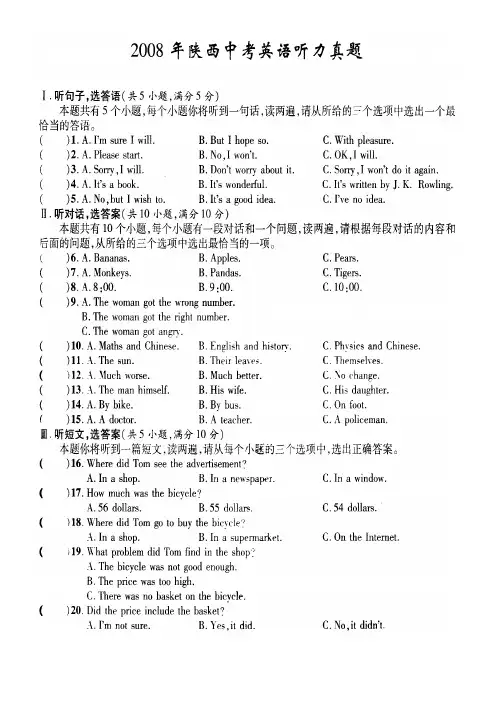
2006陕西中考英语听力真题I听句子,选答语(共5小题,计5分)本题共有5个小题,每个小题你将听到一句话,读两遍。
请从所给的三个选项中选出一个最恰当的答语。
1. A. We'd love to. B. It's nice of you to say so. C. Don't say so.2. A. Sorry B. That's right. C. It doesn't matter3. A. I don't think so. B.It's a pleasure. C. Let me see.4. A. See you later. B. Excuse me. C. Yes, please.5. A. Good luck. B. It's great. C. I'll try it.II听对话,选答案(共10小题,计10分)本题共有10 个小题,每个小题有一段对话和一个问题,读两遍。
请根据每段对话内容和后面的问题,从所给的三个选项中选出最恰当的一项。
6. A. Fruit B. Vegetables C. Meat7. A. About 3 kilometers. B. About 4 kilometers. C . About 5 kilometers.8. A. On Monday. B. On Tuesday. C. On Wednesday.9. A. At home. B. In a book store. C. In a zoo.10. A. He is well. B. He isn't well enough. C. He is still badly ill.11. A. A singer B. A player C. A nurse12. A. Study for the test. B. Go to play table tennis. C. Go to visit her friends.13. A. She needs a small house.B. She needs a besutiful house.C. She needs a big house.14. A. His bike is broken on his way to school.B. The traffic is too heacy.C. He gets up late in the morning.15. A. She drives her car. B. She takes a bus. C. She rides her bike.VII听短文,选答案(共5小题,计10分)本题你将听到一篇短文,读两遍。
2007[1].12听力原文及答案
![2007[1].12听力原文及答案](https://360docs-1393072327.cos.ap-beijing.myqcloud.com/0bb2ea1aff00bed5b9f31d6c.webp)
2007.12听力原文Section A ConversationsShort Conversations11. W: I ran into Sally the other day. I could hardly recognize her. Do you remember her from high school?M: Yeah, she was a little out of shape back then. Well, has she lost a lot of weight?Q: What does the man remember of Sally?12. W: We don’t seem to have a reservation for you, sir. I’m sorry.M: But my secretary said that she had reserved a room for me here.I phoned her from the airport this morning just before I got on board the plane.Q: Where does the conversation most probably take place?13. W: What would you do if you were in my place?M: If Paul were my son, I’d just not worry. Now that his teacher is giving him extra help and he"s working hard himself, he’s sure to do well in the next exam.Q: What’s the man’s suggestion to the woman?14. M: You’ve had your hands full and have been overworked during the last two weeks. I think you really need to go out and get some fresh air and sunshine.W: You are right. That’s just what I’m thinking about.Q: What is the woman most probably going to do?15. W: Hello, John. How are you feeling now? I hear you’ve been ill.M: They must have confused me with my twin brother Rods. He’s been sick all week, but I’ve never felt b etter in my life.Q: What do we learn about the man?16. M: Did you really give away all your furniture when you moved into the new house last month?W: Just the useless pieces, as I’m planning to purchase a new set from Italy for the sitting room only.Q: What does the woman mean?17. M: I’ve brought back your Oxford Companion to English Literature.I thought you might use it for your paper. Sorry not to have returned it earlier.W: I was wondering where that book was.Q: What can we infer from the conversation?18. W: To tell the truth, Tony, it never occurs to me that you are an athlete.M: Oh, really? Most people who meet me, including some friends of mine, don’t think so either.Q: What do we learn from the conversation?Long ConversationsConversation 1M: Mary, I hope you"re packed and ready to leave.W: Yes, I’m packed, but not quite ready. I can’t find my passport.M: Your passport? That’s the one thing you mustn’t leave behind.W: I know. I haven’t lost it. I’ve packed it, but I can’t remember which bag it’s in.M: Well, you have to find it at the airport. Come on, the taxi is waiting.W: Did you say taxi? I thought we were going in your car.M: Yes, well, I have planned to, but I’ll explain later. You’ve got to be there in an hour.W: The plane doesn’t leave for two hours. Anyway, I’m ready to go now.M: Now, you"re taking just one case, is that right?W: No, there is one in the hall as well.M: Gosh, what a lot of stuff! You"re taking enough for a month instead of a week.W: Well, you can’t depend on the weather. It might be cold.M: It’s never cold in Rome. Certainly not in May. Come on, we really must go.W: Right, we"re ready. We’ve got the bags, I’m sure there"s no need to rush.M: There is. I asked the taxi driver to wait two minutes, not twenty.W: Look, I’m supposed to be going away to relax. You"re making me nervous.M: Well, I want you to relax on holiday, but you can’t relax yet.W: OK, I promise not to relax, at least not until we get to the airport and I find my passport.Questions 19-22 are based on the conversatoin you have just heard.Q19: What does the woman say about her passport?Q20: What do we know about the woman’s trip?Q21: Why does the man urge the woman to hurry?Q22: Where does the conversation most probably take place?Conversation 2W: Oh, I’m fed up with my job.M: Hey, there"s a perfect job for you in the paper today. You might be interested.W: Oh, what is it? What do they want?M: Wait a minute. Uh, here it is. The European Space Agency is recruiting translators.W: The European Space Agency?M: Well, that’s what it says. They need an English translator to work from French or German.W: So they need a degree in French or German, I suppose. Well, I’ve got that. What’s more, I have plenty of experience. What else are they asking for?M: Just that. A university degree and three or four years of experience as a translator in a professional environment. They also say the person should have a lively and inquiring mind, effective communication skills and the ability to work individually or as a part of the team.W: Well, if I stay at my present job much longer, I won’t have any mind or skills left. By the way, what about salary? I just hope it isn’t lower than what I get now.M: It’s said to be negotiable. It depends on the applicant’s education and experience. In addition to basic salary, there"s a list of extra benefits. Have a look yourself.W: Hm, travel and social security plus relocation expenses are paid. Hey, this isn’t bad. I really want the job.Questions 23-25 are based on the conversatoin you have just heard.Q23: Why is the woman trying to find a new job?Q24: What position is being advertised in the paper?Q25: What are the key factors that determine the salary of the new position?Section B Short PassagesPassage 1When couples get married, they usually plan to have children. Sometimes, however, a couple can not have a child of their own. In this case, they may decide to adopt a child. In fact, adoption is very common today. There are about 60 thousand adoptions each year in the United States alone. Some people prefer to adopt infants, others adopt olderchildren, some couples adopt children from their own countries, others adopt children from foreign countries. In any case, they all adopt children for the same reason ---- they care about children and want to give their adopted child a happy life.Most adopted children know that they are adopted. Psychologists and child-care experts generally think this is a good idea. However, many adopted children or adoptees have very little information about their biological parents. As a matter of fact, it is often very difficult for adoptees to find out about their birth parents because the birth records of most adoptees are usually sealed. The information is secret so no one can see it. Naturally, adopted children have different feelings about their birth parents. Many adoptees want to search for them, but others do not. The decision to search for birth parents is a difficult one to make. Most adoptees have mixed feelings about finding their biological parents. Even though adoptees do not know about their natural parents, they do know that their adopted parents want them, love them and will care for them.Questions 26-29 are based on the passage you have just heard.26. According to the speaker, why do some couples adopt children?27. Why is it difficult for adoptees to find out about their birth parents?28. Why do many adoptees find it hard to make the decision to search for their birth parents?29. What can we infer from the passage?Passage 2Katherine Gram graduated from University of Chicago in 1938 and got a job as a news reporter in San Francisco. Katherine’s father used to be a successful investment banker. In 1933, he bought a failing newspaper, the Washington Post.Then Katherine returned to Washington and got a job, editing letters in her father’s newspaper. She married Philip Gram, who took over his father-in-law’s position shortly after and became publisher of the Washington Post. But for many years, her husband suffered from mental illness and he killed hims elf in 1963. After her husband’s death, Katherine operated the newspaper. In the 1970s, the newspaper became famous around the world and Katherine was also recognized as an importantleader in newspaper publishing. She was the first woman to head a major American publishing company, the Washington Post company. In a few years, she successfully expanded the company to include newspaper, magazine, broadcast and cable companies.She died of head injuries after a fall when she was 84. More than 3 thousand people attended her funeral including many government and business leaders. Her friends said she would be remembered as a woman who had an important influence on events in the United States and the world. Katherine once wrote, “The world without newspapers wo uld not be the same kind of world”. After her death, the employees of the Washington Post wrote, “The world without Katherine would not be the same at all.”Questions 30-32 are based on the passage you have just heard.30. What do we learn from the pas sage about Katherine’s father?31. What does the speaker tell us about Katherine Gram?32. What does the comment by employees of the Washington Post suggest?Passage 3Obtaining good health insurance is a real necessity while you are studying overseas. It protects you from minor and major medical expenses that can wipe out not only your savings but your dreams of an education abroad. There are often two different types of health insurance you can consider buying, international travel insurance and student insurance in the country where you will be going.An international travel insurance policy is usually purchased in your home country before you go abroad. It generally covers a wide variety of medical services and you are often given a list of doctors in the area where you will travel who may even speak your native language. The drawback might be that you may not get your money back immediately, in other words, you may have to pay all you medical expenses and then later submit your receipts to the insurance company.On the other hand, getting student heath insurance in the country where you will study might allow you to only pay a certain percentage of the medical cost at the time of service and thus you don’t have to have sufficient cash to pay the entire bill at once. Whatever you decide, obtaining some form of health insurance is something you should consider before you go overseas. You shouldn’t wait until you are sick with major medical bills to pay off.Questions 33-35 are based on the passage you have just heard.33. Why does the speaker advice overseas students to buy health insurance?34. What is the drawback of students buying international travel insurance?35. What does the speaker say about students getting health insurance in the country where they will study?Section C Compound DictationMore and more of the world’s population are living in towns or cities. The speed at which cities are growing in the less developed countries is alarming. Between 1920 and 1960, big cities in developed countries increased two and a half times in size, but in other parts of the world the growth was eight times their size. The sheer size of growth is bad enough, but there are now also very disturbing signs of trouble in the comparison of percentages of people living in towns and percentages of people working in industry. During the 19th century, cities grew as a result of the growth of industry. In Europe, the proportion of people living in cities was always smaller than that of the work force working in factories. Now, however, the reverse is almost always true in the newly industrialized world. The percentage of people living in cities is much higher than the percentage working in industry. Without a base of people working in industry, these cities cannot pay for their growth. There is not enough money to build adequate houses for the people that live there, let alone the new arrivals. There has been little opportunity to build water supplies or other facilities. So the figures for the growth of towns and cities represent proportional growth of unemployment and underemployment, a growth in the number of hopeless and despairing parents and starving children.答案四级专项练习册答案顺序11-15 DBAAC16-20 D A B C B21-25 D A B C D16-30 D C B A B31-35 C A D D C36. alarming.37. increased38. sheer39. disturbing40. comparison41. proportion42. workforce43. reverse44. The percentage of people living in cities is much higher than the percentage working in industry.45. There is not enough money to build adequate houses for the people that live there, let alone the new arrivals.46. So the figures for the growth of towns and cities represent proportional growth of unemployment and underemployment。
2005-2018年高考全国卷听力真题及答案
2005-2018年高考全国卷听力真题及答案2018—2005高考全国卷英语听力真题2018年普通高等学校招生全国统一考试(新课标I)听力部分第一节(共5小题;每小题1.5分,满分7.5分)1. What will James do tomorrow?A. Watch a TV program.B. Give a talk.C. Writea report.2. What can we say about the woman?A. She’s generous.B. She’s curious.C. She’s helpful.3. When does the train leave?A. At 6:30.B. At 8:30.C. At 10:30.4. How does the woman go to work?A. By car.B. On foot.C. By bike.5. What is the probable relationship between the speakers?A. Classmates.B. Teacher and student.C. Doctor and patient.第二节(共15小题;每小题1.5分,满分22.5分)听下面5段对话或独白。
每段对话或独白后有几个小题,从题中所给的A、B、C三个选项中选出最佳选项。
听每段对话或独白前,你将有时间阅读各个小题,每小题5秒钟;听完后,各小题将给出5秒钟的作答时间。
每段对话或独白读两遍。
听第6段材料,回答第6、7题。
6. What does the woman regret?A. Giving up her research.B. Dropping out of college.C. Changing her major.7. What is the woman interested in studying now?A. Ecology.B. Education.C. Chemistry.听第7段材料,回答第8、9题。
2007年高考全国卷英语听力试题(含试题、听力音频、听力原文和答案)
绝密★启用前2007年普通高等学校招生全国统一考试全国卷英语听力试题2007年高考 全国卷 英语听力音频 双击图标打开收听.mp3(请用电脑,双击上面图标,打开收听)注意事项:1. 答卷前,考生务必将自己的姓名、考生号等填写在答题卡和试卷指定位置上。
2. 回答选择题时,选出每小题答案后,用铅笔把答题卡上对应题目的答案标号涂黑。
如需改动,用橡皮擦干净后,再选涂其它答案标号,回答非选择题时,将答案写在答题卡上,写在本试卷上无效。
3. 考试结束后,将本试卷和答案卡一并交回。
一、听力(共两节,满分30分)回答听力部分时,请先将答案标在试卷上。
听力部分结束前,你将有两分钟的时间,将你的答案转涂到客观题答题卡上。
第一节(共5小题;每小题1.5分,满分7.5分)听下面五段对话。
每段对话后有一小题,从题中所给的A、B、C三个选项中选出最佳选项,并标在试卷的相应位置。
听完每段对话后,你都有10秒钟的时间来回答有关小题和阅读下一小题。
每段对话仅读一遍。
例:How much is the shirt?A. £19.15.B. £9.15.C. £9.18.答案是B。
1. Who is coming for tea?A. John.B. Mark.C. Tracy.2. What will the man do next?A. Leave right away.B. Stay for dinner.C. Catch a train.3. What does the man come for?A. A lecture.B. A meeting.C. A party.4. What size does the man want?A. 9.B. 35.C. 39.5. What are the speakers talking about?A. Life in Southeast Asia.B. Weather condition.C. A holiday tour.第二节(共15小题;每小题 1.5 分,满分22.5 分)听下面5 段对话或独白。
2007年全国高考英语听力试题+原文+答案__天津卷学习啊
学英语简单吗?肯定会有许多学生说:“难死了”。
为什么有好多学生对英语的学习都感到头疼呢?答案只有一个:“不得法。
” 英语与汉语一样都是一种语言,为什么你说汉语会如此流利?那是因为你置身于一个汉语环境中,如果你在伦敦呆上半年,保准说起英语来会非常流利。
但很多中学生没有很好的英语环境,那么你可以自己设置一个英语环境,坚持“多说”、“多听”、“多读”、“多写”,那么你的英语成绩肯定会很出色。
一、多“说”。
自己多创造机会与英语教师多讲英语,见了同学,尤其是和好朋友在一起时尽量用英语去问候,谈心情……这时候你需随身携带一个英汉互译小词典,遇到生词时查一下这些生词,也不用刻意去记,用的多了,这个单词自然而然就会记住。
千万别把学英语当成负担,始终把它当成一件有趣的事情去做。
或许你有机会碰上外国人,你应大胆地上去跟他打招呼,和他谈天气、谈风景、谈学校……只是别问及他的年纪,婚史等私人问题。
尽量用一些你学过的词汇,句子去和他谈天说地。
不久你会发现与老外聊天要比你与中国人谈英语容易的多。
因为他和你交谈时会用许多简单词汇,而且不太看重说法,你只要发音准确,准能顺利地交流下去。
只是你必须要有信心,敢于表达自己的思想。
如果没有合适的伙伴也没关系,你可以拿过一本书或其它什么东西做假想对象,对它谈你一天的所见所闻,谈你的快乐,你的悲伤等等,长此坚持下去你的口语肯定会有较大的提高。
二、多“听”寻找一切可以听英语的机会。
别人用英语交谈时,你应该大胆地去参与,多听听各种各样人的发音,男女老少,节奏快的慢的你都应该接触到,如果这样的机会少的话,你可以选择你不知内容的文章去听,这将会对你帮助很大,而你去听学过的课文的磁带,那将会对你的语言语调的学习有很大的帮助。
三、多“读”。
“读”可以分为两种。
一种是“默读”。
每天给予一定时间的练习将会对你提高阅读速度有很大的好处,读的内容可以是你的课本,但最好是一些有趣的小读物,因为现在的英语高考越来越重视阅读量和阅读速度。
2007年高考全国卷I英语听力录 音稿
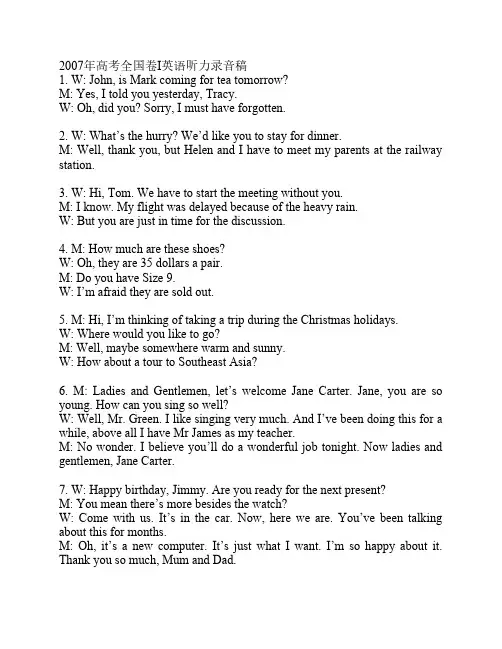
2007年高考全国卷I英语听力录音稿1. W: John, is Mark coming for tea tomorrow?M: Yes, I told you yesterday, Tracy.W: Oh, did you? Sorry, I must have forgotten.2. W: What’s the hurry? We’d like you to stay for dinner.M: Well, thank you, but Helen and I have to meet my parents at the railway station.3. W: Hi, Tom. We have to start the meeting without you.M: I know. My flight was delayed because of the heavy rain.W: But you are just in time for the discussion.4. M: How much are these shoes?W: Oh, they are 35 dollars a pair.M: Do you have Size 9.W: I’m afraid they are sold out.5. M: Hi, I’m thinking of taking a trip during the Christmas holidays.W: Where would you like to go?M: Well, maybe somewhere warm and sunny.W: How about a tour to Southeast Asia?6. M: Ladies and Gentlemen, let’s welcome Jane Carter. Jane, you are so young. How can you sing so well?W: Well, Mr. Green. I like singing very much. And I’ve been doing this for a while, above all I have Mr James as my teacher.M: No wonder. I believe you’ll do a wonderful job tonight. Now ladies and gentlemen, Jane Carter.7. W: Happy birthday, Jimmy. Are you ready for the next present?M: You mean there’s more besides the watch?W: Come with us. It’s in the car. Now, here we are. You’ve been talking about this for months.M: Oh, it’s a new computer. It’s just what I want. I’m so happy about it. Thank you so much, Mum and Dad.8. W: Excuse me, sir?M: Can I help you?W: My name is Jane Smith. I’m a designer, looking for a job.M: See my secretary. She will set you up with the test.W: When?M: Next month.W: I can’t wait that long.M: Excuse me?W: I can’t wait a month. I need something sooner.M: I’m sorry.9. M: Hi, Lily, how’s your new flat?W: It’s great. I really like it.M: How big is it?W: It’s one big room, but it has a bathroom and a small kitchen, too.M: How far is it from the office.W: It’s only about 10 minutes.M: 10 minutes by bus or by car?W: On foot. I walked to work this morning. I was 10 minutes early.M: You are lucky. I was 10 minutes late.W: What happenedM: All the buses came late.W: What did Susan say?M:She was late too.W: What happened to her?M: She took the train, and it was late too.W: Well then you’re really lucky after all. But what are you going to do tomorrow.M: I’ll start 15 minutes earlier.M: Good afternoon, everybody and welcome to this class on English words. I hope that all of you can hear me. If not, please let me know. I am Pref. John Morris. I’ll be your teacher for the next 13 weeks. As you can probably tell, this is one of popular and crowded classes. Indeed, every time these courses are offered, this room is very full. Why is that? Well, in order to use the English language, it’s very important to have at least a basic understanding of how words are formed. Just to mention one figure, and there are many. Thereare about one million words in English. If you are an English learner, you might wonder how you can possibly remember all of these words. Well, for one thing you don’t have to. No native speaker exists who knows all of the words in the English language. Besides there are shortcuts. Shortcuts? Yes, for example, if you know how words are formed by using parts of words from other languages, such Greek and French, you’ll understand a good number of English words when you first come across them. Let me put it this way. Knowing the rules will help you master a large number of words. This is probably the No. 1 reason why this class is so popular.。
2024 年新课标全国Ⅰ卷英语(含听力)真题卷含答案
2024年新课标全国Ⅰ卷英语(含听力)一、听力选择题1.What is Kate doing?A.Boarding a flight. B.Arranging a trip. C.Seeing a friend off.【答案】C【原文】M: Thanks for the wonderful weekend, Kate.W: That's okay. Bob and I are glad you came to see us.M: Oh, I have to go in. My flight will take off soon. Do contact me when you're in Sydney.W: Sure, we will.2.What are the speakers talking about?A.A pop star. B.An old song. C.A radio program.【答案】B【原文】W: Paul, listen to the radio. It's You've Stolen My Heart, one of the songs played at our wedding. M: Yeah, how beautiful! It's been popular for almost two decades.3.What will the speakers do today?A.Go to an art show. B.Meet the man's aunt. C.Eat out with Mark.【答案】A【原文】W: David, forget about Mark. His aunt is in town, so he can't go with us today.M: Oh, what a pity! It's the last day of the art show.4.What does the man want to do?A.Cancel an order. B.Ask for a receipt. C.Reschedule a delivery.【答案】C【原文】W: How may I help you?M: I bought a desk and asked for it to be delivered to my house this Friday.W: Yes, what’s the problem?M: I need to have it delivered this Saturday.5.When will the next train to Bedford leave?A.At 9:45. B.At 10:15. C.At 11:00.【答案】A【原文】W: Next, please.M: Oh, hi, I missed my 9 o'clock train to Bedford. Do I have to buy another ticket?W: No. The next train leaves at a quarter to ten at Platform 11.M: Thank you.听下面一段较长对话,回答以下小题。
1999——2008高考英语听力
答案2008年普通高等学校招生全国统一考试英语(全国卷Ⅰ)听力部分1. B2. A3. C4. A5. B6. A7. C8. C9. A 10. A11. C 12. C 13. B 14. B 15. C 16. A 17. B 18. B 19. A 20. C2007年普通高等学校招生全国统一考试英语(全国卷)听力部分1. B2. A3. B4. A5. C6. C7. A8. C9. B 10. B11. A 12. C 13. A 14. B 15. B 16. C 17. A 18. B 19. C 20. C2006年普通高等学校招生全国统一考试英语(全国卷Ⅰ)听力部分1. B2. C3. A4. A5. C6. C7. A8. A9. C 10. A11. B 12. B 13. A 14. B 15. B 16. C 17. A 18. B 19. B 20. C2005年普通高等学校招生全国统一考试英语(全国卷Ⅰ)听力部分1. B2. A3. C4. B5. C6. A7. B8. A9. B 10. C11. A 12. C 13. A 14. B 15. A 16. A 17. C 18. B 19. B 20. C2004年普通高等学校招生全国统一考试英语(全国卷Ⅰ)听力部分1. B2. A3. B4. A5. C6. C7. C8. A9. B 10. B11. C 12. B 13. A 14. B 15. C 16. A 17. C 18. A 19. B 20. A2004年普通高等学校招生全国统一考试英语(全国卷Ⅱ)听力部分1. B2. A3. B4. A5. C6. A7. B8. B9. C 10. A11. C 12. B 13. C 14. A 15. C 16. C 17. A 18. C 19. B 20. B2004年普通高等学校招生全国统一考试英语(全国卷Ⅲ)听力部分1. A2. B3. C4. B5. A6. C7. B8. C9. A 10. C11. A 12. C 13. A 14. B 15. B 16. C 17. B 18. A 19. A 20. B2004年普通高等学校招生全国统一考试英语(全国卷Ⅳ)听力部分1. C2. C3. A4. B5. B6. A7. C8. B9. A 10. C11. B 12. A 13. C 14. A 15. C 16. B 17. B 18. A 19. C 20. B2003年普通高等学校招生全国统一考试英语(全国卷)听力部分1. A2. B3. C4. B5. C6. C7. B8. A9. C 10. A11. C 12. A 13. B 14. A 15. C 16. B 17. C 18. A 19. B 20. C2002年普通高等学校招生全国统一考试英语(全国卷)听力部分1. C2. A3. B4. B5. C6. B7. A8. C9. B 10. A11. C 12. A 13. B 14. C 15. B 16. C 17. A 18. C 19. B 20.C2001年普通高等学校招生全国统一考试英语(全国卷)听力部分1. C2. A3. C4. B5. A6. B7. A8. C9. B 10. A11. B 12. C 13. B 14. A 15. C 16. A 17. B 18. A 19. C 20. B2001年普通高等学校招生全国统一考试英语(上海卷)听力部分1. A2. C3. B4. A5. C6. D7. B8. C9. D 10. A11. D 12. B 13. A 14. C 15. B 16. D 17. A 18. A 19. B 20. C2000年普通高等学校招生全国统一考试英语(全国卷)听力部分1. A2. B3. B4. C5. B6. A7. A8. C9. C 10. A11. B 12. A 13. C 14. B 15. C 16. C 17. A 18. B 19. A 20. C1999年普通高等学校招生全国统一考试英语(全国卷)听力部分1. B2. A3. C4. C5. B6. B7. A8. A9. C 10. B11. A 12. C 13. B 14. B 15. A 16. C 17. C 18. A 19. B 20. C。
2007年高考试题与答案(全国卷1英语)
2007年普通高等学校招生全国统一考试试题卷(全国卷I)英语第I卷注意事项:1.答题前,考生在答题卡上务必用直经0.5毫米黑色墨水签字笔将自己的姓名,准考证号填写清楚,并贴好条形码。
请认真核准条形码上的准考证号、姓名和科目。
2.每小题选出答案后,用2 B铅笔把答题卡上对应题目的答案标号涂黑。
如需改动,用橡皮擦干净后,再选涂其他答案标号,在试题卷上作答无效。
第一部分听力(共两节,满分30分)做题时,先将答案标在试卷上。
录音内容结束后,你将有两分钟的时间将试卷上答案转涂到答题卡上。
第一节(共5 小题;每小题 1.5 分,满分7.5 分)听下面5段对话。
每段对话后有一个小题,从题中所给的A、B、C三个选项中选出最佳选项,并标在试卷的相应位置。
听完每段对话后,你都有10秒钟的时间来回答有关小题和阅读下一小题。
每段对话仅读一遍。
例:How much is the shirt?A.£19.15.B.£9.15.C.£9.18.答案是B。
1. Who is coming for tea?A. John.B. Mark.C. Tracy.2. What will the man do next?A. Leave right away.B. Stay for dinner.C. Catch a train.3. What does the man come for?A. A lecture.B. A meeting.C. A party.4. What size does the man want?A. 9.B. 35.C. 39.5. What are the speakers talking about?A. Life in Southeast Asia.B. Weather condition.C. A holiday tour.第二节(共15小题;每小题 1.5 分,满分22.5 分)听下面5 段对话或独白。
2007年英语听力(全国卷Ⅰ)听力真题+答案
2007年高考英语听力(全国1)试题第一节(共5 小题;每小题 1.5 分,满分7.5 分)1. Who is coming for tea?A. John.B. Mark.C. Tracy.2. What will the man do next?A. Leave right away.B. Stay for dinner.C. Catch a train.3. What does the man come for?A. A lecture.B. A meeting.C. A party.4. What size does the man want?A. 9.B. 35.C. 39.5. What are the speakers talking about?A. Life in Southeast Asia.B. Weather condition.C. A holiday tour.第二节(共15小题;每小题 1.5 分,满分22.5 分)听下面5 段对话或独白。
每段对话或独白后有几个小题,从题中所给的A、B、C三个选项中选出最佳选项,并标在试卷的相应位置。
听每段对话或独白前,你将有时间阅览室读各个小题,每小题5秒钟;听完后,各小题将给出5秒钟的作答时间。
每段对话或独白读两遍。
听第6段材料,回答第6、7题。
6. What is the man doing?A. Giving a speech.B. Chairing a meeting.C. Introducing a person.7. Why does the woman sing so well?A. She has a great teacher.B. She teaches singing.C. She is young. 听第7段材料,回答第8、9题。
8. What is the second gift for Jimmy?A. A car.B. A watch.C. A computer.9. Why does Jimmy feel happy?A. He lives with his parents.B. He’s got what he dreamt of.C. He’s received lots of presents.听第8段材料,回答第10至12题。