
新目标人教版八年级下册Unit 4 Why don’t you talk to your parents Section A 3
1.掌握提出问题的方法, What’s wrong? with sb. What’s the matter? What’s the problem/the trouble? 并能讨论所给出的建议。
2. 情态动词should, should等
should,shouldn’t “(不)应该”,常 用来提出请求和建议 could “可以”可也用来给出建议。
一、按要求写出下列词汇或词组 explain 1. make sth. clear (同义词) ___________ communicate 2. talk (同义词) _______________ refuse 3. not allow (同义词) ______________ 4. worried (同义词) ______________ nervous get on with 5. get along with (同义词) ____________ 6. communicate (名词)communication _____________ older/ elder 7. old (比较级) _______________
3. 我应该做什么? _____ What _______I should do? 4. 你为什么不忘掉此事呢?尽管她错了, 但那不是一件大事。 _____ ____ you forget about it? Why don’t Although she’s wrong, it’s not ____ a _________ ___ big _____. deal
5. 他应当如何做? What _______ should he do? _____ 6. 他应当和他的朋友谈一下,以便他能 向他道谦。 He ______ should _____ talk ___ to his friend so ____ that he can say he’s sorry. ____
Read the article again and fill in the blanks. 1. Sad and Thirteen has some _________. problems He can’t __________ get on with his family. His parents _____ fight a lot. It’s the only communication they have. When _______________ argue it’s like a big black cloud they ______, ____________ hanging over their home. He doesn’t like it.
用could 给出建议一般是指自己不太肯定, 或者只是很多建议中的某一个,仅供参 考;而should就是自己很肯定的或唯一 的最好的一个建议。
should (shall) could (can) 情态动词 + v, 可表示说话人的语气, 可表达建议、要求、可能和意愿等,没 有人称和数的变化 ,完成下列句子。
1. 你看上去很疲劳,怎么了? You ____ look tired. What’s ___ the _______? matter 2. 昨晚,我一直学习到午夜,因此我没有 睡足觉。 until _________ midnight last night so I I studied _____ didn’t get ___ enough ______ sleep.
You should/could +v. Why don’t you +v.? Why not +v.? Could you please +v.? You’d better (not) +v. Would you mind doing……? What about/How about + n./doing……?
2. Robert Hunt thinks Sad and Thirteen should _________ talk about these feelings to his family. He should offer ____ to help. Maybe he could _________ do _____ more jobs around the house so that they have more time _______________________ for proper communication . Second, he could sit down and ____________ ____ communicate with his brother.
His brother always watches TV whatever he wants until midnight. He _______ refuses to let him watch his favorite lonely and TV show. So He always feels ______ nervous at home. ________
7. 或许你应当去他家。 Maybe you ______ could go to his house. _______ 8. 我猜我可以,但是我不想让他吃惊。 I guess I _______, could but I don’t want to _______ surprise _______. him
He could ________ _________ explain that he don’t mind him watching TV all the time, however, he should let him watch his _____________. favorite show
2020年人教版新目标 英语 八年级下册 Unit 4 Why don’t you talk
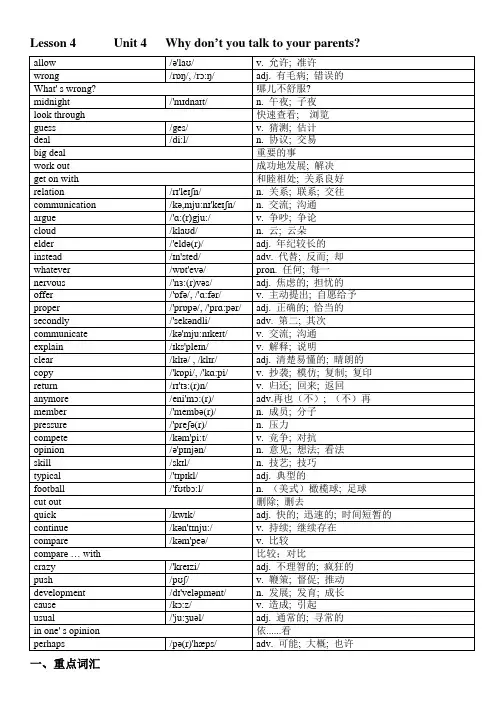
Lesson 4 Unit 4 Why don’t you talk to your parents?一、重点词汇1. allow v.允许;准许allow sb to do sth ; allow doing sth;be (not) allowed to do妈妈允许我周末看电视。
My mother allows me to watch TV on weekends.不允许在教室吃饭。
We don’t allow eating in the classroom.2.deal n.a great deal of time许多He was trying to make a deal with them.交易v. 处理,多与with连用相关词组:a good/great deal很多It' s a deal.就这么定了 a big deal大事deal with常与how连用do with常与what连用3.Look through浏览,快速查看含look的常用短语:look up;look at; look out; look for; look after; look like; look around; look down on/ upon; look over 4.argue v.争论argument n.Argue with sb = have an argument with sb 与某人争辩Argue on / about sth 辩论某事Argue with sb about sth为某事与某人争论我和她争论哪个队伍会赢。
I’m arguing with her about which team will win.5.Offer v.&n.提供Offer to do sth主动提出做某事;offer sb sth = offer sth to sb 提供某人某物他主动提出借我几本书。
八年级英语人教版下册Unit4Whydon'tyoutalktoyourparents教学设计

(4)巩固:通过听力、阅读练习,帮助学生巩固所学知识,提高听力和阅读能力。
(5)拓展:鼓励学生课后观察和思考家庭成员之间的沟通问题,尝试用英语与家人进行有效沟通,将所学知识运用到实际生活中。
3.教学评价设想:
5.引导学生树立正确的人生观和价值观,关注家庭和谐,为构建和谐社会贡献自己的力量。
二、学情分析
八年级的学生已经具备了一定的英语基础,他们在一、二年级的学习中,掌握了基本的语法、词汇和日常会话。在此基础上,他们对英语学习有了更深入的了解,具备了一定的自学能力和合作学习能力。然而,在语言实际运用方面,尤其是家庭成员之间的沟通问题,学生们的表达能力和解决问题的能力还有待提高。
5.教师在教学过程中关注学生的个体差异,给予个性化的指导和鼓励,提高学生的学习信心。
(三)情感态度与价值观
1.培养学生关爱家人、尊重家庭成员之间的差异,学会与家人沟通、解决问题的情感态度。
2.培养学生团结协作、互相帮助的精神,增强团队意识。
3.培养学生面对问题时,保持积极乐观的心态,勇于承担责任。
4.增进学生对家庭、亲情和友谊的认识,培养珍惜家人、朋友之间的感情。
(1)形成性评价:关注学生在课堂活动中的表现,鼓励学生积极参与,给予及时的反馈和指导。
(2)终结性评价:通过单元测试、口语表达等形式,全面评估学生的学习效果。
(3)个性化评价:针对学生的个体差异,给予个性化的评价和指导,激发学生的学习兴趣和自信心。
四、教学内容与过程
(一)导入新课
1.教师展示一幅家庭成员争吵的图片,引导学生观察并思考:“What is happening in this picture? Can you guess why they are arguing?”
人教新目标2014春八年级下册unit4-Why-don't-you-talk-to-your-parents课文重难点讲解(打印)
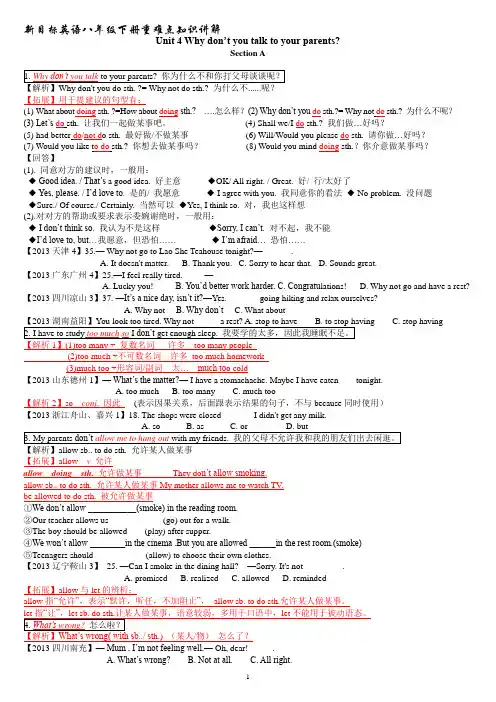
新目标英语八年级下册重难点知识讲解Unit 4 Why don’t you talk to your parents?Section A【拓展】用于提建议的句型有:(1) What about doing sth. ?=How about doing sth.? ….怎么样?(2) Why don’t you do sth.?= Why not do sth.? 为什么不呢?(3) Let’s do sth. 让我们一起做某事吧。
(4) Shall we/I do sth.? 我们做…好吗?(5) had better do/not d o sth. 最好做/不做某事(6) Will/Would you please do sth. 请你做…好吗?(7) Would you like t o do sth.? 你想去做某事吗?(8) Would you mind doing sth.?你介意做某事吗?【回答】(1). 同意对方的建议时,一般用:◆ Good idea. / That’s a good idea. 好主意◆OK/ All right. / Great. 好/ 行/太好了◆ Yes, please. / I’d love to. 是的/ 我愿意◆ I agree with you. 我同意你的看法◆ No problem. 没问题◆Sure./ Of course./ Certainly. 当然可以◆Yes, I think so. 对,我也这样想(2).对对方的帮助或要求表示委婉谢绝时,一般用:◆ I don’t think so. 我认为不是这样◆Sorry, I can’t. 对不起,我不能◆I’d love to, but…我愿意,但恐怕……◆ I’m afraid… 恐怕……【2013天津4】35.— Why not go to Lao She Teahouse tonight?— ______.A. It doesn't matter.B. Thank you.C. Sorry to hear that.D. Sounds great.【2013广东广州4】25.—I feel really tired. —______A. Lucky you!B. You’d better work harder.C. Congratu lations!D. Why not go and have a rest? 【2013四川凉山3】37. —It’s a nice day, isn’t it?—Yes. ______ going hiking and relax ourselves?A. Why notB. Why don’tC. What aboutC. stop having【解析1】(1)too many + 复数名词许多too many people(2)too much +不可数名词许多too much homework(3)much too +形容词/副词太… much to o cold【2013山东德州1】—What’s the matter?— I have a stomachache. Maybe I have eaten ___ tonight.A. too muchB. too manyC. much too【解析2】so conj. 因此(表示因果关系,后面跟表示结果的句子,不与because同时使用)【2013浙江舟山、嘉兴1】18. The shops were closed_______ I didn't get any milk.【拓展】allow v 允许allow doing sth.允许做某事They do n’t allow smoking.allow sb.. to do sth. 允许某人做某事My mother allows me to watch TV.be allowed to do sth. 被允许做某事①We don’t allow ___________(smoke) in the reading room.②Our teacher allows us ____________(go) out for a walk.③The boy should be allowed____(play) after supper.④We won’t allow ________in the cinema .But you are allowed ______in the rest room.(smoke)⑤Teenagers should ___________ (allow) to choose their own clothes.【2013辽宁鞍山3】25. —Can I smoke in the dining hall? —Sorry. It's not_________.A. promisedB. realizedC. allowedD. reminded【拓展】allow与let的辨析:allow指“允许”,表示“默许,听任,不加阻止”,allow sb. to do sth.允许某人做某事。
人教新目标八年级下册英语 Unit 4 Why don't you talk to your pa

Unit 4 Why don’t you talk to your parents?单元检测卷满分100分,限时90分钟I.单项选择(15分)1.No teachers allow their students gum in the class.A.to chewB.chewC.chewingD.chews2. What's with you?A. WrongB. the wrongC. matterD. up3. give him a watch?A. What aboutB. Let' sC. Why don'tD. Why don't you4. he is very poor, he feels very happy.A. Although; butB. Although;/C. Because; soD. Because;/5. He has two sons. They are Jim and Tom. Jim is Tom's brother.A. oldB. olderC. elderD. young6.I don't want to have a fight my brother.A.forB.toC.withD.at7.Molly is good chess and she is good students in the chess club.A.with,withB.at,atC.with,atD.at,with8.--What are they talking about?--They are talking about animals.A.protectB.to protectC.protectingD.protected9. He should the teacher.A.explainB.explain toC.explainedD.explained to10.--What’s wrong?--I can’t do my homework now. I my homework in the classroom this morning.A.leaveB.forgetC.forgotD.left11. He didn’t go to the children’s home. His friend Jack went there ________.A. insteadB. tooC. alsoD. either12. I’m going to take a vacatio n. Could you please me some information about interesting places to travel?A. offer, toB. offer, forC. provide, withD. provide, for13. Every year driving after drinking wine a lot of traffic accidents.(交通事故)A. happensB. providesC. causesD. results14.--Do you mind your room?--No, I’ll do that after finishing this article.A. clean, writeB. clean, writingC. cleaning, writeD. cleaning, writing15. Parents often their own children ot hers’ children.A. compare; withB. compare; asC. compare; toD. compare; forII.完形填空(10分)Monday morning is an important time at our school. All of the students go to the playground. We listen to music, and we 1 the national flag (国旗) go up.Usually, one student gives a talk on Monday mornings. One Monday last year, a boy gave the talk. He was 2 and excited! When I saw him, I wanted to have a try, too.Can I really do it?Last week, our teacher said our class should give the talk. My teacher 3 me, “I know you want to have a try. Ne xt Monday, you can give the talk. Go and write something down. Get ready for it. I’m sure you’ll do well.”“Thank you,” I answered. It was such a great 4 for me! When I got home, I was excited. I wrote two pages for the talk. I read them again and again. When I read, I asked my parents 5 . I wanted to make my teacher happy.Monday morning came. I began to feel 6 . When did I last give a talk to so many people? Never! This was my first time. Could I really do it? Maybe I couldn’t finish the talk.When I got to school, we all went out to playground. I 7 in front of everyone.I opened my mouth, but I couldn’t say anything.“Take it easy,” I said to8 .“Don’t be nervous. You can do it.”Just then, I looked down at everyone. I saw about 1,000 eyes. They were all looking at me! I couldn’t even stand u p.I looked at their eyes more carefully. Their eyes were saying, “You can do it! Don’t be afraid, just talk!”I 9 a big breath(呼吸).Then I bega n to talk. It wasn’t hard. It was easy.I don’t know10 I finished my talk. But I did it. I felt so good that day. I showed myself to everyone what I can do.1.A.watch B.see C.notice D.look at2.A.surprising B.proud C.amazed D.careful3.A.asked B.asked for C.said to D.showed4.A.chance B.news C.time D.message5.A.to listen to B.to listen C.listen to D.listen6.A.excited B.happy C.nervous D.surprised7.A.stand B.stood C.was standing D.have stood8.A.me B.my class C.myself D.my parents9.A.took B.held C.put D.left10.A.when B.how C.why D.whetherIII.补全对话(5分)根据对话内容,从方框内的选项中选出能填入空白处的最佳选项,其中有两个A. A scarf is interesting. D. It’s too personal.B.That sounds good. F. At least 20 dollars.C.Why don’t you get her a pet cat?E. How can I get to her house?G. What should I get her?A: My friend Kate invited me to her birthday party . 1. ___________B: How about an album?A: 2._______________ How much is an album?B: 3._______________A: That’s too expensive.I don’t have enough money for it.B: Oh. 4._____________A: No, no. She doesn’t like cats.B: I see. What about a scarf?A; 5.___________B: Does she like flowers? Maybe flowers are wonderful.A: Great! I will buy some for her. Thanks for your advice.IV.阅读理解(30分)AMaybe you have seen this in schools: some students are studying nearly all the time but they just pass their exams, while some others may spend much less time on their books but do much better in exams. How could this happen? People used to think that hard work is the only way to success. But now they have understood that smart work can make them succeed, too.Hard workers don't mind working for long hours, while smart workers always think of several different answers to these questions, “Why should I suffer this?” “Isn't there a better way to do this?” Thanks to these people, we can use computers instead of the abacus now. Progress in eve ry field is the direct result of “try to find a better way” by smart workers.There was a large soap factory in Japan. Once it received an un usual letter from someone who complained that there was no soap in the soapbox he bought.How could empty soapboxes go out of the factory? The engineers checked the producing and packing. The producing was fine, but in about one in ten thousand cases, the packing machine (机器) let an empty soapbox go. There was no need to spend a lot of money repairing the machine for such a small problem. The engineer soon worked out a solution; he put a huge X-ray machine and two large computers to find out the empty soapboxes. After teaching the workers how to use it, he sat down in his seat, exhausted.“Sir, we could have solved t he problems in a much simpler and cheaper way,” a worker said.“Really? How?”“We can put a huge fan near the packing machine. The wind coming from the fan will blow away the empty boxes, leaving the other boxes with soap.”See, this is smart work. In order to succeed, we should not only work hard like the engineer, but also think smart like this worker.1. Some students spend less time on schoolwork but do better in exams ________. A.because of their hard workB.because of different educationC.because they try to find a better wayD.because they study for a much longer time2. Someone wrote to the soap factory and complained that ________.A.the soapbox he bought was empty B.their soap was too expensive C.the soap he bought was terrible D.their service was very bad3. The soap factory could only ________ near the packing machine to solve the problems in a much simpler and cheaper way.A.set some soapboxes B.set an X-ray machineC.put two large computers D.put a huge fan4. The phrase “blow away”in the passage means “________”.A.停止B.远离C.吹走D.逃脱5. The article mainly tells us we should ________ in order to succeed. A.work hard for long hours and study all the timeB.work hard like the engineer and think smart like the workerC.spend much less time on our schoolwork than beforeD.spend enough money repairing the machine for any problemBMr. Gao lives in a town. When he was twenty-five, his son was born. He calls him Gao Xiaobao. The little boy is clever. He and his wife love him very much. It’s September 1st today. A new school year begins. Gao Xiaobao is happy and wears his most beautiful clothes. He’s going to school with his new bag. “Let me take you to school, dear.” said Mrs. Gao. “Thank you, Mummy,” said the boy. “The school is not far from here. I can walk there myself.”At school a teacher met the little boy and asked, “What’s your name, my little friend?” “Gao Xiaobao, sir.” answered the boy. “How old are you?” “Six, sir.” “What’s your father’s name?” “Gao Dabao, sir.” “How old is he?” “He is six, too, sir.” “Oh,” the teacher said in surprise. “Is he as old as you?”“Yes, sir,” said the boy. “He became a father only on the day when I was born.”6. How old is Mr. Gao now ?A. Six.B. Twenty-five.C. Thirty.D. Thirty –one.7. Mr. and Mrs. Gao love their son because __________.A. he likes to go to school C. he can go to school himselfB. the boy is clever D.he can answer the teacher ’s questions8. Gao Xiaobao didn’t let his mother take him to school because_________.A. she was too busyB. his friends could took him togetherC. the policeman could help himD. the school is near and he could take care of himself9. How did Gao Xiaobao go to school ?A. By car.B. On foo.C. By bus.D. By bike.10. Gao Xiaobao thought_________.A. Gao Dabao became a father only for six yearsB. his father was younger than himC. his father and he were born on the same dayD. his father was named Gao Dabao when he was born.COne of the most popular items (项目) in the class newspaper is the advice column(专栏). Here are some of them and their answers:Question1: I’m always late for school. I try not to be late, but I can’t help it. Please advise me what to do.—Tommy.Answer:You are probably late for school because you don’t really like school. My advice to you is to enjoy school more, and then you won’t be late so often.Question 2:I find it difficult to make friends. What do you think I should do? —Sara.Answer : I can’t advise you until I know more about you. Your problem may be that you are shy. On the other hand, it may be the opposite. You can try to be brave.Write and tell me more about yourself.Question3:I’m always at the bottom of the class. What do you advise me to do? —Molly.Answer : I advise you to concentrate (集中注意力) on improving your grades in one subject at first. Next, try to improve your grades in another subject. If you do this, by the end of the year you should be quite a long way up from the bottom in all your subjects.11.What is the main idea of this passage?A. The school newspaper has an advice column.B Tommy wrote to the school newspaper to ask for advice.C. Sara finds it difficult to make friends.D. The advice column in the school newspaper is very popular.12. What is Tommy’s problem?A. He is always late for school.B. He finds it difficult to make friends.C. He is always at the bottom of the class.D. He needs help with his homework.13. What does the adviser (建议者) want Sara to do?A. Stop being so shy.B. Stop being so brave.C. Make more friends.D. Give more information about herself.14. What does Molly want to do?A. Make more friends. B Improve her grades.C. Stay at the bottom of her class.D. Concentrate on one subject at a time.15. By the end of the year, what should Molly have in all her subjects?A. At the bottom.B. At little way up from the bottom.C. Quite a long way up from the bottom.D. At the top.V.句型转换(10分)1.Why don’t you ask your teacher for help?(改为同义句)ask your teacher for help?2.It’s time for breakfast.(改为同义句)It’s time.3.He would like to offer us some help.(改为同义句)He would like to some help us.4.I think he should tell the news to his father.(改为否定句)I tell the news to his father.5.These fans arrived very early. They could see their favorite stars.(合并成一个句子)These fans arrived very early they could see their favorite stars.VI.单词拼写(10分)A)根据首字母及汉语提示,完成下列单词的拼写,使句意明确,语言通顺。
2023-2024人教版英语八年级下册大单元整体教学设计【新课标】Unit 4 Why don't
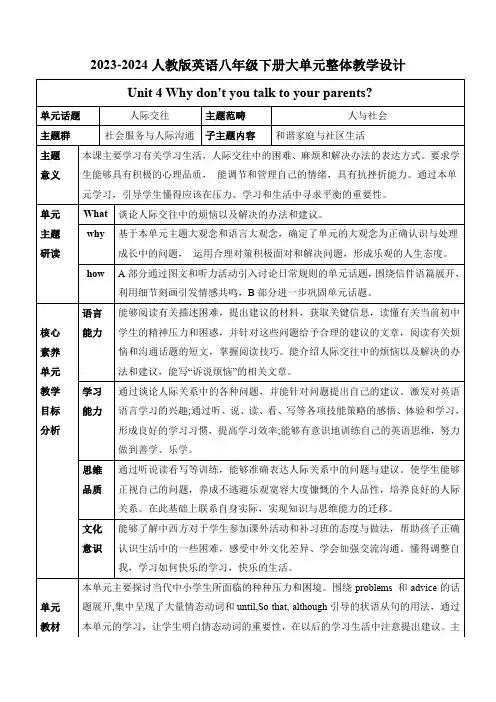
能理解和掌握含有连词until,athough.so that的相关表达个人困扰的句子。
Period 3
Section A
2d + F-4c)
1.学生通过学习词汇详解,学习本课时新单词和短语。
3.能够学会在语境中感悟或体会词汇含义,找出意思相近或相同的语言表达。
课时教学目标
Period 1
Section A 1a-2c
能初步使用“should ”“why don’t you...?”谈论表达个人建议。
能简单地谈论青少年在人际交往中遇到的困扰,并能说出自己的观点。
Period 2
Section A 3a-3c
1.归纳、梳理了本单元的重要句式结构和语法。
2.强化和巩固本单元目标语言。
1.选词填空。对连词表意功能的理解和运用。
2.写出完整的表达建议的句子。
3.开放性较强的口语交际活动,训练学生对所学语言内容的实际运用能力。
Period 4
听说
课
1a-1b融入新的词汇,让学生能够使用更丰富的语言表达来描述遇到的压力,讲述他们舒缓压力的方式,1c-1d进一步巩固单元所学的语法知识,强化连词的运用意识;1d体现了词块学习的特点;1e是一个全开放式口语实战演练,学生就三个小话题展开讨论,给出舒缓压力的建议。
思维
品质
通过听说读看写等训练,能够准确表达人际关系中的问题与建议。使学生能够正视自己的问题,养成不逃避乐观宽容大度慷慨的个人品性,培养良好的人际关系。在此基础上联系自身实际,实现知识与思维能力的迁移。
新目标八下 Unit4 Why don't you talk to your parents

教学过程Unit 4 Why don’t you talk to your parents?一、课堂导入1. Why don’t you...?2. Could you please ...?二、复习习惯用法、搭配1.work on 从事in surprise 惊讶地2.take out the rubbish 倒垃圾3.throw down 扔下come over 过来4.take sb. for a walk 带某人去散步5.get something to drink 拿点喝的东西6.lend sb. sth. 把某物借给某人7.hate to do sth. 讨厌做某事8.make sb. do sth. 使某人做某事9.enough stress足够的压力10.waste of time浪费时间11.in order to do为了做...12.mind doing sth. 介意做某事13.depend on依赖;依靠14.develop children’s independence16.look after/take care of 照顾;照看17.do one’s part in (doing ) sth.做某人分内的三、知识讲解:重点语法、句型知识点 1 习惯用法、搭配1.cut out删除2. allow sb. to do sth. 允许某人做某事3. hang out with sb. 与某人闲逛4. after-school classes课外活动课5. get into a fight with sb.6. until midnight直到半夜7. cause stress造成压力8.learn exam skills学习应试技巧9. study too much学得过多10. get enough sleep有足够的睡眠11.give one’ s opinion提出某人的观点12. call sb. up打电话给某人13. surprise sb. 令某人惊讶14. look through翻看15. be angry with sb. 生某人的气16. a big deal重要的事17.work out成功地发展;解决18. get on with 和睦相处;关系良19.free time activities业余活动20. hang over笼罩21.refuse to do sth. 拒绝做某事22. offer to do sth. 主动提出做某事23.so that以便24. in future今后25.make sb. angry使某人生气pete with sb.与某人竞争27.have a fight with sb. 与某人吵架28. worry about sth.担心某事29.copy one’ s homework抄袭某人的作业30. be oneself做自己32. spend time alone独自消磨时光33. give sb. pressure给某人施压知识点2Why don’t you talk to your parents? 你为什么不和你打父母谈谈呢?【解析】Why don't you do sth. ?= Why not do sth.? 为什么不......呢?【拓展】用于提建议的句型有:(1)What about doing sth ?=How about doing sth? ….怎么样?(2)Why don’t you do sth?= Why not do sth? 为什么不呢?(3)Let’s do sth.让我们一起做某事吧。
人教新目标版英语八下Unit4《Whydon’tyoutalktoyourparents》说课稿
人教新目标版英语八下Unit 4《Why don’t you talk to your parents》说课稿一. 教材分析人教新目标版英语八下Unit 4主要讨论了如何与父母沟通的问题,通过本节课的学习,学生能够掌握一定的沟通技巧,提高与父母交流的能力。
本单元的主题贴近学生的生活,有利于激发学生的学习兴趣和积极性。
二. 学情分析根据我对学生的了解,他们在学习过程中已经掌握了基本的英语语法和词汇,具备一定的听说读写能力。
但部分学生在与父母沟通方面存在一定的困扰,可能因为害羞、害怕被批评等原因而不愿意与父母交流。
因此,本节课的教学目标在于帮助学生克服这些障碍,提高他们的沟通能力。
三. 说教学目标1.知识目标:学生能够掌握本节课的重点词汇和句型,如“Why don’tyou…?”,“Because…”等,并能够运用这些词汇和句型进行简单的交流。
2.能力目标:学生能够通过听力、口语、阅读和写作等多种方式,提高自己的英语应用能力。
3.情感目标:学生能够认识到与父母沟通的重要性,学会尊重和理解父母,提高与父母相处的质量。
四. 说教学重难点1.重点:本节课的重点是让学生掌握并运用句型“Why don’t you…?”和“Because…”进行交流。
2.难点:如何帮助学生克服害羞、害怕被批评等心理障碍,提高他们与父母沟通的勇气和信心。
五. 说教学方法与手段1.任务型教学法:通过设计各种真实的任务,让学生在完成任务的过程中运用所学知识,提高英语实际应用能力。
2.情境教学法:创设各种与父母沟通的情境,让学生在模拟实践中学会如何与父母交流。
3.小组合作学习:通过小组讨论、分享等方式,促进学生之间的互动,提高他们的合作能力和沟通能力。
六. 说教学过程1.导入:通过一个关于父子间沟通的小故事,引发学生对与父母沟通的思考,激发他们的学习兴趣。
2.呈现:介绍本节课的主题,展示相关的词汇和句型,让学生初步感知和学习。
3.实践:设计各种与父母沟通的情境,让学生在模拟实践中运用所学知识。
新目标人教版英语八年级下册《Unit 4 Why do not you talk to your parents?》单元主题阅读与写作课件
relax ourselves. Fourthly, we should try our best to study hard and learn to face our grades bravely. Fifthly, if we have too much stress, we'd better see a doctor.
How to deal with our stress
Advice
Effect
Take more part in
Help us to (1)_h_a_v_e_a__h_e_a_lt_h_i_er__b_o_d_y
exercise.
and study better.
Talk with(2)_o_u_r_t_e_a_c_h_e_r_s, We can (3)_g_e_t _s_o_m_e__u_s_ef_u_l_a_d_v_i_c_e _p_a_r_e_n_ts__o_r_f_r_ie_n_d_s______ from them.
about our trouble.
(4)_L__is_t_e_n_t_o_m__u_s_i_c_o_r___ Help us relax ourselves. ___r_e_a_d_b_o_o_k_s_.________ Try our best to study hard and (5)_le_a_r_n__to__fa_c_e__o_u_r_g_r_a_d_e_s_b_r_a_v_e_l_y__.
列纲
①I'm not tall and I'm not good-looking. ②My parents can't understand what I do and say. 提出问题 I have few friends at school. ③I have too much pressure in study. I have few afterschool activities.
人教新目标八年级英语下册Unit4Whydon'tyoutalktoyourparents说课稿
人教新目标八年级英语下册Unit 4 Why don’t you talk to your parents说课稿一. 教材分析人教新目标八年级英语下册Unit 4 Why don’t you talk to your parents是一篇关于日常交流和沟通的文章。
本篇文章主要讲述了在遇到问题时,如何与父母沟通,寻求解决方案。
通过本节课的学习,学生能够掌握情态动词why not的用法,以及如何运用交际策略进行日常交流。
教材内容贴近学生生活,有利于激发学生的学习兴趣和积极性。
二. 学情分析八年级的学生已经掌握了基本的英语语法和词汇,具备一定的听说读写能力。
但在实际交流中,学生往往因为害羞、紧张等原因不敢开口说英语,本题正好可以引导学生学会如何与父母沟通,提高他们的交际能力。
同时,学生在这个年龄段开始关注家庭和社交问题,对本节课的内容会产生浓厚兴趣。
三. 说教学目标1.知识目标:学生能够掌握情态动词why not的用法,了解日常交际中的沟通策略。
2.能力目标:学生能够运用所学知识进行日常交流,提高口语表达能力。
3.情感目标:学生学会与父母沟通,增进家庭关系,培养良好的交际习惯。
四. 说教学重难点1.重点:情态动词why not的用法和日常交际策略。
2.难点:如何运用所学知识进行实际交流,克服羞涩、紧张等心理障碍。
五. 说教学方法与手段1.情景教学法:通过设定情景,让学生在实际语境中学习英语,提高交际能力。
2.任务型教学法:学生分组完成任务,激发学习兴趣,培养合作精神。
3.互动式教学法:教师与学生互动,引导学生积极参与课堂讨论,提高口语表达能力。
六. 说教学过程1.导入:用一段关于家庭沟通的短片引出本节课的主题,激发学生的学习兴趣。
2.新课呈现:教师展示文章,引导学生关注文章标题和关键词,预测文章内容。
3.课堂讲解:教师讲解情态动词why not的用法和日常交际策略,让学生通过例句理解并掌握。
4.实践环节:学生分组进行角色扮演,运用所学知识进行实际交流,教师巡回指导。
新目标英语八年级下册Unit4-Why-don't-you-talk-to-your-parents
Unit4 Why don't you talk to your parents?单元练习一、听力(听力)(共20小题;共20分)一、听句子,选择与所听内容相符的图片。
每个句子读一遍。
1。
A。
B。
C. 2。
A. B。
C.3. A。
B. C。
4。
A。
B. C.5. A. B. C.二、听下面五段对话,选择正确答案.每段对话读一遍。
6. What does the woman think of John?A. Honest。
B. Generous。
C。
Friendly.7。
How does the woman think of the dress?A。
It's of high quality. B。
It’s cheap and nice. C. It's too expensive.8. Who is the tallest student in the woman's class?A. Jerry。
B。
Jane. C。
Jason.9. What is Rose doing now?A. Playing with her sisters.B. Watching a movie.C。
Doing her homework.10. Why is the woman asking for more hot water?A。
She is thirsty. B。
She hurt her feet. C。
It’s cold today.三、听下面两段对话,选择正确答案。
每段对话读两遍。
听第11段对话,回答第11至第12题。
11. What’s the matter with Lucy?A。
She speaks too much。
B。
She has a sore throat。
C. She drinks too much water.12. What should not Lucy have to do?A. Not to speak too much。