
北京 英文版简介
北京名胜介绍英文版
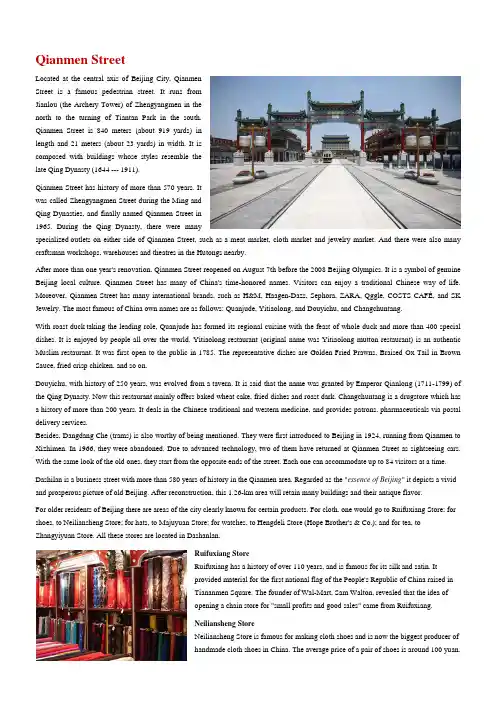
Qianmen StreetLocated at the central axis of Beijing City, QianmenStreet is a famous pedestrian street. It runs fromJianlou (the Archery Tower) of Zhengyangmen in thenorth to the turning of Tiantan Park in the south.Qianmen Street is 840 meters (about 919 yards) inlength and 21 meters (about 23 yards) in width. It iscomposed with buildings whose styles resemble thelate Qing Dynasty (1644 --- 1911).Qianmen Street has history of more than 570 years. Itwas called Zhengyangmen Street during the Ming andQing Dynasties, and finally named Qianmen Street in1965. During the Qing Dynasty, there were manyspecialized outlets on either side of Qianmen Street, such as a meat market, cloth market and jewelry market. And there were also many craftsman workshops, warehouses and theatres in the Hutongs nearby.After more than one year's renovation, Qianmen Street reopened on August 7th before the 2008 Beijing Olympics. It is a symbol of genuine Beijing local culture. Qianmen Street has many of China's time-honored names. Visitors can enjoy a traditional Chinese way of life. Moreover, Qianmen Street has many international brands, such as H&M, Haagen-Dazs, Sephora, ZARA, Qggle, COSTS CAFÉ, and SK Jewelry. The most famous of China own names are as follows: Quanjude, Yitiaolong, and Douyichu, and Changchuntang.With roast duck taking the leading role, Quanjude has formed its regional cuisine with the feast of whole duck and more than 400 special dishes. It is enjoyed by people all over the world. Yitiaolong restaurant (original name was Yitiaolong mutton restaurant) is an authentic Muslim restaurant. It was first open to the public in 1785. The representative dishes are Golden Fried Prawns, Braised Ox Tail in Brown Sauce, fried crisp chicken, and so on.Douyichu, with history of 250 years, was evolved from a tavern. It is said that the name was granted by Emperor Qianlong (1711-1799) of the Qing Dynasty. Now this restaurant mainly offers baked wheat cake, fried dishes and roast dark. Changchuntang is a drugstore which has a history of more than 200 years. It deals in the Chinese traditional and western medicine, and provides patrons, pharmaceuticals via postal delivery services.Besides, Dangdang Che (trams) is also worthy of being mentioned. They were first introduced to Beijing in 1924, running from Qianmen to Xizhimen. In 1966, they were abandoned. Due to advanced technology, two of them have returned at Qianmen Street as sightseeing cars. With the same look of the old ones, they start from the opposite ends of the street. Each one can accommodate up to 84 visitors at a time. Dashilan is a business street with more than 580 years of history in the Qianmen area. Regarded as the "essence of Beijing" it depicts a vivid and prosperous picture of old Beijing. After reconstruction, this 1.26-km area will retain many buildings and their antique flavor.For older residents of Beijing there are areas of the city clearly known for certain products. For cloth, one would go to Ruifuxiang Store; for shoes, to Neiliansheng Store; for hats, to Majuyuan Store; for watches, to Hengdeli Store (Hope Brother's & Co.); and for tea, to Zhangyiyuan Store. All these stores are located in Dashanlan.Ruifuxiang StoreRuifuxiang has a history of over 110 years, and is famous for its silk and satin. Itprovided material for the first national flag of the People's Republic of China raised inTiananmen Square. The founder of Wal-Mart, Sam Walton, revealed that the idea ofopening a chain store for "small profits and good sales" came from Ruifuxiang.Neiliansheng StoreNeiliansheng Store is famous for making cloth shoes and is now the biggest producer ofhandmade cloth shoes in China. The average price of a pair of shoes is around 100 yuan.The cloth shoes have become increasingly popular as people around the world have become more interested in ecological issues.Xianyukou Street, Time-Honored Food Brand Area in BeijingXianyukou Street, near the famous Qianmen Street, has justreopened to the public this month. After a three-year renovation, the570-year-old commercial street has been restored into a Chinatime-honored food brand area. All China time-honored brands likeBianyifang Roast Duck Restaurant and Tianxingju Fried Liver hasreturned this street to excite the Beijing old memory and taste.The first part of its name, "Xian Yu”, translates to "Fresh Fish" inEnglish, indicating the culinary history of the street. Thenewly-paved street pays homage to its history in a number of details,from fish-adorned manhole covers to brick sculptures, urbanfurniture, and even streetlights.On a sunny afternoon the day after opening, the street was floodedwith visitors getting a taste of old Beijing. Many shops sell old Beijing snacks and specialties and boast a golden plaque telling the public of their origins in the 19th and early 20th centuries. Several shops had a queue extending out the front door and onto the street, with shoppers waiting for old Beijing confections, stewed liver, and even roasted meat.Besides the Beijing local restaurants and traditional snacks, many regional or international dishes and goods with ethnic and cultural flavor can be found in this street, too.Xianyukou Street perfectly embraces Beijing's hutong past. During Ming and Qing Dynasties, most residences were 1-story courtyard houses and the city's shops occupied 1 or 2-story buildings along narrow streets. Walking along the alley, paved with bricks instead of asphalt, visitors will gain a glimpse of the city's profound history.While old brands and traditional snacks and crafts are disappearing from other parts of the city, they have been revived in Xianyukou Street. The popular opening of the new Xianyukou Street proves that old Beijing has never lost but still remains unique and attractive.Wangfujing Street - biggest commercial center of BeijingWangfujing is now considered as the central heart of Beijing City. It is thefirst modern-style commercial street in Beijing, about 800 meters long andon two sides of it standing many stores and malls. A walk from end to endwould take you about 30 mins, and that's without looking at any shops andmalls.Layout of Wangfujing StreetIt starts from Wangfujing Nankou, where the Oriental Plaza and the BeijingHotel are located. It then heads north, passing the Wangfujing XinhuaBookstore, the Beijing Department Store as well as the Beijing ForeignLanguage Bookstore before ending at the Sun Dong An Plaza.Much of the road is off-limits to cars and other motor vehicles, and it is not rare to see the entire street full of people. It is embellished with squares, lawns, flower beds, fountains, ornamental columns, sculptures and benches. This pleasant environment has made shopping an exercise in fashionable leisure.Wangfujing Department StoreIt is comparable to Bloomingdales. Unlike shanghai, beijing has less luxury department stores and this is the most popular, situated in the hip wang fu jing street, it carries many foreign brands such as Calvin Klein, Nina Ricce, Gucci, Prada, Lanvin etc. The first floor is home to cosmetic brands such as Christian Dior, Elizabeth Arden and Guerlain and boutiques like Mondi, Yves Saint Laurent, Nina Ricci, D'urban and Charles Jourdan. The second floor houses the ladies department, lingerie, accessories and leather bags plus a coffee shop. The third floor has the men's department, and on the fourth floor are children's clothes, toys (plenty of foreign brands) and household items.Snack Street in WangfujingThe Wangfujing Night Market has a selection of exotic Street food on the Snack Street. Deep fried insects, scorpions, and sea creatures can be found, along with other animals and animal parts not ordinarily consumed as food in the west. But while these exotic snacks can be found, other more common foods, such as Chuanr (meat kebabs, commonly made of lamb) and desserts, such as Tang hu lu, or candied fruits make up the majority of the food sold on the street.Wangfujing at NightThe stores of Wangfujing Street close at 9PM, but a small night market stays open after that which caters to tourists. The night market consists of vendor stalls that stretch along a few blocks of side streets and alleys that branch off from Wangfujing Street near the southern end of its pedestrian mall section.Most of the stalls sell either souvenirs or food. The souvenirs are the same things that you see in shops all over the city, and you will have to bargain to get down to the right price. We shopped for postcards and Christmas ornaments there. The food on offer in the food stalls ranges from ordinary (ice cream) to unusual (scorpion-on-a-stick and seahorse-on-a-stick are a couple of the stranger ones that we saw).For souvenirs, try to buy them for about 1/3 of the asking price. You will have to bargain for a few rounds and walk away once or twice to get to the right price.Old-Beijing-Street in WangfujingThe Old-Beijing-Street which is located on Wangfujing Dajie (-1/F, Xin Dong AnPlaza) is an underground street built in Ming and Qing styles. The outstandingcharacteristic of it is the centralized well-known longstanding stores selling shoes,caps, silk cloth, scissors, Chinese brushes and ink-stick, jade, teas, desserts, pickledvegetables and roast duck. Beijing Craftwork and Art Mansion specially operatesvarious industrial arts and artworks, and is famed all over Beijing, and is an old shopin Wangfujing Street.Beijing Local Snacks:Beijing has a time-honored history of producing various kinds of snacks. With strong flavors, Beijing's snacks attract almost all visitors. Typical Beijing snacks include:Sticky rice with sweet fillings (Ai Wo Wo,): As white as snow, this delicacy is made of sticky rice.Pancakes with sweetened bean paste filling (Douxian Shaobing,): This is a very popular Beijing snack. Crisp outside, they are soft and sweet inside.Sticky rice cake with a layer of sweetened bean paste (Qiegao,)Pea Flour Cake (Wandouhuang )Pastry Made of Soy Bean Flour (Ludagun)Douxian Shaobing: typical snack of Old BeijingLudagun will delight you with its sugary filling, yummy...Quanjude (全聚德)The well-known All-Duck Banquet is headed by Quanjude roast duck and supported by over 400 dishes with Quanjude characteristic flavor. Government leaders, officials and VIPs from nearly 200 countries and regions have visited Quanjude roast duck restaurants and had dinner here. Foreign credit cards are accepted here. Watch the Videos of Quanjude Roast Duck Restaurant.。
北京奥运会简介英文版
北京奥运会简介英文版北京奥运会简介The Games of the 某某IX Olympiad, also known as the 2022 Beijing Olympic Games, was held in Beijing, the capital of the People's Republic of China, at 8:00 pm on August 8, 2022.2022 Beijing Olympic Games host city is Beijing, Shanghai, Tianjin, Shenyang, Qinhuangdao, Qingdao co-host city. Hong Kong to undertake equestrian events.2022 Beijing Olympic Games a total of 204 participating countries and regions, 11438 athletes, 302 (28) campaign, a total of more than 60,000 athletes, coaches and officials to participate.2022 Beijing Olympic Games created a total of 43 new world records and 132 new Olympic records, a total of 87 countries and regions in the tournament to obtain medals, China to 51 gold medal gold medal top, is the first in the history of the Olympic gold medal Of the Asian countries.北京奥运会申奥过程In 1993, Beijing applied for the 27th Olympic Games in 2022, but in the final round of the vote to 2 votes in the defeat of Sydney. In 1998, Beijing proposed to bid for the 29th Olympic Games in 2022.On November 25, 1998, Beijing submitted an application for hosting the 2022 Olympic Games. April 7, 1999, the International Olympic Committee officially accepted the Beijing Olympic bid.February 1, 2022, to determine the Beijing Olympic bid and the Olympic slogan "New Beijing, the new Olympic Games", the official website of the Olympic Games opened.June 20, 2022, Beijing Olympic Committee Secretary-General WangWei in Lausanne, Switzerland to the International Olympic Committee formally submitted an application report. The report answers the 22 questions raised by the International Olympic Committee (IOC) to the city, and stated the plans and ideas for Beijing to organize the 2022 Olympic Games.August 28, 2022 19:39, Beijing, China with Istanbul, Istanbul, Japan, Osaka, France, Paris, Canada, Toronto, five cities in 2022 to become the 29th Olympic Games candidate cities.September 8, 2022, Beijing 2022 Olympic Games bid committee secretary of the Secretary-General Wang Wei led the Olympic delegation to the delegation of 10 people, starting from Beijing, to Sydney, by the Sydney Olympic Games propaganda Olympic slogan "New Beijing, the new Olympic Games "On September 9, 2022, Chinese President Jiang Zemin sent a letter to the International Olympic Committee President Juan Antonio Samaranch and expressed his full support for Beijing's bid to host the 2022 Olympic Games. On the same day, the Beijing 2022 Olympic Games bid committee with the English candidate city and the International Olympic Committee logo logo emblem was approved by the International Olympic Committee.In December 2022, the Beijing Olympic Committee of the Communist Party of China for the Olympic ambassador, and then with Yang Lan, Gong Li, Deng Yaping and Sang Lan four women signed an agreement, they later joined Liu Xuan, Wang Zhi and other efforts to promote the Beijing Olympic bid, and use their own Of international relations to help Beijing in the bid to host the 2022 Olympic Games in the competition to win.From February 19 to February 24, 2022, 17 members of theInternational Olympic Committee (IOC) assessment mission, led by the Dutch Hein Villebrügen and the Swiss Gilbert Felie, visited the Beijing Olympic bid. Assessment mission evaluation, Beijing bid for the Olympic Games by the Chinese government and the Beijing people strong support.On 13 July 2022, at the 112th plenary session of theInternational Olympic Committee (IOC) in Moscow, the International Olympic Committee (IOC) voted to accept Beijing's right to host the 2022 Olympic Games. Subsequently, the International Olympic Committee President Juan Antonio Samaranch in Moscow announced that Beijing became the host city of the 2022 Olympic Games. On the same day, the success of the Beijing Olympic bid came, Beijing 400,000 people flock to Tiananmen carnival.北京奥运会筹办过程December 13, 2022, the establishment of the 29th Olympic Games Organizing Committee (Beijing Olympic Organizing Committee).July 13, 2022, the Beijing Municipal Government and the Beijing Olympic Organizing Committee jointly developed and officially announced the implementation of the "Beijing Olympic Action Plan", put forward the "new Beijing, the new Olympic Games," the two themes and the "Green Olympics, Science and Technology Olympics, Humanities Olympics "Three major ideas.August 3, 2022, the 29th Olympic Games emblem "China India dancing Beijing" in the Temple of Heaven in Beijing Temple officially released. September 1, the Beijing Olympic Games market development plan started. December 24, the national stadium and the national swimming center started foundation, opened the 2022 Beijing Olympic Games stadium construction prelude.On August 29, 2022, Wang Qishan, the mayor of Beijing, took the Olympic flag at the closing ceremony of the 28th Olympic Games at the Olympic Main Stadium in Athens, marking the official entry of the Olympic Games into Beijing. September 21, the Beijing Olympic Games countdown to the official museum in Tiananmen Square before the start.June 5, 2022, the Beijing Olympic Games volunteer logo release, the volunteer project was officially launched. June 26, the Beijing Olympic Organizing Committee announced the theme of the 29th Olympic Games slogan: "the same world, with a dream" (One World, One Dream). November 11, the 29th Olympic Games mascot was released in Beijing. On April 10, 2022, Beijing issued the first batch of about 70 "Olympic legislation" needs, the development of targeted relevant laws. August 7, 2022, the Beijing Olympic Organizing Committee released the 29th Olympic Games sports icon.March 27, 2022, the Beijing Olympic Organizing Committee released the 29th Olympic Games medal style. April 15, the Beijing Olympic Organizing Committee officially announced the 29th Olympic Games tickets for the global public pre-sale tickets. April 26, the 29th Olympic Games torch relay transmission route and the torch in Beijing China Millennium Monument. June 23, the Beijing Olympic Organizing Committee announced the "Beijing 2022 Olympic torch relay torchbearer selection plan", marking the official launch of the torchbearer. August 8, in Tiananmen Square, Beijing Olympic Games countdown to celebrate the first anniversary of the celebration, hundreds of singers singing "We are ready." International Olympic Committee President Jacques Rogge attended the celebration and sent invitations to national and regional Olympic committees for the Beijing OlympicGames.In the first half of 2022, the Olympic venues were held in succession, including the Handball International Invitational Tournament, Weightlifting China Open, Wheelchair Basketball International Invitational Tournament and other events. March 24, Greece Hera Temple site, the Beijing Olympic torch to take fire success. March 31, the Olympic torch arrived in Beijing, China capital. Hu Jintao, general secretary of the Central Committee of the Communist Party of China, personally ignited the torch at the ceremony and announced that the Beijing 2022 Olympic torch relay began. On April 2, the first leg of the Beijing Olympic torch relay was held in Almaty, Kazakhstan. May 4, the Olympic torch departure from China's Sanya, began to pass the territory. May 8, the Beijing Olympic torch successfully boarded the world's highest peak Mount Everest. On July 27th, the Olympic Village in the Olympic Park opened the village. August 8, ignited the Beijing Olympic Games main torch, the opening of the Olympic Games.。
关于北京介绍的英文范文
关于北京介绍的英文范文English:Beijing, the capital of China, is a city steeped in history, culture, and modernity. As one of the world's oldest continuous civilizations, Beijing boasts a rich tapestry of historical sites, including the iconic Forbidden City, a sprawling imperial palace complex dating back to the Ming dynasty. The city is also home to the majestic Great Wall of China, a testament to ancient engineering and a UNESCO World Heritage Site. Beyond its historical treasures, Beijing pulsates with modernity, evident in its soaring skyscrapers, bustling shopping districts like Wangfujing, and vibrant arts scene, exemplified by the 798 Art Zone. Moreover, Beijing stands as a global hub for diplomacy and innovation, hosting important institutions such as the headquarters of the Asian Infrastructure Investment Bank and significant international conferences like the Belt and Road Forum. With its blend of tradition and progress, Beijing offers visitors a glimpse into China's past, present, and future, making it an unparalleled destination for cultural exploration and discovery.中文翻译:北京,中国的首都,是一座充满历史、文化和现代气息的城市。
介绍城市北京英语作文200字
介绍城市北京英语作文200字(中英文实用版)Title: Introduction to Beijing, the CityBeijing, the capital city of China, is a vibrant metropolis that captivates its visitors with its rich history, cultural heritage, and modern development.As one of the oldest cities in the world, Beijing is home to numerous historical sites, such as the Great Wall, the Forbidden City, and the Temple of Heaven, which showcase the millennia-old traditions and wisdom of the Chinese civilization.The city"s cultural significance is further enhanced by its thriving arts scene, including traditional opera, folk music, and dance performances.Beijing is also renowned for its delicious cuisine, particularly the famous Peking duck, which has been a culinary highlight for centuries.In recent years, Beijing has undergone rapid modernization, with the construction of high-rise buildings, modern transportation systems, and innovative technology parks.This juxtaposition of old and new creates a unique and exciting atmosphere, making Beijing a city that is both timeless and contemporary.In conclusion, Beijing is a city that offers awindow into China"s past, while also providing a glimpse of its future.Its historical landmarks, cultural diversity, and modern advancements make it a truly remarkabledestination that is not to be missed.。
英语作文北京介绍120字左右

英语作文北京介绍120字左右English:Beijing, the capital of China, is a city steeped in rich history and culture. Home to iconic landmarks such as the Great Wall, Forbidden City, and Temple of Heaven, Beijing offers visitors a glimpse into China's imperial past. The city also boasts a vibrant modern side, with bustling markets, contemporary art galleries, and innovative architecture. Food lovers can delight in Beijing's diverse culinary scene, from traditional Peking duck to street food snacks like jianbing and lamb skewers. With world-class museums, beautiful parks, and a dynamic nightlife, Beijing is a city that seamlessly blends the old with the new, making it a must-visit destination for travelers from around the globe.中文翻译:北京,中国的首都,是一座充满丰富历史和文化的城市。
拥有长城、故宫和天坛等标志性地标的北京,为游客展示了中国帝国时代的一瞥。
这座城市还拥有充满活力的现代一面,拥有熙熙攘攘的市场、当代艺术馆和创新建筑。
北京名胜古迹介绍及图片(英文版)
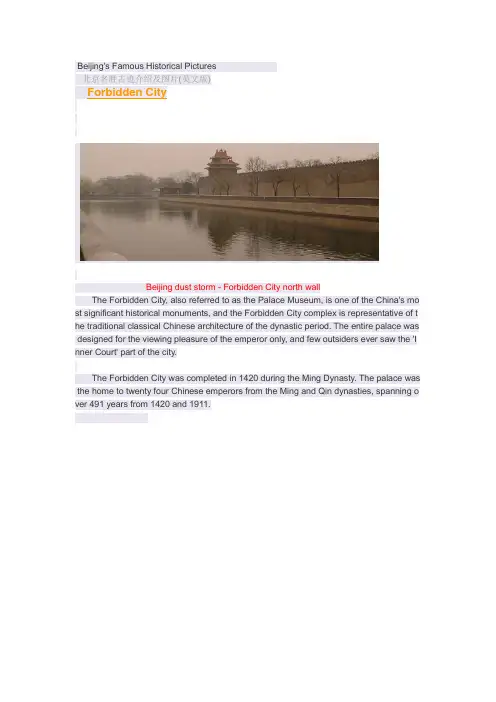
Beijing's Famous Historical Pictures北京名胜古迹介绍及图片(英文版)Forbidden CityBeijing dust storm - Forbidden City north wallThe Forbidden City, also referred to as the Palace Museum, is one of the China's mo st significant historical monuments, and the Forbidden City complex is representative of t he traditional classical Chinese architecture of the dynastic period. The entire palace was designed for the viewing pleasure of the emperor only, and few outsiders ever saw the 'I nner Court' part of the city.The Forbidden City was completed in 1420 during the Ming Dynasty. The palace was the home to twenty four Chinese emperors from the Ming and Qin dynasties, spanning o ver 491 years from 1420 and 1911.Tai'he Gate Square - Looking at the north Meridian GateThe Meridian Gate (above) was constructed in 1420, and is the main gate of the Forbidd en City. It was used primarily by the emperor, who always entered from the south. The M eridian Gate is over 37 meters high, and is the second main gate after the outer-most 'Tia n'anmen Gate' or "Gate of Heavenly Peace."Tai'he Gate SquareWithin the Tai'he Gate Square lies the Golden Water River, which snakes through the squ are like a winding jade belt. Five marble bridges span the Golden Water River. The use of wide open space was designed to limit an invader's ability to hide. The stone flooring in t he square was several layers thick to prevent someone from tunneling into the compound.Tai'he Gate Square - Golden Water RiverThe Forbidden City occupies a total space of more than 720,000 square meters, surroun ded on three sides by imperial gardens. The entire complex is surrounded by a 50 meter wide moat and a 10 meter high wall with watch towers at each of its corners. The palace walls have a total length of 3,400 metres.The Forbidden City complex consists of two main parts: the 'Outer Court' and the 'Inner C ourt.' The Forbidden City complex contains 9,999.5 bays or "rooms," which is .5 less roo ms than the 1000 rooms heaven was believed to be.No. 2 Long Alley looking towards the western palacesThe 'Outer Court' centers around the Hall of Preserved Harmony, Hall of Supreme Harmo ny, and the Midway Hall of Harmony, all of which are flanked by the Hall of Literary Glory and the Hall of Military Prowess.At the center of the 'Inner Court' lies the Hall of Celestial Heavenly Purity, Hall of Uni on and Peace, and the Hall of Terrestrial or Earthly Transquility, which are symmetrically f lanked by the Six East Palaces and the Six West Palaces.Jingshan Park & Coal HillTo the north of the Qianqing Gate or "Gate of Obedience and Purity" and directly across f rom the "Gate of Divine Prowess" (aka "Gate of Divine Might") is Jingshan Park, which is also known as Coal Hill or Jing Shan Hill (below). The hill is artificial, created from the soil excavated to build the palace moat and adjoining lakes. To this day Jingshan Park is a p opular morning gathering spot for the locals to preform Tai Chi.Overlooking Qianqing Gate Square and Coal HillChongzheng - The Last Ming EmperorThe last Ming emperor Chongzheng hanged himself atop Jingshan Hill (meaning "Prospe ct Hill" or "Dominating Hill") in 1644, as the rebel Manchu army of Li Zicheng overtook the palace. The Forbidden City is situated to the south of a Jingshan Hill in accordance with t he dictates of Feng Shui. This is why Coal Hill is also known as "Feng Shui Hill."Baohe Hall and Zhonghe Hall marble stepsYangxin Hall - Qing Dynasty ThroneYangxin Hall was where the emperors of the Qing Dynasty met with their ministers.Entrance to the Yangxin HallThe horizontal board above the throne (below left) in Yangxin Hall is inscribed with "Z hong Zheng Ren He," written by Emperor Yong Zheng (1678 - 1735), the fourth emperor of the Manchu Qing Dynasty.Yangxin Hall - Qing Dynasty Throne (left), Ci Xi's Bedroom (right)The wedding bedroom and bridal chambers are surprisingly intimate, possibly due to the need conserve heat during the cold Beijing winters. The bedroom to the right belonged to Empress Ci Xi (Cixi) known as the "Dragon Lady," "Empress Dowager," or "the power be hind the curtain," as she was a surrogate ruler for nearly 50 years.Tai'he Hall - Ming Dynasty ThroneTai'he Hall's gold-painted throne was created during the Ming Dynasty (below left), and w as used to enthrone the emperor when he performed important ceremonies and handed down official edicts. The throne is surrounded by six golden pillars encircled by golden dr agons, and the ceiling contains a phoenix above the throne.Entrance to the Yangxin HallImperial Garden - Yujing & Qiangqiu PavilionThe Imperial garden was constructed using a prized variety of rock known as Taihu Rock that is found at the bottom of Taihu Lake to the west of Suzhou in the Yangtze River Delta . The garden and hill were used to view the Queen to autumn colors that lay outside the p alace walls.Yujing Pavilion Garden - Duixiu Hill made of Taihu RockYujing Pavilion on Duixiu Hill (left), Qiangqiu Pavilion (right)Forbidden City Palace Moat & WallsThe heavily fortified Forbidden City palace is surrounded by a 3,800 meter-long moat that is 52 meters wide, and six meters deep. Behind the moat is a 10 meters high red-painted wall, with watchtowers at each corner.Northwest Palace Wall and City MoatThe Last Emperor - PuyiEmperor Puyi of the Manchu Aisin-Gioro Imperial family was the 12th emperor of the Qin g Dynasty, and the last Emperor of China, from 1908 to 1924.Puyi ascended the throne at the age of two, under the deathbed edict of Dowager Empre ss, Cixi (the "Dragon lady"). Puyi was taken from his home in Peking as an infant, and pla ced in the care of a wet-nurse, Wen-Chao Wang in the Forbidden City.In 1912, China became a Republic following the Xinhai Revolution, and the Monarchy wa s ended. Under the treaty entitled "Articles of Favourable Treatment of the Emperor of the Great Qing after his Abdication," Puyi would retain the symbolic title of "Emperor," and b e provided with an annual stipend of 4 million dollars.After an aborted attempt to revive the monarchy in 1917, Puyi and the rest of his imperial court were held as a virtual prisoners within the walls of the northern section of the Forbid den City and the Summer Palace, under the watchful eyes of the court eunuchs, and Imp erial Guards.Puyi and his concubines were finally evicted from the Forbidden City in 1924. Being of M anchu descent, Puyi was installed as a puppet ruler of Manchukuo in 1932, at the behest of Imperial Japan. Puyi "ruled" Manchukuo until 1945 when the Soviet Red Army drove th e Japanese out of northern China at the end of WWII.Puyi's life story was poignantly told in the 1987 film The Last Emperor, Directed by Berna rdo Bertolucci.Shenwu Gate Palace Watchtower and Southwest City MoatEach year millions of Chinese and foreign visitors stroll through the massive palace grounds to witness the past power, glory, and extravagance of China's notorious emperor s.This page contains maps, diagrams, and satellite imaging of Beijing's Forbidden City Palace Museum, Jingshan Park Beihai Lake, and the surrounding city.Beijing City MapBeijing Palace City Scroll at the National Museum of China, in Beijing Temple of Heaven (Tiantan Park)。
北京旅游指南英文版
Exploring the Charms of Beijing: A TravelGuideWelcome to Beijing, a city steeped in history and culture, brimming with modern conveniences and offering a unique blend of old and new. This travel guide aims to assist you in navigating the city's vast landscape, fromits famous landmarks to its hidden gems, ensuring that your visit to Beijing is an enriching and memorable experience. **1. The Forbidden City**A visit to Beijing is incomplete without a stop at the Forbidden City, once the imperial palace of the Ming and Qing dynasties. This vast complex of palaces, temples, and gardens is a testament to the grandeur and splendor of ancient China. Wandering through its vast courtyards and intricate architecture, you can imagine the bustling life that once thrived here.**2. The Great Wall of China**One of the world's most renowned engineering feats, the Great Wall of China is a must-visit destination in Beijing. Stretching for thousands of kilometers, this massive wallwas built to protect China from invaders. A trip toBadaling or Mutianyu sections of the wall offers breathtaking views and a chance to walk in the footsteps of history.**3. Tiananmen Square and the National Museum ofChina**Tiananmen Square, the heart of Beijing, is a hub of political and cultural activities. Surrounded by important buildings like the National Museum of China and the Monument to the People's Heroes, this vast plaza is a must-visit for anyone interested in Chinese history and culture. The National Museum of China, in particular, boasts a vast collection of artifacts that trace the country's rich historical journey.**4. Hutong Tours**To experience the authentic flavor of old Beijing, a hutong tour is recommended. These narrow alleyways, oncethe lifeblood of the city's old neighborhoods, are now a haven for history and culture. Cycling or walking throughthe hutongs, you can visit traditional courtyard houses, taste local delicacies, and engage with the friendly locals.**5. Modern Beijing**In addition to its rich historical heritage, Beijing is also a vibrant and modern city. The Central BusinessDistrict (CBD) offers a glimpse into the city's economic prowess, with skyscrapers and bustling shopping malls. The Olympic Park, with the iconic Bird's Nest Stadium and the Water Cube, is a must-visit for sports enthusiasts.**6. Culinary Delights**Beijing cuisine, a blend of northern Chinese flavors,is a must-try for food lovers. Dishes like Peking Duck, a thinly sliced duck served with pancakes and sweet bean sauce, are a delicacy not to be missed. Other local favorites include dumplings, noodles, and various types of fried buns.**7. Traditional Arts and Culture**Beijing is home to various traditional arts and cultures, including Peking Opera, Chinese calligraphy, and tea culture. Watching a performance of Peking Opera, with its intricate costumes, vibrant music, and powerful vocals, is an immersive experience that brings you closer to theheart of Chinese culture. Visiting a tea house to enjoy a cup of fragrant tea while watching traditional performances is another way to unwind and immerse yourself in the city's slow pace.In conclusion, Beijing is a city that offers something for everyone, from its rich historical heritage to its modern conveniences, delicious cuisine, and vibrant arts culture. This travel guide hopes to assist you in makingthe most of your visit to Beijing, ensuring that you havean enriching and memorable experience.**探索北京的魅力:旅游指南**欢迎来到北京,这座充满历史与文化的城市,融合了现代便利,展现了古老与现代的独特融合。
北京旅游指南英文版
北京旅游指南英文版Beijing is a captivating city that seamlessly blends ancient history and modern wonders. As the capital of China, it offers a rich tapestry of cultural experiences, breathtaking landmarks, and a vibrant urban landscape. Whether you're a first-time visitor or a seasoned traveler, this comprehensive guide will help you navigate the best of what Beijing has to offer.One of the most iconic and must-see attractions in Beijing is the Forbidden City also known as the Imperial Palace. This vast complex of ornate palaces, temples, and courtyards served as the exclusive domain of China's emperors for centuries. Visitors can marvel at the intricate architecture, explore the grand halls, and immerse themselves in the grandeur of the Ming and Qing dynasties. The Forbidden City is a UNESCO World Heritage Site and a testament to China's imperial legacy.Another renowned landmark in Beijing is the Tiananmen Square the world's largest public square. This expansive plaza is surrounded by significant buildings such as the Tiananmen Gate, the Great Hall ofthe People, and the National Museum of China. Visitors can witness the daily flag-raising ceremony, explore the monuments, and soak in the energy of this iconic civic space.Nearby, the Temple of Heaven is a stunning example of traditional Chinese architecture and a testament to the country's rich spiritual heritage. This UNESCO World Heritage Site was once the site of elaborate annual ceremonies where emperors would pray for good harvests and the well-being of the nation. Visitors can stroll through the serene gardens, admire the ornate buildings, and gain insights into China's ancient traditions.For those seeking a glimpse into Beijing's modern transformation, the 798 Art District is a must-visit destination. This former industrial area has been transformed into a vibrant hub of contemporary art galleries, trendy cafes, and cutting-edge design studios. Visitors can explore the unique blend of Bauhaus-style architecture, street art, and avant-garde exhibitions that make this neighborhood a cultural hotspot.One of the most impressive natural wonders near Beijing is the Great Wall of China. This iconic fortification snakes its way across the rugged terrain, offering breathtaking vistas and a chance to connect with one of the world's most remarkable engineering feats. Visitors can choose from various sections of the Great Wall to hike, such asthe well-preserved Badaling or the less crowded Mutianyu, each offering its own unique challenges and panoramic views.In addition to its renowned landmarks, Beijing is also renowned for its rich culinary scene. From the ubiquitous Peking roast duck to the delicate dumplings and fragrant hot pot, the city's diverse range of dining options caters to every palate. Visitors can explore bustling night markets, high-end restaurants, and family-run eateries to savor the authentic flavors of Beijing and the broader Chinese cuisine.Beyond the city's iconic sights, Beijing also offers a wealth of cultural experiences. Visitors can immerse themselves in the traditional arts by attending a Peking Opera performance, witnessing the graceful movements of a Tai Chi class, or exploring the intricate world of Chinese calligraphy and painting. These cultural activities provide a deeper understanding of the country's rich heritage and the enduring traditions that continue to shape modern-day Beijing.For those seeking a respite from the urban hustle, the Summer Palace is a tranquil oasis on the outskirts of the city. This expansive imperial garden features serene lakes, ornate pavilions, and picturesque landscapes that transport visitors to a bygone era. Visitors can stroll through the grounds, admire the iconic Marble Boat, and enjoy the scenic vistas that have inspired artists and poets throughout the centuries.In addition to its cultural riches, Beijing also boasts a thriving contemporary art scene. The 798 Art District, as mentioned earlier, is just one example of the city's vibrant creative community. Visitors can also explore the cutting-edge galleries and studios in the Caochangdi and 751 D-Park neighborhoods, where local and international artists showcase their innovative works.For those interested in the city's historical legacy, the Bell Tower and Drum Tower are two iconic landmarks that offer a glimpse into Beijing's past. These towering structures were once used to mark the passage of time in the imperial capital, and today, they stand as reminders of the city's rich heritage. Visitors can climb to the top of the towers for panoramic views of the surrounding neighborhoods and gain a deeper understanding of Beijing's storied history.Finally, no visit to Beijing would be complete without a stroll through the hutongs the narrow alleyways and traditional courtyard residences that have long been the heart of the city's local communities. These charming neighborhoods offer a glimpse into the daily lives of Beijingers, with their quaint shops, family-run eateries, and a sense of timeless authenticity.In conclusion, Beijing is a city that captivates the senses and offers a wealth of experiences for travelers. From the grandeur of theForbidden City to the vibrant contemporary art scene, this dynamic capital seamlessly blends its ancient heritage with modern sensibilities. Whether you're exploring the city's iconic landmarks, indulging in its culinary delights, or immersing yourself in its rich cultural tapestry, Beijing is a destination that will leave a lasting impression on all who visit.。
介绍北京的英语信件作文
介绍北京的英语信件作文English:Beijing, the capital city of China, is a vibrant metropolis with a rich history and culture. Known for its iconic landmarks such as the Great Wall, Forbidden City, and Temple of Heaven, Beijing offers a blend of traditional and modern attractions for visitors to explore. The city is also a hub for art, music, and culinary delights, with a plethora of museums, galleries, theaters, and restaurants to choose from. Additionally, Beijing's dynamic atmosphere is complemented by its bustling markets, lively street scenes, and diverse neighborhoods, offering a glimpse into daily life in the city. Whether it's sampling authentic Chinese cuisine, shopping for unique souvenirs, or immersing oneself in the ancient traditions of the city, Beijing has something to offer for everyone who visits.中文翻译:作为中国的首都,北京是一个充满活力的大都市,拥有丰富的历史和文化。
介绍中国北京的景点英语作文高一
介绍中国北京的景点英语作文高一Beijing Is So Cool!Hey guys! My name is Xiaoming and I'm a high school student in Beijing. I love my city so much and want to tell you all about the awesome places we have here. Beijing has been the capital of China for like, forever, so it's packed with incredible historical sites and fun stuff to do. Let me give you a tour!Let's start with the most iconic landmark - the Forbidden City. This massive palace complex was home to 24 emperors during the Ming and Qing dynasties from 1420 to 1912. Can you imagine living in a place with 9,999 rooms? That's just crazy! The Forbidden City covers 72 hectares of land right in the heart of Beijing. All the buildings have those cool traditional Chinese architecture designs with yellow glazed tile roofs, carved wooden pillars and decorations like dragons and phoenixes. My favorite part is the intricate designs and bright colors on the ceilings inside the palaces. They are so pretty!Right across the road from the Forbidden City is Tiananmen Square. This giant plaza can hold around a million people! There are some important buildings and monuments here like the Mausoleum of Mao Zedong and the Monument to the People'sHeroes. But the real highlight is getting photos in front of the iconic portrait of Mao Zedong hanging on the Tiananmen Gate. My friends and I like to goof around and pose like we're guarding the gate. Haha!Another must-see is the Temple of Heaven park. This was built in 1420 as a sacred place for emperors to pray for good harvests. The iconic round temple with its triple-eaved blue-tiled roof is just breathtaking. But my favorite spot is the Echo Wall where you can hear even a tiny whisper from the other side if you stand in the right spot. My friends and I spent hours whispering jokes to each other - it's hilarious!For some nature and fresh air, you have to check out the Summer Palace. This huge imperial garden dates back to 1750 and centers around a massive lake called Kunming Lake. You can rent a boat and row around the lake, passing by willow trees, jade bridges, temples and even a marble boat! At one end is the Long Corridor, a 700m covered walkway lined with 8,000 painting scenes. I love wandering through it while listening to the sounds of birds and fountains.Speaking of nature, no trip to Beijing is complete without hiking a section of the Great Wall. This amazing feat of construction snakes over mountains for thousands of miles! Theclosest section to Beijing is at Badaling, about an hour's drive away. Even though it's been reconstructed and turned into a tourist zone, it's incredible to be able to walk on this500-year-old wall. Make sure to bring lots of water and energy bars - that hike is no joke!For kids, the Beijing Zoo is the place to be. We have one of the largest populations of pandas in the world! You can watch the giant pandas tumbling and munching bamboo while little red pandas scamper around. My favorite animals are the snowy owls and cheeky monkeys. The zoo also has an awesome aquarium and reptile house with deadly snakes and massive crocodiles.No visit to Beijing is truly complete without sampling all the delicious food! Beijing is famous for dishes like juicy Peking roast duck, fresh dumplings and noodles like zhajiangmian (a dry noodle dish with a thick fermented soybean paste sauce). Street food is also huge here - grab a jianbing (crispy crepe stuffed with scrambled eggs and other fillings) or some tanghulu (candied fruit kabobs) from a street vendor. And for dessert, you must try the bingtanghulu - that's a frozen sweet yogurt bar dipped in sugar syrup!There's just so much to experience in this amazing city. The blend of ancient traditions, modern life, delicious cuisine and fun attractions make Beijing one of the coolest capitals in the world. You guys have to come visit sometime! I'll show you all the hot spots and we can make some awesome memories together. See you in Beijing!。