
高二英语外研版选修六Module1 说课_The Wrong Kind of Small talk 教学设计
Blackboard
Module 1The Wrong Kind of Small Talk
1.What kind of person of she?
outspoken
2.what’s the reason?
never learn the rules
Function
Good pictures and music give us good feelings ,on the contrary ,bad works give us badfeelings ,just like bad small talks will hurt others, we should let others have good feelings by good small talk.
Careful Reading2
7分
Learn the phrases: as a consequence and so on, first explain by students, and then the teacher gives a necessary adding.
Function
To finish the knowledge aims; practice students’ learning ability
I think/In my opinion ….she or he is____
Function
1.to improve the reading ability;
2.to think over《The Wrong Kind of Small Talk》,students can learn each other.
Emotion Aims
Students can know about the power of a language ,especially a wrong kind of small talk by learning the reading ;
Call for students pay more attention to your spoken language and not to make others embarrassed .
说课:The Wrong Kind of Small talk
姓名
地址
Reading Position
and Function
Module 1 Small talk
READING 2 The Wrong Kind of Small Talk is from Student’s Book 6,which is published
Solving strategy
Divide students into 4groups ,each group have different level students ,they can help each other ;
Questions were set in different types and difficulties to make different students can finish different questions.
and students will be interested in the reading .
Teaching
Aims
Knowledge Aims
To save words and phrases that we will learn in this module .F Nhomakorabeanction
Students can understand the reading and get some information to finish the questions smoothly.
Teaching Method
Method
1.To learn each other ;
2.To learn by oneself;
3.When necessary the teacher gives them help.
Function
To develop students learning quality
To grasp the words and phrases;
To change the method of Small Talk
Function
Enrich students’ knowledge and how to communicate politely.
Difficulty
To improve the reading skills;
1).What did Esther often do when she
spoke to others?
2).Why did the customer look awkward when she was asked how old she was?
3).How did the typist contradict Esther?
Teaching
procedure
Teaching
procedure
1.The preparation before reading
6分
action actor outspoken、motto、shortcoming、cautious、mature anniversary……put one’s foot in one’s mouth、as a
Homework1分
look back on what you said ,which are impolite ,please find an opportunity to make an apologize to those who we hurt.
Function
Students can find an opportunity and make an apology in real life
Leading
2分
Method
We can use “A good language winter is warm, slander half a word in June is cold.” to lead to “ The Wrong Kind of Small Talk”
Function
To form an easy atmosphere briefly
Ability Aims
Practise and improve the reading skills; Fast reading、Skip、Careful reading.
During the reading, pay more attention to the first sentence and the last sentence of every paragraph.
consequence consequence、in addition……
Function
Encourage students to enrich their words and phrases
Fast Reading
6分
Part1.Listen to the reading ,and answer the questions:
Know about the heroin’character.
Skip Reading
7分
Fill in the blanks:
Esther Greenbaum’s major _____was that she had a complete ______of small talk.No,that’s not quite true. She had small talk, but it was the wrong kind .In fact, she had never learnt the basic rules of social communication, and as a _______,she made ______mistakes every time she opened her mouth .It was no _____either that she was not a very good _________.
Function
To finish the reading questions ;
Students Analysis
Students I teach are not good at and interested in English learning .only a few can finish questions smoothly, most of them cannot.
Pay more attention to the right paragraph to get the information to solve the certain questions.
Teaching
Aims
Function
Reading ability improving can help students understand the reading better and solve the questions better.
Function
1.Face the mistakes bravely;
2. Realize the emotion aims
Summary2分
1.Reading skills;
2.Knowledge points;
3.Respect the different culture and custom.
Function
外研版高二英语选修6-Module1-Vocabulary-and-Reading-公开课教学设计
Module1 Vocabulary and Reading 公开课教学设计(一)1教学目标1. To be able to have a thorough understanding of the passages in this module.2. To understand what small talk is, the importance of small talk and be able to make a small talk.3. To practice reading skill and enjoy the process of learning English.2学情分析学生通过预习,已经基本掌握了单词以及相关短语。
并对small talk已经有了基本的了解。
3重点难点1. The characteristics of small talk.2. Reading skills: skimming and scanning.4教学过程4.1第一学时4.1.1教学目标1. To be able to have a thorough understanding of the passages in this module.2. To understand what small talk is, the importance of small talk and be able to make a small talk.3. To practice reading skill and enjoy the process of learning English.4.1.2学时重点1. The characteristics of small talk.2. Reading skills: skimming and scanning.4.1.3学时难点Help the students master the basic social skills.4.1.4教学活动活动1【讲授】教学活动导课阶段Leading-inTeacher’s activity: Show some pictures on the screen and give the different definitions of small talk.Students’ activity:Discuss who make, and where and why people make small talk. 授课阶段:教学内容(一)PresentationTeacher’s activity 1: V ocabulary test.Students’ activity 1: Speak out the meaning of the vocabulary.Teacher’s activity 2: Hand out the answer sheet.Students’ activity 2: Check the answers of assignment.Teacher’s activity 3: Explain the difficult questions.Students’ activity 3: Try to polish the sentences on the screen.教学内容(二)PresentationTeacher’s activity 1: Show Ss the requirements of crazy Engli sh.Students’ activity 1: Recite the phrases.Teacher’s activity 2: Test.Students’ activity 2: Play a game.Teacher’s activity 3: Assign the Ss to read the article and discuss the questions with their partners.Students’ activity 3: Read the article and discuss the questions group.评学阶段Teacher’s activity : Require Ss to write a short conversation to give Esther some suggestions on how to give small talk.Students’ activity: Give some suggestions to Esther and polish them, then present to others.课后作业Finish the conversation in full length.4.2第二学时4.2.1教学目标1. To be able to have a thorough understanding of the passages in this module.2. To understand what small talk is, the importance of small talk and be able to make a small talk.3. To practice reading skill and enjoy the process of learning English.4.2.2学时重点1.Help the students master the important phrases and sentence pattern.2.Help the students master the basic reading skills.4.2.3学时难点1. Phrases and sentence pattern.4.2.4教学活动。
高中英语Module1SmallTalkSectionⅡ教师用书教案外研版选修6

外研版选修6高中英语教师用书教案:Module 1 Small TalkPart Ⅰ第一步速读——了解文章主题和段落大意速读P8-9教材课文,回答下列问题What's the main idea of the passage?It tells of a person who always had the wrong kind of small talk.或It tells of a person who always put her foot in her mouth.第二步细读——把控文章关键信息细读P8-9教材课文,选择最佳答案1.What's the reason for Esther to have the motto “Every time I open my mouth, I put my foot in it”?A.She was the most outspoken human being in the world.B.She was not a very good saleswoman.C.She had a complete absence of small talk.D.She had never learnt the basic rules of small talk.2.From the conversation between Esther and one of her customers in Paragraphs 3 to 5 , we can know that .A.Esther was quite familiar with the customerB.Esther was laughing at the customer for her old lookingC.it was impolite to ask one's ageD.the customer was pleased to talk with Esther3.What was the possible result after Esther comforted her acquaintance who was going through a divorce?A.He was out of depression.B.He was cheered up by Esther.C.He became angry as well as depressed.D.He thanked Esther a lot for her help.4.The sentence in the 15th paragraph“You're writing a book and I'm reading one!” actually means “”.A.I am reading the book you are writing nowB.I'm reading a book similar to yoursC.while you are writing books, I'm reading booksD.I'm very interested in the book you are writing now[答案]1-4 DBCB第三步研读——能力升华接轨高考根据P8-9教材课文,在空白处填入1个适当的单词或括号内单词的正确形式Esther Greenbaum was the 1.most outspoken(outspoken) human being in the world. She had a complete absence of small talk. In fact, she had never learned the basic rules of social communication. As 2.a consequence, every time she 3.opened(open) her mouth, she put her foot in it.She was never 4.cautious(caution) about other people's feelings. She once said to a mature woman, 5.who was an important customer of hers, “Are you forty 6.or fortyfive? You look much 7.older(old)!” On another occasion, one of her8.acquaintances(acquaintance) was going through a very messy divorce and was very9.depressed(depress). But she tried to cheer him up by 10.saying(say) that his wife was a complete fool and that no one liked her anyway.Part Ⅱ细读——把控文章关键信息细读P13教材课文,选择最佳答案1.The example given in this passage is intended to .A.show how to talk to strangers in the café or at a partyB.tell us what the AAA is aboutC.tell us what should be talked about when chatting with a strangerD.begin small talk2.What do neither of the speakers want to do most?A.To understand each other.B.To make friends with each other.C.To keep silent.D.To smile.3.When ,the AAA model ends during your conversation with a stranger.A.you and the other person find the common topic to shareB.you don't want to go on with your conversationC.you find the other person doesn't share your opinionD.you can't make yourself understood4.The writer's attitude towards the AAA model is .A.opposed B.supportiveC.objective D.unclear[答案]1-4 BCABⅠ.单词拼写根据汉语或首字母提示,写出下列单词1.The more learned a man is, the more modest(谦虚的) he usually is.2.It may rain, but anyhow(无论如何) we should hold the sports meeting today.3.He has determined to overcome his shortcoming(缺点) of not being punctual.4.It's a coincidence(巧合) that they are from the same town and have the same hobbies.5.It's impolite to interrupt a speaker with frequent questions.6.When questioned about his research project, he simply replied with a smile.7.There was a time when people may have felt awkward about asking for a table for one,but those days are over.8.He returned to his homeland with the purpose of serving his own people.Ⅱ.拓展词汇根据词性和汉语提示,写出下列单词1.apply v.申请→application n.申请→applicant n.申请人2.polite adj.礼貌的→impolite adj.不礼貌的3.favour n.恩惠,照顾→favourable adj.赞成的,有利的→favourite adj.特别喜爱的4.absent adj.缺席的;不在的→absence n.缺乏,不存在5.apology n.道歉,致歉→apologize v.道歉6.caution n.小心;谨慎;慎重→cautious adj.谨慎的,慎重的,小心的7.mess n.混乱的局面→messy adj.棘手的,难办的8.fool n.傻瓜,笨蛋→foolish adj.愚蠢的9.succeed v.成功→success n.成功→successful adj.成功的10.imagine v.想象→imagination n.想象力→imaginary adj.想象的;虚构的Ⅲ.补全短语根据提示补全下列短语1.put one's foot in one's mouth 犯使人难堪的错误2.as a consequence 因此,结果3.go through 经受,经历4.cheer sb.up 使某人高兴/振作起来5.leave out 省去,删去6.(be) aware of 知道7.take the lead 带头,领先8.show off 炫耀Ⅳ.选词填空选用上述短语的适当形式填空1.If we take the lead in the activity, others may follow.2.He went up to us to show off his new clothes and his expensive car.3.Many people are aware of the benefits of physical activities on their general health.4.The most important word has been left out, so it doesn't make any sense.5.He was always diligent in his study and as a consequence received high marks.背教材原句记句式结构仿写促落实1.Every time I open my mouth, I put my foot in it. 每当我张口,就会讲错话。
高二外研版选修6Module1SmallTalk教案
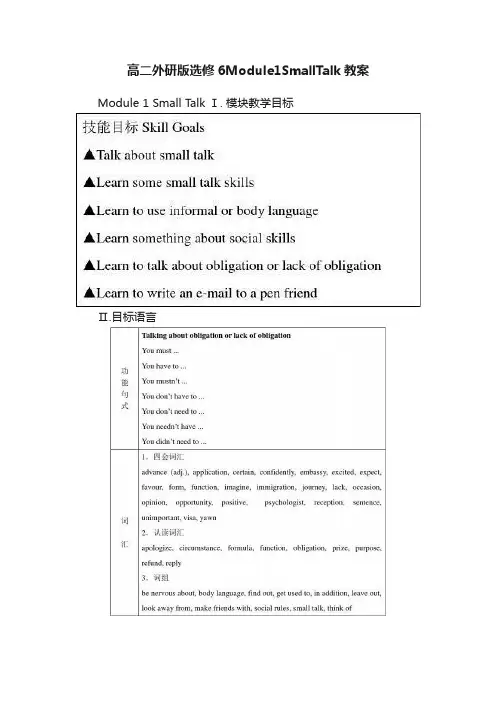
高二外研版选修6Module1SmallTalk教案Module 1 Small Talk Ⅰ. 模块教学目标Ⅱ.目标语言Ⅲ.教材分析与教材重组1. 教材分析本模块以Small Talk为话题,旨在通过教学,使学生对各种不同的闲聊话题、技巧、注意事项、社交方法、规则等加以了解并能够学会用small talk和别人进行交流。
学会使用非正式的日常用语;能正确运用“责任义务和无责任义务”的表达法;学会读、写电子邮件。
1.1 INTRODUCTION提供了四本权威词典对small talk的解释,让学生了解small talk的含义、small talk涉及的话题以及small talk 和serious talk的区别。
1.2 VOCABULARY AND READING是一篇介绍社交技巧的说明文。
文中介绍了交际活动中应注意的事项、社交技巧等。
1.3 FUNCTION 部分学习“责任义务和无责任义务”的表达法。
1.4 READING AND LISTENING部分要求学生朗读三段对话,选出对话发生的地点;根据对话内容回答问题;并通过听取对话录音回答问题、完成句子。
1.5 GRAMMAR学习并使用didn’t need to和needn’t have done结构。
1.6 READING AND WRITING 要求学生阅读并回复网友的电子邮件。
1.7 EVERYDAY ENGLISH 学习非正式交际用语中词汇的省略法。
1.8 SPEAKING 部分要求学生根据问题和提示,以small talk为话题展开小组活动并继续READING AND LISTENING中的对话。
1.9 CULTURAL CORNER部分介绍了英语国家“small talk”的一种较为成功的模式——AAA model.1.10 TASK部分要求学生在掌握small talk相关知识的基础上,收集课内外small talk中经常使用的表达并鼓励学生实现资源共享,编写一个供全班同学使用的小册子。
外研版高中英语选修6《Module1 The wrong kind of small talk》课件
a typist
Paras.6-8
a salesman Paras.9-10
a clerk
Paras.11-14
a writer
Para.15
a young man Paras.16-18
an old friend Paras.19-22
Careful reading 1-8
1.What is your first impression of Esther?Why?
day at school.Try to have a looks upset. Try to
pleasant talk with her/him. cheer him/her up with
Remember: Your goal is to proper small talk.
make friends with her/him.
16-22
1.Which sentence in this part is the closest in meaning to the following one?
I think they picked you out in order to prevent you from working with us all through your life.
outspoken
the wrong kind of small talk
never learn the basic rules of social communication
as a consequence She wasn’t a good saleswoman.
1-8
2.Why did the customer look awkward? Because she didn’t want to tell others her age.
外研社选修六module 1The Wrong Kind of Small Talk公开课

Detailed-reading (pair work)
Find out the examples of her wrong kind of small talk. mature woman 1. Esther vs. a _______ typist heavy/ fat 2. Esther vs. a _______ who looks ______ 3. Esther vs. a _________ who is going through a salesman ___________ messy divorce hairstyle clerk with a new _______ 4. Esther vs. a ______ writer 5. Esther vs. a famous _______ job colleague 6. Esther vs. a __________ who has got a new _____ miles away school friend 7. Esther vs. an old ____________ at the party
outspoken Character:___________________ Every time I open my mouth, I put my foot in it. Motto:_______________________________________
(我一张嘴就使人难堪)
a complete absence of small talk Major shortcoming:____________________________
You look quite cute, my new roommate. Do you have a boyfriend?
高中英语 Module 1 Small Talk教案 外研版选修6

【课堂新坐标】(教师用书)2013-2014学年高中英语 Module 1 SmallTalk教案外研版选修6【美文阅读】无论在自己熟悉的场合还是在陌生的场合,和人闲聊是必不可少的一个交际方式。
那怎么样闲聊,闲聊的话题又该是什么,又仿佛是很多人感到棘手的问题。
本文就闲聊这个话题给了一些建议,我们一起看看吧!Making Small TalkThe ability to make small talk is highly valued. In fact, many English students are more interested in making effective small talk than knowing correct grammar structures. Small talk gets friendships started and “breaks the ice” before important business meetings and other events.Why is small talk difficult for some English learners?First of all, making small talk is not difficult only for English learners, but also for many native speakers of English. However, small talk can be especially difficult for some learners because making small talk means talking about almost anything and that means having a wide vocabulary that can cover most topics.How to improve small talk skills?Now that we understand the problem, the next step is to improve the situation. Here are some tips to improve small talk skills. Of course, making effective small talk means lots of practice, but keeping these tips in mind should improve overall conversational skills.·Do some researchSpend time on the Internet, reading magazines, or watching TV specials about the type of people you are going to meet. For example: If you are taking a class with students from other countries, take time after the first few days of class to do some research. They will appreciate your interest and your conversations will be much more interesting.·Use the Internet to gain specific vocabularyThis is related to doing research about other people. If you have a businessmeeting, or are meeting people who share a mon interest (a basketball team, a tour group interested in art,etc.), take advantage of the Internet to learn specific vocabulary. Almost all businesses and interest groups have glossaries(词汇表) on the Internet explaining the most important jargon(行话) related to their business or activity.·Find mon interestsOnce you have a subject that interests both of you, keep to it! You can do this in a number of ways: talking about travel, talking about the school or friend you have in mon, talking about the differences between your culture and the new culture.【诱思导学】1.In your opinion, what's small talk in China?________________________________________________________________________ 2.What topics do you often choose when you do small talk with others?________________________________________________________________________ 【答案】 1.Small talk means an informal conversation between friends, classmates, workmates, acquaintances and so on. 2.Sports, exams, food, fashion, weather, music, friendship, mood and so on.Period ⅠPreviewing(教师用书独具)●教学目标初步掌握本课文中的词汇,浅层次理解课文,了解相关的背景知识。
外研版英语选修六Module1课文教学文稿
外研版英语选修六Module1课文教学文稿外研版英语选修六M o d u l e1课文外研版英语选修六课文Module 1Module 1 Small TalkIntroductionRead the dictionary definitions of small talk and answer the questions.1.Which definitions make small talk sound like a positive thing?2.Which definitions refer to places where small talk might take place?3.Why is it a problem if someone has no small talk?4.What do you think is the Chinese for "smalltalk"?small talk informal conversation about things that arenot importantMacmillan English Dictionary small talk light conversation that people make at social occasions about unimportant things: We stood around making small talk.Collins Cobuild English Language Dictionary small talk polite friendly conversation about unimportant subjectsLongman Dictionary of Contemporary Englishsmall talk conversation about ordinary or unimportant matters, usually at a social event: He has no small talk (i.e. he is not good at talking to people about ordinary or unimportant things).Oxford Advanced Learner's Dictionary Look at the conversation topics below and answer the questions.careers; cars; examinations; film stars; music; politics; sport;travel; weather; food1.If you talk about these topics, is theconversation serious or small talk?2.Which of the topics do you like talking aboutwith your friends?3.Which of them do you talk about with your parents?4.Which of them do you talk about with your teacher?5.Which of them do you never talk about?Vocabulary and ReadingComplete the sentences with the correct forms of the words in the box. damage; encourage; impress; prepare; recognise1.2.3.4.homework!5.Read the passage and decide what kind of book it is from. Choose from this list.The text is from ____.a book to help you prepare for a speaking examinationa business coursean English teaching booka book which tells you what to do at social eventsHow Good Are Your Social Skills?Have you ever crossed the road to avoid talking to someone you recognise? Would you love to go to a party and talk confidently to every guest? Do you want to make more friends but lack the confidence to talk to people you don't know? And are you nervous about the idea of being at a social event in another country? Don't worry—we can help you!You needn't worry about situations like these if you have good social skills. And they are easy to learn. People with good social skills communicate well and know how to have a conversation. It helps if you do a little advance planning.Here are a few ideas to help you.Learn how to do small talkSmall talk is very important and prepares you for more serious conversations. Be prepared! Have some low-risk conversation openers ready. For example: ?think of a recent news story—not too serious, e.g. a story about a filmstar or sports starthink of things to tell people about your studiesthink of"safe" things you can ask people's opinions about—music, sport, films, etc.think of topics that you would avoid if you were talking to strangers—and avoid talking about them! That way, you don't damage yourconfidence!Develop your listening skillsListening is a skill which most people lack, but communication is a two-way process—it involves speaking AND listening. Always remember—you won'timpress people if you talk too much. Here are some ideas to make you a better listener:Do ...show that you are listening by using encouraging noises and gestures—smiling, nodding, saying "uh-huh" and "OK", etc.keep good eye contactuse positive body languageask for more information to show your interestDon't ...look at your watchyawnsighlook away from the person who's talking to youchange the subjectfinish other people's sentences for themAlways remember the words of Benjamin Disraeli, British Prime Minister in the nineteenth century: "Talk to a man about himself, and he will speak to you for hours!"Learn the rulesIf you go to a social occasion in another country, remember that social rules can be different. In some countries, for example, you have to arrive on time at a party; in other countries, you don't need to. In addition, you need to know how long you should stay, and when you have to leave. Some hosts expect flowers or a small gift, but in other places, you can take things, but you needn't if you don't want to. Remember also that in some countries, you mustn't take flowers of a certain colour, because they're unlucky.In most places, you don't have to take a gift to a party—but find out first!Answer the questions.1.According to the article, should people plan what they're going to say at parties?2.What do people think about those who talk too much?3.Describe two things you shouldn't do in a conversation.4.Why is it a good idea to nod and smile when the other person is talking?5.What does the quotation from Benjamin Disraeli tell you about people?Complete the sentences with the correct forms of the words in the box.sigh; yawn; nod; avoid; lack; smile1.personal questions.2.meet people from other countries.3.head in agreement.4.I think the man I spoke to was tired—5.answered me.6.shook my hand.Look at the phrases from the passage and answer the questions.1.If you can talk confidently, does this mean that you are worried about talking topeople?2.What kind of advance planning could you do before going to a party in a foreigncountry?3.Can you give an example of a low-risk conversation opener if you were talking toa friend of your parents', for example?4.What encouraging noises and gestures can you make when you're having aconversation in Chinese?5.What is an example of positive body language?6.Are social rules the same in every country?Discuss your answers to the questions.1.Which of the ideas in the reading passage do you think are useful in your society?2.Are there any conversation techniques that you think you will use in the future?3.Which of the listening skills are you good at?4.Which of the social skills do you need to improve?5.What are some of the usual small talk topics in China?FunctionRead the pairs of sentences and answer the questions.1.You must arrive on time at a party.2.You have to arrive on time at a party.3.You mustn't take yellow flowers for the host.4.You don't have to take yellow flowers for the host.5.You don't have to take a gift.6.You don't need to take a gift.1. Which of the following is true about the first pair of sentences?The first one is an obligation, the second one is a suggestion.They both indicate an obligation.They are only suggestions about what to do.2. Which of the following is true about the second pair of sentences?The first one indicates that something is against the law.They mean the same thing.The first one is an obligation, the second one indicates a lack ofobligation.3. Which of the following is true about the third pair of sentences?The second one is an obligation, the first one isn't.They mean the same thing.The first one is an obligation, the second one isn't.Write three rules for a social event in your country.If you go to a social event in my country,1.you have to ____.2.you don't have to ____.3.you mustn't ____.4.Look at the two sentences and decide which explanation is correct.1. We all know each other. We don't need to worry about small talk. Thismeans ____.it isn't necessary to worry about itunfortunately we worry about it2. The party is informal. You needn't wear a tie. This means ____.we must not wear a tiewe can wear a tie if we chooseComplete the sentences with verbs to express obligation or lack of obligation.1.2.3.been given.4.5.you do.Reading and ListeningRead and match the conversations with the places. There is one extra place. at a summer school; during a job interview; in a business meeting; on a boatA: Wonderful, aren't they?B: Er ... I'm sorry?A: The cliffs.B: Oh, yes, they are.A: Been here before?B: Pardon?A: So ... you wrote in your application form that you're interested in mountains. B: Yes.A: Have you ever climbed a mountain?B: No.A: Have you ever read any books about mountain-climbing?B: No.A: When did you arrive?B: Yesterday.A: Nice journey?B: Very nice.A: Did the immigration people ask to see your visa?B: I didn't need to get a visa.A: Really? Why not?B: Because I was born here.A: Oh yes, of course!Answer the questions about the conversations.1.Do you think the conversations are between people who know eachother? Give reasons for your answers.2.Which of the conversations would you call small talk?3.What do you think about the answers in the interview?a.The answers show that the interviewee is interestedin the job.b.The answers are too short.c.The answers are impolite.Listen to the whole of the first conversation and answer the questions.1.Do the people both speak English as a first language?2.Why did the woman have problems understanding what the manwas saying?3.How did the man help her to understand him better?4.Listen and check. Choose the correct endings to the lines from theconversation.1. Sorry, I couldn't ____.hear what you saidunderstand what you said2. I didn't ____.like what you saidcatch what you said3. Could you ____?repeat what you saidexplain what you said4. You needn't have ____.spoken to mespoken so slowly5. I just needed a few seconds ____.to get used to your voiceto understand your voiceGrammarRead the sentence from the listening passage and answer the questions.You needn't have spoken so slowly.1. Who said this?the touristthe English person2. Why did she say it? Choose one of these possible reasons.The other person was speaking too quickly.The other person was speaking too slowly.The other person was speaking slowly and it wasn't necessary.Rewrite these sentences using needn't have done.1.It wasn't necessary for you to bring some flowers!2.You needn't have brought some flowers.3.Thank you for tidying the room—but it wasn't necessary.4.5.There was no need for you to buy the box of chocolates.6.7.Why did you go to school? It's Sunday!8.9.Thank you for bringing the book to show me, but I already have it.10.Read the sentence and decide which endings are possible.I didn't need to buy a gift for my host family ____.so I didn't get onebecause I already had oneso I bought oneso I took it back and got a refundComplete the sentences using didn't need to or needn't havedone. Example: It was an informal party so I didn't need to wear (wear) a suit.1.We brought some food to the party but there was too much, so we2.speech for him.3.The office had already opened when we arrived so we4.I got to the party at 6 p.m. but there was no one there, so I5.I told the host all about my home town and then he told me he'dReading and WritingRead the email.Hi! How are you? I hope you and your family are well.I have a favour to ask. Next week, I'm going to a reception at the Chinese Embassy here in London and I'm really looking forward to it. I'm going to meet some senior high school students and their teachers. The only problem is that I'm not very good at small talk with people I don't know—I'm always worried about saying the wrong thing or making people feel bored.I need to know what I can talk about with the Chinese people that I meet. I wonder if you would be kind enough to answer these questions.Here in England, there are certain questions that you shouldn't really ask people that you don't know—"How old are you?" for example, and "How much do you earn?" Are there anyquestions that you shouldn't ask people in China?What sort of things do Chinese teenagers like talking about? Sport? Music? Films? And what sort of things do they find boring? Politics? The weather?Looking forward to your reply.AlexWrite a reply. Answer the main questions and offer other advice. Use some of the following sentences to start and finish your email.Very nice to hear from you.Thank you for your interesting email.How are you? It's a long time since I heard from you.I hope this information has been useful.Best of luck at the Chinese Embassy.Looking forward to hearing from you again soon.Reading and VocabularyYou're going to read a story about a saleswoman. Discuss what kind of small talk you need as a salesperson.The Wrong Kind of Small TalkEsther Greenbaum was a saleswoman for a firm of fax machines and business supplies. But she was also the most outspoken human being in the world—well, Westchester County, at least. Her motto was "Every time I open my mouth, I put my foot in it."Esther Greenbaum's major shortcoming was that she had a complete absence of small talk. No, that's not quite true. She had small talk, but it was the wrong kind. In fact, she had never learnt the basic rules of social communication, and asa consequence, she made systematic mistakes every time she opened her mouth. It was no coincidence either that she wasn'ta very good saleswoman.One day during a meeting, Esther was introduced to an important customer, a mature woman."Nice to meet you," she said. "How old are you?" The customer looked awkward."Forty? Forty-five?" said Esther. "You look much older. And your friend ... she's older than you, but she looks much younger!"On another occasion, Esther teased a typist, "Hey! When's your baby due?"The typist went red and contradicted Esther. "Actually, I'm not pregnant," she said."Oh, sorry," said Esther without any apology. "Just putting on a little weight, huh?"Esther was never cautious about other people's feelings. One of her acquaintances, a salesman in the firm, was going through a very messy divorce and was very depressed. She tried to cheer him up."Forget her! She was a complete fool. No one liked her anyway."Much of the time, Esther said the first thing to come into her head. One day at work, a clerk came into the office with a new hairstyle."Nice haircut," said Esther. "How much did it cost?"The woman replied, "I'd rather not say."Esther replied, "Well, anyhow, either you paid too much or you paid too little."She met a very famous writer once. "Hey, what a coincidence!" she said. "You're writing a book and I'm reading one!"The trouble with Esther was she said what she thought, anddidn't think about what she said. A young man was trying to be modest about his new job many miles away."I guess the company chose me so they'd get some peace in the office," he smiled."No, I guess they chose you to discourage you from spending your whole career with us," Esther replied sweetly.Once, Esther went to a brunch party to meet some old school friends on the anniversary of their graduation. She greeted the hostess."Do you remember that guy you were dating? What happened to him?" she asked. "You know, the ugly one."At that moment, a man came up and stood by her friend. "Esther, I'd like you to meet my husband," she said. "Charles, this is ..."。
外研版高考英语选修6 module 1small talkvocabulay th
黑龙江省宁安市东京城林业局第三中学高中英语 Module 1 Small Talk Vocabulay The Wrong Kind of Small Talk学案外研版选修6I. 学习目标1. 了解一些关于如何提高你的社会技术。
2. 让学生学会正确的利用一些关键词和一些表达方式。
II. 导学预习——完成讲义练习III. 难点冲破In fact, she had never learned the basic rules of social communicati on, and asa consequence, she made systematic mistakes every time she opened her mouth. IV 自主学习1. Fast reading Grasp the main idea of the passage.2. Careful reading Answer the questions in Activities 2 ,3 on P9.3. Language study:短语翻译1.心直口快的人2.说错话,引起麻烦3.结果4.对……小心5.使…… 高兴6.巧合7.阻止……8.在…… 周年纪念会上9.社交基本原则10.有点发胖4. 知识点学习1)Every time I open my mouth, I put my foot in it. 每当我张嘴,我就会说错话。
(1)put one’s foot in it, it指代前面的mouth; put one’s foot in one’s mouth意思是“说错话,失言,犯令人尴尬的错误”。
(2)every time在句中作连词,引导时刻状语从句。
If you keep your mouth shut, you will never put your foot in it.假使你不开口,就决不会说错话。
能够用作从属连词的名词或名词词组有:①由“不定代词+time”:each time, every time(每一次,每当),any time(任何时候)等。
高中英语外研选修六Module1说课+(共12张PPT)
The Wrong Kind Of Small Talk
Part 1 The analysis of the teaching material and the students.
Part2. Teaching aims
The Wrong Kind of Small
She said her husband was ugly and
2)Paraphrasing 1. Which sentence can be replaced by “Whenever I say something, I always make
mistakes and make people feel awkward and uncomfortable.”
they can use reading materials in page 2 and 3
or from other articles
Step 6: Role Play
• Suppose Esther has learnt the skills of small talk. Imagine that she is on the anniversary of the graduation and she meets her former deskmate with her husbandT,hwe haoctEivsityhearimal:sgoivkenew years ago. Mstaukdeeantdsiaolpopgouretuonfithyrteoeupseeople with ntoheleirsismtahgainnatteionnsaendtesnkciellss. just talked about
高中英语Module1SmallTalkSectionⅣOtherPartsoftheModule教学案外研版选修6
Module 1 Small Talk Section Ⅳ Other Parts of the Module[原文呈现] [读文清障]The Wrong Kind of SmallTalkEsther Greenbaum was a saleswoman①for a firm②of fax③machines and business supplies. But she was also the most outspoken④human being⑤in the world —well, Westchester County, at least⑥. Her motto⑦was “Every time⑧I open my mouth, I put my foot in it⑨.”Esther Greenbaum's major○10 shortcoming⑪ was that she had a complete absence⑫ of small talk⑬. No, that's not quite true. She had small talk, but it was the wrong kind. In fact ⑭, she had never learnt the basic rules of social communication, and as a consequence⑮,she made systematic⑯mistakes every time she opened her mouth. It was no coincidence⑰either that she wasn't a very good saleswoman⑱.①saleswoman/'seIlzˌwʊmən/n.女推销员,女销售员②firm/fɜːm/n.公司③fax/fæks/n.传真(机)④outspoken/ˌaʊt'spəʊkən/adj.直言不讳的,坦率的⑤human being人类,其复数形式是human beings。