
最新精选新版-牛津上海版小学英语一年级上册练习题第一篇
【答案】:
a peach
A、
B、
【答案】:
This is an ________.
A、apple
B、orange
【答案】:
A、two
B、one
C、five
【答案】:
A、one
B、seven
【答案】:
—How many books?
— One book.
A、
B、
【答案】:
two oranges
A、
B、
【答案】:
你想告诉别人说“看!这是Ben。”,应该说:
A、Look!He is Ben.
BHale Waihona Puke Look! This is Ben.
【答案】:
四本书
A、four books
B、four rulers
【答案】:
选出与下列中文相应的英文单词。
树木
A、three
B、tree
【答案】:
当你表示感谢时,你说:
A、Here you are.
B、Thank you.
【答案】:
看图,给图片写上相应的编号。
① peach ② tree ③ pear ④ apple ⑤ orange
______ ______ ______ ______ ______
【答案】:
填空。
①有多少支铅笔?______A. Here you are.
最新精选新版-牛津上海版小学英语一年级上册练习题第一篇
A、cake
B、book
【答案】:
two
A、
B、
【答案】:
A、one
B、four
【答案】:
A、Show me six.
B、Show me two.
【答案】:
A、seven
B、six
【答案】:
A、short
B、tall
【答案】:
A、three
②给你。______B. Five pencils.
③5支铅笔。______C. How many pencils?
【答案】:
看图读一读,选择句子把对话补充完整。
A. Thank you. B. Apples, please. C. Five apples.
A:______
B: How many apples?
B、six
C、five
【答案】:
six
A、
B、
【答案】:
门牌号362,可以说:
A、six, two, three
B、three, six, two
【答案】:
选出与下列中文相应的英文单词。
脸
A、face
B、five
【答案】:
A、two
B、one
C、five
【答案】:
两只眼睛
A、two eyes
A:______
B: Here you are.
A:______
【答案】:
2019年精选新版-牛津上海版小学英语一年级上册复习巩固第七十二篇
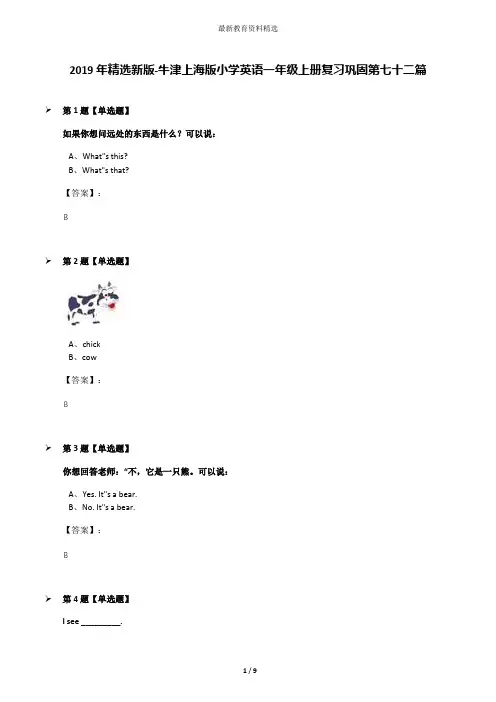
I see _________.
A、a cow
B、three cows
【答案】:
What can you do?
A、I can draw.
B、I can sing.
【答案】:
Moo ... Moo ... I"m a cow.
A、
B、
【答案】:
把苹果涂成红色。可以说:
A、Colour the peach red.
Have you got a cake? Yes, I have got a cake.
A、正确
B、错误
【答案】:
—Is that a monkey?
—No. It"s a ______(lionБайду номын сангаасtiger).
【答案】:
填一填。
① ______A. cow
② ______B. pig
③ ______C. duck
B、Colour the apple red.
【答案】:
选择相应的英文。
颜色
A、color
B、class
【答案】:
What"s this?
A、It"s a chick.
B、It"s a duck.
【答案】:
选择与下列单词相对应的英文。
鸭子
A、duck
B、chick
【答案】:
apple
A、
B、
【答案】:
B、
【答案】:
A、pig
B、cow
【答案】:
你想回答老师:“是,它是一只小鸡。”可以说:
A、Yes. It"s a chick.
牛津上海版小学英语一年级上册《Unit 1 On the farm》ppt课件

KEY WORDS
Vocation 职业; Vacation 休假
▪ welcome, vocational, glad, meet, look, class, read, study, after, after class,
▪ see, let, every, love, hard, thank, visit, time, English, want, desk, chair.
▪ 4. Do you see the red building next to the library?
▪ 你看见紧挨着图书馆的那栋红楼吗? ▪ next to… “邻接着,紧挨着”
▪ 教师办公室紧挨着我们的教室。 ▪ The teachers’ room is next to our
classroom. ▪ My company is next to a shopping mall.
Unit 1
Unit 2 Unit 3 Unit 4 Unit 5
Unit 6
Unit 7
Unit 8
Unit 9 Unit 10 Unit 11 Unit 12
Grammar Link verb "be"; there be Pronouns Nouns Numerals, Time Articles degrees of adj. and adv. verb tenses 1 categories of sentences verb tenses 2 prepositions object clauses adverbial clauses
▪ 2. Read the passage again. ▪ 3. Finish the workbook exercises P2 (1)
上海牛津版英语小学一年级1BM3U2(5)
Module 3 Things around usUnit 2 Weather (1)Ⅰ. Look and circle〈根据所给的单词,把正确的单词部分圈出来〉:1. weather2. rainy3. how4. the5. cloudy6. sunnyⅡ. Look and number〈看图,将单词的编号写在相应的图片下〉:1. rainy2. cloudy3. sunny4. windy ( ) ( ) ( ) ( ) w e a w e a t h e rr a i n r a i n y yh o m n o w h o w wt h a t h e r t h uc l o u c l o ud ys u n n s u n n y yⅢ. Read and match1. How is the weather? It’s sunny.●●A.2. How is the weather? It’s cloudy. ●●B.3. How is the weather? It’s windy. ●●C.4. How is the weather? It’s rainy. ●●D.5. How is the weather? It’s hot. ●●E.Ⅳ. Read and judge〈判断下列句子是否符合所给的情景,用☺或☹表示〉:1.想知道天气情况,你问:How is the weather?2.今天是下雨天,你说:It’s a sunny day.3.别人问你是否喜欢晴天,你说:Yes, I like rainy days.4.早晨,看见好朋友,你对好朋友说:Good afternoon..5.想邀请朋友去公园,你说:Let’s go to the park.Module 3 Things around usUnit 2 Weather (2)Ⅰ. Read and circle 〈读一读,圈出在意义上属于不同类的单词〉: 1. 2. 3. 4.Ⅱ. Read and tick 〈读句子,在相应的图片下打勾〉:1. It ’s summer. It ’s hot.A. ( )B. ( )2. Do you like windy days? No.A. ( )B. ( )3. It ’s summer. It ’s hot.A. ( )B. ( )4. Let ’s go to the beach.A. ( )B. ( )5. Do you like cloudy days? Yes.A. ( )B. ( ) A. how B. cowC. cat A. sunny B. weather C. rainy A. is B. are C. can A. beach B. peach C. appleⅢ. Look and choose〈看图,选出正确的单词,圈在字母代号上〉:1. 2. 3. 4. 5.A. rainy A. morning A. peach A. sunny A. AliceB. sunny B. afternoon B. beach B. cloudy B. KittyⅣ. Read and judge〈判断下列句子是否符合图意,用√或╳表示〉:1. 2.It’s a rainy day. ( ) Do you like cloudy days? Yes. ( ) 3. 4.Good afternoon. ( ) Do you like windy days? Yes. ( ) 5. 6.It’s spring. It’s warm. ( ) Is it a cloudy day? Yes. ( )Ⅴ. Read and judge〈阅读对话,按顺序用“1—4”给下列图片编号〉:1. Alice: Mum, how is the weather? Mum: It’s windy.2. Alice: Mum, is it sunny? Mum: No, it’s cloudy.3. Alice: Do you like sunny days? Mum: Yes, It’s nice.4. Alice: How is the weather? Mum: It’s rainy. Take an umbrella, please.Module 3 Things around usUnit 2 Weather (3)Ⅰ. Read and circle〈读一读,圈出正确的图片〉:1. 2.sunny summerA. B. A. B.3. 4.windy rainyA. B. A. B.5. 6.warm cloudyA. B. A. B.Ⅱ. Read and number〈读句子,在相应的图片下编号〉:1. --- How is the weather?2. --- How is the weather?--- It’s sunny. --- It’s cloudy.3. --- How is the weather?4. --- How is the weather?--- It’s rainy. --- It’s windy.Ⅲ. Look and circle〈看图,圈出适当的单词完成句子,圈在字母代号上〉:1. Let’s go to the ____________.A. peachB. beach2. How __________ the weather? It’s ho t.A. isB. are3. It’s a __________ day.A. rainyB. sunny4. Do you like windy days? ___________.A. YesB. No5. Is it a __________ day? Yes.A. cloudyB. windyⅣ. Read and choose〈读一读,选择正确的问句或答句,将字母代号写在前面的括号内〉:A. It’s summer. It’s hot.B. Yes, I like sunny days.C. I see the red sun.D. It’s sunny. It’s hot.E. I like hot days.( ) 1. --- How is the weather? --- _____________________( ) 2. --- Do you like sunny days? --- _____________________( ) 3. --- What do you like? --- _____________________( ) 4. --- What do you see? --- _____________________( ) 5. --- What season is it? --- _____________________Module 3 Things around usUnit 2 Weather (4)Ⅰ. Look and circle〈根据所给例词,在每行中找出一个,并把它圈出来〉:1. season2. weather3. how4. rain5. morningr a i m r a r a i nw e w e a t h e r rm o r n i n g i n gh o m n o w h o w hs e e s e a s o n sⅡ. Look and match〈看图,将下列图片与相应的句子连线〉:1.● ● A. Is it a rainy day? Yes.2.● ● B. How is the weather? It’s windy.3.● ● C. It’s summer, a hot day. ays.4.● ● D. Do you like sunny days? Yes.5.● ● E.No, I like cloudy day.Ⅲ. Read and tick〈看图,在符合要求的句子前打√〉:1. 2.( ) A. Do you like rainy days? Yes. ( ) A. How is the weather? It’s hot. ( ) B. Do you like rainy days? No. ( ) B. How is the weather? It’s cold.3. 4.( ) A. It’s a cloudy day. ( ) A. How is the weather? It’s sunny. ( ) B. It’s a windy day. ( ) B. How is the weather? It’s rainy.Ⅳ. Read and choose〈读一读,选择合适的应答句,将字母代号写在前面的括号内〉:( ) 1. What do you see? A. It’s hot. It’s big. I like the sun. ( ) 2. How is the sun? B. Yes, I eat ice cream.( ) 3. How is the weather? C. It’s windy. I like windy days.( ) 4. Do you like the sunny days? D. It’s yellow.( ) 5. What colour is the sun? E. I see the clouds in the sky.Ⅴ. Read and judge〈阅读对话,判断下列句子是否符合对话,用√或╳表示〉:A: Good morning. B: Good morning.A: How is the weather? B: It’s hot.A: Is it sunny? B: Yes, it is.A: Let’s go to the beach. B: OK.A: Look, the beach is nice. B: Yes, it’s very nice.( ) 1. It’s afternoon.( ) 2. It’s a hot day.( ) 3. We can see the sun.( ) 4. Is the beach nice? No.Module 3 Things around usUnit 2 Weather (5)Ⅰ. Read and number〈读一读,将下列图片的编号写在相应的句子前〉:How is the weath er? It’s su nny. How is the weather? It’s rainy.How is the weather? It’s windy. How is the weather? It’s cloudy.Ⅱ. Read and judge〈判断下列图片是否符合所给的句子,用√或╳表示〉:1. 2.Good afternoon. How is the weath er? It’s hot.( ) ( )3. 4.Do you like sunny days? Yes. Do you see the sun? No.( ) ( )Ⅲ. Read and choose〈情景选择,在符合情景的句子前打勾〉:1. 想要询问天气情况,你问:( ) A. What season is it? ( ) B. How is the weather?2. 告诉朋友,你喜欢有太阳的日子,你说:( ) A. I like sunny days. ( ) B. It’s a sunny day.3. 下午看见方老师,你说:( ) A. Good morning, Miss Fang. ( ) B. Good afternoon, Miss Fang.4. 想邀请同学一起去公园,你说:( ) A. Let’s go to the zoo. ( ) B. Let’s go to the park.5. 夏天真热啊,你说:( ) A. Summer is hot. ( ) B. Is summer hot?Ⅳ. Read and tick〈阅读短文,在图片下的空格内打勾〉:Hello, I am Kitty. I am a girl. I am tall. But Iam thin. I like spring. In spring, I smell theflower. The flowers are red and yellow. I likesunny days. I can see some bees in the park.But my brother〈弟弟〉likes windy days. Hecan fly the kites in the park.1. 2.A. ( )B. ( ) A. ( ) B. ( )3. 4.A. ( )B. ( ) A. ( ) B. ( )Module 3 Things around usUnit 2 Weather (1)Ⅰ. 1. weather 2. rainy 3. how 4. the 5. cloudy 6. sunny Ⅱ. 4213Ⅲ. 1. B 2. A 3. E 4. C 5. DⅣ. 1. ☺ 2. ☹ 3. ☹ 4. ☹ 5. ☺Module 3 Things around usUnit 2 Weather (2)Ⅰ. 1. A 2. B 3. C 4. AⅡ. 1. A 2. B 3. B 4. A 5. AⅢ. 1. A 2. A 3. B 4. A 5. BⅣ. 1. ╳ 2.╳ 3. √ 4. ╳ 5. ╳ 6. √Ⅴ. 4132Module 3 Things around usUnit 2 Weather (3)Ⅰ. 1. B 2. B 3. A 4. B 5. B 6. AⅡ. 3241Ⅲ. 1. B 2. A 3. A 4. B 5. AⅣ. 1. D 2. B 3. E 4. C 5. AModule 3 Things around usUnit 2 Weather (4)Ⅰ. 1. rain 2. weather 3. morning 4. how 5. seasonⅡ. 1. D 2. A 3. E 4. B 5. CⅢ. 1. B 2. A 3. B 4. AⅣ. 1. E 2. A 3. C 4. B 5. DⅤ. 1. ╳ 2. √ 3. √ 4. ╳Module 3 Things around usUnit 2 Weather (5)Ⅰ. 3124Ⅱ. 1. √ 2. ╳ 3. ╳ 4. √Ⅲ. 1. B 2. A 3. B 4. B 5. AⅣ. 1. A 2. B 3. A 4. A。
上海牛津版小学一年级英语练习 1B

Unit 3 Clothes (1)Ⅰ. Look and circle (根据所给的单词,把正确的单词部分圈出来):1. need2. shirt3. shorts4. blouse5. thank6. newⅡ. Look and number (看图,将单词的编号写在相应的图片下):Ⅲ. Read and match1. What do you see? I see a blouse.●●A.2. Oh, I need a pair of shorts. ●●B.3. How many dresses? One dress. ●●C.4. What’s this? It’s a T-shirt. ●●D.5. Is this a shirt? Yes, it is. ●●E.Ⅳ. Read and judge(判断下列句子是否符合所给的情景,用或表示):1.Danny需要一件T恤衫,他说:I need a T-shirt.2.Kitty有一条红色连衣裙,她说:This is my blouse. It’s red.3.别人问你冬天喜欢穿什么,你说:It’s cold. I like my dress.4.告诉朋友,你不喜欢蓝色,你说:I don’t like green.5.想知道对方需要什么,你问:What do you need?Module 3 Things around usUnit 3 Clothes (2)Ⅰ. Read and circle (读一读,圈出在意义上属于不同类的单词):1. 2. 3. 4.Ⅱ. Read and tick2. Do you like shorts? Yes.3. I need a yellow T-shirt.4. I ’5. How many dresses? Three.Ⅲ. Look and choose (看图,选出正确的单词,圈在字母代号上):1. 2. 3. 4. 5.A. shortB. shortsC. shirt A. what B. that C. this A. red B. read C. green A. blouse B. dress C. shortshouse2.4.6.Ⅴ. Read and judge (阅读对话,选择最佳答案,将字母代号写在前面的括号内): Miss Fang: It ’s summer. It ’s red. It ’s hot. What do you need?Kitty: I need a new blouse. It ’s blue. Alice: I need a new dress. It ’s yellow.Ben: I need a new T-shirt. It ’s green. Jack: I need a new T-shirt, too. It ’s red.Miss Fang: OK. Let ’s buy them together. Children: OK.( ) 1. Summer is _________. A. green B. red( ) 2. Jack and Ben need ________. A. T-shirts B. shorts ( ) 3. The new dress is ________. A. yellow B. blue ( ) 4. I see ________ children. A. 3 B. 4Module 3 Things around usUnit 3 Clothes (3)Ⅰ. Read and circle(读一读,圈出正确的图片):4.Ⅲ. Look and circle (看图,圈出适当的单词完成句子,圈在字母代号上):1. What ____________you need? A rubber. A. are B. do2. What do you see? __________ .A. ShortsB. Short3. What colour is the __________?A. shirtB. blouse4. Do you like ___________?A. T-shirtsB. shorts5. Look at the __________. Is it nice ? Yes.A. dressB. blouseⅣ. Read and choose (读一读,选择正确的问句或答句,将字母代号写在前面的括号内):( ) 2. --- What do you see? --- _____________________( ) 3. --- What do you like? --- _____________________( ) 4. --- What do you hear? --- _____________________( ) 5. --- What colour is it? --- _____________________Module 3 Things around usUnit 3 Clothes (4)Ⅰ. Look and circle (根据所给例词,在每行中找出一个,并把它圈出来):Ⅱ. Look and match (看图,将下列图片与相应的句子连线):1.●2.3.5.chick.Ⅲ. Read and tick (看图,在符合要求的句子前打√):1. 2.( ) A. Do you like blouses? No. ( ) A. What do you see? I see a dress.( ) B. Do you like dresses? No. ( ) B. What do you see? I see a T-shirt.3. 4.( ) A. Look at the blue trousers. ( ) A. What do you need? I need a bicycle.( ) B. Look at my blue shorts. ( ) B. What do you need? I need a blouse.Ⅳ. Read and choose (读一读,选择合适的应答句,将字母代号写在前面的括号内):( ) 1. What do you like? A. It ’s red and green.( ) 2. How many T-shirts? B. I need a T-shirt.( ) 3. Do you need a T-shirt? C. One T-shirt.( ) 4. What do you need? D. I like my T-shirt.( ) 5. What colour is the T-shirt? E. Yes, I need a T-shirt.ⅤMum: Here you are.Unit 3 Clothes (5)Ⅱ. Read and judge (判断下列图片是否符合所给的句子,用√或╳表示):( ) ( )Ⅲ. Read and choose(情景选择,在符合情景的句子前打勾):1. 在文具店里,营业员问你需要什么,你说:( ) A. I need some cola. ( ) B. I need some pencils.2. 你肚子很饿,你对妈妈说:( ) A. Mum, I need some biscuits. ( ) B. Mum, I need some water.3. 看见了一条新连衣裙,你说:( ) A. I see a new dress. ( ) B. I see a new blouse.4. 新学期到了,你需要一只新书包,你说:( ) A. I need a new bag. ( ) B. Do you like your new bag?5. 想知道对方需要什么,你问:( ) A. What do you like? ( ) B. What do you need?Ⅳ. Read and tick(读句子,在正确的图片前打勾):1. I need two apples. ( ) A. ( ) B.3. I like my blouse. ( ) A. ( ) B.4. Look at the yellow dress.5. I see a pair of shorts. ( ) A. ( ) B.Ⅴ. Read and judge(读短文,判断正误,用√或╳表示):Hello, I’m Danny. I am a boy. I am nine. I can read a book, draw and sing. I can’t dance. I like oranges, but I don't like orange juice. I like yellow sweets. Four are big and five are small. I need red shorts and green T-shirts.( ) 1. Danny is ten.( ) 2. He can sing.( ) 3. The sweets are red and yellow.( ) 4. I see nine sweets.Module 3 Things around usUnit 3 Clothes (1)Ⅰ. 1. need 2. shirt 3. shorts 4. blouse 5. thank 6. newⅡ. 2143Ⅲ. 1. E 2. D 3. B 4. A 5. CⅣ.1. 2. 3. 4. 5.Module 3 Things around usUnit 3 Clothes (2)Ⅰ. 1. A 2. A 3. B 4. CⅡ. 1. A 2. A 3. B 4. B 5. AⅢ. 1. B 2. B 3. A 4. A 5. AⅣ. 1. ╳ 2. √ 3. ╳ 4. √ 5. ╳ 6. √Ⅴ. 1. B 2. A 3. A 4. BModule 3 Things around usUnit 3 Clothes (3)Ⅰ. 1. B 2. A 3. A 4. B 5. B 6. AⅡ. 2413Ⅲ. 1. A 2. A 3. B 4. A 5. AⅣ. 1. E 2. B 3. A 4. D 5. CModule 3 Things around usUnit 3 Clothes (4)Ⅰ. 1. what 2. new 3. need 4. this 5. likeⅡ. 1. D 2. B 3. A 4. C 5. EⅢ. 1. A 2. A 3. B 4. BⅣ. 1. D 2. C 3. E 4. B 5. AⅤ. 2413Module 3 Things around usUnit 3 Clothes (5)Ⅰ. 2314Ⅱ. 1. ╳ 2. ╳ 3. √ 4. √Ⅲ. 1. B 2. A 3. A 4. A 5. BⅣ. 1. B 2. A 3. B 4. BⅤ. 1. ╳ 2. √ 3. ╳ 4. √。
牛津上海版一年级上册小学英语同步练习试题含答案(全册)

Module 1 Getting to know youUnit 1 Greetings同步练习看图,圈出正确的单词1. morningafternoon2. DannyEddie3. AliceKitty按图片选出正确的句子1. Good morning!Goodbye!2. Good afternoon!Goodbye!找出下列句子的答句,圈在字母代号上1. Hello! A. Hi! B. Good morning!2. Good morning!A. Good morning! B. Good afternoon!3. Good afternoon! A. Good morning! B. Good afternoon!4. Goodbye! A. Goodbye! B. Hello!正确朗读下列单词和句子,并写出它们的中文意思1.Good morning, Danny.________________________________2.Goodbye, Peter._______________________________3.Hello, Kitty.______________________________4.Hi! I’m Alice.______________________________5.Good afternoon!_____________________________在字母盒中找出下列单词1. morning a m b m o r n i n g h e2. hello h e l l o o b e a l l o g3. afternoon a b a f t e r n o o n o n参考答案看图,圈出正确的单词1. afternoon2. Danny3. Kitty按图片选出正确的句子1. Good morning!2. Good afternoon!找出下列句子的答句,圈在字母代号上1. Hi!2. Good morning!3. Good afternoon!4. Goodbye!正确朗读下列单词和句子,并写出它们的中文意思1.早上好,丹尼。
小学英语牛津译林版(一起)一年级上册Project 2A poster-章节测试习题
章节测试题1.【答题】What can you do?A. I can make the bed.B. Yes, I can.【答案】A【分析】本题考查特殊疑问句的回答。
【解答】句意:你会做什么?我会铺床。
这是询问对方会做什么的句型,“can”意为“会;能”。
2.【答题】I can dance.(对画线部分提问)______ ______ you ______?【答案】What can do【分析】本题考查句型转换。
【解答】对dance提问用What,后加一般疑问句can you do,故为What can you do?3.【答题】How many apples are there ________ the tree?A.onB.forC.in【答案】A【分析】本题考查介词辨析。
【解答】“生长在树上的”用介词on,如apples on the tree. “非生长在树上的”用介词in,如a kite in the tree.选A.4.【答题】--Look at my skirt.--_____A. Hello!B. It's nice.C. Thank you.【答案】B【分析】本题考查情景交际。
【解答】根据题干“Look at my skirt.”看我的裙子,可知应回答:It's nice.它很好。
选B.。
5.【答题】为下列短语选择正确的翻译I can skip.______A.我会跳绳。
B.我会走路。
【答案】A【分析】本题考查英译汉。
【解答】skip意为“跳绳”,walk意为“走路”。
选A.6.【答题】同学问你会做什么,你回答:_______A.I can skip a rope.B.I like skipping a rope.【答案】A【分析】本题考查生活交际用语。
【解答】I can skip a rope意为“我会跳绳”,I like skipping a rope意为“我喜欢跳绳”。
牛津上海版一年级上册小学英语教案全册
牛津上海版一年级上册小学英语教案全册一、教学内容Chapter 1:Hello!(问候)Chapter 2:My family(我的家庭)Chapter 3:My pets(我的宠物)Chapter 4:At school(在学校)Chapter 5:My body(我的身体)Chapter 6:Fruits(水果)二、教学目标1. 让学生掌握基本的英语问候语,学会介绍自己的家庭成员、宠物、身体部位等。
2. 培养学生的英语听说能力,使他们能够进行简单的日常交流。
3. 培养学生热爱生活、关爱家人和动物的价值观。
三、教学难点与重点1. 教学难点:单词和句型的发音,以及日常对话的应用。
2. 教学重点:问候语、介绍家人和宠物、描述身体部位等日常用语。
四、教具与学具准备1. 教具:卡片、挂图、录音机、磁带、多媒体设备等。
2. 学具:课本、练习册、彩色笔、剪刀、胶水等。
五、教学过程1. 实践情景引入:通过播放教材配套录音,让学生模仿并参与角色扮演,进行问候、介绍家人等情景交流。
2. 例题讲解:针对每个章节的重点句型和单词进行讲解,引导学生跟读、模仿。
Chapter 1:Hello!(问候)句型:Hello! Hi! How are you? I'm fine, thank you!单词:hello, hi, how, are, you, fine, thank, you Chapter 2:My family(我的家庭)句型:This is my mother/father/brother/sister. I love my family.单词:mother, father, brother, sister, family, love Chapter 3:My pets(我的宠物)句型:I have a dog/cat/bird. My pet is cute.单词:dog, cat, bird, pet, cuteChapter 4:At school(在学校)句型:I go to school. I like my teacher and classmates.单词:school, teacher, classmates, likeChapter 5:My body(我的身体)句型:This is my head/eye/nose/mouth. I cansee/hear/smell/taste.单词:head, eye, nose, mouth, see, hear, smell, tasteChapter 6:Fruits(水果)句型:I like apples/oranges/bananas. Fruits are healthy.单词:apple, orange, banana, fruit, healthy3. 随堂练习:针对每个章节的内容,设计相应的练习题,让学生进行口语练习和书写练习。
牛津上海版一年级上册小学英语优质教案全册
牛津上海版一年级上册小学英语优质教案全册一、教学内容本节课,我们将学习牛津上海版一年级上册小学英语教材第三单元“Meeting new friends”第一课时。
具体内容包括:引言部分,通过图片和情景对话,让学生掌握基本问候语和介绍自己方式;课文部分,通过故事主人公小熊Bob交朋友过程,教授学生如何用简单英语进行自我介绍和询问他人信息;练习部分,通过各种实践活动,巩固问候语和介绍自己表达方式。
二、教学目标1. 让学生掌握基本问候语,如“Hello”、“Hi”、“Good morning”等,并能够灵活运用。
2. 培养学生用简单英语进行自我介绍和询问他人信息能力。
3. 增强学生英语口语表达能力,提高他们与人交往信心。
三、教学难点与重点1. 教学难点:问候语和自我介绍表达方式,以及如何用英语询问他人信息。
2. 教学重点:让学生在实际情景中灵活运用所学知识,提高口语表达能力。
四、教具与学具准备1. 教具:图片、卡片、录音机、磁带、多媒体设备。
2. 学具:课本、练习本、彩色笔。
五、教学过程1. 导入:通过图片展示不同问候场景,引导学生用英语问候彼此,激发学习兴趣。
2. 新课内容展示:播放课文录音,让学生跟读,学习问候语和自我介绍表达方式。
3. 实践活动:分组进行角色扮演,模拟小熊Bob交朋友场景,巩固所学知识。
4. 例题讲解:针对学生在实践活动中遇到问题,进行讲解和示范。
5. 随堂练习:让学生用所学知识,编写一段自我介绍对话,并进行展示。
六、板书设计1. Meeting new friends2. 内容:Greetings: Hello, Hi, Good morning, Good afternoon, Good evening, Goode七、作业设计1. 作业题目:编写一段与同学问候和自我介绍对话。
2. 答案示例:八、课后反思及拓展延伸1. 课后反思:本节课通过情景教学法和实践活动,让学生掌握基本问候语和自我介绍表达方式,提高口语表达能力。
上海小学牛津英语1A一年级上册详细知识点
M1 U1 GreetingsUsing the key words in contextUsing formulaic expressions to greet people ,bid farewell. Using the common pattern to introduce oneself.M1 U2 My classmatesUsing nouns to identify school suppliesUsing simple language to point out objectsUsing imperatives to give simple instructions.Using formulaic expressions to offer people things.Using formulaic expressions to express thanks.M1U3 My faceUsing nouns to identify parts of the bodyUsing formulaic expressions to introduce oneselfUsing pronouns to show which item is being referred to Using imperatives to give simple instructionsUsing pronouns to show which item is being referred to Using imperatives to catch people’s attentionUsing pronouns to refer to particular peopleM2U1 P1 MY AbilitiesUsing verbs to indicate actionsUsing the modal verb can to express abilitiesAsking wh-questions to find out a person’s ability. E.g., What can you do?Using verbs to indicate actions. E.g., I can sing.M2U2 My familyUsing pronouns to identify people. E.g., meUsing nouns to identify family members. E.g., mother, father, grandfather, grandmotherUsing nouns to identify family membersUsing possessive adjectives to express possessionAsking wh-questions to find out a person’s identityUsing pronouns to identify peopleUsing formulaic expressions to confirm or denyM2U3 My friendsUsing adjectives to describe people. E.g., thin, fat, tall, shortUsing pronouns to identify peopleUsing adjectives to describe peopleAsking wh-questions to find out a person’s identityUsing the modal verb can to express abilitiesM3U1 In the classroomUsing numerals to count from one to sixUsing numerals to show quantityUsing numerals to count from one to sixUsing numerals to show quantityAsking questions to find out quantity?M3U2 In the fruit shopUsing nouns to identify fruit.e.g., apple, pear, peach, orangeAsking questions to find out quantitye.g., How many..?Using formulaic expressions to request something.Using formulaic expressions to reply requestsUsing formulaic expressions to express thanksM3U3 In the restaurantUsing nouns to identify food.e.g., pizza, hamburger, cake, pieHear specific information in response to simple questions.e.g., Give me a hamburger, please. Here you are.Using formulaic expressions to request somethingUsing an indefinite article to refer to somethingUsing formulaic expressions to greet customersM4U1 On the farmUsing nouns to identify common farm animalsUsing some onomatopoeic words to imitate the sounds of the farm animalsUsing verbs to give instructionsUsing the key pattern to role-play as farm animalAsking wh-questions to find out specific information about something Using a pronoun to refer to somethingM4U2 In the zooUsing nouns to identify animalsUsing adjectives to describe things.Asking yes/no questions to obtain simple responses.e.g., Is this a bear?Using formulaic expressions to confirm or deny.e.g., Yes./No. It’s a panda.M4U3 In the parkUsing adjectives to identify colours.e.g., It’s red.Asking wh-questions to find out the colours of objects.e.g., what colour is it?Using adjectives to identify coloursUsing imperatives to give simple instructionsUsing onomatopoeic words to indicate animal soundsUsing adjectives to describe animalsAsking wh-questions to find out specific information about an animal.。
牛津上海版一年级上册小学英语教案全册(1)
牛津上海版一年级上册小学英语教案全册一、教学内容Unit 1 HelloLesson 1 HelloLesson 2 Good morningUnit 2 I'mLesson 3 I'm a girlLesson 4 I'm seven二、教学目标1. 学生能够熟练掌握基本的英语问候语,如“Hello”,“Good morning”等。
2. 学生能够表达自己的基本信息,如姓名、年龄和性别。
3. 学生能够在实际情景中运用所学英语进行简单的交流。
三、教学难点与重点1. 教学难点:正确使用“I'm ”句型表达自己的基本信息。
2. 教学重点:掌握基本的英语问候语和自我介绍。
四、教具与学具准备1. 教具:教学卡片、图片、录音机、磁带2. 学具:学生用书、练习册、彩色笔五、教学过程1. 实践情景引入教师以日常生活场景为例,引导学生用英语进行问候和自我介绍。
学生进行角色扮演,练习问候和自我介绍。
2. 例题讲解教师讲解教材中的例题,如“Hello, I'm ”,“Good morning, I'm ”等。
学生跟随教师一起朗读,并模仿例题进行练习。
3. 随堂练习学生两人一组,互相问候和自我介绍。
教师随机抽取学生进行展示,并及时给予反馈。
4. 小组活动学生分成小组,进行“猜猜我是谁”的游戏,巩固所学知识。
六、板书设计1. 在黑板上写出本节课的重点词汇和句子。
2. 用不同颜色的粉笔标出教学难点和重点。
七、作业设计1. 作业题目:制作一张自己的名片,包括姓名、年龄、性别等信息,并用英语进行自我介绍。
2. 答案示例:Name: Zhang WeiAge: EightGender: BoySelfintroduction: Hello, I'm Zhang Wei. I'm eight years old. I'm a boy.八、课后反思及拓展延伸1. 教师反思:本节课学生的参与度较高,但部分学生在自我介绍时仍存在发音不准确的问题,需要在今后的教学中加强指导。