
最新人教版七年级上册Unit 3 Is this your pencil
2013—2014年度人教版七年级上册英语教案Unit 3 Is this your pencil?主备人:备课时间:2013年月日成员:The 1st period (Section A 1a—2c)Teaching aims:1. Knowledge objects:(1). Words & expressions: schoolbag, pencil, pen, book, eraser, ruler, dictionary, pencil box(2). Key sentences:---- Is this your ruler? ----Yes, it is. It’s mine.----Is that your schoolbag? ----No, it isn’t. It’s his.----Are these your books? ----No, they aren’t. They’re hers.2. Ability goals: Enable the students to learn to identify ownership3. Moral goals: You must take good care of your personal possessions.Teaching important points:1.Get the students to learn the names of the objects.2.Get the students to learn to talk about ownership.Teaching difficulties:1. The usage of Yes/ No questions sentences.2. The usage of possessive pronouns.Teaching methods:Task-based Language Teaching, Visual teaching method, situational teaching methodTeaching aids: A box filled with some school thingsTeaching steps:Ⅰ.Warming- up and revisionT: Good morning. What’s your name? S: Good morning. My name is ….T: Nice to meet you. S: Nice to meet you, too.T: Excuse me, what’s your telephone number?S: It’s 628-9904.2. T: What’s your first name?S: My first name is Lin. Then ask the class: What’s her first name?T: What’s your last name?S: My last name is Kan. Then ask the class: What’s her last name?II. PresentationT shows a pen and asks “What’s this in English?” Ss: It’s a pen. T writes a pen on the blackboard. Then show a pencil and ask the same questions. Write the word on the blackboard. After all the words are on the blackboard, ask them to read after the teacher. Then practice like this. If the teacher reads the word correctly, students read after the teacher. If the teacher does not read that word, the students should stop. If one student reads at this time, then he or she will lose a point. First the teacher reads slowly, then fast, then faster.III. SummaryWrite a sentence: This is your ruler. This is a statement. Is this your ruler? This is a Yes/ No question sentence. In writing, an interrogative sentence ends with a question mark. In spoken English, your voice goes down when you speak a statement, and your voice goes up when you speak an interrogative sentence.IV. Work on 1a and 1b1. Ask the students to match the words and objects in the picture by writing the letter of the object on the blank line after the word. Focus attention on each of the three conversations. Ask students to identify the objects the person in each conversation is holding or pointing to.(A boy is holding a pencil, a girl is holding a ruler, and the teacher is pointing to a schoolbag.)2. Then Play the recording the first time. Students only listen. Point out the boxes where students will write a number in the box to each conversation.3. Check the answers.V. Work on 1c1. Get the students to listen again repeat each conversation. Pay attention to the falling and rising tones in each conversation.2. Ask students to practice the conversation in pairs.3. The teacher checks the progress and pronunciation.VI. Listening 2a and 2bRead the instruction in 2a and ask Ss to check the things they hear.Play the recording the first time. Students listen and check.Then ask students to point to the blank lines in the conversation in 2b. Say, You will write one of the words from the box on each blank line.Play the recording a second time. This time Ss complete the conversation.Check the answers.VII. PracticeGive Ss 3 minutes to practice the conversation in 2b.Ask Ss to make new conversations by using the things in the class and then practice.Have some pairs to make out.Homework:1. Listen and read after the tape for thirty minutes.2. Recite the conversation of Section A, 2b.本课教学后记(课堂设计理念,实际教学效果及改进设想)The 2nd period (Section A 2d – 3c)Teaching aims:1. Knowledge objects:(1). Words & expressions:about, what about, thank you for…, help, welcome(2). Key sentences: What about…? Thank you for your help. You are welcome.2. Ability goals: Enable the students to identify ownership.3. Moral goals: You should thank others if they help you.Teaching keys:1. How to identify ownership and get information.2. Master the Yes/ No questions sentences.3. The Yes/ No questions sentences.Teaching difficulties:1. The usage of Yes/ No questions sentences.2. The usage of possessive pronouns.Teaching methods:Task-based Language Teaching, Visual teaching method, situational teaching methodTeaching aids: A tape recorder and some objects.Teaching steps:Ⅰ.Warming upGreet the class and ask some daily questions.II. RevisionReview the words by asking and answering questions.T: What’s this? S1: It’s a pencil.T: Is this your pencil? S1: Yes, it is. It’s mine.T: What’s that? S2: It’s a dictionary.T: Is this your dictionary? S2: No, it isn’t. It’s his.Ⅲ.Role-playHave two Ss read the conversation first.Explain the conversation and ask Ss to read by themselves.Several minutes later, call some pairs to practice it.Correct theirs pronunciation if they make mistakes.IV. Grammar FocusWrite the sentences on the blackboard and ask them to read.Explain the sentences and point the key grammar.Is this your pencil? Yes, it is. It’s mine. / No, it isn’t. It’s hers.Are these your books? Yes, they are. / No, they aren’tMake more examples about the usage of the Yes/ No questions sentences and possessive pronouns. Is that his green pen? No, it isn’t. It’s mine. Here mine means my green pen.Ⅴ.PracticeRead the instruction to the class and them to finish it by themselves.Ask some students to speak out their answers and check them.Give students some time to practice the conversation and then ask some pairs to practice.Ⅵ. Work on 3bGive Ss 4 minutes to finish this part.Walk around the classroom and give help if possible.Check the answer and read together.Ⅶ.GamePrepare a box and some things and put them into the box.Ss take one thing out of the box and find the owner by asking questions, only twice.Eg: Is this your eraser? No, it isn’t.Is this Li Ming’s eraser? Yes, it is.Homework:1. Read and copy Grammar Focus twice.2. Remember the words learned today.3. Listen to the tape for at least 30 minutes.本课教学后记(课堂设计理念,实际教学效果及改进设想)The 3rd period (Section B 1a – 1e)Teaching aims:1. Knowledge objects:(1). Words & expressions:baseball, watch, computer, game, key, notebook, ring, bag(2). Key sentences: What’s this? It’s a watch. How do you spell it? W-A-T-C-H.2. Ability goals:(1). Enable the students to ask and answer the names of some possessions and get information.(2). Improve their listening ability.3. Moral goals:Help the students learn how to ask and answer the names of some possessions and get information. Teaching keys:New words:baseball, watch, computer game, key, notebook, ring, bagSentences:---- What’s this in English? ----It’s a pen.----How do you spell it? ----P-E-N.Teaching difficulties:How ask the names of the objects in English.Get the students to learn to ask the names of the objects in English.Teaching methods:Task-based Language Teaching, Visual teaching method, situational teaching method Teaching aids: A tape recorder and some objects.Teaching steps:I. Warming- upGreet the class as usual.Ⅱ.DictationWords and expressions:1.a book2. an eraser3. a pencil box4. a dictionary5. a pen6. a schoolbagSentences:----Is this your ruler? ----No, it isn’t. It’s hers.----Is that your pencil? ----Yes, it is. It’s mine.Ⅲ.RevisionHave a review of the last lesson, especially the sentences.----Is this your ruler? ----No, it isn’t. It’s hers.----Are those his keys? ----Y es, they are. They are his.Explain the usage of Yes/ No questions sentences and possessive pronouns.Ⅳ. PresentationT: Boys and girls, let’s play a guessing game, “What’s in the box?” OK? Cover one student’s eyes with a cloth and let him or her guess what it is.Show the things one by one and learn the new words in this part like this.---What’s this in English? ---It’s a baseball.---How do you spell it? ---B-A-S-E-B-A-L-L.Write all the words on the Bb and read after the teacher, then Ss read by themselves.Ⅴ.PracticeAfter learning the new words, ask two Ss to read the sample dialogue.Have them practice with their partners.Find some pairs to act their dialogues out.Ⅵ. Listening 1c and 1dRead the instructions first.Play the recording for the first time, and Ss circle the words they hear.The second listening, ask Ss to write the things belong to Linda or Mike.Check the answers.Ⅶ. PairworkPoint out the dialogue in 1b again.Student A is Linda, and student B is Mike, to make conversations like 1b.Give Ss some minutes to practice, and then ask some pairs to read theirs out.Homework:1. Copy the words in 1a three times.2. Read and recite the conversation of Section B,1 b, and then copy it.本课教学后记(课堂设计理念,实际教学效果及改进设想)The 4th period (Section B 2a – 2c)Teaching aims:1. Knowledge objects:(1). Words & expressions: at, in, the, lost, found, lost and found, library, some, must(2). Key sentences: Call … at ….. Please call ….E-mail … at ….2. Ability goals: Enable the students to write found and lost3. Moral goals:If you find something that doesn’t belong to you, you can take it to a Lost and Found office. People can go to this office to get their lost things.Teaching keys:1. Train Ss reading skills.2. Get Ss know something about Lost and Foun d.Teaching difficulties:1. Let Ss know the writing methods about Lost and Found.2. Help the students learn how to write found and lost.3. Get the students to learn to write their bulletin board messages.Teaching methods:Task-based Language Teaching, Visual teaching method, situational teaching methodTeaching steps:I. Warming-upT: Good morning, boys and girls. Ss: Good morning, teacher.T: How are you today? Ss: I’m fine, thank.Ⅱ. RevisionReview the words learned last time first by asking Ss to read them.Show some things and then ask questions like:T: What’s this? Ss: It’s a watch.T: How do you spell it? Ss: W-A-T-C-H.Ⅲ. PairworkGive Ss some time to make conversations like the sample one.Then choose some pairs to act out.Give them help if necessary.Ⅳ. Work on 2aPoint to the word in 1a first, and then have the Ss to write more words.Read the instructions and let them to write the things they lose easily.Ask some to read the words they write.Ⅴ.Reading 2b and 2cHave the Ss read the four short passages first and circle the lost things.Explain the passages and teach some grammars.Read the instruction of 2c and ask Ss read the notices again.Let Ss to write down the items and check Lost or Found.Homework:1. Listen and read after the tape for thirty minutes.2. Copy 3b and translate it.本课教学后记(课堂设计理念,实际教学效果及改进设想)The 5th period (Section B 3a – Self-check)Teaching aims:1. Knowledge objects:(1). Words & expressions: a set of, of(2). Key sentences: Is that your backpack? Yes, it is. /No, it isn’t.2. Ability goals: Enable the students to identify ownership.3. Moral goals:Help the students learn how to identify ownership, get the information they need and write a bulletin board message.Teaching keys:1. Learn how to write Lost and Found notices.2. Get the students to review what they’ve learned in this unit.3. The writing methods of Lost and Found notices.Teaching difficulties:How to write Lost and Found notices.Teaching methods:Task-based Language Teaching, Visual teaching method, situational teaching methodTeaching steps:I. GreetingGreet the class as usual.Ⅱ.RevisionReview the words learned last time first by asking Ss to read them.Review the reading material about Lost and Found, and ask student to have a review of the key grammars in this part.Ⅲ. PracticeAfter review the reading, let Ss complete two notices about Lost and Found. During this time, the teacher walk around the classroom, and give help if possible. Check the answers and let them to read the two notices.Ⅳ.WritingWrite a lost notice as a example.Lost: My English book.My name is Mr. ….Please call me at ….Ask Ss to write their own lost or found notice.Have some Ss to read theirs out and correct their mistakes.Ⅴ.Self Check1. Write the school things you know.pen, ruler, eraser, book, pencil, crayon,………3. Look at the picture and write conversations.A: Is that your schoolbag? B: No, it isn’t.A: Are those your pencils? B: No, they aren’tA: Is that your key? B: No, it isn’t.A: Is that your notebook? B: No, it isn’t.Homework:1. Remember the words in Unit 3.2. Finish the exercises in our books.3. Preview of Unit4.本课教学后记(课堂设计理念,实际教学效果及改进设想)。
人教版七年级英语上册Unit3单元知识点总结及同步练习题附答案
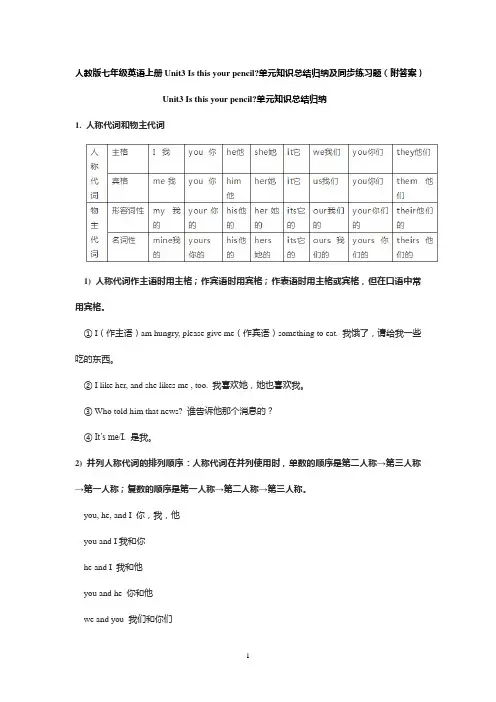
人教版七年级英语上册Unit3 Is this your pencil?单元知识总结归纳及同步练习题(附答案)Unit3 Is this your pencil?单元知识总结归纳1. 人称代词和物主代词1) 人称代词作主语时用主格;作宾语时用宾格;作表语时用主格或宾格,但在口语中常用宾格。
① I(作主语)am hungry, please give me(作宾语)something to eat. 我饿了,请给我一些吃的东西。
② I like her, and she likes me , too. 我喜欢她,她也喜欢我。
③ Who told him that news? 谁告诉他那个消息的?④It’s me/I. 是我。
2) 并列人称代词的排列顺序:人称代词在并列使用时,单数的顺序是第二人称→第三人称→第一人称;复数的顺序是第一人称→第二人称→第三人称。
you, he, and I 你,我,他you and I我和你he and I 我和他you and he 你和他we and you 我们和你们you and they 你们和他们we, you and they我们,你们和他们3) 形容词性物主代词修饰名词,必须放在名词前面,相当于形容词,在句中作定语。
名词性物主代词相当于名词(即指代名词,后面不能再加名词),在句中作主语、表语或宾语。
This is your ruler, it is not mine.这是你的尺子,不是我的。
2. Is this/that...? 这/那是......吗?Yes, it is. / No, it isn’t. 是的,这/那(它)是。
/ 不,这/那(它)不是。
回答时,要用it来代替this和that。
不可回答Yes, this/that is. / No, this/that isn’t.1)Is this your pencil ?这是你的铅笔吗?Yes, it is. It’s mine是的,它是我的(铅笔)。
人教版英语七年级上册Unit 3 Is this your pencil PPT课件
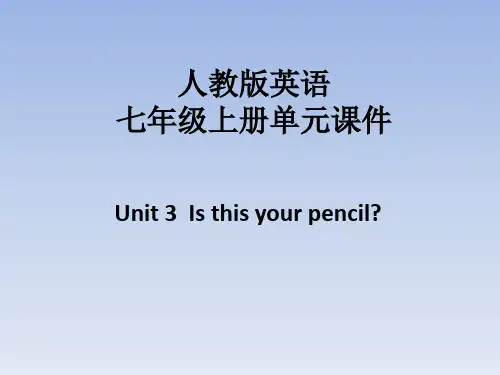
his
his
mine
mine
hers
Are these your dictionaries? Yes, they are. They’re mine.
my dictionaries
Are these your books? No, they aren’t. They’re hers.
her books
hers
Are those your pencil boxes? No, they aren’t. They’re his.
his pencil boxes
his
Pairwork
A: Are these your pencil boxes? B: Yes, they are. They’re mine.
义句)
My pen is red. What color is __yo_u_r_s___? 3. This is his green jacket. (改为同义句)
This green jacket is __h_is__.
4. Your pen is red, my pen is red, too.(同义 句)
人教版英语 七年级上册单元课件
Unit 3 Is this your pencil?
Unit 3 Is this your pencil?
• 1.Section A (1a—1c) • 2.Section A (2a—2d) • 3.Section A (Grammar Focus—3c) • 4.Section B (1a—1e) • (单击上面课题进入对应幻灯片)
人教版七年级英语《Is.this.your.pencil》教案

Unit 2 Is this your pencil?Topic: Things in the classroomFunctions: Identify ownershipStructures: Demonstratives this, thatWhat questionsYes / No questions and short answersHow do you spell pen?P-E-N.Target language: Is this your pencil?Yes, it is./ No, it isn’t.What’s this in English?It’s a pen.How do you spell it?P-E-N.Teaching StepsPeriod 1Lead in:Good morning, everyone! Last week, we finished Unit 1. Today we are going to learn a new unit, Unit 2.Ask and answera. In starter Unit 2, we learnt to identify things. Did you remember how to ask the names of things in English? Yes. What’s this in Engl ish?b. Let’s look at the title of Unit 2. Is this your pencil? What is the unit about?c. Great! 本单元我们将学习物品的所属者是谁?Step 1: Section A 1aOK, let’s have today’s new unit. Please open your books at page 7 and look at activity 1a.1.Look and findPlease look at the picture in activity 1a. What can you find?2.Match and discussa. Would you please match the words with the things in the picture?b. How many words do you know? Can you share the words you know with your partners?c. Please discuss with your partners and check whether your answers are the same.3.Check the answersLet’s check the answers together.Answers: 1.c 2.f 3.b 4.g 5.e 6.d 7.a 8.h 9.i4.Reada. Please read the words after me. Pencil ...b. I would like you to read the words together and one word twice. Pencil one two ...c. Who would like to read the words in class?d. Let’s read the words one by one.Step 2: Section A 1b1.Listen and numbera. Listen to the tape for the first time.b. Number the conversations from 1 to 3 while you listen to them for the second time.2.Check the answersLet’s check the answers.Answers: 3 2 13.Reada. I would like you to read the conversations together.b. Would you please read them in pairs?c. Who would like to read in class?4.Translate and explaina. Let’s translate the conversations into Chinese. Would you please work in pairs?b. Let’s translate the conversations together now.c. When do you ask the questions like: Is this your ...? or Is that your ...? Can you tell me? 是的,当我们想问某物是对方的吗?用这样的句型。
七年级英语上册Unit3-Is-this-your-pencil教案
Unit3 Is this your pencil? 教案Period1 Section A 1a-1cⅠ.教学准备1.教师:录音机和录音磁带,多媒体课件,图片图片和物品实物。
2.学生:学习用品实物。
Ⅱ.教学目标1.调动学生学英语和说英语的积极性。
2.使学生了解并掌握一些学习用品的英语表达。
3.学习本课的知识点。
(1)词汇:pencil, book, eraser, box, pencil box, schoolbag, dictionary, his, mine, hers(2)句型:–Is this/ that your pencil?– Yes, it is. It’s mine.No, it isn’t. It’s his/ hers.4. 训练学生在听录音时听懂简单英语词汇的能力。
Ⅲ.教学重点1.词汇:pencil, book, eraser, box, pencil box, schoolbag, dictionary,his, mine, hers2.句型:–Is this/ that your pencil?– Yes, it is. It’s mine.No, it isn’t. It’s his/ hers.Ⅳ.教学难点让学生运用所学句型“Is this/ that your pencil? Yes, it is. It’s mine. / No, it isn’t. It’s his/ hers.”等内容对物品的所属进行问答,能辨认物品的所有者。
Ⅴ.教学步骤Step1: Greetings and talking1.教师向学生表示问候,并复习之前所学的问候语。
2.师生问答:教师向学生询问一些已经学过的信息。
For example:T: What’s this in English?Ss: It’s a pen.T: What color is it?Ss: It’s blue.…Step2: Lead-in & Presentation利用实物直接导入,通过师生问答学习新单词:pencil, book, eraser, schoolbag, dictionary, pencil box, mine, his, hers。
七年级英语上册Unit3Isthisyourpencil笔记重点大全(带答案)
七年级英语上册Unit3Isthisyourpencil笔记重点大全单选题1、— ________ these her hats?— No, they ________.A.Is;isn’tB.Am;areC.Are;isn’tD.Are;aren’t答案:D分析:句意:——这些是她的帽子吗?——不,它们不是。
考查谓语动词的单复数。
根据hats提示,第一个空应用be动词的复数形式are,A、B选项可排除。
答句主语they为复数概念,故应用aren’t,故选D。
2、—It's very kind of you to help me. Thank you very much.—________.A.Thank youB.Don't thank meC.Sorry to help you very littleD.You are welcome答案:D句意:——你帮助我真是太好了。
非常感谢你。
——不用谢。
A. Thank you谢谢你;B. Don't thank me不要谢谢我;C. Sorry to help you very little很抱歉帮了你一点忙;D. You are welcome不用谢。
回答谢谢说不用谢即可,故答案选D。
小提示:对方如果表达了感谢,用来表述“不用谢”的短语有:You are welcome. That's all right. That’s OK. Not at all. My pleasure.3、Jim lost his ID card and he must ________ it.A.loseB.findC.lookD.find out答案:B句意:吉姆把身份证丢了,他必须把它找回来。
考查动词和动词短语辨析。
lose丢失;find找到;look看;find out查明。
根据“Jim lost his ID card”可知,东西丢了,要找回来。
七年级英语上册人教版Unit3Isthisyourpencil讲解及练习
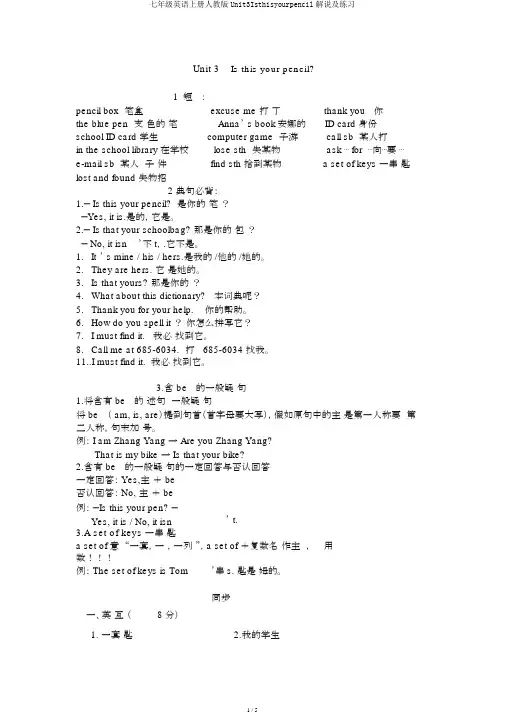
Unit 3Is this your pencil?1短:pencil box 笔盒excuse me 打了thank you 你the blue pen 支色的笔Anna’ s book安娜的ID card 身份school ID card 学生computer game 子游call sb 某人打in the school library 在学校lose sth 失某物ask ⋯ for ⋯向⋯要⋯e-mail sb 某人子件find sth 拾到某物 a set of keys 一串匙lost and found 失物招2典句必背:1.— Is this your pencil? 是你的笔?—Yes, it is.是的,它是。
2.— Is that your schoolbag? 那是你的包?— No, it isn ’不t,.它不是。
1.It ’ s mine / his / hers.是我的 /他的 /她的。
2.They are hers. 它是她的。
3.Is that yours? 那是你的?4.What about this dictionary? 本词典呢?5.Thank you for your help. 你的帮助。
6.How do you spell it ?你怎么拼写它?7.I must find it. 我必找到它。
8.Call me at 685-6034. 打 685-6034 找我。
11..I must find it.我必找到它。
3.含 be 的一般疑句1.将含有 be 的述句一般疑句将 be ( am, is, are)提到句首(首字母要大写),假如原句中的主是第一人称要第二人称,句末加号。
例: I am Zhang Yang → Are you Zhang Yang?That is my bike → Is that your bike?2.含有 be 的一般疑句的一定回答与否认回答一定回答: Yes,主+ be否认回答: No, 主+ be例:—Is this your pen? —Yes, it is / No, it isn’ t.3.A set of keys一串匙a set of 意“一套,一,一列”,a set of +复数名作主,用数!!!例: The set of keys is Tom’串s.匙是姆的。
人教版七年级英语上册课件:Unit 3 Is this your pencil (26张)
Ⅱ.词汇运用。(每空1分,共10分) (A)根据句意及汉语提示填空。 11.It is her _p_e_n_c_i_l (铅笔). 12.That isn’t my _n_o_te_b_o_o_k_ (笔记本). 13.Please __c_a_ll__ (打电话) Jane at 966-5789. 14.That is an English-Chinese _d_ic_t_io_n_a_r_y_ (字典). 15.—Is this your baseball?
A.five B.four C.three D.two
Ⅵ.书面表达。(10分) 魏华和李磊是同级不同班的同学。今天早上魏华丢
了一块红色手表,被李磊捡到。魏华写了一张寻物启 事,李磊写了一张失物招领启事。请参考表格中关于 魏华和李磊的信息提示并发挥想象,写出他们的寻物 启事和失物招领启事。
信息提示:
W:Good morning! M:Good morning!I lost my baseball and watch. W:What color are they? M:The baseball is white.And the watch is black. W:OK.What’s your name? M:My name is Jeff Green. W:How do you spell it? M:J-E-F-F,Jeff,G-R-E-E-N,Green. W:What’s your telephone number? M:288-6342. W:OK.
—No,it __is_n_’_t _ (不是的).
(B)用括号内所给单词的适当形式填空。 16.I __lo_s_t_ (lose) my bag and found it. 17.Is that green bag _y_o_u_rs_ (your)? 18. __H_e_r_ (She) parents are in the classroom. 19.I have a set of _k_e_y_s_ (key). 20.That’s _J_im__’s_ (Jim) watch.
人教版七年级上Unit3 Is this your pencil知识点归纳
Unit3 Is this your pencil?知识点归纳1.Is this/that your pen ?这(那)是你的钢笔吗?释:这是一个一般疑问句,它是在陈述句“This /That is--- ”的基础上把句中“is”提到句首转换而来。
在英语中 be 动词的一般疑问句式为: be + 主语 + 其它?肯定回答: Yes,it is. 否定回答 No,it isn’t.注: Yes,it is. 不能缩写为 Yes, it ’s.但否定回答可缩写成No,it isn’t.2.That 意为“那,那个”,“ Is that---- ?”指问话人问较远的人或事物,“表示那是…吗”?;“ Is this ---- ?”指问话人问较近的人或事物,“表示这是…吗”?,回答时要用it 来代替“that和”“this”,以避免重复。
3.no 与 not①这两个词均指“不”,但用法不同。
no 常用作一般问句否定回答开头;也可单独使用成为一句话;此外具有形容词词性,修饰可数名词或不可数名词,相当于 not a/an 或 not any.例如:— Is this a book? —No,it isn’t.—这是一本书吗?—不,它不是。
又如: I have no(not an)old pen. 我没有旧钢笔。
②not 多用于否定动词,使整个句子或句子的一部分含有否定之意,not 不能单独使用,放在句子中的动词之后,并与前面的词缩略为 n’t。
例如: Sorry,I don ’t know. 对不起,我不知道。
—Is that your case?—No,it isn’t.—那是你的箱子吗?—不,它不是。
4.Excuse me ; SorryExcuse me 和 Sorry 都可以表达“对不起”。
不过,实际运用时还有一些区别。
Excuse me 意思是“对不起”“劳驾”“请原谅”,常用在你所说的话或要做的事可能引起对方不愉快时或需要打扰或求助别人时,或要引起别人注意时。
人教版七年级英语上册Unit 3Is this your pencil?(5课时教案)
初中英语教案Unit 3 Is this your pencil?The First PeriodSection A (1a-2d)Ⅰ.Teaching aims:1.Knowledge aims:(1)Key words:pencil,book,eraser,box,schoolbag,dictionary,his,mine,hers,excuse,me,thank,teacher,about,yours,for,help,welcome(2)Key phrases:excuse me,thank you for...,pencil box(3)Important sentences:①—Is that your schoolbag?—No,it isn’t.It’s his.②—Are these your book?—No,they aren’t.They’re hers.2.Ability aims:Learn to identify ownership of the things in the classroom.3.Emotion aims:Make students guess the owners of the things in the classroom.II.Important points:Train students’ listening skills.III.Difficult points:Grasp some new words about their school things.IV.Teaching processStep 1 Warming up1.Show some pictures or objects about school things like pen,ruler,cup,schoolbag,pencil... —What’s this in English?—It’s...2.Work on 1a.①Read the words in 1a.②Let students look at the picture in 1a.③Ask students to find out the things in the picture,then match the things with words.Teacher checks the answers with students.④Let the students read the new words aloud after the teacher.Then remember the new words. Step 2 ListeningWork on 1b,2a and 2b.1.Listen and number the conversations [1-3].2.Listen and check(✔) the things you hear.3.Listen plete the conversation with the words in the box.4.Check the answers in 1b,2a and 2b.Step 3 PairworkWork on 1c and 2c.1.Practice the conversations above with your partner. Then greet your classmates.2.Practice the conversation in 2b.Then make your own conversations using the things in your classroom.e.g.—Is this your schoolbag?—No,it isn’t.Step 4 Role-playWork on 2d.Let students read the conversation.Then let students role-play the conversation and give them 5 minutes to recite it.Language points1.pencil box文具盒pencil box=pencil case注意:box的复数形式是boxes。
人教版七年级英语上册教案(RJ) Unit 3 Is this your pencil
Unit 3Is this your pencil?第一课时Section A(1a-1c)1.重点单词:pencil,book,eraser,box,schoolbag,dictionary,his,mine,hers 2.重点短语:your pencil,your schoolbag,your books,pencil box3.重点句式:—Is that your schoolbag?—No,it isn't.It's his.—Are these your books?—No,they aren't.They're hers.1.含有be动词的一般疑问句2.名词性物主代词的用法1.含有be动词的一般疑问句2.名词性物主代词的用法一、预习课本P13新单词并背诵,完成下面的汉译英。
1.铅笔____________ 2.书____________3.橡皮____________ 4.盒子____________5.书包____________ 6.字典____________7.他的____________ 8.我的____________9.她的____________二、认真预习1a,1b,1c,找出下列短语和句型。
1.你的铅笔________________2.你的书包________________3.你的尺子________________4.你的书________________5.铅笔盒________________6.—那是你的书包吗?—不,不是。
它是他的。
________________________________________________________________________ 7.—这些是你的书吗?—不,不是。
它们是她的。
________________________________________________________________________Step 1情景导入Teacher:We have some school things at school.The things are very important to our study.Do you know how to say them in English?If you can't,please don't worry about it,you can know them after this class.Then show some pictures of the school things to let the students learn.环节说明:通过与学生日常学习生活紧密相关的话题——学习用品,导入新课,能引起学生的学习兴趣。