
高中英语16种时态专题讲解
时间轴
现在完成,会延续至将来
过去
现在
将来
常连用的时间状语: for +时间段(five years), all+时间段(afternoon)
例句:They haven't been meeting each other for five years.
过去完成进行时:表示一个动作从过去某时开始,一直延续到另一个过去时刻,到那个时刻,该动作可能
过去进行时:过去某个时间正在发生的动作。
时间轴
过去正在发生
过去
现在
将来
常连用的时间状语: at that time, at 10 o’clock last night,at that moment
例句:I was doing my homework at that time.
将来进行时:将来某个时间正在发生的动作。
将来
例句:He told them he would have finished it by 8 o'clock
过去将来完成进行时:表示动作从过去某一时间开始一直延续到过去将来某一时间(一般出现 在间接引语中和虚拟语气)
过去将来完成,并延续
时间轴
过去的将来
过去
现在
将来
例句:I knew by that time he would have been working there for 30 years
刚刚终止,也有可能还在继续。
时间轴
现在完成,会延续
过去
现在
将来
常连用的时间状语: By the end of+过去时间段(last month, last year),
例句:By the end of last month they had been working here for about ten days.
时间轴
过去
现在
将来正在发生
将来
常连用的时间状语: This time tomorrow, at 9 o’clock tomorrow, in a minute 例句:This time tomorrow they will be sitting in the cinema..
现在完成时:用来表示之前已发生或完成的动作或状态,其结果的确和现在有联 系。
时间轴说明英语时态(16 种时态)
一般现在时:表示没有时限的持久存在的习惯性的动作或状态,或现阶段反复发生 的动作或状态
习惯性,反复发生
时间轴
过去
现在
将来
常连用的时间状语: every…,sometimes,always,never,often, usually
例句:I often go to work by foot.
过去
现在
将来
常连用的时间状语: tomorrow, next year, the month after next, in two hours
例句:I will fly to HK tomorrow.
现在进行时:表示现在( 指说话人说话时) 正在发生的事情。
时间轴
现在正在发生
过去
now,at the moment,look!... 例句:He is doing the housework at home now.
过去的将来
现在
将来
例句:She said she would be setting off on the 10 o’clock train
过去将来完成时:表示在过去将来某一时间以前发生的动作,并往往会对过去 将来某一时间产生影响。(一般出现在间接引语中和虚拟语气)
时间轴
过去将来完成
过去
过去的将来
现在
一般过去时:在过去时间里所发生的动作或存在的状态。
时间轴
过去发生
过去
现在
将来
常连用的时间状语: yesterday,last week,an hour ago,the day before 例句:We studied English there in 1998
一般将来时:即将发生动作或状态。
时间轴
将要发生
现在完成
时间轴
过去
现在
将来
常连用的时间状语: already;yet;ever;never;for two weeks;since 例句:Has he worked here since he came here?
过去完成时:动作发生在过去的过去。
时间轴
过去完成
过去
现在
将来
常连用的时间状语: by the end of last year, by last year, before 从句(过去时) 例句:how many English words had he learnt by the end of last year
将来完成时:将来某个时间将会完成的动作,并对将来产生影响。
时间轴
过去完成
过去
现在
将来
常连用的时间状语:by the end of +将来时间
例句:Will scientists probably have discovered a cure for cancer by the year 2050?
现在完成进行时:表示某一动作开始于过去某一时间,延续或重复地出现至今,或 将继续延续至将来。
过去将来时:在过去将会发生的动作。(一般出现在间接引语中)
时间轴
过去将要发生
过去
过去的将来
现在
将来
例句:I said I would buy you a car one day.
过去将来进行时:过去某一时间而言,将来某一时刻或某一段时间正在进行的 动作。(一般出现在间接引语中)
时间轴
过去将来正进行
过去
高中英语16种时态详细讲解
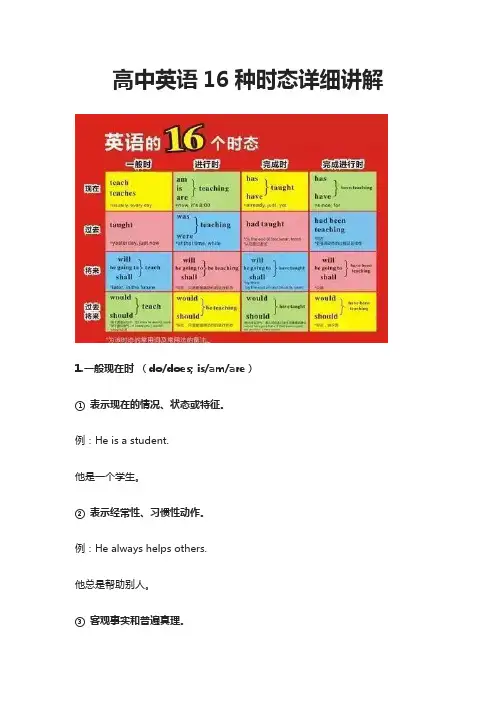
高中英语16种时态详细讲解1.一般现在时(do/does; is/am/are)①表示现在的情况、状态或特征。
例:He is a student.他是一个学生。
②表示经常性、习惯性动作。
例:He always helps others.他总是帮助别人。
③客观事实和普遍真理。
例:The earth moves the sun.地球绕着太阳转。
④表示一个按规定、计划或安排要发生的动作。
仅限于某些表示“来、去、动、停、开始、结束、继续”等的动词,可以与表示未来时间的状语搭配使用。
常见的用法是:飞机、火车、轮船、汽车等定期定点运行的交通方式。
例:The next train leaves at 3 o'clock this afternoon.下一趟火车今天下午3点开车。
⑤在时间、条件和让步状语从句中经常用一般现在(有时也用现在完成时)表示将的来事情。
(即:主将从现原则)例:I will call you as soon as I arrive at the airport.我一到机场就会给你打电话。
When you have finished the report, I will have waited for about 3 hours. 等你完成这份报告的时候,我就已经等了将近3个小时了。
2. 现在进行时(am/is/are doing)①表示此时此刻正在发生的事情。
例:He is listning to the music now.他现在正在听音乐。
②表示目前一段时间内一直在做的事情,但不一定此时此刻正在做。
例:I am studying computer this term.这个学期我一直在学习计算机。
③现在进行时可以表示将来的含义。
a. 瞬时动词的进行一定表将来。
例:I am leaving.我要离开了。
b. 持续动词的进行只有有将来的时间状语或有将来语境中才表将来。
例:I am travelling next month.下个月我要去旅行。
高中英语16种时态用法详解

高中英语16种时态用法详解:一般现在时导语:中学英语涉及到的时态一共有16种,下面给大家准备了一般现在时的用法说明,希望对大家复习备考有帮助。
一、一般现在时表现在1. 表示现在经常性或习惯性的动作。
如:My sister wears glasses. 我妹妹戴眼镜。
He often goes to the cinema. 他经常去看电影。
【注】询问某人的习惯时,有时还可用ever。
如:“Do you ever eat meat?” “No, I never eat meat.”“你吃肉吗?”“从不吃肉。
”2. 表示现在(或经常性)的情况或状态。
如:Mother is ill. 母亲病了。
He is always like that. 他总是那样。
He likes living in the country. 他喜欢住在乡下。
We need a lot of money. 我们需要一大笔钱。
3. 表示现在的能力、特征、职业等。
如:He sings well. 他唱歌唱得好。
Mr. Smith teaches French. 史密斯先生教法语。
4. 表示客观真理、科学事实、格言以及不受时间限制的客观存在。
如:Summer follows spring. 春去夏来。
Knowledge is power. 知识就是力量。
The earth turns around the sun. 地球绕着太阳转。
二、一般现在时表将来1. 当主句为将来时态或表示将来意义时,时间和条件的状语从句必须用一般现在时表将来。
如:I’ll write to her when I have time. 我有空会给她写信。
Turn off the lights before you leave. 走前关灯。
If we hurry, we may catch the bus. 如果赶紧走我们可能赶得上公共汽车。
Tell me in case you get into difficulty. 遇到困难请告诉我。
高中英语16个时态全解析
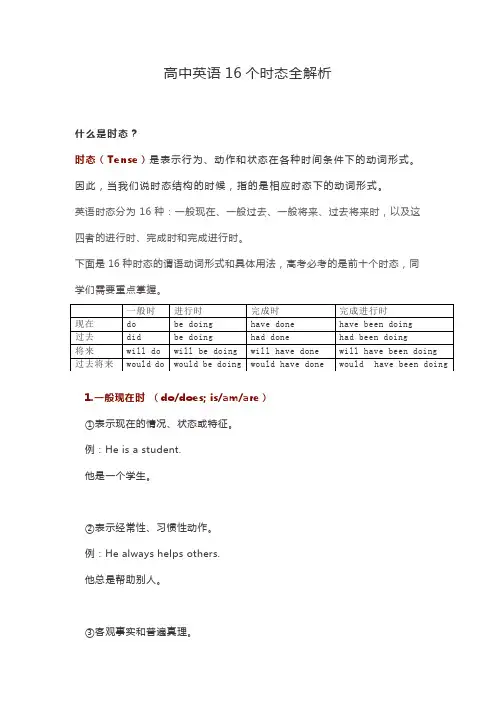
1.一般现在时(do/does; is/am/are)①表示现在的情况、状态或特征。
例:He is a student.他是一个学生。
②表示经常性、习惯性动作。
例:He always helps others.他总是帮助别人。
③客观事实和普遍真理。
例:The earth moves the sun.地球绕着太阳转。
④表示一个按规定、计划或安排要发生的动作。
仅限于某些表示“来、去、动、停、开始、结束、继续”等的动词,可以与表示未来时间的状语搭配使用。
常见的用法是:飞机、火车、轮船、汽车等定期定点运行的交通方式。
例:The next train leaves at 3 o'clock this afternoon.下一趟火车今天下午3点开车。
⑤在时间、条件和让步状语从句中经常用一般现在(有时也用现在完成时)表示将的来事情。
(即:主将从现原则)例:I will call you as soon as I arrive at the airport.我一到机场就会给你打电话。
When you have finished the report, I will have waited for about 3 hours.等你完成这份报告的时候,我就已经等了将近3个小时了。
2. 现在进行时(am/is/are doing)①表示此时此刻正在发生的事情。
例:He is listning to the music now.他现在正在听音乐。
②表示目前一段时间内一直在做的事情,但不一定此时此刻正在做。
例:I am studying computer this term.这个学期我一直在学习计算机。
③现在进行时可以表示将来的含义。
瞬时动词的进行一定表将来。
例: I am leaving.我要离开了。
持续动词的进行只有有将来的时间状语或有将来语境中才表将来。
例: I am travelling next month.下个月我要去旅行。
高中英语时态全版.ppt
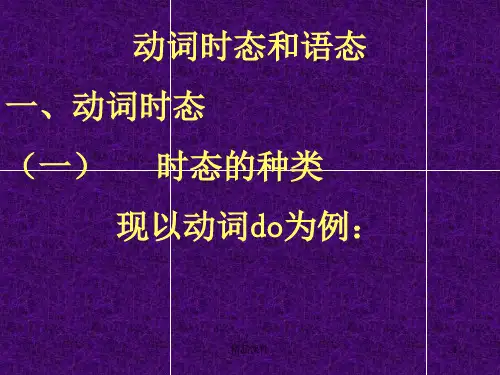
Tom is seeing his friend off at the airport.
.精品课件.
16
过去进行时 表示过去某一时刻或某一段时间内正在进行 的动作。这一特定的过时间可用时间状语表 示
He was watching TV when I came in.
---What were you doing this time yesterday? ---I was writing a letter.
I will study hard to keep up with my classmates.
He won’t do it.
You shall have the book.
.精品课件.
8
2.be going to + 动词原形:含有打算、计划、 准备将做某事的意思,或表示很有可能要发 生的事。
3.若表示已安排或计划好的将来动作或存 在状态,可用一般现在时代替一般将来 时,其谓语动词常为be, come, go, arrive, leave, start等
Where shall we meet tomorrow?
.精品课件.
7
注:shall和will除了上述表示单纯的将来外, 还有其他用法。在第一人称后,will常表示 “决心”、“意愿”或“打算”,在否定
句中用于所有人称,有“不愿”的意思。 shall用于第二人称时,可表示说明者的将 来意愿或允诺。
the window.)
.精品课件.
4
7. 由here, there开头的句子,动词 用一般现在时表示正在发生的动 作。如:
There goes the bell.
Here comes the teacher.
高中英语高考复习时态详细讲解(共16类)
高考英语时态详解一、现在一般时1.表示普遍的事实或真理名言The sun rises in the east and sets in the west.太阳东升西落。
Time flies.时光飞逝。
Failure is the mother of success.失败是成功之母。
2.表示经常性的重复活动,包括动作和状态(常态)I often get up at 6 o’clock in the morning.我经常早晨六点起床。
I am an English teacher.我是一名英语老师。
二、现在进行时1.表示现在正在做的动作He is playing the piano now.他现在在弹钢琴。
2.表示即将发生的动作(come, go, arrive, leave, start, begin, return, die, take...) They are coming to dinner.他们要来吃晚餐。
I am leaving.我要走了。
3.表示现阶段正在进行的动作或者发生的事We are learning English this summer holiday.我这个暑假在学英语。
三、现在完成时表示到目前为止已经完成的动作,如果是延续性动词,表示持续到现在的动作或者状态I have received your letter.我已经收到了你的信。
He has been here for 10 years.他在这住了十年了。
四、现在完成进行时表示一直持续到现在,且可能继续持续下去I have been learning English in school for 7 years.我在学校学英语7年了。
It has been raining for 2 hours.雨下了两个小时了。
五、过去一般时过去的动作,习惯,事实I began to learn English five years ago.我五年前开始学英语。
完整版)高中16种英语时态总结归纳
完整版)高中16种英语时态总结归纳时态(Tense)是用来表示行为、动作和状态在不同时间条件下的动词形式。
因此,时态结构指的是相应时态下的动词形式。
一般现在时表示现在发生的动作、情况、状态和特征,惯用语,经常性、惯性动作,客观事实和普遍真理。
特别要注意,如果前后文不是一般现在时,则无法保持主句、从句时态一致。
此外,它还可以表示一个按规定、计划或安排要发生的动作,通常与表示未来时间的状语搭配使用,如飞机、火车、轮船、汽车等定期定点运行的交通方式。
在时间和条件状语从句里,一般现在时经常用于表示将来事情。
现在进行时用来表示现在正在进行的动作。
现在完成时有两种用法。
一种是表示动作到现在为止已经完成或刚刚完成,如“I bought a new house。
but I haven't soldmy old one yet。
so at the moment I have two houses.”另一种是表示从过去某时刻开始,持续到现在的动作或情况,并且有可能会继续延续下去。
这时通常使用延续性动词,时间状语常用since加一个过去的时间点,或for加一段时间,或by加一个现在时间。
4.现在完成进行时 (have been doing)现在完成进行时用来描述一个从过去某一时间开始一直持续到现在的动作或状态,或将继续持续到未来。
例如:我们已经处理这个项目一个多月了,一直在进行中。
5.一般过去时一般过去时用来描述过去某个时间发生的动作或情况,或者过去的惯性动作。
例如:这位老人过去常常坐在公园的长椅上看着别人,一坐就是数个小时。
他以前总是每周看望他的母亲。
在句型中使用 "no sooner than"、"___"、"before"、"r to" 等连接词时,主句要求完成时。
例如:今天之前我从未见过那位教授。
在填空题中,句子中的动作已经持续了一段时间,并且需要进行修理。
16种时态及语态总结
16种时态及语态总结在英语学习中,时态和语态是非常重要的语法点。
掌握好这 16 种时态及语态,对于准确表达意思、理解英语句子的含义至关重要。
下面我们就来详细了解一下这 16 种时态及语态。
一、一般现在时(Simple Present Tense)一般现在时表示经常发生的动作、习惯性的动作或者客观事实、真理等。
其结构为:主语+动词原形(当主语为第三人称单数时,动词要加“s”或“es”)。
例如:“I play football every weekend”(我每个周末踢足球。
)“He likes music”(他喜欢音乐。
)一般现在时的被动语态(Simple Present Passive Voice)结构为:am/is/are +过去分词。
例如:“The room is cleaned every day”(这个房间每天都被打扫。
)二、一般过去时(Simple Past Tense)一般过去时表示过去某个时间发生的动作或存在的状态。
其结构为:主语+动词的过去式。
例如:“I went to Beijing last year”(我去年去了北京。
)一般过去时的被动语态(Simple Past Passive Voice)结构为:was/were +过去分词。
例如:“The book was written by him”(这本书是他写的。
)三、一般将来时(Simple Future Tense)一般将来时表示将来要发生的动作或存在的状态。
其结构有多种,常见的有:will +动词原形、be going to +动词原形。
例如:“I will visit my grandparents tomorrow”(我明天将去看望我的祖父母。
)“She is going to have a party next week”(她下周要举办一个派对。
)一般将来时的被动语态(Simple Future Passive Voice)结构为:will be +过去分词、be going to be +过去分词。
高中英语知识点总结十六种时态.doc
高中英语知识点总结十六种时态十六种时态:一般现在时,一般过去时,一般将来时,一般过去将来时;现在进行时,过去进行时,将来进行时,过去将来进行时;现在完成时,过去完成时,将来完成时,过去将来完成时;现在完成进行时,过去完成进行时,将来完成进行时,过去将来完成进行时 .一、一般现在时 :take形式为原形例子: It take sme five years to finish the painting。
这幅画花了我十年功夫1.概念:经常、反复发生的动作或行为及现在的某种状况。
2.时间状语:always,usually,often,sometimes,everyweek(day,year,month), once a week,on Sundays,3.基本结构:动词原形 ( 如主语为第三人称单数,动词上要改为第三人称单数形式 )二、一般过去时: take 形式为 took.1.概念:过去某个时间里发生的动作或状态 ; 过去习惯性、经常性的动作、行为。
2.时间状语: ago,yesterday,the day beforeyesterday,lastweek,last(year,night,month ),in1989,just now,at the age of 5,one day,long long ago,once up on a time,etc.3.基本结构: be 动词 ; 行为动词的过去式三、现在进行时 :take形式为am/is/are taking1.概念:表示现阶段或说话时正在进行的动作及行为。
2.时间状语: now,at this time,these days,etc.3.基本结构: am/is/are+doing四、过去进行时: take 形式为 was/were+taking1.概念:表示过去某段时间或某一时刻正在发生或进行的行为或动作。
2.时间状语: at this time yesterday,at that time 或以 when 引导的谓语动词是一般过去时的时间状语等。
高中16种英语时态总结归纳
高中16种英语时态总结归纳1. Simple Present Tense:- Used for regular actions or habits, and general truths.- Form: Base form of the verb (e.g. I go, he/she/it goes).2. Present Continuous Tense:- Used to describe actions happening at the moment of speaking, or for future arrangements.- Form: am/is/are + present participle (e.g. I am writing, he/she/it is reading).3. Present Perfect Tense:- Used for actions that happened at an unspecified timein the past, and have relevance to the present.- Form: has/have + past participle (e.g. I have seen,he/she/it has done).4. Present Perfect Continuous Tense:- Used for actions that started in the past and continue into the present, and emphasize duration.- Form: has/have been + present participle (e.g. I have been waiting, he/she/it has been working).5. Simple Past Tense:- Used for actions that started and finished at aspecific time in the past.- Form: Past form of the verb (e.g. I went, he/she/it played).6. Past Continuous Tense:- Used to emphasize the duration of an action in the past, or for two actions happening simultaneously in the past.- Form: was/were + present participle (e.g. I was sleeping, he/she/it was writing).7. Past Perfect Tense:- Used to describe an action that happened before another action in the past.- Form: had + past participle (e.g. I had seen, he/she/it had finished).8. Past Perfect Continuous Tense:- Used to show the duration of an action that happened before another action in the past.- Form: had been + present participle (e.g. I had been waiting, he/she/it had been studying).9. Simple Future Tense:- Used to talk about actions that will happen in the future.- Form: will/shall + base form of the verb (e.g. I will go, he/she/it will eat).10. Future Continuous Tense:- Used to describe actions that will be ongoing at a specific time in the future.- Form: will/shall be + present participle (e.g. I will be waiting, he/she/it will be working).11. Future Perfect Tense:- Used for actions that will be completed before another action in the future.- Form: will have + past participle (e.g. I will have finished, he/she/it will have left).12. Future Perfect Continuous Tense:- Used to emphasize the duration of an action that will be completed before another action in the future.- Form: will have been + present participle (e.g. I will have been waiting, he/she/it will have been studying).13. Present Unreal Conditional:- Used to talk about hypothetical situations in the present or future, expressing results that are unlikely or impossible.- Form: if + simple past, would + base form (e.g. If I were rich, I would travel the world).14. Past Unreal Conditional:- Used to talk about hypothetical situations in the past, expressing results that didn't happen.- Form: if + past perfect, would have + past participle(e.g. If I had studied harder, I would have passed the test).15. Mixed Tenses:- Used to describe actions that happen at the same time but in the past and present or future.- Form: Mix of different tenses.16. Future Time Clauses:- Used to indicate two actions happening in the future, with the main clause in the future and the time clause in the present.- Form: Present tense in the time clause, will/shall or other future tense in main clause (e.g. When I am 25, I will have graduated).。
(完整版)(完整版)高中英语时态讲解
表示以过去某一时间为参照,在过去看将要发生的动 作或存在的状态。常用于宾语从句和间接引语 。
The boy promised he would work hard. I told my parents I shold return early.
其他表示过去将来的句型
was (were) going to
I have had that book for six days √
I have borrowed(瞬时性动词) this book for seven
days(时间段)
×
borrow(v.)(瞬时性动词)→keep(v.)(延续性动词)
I have kept this book for seven days √
2)be about to do… 表示眼下马上就要发生的动作 He is about to leave for Beijing. 他马上要去北京。
3) be +to do… 表示计划中约定的必须将发生的行为; 按职责义务必须去做的事情/要发生的动作 You’re to deliver these flowers before 10. 你在10点钟之前把这些花送去。 4)be+doing 主要用于go, come, leave, start等表示去向的短暂性动 词。 I’m leaving tomorrow. 明天我要走了。
(时间段)
×
open(v.)(瞬时性动词)→open(adj.)(状态)
This shop has been open for five days. √
I have bought(瞬时性动词) that book for six days
(时间段)