
牛津深圳版英语七年级上册 Unit 2 Daily life自学案
Unit 2 Daily life单元知识点自学案
重点单词:
daily 每天的article 文章n ever从不break n. 休息v.打破打碎usually经常so因此bell 铃声ring 打电话,戒指seldom很少ride,骑,乘guitar,吉他band乐队,传送带together,一起grade年级Geography n. 地理;地形
market,市场practice, 不可数名词,练习v.练习
常考短语:
junior high school 初中senior high school 高中primary school 小学
on foot 步行take part in 参加go to bed睡觉get up起床
have a good/great/wonderful time =enjoy oneself =have fun 玩得开心,愉快。
经典句型:
1.H ow do /does... go to school?
2.How long is...
3.I alway have a good time...
4.Is...close to...?
5.Once a month ,I...
6.How often do you...?
7.They t hink ...as...
详细讲解:
1.Listen to a boy talking about his weekend.
Listen ①不及物动词Listen!The boy is singing.
②若要加宾语,要加“to”. 如:Pleasen listen to the teacher.
Listen for 留心听
2.辨析That’s right .All right与That’s all right
①That’s right 对的,正确的。
(对别人所说的话表示肯定)
②All right 好吧;身体康复了;令人满意的
③That’s all right 不用谢;没关系(客气话和道歉的回应)
3.Which of the se things do you do once or twice a week?(page16)
①助动词do/does/did后面要跟动词原形;
②once or twice a week每周一两次
注意:在英语中,表示一次用“once”,两次用“twice”,表示三次或者三次以上就用“基数词+times”(time在这里是可数名词,表示次数,需要加“s”)
如:once a week,twice a week, three(four/ five…)times a week
4. brush one’s teeth刷牙(page16)
Brush①在这里是动词,表示“刷”
②n.可数名词,“刷子”复数形式是“ brushes”。
如:I need some brushes for paiting. Tooth的复数形式是“ teeth”牙齿(因为每个人刷牙的时候不止刷一颗牙齿,所以要用复数)
1.how often do you watch television(page 23)
②watch television= watch TV 看电视
”
2.ride a bicycle 骑自行车(page 16)动词短语,交通工具前要加限定词(如a ,the)同义词:by bicycle/bike 介词短语,交通工具前不用加限定词
3.My school is close to my home, so I always go to school on foot.(page17)
①be close to 离……近= near =beside= not far away from(上节课学过)
③so在此处用作连词,表示结果“因此;所以”的意思。
不可以将because和so同在一个句子里。
(他们两个就像两只老虎,一山不能容二虎。
类似的还有although/ though 和but。
)
④go to school on foot= walk to school步行去学校go to…on foot = walk to …
4.Classes start at 8 am, and I am seldom late.(page17)
①Start 在这里是不及物动词,开始。
同义词:begin 反义词:end、finish
还可以做及物动词,后加n./pren./to do/doing
start at: 几点开始
②be late: 迟到be late for school ····迟到
如:He gets up late in the morning,so he is often late for shcool.
Later 副词。
后来,过后。
一段时间+later 如:He come back two days later。
午、下午或晚上;年月或季节
注意:arrive+地点名词=reach /get to (但是后面是home、here、there则不需要加介词)。
牛津深圳版Module1MylifeUnit2Dailylife阅读课件
bike to
4.我从不迟到,我在学校过得很愉快。
I am never late for school. I have a 5.每周三下午从4:30到5:30我通常去参加篮球比赛。
good
7.practise doing sth.
练习做某事
8.be close to = near = beside = not far away from
接近;靠近
9.be late for school
上学迟到
10.have a break
休息
11.end at
在……结束
12.from…to… 从……到……
( A )6.—
—
A.far away from; close to
B.close to; far away from
C.
( A )7.—
—
A.blog
B.radio
C.
( B )8.— —My father is _________.He always uses scientific knowledge to solve
9.We make great music together. 我们一起演奏动听的音乐。 (1)make 是初中英语中出现频率很高的一个动词,它的用法主要有; 1)make/have/let sb. do sth. 使某人做某事 2)make sb.+adj. 使某人…… 3)make friends 交朋友 make cakes 做蛋糕 make a noise 发出噪音 make yourself at home 像在家里一样自在 make sure 确保 (2)go to…together 一起去…… together with 与……一样(常用作插入语) have a good time = enjoy oneself= have(great)fun 玩得开心
牛津深圳版(广州沈阳)七年级英语上册Unit2dailylifeReading教学设计

一、教学目标
(一)知识与技能
1.掌握本章节阅读材料中的关键词汇和短语,如get up, go to school, do homework等,并能熟练运用到日常英语交流中。
2.能够理解并运用一般现在时描述日常生活中的动作和状态。
d.教师布置作业,提醒学生复习本节课的内容。
五、作业布置
为了巩固本节课的学习内容,确保学生对一般现在时描述日常生活的用法有更深入的理解,以及提高阅读策略的运用能力,特布置以下作业:
1.书面作业:
a.根据本节课所学的知识,编写一段关于自己或家人日常生活的对话,要求使用一般现在时。
b.完成课后练习册中与本节课相关的练习题,巩固词汇和语法知识。
b.撰写一篇关于文章的阅读心得,要求使用一般现在时描述文章中的日常生活场景。
4.拓展作业:
a.利用网络资源或课外书籍,了解其他国家的日常生活,对比自己国家的异同,提高跨文化意识。
b.与家长交流,用英语向他们介绍本节课所学的内容,展示自己的学习成果。
作业要求:
1.完成作业时,注意书写规范,保持卷面整洁。
二、学情分析
牛津深圳版(广州沈阳)七年级英语上册Unit2 Daily Life的学情分析如下:七年级学生正处于青春期,他们对新鲜事物充满好奇,具有较强的好奇心和求知欲。经过小学阶段的学习,他们已经具备一定的英语基础,能够进行简单的日常交流。然而,在阅读理解、词汇量和语言运用方面,学生之间存在较大差异。
在本章节的学习中,大部分学生对描述日常生活的话题较为熟悉,能够积极参与课堂讨论。但部分学生对一般现在时的掌握程度不够熟练,容易在表达时出现时态错误。此外,对于阅读策略的运用,学生普遍缺乏系统的训练,需要教师在教学中予以引导和培养。
牛津深圳版七上Unit 2Daily lif教材整合2
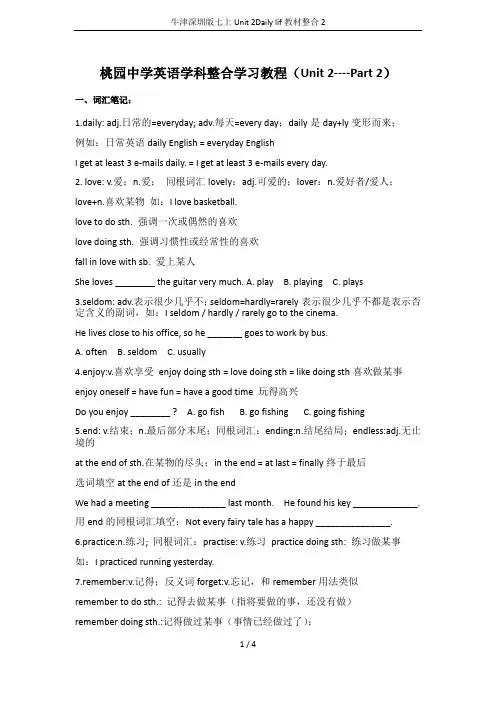
桃园中学英语学科整合学习教程(Unit 2----Part 2)一、词汇笔记:1.daily: adj.日常的=everyday; adv.每天=every day;daily是day+ly变形而来;例如:日常英语daily English = everyday EnglishI get at least 3 e-mails daily. = I get at least 3 e-mails every day.2. love: v.爱;n.爱;同根词汇lovely:adj.可爱的;lover:n.爱好者/爱人;love+n.喜欢某物如:I love basketball.love to do sth. 强调一次或偶然的喜欢love doing sth. 强调习惯性或经常性的喜欢fall in love with sb. 爱上某人She loves ________ the guitar very much. A. play B. playing C. plays3.seldom: adv.表示很少几乎不;seldom=hardly=rarely表示很少几乎不都是表示否定含义的副词,如:I seldom / hardly / rarely go to the cinema.He lives close to his office, so he _______ goes to work by bus.A. oftenB. seldomC. usually4.enjoy:v.喜欢享受enjoy doing sth = love doing sth = like doing sth喜欢做某事enjoy oneself = have fun = have a good time 玩得高兴Do you enjoy ________ ? A. go fish B. go fishing C. going fishing5.end: v.结束;n.最后部分末尾;同根词汇:ending:n.结尾结局;endless:adj.无止境的at the end of sth.在某物的尽头;in the end = at last = finally终于最后选词填空at the end of还是in the endWe had a meeting _______________ last month. He found his key _____________. 用end的同根词汇填空:Not every fairy tale has a happy _______________.6.practice:n.练习; 同根词汇:practise: v.练习practice doing sth: 练习做某事如:I practiced running yesterday.7.remember:v.记得;反义词forget:v.忘记,和remember用法类似remember to do sth.: 记得去做某事(指将要做的事,还没有做)remember doing sth.:记得做过某事(事情已经做过了);It’s raining heavily outside, please remember __________ the windows.A. closeB. to closeC. closing8.help:v.帮助; n.帮助;同根词汇:helpful: adj.有用的有益的;helpless: adj.无助的help sb. with sth.在某方面帮助某人I helped them with this job.help sb. to do sth. = help sb. do sth. 帮助某人做某事can’t help doing sth. 忍不住做某事help oneself to sth.随便用或吃某物;自便help sb. out帮助某人摆脱困境9.go to bed: = fall asleep:入睡表示瞬间动作;be asleep:睡着了表示延续动作选go to bed/ fall asleep还是be asleep填空IF you want to keep healthy, you should _____________ early and get up early. Look! The dog ________________.二、词汇变身:ually(形容词adj.): _______________2. daily(同义词): _______________3.ride(过去分词): _______________4. end(同义词): _______________5.practice(动词v.): _______________6. tooth(复数): _______________7.foot(复数): _______________ 8. class(反义词): _______________9.junior(反义词): _______________ 10.seldom(反义词): _______________三、词汇应用:1.break(v.); break(n.)①They always worked all day without a ____________ . How hard they were!②Do n’t ____________ my sunglasses.③He ____________ his leg when he rode a bike.2.ring(v.); ring(n.)①Students run out of the classroom as soon as the bell ____________.②I ____________you yesterday but you weren’t in.③There is a ____________ around his finger.3.practice(n.); practise(v.)①There is a football ____________ every weekend.②In this lesson, we will ____________ using some new words.4.end(v.); end(n.)①The lesson ____________ with an interesting story.②At the ____________ of the road, there is a red house.③They walked out of the forest in the ____________ .5.ride(v.); ride(n.)①George taught him how to ____________ a horse.②Would you like to go for a ____________ ?③The little boy ____________ on his father’s shoulders when I saw him.6.enjoy oneself; enjoy doing①----What should I do in my free time?----Get out and enjoy ____________ (your), make new friends.②I enjoy ____________ (go) to park and ____________ (fly) kites.7.play with sth./sb.①She likes to ____________ ____________ her little pets.②I don’t need you to ____________ ____________ ____________ (me)!----Yes. Please write it down on your notebook.8. different(adj.); difference(n.)①In the forest, we can find many ____________ kinds of plants.②There is no ____________ between the two pictures on the wall.四、用时间状语(at 8 a.m.; in the morning/afternoon/evening; from 11:50 a.m. to 12:30 a.m.; when the bell rings; after lunch; between 8 and 9 in the evening; later in the afternoon)和相关的动词(start/begin; end)来描述与日常生活:1.Tom每天在6:20a.m.起床。
最新牛津深圳版七年级英语上Unit2 daily life教案
授课教师 学 生 课 题 教学目标 要 求 教学重难点 分 析 日期 年级
Daily life 教案
时间 科目
Daily life
初一
牛津深圳版 Unit Two
英语
掌握本单元的单词、短语,一般现在时
一般现在时的变化
教
课 前 准 备 Байду номын сангаас周学 校 学习内 容 存在和 要解决 的问题
学
过
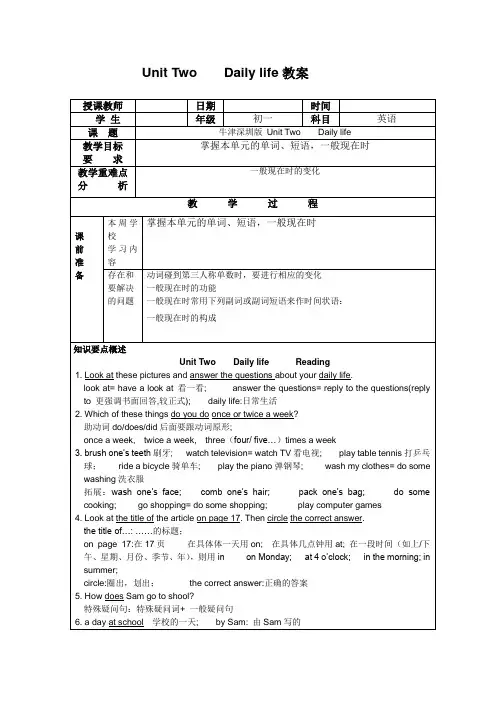
at school 在上学 at the school 在学校(可能是老师或家长) in hospital: 生病住院 in the hospital: 在医院(可能是护士或家属) in bed: 卧病 在床;躺在床上 in the bed: 在床上(被窝里) ; on the bed: 在床上(如枕头) 7. I am a junior high school student. I love going to school. junior high school 初中 senior high school 高中 primary school 小学 love doing sth.= live doing sth. = enjoy doing sth.喜欢做某事 practice doing sth.练习做某事 finish doing sth. 做完某事 go to school 去上学 8. My school is close to my home, so I always go to school on foot. be close to 离……近= near =beside= not far away from family 的意思是“家庭、家庭成员”,与居住的房子无关。 当 family 作为整体概念的“家庭” 讲时是单数; 当“家庭成员”讲时是复数; house 指“家”时含义较窄, 仅指“房屋”这一建筑物, 一般指独门独户的房子,不指楼房; home 指“家、住所”,指一个人(或一家人) 居住 的地方,也可指一个人出生或长大的地方(乡村、城市或国家等) 。 它具有 house 所 没有 的感情色彩 always:总是.频率副词 always/ usually/ often/ sometimes/ seldom/ hardly/ never 表示频率 由多到少, 是一般现在时的标志。 (位于 be 动词之后, 实义动词前)对频率提问用 how often go to school on foot= walk to school 步行去学校 go to…on foot = walk to … 9. Classes start at 8 am, and I am seldom late. start at: 几点开始 be late: 迟到 be late for school 上学迟到 10. I enjoy learning about different places in the world. enjoy doing sth= like/love doing sth. very much 喜欢做某事 learn about:获悉;了解 different places in the world: 世界各地 11. We have our morning break at 9:50. have one’s morning break: 上午休息时间 have a break 课间休息 have a rest 休息一会 12. When the bell rings, I run to the playground with my best friends Tom and Jack. when:当……的时候 此处连接两个先后发生的动作; 也可表示两个动作同时发生, 则: “过 去进行时+ when+ 一般过去时”;另外, when 也可对时间提问,“何时” run to…with sb. 和某人一起跑到…… my best friends: 我最好的朋友们 13. Break ends at 10:10. How Short it is! end at: ……时间结束 how+ adj. (+主+谓) = what+ (a/an) + adj.+ n. (+主+谓) how 主要修饰形容词和副词, what 修饰名词。 How short it is! = What short time it is! 14. Lun ch is from 11:50 to 12:30 p.m. from…to… 从……到…… from Monday to Friday 15. Then Tom, Jack and I take part in the school band practice. take part in:参加,指参加会议或群众性活动等,着重说明句子主语参加该项活动并在活动 中发挥作用; join 指加入某个党派,团体组织等,成为其成员之一,意为:“参军、入团、入党”等; 和某 人一道做某事,其结构为:join sb. in (doing) sth.,根据上下文,in (doing) sth. 也可以省 去(join in 多指参加小规模的活动如“球赛、游戏”等,常用于日常口语); attend 是正式用语,指参加会议、婚礼、典礼;听报告、讲座等。 He'll attend an important meeting tomorrow.他明天要参加一个重要会议
七年级英语上册(牛津深圳版)Unit 2《Daily Life》(ReadingA)公开课课件

Talk about the picture on page 15
1.Where are Hi and Lo standing? They are standing at the school gate. 2 .What does Hi ask to Lo? What do students say most often in school, LO?
Sam: Is your school close to your home, Mandy?
on foot Mandy: Yes, it is, so I go to school (1)_____.
Sam: Do you have a lunch (2)_________? break
Mandy: Yes. We have one at 11:30 a.m.
2. Why does Sam like Geography best?
1. seldom 2. break 3. rings 4. end
A. often B. not often A. a short time between classes B. a short holiday A. makes a sound B. is quiet
A. stop B. begin
WhileReading
D2 Read the article again and answer the Whilequestions below in complete sentences. Reading
1. Why does Sam go to school on foot?
Because his school is close to his home. __________________________________
七年级英语上册 Unit 2 Daily life教案3 (新版)牛津深圳版-牛津深圳版初中七年级上
课题
Unit2 Daily life
课型
Reading (Ⅱ)
备课时间
1 period
教
材
分
析
教学目标
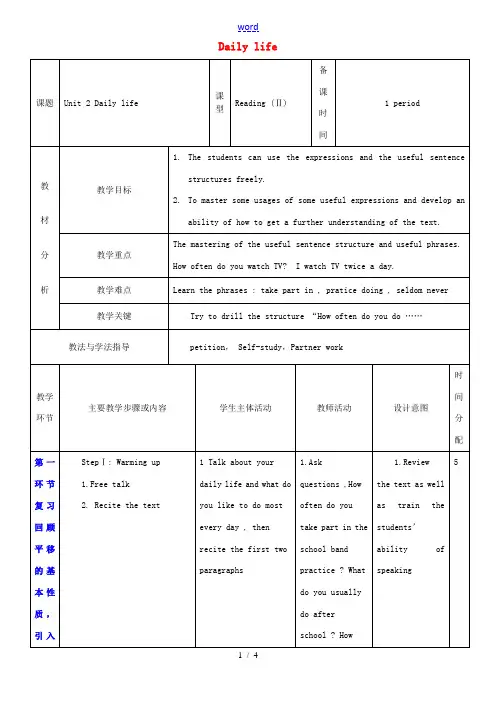
1.The students can use the expressions and the useful sentence structures freely.
2.To master some usages ofsomeuseful expressions and develop an ability of how to get a further understanding of the text.
1.Review the text as well as train thestudents’ability of speaking
5
第二环节 观察操作、探索归纳平移的作法
Step Ⅱ: Detailed reading.
Filling the blanks.
StepⅢ:Important phrases andSentence structures learning.
6. to cultivate the ability of taking notes.
第五环节 课后作业
Step V: Homework
1. remember the important points and prepare for the dictation
2. Make sentences with the important points and structures learned in this class
5.Give them an example to do the exercise.
牛津深圳初中英语七年级上册Unit 2《Daily life Writing》精品课件
Fang Fang usually __h_a_s_d_i_n_n_e_r__ at 6:30 p.m. She sometimes watches TV in the evening. She always g_o_e_s__to__b_e_d_a_t__9_p_._m_._.
最新初中英语精品课件设计
After school, she _p_l_a_y_s___ __b_a_sk__et_b_a_l_l _w_i_th__f_r_ie_n_d_s___ __tw__ic_e_a__w_e_e_k_. She __g_o_es__h_o_m_e__ at 4.45 p.m.
最新初中英语精品课件设计
One possible version: Zhang Qiang’s Daily Life Zhang Qiang is a junior high school student in Shenzhen. He gets up at 6 every day and reads English for 15 minutes. Then he has breakfast. He goes to school at 7 o’clock. He has 5 lessons in the morning. Then he goes home to have lunch.
最新初中英语精品课件设计
Fang Fang’s daily life
Read Fang Fang’s daily schedule below and complete the article about her daily life.
6.30 a.m.
get up
7 a.m.
Unit2+词汇+课件2023-2024学年牛津深圳版英语七年级上册
Sam goes back home. Sam goes to bed very early. Sam has a good time at school.
go to bed have a good time
Sam’s daily Life
The children play games together during the m__o_rn_i_n_g b_r_e_ak__ . 4. 他在课后参加各种各样的活动。
He __ta_k_es__p_ar_t _in___ all kinds of activities after school.
1. 昨天我过得很开心,因为我见到了很多老朋友。 I __h_a_d _a___g_o_o_d_ t_im__e_ yesterday because I met a lot of old friends. 2. 我妈妈从早到晚都在做家务。
My mother does the housework __fr_o_m morningto____ night. 3. 在早上休息期间,小朋友们一起玩游戏。
2. When I was doing my homework at home yesterday afternoon,
suddenly the door b_e_ll___ rang.
3. Starting to speak a foreign language takes lots of p_ra_c_t_ic_e__. 4. It u_su_a_l_l_y_____ snows hard in winter in Harbin because its
牛津深圳版(广州沈阳通用)七年级英语上册Unit2(课后作业)
三、阅读理解 Tony is very busy on Saturdays. Tony gets up at
seven o'clock. And after breakfast, he goes out to exercise. At about 9:30, he gets back home and his mother asks him to do some shopping. The supermarket is far from his home, so he has to take a bus. He buys much food there. In the afternoon, he first does his homework. He finishes it at three o'clock. At four o'clock, he goes to play football with his friends. They have a good time, and when he gets home, it is already six thirty.
brother goes to school _______ bike.
A. on; by
B. on; in
C. by; by
( C ) 14. Look at that boy. _______ he is!
A. What tall
B. What a tall
C. How tall
( A ) 15. —Is everyone here today?
七年级 全一册 配上海教育版
●上册● Module 1 My life
Unit 2 Daily life
深圳牛津版初中英语Unit 2 Daily Life Period 1
A What do you know about …?
Which of these things do you …
a do every day? b do once or twice a week? c never do?
brush my teeth
watch television
play table tennis
Paragraph 3
Paragraph 4 Paragraph 5
Now answer the questions below.
1 How does Sam go to school? He goes to school on foot.
2 What subjects does Sam usually study in the morning? He usually studies Chinese, Maths and English in the morning.
In the morning, we usually study Chinese, Maths and English. We have our morning break at 9:50 a.m. When the bell rings, I run to the playground with my best friends Tom and Jack. We often play games. Break ends at 10:10 a.m. How short it is! Lunch is from 11:50 a.m. to 12:30 p.m. Afternoon classes end at 3:30 p.m. Then Tom, Jack and I take part in the school band practice. We make great music together.