
外研版(三起)-英语-六年级下册--外研版三起Module 8 Unit 1教材同步讲解
例句:I like to play baseball.我喜欢玩棒球。
④smile/smal/v.(动词)微笑;挖.(名词)微笑
短语:wear a smile面带笑容big smile热情的微笑
例句:They all smiled at the good news.听到这个好消息,他们都喜笑颜开。
是连词,作“因为”讲,其后要接一个句子来陈述原因、理由。例如:
-Why do they want to go to China?他们为什么想去中国?
-Because they want to learn Chinese.因为他们想学习汉语。
【即学即用】
do you like eating fish? -Because it's delicious.
He smiled at her.他对她微笑。
⑤mistakes /mɪ'stek/n.(名词)错误
同义词:error错误,过失
短语:bad mistake严重的错误(过失)sad mistake惨痛的错误(过失)
例句:We all make mistakes,我们都会犯错误。
I made a mistake about the time.我把时间搞错了。
they put the cups on their heads and laughed more.
大明告诉了他这个故事。他们打算玩一个棒球游戏。埃米让玲玲为这个游戏拿来一些帽
子。但是玲玲拿来了一些杯子。他们都笑了。然后他们把这些杯子放在他们的头上并
大笑。
Sam smiled.④ "It's easy to make mistakes⑤with⑥ English words," he said. "I make lots of mistakes with Chinese words too. Now look what's in my bag! "Sam opened his bag.There were baseball caps " Hooray!"everyone shouted. They put the caps on Then they went to the playground and played baseball together.
山姆微笑着。“用英语单词很容易犯错误,”他说。“我使用汉语词语也犯很多错误。现在看什么在我的包里!”山姆打开了他的包。有棒球帽!“好哇!”每个人都大叫起来。他们戴上帽子。然后他们一起去操场打棒球。
新词速记
①cup/kʌp/n.(名词)杯子,一杯(的容量)
短语:a cup of tea -杯茶
例句:Would you like to have a cup of tea?你想喝杯茶吗?
A. baseball B.football C.volleyball
4.Everyone stopped to look andsmile at us.(选出画线部分的汉语意思)
A.看我们笑B.对我们微笑C.我们微笑着
5.We have made many
A. mistake B. mistakes C. mistaken
【即学即用】
1.I'd like two,please.
A. cups of tea B.cup of tea C.cups of teas
2. Heto leave Beijing on Monday.
A. plan B.planning C.planned
3. For American people,is their national game.
2.have的用法…………(133)
3.tell的用法……… …(133)
4.plan的用法…………(133)
5.ask.for和game的用法…………(134)
6.all的用法……………(135)
7.more的用法…………(135)
8.it和with的用法…………………(136)
9.make和lots of的用法……………(136)
Module 8
模块内容导读新课导学
英语发音很重要,这点我们要记牢。understand不容易,cap,cup易混淆。mistake -个接一个,惹人laugh哈哈笑,从此发音会记准,人人夸我口语好。同学们,我们一起走进快乐课堂来分辨相近的英语单词吧!
语法索引
Unit l(第一单元)
1.why的用法…………(130)
巧记:mis(前缀)+take(拿)→mistake(错误)
⑥with/wɪð/prep.(介词)与……有关
短语:agree with同意,赞同
例句:He always sleeps with the windows open.他总是开着窗户睡觉。
I have no money with me.我身上没有钱。
Tell me your phone number.告诉我你的电话号码。
Please tell me something about your school life.请给我讲讲你的校园生活吧。
【生活实例】冉冉到英语老师的办公室去上交作业本,恰巧老师要找她的同学孙浩,于是英语老师向冉冉要求道:Please tell Sun Hao to come at once.请叫孙浩马上来。
A. What B.Why C.When
答案速查B
2.Listen and read .听一听并读一读。(教材第44~45页)
课文英汉互译
Sam came into the classroom and saw some friends there. They hadcups① on their heads. "Why do you have cups on your heads?Why are you laughing?"he asked.
作“吃,喝”讲。例如:I have breakfast at home.我在家吃早饭。
1 would like to have a cup of tea.我想喝杯茶。
作‘‘组织,举办’’讲。例如:
Let's have a party.咱们举办一次聚会吧。
【即学即用】
Ia new bike.
A. have B.has C.having
同学们,下列词汇要求你们能听懂、会说、会读,你们能做到吗?
单词
raincoat(雨衣),wear(穿着,戴着),because(因为)
短语
look at the sky(看着天空),go to the theatre(去剧院),look down(俯视向下看),hide-and-seek(捉迷藏),wear a raincoat(穿着雨衣)
单词
cup(杯子),planned(plan的过去式)计划,mistake(错误),baseball(棒球),
smile(微笑),with(与……有关),like(像……一样)
短语
ask... to do...(让……做……),on your heads(在你们的头上),want to do sth(想要做某事),play baseball(打棒球),make mistakes(犯错误),the baseball caps(棒球帽)
巧记:cut(切,割)字母t替换成p→cup(杯子)
②planned/plænd/v.(动词)(plan的过去式)计划
短语:well planned计划周详的
例句:We planned to floor our room with oak.我们计划用橡木材料给房间铺地板。
③baseball/'beɪsbɔ:l/n.(名词)棒球
2.Because it's going to rain因为天将要下雨。
语法why引导的特殊疑问句及回答。
能力目标
1.能够正确使用why来询问事情的原因并回答。
2.能够分辨相近的英语单词。
文化目标
了解棒球文化。
教材知识解读全面提升
Unit l:Why do you have cups on your heads?
6. Leave the dog me.
A. at B. by C. with
答案速查1. A 2. C 3. A 4. B 5. B 6. C
重难点精析
一、have的用法
1.They had cups on their heads.他们的头上有杯子。
have作“有”讲,表示所属。例如:I have a pen.我有一支钢笔。
山姆走进教室看到了一些朋友在那儿。他们的头上有杯子。“为什么你们的头上有杯子?你们为什么笑?”他问道。
Daming told him the story. They planned② to play a baseball③ game Amy asked Lingling
to bring some caps for the game. But Lingling brought some cups. They all laughed. Then
我为什么看不见它?哦,它在我的床下。
重难点精析
why的用法
why can't I see it?我为什么看不见它?
【点拨】why引导特殊疑问句:why是疑问词,意思是“为什么”,用来询问原因、理由。一般由“Why+一般疑问句?”构成特殊疑问句。例如:
Why are you late?你为什么晚了?
why引导的特殊疑问句,一般用because引导的状语从句来回答。Because
Unit 2(第二单元)
M3 Unit 1 The sun is shining(课件)-六年级英语下册(外研版三起)
目录丨CONTENTS
01 Vocabulary 02 Text 03 Grammar 04 Practice
Part one
Vocabulary
Vocabulary
shine /ʃaɪn/ 发光,照耀
【拓展】sunshine 阳光 【例句】Why does the sun shine?
a picture book. We are very happy.
( )1.What’s the weather like today?
A.It’s Sunday.
B.It’s fine.
C.It’s raining.
It is on Sunday morning. The sun is shining. We have no classes. We are playing in the park. Some girls are singing and dancing under a big tree. Some boys are climbing the hill. Tom is drawing by the lake. Mike and John are swimming in the lake. Where are Betty and Mary? They are sitting under a small tree. They are reading a picture book. We are very happy. ( )2.Where are they playing? A.In the park. B.On the hill. C.In the lake.
Part Three
外研版-英语-三年级上册-外研版三年级 Module 8 Unit 1 教材全解
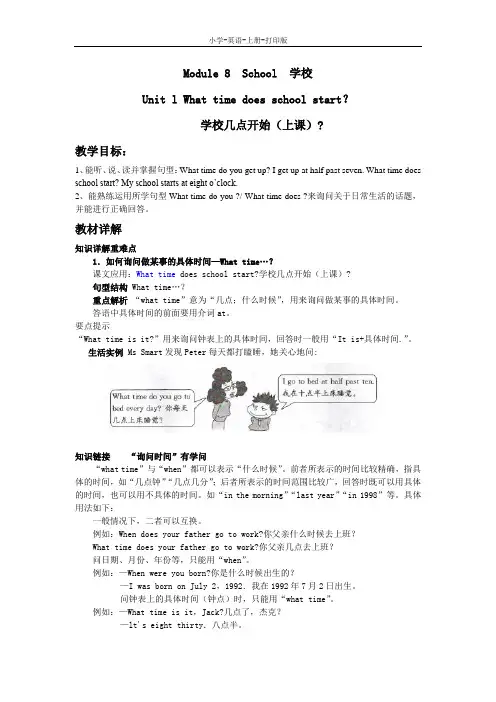
Module 8 School 学校Unit l What time does school start?学校几点开始(上课)?教学目标:1、能听、说、读并掌握句型:What time do you get up? I get up at half past seven. What time does school start? My school starts at eight o’clock.2、能熟练运用所学句型What time do you ?/ What time does ?来询问关于日常生活的话题,并能进行正确回答。
教材详解知识详解重难点1.如何询问做某事的具体时间—What time…?课文应用:What time does school start?学校几点开始(上课)?句型结构What time…?重点解析“what time”意为“几点;什么时候”,用来询问做某事的具体时间。
答语中具体时间的前面要用介词at。
要点提示“What time is it?”用来询问钟表上的具体时间,回答时一般用“It is+具体时间.”。
生活实例 Ms Smart发现Peter每天都打瞌睡,她关心地问:知识链接“询问时间”有学问“what time”与“when”都可以表示“什么时候”。
前者所表示的时间比较精确,指具体的时间,如“几点钟”“几点几分”;后者所表示的时间范围比较广,回答时既可以用具体的时间,也可以用不具体的时间。
如“in the morning”“last year”“in 1998”等。
具体用法如下:一般情况下,二者可以互换。
例如:When does your father go to work?你父亲什么时候去上班?What time does your father go to work?你父亲几点去上班?问日期、月份、年份等,只能用“when”。
例如:—When were you born?你是什么时候出生的?—I was born on July 2,1992.我在1992年7月2日出生。
外研版三起六年级英语下册Module8 单元测试(含答案及解析)
六年级下册Module8 单元测试外研版三起(含答案及解析)一、单选题(共10题)1.Will it ________ in New York?A.windB.windyC.be windy2.I think he's ________ some presents from his friends.A.getB.gotC.gets3.I will________ you to the zoo.A.takeB.tookC.taking4.We can ________ a picture on the paper.A.drawB.drewC.drawing5.—What about a storybook?—________.A.Thank youB.You're greatC.Good idea6.—________ do you make a kite?—Draw a dragon on a piece of paper; then cut the paper; at last tie strings to it.A.HowB.WhatC.Where7.It's going to________.A.rainingB.rainC.rained8.Why________ you looking at the sky?A.beB.isC.are9.—Why was he sad?A.Because he becomes blindB.Because he became blindC.Because he went to the park10.—________ will you do this evening?—I will watch TV.A.WhoB.WhatC.When二、填空题(共1题)11.给下列句子选择相符的图片A. B. C. D. E.⑴They watched TV last night.________⑵I put sticks on the kite.________⑶I did homework yesterday.________⑷Will you eat a hamburger?________⑸We will play table tennis tomorrow afternoon.________三、完形填空(共1题)12.完形填空。
2019-2020年六年级英语下册 Module 8 Unit 1(1)教学反思 外研版(一起)
2019-2020年六年级英语下册 Module 8 Unit 1(1)教学反思外研版(一起)宽松和谐的情感体验能使学生乐于表达、乐于交流,使其充分地参与其中,并进行自我表达与个性展示,使学习成为一种自觉的情境化的交谈。
今天我上了“Helen Keller”这一课,在教学过程中,我有以下几点体会:一、兴趣是学习最好的老师。
本课教学中,我注重激发学生的学习兴趣,通过设计符合学生生理和心理的活动来丰富课堂教学。
如Warm-up中的说唱英文歌曲,使学生很快融入英语气氛;师生间的Free talk很快拉近了心理距离,同时又较好地复习了旧知引入新知。
另外,在practise中我通过设计阶梯性的练习,使学生学之能用,学之即用。
既培养了学生的协作精神,又培养了学生的交际能力,真正体现了英语学习的交际性。
二、在教学中,成功实现了教师角色的转化,体现了以学生为中心的原则。
使教师从单纯的示范者转化为情景的设计者和学习的指导者,通过卡片、图片和和创设生动的教学情景,帮助学生理解语言的结构和意义。
同时给学生提供模仿、体验、实践和创造性运用语言的机会,并在活动中适时地表扬和鼓励学生,保护学生的自信心和学习的自觉性,使学生真正学有所获。
三、在教学中,特别注重评价的作用。
在教学中,我全力肯定学生的一切努力,保护、激励学生的一切创造欲和尝试。
我一贯以不同的标准评价不同层次的学生,对学生的课堂活动都给予发自内心的赞赏,肯定他们的点点滴滴的进步,真诚地称赞他们:“You are so clever. You did a great job. That is a good boy.”学生从我的举手投足中感受到了我对他们的赞赏和鼓励性评价,对他们能力的肯定和进一步的期望,体会到了自己的生命价值,逐渐消除了用英语交际的胆怯心理,树立了参与课堂活动的信心。
四、语法教学始终是横亘于学生和教师之间的一道屏障。
语法对于英语学习的重要性是有目共睹的。
M8U1课文知识复习+巩固练习-2023-2024学年六年级英语上册单元速记·巧练(外研版三起)
Module 8 Unit1 Do you often play with dolls?课文知识复习+巩固练习课文知识复习重点单词:1)long ago很久以前2)I’d love to我很乐意3)not really不全是,事实上没有4)stop (使)停止5)clean 打扫,(使)清洁6)camera 照相机7)show 把……给(某人)看重点词组:1)play with dolls 玩玩具娃娃2)look at 看3)long ago 很久以前4)want to 想要5)I’d love to 我很乐意6)not really 不全是,事实上没有7) a long time ago 很久以前8) a picture book 一本图画书9)in this photo 在这张照片里10)like reading books 喜欢读书11)of course 当然12)read stories 读故事13)clean your room 打扫你的房间14)take photos 拍照片15)has got 有16)a good camera 一个好照相机17)take photos of 给……拍照18)in China 在中国19)watch films 看电影20)speak English 说英语21)play computer games 玩电脑游戏22)help your mum 帮你妈妈23)eat fast food 吃快餐重点句型:1)Do you want to see my photos? 你想看我的照片吗?2)Yes, I’d love to. 是的,我很乐意。
3) You ’re playing with dolls. 你正在玩玩具娃娃。
4) Do you often play with dolls? 你经常玩玩具娃娃吗? 5) You are cleaning your room. 你正在打扫房间。
外研版(三起)-英语-六年级下册--外研版三起Module 7 Unit 1教材同步讲解
【新课堂】外研版三起Module 7 Unit 1教材同步讲解模块内容导读新课导学2003不一般,“神五”flew上了天,taikonaut杨利伟,21 hours太空游,儿子son记得牢,be proud of很自豪,国人、家人齐欢笑,科技强国最有效。
亲爱的同学们,让我们一起来看一下英雄杨利伟的太空之旅吧!语法索引Unit l(第一单元)1.一般过去时的用法 (113)2.ago的用法 (113)3.spend的用法 (115)4.also的用法 (116)5.辨析:too, also与either (116)6.proud的用法 (116)Unit 2(第二单元)7.could的用法 (119)8I be born的用法 (121)9.as的用法 (121)10.由助动词Did引导的一般疑问句的用法 (123)模块目标预览学前必备知识目标语音能够了解并掌握音标//,//,//,/d/;能够区分双元音//和/e/的发音。
词汇同学们,下列词汇要求你们能听懂、会说、会读、会写,你们能做到吗?单词model(模范,榜样),flew( fly的过去式)(飞,飞行),became(become的过去式)(变成),spent(spend的过去式)(度过),live(活着),proud(感到自豪的,感到骄傲的),about (大约),video(录像),born(出生,诞生),as(作为),herself(她自己)短语a long time ago(很久以前),in space(在太空中),be from(来自),make a video(制作一份录像),very famous(非常有名),be proud of(为……感到骄傲),come back(返回),go to the airport(去机场),a great day(美好的一天),fly into(飞入),all over(到处,遍及,处处) 同学们.下列词汇要求你们能听懂、会说、会读,你们能做到吗?单词Confucius(孔子,中国哲学家、教育家),blind(盲的),deaf(聋的),taikonaut(中国的太空人,宇航员),video(录像),travel(旅行),people(人们),famous(著名的)短语in October(在十月),a taikonaut(-名中国宇航员),space travel(太空旅行),on Saturday(在周六),blind and deaf(又盲又聋),learn to speak(学说话),lots of animals(许多动物)句型同学们,下列句型要求你们能听懂、会说、会读、会写,你们能做到吗?1.I flew to the earth in it a long time ago.很久以前我乘坐它飞向地球。
三年级下册英语教案Module 8Unit 1 It’s on your desk∣外研版(三起)
新标准英语(三年级起点)三年级下册《 M8 U1 It’s on your desk.》课堂教学设计◆课标解读(Curriculum interpretation)《英语课程标准》中提出:激发和培养学生学习英语的兴趣,使学生树立自信心,养成良好的学习习惯和形成有效的学习策略,发展自主学习的能力和合作精神;使学生掌握一定的英语基础知识和听、说、读、写技能,形成一定的综合语言运用能力是小学英语教学的任务。
课标中要求学生对英语学习有持续的兴趣和爱好。
能用简单的英语互致问候、交换有关个人、家庭和朋友的简单信息。
能根据所学内容表演小对话或歌谣。
能在图片的帮助下听懂、读懂并讲述简单的故事。
能根据图片或提示写简单的句子。
在学习中乐于参与、积极合作、主动请教。
◆教材分析(Text description)本节课是外研版小学英语三年级下册第八模块第一单元第一课时,本课主要内容是围绕“方位”这一话题展开,主要通过大明在屋中按照提示找礼物的过程中呈现学习了不同的方位词in,on, behind, under,要求学生能够正确区分和使用介词,并能在一定的情景中描述物品的位置。
掌握重点句型It’s in\on\ behind \under the..的句型,并能区分It’s…the…和It’s …your…句型的使用。
以及四会词语box, bedroom。
还要熟练掌握文中涉及到一些情景单词和词汇如toy, chair,present, your, desk, birthday等。
◆学情分析(Pupil description)三年级的学生通过半年多的英语学习,已有一定的英语基础。
在上学期已经学习了方位词in, on,以及询问方位的句型:Where’s the cat? Is it in the…? 对于方位单词和相关句型的学习已有了一定的基础。
并且三年级的学生思维比较活跃,活泼好动,喜欢探究发现学习,接受知识的能力也较强,敢说敢演,善于表现,而且也掌握了一定的英语学习方法及策略,这些都是我在教学中可以利用的资源。
外研版三起三年级英语下册Module8 Unit1 It`s on your desk试题(含答案及解析)
三年级下册Module8 Unit1 It`s on your desk 外研版三起(含答案及解析)一、单选题(共18题)1.选出与所给单词同类的一项:deskA.catB.pandaC.chair2.选出与所给单词同类的一项:weA.yourB.youC.my3.选出与所给单词同类的一项:underA.behindB.threeC.bedroom4.Happy ________ to you!A.catB.birthday5.—Where's the ball?—________A.It's on the chair.B.It's under the chair.6.The panda is on the cap.A.B.7.你的玩具找不到时,你会问:A.Where is my ball?B.Where is my toy?8.你的钢笔在书包里,你会说:A.My pen is in the schoolbag.B.My pen is on the schoolbag.9.—Where's the cat?—________A.It is behind the door.B.It is behind the bed.10.A ________ for you.A.kiteB.present11.It's in the box.A.B.12.选出与所给单词同类的一项:onA.anB.andC.in13.—Where's the dog?—________A.It's in the box.B.It's behind the box.14.The panda is under the cap.A.B.15.The panda is behind the cap.A.B.16.你的朋友过生日时,你会说:A.Happy birthday to you!B.You are my good friend.17.送礼物给朋友时,你会说:A.A present for you.B.Here you are.18.选出与所给单词同类的一项:boxA.bagB.hotC.under二、选词填空(词汇运用)(共1题)19.根据句意选择合适的单词填空A. inB. onC. behindD. underE. at(1)Put your pen ________ your schoolbag.(2)Put the picture (图画) ________ the wall (墙).(3)Put your toy box ________ the bed.(4)Put the rubbish bin (垃圾桶) ________ the door. (5)What do you have ________ school?三、(共1题)20.看图,选一选A. B. C. D.①shoes ________②sweater ________③trousers ________④hat________答案部分第 1 题:【答案】C【考点】名词【解析】【分析】desk是家具"桌子",cat"猫"和panda"熊猫"都是动物名称,只有chair也是家具"椅子"。
六年级下册英语试题-Module8模块知识梳理卷(含答案)-外研版(三起)
Module8模块知识梳理卷班级__________姓名__________得分__________ 时间:30分钟满分:100分基础知识梳理一、单词过关(英汉互译) (8分)1. 与……有关____________2. 说(say的过去式) ____________3. cup____________4. plan____________5. baseball____________6. more____________7. smile____________ 8. mistake____________9. raincoat____________二、核心短语(英汉互译) (14分)1. 计划做某事________________________________________________________2. 犯错误____________________________________________________________3. 打棒球比赛________________________________________________________4. 打棒球____________________________________________________________5. 棒球帽____________________________________________________________6. 在某方面犯错______________________________________________________7. 穿雨衣____________________________________________________________8. go to the theatre______________________________________________________9. put on______________________________________________________________10. come into sp. ______________________________________________________11. tell sb. the story_____________________________________________________12.hide-and-seek______________________________________________________ 13. have cups on their heads______________________________________________14. play basketball______________________________________________________三、重点句子(汉译英)(12分)1. 你们为什么在笑?__________________________________________________________________2. 你们为什么把杯子放在头上?__________________________________________________________________3. 他们计划打一场棒球赛。
三年级英语下册知识讲义-说一说(Module 8 Unit 1 It’s on your desk. Unit 2 Daming flies a kite in the park.)-外研版(三起)
学习目标能够询问某物在哪里的句型的应用及回答。
重点:句型:1. Where is my toy? 我的玩具在哪里?2. It’s in the box. 它在盒子里。
难点:where引导的特殊疑问句以及用介词来回答方位的句型。
【课文朗读】1. A: Where is my toy?B: It’s in the bag.A: Where is the bag?B: Oh! It’s under the cat.2. Daming: Oh, what’s this?Note: A present for you. It’s in the box.Note: It’s on your desk.It’s behind the door.It’s under your chair.It’s in your bedroom.Friends: Happy birthday to you!Daming: Wow! Ha ha…3. Monkey: One, two, three… ten!Monkey: It’s behind the door.Monkey: It’s under the chair.4. The dog is in the lake.The cat is under the tree.The monkey is behind the tree.5. In spring, Daming flies a kite in the park.In summer, he swims in the lake.In autumn, he goes fishing under the tree.In winter, he walks in the snow.6. A: Where’s the apple?B: It’s on the chair.A: Where’s the orange?B: It’s on the desk.7. A: Where’s the pen?B: It’s under the book.Class: Yes, it is.【句型赏析】1.Where is my toy? 我的玩具在哪里?Where is+某物(my book, my cap…)?此问句用于询问某物在哪里。