
译林版七年级上 Unit4 知识点梳理
Unit4知识梳理
【重点短语】
1. wake up 醒来
2.wake sb. up 叫醒某人
3. It’s time for sth. /It’s time (for sb.) to do sth.
是(某人)干某事的时候了
4. go walking in the hills 去山上散步
5. seldom go out 很少外出
6. need a good rest =need to have a good rest
需要好好休息
7. need to do sth. 需要做某事
8. write to her online friend 写信给她的网友
9. do morning exercises 做早操
10. do eye exercises做眼保健操
11. do some exercise 锻炼
12. have lessons 上课
13. start (begin) lessons 开始上课
14. do after-school activities 做课外活动
15. be never late for work / school 上班/ 上学从不迟到
16. one of ….. …….之一。
后接可数名词复数或复数代词
17. be all nice to sb. 都对某人很好
18. chat with sb. 和某人聊天
19. chat with each other 互相聊天
20. help each other 互相帮助
21. play in the playground 在操场上玩
22. be in the school volleyball team是校排球队成员
=be a member of the school volleyball team
23. practise after school 放学后训练
practise doing sth. 练习/训练做某事
24. on Wednesday afternoon 在周三下午
25. have a good time doing sth=have fun doing sth.
做某事过得愉快
26. in spring / s ummer / autumn / winter 在春(夏、秋、冬)季
27. at 6 years old =at 6 在六岁
=at the age of 6
28. all the best 一切顺利,万事如意
29. have much time to do sth.有很多时间做某事
30. have no time to do sth. 没有时间做某事
31. go to her dancing lessons 去上舞蹈课
32. dance for half an hour 跳舞半小时
33. go roller skating 去溜旱冰
34. go walking 去散步
35. between...and... 在...和...之间
36. visit the museum 参观博物馆
37. go on picnics with my family twice a month
一个月两次和我家人去野餐
38. at noon 在中午
39. at night 在夜里
40. at work 在工作
41. be good for sb.对...有益
42. be bad for sb. 有…..害
43. help sb. get ready for sth 帮助某人为...做好准备
44. get ready to do sth 准备好做某事
=be ready to do sth.
45. learn a lot about sth 关于某事了解很多
46. learn more about sth. 关于某事了解更多
47. too much homework (to do) 要做太多作业
48. too many lessons 太多课
49.much too cold (hot)太冷(热)
【重点句型】
1. Some dogs just don’t know how to have fun.
有些狗就是不知道怎样玩乐。
2. What time do you start lessons?
你们什么时候开始上课?
3. Our lessons begin at a quarter past eight.
我们的课于8:15开始。
4. We have a Reading Club.
我们有一个阅读俱乐部。
5. I also like playing volleyball.
我也喜欢打排球。
6. We always have a good time at school.
我们在学校总是过得很开心。
7. Millie seldom chats with her friends after class.
Millie很少与朋友在课后闲聊。
8. I would like to tell you about my life here.
我想告诉你我在这儿的生活。
9. We do not have lessons on Saturday or Sunday.
我们在周六和周日不上课。
10. How often do they exercise?
他们多久锻炼一次?
11. I hope everyone can come and watch the game.
我希望每个人能来看比赛。
12. Wish our team good luck!
祝我们队好运!
13. They help us get ready for the day.
他们帮助我们为一天做好准备。
【重点语法】
时间介词(at, in ,on) 的用法
1. at
(1)时间的一点、时刻等。
如:
They came home at seven o’clock.
(at night, at noon, at midnight, at ten o’clock, at daybreak, at dawn).(2)后面接表示岁数的词。
Children inChinastart school at 6 years old.
(3)较短暂的一段时间。
可指某个节日或被认为是一年中标志大事的日子。
如:
He went home at Christmas (at New Year, at the Spring Festival).
2. in
(1)在某个较长的时间(如世纪、朝代、年、月、季节以及泛指的上午、下午或傍晚等)内。
如:
in 2004, in March, in spring, in the morning, in the evening, etc
(2)在一段时间之后, 常用于将来时。
He will arrive in two hours.
These products will be produced in a month.
3. on
(1)具体的时日和一个特定的时间,如某日、某节日、星期几等。
如:
On Christmas Day(On May 4th), there will be a celebration.
(2)在某个特定的早晨、下午或晚上。
如:
He arrived at 10 o’clock on the n ight of the 5th.
The boy was born on a cold winter morning.
(3)准时,按时。
如:
If the train should be on time, I should reach home before dark.。
Unit4知识点 牛津译林版英语七年级上册

7AU4知识点New words and expressions:1.wake up.He wakes up at six o’clock.1.He wakes her up at seven o’clock.2/Shall we go fishing this afternoon?OK/Good idea! That’s all right. (No,let’s go shopping.3.He seldom goes out.He’s never late for school.4.She has breakfast/lunch/dinner.5.I need to go home early6.have a good rest7.have fun/have a good (great) time (in) doing sth.I have fun playing football8.have lessons/have an English lesson.9.after-school activities10.do one’s homeworkHe does his homework/We do our homework.He doesn’t do his homework./Does he do his homework?11.go to bed. He goes to bed at 9/He gets up at six .12.be late for He is late for school/the meeting.13.The meeting/Our school starts at 8 o’clock.14.a quarter past six/seven half past eight15.at six in th emorning/afternoon16.play football first.17.chat with him/her chat with each other18.learn from each other/ help each other19wish best wishes wish you successWish your team good luck.20.would like to go shopping.Would you like to go shopping this afternoo ?21.save my life---save their lives.22.go to the museum.23twice a week/once a year. How often does he go home?24.go on a picnic=go on picnics25.dislike playing games27.get ready for th eparty/th emeeting.28.learn a lot about the worldLanguage points: 1.It’s time for breakfast=It’s time to have breakfast2.Shall we go running/walking in the hill?3.I seldom go out /play games.4.After sleep I sleep.5.nad a good rest/He needs some milk.6.I don’t know how to have fun/what to do /how to do it/where to go7.What time do you strat lessons?8enjoy myself/enjoy working in Beijing/living in Shanghai.9.talk about playing games.10.from Monday to Friday—five days a week.11.Our lessons begin at 8:15.12.My favourite subject is English/sport is swimming.13.a lot of friends—lots of /many14.They are all nice(kind) to us---All of them are nice to us.15.a Reading Club16.read books/borrow books from the library.17.I also like playing volleyball.18.I’m in the school volleyball team=I’m a member of the school team.19.on Wednesday afternoon20.in the evening/in March/in winter/in 2202/in 2012.321.on Saturday/on 1 July/on Sunday morning/on Children’s Dayon a cold morningo/ on the afternoon of September 122.at seven o’clock/at 6 years old/at Christmas23.Thanks for your e-mail/giving me a pen/helping us with our English.24.tell you about my life/tell us about your school.25.I’m good at playing football=I play footballwell.26.He often plays football in the playground.27.She doesn’t have lunch time to play tennisShe has atime to sing.28.She’s a member of th eswimming team.She usually swims after school.29.He never plays basketball.30.He goes to her dancing lessons.31.She always dances for half an hour.32.She sometimes goes roller skating.33.Saturday ,7 November.34.Welcome to our schol/our school football match.35.There’s a volleyball match between A and B.36.He goes there by bus.37.I hope everyone can come and watch the game.38Wish our team good luck.39.What do you like to do at weekends?40.How often do you visit the Great Wall.Twice a month41.Morning exercises are good fo rus.42.Reading in th esun is bad for your eyes.43.have too much homework to do.44.so I can’t play basketball well.45.It helps me get ready for the day.48.I don’t like singing.49.It’s fun/interesting.。
牛津译林版七年级上册(2024)Unit 4 School day 语言点和语法点整理
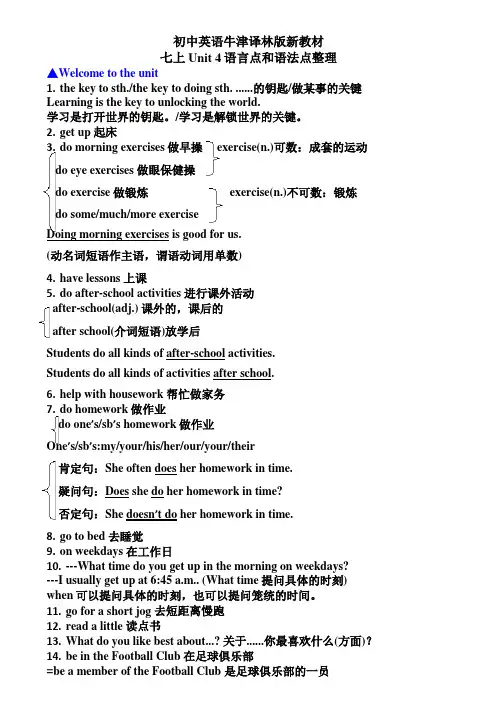
初中英语牛津译林版新教材七上Unit 4语言点和语法点整理▲Welcome to the unit1.the key to sth./the key to doing sth. ......的钥匙/做某事的关键Learning is the key to unlocking the world.学习是打开世界的钥匙。
/学习是解锁世界的关键。
2.get up 起床3.do morning exercises做早操 exercise(n.)可数:成套的运动 do eye exercises 做眼保健操do exercise 做锻炼 exercise(n.)不可数:锻炼do some/much/more exerciseDoing morning exercises is good for us.(动名词短语作主语,谓语动词用单数)4.have lessons 上课5.do after-school activities 进行课外活动after-school(adj.) 课外的,课后的after school(介词短语)放学后Students do all kinds of after-school activities.Students do all kinds of activities after school.6.help with housework 帮忙做家务7.do homework做作业do one’s/sb’s homework做作业One’s/sb’s:my/your/his/her/our/your/their肯定句:She often does her homework in time.疑问句:Does she do her homework in time?否定句:She doesn’t do her homework in time.8.go to bed 去睡觉9.on weekdays 在工作日10.---What time do you get up in the morning on weekdays?---I usually get up at 6:45 a.m.. (What time提问具体的时刻) when可以提问具体的时刻,也可以提问笼统的时间。
七年级上册英语Unit 4 My day Reading知识点梳理-译林版

Unit 4 My dayReadingually we do morning exercises first.通常我们先做早操。
【解析】first此处用作副词,意为“首先,最初”,用作状语。
例:You must finish your homework first.你必须先完成作业。
【拓展】first还可以构成短语at first,意为“首先,起初”。
表示顺序上的先后。
First of all,意为“首先,第一”。
常常放在句首,表示重要性上的先后。
例:At first, let me introduce my friend Mike to you. Then...首先,让我介绍我的朋友迈克给你。
其次...First of all,let me tell you the news.首先,让我告诉你这个消息。
2.They are all nice to me.他们都对我很好。
【解析】be nice to...意为“对(待)... ...好”,与be good to的意思相同。
to 是介词,后面一般接表示人的名词或代词的宾格。
例:The teachers are nice/good to us all.老师们对我们都很好。
【固定搭配】have a nice time玩得痛快;玩得高兴例:I hope you have a nice time in Spain next week.我希望你们下周在西班牙玩得开心。
3.After class, we often chat with each other or play in the playground.下课后,我们经常相互聊天或在操场上玩。
【解析】chat with...意为“和......聊天”,与talk with...(与......谈话)的意思相近。
例:Do you often chat with your friends?你经常和你的朋友们聊天吗?【解析】each other相当于代词,表示相互关系,意为“互相,彼此”。
Unit4单元测试必备知识点牛津译林版英语七年级上册
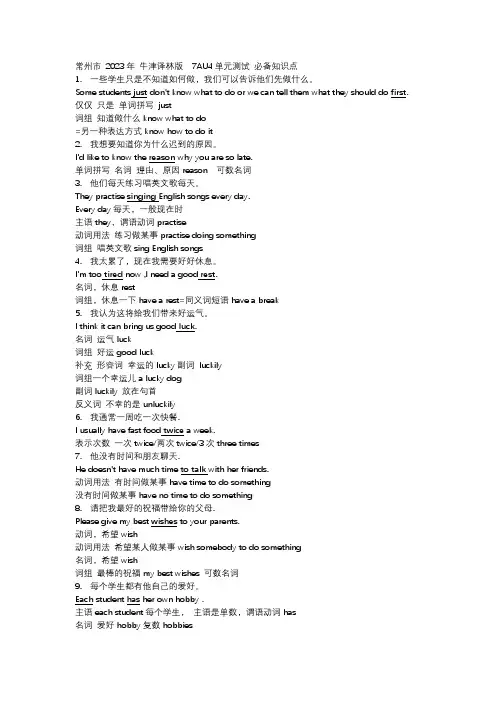
常州市2023年牛津译林版7AU4单元测试必备知识点1.一些学生只是不知道如何做,我们可以告诉他们先做什么。
Some students just don't know what to do or we can tell them what they should do first. 仅仅只是单词拼写just词组知道做什么know what to do=另一种表达方式know how to do it2.我想要知道你为什么迟到的原因。
I'd like to know the reason why you are so late.单词拼写名词理由、原因reason 可数名词3.他们每天练习唱英文歌每天。
They practise singing English songs every day.Every day每天,一般现在时主语they,谓语动词practise动词用法练习做某事practise doing something词组唱英文歌sing English songs4.我太累了,现在我需要好好休息。
I'm too tired now ,I need a good rest.名词,休息rest词组,休息一下have a rest=同义词短语have a break5.我认为这将给我们带来好运气。
I think it can bring us good luck.名词运气luck词组好运good luck补充形容词幸运的lucky副词luckily词组一个幸运儿a lucky dog副词luckily 放在句首反义词不幸的是unluckily6.我通常一周吃一次快餐.I usually have fast food twice a week.表示次数一次twice/两次twice/3次three times7.他没有时间和朋友聊天.He doesn't have much time to talk with her friends.动词用法有时间做某事have time to do something没有时间做某事have no time to do something8.请把我最好的祝福带给你的父母.Please give my best wishes to your parents.动词,希望wish动词用法希望某人做某事wish somebody to do something名词,希望wish词组最棒的祝福my best wishes 可数名词9.每个学生都有他自己的爱好。
牛津译林英语七年级上期中知识点考点复习 Unit4 知识点
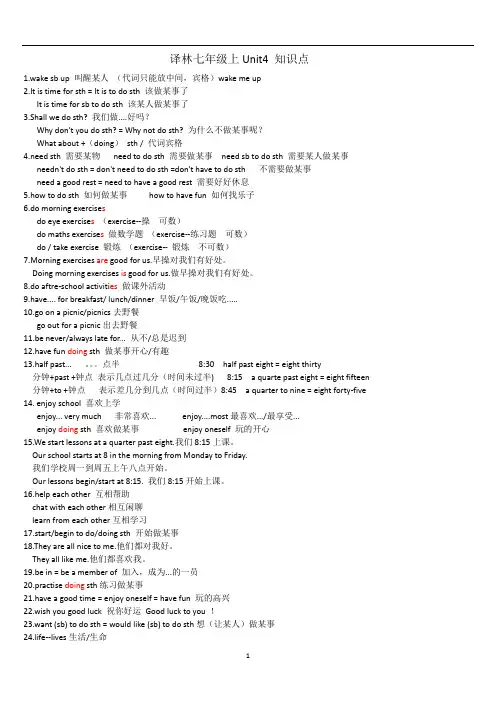
译林七年级上Unit4 知识点1.wake sb up 叫醒某人(代词只能放中间,宾格)wake me up2.It is time for sth = It is to do sth 该做某事了It is time for sb to do sth 该某人做某事了3.Shall we do sth? 我们做....好吗?Why don't you do sth? = Why not do sth? 为什么不做某事呢?What about +(doing)sth / 代词宾格4.need sth 需要某物need to do sth 需要做某事need sb to do sth 需要某人做某事needn't do sth = don't need to do sth =don't have to do sth 不需要做某事need a good rest = need to have a good rest 需要好好休息5.how to do sth 如何做某事how to have fun 如何找乐子6.do morning exercise sdo eye exercise s(exercise--操可数)do maths exercise s做数学题(exercise--练习题可数)do / take exercise 锻炼(exercise--锻炼不可数)7.Morning exercises are good for us.早操对我们有好处。
Doing morning exercises is good for us.做早操对我们有好处。
8.do aftre-school activiti es做课外活动9.have.... for breakfast/ lunch/dinner 早饭/午饭/晚饭吃.....10.go on a picnic/picnics去野餐go out for a picnic出去野餐11.be never/always late for... 从不/总是迟到12.have fun doing sth 做某事开心/有趣13.half past... 。
Unit4MyDay(知识梳理)-七年级英语上册精品课堂(牛津译林版)
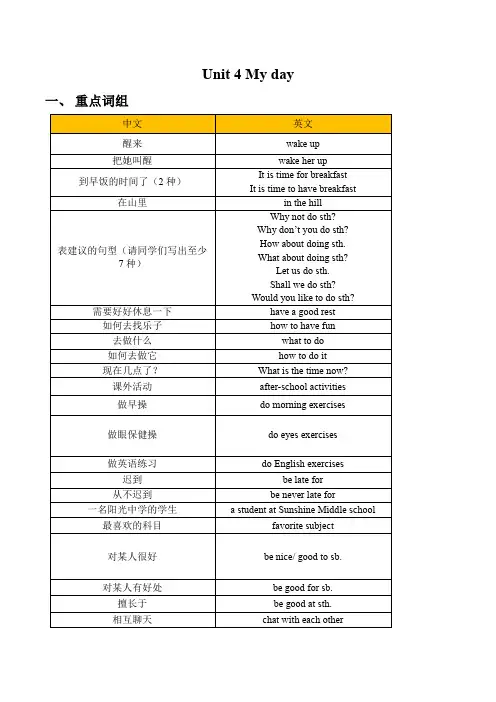
Unit 4 My day 一、重点词组二、重点语言点1. wake upwake 常作及物动词,意为“使醒来,唤醒” Please wake me up at seven o’clock.wake作不及物动词,意为“醒,醒来” He woke three times during the night.当wake up意为“叫醒”时,要注意宾语的位置。
如果宾语是人称代词,通常位于wake和up之间。
如果宾语是名词,则既可以位于wake和up之间,也可以位于wake up之后。
wake up your dad=wake your dad up wake me up2. It’s time for ...It’s time for sth = It’s time to do sth 该是做某事的时候了It’s time for lunch. = It’s time to have lunch. 该是吃午饭的时候了。
It’s time for sb to do sth 该是某人做某事的时候了。
It’s time for the children to go to bed. 该是孩子们上床睡觉的时候了。
3. Shall we go walking in the hills?【精讲】Shall we...?意为“我们……好吗?”,shall用于第一人称,表示提出或者征求建议,常用Good idea.或者Sounds great.来回答。
4. go outgo out 外出;出去;熄灭;过时Let's go out on Saturday night. 我们星期六晚上出去吧。
Let's go out for some fresh air. 咱们出去呼吸点新鲜空气。
The bedroom light went out after a moment. 卧室的灯片刻后熄灭了。
The fire seemed to be going out. 火看来快熄灭了。
Unit4知识点梳理2023-2024学年牛津译林版英语七年级上册
第三讲7AUnit4 Language Point 复习1.How often和How many times的区别①How often do you watch TV?I watch TV every day.How many times do you watch TV a week?I watch TV seven times a week.2.How often和How many times的区别②How often do you watch TV?How many times do you watch TV a week?How often= How many times +时间范围1. will he leave here?He will leave here in a month.A. How oftenB. How longC. How soonD. How many times2. does he watch TV.Once a week.A. How oftenB. How manyC. How longD. How soon3. I don't know he will get here.A. how longB. how soonC. how oftenD. how4. does he take this medicine?Twice a day.A. How soonB. How longC. How muchD. How often5. can you finish this work?A. How oftenB. How manyC. How longD. How soon6. have you been at this factory?I have been here since 1993A. how longB. how soonC. how oftenD. how many7. does your sister write to your parents?A. How soonB. How longC. How muchD. How often8. does it take you to finish you homework every day?.A. How oftenB. How manyC. How longD. How soon9. will he stay here?A. how longB. how soonC. how oftenD. how many10. did the meeting last?About half an hour.A. How soonB. How longC. How farD. How often3.Reading is fun.阅读是有趣的事。
Unit4知识点梳理牛津译林版七年级英语上册
牛津译林版七上Unit 4 知识点梳理1.Wake up, Eddie. 醒醒,埃迪。
wake up:“醒来”。
“唤醒某人”:如果所接宾语是人称代词,只能放在wake和up中间;如果所接宾语是名词,放在up、前后均可。
awake:adj.“醒着的”。
2.Is it time fro breakfast? 到吃早饭的时间了吗?It’s time for sth.“是做某事的时间了。
”= It’s time to do sth.It’s time for sb. to do sth.“该是某人做某事的时候了。
”3.Shall we go walking in the hills? 我们去山上散步好吗?Shall we...? “我们……好吗?”(表示征求或提出建议。
)4.I seldom go out. 我很少外出。
seldom:adv.“很少,不常,难得”(位于行为动词之前,助动词、情态动词或连系动词之后),表示否定。
go out:“出去”。
5....and then I have lunch. ……然后吃午饭。
have lunch:“吃午饭”。
→have breakfast “吃早饭”;have dinner/supper “吃晚饭”。
have:v.“吃;喝”;“有”;“举办,举行”;“度过,经历”。
三单:has。
6.After lunch, I always need a good rest. 午饭后,我总是需要好好休息。
need:v.“需要”。
need sth. “需要某物”;need to do sth. “需要做某事”;need sb. to do sth. “需要某人做某事”;sth. need(s) doing “需要”。
情态动词,“需要”,后接动词原形,常用于否定句和疑问句。
rest:n.“休息,歇息”(= break)。
have a (good) rest “(好好)休息”。
作动词,“休息”。
译林牛津版七年级上册英语Unit 4 单元词句梳理
Unit 4 My dayPeriod 1 Comic strip & Welcome to the unit 必背单词1. wake vi.&vt. 醒,醒来;唤醒2. shall modal v.(表示提出或征求建议)3. hill n. 小山4. seldom adv. 很少,不常5. out adv.(从……里) 出来,向外,外出6. need vt. 需要7. rest n. 休息,歇息8. just adv. 只是9. after-school adj. 课外的,课后的10. activity n. 活动→ activities(复数)11. homework n. 家庭作业12. usually adv. 通常,经常→ usual adj. 通常的;惯常的13. never adv. 从不,绝不14. start vt.&vi. 开始,着手→(同义词) begin15. quarter n. 一刻钟16. past prep. 晚于必背短语17. wake up 醒来18. go out 出去;熄灭19. have fun 玩得高兴20. have breakfast 吃早饭21. get up 起床22. have lessons 上课23. do after-school activities 做课外活动24. do homework 做作业25. be late for 迟到必背句子26. Is it time for breakfast?是吃早饭的时间了吗?27. Shall we go walking in the hills?我们去山里散步好吗?28. I seldom go out.我很少出去。
29. I always need a good rest.我总是需要好好休息一下。
30. Some dogs just don’t know how to have fun.一些狗就是不知道怎样寻找乐趣。
+Unit+4+Comic--Reading+知识点总结 牛津译林版七年级英语上册
Unit 4 Comic--Reading 知识点总结课时11.wake /weɪk/ vi. & vt. 醒,醒来;唤醒e.g. My mum often wakes me up at seven o’clock.我妈妈经常在七点钟叫醒我。
wake up 还可作及物动词短语,意为“叫醒”。
如果宾语是名词,可以放在wake 与up 中间,也可放在up 之后;如果宾语是人称代词,则必须放在wake 与up 中间,且用宾格形式。
wake up 是“动词+ 副词”构成的短语。
wake up 表示“醒过来,醒来”时可单独使用,其中wake 是不及物动词。
e.g. The baby is sleeping. Please don’t wake him up.婴儿正在睡觉,请不要弄醒他。
I want to try it on. 我想试穿一下。
与wake up 结构类似的短语有:try on 试穿put on 穿上turn on/off 打开/关闭put away 把……收起来2.It’s time for... 是……的时间了。
/ 该……了。
Is it time for ...? 到……的时间了吗?是固定句型It is time f or sth.“该做某事了。
/做某事的时间到了。
”的一般疑问句句式。
It is time for 后面只能接名词或代词;当后面接动词时,用固定句式“It is time to do sth.”。
It is time for sb. to do sth. 表示“该是某人做某事的时间了/ 某人做某事的时间到了”。
e.g. It is time for school.=It is time to go to school. 该去上学了。
It is time for the students to play games.学生们做游戏的时间到了。
3.seldom /'seldəm/ adv. 很少,不常seldom 表示否定意义,在构成反意疑问句时,附加问句要用肯定形式。