
人教版七年级上英语Unit6复习提纲
一重点单词
Section A
1.banana(n.) → bananas(pl.)香蕉
2.hamburger(n.) 汉堡包→ hamburgers(pl.)
=burgers
3.tomato(n.) 西红柿→ tomatoes(pl.)
4.ice-cream(c./u.) 冰激凌 an ice-cream 5.salad(c./u.)沙拉 a vegetable salad
--Yes, they do.是的,他们喜欢。 --No, they don ’t.不,他们不喜欢。 7. She likes tomatoes.她喜欢西红柿 . 8.She doesn't like tomatoes.她不喜欢西红柿 . 9.--Does she like tomatoes?她喜欢西红柿吗? --Yes, she does是. 的,她喜欢。 --No, she doesn't.不,她不喜欢。 10.He likes hamburgers.他喜欢汉堡包。 11.He doesn't like hamburgers.他不喜欢汉堡包 . 12.--Does he like hamburgers?他喜欢汉堡包吗?
I like salad. They like pears. She likes tomatoes. He likes hamburgers. (3) 某人不喜欢某物的句型。 否定句: 主语 + don't/doesn't like +... I don't like salad. They don't like pears. She doesn't like tomatoes.
四.重点知识点 Section A
1. (1) 询问某人是否喜欢某物的句型。 一般疑问句: Do/Does +主语 + like +...?
肯定回答 : Yes,主语 +do/does. 否定回答 : No, 主语 +don't/doesn't. --Do you like tomatoes? --Yes, I do. -No, I don't. --Does Tom like milk? --Yes, he does. --No, he doesn't. --Do they like pears? --Yes, they do. --No, they don ’t. --Does she like tomatoes? --Yes, she does. --No, she doesn't. (2) 某人喜欢某物的句型。 肯定句:主语 + like/likes+...
21.chicken(u.) 鸡肉→ chicken(c.)小鸡
Section B
1.breakfast(n.) 早餐;早饭
eat(v.)吃→ (近义词) have(v.)吃 /喝; drink(v.) 喝
2.habit(n.) 习惯→ habits(pl.) 3.healthy(adj.) 健康的→ (反义词 )unhealthy(adj.) 不健康的 → health(n.)健康→ healthily(adv.) 健康地
三、重点句子 Section A
1. I like salad. 我喜欢沙拉。 2.I don't like salad. 我不喜欢沙拉。 3.--Do you like salad? 你喜欢沙拉吗?
--Yes, I do. 是的,我喜欢。 --No, I don't. 不,我不喜欢。 4.They like pears. 他们喜欢梨 . 5.They don't like pears. 他们不喜欢梨 . 6.--Do they like pears? 他们喜欢梨吗?
--Yes, he does.是的,他喜欢。 --No, he doesn't. 不,他不喜欢。 13.John's birthday dinner is next week. 约翰的生日晚宴在下周。 14.Let's think about the food. 让我们来想想 (吃什么 )食物吧。 15..How about burgers, vegetable salad, and some fruit? 汉堡包、蔬菜沙拉和一些水果怎么样?
9.star(n.)→ stars(pl.) 明星,星星
二 .重点短语 Section A
1.talk about likes and dislikes 谈论好恶 2.like/likes tomatoes and strawberries 喜欢西红柿和草莓 3. don't/doesn't like pears or bananas 不喜欢梨子和香蕉
2.一般现在时(二) (含有实义动词的一般现在时)
发生的动作。
(常用
often,sometimes,usually,always, every week, every
day 等频率副词或短语连用) He often eats meat.
She always takes a walk in the evening.
Section B 1. Tom likes eating carrots, eggs and chicken. 汤姆喜欢吃胡萝卜,鸡蛋和鸡肉。 2.Sally doesn't like eating pears, rice or hamburgers. 莎莉不喜欢吃梨子,米饭或汉堡。 3.David asks the volleyball star about her eating habits. 大卫问足球明星关于她的饮食习惯。
6.strawberry(n.) 草莓→ strawberries(pl.) 7.pear(n.) →pears(pl.)梨子
k (u.) 牛奶 9.bread(u.) 面包
a glass of milk a piece of bread
10.birthday(n.) 生日 [birth(n. 出生 )+day(n. 天 )=birthday]
4. I think it ’s healthy.我认为它是健康的。 5. I like chicken for dinner. 晚餐我喜欢吃鸡肉。 6.I don ’t want to be fat.我不想变胖。 7.Do you like hamburgers for dinner?=For dinner, do you like hamburgers?你喜欢汉堡作为正餐吗? 8. For breakfast, she likes (eating) strawberries, rice and chicken. 作为早餐,她喜欢(吃)草莓,米饭和鸡肉。 9.What do you like for breakfast? 你早餐喜欢吃什么?
16.fruit(c./u.) → fruits(pl.) 水果 17..right(adj.) 正确的 ,适当的→ write(v.) 写( 同音 词 );wrong(adj.) 错误的 (反义词 )
18.apple(n.) 苹果→ an apple→ apples(pl.)
19.egg(n.)→an egg→ eggs(pl.) 鸡蛋 20.carrot(n.) → carrots(pl.) 胡萝卜
16..What about the fruit? 水果怎么样? 17.I think John likes strawberries and apples. 我认为约翰喜欢草莓和苹果。 18. Mike likes potatoes, but he doesn't like chicken. 麦克喜欢土豆,但他不喜欢鸡肉。
4.really(adv.) 真正地→ real(adj.)真的
5.question(n.) 问题 → answer(n.)答案 6.well(adv.) 好地 → good(adj.) 好的
7.want(v.) 需要,想要→ need(v.)需要 8.fat(adj./n.) 肥胖的 /脂肪→ thin(adj.) 瘦的
4.look/sound like 看上去 /听起来像 5.two glasses of milk 二杯牛奶 6.two pieces of bread 二片面包 7.birthday dinner 生日宴会 8.birthday cakes/candles/parties 生日蛋糕 /蜡烛 /晚会 st/this/next week 上 / 这/下周 10.think about doing sth. 思考 ;思索做 ... 11.How/What about doing sth.( 提出建议 ) 做... ...怎么样? 12.for breakfast/lunch/supper/dinner 作为早餐 /午餐 /晚餐 / 正餐
11.dinner(u.) 正餐→ lunch/supper(中餐 /晚餐)
12.week(n.) 周;星期→ weekday(n.)工作日 ;
weekend(n.)周末
13.food(c./u.) 食物→ junk food 垃圾食品 ; fast food 快餐
14.sure=certainly(adv.) 当然,肯定 15.vegetable(n.)→ vegetables(pl.)蔬菜
He doesn't like hamburgers. (4) 询问某人喜欢什么的句型。 特殊疑问句: What do/does+主语 + like?
What fruit/ vegetables/food do/does+主语 + like? What do you like? What do they like? What food does he like? What vegetables does she like ( to eat) ?
2019-2020人教版七年级英语上册unit 6期末基础知识点复习和训练(含答案)
2019-2020人教版七年级英语上册Uni t 6期末基础知识点复习及训练(含答案)Unit6 Do you like bananas?一、基础知识点及句型复习1、like v.喜欢;想要;愿意(1)跟名词或代词宾格作宾语,即like sb/sth.(2)跟动名词作宾语,即like doing sth.(3)跟不定式作宾语,即like to do sth.注意:like to do表示一次性或尚未发生的动作;like doing表示习惯性的动作或爱好。
类似用法的单词还有:love, hate.2、---Do you like banana?---Yes, I do.like为实义动词,意为“喜欢,喜好”。
构成肯定句时,若主语不是第三人称单数,直接用like作谓语;若主语是第三人称单数,则用likes。
在变为否定句或疑问句时,要借助助动词do或does,动词like用原形。
3、some一些,若干(1)adj. 既可以修饰可数名词的复数,也可以修饰不可数名词。
(2)pron. 代词(3)可以用在表示邀请、请求或期望得到肯定回答的疑问句中。
5.wantWant作动词,意为“想,想要”,其用法如下:+名词,想要某物:He wants a pen.Want +to do sth想要做某事:I want to be a teacher.+sb.to do sth想要某人做某事:He wants me to help him.5、breakfast n.早餐,早饭(1)表示吃早餐,通常用have,有时可以用eat或take.(2)三餐前一般不加冠词a/an/theAfter breakfast, I go to school.(3)如果在表示三餐的名词前加上形容词或形容词性的词时,前面要加不定冠词。
例:He had a big lunch.(4)like…… for breakfast/lunch/dinner.have……某餐喜欢吃……例1、 She likes eggs, bananas and apples for lunch.=例2、For lunch ,she likes eggs, bananas and apples.5、ask(1)ask v. 询问:ask sb about sth就某事询问某人。
人教版七年级英语上册 Unit 6 知识归纳(含答案)
人教版七年级英语上册 Unit 6 知识归纳(含答案)汉译英1.生日聚餐_______________2.体育明星_______________3.饮食习惯_______________4.健康食品_______________5.最后一个问题_______________6.作为早餐_______________7.晚餐后_______________8.下周_______________9.思考;思索_______________10.询问我关于午餐的事情_______________11.想变胖_______________12.买沙拉_______________【参考答案】1. birthday dinner2. sports star3. eating habit4. healthy food5. one last question6. for breakfast7. after dinner8. next week9. think about10. ask me about lunch11. want to be fat12. get salad汉译英1. Cindy认为她妹妹喜欢冰激凌。
____________________________________ 2.那么咱们喝牛奶吧!____________________________________ 3. Jack喜欢什么蔬菜?____________________________________ 4.——咱们早饭吃什么?——水果沙拉怎么样?____________________________________ ____________________________________ 5.——Tom喜欢梨吗?——不,他不喜欢。
____________________________________ ____________________________________ 6.——你们午饭后吃草莓吗?——是的,我们吃。
七年级上册Unit 6 人教版英语中考一轮复习(词汇+语法讲解)
一轮复习:七上U6 词汇+语法讲解【单词默写】【单词变性】healthy形容词变名词______________ really副词变形容词______________ well副词变形容词______________ week名词变形容词______________1. well ______________ _____________________ ___________________ ________________Well, let’s talk about it next time.Mary does well in English.I don't feel very well today.You can get water in the well.2. right ______________ _____________________ ___________________ ________________ ______________ Everyone has his own rights in the society.Yes, that’s right.All right, let’s go to the cinema.I’m sorry. That’s all right.I sit on the right of Mary while Mary sits on the left of me.3. then __________ ___________Till then, everything is too late.First, you put the meat into the pot. Then, mix it with water.4. question ________________ ________________I have many questions to ask my teacher.I was questioned by a policeman about the murder last night.5. want ________________ ________________I want to stay at home because of the rain.You are wanted to be a volunteer.The thief was wanted on the web.Do you want something to drink?【词汇用法】1. sure: adv./adj./be sure to do sth./be sure that…/make sure that…/make sure to do sth.2. so: adv./conj./so adj./adv. that/so that/so as to/not as adj./adv. so/I think so/I hope so.相关词辨析: because vs. sobecause: conj./因为/不与so连用so: conj./所以/不与because 连用3. habit: n./develop a habit of/break a habit of/good habits/bad habits近义词辨析: habit vs. custom vs. culturehabit: n./习惯custom: n./习俗culture: n./文化4. be: v./be+Adj./be+done/be+n./be+to do/be +doing/be +PP(prep. Phrase)5. eat: vt./eat sth./eat up近义词辨析: have vs. eathave: vt./have lunch(享用一餐)eat: vt./eat rice(享用具体的东西)【攻占语法】动词(二) 实义动词一、动词的分类: ____________ _____________ _____________ ______________二、动词的位置: 在句中充当_____________, 放在___________ 的前面或_____________的后面三、动词的用法:2. 实义动词1) 感官动词look/sound/taste/smell/feel +adj.2) 感观动词watch/see/hear/observe sb. do/doing sth.3) 使役动词make/let/have sb. do sth.get sb. to do sth.make sb./sth. donehave sth. donehave sth. doingget sb./sth. done4) 及物动词动词+名词5) 不及物动词动词单独使用动词+介词+名词请在及物动词的框内打”√”,不及物动词的框内打”×”□ask□buy □call□come □eat□excuse □find □finish □get□go□have□know□let□like□look□lose□meet□need□play□say□see□sell□sound□spell□take□thank□think□want□watch□help□love6) 双宾语动词动词+间接宾语+直接宾语动词+直接宾语+to/for +间接宾语请在是双宾语动词的框内打”√”□teach □learn □buy□sell□order □lend □borrow □dress□bring□take□send□give□tell□pay□hand□show□offer□read□pass□help□want【词汇练习】1.Amy usually eats an a ________ after lunch because it's her favorite fruit.2.Let’s think about some food for Henry’s b ________ party.3.For b ________ I have a glass of milk and some bread. They are healthy.4.Potatoes, c ________, and cabbages are vegetables my son likes best.5.We always have rice, chicken and salad for d________.6.I want to know something about David, the volleyball star's e________ habit.7.I have e________ for breakfast every day.8.Judy likes eating sweet food and doesn’t like doing sports. As a result, she becomes f ________ and unhealthier.9.Eggs, milk and strawberries are all healthy f________.10.I eat f ________ and vegetables every day, which are good for my health.11. A good study h ________ will help you learn English well.12.Tom ate a big breakfast. He had a h ________, an egg and milk.13.Do you want to be h _______? Then you need to eat well and do sports every day.14.All the students have l________ at school from Monday to Friday.15.I can’t answer this q ________. It’s too difficult.16.I like English very much. It's r________ easy.17.I need some vegetables, fruits and yogurt to make fruit s ________.18.He doesn’t want to be late for school again, s ________ he eats quickly and runs to school.19.For fruit, Jack likes apples and s________.20.—Can you come to my party?—That’s for s _______.21.I want a bowl of t ________ noodles, because I like vegetables very much.22.Eat more v ________ and less meat, then you will be healthier.23.We have five English classes a w________.24.It is w________ known that Hangzhou is a perfect city for sightseeing.25.Please come to our club, you are w ________ to join us!【参考答案】healthy形容词变名词health really副词变形容词real well副词变形容词good week名词变形容词weekly1. well 好吧擅长感觉舒服井Well, let’s talk about it next time.Mary does well in English.I don't feel very well today.You can get water in the well.2. right 权力对的好吧没关系右边Everyone has his own rights in the society.Yes, that’s right.All right, let’s go to the cinema.I’m sorry. That’s all right.I sit on the right of Mary while Mary sits on the left of me.3. then 那时然后Till then, everything is too late.First, you put the meat into the pot. Then, mix it with water.4. question 问题询问I have many questions to ask my teacher.I was questioned by a policeman about the murder last night.5. want 想应聘通缉想要I want to stay at home because of the rain.You are wanted to be a volunteer.The thief was wanted on the web.Do you want something to drink?一、动词的分类: be 动词情态动词助动词实义动词二、动词的位置: 在句中充当谓语,放在主语的前面或宾语的后面三、动词的用法:请在及物动词的框内打”√”,不及物动词的框内打”×”√ask√buy √call×come √eat√excuse √find √finish √get×go√have√know√let√like×look√lose√meet√need√play√say√see√sell×sound√spell√take√thank×think√want√watch√help√love6) 双宾语动词动词+间接宾语+直接宾语动词+直接宾语+to/for +间接宾语请在是双宾语动词的框内打”√”√teach □learn √buy √sell √order √lend□borrow□dress√bring□take√send√give√tell√pay√hand√show √offer √read√pass□help□want【词汇练习】apple birthday breakfast carrots dinner eating eggs fatter food fruits habit hamburger healthy lessons question really salad so strawberries sure tomato vegetables week well。
最新人教版七年级上册英语知识点全第六单元unit6知识点.docx
人教版七年级上册英语知识点全第六单元unit 6知识点教学重、难点1、掌握本节重点词汇; 2 、掌握可数名词的构成, 辨析分类可数与不可数名词;3、运用本节所学能够灵活地询问别人对食物的喜恶.1、重点词汇:banana, hamburger, tomato, ice-cream, salad, strawberry, pear, milk, bread,birthday ,dinner, week, burger, vegetable, fruit, right, apple, then, egg, carrot, chicken, breakfast,lunch, star, eat, well, habit, healthy, really, question, want, be, fat2、可数名词和不可数名词:1)food n.仅仅指“食物, 食品”时 , 是不可数名词;强调食物的种类时就是可数名词.可数名词不可数名词可数与不可数名词hamburger,egg, orange, banana,milk, bread, rice food, fruit, ice-cream,salad, apple, pear, carrot, vegetable,chickentomato, strawberries.e.g. I’ m hungry. I need some food.(不可数)/ There are all kings of foods onthe table.(可数)2)fruit n.水果.表示水果总称时, 无复数形式 , 但表示种类时有复数形式.Do you have much fruit? / There are many fruits in the basket.Fruit水果3)ice-cream, salad, chicken总称不可数名词much fruit许多水果种类可数名词kinds of fruits这几个名词 , 当表示物质的时候是不可数名词, 但当表示个体的时候是可数的.e.g. Let ’ s have some ice-cream.中ice-cream是泛指,强调“冰激凌”这类物质, 而非它的数量 .How many ice-creams do you want?中是要询问对方想要的数量 , 即几份 . 可以回答an ice-cream或two ice-creams.3、短语归纳:John’ s birthday dinner约翰的生日晚餐next week下周think about思考,考虑how about怎么样some fruit一些水果his birthday他的生日sport star体育明星eating habits饮食习惯for breakfast作早餐for dinner作晚餐one last question最后一个healthy food健康的食品3、 tomato可数n.“西柿”复数形式:tomatoes似的以o 尾的名 , 需加– es 构成复数形式的有potato, hero 但 photo 等而是以加—s 构成复数形式的.可以:有生命的名, 复数尾加-es,e.g. potato,hero;无生命的尾加-s,e.g. photo.4、某人的喜好, 通常用一般疑句:Do/does +主+ like +⋯?句型.肯定回答用: Yes, 主 + do/does.否定回答用: No, 主 + don ’ t /doesn’ t.(其中,do/does助).----Do you like the sweater ?----Yes, I do.----Does he like the pen ?----No, he doesn’ t.5、 Do you like bananas?1)bananas是banana的复数形式,表示一事物;在英中, 常用复数形式表示一事物 , 其前不用定冠the.2)like sb./sth.喜某人或某物 e.g. I like this ruler?/I like them.like to do sth.喜做某事(表示一次性的或不常的喜) e.g. She likes to play with her little sister.like doing sth.喜做某事(常性的喜) e.g. He likes playing the guitar.5、 Hey, John ’ s birthday dinner is next week翰的生日宴会在下周.1)John’ s birthday dinner翰的生日宴会.John ’s 是名所有格形式, 用于表示所属关系 .e.g. This is Jim’ s sister./It is Tom’s pen.2)next week下周e.g. Teacher’ s Day is next week.6、 think about考e.g. Let’ s think about the eggs./ Let’ s think about the food.7、 Howabout ⋯?====What about ⋯ ?⋯⋯怎么?, 用于提出建或求. 其中 about 是介, 后接 n./ pron./v-ing.e.g. How about him? / How about having some bread?展:英中常用于提建的句型有:1)Let’ s⋯ .我⋯⋯吧. e.g. Let’ s have some apples.2) Why not⋯?什么不⋯⋯呢? e.g. Why not ask our teacher?8、some “一些” , 用于修饰可数名词, 也可用来修饰不可数名词 . 一般用于肯定句中 . 但当表示建议或请求 , 并希望对方给予肯定回答时 , 句中也用 some, 而不用 any.any 一般用于否定句疑问句中.e.g. I have some apples./He has some milk./Would you like some orange juice?I don’t have any pears./Do you have any milk?9、 Let ’ s have strawberries and apples then.1)strawberries是可数名词strawberry的复数形式,其变化是将词尾y 变为 I, 再加 es.2)have v. “有 , 吃、喝” . 英语中 , 习惯上用have breakfast/lunch/supper/dinner来表示吃早饭、午饭、晚饭. 表示吃具体食物时, 可与 eat 替换 .e.g. Let’ s have /eat some apples.10、 so 连词 , “因此 , 所以”不可与because 同时出现在一个句子中 .e.g. I’ m ill today, so I can’t go to school.11、 well adv“好” , 在课文中是修饰动词eat.】辨析 well和 good两者都意为“好” ,但其用法不同 .形容词放在连系动词后 , 表达“健康的”意思I ’ m very well.我很好 .well副词修饰动词We eat well. 我们吃的很好 .good形容词放在名词前作定语 , 或放在连系动词后She is a good girl.作表语12、 for prep.“为 , 替 , 给”可以表示用途、对象、目的、愿望, 等 .e.g. Let’s get a new light for the bedroom./ let’s go out for a walk./Good luck for you.( )Mary often has eggs and bread _____breakfast.A. with B. for C. on13、 really adv.“事实上 , 真正地” , 用于加强语气 , 表示程度 , 放在动词前 .real adj. “真的”e.g. I really don’ t know./Hi, Joe, is it really you?That is not her real name.14、 after dinner用餐后dinner n.“正餐 , 晚餐”常用来表示一天中的正餐( main meal ) , 英语国家晚餐一般是一天中最丰富的一餐, 因此 dinner常用来指晚餐 . 而 supper 只指晚餐 . 此外 ,dinner 一词比较正式 , 邀请朋友赴宴常用它 .e.g. We ’ ll have dinner together in the evening.15、 want v.“想”1 ) want sth.想要某物 e.g. I want an apple.2)want to do sth.想要去做某事 e.g. I want to eat an apple.3)want sb. to do sth.想要某人做某事 e.g. I want you to help me.。
人教版英语七年级上册Unit6知识点总结
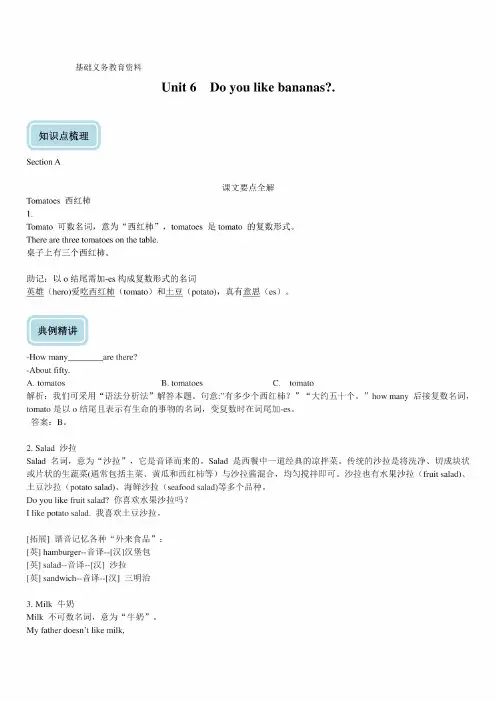
基础义务教育资料Unit6Do you like bananas?.知识点梳理Section A课文要点全解Tomatoes西红柿1.Tomato可数名词,意为“西红柿",tomatoes是tomato的复数形式。
There are three tomatoes on the table.桌子上有三个西红柿。
助记:以o结尾需加-es构成复数形式的名词英雄(hero)爱吃西红柿(tomato)和土豆(potato),真有意思(es)。
典例精讲-How many are there?-About fifty.A.tomatosB.tomatoesC.tomato解析:我们可采用“语法分析法”解答本题。
句意:”有多少个西红柿?”“大约五十个。
”how many后接复数名词, tomato是以o结尾且表示有生命的事物的名词,变复数时在词尾加・es。
答案:Bo2.Salad沙拉Salad名词,意为“沙拉”,它是音译而来的。
Salad是西餐中一道经典的凉拌菜。
传统的沙拉是将洗净、切成块状或片状的生蔬菜(通常包括主菜、黄瓜和西红柿等)与沙拉酱混合,均匀搅拌即可。
沙拉也有水果沙拉(fruit salad)、土豆沙拉(potato salad)>海鲜沙拉(seafood salad)等多个品种。
Do you like fruit salad?你喜欢水果沙拉吗?I like potato salad.我喜欢土豆沙拉。
[拓展]谐音记忆各种“外来食品”:[英]hamburger-#译--[汉]汉堡包[英]salad--音译--[汉]沙拉[英]sandwich-音译-[汉]三明治k牛奶Milk不可数名词,意为“牛奶”。
My father doesn't like milk,我父亲不喜欢牛奶。
[拓展]milk作动词,意为“挤(牛、养等的)奶”。
He is milking a cow.他正在挤牛奶。
典例精讲There is some in the fridge.It's fresh.kB.applesC.egg解析:我们可以采用“综合分析法”解答本题。
Unit6单元知识点归纳总结人教版七年级英语上册
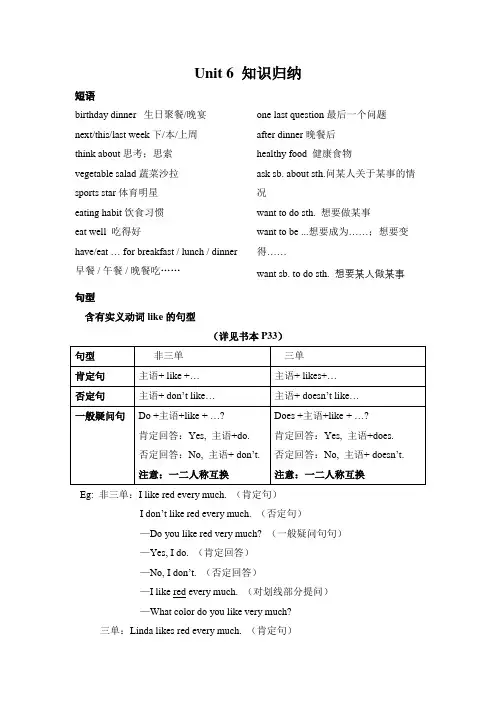
Unit 6 知识归纳短语birthday dinner 生日聚餐/晚宴next/this/last week 下/本/上周think about 思考;思索vegetable salad 蔬菜沙拉sports star 体育明星eating habit 饮食习惯eat well 吃得好have/eat … for breakfast / lunch / dinner 早餐 / 午餐 / 晚餐吃……one last question 最后一个问题after dinner 晚餐后healthy food 健康食物ask sb. about sth.问某人关于某事的情况want to do sth. 想要做某事want to be ...想要成为……;想要变得……want sb. to do sth. 想要某人做某事句型含有实义动词like的句型(详见书本P33)Eg: 非三单:I like red every much. (肯定句)I don’t like red every much. (否定句)—Do you like red very much? (一般疑问句句)—Yes, I do. (肯定回答)—No, I don’t. (否定回答)—I like red every much. (对划线部分提问)—What color do you like very much?三单:Linda likes red every much. (肯定句)Linda doesn’t like red every much. (否定句)—Does Linda like red very much? (一般疑问句句)—Yes, she does. (肯定回答)—No, she doesn’t. (否定回答)—Linda likes red every much.(对划线部分提问)—What color does Linda like very much?语法知识:名词可数名词:分为单数名词和复数名词(1)是可以计数的名词。
Unit6讲义人教版英语七年级上册
Unit 6 Do you like bananas?1.salad n. 沙拉当salad 为不可数名词时,通常指整体的食物概念,例如:He likes eating salad.“一盘沙拉”时,是可数名词,复数形式为salads。
当salad的含义为“一份色拉”、k n.牛奶a glass of milk 一杯牛奶two glasses of milk 两杯牛奶3.bread n.面包a piece of bread 一片面包4.birthday n. 生日Happy birthday to you! 祝你生日快乐!5.dinner n.正餐have dinner 吃晚餐birthday dinner 生日晚宴6.week n. 周;星期(adj./adv.)weekly 每周的next week 下周7.★think about 思考;思索(强调思考的过程)★think of 认为;想起(强调思考的结果)Eg:Let’s think about the food.I like this song,but I can’t think of its name.8.food n. 食物指“食物,食品”时,是不可数名词;强调食物的种类时,是可数名词。
9.right adj. 正确的;—(反义词)wrong 错误的adj. 右边的;—(反义词)left 左边的★All right!用作对方建议或劝告的应答语。
Eg:—Let’s go and ask him.让我们去问他。
—All right. 好的。
10.star n. 星星;明星a volleyball star 一个排球明星11.eat v. 吃★eating habits 饮食习惯12.well adv. 好;令人满意地(adj.)good 好的Eg:Sports Star Eats Well.I have good eating habits.13.question n. 问题one last qusetion 最后一个问题14.healthy adj. 健康的(n.)health 健康★keep healthy 保持健康15.want v. 想要want sth. 想要某物want to do sth. 想要做某事want sb. to do sth. 想要某人做某事Eg:I don’t want to be fat.16.—What do you like for breakfast?—I like ........【语法】名词的单复数有些名词既可作可数名词又可作不可数名词,但意义不同,要注意区分.①glass cn.杯子un.玻璃orange cn橘子un.橘汁①还有表示动物类的名词,表示动物时是可数名词,表示为菜肴时是不可数名词. chicken cn.小鸡un.鸡肉fish cn鱼un鱼肉①salad, icecream, food, fruit 作总称讲是不可数名词,作种类讲是可数名词【即学即练】一、请写出下列词的复数形式city _____ _zoo ______country _____ tooth ____mouse _________ boy____________ broom ___________car ____tree ______horse ______ bus______________ fox _____branch ____ baby _____ family _____ dish _____radio _____ photo _____ piano _____ knife _____leaf _____ life _____ thief _____ _man _____woman _____ child ___ foot______this _____________ watch___________ diary____________ day____________ book____________dress____________ sheep___________ tea_____________ box___________ strawberry_________ peach__________ sandwich__________ paper_________ juice__________ water____________ milk___________ rice__________people ______CD________ ox___________deer____________ fish___________二、选择填空.( )1. They e from different ______A. countryB. countriesC. a countryD. countrys( )2. How many ______ do you see in the picture?A. tomatosB. tomatoesC. tomatoD. the tomato( )3. They are______.A . woman teachers B. women teachersC. women teacherD. woman teacher( )4. Would you like _______ ,please?A. two glass of waterB. two glasses of waterC. two glass of watersD. two glasses of waters( )5. Most of ______ live in _______.A. Germans, GermanB. German, GermenC. Germen, GermanyD. Germans, Germany( )6. There are some ______ in these _______.A. knifes pencilboxesB. knives pencilsboxC. knives pencilboxD. knives pencilsboxes( )7. ______ like ______ by air.A. Greens, travellingB. The Green, travelingC. The Greens, travelD. The Greens, traveling( )8. I wonder why ______ are interested in action films(武打片).A. the peopleB. peopleC. peoplesD. the peoples( )9. There is no ______ in the plate.A. applesB. orangesC. riceD. eggs( )10.My uncle has three _______.A.childB.childsC.childrenD.childrens四.填入所给名词的正确形式。
七年级上册英语提纲人教版
七年级上册英语提纲人教版七年级上册英语是人教版的一本教材,主要适用于初中七年级学生。
本教材的内容丰富多样,包括了语法、词汇、听力、口语、阅读和写作等方面,旨在帮助学生全面提高自己的英语能力。
本教材一共分为八个单元,每个单元都有重点词汇、重点句型和重点语法。
以下将详细介绍每个单元的内容。
第一单元:Greeting这个单元主要介绍了问候语和自我介绍的表达方式。
学生可以通过这个单元学习如何礼貌地与他人打招呼,并且向别人介绍自己。
第二单元:School life这个单元主要介绍了学校的相关信息,如教室、学科、老师等。
学生可以通过这个单元学习如何描述自己的学校生活以及谈论他们的学校。
第三单元:Hobbies这个单元主要介绍了爱好和兴趣方面的内容。
学生可以通过这个单元学习如何向别人介绍自己的爱好,以及询问别人的爱好。
第四单元:Family这个单元主要介绍了家庭成员和家庭活动方面的内容。
学生可以通过这个单元学习如何描述自己的家庭,以及询问别人的家庭情况。
第五单元:Food and drinks这个单元主要介绍了食物和饮料方面的内容。
学生可以通过这个单元学习如何订餐、购物以及谈论他们喜欢的食物和饮料。
第六单元:Jobs这个单元主要介绍了职业方面的内容。
学生可以通过这个单元学习如何向别人介绍自己的梦想职业,以及向别人询问他们的职业。
第七单元:Transportation这个单元主要介绍了交通方式和地点方面的内容。
学生可以通过这个单元学习如何描述自己的出行方式,以及询问别人他们如何去某个地方。
第八单元:Time and weather这个单元主要介绍了时间和天气方面的内容。
学生可以通过这个单元学习如何描述今天的天气以及询问别人某个时间。
在每个单元中,教材还包含了大量的听力和口语练习,通过这些练习,学生可以更好地理解和运用所学知识。
此外,教材还提供了一些阅读和写作任务,通过这些任务,学生可以提高自己的阅读理解能力和写作水平。
人教版初中英语七年级上册期末复习Unit6知识与练习
人教版初中英语七年级上册期末复习Unit6知识与练习Unit 6 Do you like bananas ?1.单元词汇:tomato(复数) strawberry(复数) health(形容词) eat(现在分词) real(副词) be(现在分词) 吃得好(英语)吃午饭(英语) 在一周内(英语) 吃的习惯(英语) 一些鸡肉(英语) 喜欢吃水果(英语)下周(英语)2.词汇归类:水果:banana香蕉orange橙子strawberry草莓pear梨apple苹果蔬菜:tomato西红柿carrot胡萝卜broccoli花椰菜salad沙拉食品:hamburger汉堡包milk牛奶ice cream冰淇淋bread面包chicken鸡肉eggs鸡蛋3. sports star体育明星4.lots of = a lot of非常多,很多5.healthy food健康食品6. have sth. for breakfast/lunch/dinner/dessert早餐/中餐/晚餐/甜点吃……7.他喜欢吃蔬菜。
(英语)8.我们不喜欢沙拉,但她喜欢.(英语)9.Gina晚饭吃香蕉。
(英语)10.我不喜欢吃冰淇淋。
(英语)11.他不想变胖。
(英语)12.他考虑食品了吗?(英语)13.踢足球怎么样?(英语)14.She likes pears and apples. (否定句)15.David asks the volleyball star. (一般疑问句)16.不可数名词见P3317. have … for breakfast/ lunch/ dinner 早餐/ 午餐/ 晚餐吃……18. good(adj. 好的)& well(adv. 好)The good runner eats well.这个优秀的运动员吃得好。
19. 名词所有格:①一般加’s;以s 结尾的(特别是名词复数),在s 后加’ 如:Sally’s address 莎莉的地址the teachers’ room 老师们的房间three hours’ class 三小时的课② Mary and Linda's desk 玛丽和琳达的课桌(两个人共有的课桌,desk用单数)Mary's and Linda's birthday s玛丽的生日和琳达的生日(各自的生日,birthday用复数)③…of + 名词(无生命的物体) 如:the color of the sweater a photo of your family20.句式:1)询问某人是否喜欢某物的句型及答语—Do/Does sb. like sth.?—Yes,sb. do/does. —No,sb. don’t/doesn’t.—Do you like salad?—Yes,I do./ No,I don’t.—Does he like pears?—Yes,he does. / No,he doesn’t.2)祈使句——Let’s do sth. Let’s have ice cream.3)一般现在时的肯定句及否定句I like oranges. 否定句I don’t like bananas. They like salad. 否定句They don’t like broccoli. 疑问句:Do they like salad? She likes bananas. 否定句She doesn’t like ice cream. 疑问句:Does she like bananas?EXERCISES:一、单项选择。
2021年人教版七年级英语上册Unit 6 要点梳理.ppt
那么我们吃草莓和苹果吧。
Hale Waihona Puke 6.He likes icecream. 他喜欢冰激凌。
7.—What do you like for breakfast? —你早饭喜欢吃什么? —I love fruit. I think it’s healthy. —我喜欢水果。我认为它很健康。
•
THE END 17、一个人如果不到最高峰,他就没有片刻的安宁,他也就不会感到生命的恬静和光荣。2020/12/142020/12/142020/12/142020/12/14
谢谢观看
日常交际用语
1.Do you like bananas? 你喜欢香蕉吗? 2.Let’s think about the food.
让我们来想想(吃什么)食物吧。
3.—How about burgers, vegetable salad, and some fruit? 汉堡、蔬菜沙拉和一些水果怎么样? —Sounds good. 听起来不错。
。2020年12月14日星期一2020/12/142020/12/142020/12/14
• 15、会当凌绝顶,一览众山小。2020年12月2020/12/142020/12/142020/12/1412/14/2020
• 16、如果一个人不知道他要驶向哪头,那么任何风都不是顺风。2020/12/142020/12/14December 14, 2020
• 14、Thank you very much for taking me with you on that splendid outing to London. It was the first time that I had seen the Tower or any of the other famous sights. If I'd gone alone, I couldn't have seen nearly as much, because I wouldn't have known my way about.