
新课标八年级上册英语单元知识点归纳知识点1-3
新课标八年级上册英语单元知识点归纳Unit1 Where did you go on vacation?短语归纳1.go on vacation去度假2.stay at home待在家里3.go to the mountains去爬山4.go to the beach去海滩5.visit museums 参观博物馆6.go to summer camp去参加夏令营7.quite a few相当多8.study for tests为测验而学习9.go out出去10.most of the time大部分时间11.have a good time doing=have fun doing =enjoy oneself玩得高兴12.of course=sure =certainly当然13.feel like给……的感觉;感受到14.go shopping去购物15.in the past在过去16.walk around四处走走17.because of+名词短语:因为because+句子18. a/one bowl of… 一碗……19. the next day第二天20.drink tea喝茶21.find out找出;查明22.go on继续23.take photos照相24.something important重要的事25.up and down上上下下e up出来come out 出版发行27.go out with anyone 跟别人出去28.say about 发表对…看法29.rain hard 雨下得大30.too much+不可数名词太多too many+可数名词复数太多much too+形容词太用法:1.buy sth. for sb. / buy sb. sth.为某人买某物2.taste / look/sound/smell good. 尝起来/看起来/听起来/闻起来不错3.nothing…but+动词原形除了……之外什么都没有4.seem+(to be)+ adj. 看起来……5.arrive in+大地点/ arrive at+小地点/get to +地点/reach +地点到达某地6.decide to do sth.决定去做某事7.try doing sth.尝试做某事/ try to do sth.尽力去做某事8.forget doing sth.忘记做过某事/ forget to do sth.忘记做某事9.enjoy doing sth.喜欢做某事10. want to do sth.想去做某事11.start doing sth.开始做某事12.stop doing sth. 停止做某事13.dislike doing sth. 不喜欢做某事14.keep doing sth.继续做某事keep on doing sth 不停做某事15.Why not do. sth.=why don’t you do sth为什么不做……呢?16.so+adj.+that+从句如此……以至于……17.tell sb. (not) to do sth. 告诉某人(不要)做某事18.enough +名词,形容词+enough19.not really .真的没有。
20.seem to do sth 似乎好像做某事21.Bye for now!到这该说再见了。
22.How do you like …=What do you think of…=What do you think about…Unit2 How often do you exercise?短语1.help with housework帮助做家务2.on weekends=on the weekend在周末3.how often多久一次how soon多久(回答in 10 years)4.hardly ever几乎从不5.5.once a week每周一次twice a month每月两次every day每天three/four…times a week每周三四…次6.be free =be available有空7.go to the movies去看电影e the Internet用互联网on the Internet在网上surf the Internet 上网9.swing dance摇摆舞10.play tennis打网球play+球类/棋类/中国乐器play the +西洋乐器11.stay up late熬夜;睡得很晚12.12.at least至少at most最多13.have/take dance and piano lessons上舞蹈课和钢琴课14.go to bed early早点睡觉15.play sports=do sports进行体育活动16.be good for对…有好处be good at=do well in 擅长be good with 与…相处融洽17.go camping去野营18.not…at all一点儿也不…… at all 根本first of all首先19.in one’s free time在某人的业余时间20.the most popular最受欢迎的21.such as比如;诸如22.old habits die hard积习难改23.go to the dentist去看牙医24.more than多于;超过less than少于25.the answers to the questions 问题的答案用法1.help sb. with sth.帮助某人做某事2.How about doing…?=what about doing ......怎么样?3.want sb. to do sth.想让某人做某事4.How many+可数名词复数+一般疑问句?有多少…?5.主语+find+that从句. ……发现……6.spend time with sb.和某人一起度过时光7.It’s+ adj.+(for sb)+ to do sth. 对某人来说,做某事是……的。
8.ask sb. about sth.向某人询问某事9.by doing sth. 通过做某事(回答how引导的疑问句)10.What’s your favorite…?你最喜爱的…是什么?11.the best way to do sth.做某事的最好方式12.How come ?怎么回事?Unit3 I’m more outgoing than my sister.短语1.more outgoing更外向2.as+形容词/副词原形as…与……一样not as/so…as不如3.the singing competition唱歌比赛4.be similar to与……相像的/类似的t he same… as和……相同;与……一致be different from与……不同5.care about关心;介意take care of =look after照顾6.be like a mirror像一面镜子7.the most important最重要的8.as long as只要;既然9.bring out使显现;使表现出10.get better grades取得更好的成绩11.reach for伸手取12.in fact事实上;实际上13.make friends交朋友14.one…,the other… 一个…,另一个15.touch one’s heart感动某人16.be talented in music有音乐天赋17.share everything 分享一切18.talk about 谈论19.primary school students小学生middle school student 中学生20. information 是不可数名词,一则消息:a piece of information21.the English study center英语学习中心用法1.make sb. do sth.让某人做某事2.want to do sth.想要做某事3.That’s not important for me… 对我来说,那是不重要的4.both 放于be 动词之后5.call sb at +电话号码:给某人打电话6.主语+谓语+比较级+than +比较对象形容词和副词的比较级、最高级大多数形容词和副词有三个等级:1)原级(不作比较),修饰词very,so,too,pretty,really;2)比较级,表示“较……”或“更……”的意思(两者之间进行比较), 标志词than,A or B,of the two, 修饰词much,a lot,a little;3)最高级,表示“最……”的意思(三者或三者以上作比较),形容词最高级前面一般要加定冠词the,后面可带in(of)短语来什么比较的范围。
Unit4 What’s the best movie theater?1.movie theater电影院2.close to…离……近3.clothes store服装店4.in town在镇上be new in town 新来到镇上的5.so far到目前为止6. 10 minutes by bus坐公共汽车10分钟的路程7.talent show才艺表演8.have …in common有相同特征的in common 共同,共有9.around the world世界各地;全世界10.more and more……越来越…11.and so on等等12.all kinds of……各种各样的kind of 稍微,有点what kind of 哪种类型的13. be up to是……的职责;由……决定14.not everybody并不是每个人15.make up编造(故事、谎言等)16.for example例如17.take…seriously认真对待18.give sb. sth.=give sth to sb 给某人某物e true(梦想、希望)实现;达到20.play a role in doing =play a part in doing 在…方面发挥作用/有影响fortable seats舒适的座位22.big screens大屏幕23.buy tickets quickly 买票快24.waiting time 等待时间25.my way around 周围的路26.get a very good prize得到一个非常不错的奖品用法:1.Can I ask you some…?我能问你一些……吗?2.Thanks for doing sth.因做某事而感谢。
(完整word版)八年级上册UNIT1-3知识点总结,推荐文档

Unitl Where did you go on vacation?1. go on vacation 去度假2. stay at home 待在家里3. go to the mountains 去爬山4. go to the beach 去海滩5. visit museums 参观博物馆6. go to summer camp 去参加夏令营7. quite a few 相当多8. study for 为... 而学习9. go out 出去10. most of the time 大部分时间11. taste good 尝起来很好吃12. have a good time 玩得高兴13. of course 当然14. feel like 给... 的感觉;感受到15. go shopping 去购物16.in the past 在过去17. walk around 四处走走18. because of 因为19. one bowl of 一碗 ....20. the next day 第二天21. drink tea 喝茶22. find out 找出;查明23. go on 继续24. take photos 照相25. something important 重要的事26. up and down 上上下下27. come up 出来28. buy sth. for sb. / buy sb. sth. 为某人买某物29. taste + adj. 尝起来.....30. look+adj. 看起来...31. nothing…but+动词原形除了... 之外什么都没有32. seem+ (to be) + adj. 看起来.........33. arrive in+ 大地点/ arrive at+小地点到达某地34. decide to do sth. 决定去做某事35. try doing sth. 尝试做某事/36. try to do sth. 尽力去做某事37. forget doing sth. 忘记做过某事/38. forget to do sth. 忘记做某事39. enjoy doing sth.喜欢做某事40. want to do sth. 想去做某事41. start doing sth. 开始做某事42. stop doing sth. 停止做某事43. dislike doing sth.不喜欢做某事44. keep doing sth. 继续做某事45. Why not do. sth.? 为什么不做...... 呢?46. so+adj.+that+从句如此......... 以至于....47. tell sb. (not) to do sth.告诉某人(不要)做某事48 .have a good time=enjoy oneself=have fun(doing sth.) 玩得痛快复合不定代词或副的构成及用法构成:由some, any, no, every分别加上-body,-thing,-one 构成的不定代词叫做合成不定代词;加上-where 构成副词。
(完整版)人教版八年级英语上册各单元知识点归纳和作文范文
新课标八年级上册英语单元知识点归纳Unit1 Where did you go on vacation?短语归纳1.go on vacation去度假2.stay at home待在家里3.go to the mountains去爬山4.go to the beach去海滩5.visit museums 参观博物馆6.go to summer camp去参加夏令营7.quite a few相当多8.study for tests为测验而学习9.go out出去10.most of the time大部分时间11.have a good time doing=have fun doing =enjoy oneself玩得高兴12.of course=sure =certainly当然13.feel like给……的感觉;感受到14.go shopping去购物15.in the past在过去16.walk around四处走走17.because of+名词短语:因为because+句子18. a/one bowl of…一碗……19. the next day第二天20.drink tea喝茶21.find out找出;查明22.go on继续23.take photos照相24.something important重要的事25.up and down上上下下e up出来come out 出版发行27.go out with anyone 跟别人出去28.say about 发表对…看法29.rain hard 雨下得大30.too much+不可数名词太多too many+可数名词复数太多much too+形容词太用法:1.buy sth. for sb. / buy sb. sth.为某人买某物2.taste / look/sound/smell good. 尝起来/看起来/听起来/闻起来不错3.nothing…but+动词原形除了……之外什么都没有4.seem+(to be)+ adj. 看起来……5.arrive in+大地点/ arrive at+小地点/get to +地点/reach +地点到达某地6.decide to do sth.决定去做某事7.try doing sth.尝试做某事/ try to do sth.尽力去做某事8.forget doing sth.忘记做过某事/ forget to do sth.忘记做某事9.enjoy doing sth.喜欢做某事10. want to do sth.想去做某事11.start doing sth.开始做某事12.stop doing sth. 停止做某事13.dislike doing sth. 不喜欢做某事14.keep doing sth.继续做某事keep on doing sth 不停做某事15.Why not do. sth.=why don’t you do sth为什么不做……呢?16.so+adj.+that+从句如此……以至于……17.tell sb. (not) to do sth. 告诉某人(不要)做某事18.enough +名词,形容词+enough19.not really .真的没有。
八年级上册英语一到三单元笔记
八年级上册英语一到三单元笔记Unit 1 Where did you go on vacation?一、重点单词。
1. anyone.- 词性:代词,意为“任何人”,常用于疑问句和否定句中。
例如:Did you meet anyone interesting on your vacation?(你在假期遇到有趣的人了吗?)2. anywhere?- 词性:副词,意为“在任何地方;无论何处”。
例如:I can't find my keys anywhere.(我到处都找不到我的钥匙。
)3. wonderful.- 词性:形容词,意为“精彩的;绝妙的”。
例如:We had a wonderful time at the beach.(我们在海滩度过了一段美妙的时光。
)4. few.- 词性:形容词,意为“很少的;不多的”,修饰可数名词复数,表示否定意义。
例如:There are few apples on the tree.(树上几乎没有苹果了。
)- 区别于“a few”,“a few”表示“一些;几个”,有肯定意义。
例如:There are a few students in the classroom.(教室里有几个学生。
)5. most.- 词性:形容词,意为“大多数的;大部分的”。
例如:Most students like English.(大多数学生喜欢英语。
)- 也可作名词,意为“大多数;大部分”。
例如:Most of the time, I stay at home.(大部分时间,我待在家里。
)6. something.- 词性:代词,意为“某事;某物”,常用于肯定句中。
例如:I have something to tell you.(我有某事要告诉你。
)- 区别于“anything”(用于疑问句和否定句)和“nothing”(意为“没有什么;没有东西”)。
例如:Do you have anything to drink?(你有什么喝的东西吗?)There is nothing in the box.(盒子里什么都没有。
八年级英语上册Units1-3知识归纳(通用3篇)
八年级英语上册Units1-3 知识归纳(通用3篇)八年级英语上册Units1-3 知识归纳篇1八年级上册units 7—9 知识归纳一、词语辨析:1、win, beat二者都有“打赢;取胜”之意,但宾语不同:win后面所接的宾语一般是指一场比赛、一场辩论或一次战斗等等。
如:he came first and won the race.他跑在最前面,赢得了这场比赛。
beat后面所接的往往是比赛、辩论或战斗的对手,即宾语通常是人。
如:the girls' team beat us in the football match.在那场足球比赛中,女子队打败了我们。
i’m sure jim will win the match.we won the first place in the sports meeting. 我们赢了第一名。
i’m afraid they will beat us.i hope we can beat t he boys’ team. (男子队,相当于人。
)2、join, join in, take part in1)加入某党派、某组织或某社会团体,用join,不可用join in。
如:①he will never forget the day when he joined the party.他永远也忘不了他入党的那一天。
②his brother joined the army three years ago.他哥哥是三年前参军的。
join还可解释为“连接”。
如:①the railway joined the two cities.铁路把两个城市连接起来了。
②the two clauses are joined by a conjunction.两个分句由一个连词连接起来。
2)说参加某种活动用join in,如说“与其人一起做某事”,则用join sb. in sth. / doing sth. 。
英语八年级上册1~3单元知识点
英语八年级上册1~3单元知识点一、单元一:Hello !1. 问候和自我介绍1.1 问候语在日常交流中,问候是非常基础而且重要的部分,例如:Hello!Hi!Good morning/afternoon/evening!1.2 自我介绍当你第一次见到某人时,你需要用英语介绍自己,包括自己的尊称、芳龄、爱好等信息。
例如: My name is Tom. I'm 14 years old. Ilike playing basketball and listening to music.2. 询问及回答2.1 询问对方的尊称和芳龄询问对方的尊称和芳龄是交流中的基本内容,例如:What's your name? How old are you?2.2 回答询问当他人询问你尊称和芳龄时,你需要会做简单而又礼貌的回答,例如:My name is Lily. I'm 13 years old.3. 介绍自己的朋友3.1 描述外貌在介绍朋友时,需要用英语描述对方的外貌特征,例如:He has short black h本人r and big blue eyes.3.2 描述性格和爱好介绍朋友的性格及爱好也是非常重要的部分,例如:She is outgoing and she likes singing and dancing.二、单元二:My Day1. 时间表及日常活动1.1 表述时间在日常生活中,我们需要学会用英语表达时间,例如:It's seven o'clock. It's time for breakfast.1.2 描述日常活动描述日常活动是非常重要的,通过用英语描述,可以让对方更好地了解你的生活,例如:I get up at six thirty in the morning.2. 描述一天的安排2.1 早上在英语中,描述早上的活动需要用适当的词汇和句子结构,例如:In the morning, I usually have breakfast at seven o'clock.2.2 中午描述中午的安排也需要合适的表述方式,例如:At noon, I have lunch with my classmates.2.3 下午形容下午的活动也需要用英语来描述,例如:In the afternoon, I play basketball with my friends after school.3. 时间状语及延续性动词3.1 时间状语在描述一天的安排时,时间状语能让你的描述更加清晰和连贯,例如:At eight in the evening, I do my homework.3.2 延续性动词在描述日常活动时,延续性动词的使用极为重要,能够更准确地表达你的日常习惯,例如:I'm reading a book at the moment.三、单元三:At Home1. 家庭成员及家庭关系1.1 家庭成员描述家庭成员时,需要用英语进行表述,例如:My mother is a teacher and my father is a doctor.1.2 家庭关系通过用英语描述家庭成员之间的关系,能够更好地展现出你的家庭情况,例如:My parents are very kind to me and my sister.2. 描述家中的布置2.1 房间及家具通过用英语描述家中的布置,能够让对方更好地了解你的家庭环境,例如:There is a bed, a desk and a ch本人r in my room.2.2 家居摆设描述家居摆设也是非常关键,通过合适的表述,可以给对方留下深刻的印象,例如:There are some photos on the wall and some plants on the table.3. 家庭活动及家务3.1 家庭活动描述家庭活动时需要用英语进行表述,例如:We often watch TV together on weekends.3.2 家务描述家务活动同样需要用合适的方式表述,例如:I help my mom with the cooking every evening.以上是英语八年级上册1~3单元的部分知识点,希望同学们能够认真学习,掌握这些知识,提高英语的表达能力。
八年级英语第一二三单元知识点整理
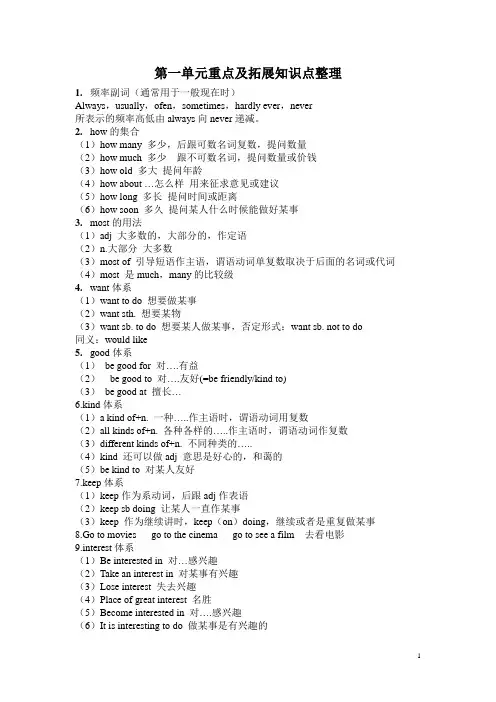
第一单元重点及拓展知识点整理1.频率副词(通常用于一般现在时)Always,usually,ofen,sometimes,hardly ever,never所表示的频率高低由always向never递减。
2.how的集合(1)how many 多少,后跟可数名词复数,提问数量(2)how much 多少跟不可数名词,提问数量或价钱(3)how old 多大提问年龄(4)how about …怎么样用来征求意见或建议(5)how long 多长提问时间或距离(6)how soon 多久提问某人什么时候能做好某事3.most的用法(1)adj 大多数的,大部分的,作定语(2)n.大部分大多数(3)most of 引导短语作主语,谓语动词单复数取决于后面的名词或代词(4)most 是much,many的比较级4.want体系(1)want to do 想要做某事(2)want sth. 想要某物(3)want sb. to do 想要某人做某事,否定形式:want sb. not to do同义:would like5.good体系(1)be good for 对….有益(2)be good to 对….友好(=be friendly/kind to)(3)be good at 擅长…6.kind体系(1)a kind of+n. 一种…..作主语时,谓语动词用复数(2)all kinds of+n. 各种各样的…..作主语时,谓语动词作复数(3)different kinds of+n. 不同种类的…..(4)kind 还可以做adj 意思是好心的,和蔼的(5)be kind to 对某人友好7.keep体系(1)keep作为系动词,后跟adj作表语(2)keep sb doing 让某人一直作某事(3)keep 作为继续讲时,keep(on)doing,继续或者是重复做某事8.Go to movies go to the cinema go to see a film 去看电影9.interest体系(1)Be interested in 对…感兴趣(2)Take an interest in 对某事有兴趣(3)Lose interest 失去兴趣(4)Place of great interest 名胜(5)Become interested in 对….感兴趣(6)It is interesting to do 做某事是有兴趣的10.about体系(1)Adv 大约,差不多(2)介词在….周围,在….附近(3)表示关于….时,后接的内容比较普通,不太正式11.pretty体系(1)Adv 相当修饰形容词或者是副词(2)Adj 漂亮的;优美的12.try 体系(1)Try to do 努力做某事(2)Try doing 尝试做某事(3)Try ones best to do 尽某人最大努力做某事(4)Try on 试穿(5)Try 作为n 尝试,have a try 试一下12.shop体系(1)v.购物;买东西(2)n 商店相当于store13.some体系(1)一些;若干即可以修饰可数名词也可以修饰不可数名词(2)用于肯定句中或者是表示委婉客气请求的一般疑问句中14.may be与may beMaybe 是副词,可能;也许;大概通常位于句首May be 情态动词+动词原形可能是;也许是第二单元重点及拓展知识点整理1.matter体系(1)作n.时,意思为事情;问题;情况(2)v.要紧;关系重大,主要用于否定句中。
八年级unit1 3知识点
八年级unit1 3知识点八年级英语Unit1包括三个重要的知识点:be动词、物主代词和一些日常交际用语。
让我们一起来了解一下这些知识点的具体内容和相关练习。
一、be动词:1. be动词的用法:be动词是英语中最基本的动词之一,用于表达人或物的存在、状态等。
(1)表达人或物的存在:I am a teacher.(我是一名老师。
)(2)表达人或物的状态:She is happy.(她很开心。
)2. be动词的变化:be动词变化分为三种情况:肯定句、否定句和疑问句。
(1)肯定句:主语+ am/is/are +其他成分。
例如:I am a student.(我是一名学生。
)(2)否定句:主语+ am not/is not/are not +其他成分。
例如:He is not at home.(他不在家。
)(3)疑问句:be动词提前,主语后置。
例如:Are you a doctor?(你是医生吗?)二、物主代词:1. 物主代词的用法:在英语中,物主代词用于指示人或物的所属关系。
例如:This is my book.(这是我的书。
)其中,“my”代表“我的”。
2. 物主代词的变化:物主代词变化分为两种情况:主格和宾格。
例如:My book is on the table.(我的书在桌子上。
)在这个句子中,“my”是主格形式,在句中作主语。
例如:She gave me her phone number.(她给了我她的电话号码。
)在这个句子中,“her”是宾格形式,在句中作宾语。
三、日常交际用语:在日常生活中,我们需要使用一些简单的英语交流,例如问候、感谢、请求等。
1. 问候:- Hello!(你好!)- Good morning/afternoon/evening!(早上/下午/晚上好!)- How are you?(你好吗?)2. 感谢和道歉:- Thank you.(谢谢。
)- You’re welcome.(不客气。
八年级上英语M1到M3知识点
八年级上英语M1到M3知识点在八年级上英语学习中,M1到M3是非常重要的知识点。
下面将对这些知识点进行详细的介绍。
M1:基本句型结构英语中的句子结构比较简单,通常由主语、谓语和宾语构成。
有些句子还会加上状语,以更好地描述事物。
例如:- He reads a book. (他读一本书。
)- She is writing an email to her friend. (她正在给她的朋友写邮件。
)- They often go to the cinema on weekends. (他们经常在周末去电影院。
)在句子中,主语通常在谓语的前面,宾语则在谓语的后面。
M2:一般现在时态一般现在时态表示现在的状态或常态,通常使用动词的原形。
例如:- She loves playing basketball. (她喜欢打篮球。
)- We learn English every day. (我们每天学英语。
)- They live in a big house. (他们住在一栋大房子里。
)除了用于描写现在,一般现在时态还可以用来表示一些事实或普遍真理。
M3:物主代词物主代词用来代替某人或某物所拥有的东西。
英语中的物主代词分为两种,即形容词性物主代词和名词性物主代词。
例如:- This is my book. (这是我的书。
)- His hat is on the table. (他的帽子放在桌子上。
)- Their pencils are blue. (他们的铅笔是蓝色的。
)形容词性物主代词修饰名词,通常放在名词的前面。
名词性物主代词则直接代替名词,通常放在谓语的后面。
总结八年级上英语的M1到M3知识点包括基本句型结构、一般现在时态和物主代词。
掌握这些知识点对于学习英语非常重要,希望大家能够认真学习并加以运用。
新版八年级上册英语一至三单元知识点
新版八年级上册英语一至三单元知识点一. 单元一:What’s your name?1. 问候与自我介绍•问候语:Hello! How are you?•自我介绍:My name is [你的名字]. I’m [你的年龄]. I’m from [你的国家/城市].2. 询问姓名与国籍•What’s your name?(你叫什么名字?)•Where are you from?(你从哪里来?)3. 熟悉数字•数字1-100的读法:one, two, three, four, five, six, seven, eight, nine, ten, eleven, twelve, thirteen, fourteen, fifteen, sixteen, seventeen, eighteen, nineteen, twenty, thirty, forty, fifty, sixty, seventy, eighty, ninety, one hundred.4. 人称代词•第一人称代词:I, we•第二人称代词:you•第三人称代词:he, she, it, they5. 介绍家庭成员•Who is he/she?(他/她是谁?)•Is he/she your brother/sister?(他/她是你的哥哥/姐姐吗?)•How old is he/she?(他/她多大了?)二. 单元二:How are you?1. 询问他人身体状况•How are you?(你好吗? / 你身体好吗?)•I’m fine/good, thanks.(我很好,谢谢。
)2. 表达感受•I’m happy/sad.(我开心/伤心。
)•I’m tired.(我累了。
)•I’m hungry/thirsty.(我饿了/渴了。
)•I’m cold/hot.(我冷/热。
)3. 询问原因•Why are you happy/sad?(你为什么开心/伤心?)4. 回答方式•I’m happy/sad because…(我开心/伤心是因为…)5. 询问并回答他人的感受•How is he/she?(他/她好吗?)•He/She is happy/sad/tired/hungry/thirsty/cold/hot.(他/她很开心/伤心/累了/饿了/渴了/冷/热。
八年级英语上册1-3单元_重要知识点归纳概括
八年级上册Uni’t 1 How often do you exercise?1. How often 多久一次(问频率)How long 多长(问时间或物的长短多用for+一段时间来回答How soon 多久(用来对将来的提问)常用in+时间来回答How far 多远(对距离的提问)How many 多少用于可数名词复数前)How much 多少(用于少数名词前)用于问何格= What’t the price of2、频度副词always(100%)总是 =all the timeusually (90%)通常 = often/generallyoften(80%)经常 = many timessometimes(50%)有时= at times / now and thenhardly ever (10%)几乎不 = almost notnever(0%) 从不 = not ever3、sometimes 有时、不时some times 几次、几倍sometime 某时some time 一段时间,当某时讲时,常与of连用4、once 一次 twice 两次three times 三次(数词+times……次)5、exercise:a、锻炼、运动,不可数名词(morning exercises.eye)b、练习、训练、两操,可数名词do exercisesc、锻炼、运动6、surf the Internet 网上冲浪7、most students = most of the students8、as for 至于/关于,后接名、代、动名词9、do homework(不可数名词)= do on e’s homework 做家庭作业10、junk food 垃圾食品green food 绿色食品healthy food 健康食品safety food 安全食品11、green tea 绿茶black tea 红茶12、maybe = perhaps 也许(句首、作状语)may be 可能是,也许是(作谓语)13、try to do sth 尽力做某事try doing sth 试着做某事14、pretty a 很,非常 = veryb、漂亮的15、eating habits 饮食习惯balanced diet 平衡饮食16、help sb.(to)do sth= help sb with sth (帮助别人做某事)17、look after = take care of 照顾、保管look for 寻找look through 浏览 = read quicklylook out 当心、小心 = be careful= watch onlook over 检查(作业)look at 看……look around 四周看看18、be good at 擅长于…… = do well inbe good for 对……有益be good to 对某人友善 = be friendly to19、kind of = a little /a bit of 一点,有几分20、of course = certainly = sure 当然(可以)21、get good grades 取得好成绩22、although = though 尽管……虽然……不与but连用23、keep in good health 保持健康= keep healthy= stay healthy= keep fit24、healthy lifestyle健康的生活方式health(n)→healthy(adj) →healthily(adv)重点句型:1.A:What do you usually do on weekends?B:I often watch TVA:How often do you watch TV?B:Three or four times a week.A:What’s your favourite program?B:lt’s Animal world.2、Here are the results of the students’ activity surrey of Green high school.3、I look after my health. My healthy lifestyle helps me get good grades so I have to eat healthy every day.Unit 2 what’s the matter?1、what’s the matter?= what’s the trouble (win you) ?= what’s wrong?= what’s up? 怎么啦?2、have a cold(感冒)/stomachache (胃疼)/throat (噪子疼)/ toothache(牙疼)/headache(头痛)sore back(背疼)= backache3、tooth-teach(pl)4、lie down躺下 (lie-lay-lying)5、feel+adj 作表语 (get become burn等)6、hot tea with honey 热茶加蜂蜜7、one……the other……一个……另一个Some……others……一些……另一些8、advice 建议,劝告 n 不可数名词Suggest v →suggestion 名词,可数 suggestions9、ago 放在时间之后 three days agobefore 放在时间之前 before three days10、(be)stressed out 有压力的,紧张的= be nervous11、need to do sth 需要做某事need doing 含有被动的意思12、be healthy = stay healthy = keep healthy= keep fit 保持健康13、I t’s + adj+ (for sb) + to do sth对某人来说做某事…14、at the moment = now = at present目前,现在at once = in a minute away 立刻,马上15、balanced diet 平衡饮食16、host family 寄宿家庭重点句型1、I’m sorry to heat that听到这件事我感到很难过。