
必修一Unit 4 Natural Disasters Reading and Thinking
in shock 震惊;吃惊
electricity trap
bury breathe
revive revival
effort unify wisdom context suffer
n. 电;电能 vt. 使落入险境;使陷入圈套 n. 险境,陷阱 vt. 埋葬;安葬 vi. & vt. 呼吸
2. What does the writer mean by “Slowly, the city began to breathe again”?
The writer means that the city began to function again, because the earthquake had stopped people and supplies moving about, and so it was like the city couldn't breathe.
必修 第一册
crack n. 裂纹;裂缝 vt. & vi.(使)破裂 as if 似乎;好像;仿佛 ruin n. & vt. 破坏;毁坏
in ruinsR严ea重d 受aft损er;th破e败ta不pe堪 percentann.d百sp分e之ak…o…ut tahdej.&adv. 每一百中
bricCkhnin. e砖se;im砖m块ediately. metal n. 金属 shock n. 震惊;令人震惊的事;休克
Read and finish the tasks as quickly as possible.
Task 1
Find the main idea.
What's the main idea of the text?
The text mainly talks about _th__e_e_a_r_th__q_u_a_k_e_t_h_a_t_h_a_p_p__en__ed__i_n_ _T_a_n_g_s_h_a_n_i_n_1_9_7_6___.
away _b_ri_c_k_s_ and rocks, and rescue those who were _tr_a_p_p_e_d_ under the ruins. 5. Some were found alive, though they were suffering from terrible injuries, but others had already stopped _b_r_e_a_th__in_g_ when they were discovered. 6. A few buildings were still standing, but people were afraid to use them as shelters, worrying they would be _b_u_r_ie_d_ if the buildings fell.
1. The huge earthquake left nearly the whole city _in__r_u_in_s__. 2. Everyone was _in__s_h_o_c_k_, thinking the world must be coming
to an end. 3. Millions of people were left without water, food, or _e_le_c_t_r_ic_i_ty_. 4. Soldiers and volunteers worked as hard as they could to pull
the earthquake. In a short time, a lot of damage was done, so it must describe a place that has been badly damaged.
from the context. They sound like the red
e_a_r_th__q_u_a_k_e_. ______________________ Para 4: _T_h_e_r_e_s_c_u_e__w_o_r_k_._________________ Para 5: _T_h_e_r_e_v_i_v_a_l _o_f _th_e__c_it_y_._____________
Task 2
P51 3
Read the text carefully and then write down the main idea of each paragraph.
Para 1: Warning signs before the earthquake. Para 2: _T_h_e_h_a_p__p_e_n_in_g__o_f_t_h_e_b_i_g__e_a_rt_h_q_u_a_k_e_. Para 3: _T_h_e_i_m_m__e_d_i_a_te__e_ff_e_c_t_s_o_f_t_h_e________
vt. & vi. 复活;(使)苏醒 n. 振兴;复苏 n. 努力;艰难的尝试;尽力 vi. & vt. 统一;(使)成一体 n. 智慧;才智 n. 上下文;语境;背景 vt. 遭受;蒙受 vi. (因疾病、痛苦、悲伤等)受苦
Unit 4 Reading and Thinking
Describe a natural disaster
Read the text again and answer the
P51 6
questions.
Task 6
1. What were some of the strange things happening before the earthquake? Do you think they were warning signs? Why or why not?
probably helpmyovue because they are
could be what this
understand what it msetuacnks.somed the sentences describing what happened after a huge earthquake. Complete the sentences with the correct forms of the new words and phrases from the text. P51 5 Task 5
Check your answers.
1. What were some of the strange things happening before the earthquake? Do you think they were warning signs? Why or why not? Before the earthquake, the water in the village wells rose and fell. Deep cracks appeared in their walls. Animals were acting strangely. I think these were warning signs as this doesn't usually happen and it showed something strange was happening below the ground. Sometimes, animals have more sensitive reactions to some coming dangers.
Two thirds of the people in 2/3 Tangshan died or were injured.
The number of people who were 400,000 killed or injured reached more
than 400,000. Toi79t50sc%%hao,uwsetd7bwh5uaee%irelleodatiorgntofohgfntsqhdeuae.anacmckidittaeyy9g.w'0es%atfsoacovptfeoeriortyipseslhseeoraaminnoduedssthane d
Task 4 P51 4
This word describes the city straight after
Scan the text and find the words below. Guess what they mean
This word is used to describe the buildings that have fallen. They are red like leaves, but also heavy, because the wind cannot move them.
ruin brick
clay blocks commonly used to build buildings.
trap bury
Use context to understand Wdohennotykonnueowswew,eodarodwdnseooTsrtdchsritysiobopveueprbeoisplueswehdotoare
Possible Answer: · A city can be damaged in an earthquake. · The electricity can go down. · The water can be unsafe to drink. ·NFoirwes, claent'sstarret.ad a text to know more · People caabnopuatnitchoer egaetrtsehvqeuraeklyei.njured.
2019人教版高中英语必修一Unit 4 阅读课 单词 课文预习(
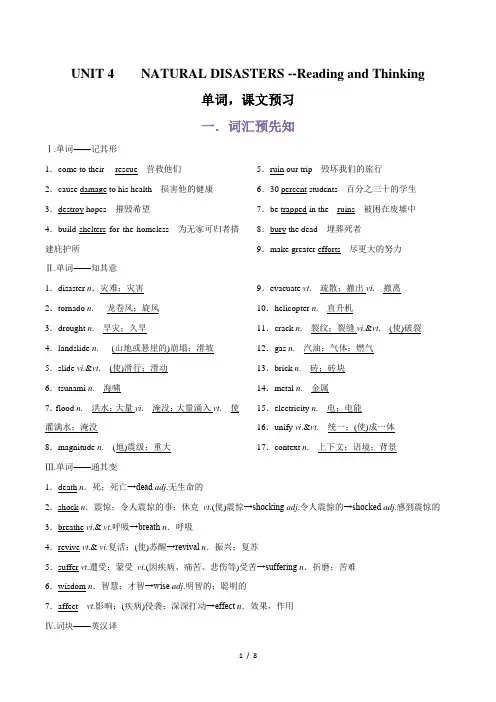
UNIT 4 NATURAL DISASTERS --Reading and Thinking单词,课文预习一.词汇预先知Ⅰ.单词——记其形1.come to their __rescue营救他们2.cause damage to his health 损害他的健康3.destroy hopes 摧毁希望4.build shelters for the homeless 为无家可归者搭建庇护所5.ruin our trip 毁坏我们的旅行6.30 percent students 百分之三十的学生7.be trapped in the__ruins 被困在废墟中8.bury the dead 埋葬死者9.make greater efforts 尽更大的努力Ⅱ.单词——知其意1.disaster n.灾难;灾害2.tornado n. 龙卷风;旋风3.drought n. 旱灾;久旱4.landslide n. (山地或悬崖的)崩塌;滑坡5.slide vi.&vt. (使)滑行;滑动6.tsunami n. 海啸7.flood n. 洪水;大量vi. 淹没;大量涌入vt. 使灌满水;淹没8.magnitude n. (地)震级;重大9.evacuate vt. 疏散;撤出vi. 撤离10.helicopter n. 直升机11.crack n. 裂纹;裂缝vi.&vt. (使)破裂12.gas n. 汽油;气体;燃气13.brick n. 砖;砖块14.metal n. 金属15.electricity n. 电;电能16.unify vi.&vt. 统一;(使)成一体17.context n. 上下文;语境;背景Ⅲ.单词——通其变1.death n.死;死亡→dead adj.无生命的2.shock n.震惊;令人震惊的事;休克vt.(使)震惊→shocking adj.令人震惊的→shocked adj.感到震惊的3.breathe vi.& vt.呼吸→breath n.呼吸4.revive vt.& vi.复活;(使)苏醒→revival n.振兴;复苏5.suffer vt.遭受;蒙受vi.(因疾病、痛苦、悲伤等)受苦→suffering n.折磨;苦难6.wisdom n.智慧;才智→wise adj.明智的;聪明的7.affect__vt.影响;(疾病)侵袭;深深打动→effect n.效果,作用Ⅳ.词块——英汉译1.as if 似乎;好像;仿佛2.in ruins 严重受损;破败不堪3.in shock 震惊;吃惊4.set up 建立5.as usual 像往常一样6.come to an end 结束7.the number of ……的数量8.dig out 挖掘9.a home to ……的家园10.go through 经历11.be gone 没有了12.provide medical care 提供医疗服务二.课文精研读原文呈现THE NIGHT THE EARTHDIDN’T SLEEPStrange things were happening in the countryside of northeastern①Hebei.For several days, the water in the village wells② rose③ and fell,rose and fell.There were deep cracks that appeared in the well walls.At least one well had some smelly④ gas coming out of it【1】.Chickens and even pigs were too nervous to eat【2】,and dogs refused to go inside buildings.Mice ran out of the fields looking for places to hide【3】,and fish jumped out of the water.At about 3:00 a.m., on 28 July 1976, bright lights were seen in the sky outside the city of Tangshan and loud noises were heard.But the city’s one million people were asleep⑤ as usual⑥ that night.【1】“coming out of it”在此为现在分词短语作后置定语,修饰gas。
Unit+4+Natural+disasters+Reading+and+thinking+课件
Para. 4- rescue and revival after the quake
Content and language
Part 1 warning signs
before the quake
1. topic sentence
five senses
2. supporting evidence
3. Awareness lack of related knowledge
neglecting the warning signs
Critical thinking Para.1 before the earthquake
2. What should be done to take precautions against earthquakes?
2. enhance awareness of disaster prevention and mitigation and feel the spirit of unity;
3. master functions of data and rhetorical devices and features of literary journalism;
3. list data
descriptive impressive persuasive
Critical thinking Para.1 before the earthquake
1. Why did the earthquake in Tangshan cause such heavy loss of lives?
unity
Read for genre Para.1 before the earthquake
Unit+4+Natural+Disasters+Listening+an教版(2019)必修第一册
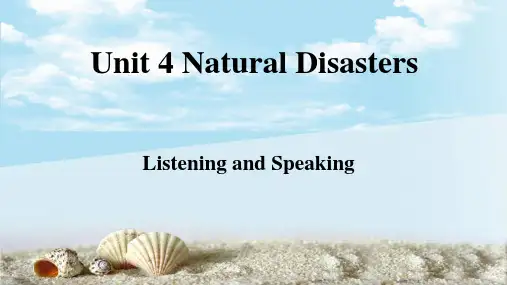
4 Read about the disasters below and prepare a short news report on one of them. Then present your news report to a partner.
Earthquake Wenchuan, China 14:28 Monday,12
3. Prepare a short news report based on key information and talk it to others.
• Lead-in
1. What’s going on in this photo?
A troop of soldiers are rescuing an injured person following an earthquake.
that people are safe.
News report 3
5. When did people see the tornado in Memphis? At 9:25 a.m.
News report 4 6. Which buildings were damaged in Seoul?
Good morning, it’s 17 April. A strong earthquake hit
Ecuador yesterday. The 7.8-magnitude earthquake
Place
Time
damaged many buildings, and early reports said that about
Good evening. Today is 27 March. More news about the
Unit+4+Natural+Disasters+Reading+an人教版(2019)必修第一册

train,truck,and plane.
3.Slowly the city began to breathe.
Summary
before : What were you doing? Feeling? unprepared
after:thinking and attitude thankful/ unify positive /hopeful
Building
people
Discuss what can happen to a city during a big earthquake.
electricity
injury
Prediction
Look at the pictures and guess what the text is about .
Strange things
wells
Water, rose and fell, cracks
animals
Chickens and pigs didn’t eat ;Mice ran out; Fish jumped out.
Light and sound
Could be seen and heard
Read and think
What are your feelings towards these terrible data?
Natural disasters will cause terrible damages, so we should learn some knowledge about how to protect ourselves during the earthquake.
during:What happened?Feeling? shake/fall down
必修第一册Unit 4 Natural Disasters Reading and thinking

ruin 3.____________n.&vt.破坏;毁坏
单 bury 12.___________vt.埋葬;安葬
in ruins percent 4.____________严重受损;破败不堪
词 breathe 13.____________vi.&vt.呼吸
revive 14.____________vt.&vi.复活;(使)苏醒
A. they didn't notice anything strange happening
B. they knew well about earthquakes
C. something strange happened in many places
D. they didn't realize the arrival of an earthquake
were too nervous ___t_o5_e__a_t (eat),and dogs refuse现d_在_t分_o6词_g_短o__语(g作o)状in语s,ide表伴随
too...to... 太......而不能
refuse to do sth. 拒绝做某事
buildings. ⑤_M__ic7_e_ (mouse) ran out of the fields looking for places t_o_8h__id_ e(hide),
A. a news report B. a literary journal(报告文学) C. a novel
3. In what order is the text written?
A. Time
B. Space
C. Feeling
Unit4+Natural+Disasters+Reading+for+人教版(2019)必修第一册
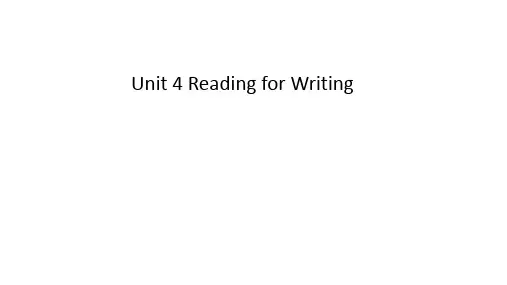
time place
date
Event: cause
A tsunami
effect
followin gevents
PresentationBiblioteka Show time秒
Homework
1. Review what we have learnt from this passage.
2. Polish what you have written following the checklist and rewrite it .
Translate the key points Damage
用not only...but also合并2,3句:
The earthquake not only destroyed plenty of houses and roads but also cut off the water and electricity.
◈ What caused the tsunami?
◈ Why would it be difficult to deliver food and supplies?
Read for factors
Read the news report released the day after a tsunami and answer the questions.
Translate the key points Damage
翻译:超过40人在地震中死亡或受伤;大量房屋道路被毁;供水、 供电中断。
1. 在地震中死亡或受伤的人数超过40人(the number of) The number of people who were killed or injured in the quake was more than 40.
Unit4NaturalDisastersReadingandthinking教学设计-高中英语人教
人教版高一英语必修一Unit4 NA TURAL DISASTERS Reading and Thinking教学设计教材分析1.单元背景。
本单元以“自然灾害”为话题,包含了地震、火山喷发、海啸、飓风等自然灾害的介绍,以及如何在灾难中自救和救人的方法。
在自然灾害面前,人类有时显得很渺小,但是了解自然灾害,掌握自救和救人的方法,却能使我们有效地减少灾害带来的损失。
2.单元分析及教材处理。
为了让学生有充足的Natural Disasters 知识和正确的情感态度去面对自然灾害,而且学生也能学有所用。
本单元旨在让学生了解自然灾害的种类、发生的原因、危害以及如何自救和救人。
让学生对Natural Disasters 的知识有一定的了解,并明白各种自然灾害的破坏性。
使学生在认识的基础上进一步学习阅读课文里有关灾难——地震来临前的征兆和地震过程中的相关知识,并懂得在地震中如何自救,如何救人等内容。
在学习知识的同时增强了学生的社会责任感,树立了正确的人生观,价值观。
珍爱生命,在大灾难前要有大爱,这样也提高了学生的自身素养I.Teaching Content:Unit4 Earthquakes ReadingA Night the Earth Didn’t Sleep II.Teaching time:45 minutesIII.Teaching Goals1. Knowledge aim1). Get the students to learn some useful words and expressions.2). Develop the students reading ability and let them learn different reading skills.2. Ability aims:1). Get the students know damages earthquake bring about and the ways to reduce losses of earthquake.2). Get the students to know how to protect oneself and help others in earthquake.3. Moral aims:1). Know what damages an earthquake will bring about and the ways to reduce losses of an earthquake.2). Know how to protect oneself and to help others in an earthquake.IV. Important points:1.Words: shake, rise, crack, burst, well, smelly, pond, steam, destroy, ruin, injure, survivor, brick, useless, shock, quake, rescue, electricity, disaster, organize, bury, coal, mine, shelter, fresh, percent.2.Phrases: right away, at an end, lie in ruins, be trapped under sth, put up, give out, wake sb up, prepare sth for sth., think little of sth.3.Sentences:(1). It seemed as if the world was at an end.(2). Onethird of the nation felt it.(3). In fifteen terrible seconds, a large city lay in ruins.V. Difficult points1. The meanings of some words and expressions.2. Describe a natural disaster, such as an earthquake3. Understanding of sentences which contain Attributive Clause.VI. Teaching tools blackboard, courseware, tape recorder and some coloured ,pictures.VII. Teaching MethodsSituational teaching methods & interactive teaching methods, cooperative exploring methods.VIII. Teaching Procedures1.Greetings2. LeadinTeacher shows some pictures about the earthquake. Students look at the pictures and think of some new words relating to the natural disasters.3.Reading1). Fast readingTeacher shows the title and the photo on page fifty. Let students guess what the text is about. Student will be given five minutes to get the main idea and pay attention to the beginning and any sentences in each paragraph and find out the topic sentence and then match the main idea with each paragraph.Para.1: A.The rescue work.Para.2: B.The revival of the city.Para.3: C.Warning signs before the earthquake.Para.4: D.The happening of the big earthquake.Para.5: E.The immediate effects of the earthquake2). CarefulreadingStudents will be given five minutes to read part one carefully and do the following exercises: What were some of the strange things happening before the earthquake and how did people in react to the signs.How did people in Tangshan react to the signs?A.Ignorant. B.Alert. C.Sensitive. D. Casual3. What rhetorical device(修辞手法) does the author use in the sentence “the water in the village wells rose and fell, rose and fell”?A.Metaphor(比喻).B.Repetition(重复).C.Parallelism(排比).D.Personification(拟人).参考答案A AFunction: To make the description more vivid and involve the readers in the atmosphere.Students read part 2 carefully and do the following exercise and read paragraph 3 to carefully to do the following exercise the teacher will choose some students to show your answers for others1. How can we protect ourselves in an earthquake at school?2.What can you do after an earthquake?(Creative thinking)PostreadingGroupwork(1) Don’t be nervous and keep calm.(2) Don’t try to run out of the classroom.(3) Sit down under your desk.(4) Protect your head by putting your bag on your head.(5) Don’t use lift.(6)If possible,run to the schoolyard.IX. Group workStudents will be given five minutes to have a group of work to have a discussion about how can we protect ourselves in an earthquake at school and what can you do after an earthquake? Whatdo you think helped in the revival of city?What lesson can we learn from these events? Some students will be invited to share their answers for the other students.The spirit of bating disaster relief抗震救灾精神Whether in Tangshan earthquake or in Wenchuan earthquake, the most important thing is the spirit of Chinese people. Every time a disaster happens, we fight against it together and we never lose hope. That is the spirit of bating disaster reliefRecently, in the battle against COVID19, China did the best in controlling the virus. That is the result of the spirit of bating COVID19X. SummarySome students will be invited to have a summary about what did we learn today.XI. Homework1.Write a passage about your feelings after today’s passage learning.2.Finish activity 5.XII. Blackboard writingXIII. Teaching reflection课后反思依据教学目标,对学生的学习过程进行评价,旨在反思教学效果,不断改进自己的教学方法与策略。
人教高一英语Unit4 Natural Disasters Reading and Thinking
Activity 2: Read the text carefully and then write down the main idea of each paragraph.
Para 1
Para 2&3
Para 4&5
_______b_e__f_o_r_e________________d_u__r_i_n__g_________________a_f_t_e_r__________________
__b_e__f_o_r_e_______________d_u__r_i_n__g______________________a_f_t_e_r_________
∆
∆
∆
Activity 3: Read the text again and sort out the detailed information.
Activity 2: Read the text carefully and then write down the main idea of each paragraph.
Paragraph 1: _W__a_r_n_in__g_s_ig_n_s__b_e_fo_r_e__th_e__e_a_r_th_q_u__a_k_e_. ___ Paragraph 2: _T_h_e__h_a_p_p_e_n_i_n_g_o_f_t_h_e__b_ig__e_a_r_th_q__u_a_k_e_. ___ Paragraph 3: _T_h_e__im__m__e_d_ia_t_e_e_f_f_ec_t_s_o_f_t_h_e__ea_r_t_h_q_u_a_k_e_._ Paragraph 4: _T_h_e__r_e_sc_u_e__w_o_r_k_._____________________ Paragraph 5: _T_h__e__r_e__v_i_v_a__l_o__f_t_h__e__c_i_t_y_.________________________
高中英语人教版必修一Unit4NaturalDisasters(ReadingandThinking
Unit 4 Natural Disasters 教学设计Teaching Aims:Knowledge Objects:(1). Get the students to learn useful new words and expressions in this passage.(2). Enable students to know basic knowledge about earthquakes.2. Ability objects:(1). Develop the students’ ability and let them learn different reading skills.(2). Get the students collect the information from the internet by themselves.3. Emotional objects:Get the students to be aware of the terrible disasters, meanwhile help them to face it, treat it in a proper way, and never get discouraged when in danger.Teaching important points:1.Students master the new words,phrases and useful expressions.2.Train students’reading ability to understand the content of the text.Teaching difficult points:Develop the students’ reading ability.Teaching Procedures:Step one LeadinGreet the students and show students a video about Australia wildfire to lead in the topic of this class. Show students the pictures and guess what these natural disasters are. A picture of earthquake to let students to discuss what can happen to a city during a big earthquake and then lead in the passage.Step two ReadingFast readingRead the text quickly and fill in the table.Task1WhatMain idea:Task 2Find out the topic sentences of each paragraph and divide the text into three parts. Para1:_______________________________________________________Para2:_______________________________________________________Para3:_______________________________________________________Para4:_______________________________________________________Part1( ):___________________________________________________Part2( ):___________________________________________________Part3( ):___________________________________________________Careful readingPart1 Before the earthquakeJoin the correct parts of the sentences.The water in the wells a.ran out of the fieldsChickens and pigs b.jumped out of waterMice c.were too nervous to eatA smelly gas d.rose and fellFish e.came out of the wellsPart 2 During the earthquakeFind out the meaning of the numbers.11kilometers:___________________________8 kilometers:___________________________30meters:____________________________one minute:___________________________400,000:_____________________________75%, 90%:____________________________Task 3 Part 3 After the earthquakeWho came to help? What were done immediately?Post readingRetell the story Circle the key time in the textHow is the text developed?Step three Discussion and pairworkSuppose student A is an interviewer of a program and student B is a survivor of Tangshan earthquake who are to be interviewed. What would they talk about? Discuss with your partners and do a roleplay activity.Example:A: Hello, Mr/Mrs Li,nice to meet you, I ’m Jack from CCTV 8. May I ask you some questions?B: Yes,of course.A; I think that you are a very lucky person. What do you think of the earthqauke ? B: Scary/terrible....A: Where were you when you heard the crash?B: I was sleeping as usual/.....A: Do you notice something strange things before the earthquake?B: Yes, the wells and.......Step four HomeworkRetell the story after class.Surf the internet to find the ways to protect ourselves in the earthquake. What were done immediate?。
英语人教版高中必修一(新课标)教案Unit 4 Reading and Thinking 教案
Unit 4 Natural DisastersPeriod 2Reading and Thinking教材分析该板块以“描述自然灾害”(Describe a natural disaster)为活动主题,要求学生通过阅读文本,了解我国20世纪70年代发生在唐山的大地震,学习报告文学这种纪实性文体的语言特征,最后完成用自己的语言描述自然灾害的任务。
该语篇文本没有报告文学中常见的中心人物,但按地震前、中、后的顺序向读者整体描述了唐山大地震这场灾难。
全文描写生动、包含情感,体现了作者想要表达“灾害无情,人有情”的思想感情。
教学目标1. 能正确理解使用下列词汇:ruin, percent, brick, metal, shock, electricity, trap, bury, breathe, effort, wisdom, context, suffer等。
2. 阅读描述重大灾害的纪实性报告文学语篇,掌握该类语篇的语言特征和叙事要点,能分析阅读语篇的文本结构。
3. 掌握在阅读中根据上下文猜测词义的策略;巩固合成词的相关知识;能运用构词法知识推测词义。
4. 从历史事件的角度了解国内外发生过的一些重大自然灾害,树立防灾意识和自我保护意识。
5. 能够了解和掌握一些与自然灾害相关的安全常识和防范措施。
教学重难点【教学重点】帮助学生掌握报告文学兼具文学性和纪实性的语言特征,让学生学会欣赏文本中所运用的修辞方法和写作技巧,理解作者在作品中所表达的情感和写作意图。
【教学难点】掌握在阅读中根据上下文猜测词义的策略。
教学过程Step 1 Warming-upHave a brief review of the natural disasters mentioned in news reports in Period 1. Discuss ingroups what can happen to a city during a big earthquake.设计意图:回顾上节课的内容,激活关于自然灾害和地震的背景知识。