
外研版-英语-六年级上册-6A Module1 Unit1教案(第1课时)
Module 1 unit 1 The Great Wall
Teaching materials:
Book 7 Module 1 Unit 1 The Great Wall
Teaching aims:
1. Be able to master words: more, postcard(s), thousand, kilometer(s), million.
2. Be able to understand and use:
Tell me more about…It’s a picture of…
How long/big is it? It’s about …It’s got …
3. Be able to understand conversations and describe different places and things.
4. Be able to love their hometown and our country.
5. Be able to cooperate with each other.
Key points: To learn to describe things and different places.
Difficult points: How to describe by using numbers.
Teaching aids :The multi-Media , word cards , key sentence structures cards, postcards. Teaching steps:
Step 1: Warming up and lead-in.
1.Warming up:
T: This is the first time I come to Xiamen, Xiamen is really beautiful, people are very good, so I want to make lots of friends here, do you want to be my friend? OK , I am Sara. Please say Hello to me.
(Teacher encourages students by using body language)
2.Lead-in:
T: Do you want to be my friends? please introduce yourself first!
S: (Encourage stude nts try to say) My name’s… I’m…
T: (ask another) What’s your hobby?....
T: Do you want to know more about me?
My hobby is collecting postcards. Look, here is my postcards book, they are very beautiful. (Show the word ‘postcard’ and ‘postcards’.)
Step 2: Look and say.
1.Presentation :
①Showing
T: Look at the screen. They are all postcards, this is a picture of panda, look at this one, it’s a picture of …(Introduce the postcards on the screen)
②New words and sentences.
Are they beautiful? Now, let’s play a guessing game.
T: (Take one postcard) please guess what it is about?
It’s a kind of animal, it’s fat and lovely. It has got a … what is it(describe the panda) S:( Guess) It’s a…
T: Yes, It’s a picture of a panda (Lead to say ‘It’s a picture of…’.)
Tell me more about the panda, ok? (Show the word ‘more’, and sentence ‘Tell me more…’ . )
S: (Lead the student to say some more about panda, and then give the postcard to him.) It is for you!
T: (Take another postcard of the Changjiang River ) It is a river in China, it is very long…(Describe the Changjiang River)
S: It’s a picture of …( Lead to answer with ‘It’s a picture of …)
T: Tell me more about The Changjiang River. How long is it? .( Show the sentence ‘How long is it?’)
Look at the screen, I have some answers here, which one is right?
Show the word card ‘thousand’ and ‘kilometre’.
Then lead to say and choose one answer. Check the answer.
T: The last picture, it is a big city in China, it is in the north, it’s very cold in winter… (Describe Harbin)
S: It’s a picture of…
T: Tell me more about Harbin. How big is it? (Show the sentence ‘How big is it?’)
Show the word card ‘million’. Then lead to say and choose one answer.
Check the answer.
2. Dialogue
(Show a picture of Daming and ask:“ Who ‘s that little boy?”)
T: Daming is visiting America, he is talking something with his cousin, Simon. What are they talking about? Do you want to know? Let’s look the questions on the screen and listen to the dialogue, then answer them.
Are the postcards beautiful? Is the Great Wall Short?
How long is the Great Wall? How big is Beijing?
How big is New York?
Then check the answer.
Step 3: Pair-work.
1.Orders:
T: Tomorrow I will be free, I want to travel in Xia Men, where should I go? Can you help me? Do you want to be my guider and tell me more about Xiamen? Here are some beautiful postcards, please choose one and describe it, I want to know where the most beautiful it is. OK?
2.Work in pairs:
Ss choose the postcards and describe in small groups.
Then write something more about the postcard on the Showing card, then say it out.
3、Share the results:
(Ask some students in each group to be a guider, and introduce their postcards.)
T: I think … is the most beautiful place, I want to go, and I can’t wait, let’s go now, ok? Say goodbye to other teachers.
Blackboard writing:
The Great Wall
It’s a picture of … postcard
Tell me more … more
Ho w long is it? It’s about … thousand kilometres
How big is it? It’s got。
外研版英语六年级上册-Module 6 Unit 1 (教案)
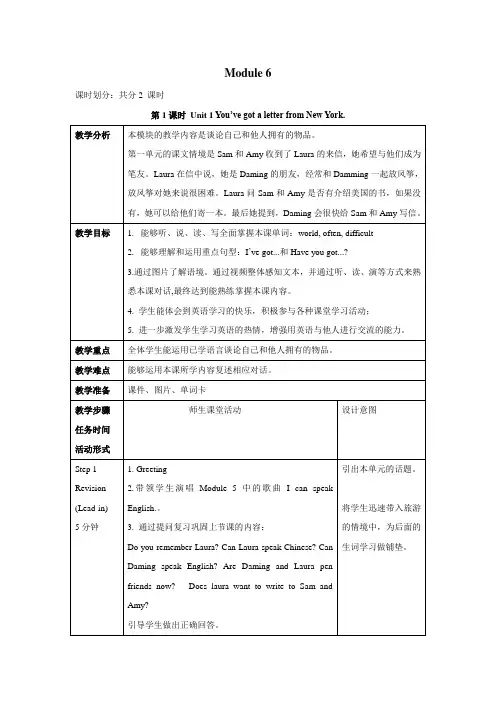
Step 5
homework
(5分钟)
Whole class
1.熟读课文。
2.我们已经了解了Laura给Sam和Amy去信的内容,请大家以Sam和Amy的名义给Laura写一封回信吧。
读写任务让学生进一步熟悉课文内容,运用并巩固所学生词。
板书设计
第1课时Unit 1You’ve got a letter from New York.
请学生看图,听录音并跟读,提醒学生注意模仿录音的语音语调。
鼓励学生根据发音规则读出生词,教师领读校正读音,并加深学生印象。
Step 4
Production
10分钟
Group work
Deal with Activity 4.
1.请学生观察课文中出现的连词“and”和“but”,教师引导学生发现这两个词连接的句子之间分别是什么关系(顺承和转折)并加以解析,完成第四部分练习题。全班一起核对答案。
4.让学生跟着录音读课文。分角色扮演。
引导学生理解练习要求。
拓宽学生的文化视野
Deal with Activity 2
(一)任务呈现
上一节课我们认识了一位新朋友Laura,她从Daming那里得到了Sam和Amy的通讯地址。今天,Sam和Amy收到了Laura的来信。让我们一起来看看信上都写了什么。
2. HasJohn got a book about the US?
3.What book hasJohn got?
再次播放录音,帮助学生理解语境。引导学生找到这些问题的答案。
2.使用图片等教具,带领学生学习单词“world”。
3.讲解课文中的重点句子:
针对“I’ve got a book ut the world.”中的have got进行讲解。
Module1Unit1It'sinthewest(教学设计)外研版(三起)英语六年级上册

- 自主学习法:引导学生自主思考,培养自主学习能力。
- 信息技术手段:利用在线平台、微信群等,实现预习资源的共享和监控。
作用与目的:
- 帮助学生提前了解本节课的知识点,为课堂学习做好准备。
- 培养学生的自主学习能力和独立思考能力。
2. 课中强化技能
教师活动:
- 导入新课:通过故事、案例或视频等方式,引出本节课的课题,激发学生的学习兴趣。
2. 设计丰富的练习和活动,如小组合作、角色扮演等,让学生在实际语境中运用方位词汇和句型。
3. 提供清晰的示范和指导,帮助学生理解和运用方位词汇进行问答。
4. 鼓励学生积极参与课堂活动,提高他们的语言表达能力和思维能力。
学具准备
Xxx
课型
新授课
教法学法
讲授法
课时
第一课时
步骤
师生互动设计
二次备课
教学方法与手段
10. 学生能够通过本节课的学习,提高思维能力和解决问题的能力,培养创新精神和实践能力。
课堂小结,当堂检测
课堂小结:
本节课主要学习了方位词汇:west, east, north, south, left, right,以及询问和回答方位的句型:Where is the...? It's in/on the...。学生能够运用所学词汇和句型描述物品的位置,提高了语言表达能力。同时,通过小组合作和角色扮演等课堂活动,学生积极参与,提高了团队合作意识和沟通能力。教师还提供了拓展资源和课后作业,帮助学生巩固课堂所学知识点和技能,提高学习效果。学生能够通过自主学习和反思总结,提高自主学习能力和自我提升的能力。通过本节课的学习,学生能够建立起对英语学习的兴趣和自信心,为今后的学习打下坚实的基础。
(三起点)外研版六年级英语上册《Module1_Unit2_第1课时教案》
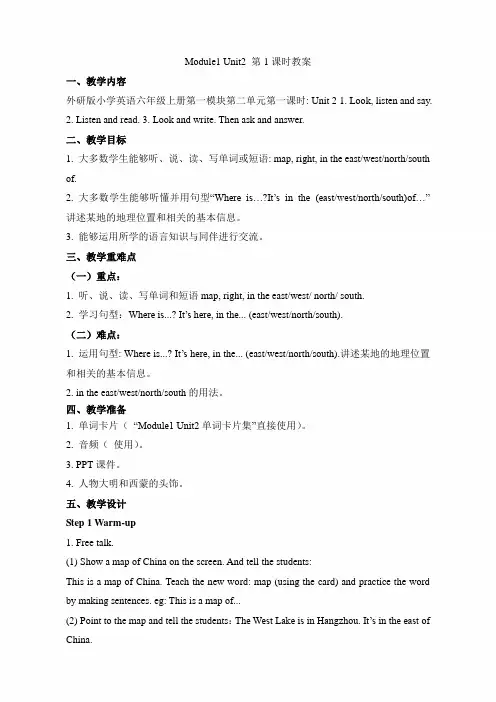
Module1 Unit2 第1课时教案一、教学内容外研版小学英语六年级上册第一模块第二单元第一课时: Unit 2 1. Look, listen and say.2. Listen and read.3. Look and write. Then ask and answer.二、教学目标1. 大多数学生能够听、说、读、写单词或短语: map, right, in the east/west/north/south of.2. 大多数学生能够听懂并用句型“Where is…?It’s in the (east/west/north/south)of…” 讲述某地的地理位置和相关的基本信息。
3. 能够运用所学的语言知识与同伴进行交流。
三、教学重难点(一)重点:1. 听、说、读、写单词和短语map, right, in the east/west/ north/ south.2. 学习句型:Where is...? It’s here, in the... (east/west/north/south).(二)难点:1. 运用句型: Where is...? I t’s here, in the... (east/west/north/south).讲述某地的地理位置和相关的基本信息。
2. in the east/west/north/south的用法。
四、教学准备1. 单词卡片(“Module1 Unit2单词卡片集”直接使用)。
2. 音频(使用)。
3. PPT课件。
4. 人物大明和西蒙的头饰。
五、教学设计Step 1 Warm-up1. Free talk.(1) Show a map of China on the screen. And tell the students:This is a map of China. Teach the new word: map (using the card) and practice the word by making sentences. eg: This is a map of...(2) Point to the map and tell the students:The West Lake is in Hangzhou. It’s in the east of China.Sanya is in the south of China. Lasa is in the west of China. Beijing is in the north of China.【设计思路】从一幅中国地图入手,激发学生的学习积极性,拉近师生间的距离。
小学英语新外研版(一起)六年级上册第一课时 Module 1 Unit 1 How long ……教案
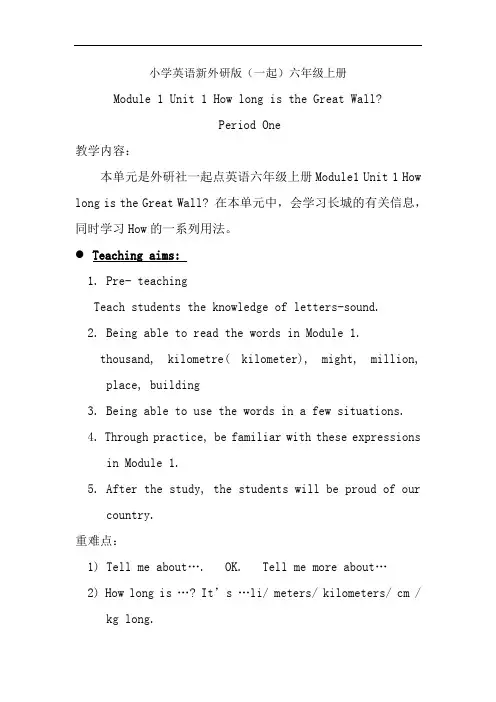
小学英语新外研版(一起)六年级上册Module 1 Unit 1 How long is the Great Wall?Period One教学内容:本单元是外研社一起点英语六年级上册Module1 Unit 1 How long is the Great Wall? 在本单元中,会学习长城的有关信息,同时学习How的一系列用法。
Teaching aims:1. Pre- teachingTeach students the knowledge of letters-sound.2. Being able to read the words in Module 1.thousand, kilometre( kilometer), might, million, place, building3. Being able to use the words in a few situations.4. Through practice, be familiar with these expressionsin Module 1.5. After the study, the students will be proud of ourcountry.重难点:1) Tell me about…. OK. Tell me more about…2) How long is …? It’s …li/ meters/ kilometers/ cm /kg long.3) How old is …? It’s… years old.4) How many… are there in …? There are more than…教具:CD-ROMTeaching steps:1. 教法,学法Teach students the knowledge ofletters-sound, which is a short-cut to read andmemorize the words.Who can say the 26 letters?Get one student to say, meanwhile, I will write them on the blackboard.a,b,c,d,e,f,g,h,i,j,k,l,m,n,o,p,q,r,s,t,u,v,w,x,y,z掐头法:f, l, m, n, s, x,去尾法:b, c, d, k, p, q, t, v, z借助汉语拼音:g, h, j, r, w, y,元音字母:a / e // i /I,/ o // u/ /### Learn more rules about word reading in the coming studies.2.Write the words on the blackboard.thousand, kilometre( kilometer), might, million, place, buildingSs: Who can read this word?Invite him/ her to read and to show others how to read.T: Give them some necessary help and rules about reading the words.3. Use the words in different situations.情景教学1) thousand 1,000 million 1, 000, 000Ten hundred is one thousand. Ten thousand is one million.There are more than one thousand students in our school.There are more than 8 million people in Weifang city.2) kilometer (km) One kilometer is one thousandmeters.The Great Wall is about 5,000 km long.3) 引导问题How far is your home from your school? It mightbe 4 km long.4) place, building Let’s talk about our school. It'sa beautiful place. There are many trees and threebuildings.### Encourage students to use different expressions to practice these new words.板书:How long is the Great Wall?It’s more than forty thousand li long.how long near alongmore than kilometre metre Homework1. Read and write the new words and Chinese meaning inyour exercises books.2. Pre-read the dialogues and passges in Unit 1. Reflection。
外研版六年级英语上册Module 1课时教案

外研版小学六年级英语上册Module1总备课【教材内容分析】本模块主要学习讲述某个地方的地理位置和相关的基本信息。
本模块的功能是:初步掌握用本模块主要句型来谈论某个地方或某件事物的情况,讲述某地的地理位置和相关的基本信息。
第一单元主要创设情景,引出话题从而进入重点语言知识的学习,主要句型是: These postcards are great! It's a picture of the Great Wall…Tell me more about…第二单元的主要句型是:Where is… It's here, in the…, Boston is in the north and Houston is the south.【模块教学目标】1.知识与技能:全体学生能朗读课文,阅读相关短文,并能按要求完成语句书写。
2.过程与方法:对所学内容主动复习和归纳。
3.情感态度与价值观:乐于接触外国文化,增强祖国意识。
Unit 1 It’s more than twenty thousand kilometers long.第一课时【教学目标】:(一)知识与技能:1. These postcards are great .2. It’s a picture of the Great Wall .3. How long is the Great Wall ?It’s about six thousand seven hundred kilometers .(二)过程与方法:讲述关于某个地方或某件事物的情况。
(三)情感、态度和价值观:【重点】: words and phrase: postcard more thousand kilometer million Mexico Canada【难点】:Sentences: Tell me more about the Great Wall. It’s a picture of great wall.【教学过程】:(一)导入:老师热情地问候学生们,欢迎他们在暑假过后回到学校。
六年级上册英语教案-Module1 Unit1 How long is the Great Wall
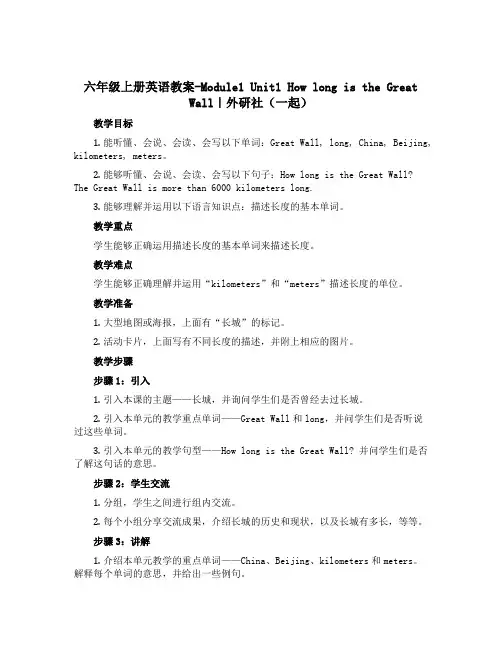
六年级上册英语教案-Module1 Unit1 How long is the GreatWall|外研社(一起)教学目标1.能听懂、会说、会读、会写以下单词:Great Wall, long, China, Beijing, kilometers, meters。
2.能够听懂、会说、会读、会写以下句子:How long is the Great Wall? The Great Wall is more than 6000 kilometers long.3.能够理解并运用以下语言知识点:描述长度的基本单词。
教学重点学生能够正确运用描述长度的基本单词来描述长度。
教学难点学生能够正确理解并运用“kilometers”和“meters”描述长度的单位。
教学准备1.大型地图或海报,上面有“长城”的标记。
2.活动卡片,上面写有不同长度的描述,并附上相应的图片。
教学步骤步骤1:引入1.引入本课的主题——长城,并询问学生们是否曾经去过长城。
2.引入本单元的教学重点单词——Great Wall和long,并问学生们是否听说过这些单词。
3.引入本单元的教学句型——How long is the Great Wall? 并问学生们是否了解这句话的意思。
步骤2:学生交流1.分组,学生之间进行组内交流。
2.每个小组分享交流成果,介绍长城的历史和现状,以及长城有多长,等等。
步骤3:讲解1.介绍本单元教学的重点单词——China、Beijing、kilometers和meters。
解释每个单词的意思,并给出一些例句。
2.通过图片或图表展示长城的长度,引出本单元的教学句型——How long is the Great Wall? The Great Wall is more than 6000 kilometers long.步骤4:练习1.学生尝试用自己的话描述长城的长度,使用刚刚学习过的句型和单词。
2.学生小组进行比赛,看哪个小组能够最快地解决活动卡片上的问题。
外研版英语六年级上册第一模块第一单元教案
Module1 Unit1How long is the Great Wall ?教学目标:1,知识目标:学习用一般现在时进行描述,2,技能目标:能够运用课文词表中出现的单词;能够运用How long is the Great Wall? It’s ten thousand li long. How old is the Great Wall? It’s more than two thousand years old. Tell me more about….描述建筑物以及Unit 1的课文。
2,情感目标:抱着认真学习的态度,积极模仿录音,大声朗读英语。
教学重点:学习并运用课文中的有用句式How long is the Great Wall? It’s ten thousand li long. How old is the Great Wall? It’s more than two thousand years old.来描述建筑物。
教学难点:收集旅行时拍摄的各地的照片或者网络图片,为各地的标志性建筑物配写简单说明学情分析:本课是本学期的第一课,内容适当,以培养学生兴趣为主。
教学设计Step1: WarmerT: Good morning, everyone .Now look at the map of the world .Do you know this place? ( Yes. It's London/Beijing/Madrid/New York.) Now I'm going to point to each city and say its name. I want you to say the number of people, please.T: London.Ss: Eight million.T: Beijing.Ss: Fourteen million.T: Well done. Now work in pairs and do the activity again.Step 2: Listen, point and find 'is/'s,are'.T: Open your book and look at Activity 1,please. What can you see? Ss: …T: Now I'm going to play the tape. (播放多媒体课文录音)Please write down all the numbers you hear.S1…( The teacher write the following words on the board.)is areT: Say the words together. Find these words in the story, please.Step 3 : Listen and say.T: I'm going to play the tape again.(再次播放多媒体课文录音)This time I'm going to stop the after A finishes talking. You are B. You can read B's sentences.T: Now work in pairs. One student is A and the other is B. Read the sentences.( The students read the dialogues in the book. Then they swap roles.)Step 4 : ExercisesListen to the story again. Then answer the questions.First, Let the students read the every sentence.Then listen to the story Then answer the every sentence.(在白板上出示有关课文内容的问题,小组间进行讨论)Answers: 2. No, it isn't. It's very long.3. It's six thousand seven hundred kilometers.4. It's got eight million people.5. It's got ( about) fourteen million people.板书设计:Module1 Unit1How long is the Great Wall ?1、How long is the Great Wall?It’s ten thousand li long.2、How old is the Great Wall?It’s more than two thousand years old.教学反思:学生经过了一个假期的休息,有些英语知识有部分遗忘。
外研版(三起)-英语-六年级上册-Module6__模块整体教案
Module6 模块整体教案模块教学分析本模块主要学习句型:Darning has got a Chinese kite and we often fly it in the park. I’ve got a kite but I can’t fly it I’ve got a knife and fork, and chopsticks. I’ve got a stamp from China, but I haven’t got a stamp from Canada. 通过介绍不同国家的人们使用不同的物品进行文化对比,复习“have/has got”的用法。
第一单元教学内容围绕着主人公Darning的新朋友Laura写给Sam和Amy的一封请求成为他们的笔友的信展开了一系列对话和练习活动。
第二单元教学内容围绕中国小朋友玲玲和外国小朋友萨姆谈论个人所拥有的物品而展开。
本模块的教学重心应放在如何让学生用本模块主要句型“I have got... He/She has got… Have you got...?”谈论个人所拥有的物品,通过介绍不同国家的人们使用不同的物品进行文化对比,复习“have/has got”的用法。
本模块的功能是:初步掌握用本模块主要句型来谈论个人所拥有的物品。
第一单元主要是创设情景,引出话题从而进入重点语言知识的学习。
主要句型是Have you got..? Yes, I have. / No, I haven’t Darning has got a Chinese kite and we often fly it in the park 第二单元的主要句型是:I’ve got a knife and fork, and chopsticks. I’ve got a stamp from China, but I haven’t got a stamp from Canada.模块教学目标☆知识目标1. 能理解并会说唱Unit 2 Activity 5 Listen and say. Then chant.2. 能听、说、读、写Unit 1 Activity 1 Look, listen and say. Activity 3 Listen and say. Unit 2 Activity 1 Look, listen and say. Activity 2 Listen and read.中的单词和句子。
外研版(三起)-英语-六年级上册-Module 6 Unit 1 You've got a letter from New York 教学设计
Module6 Unit1 You’ve got a letter from New York. 教学设计一、教学内容分析本模块的教学内容是谈论自己和他人拥有的物品。
第一单元的课文情境是Sam 和Amy 收到了Laura的来信,她希望与他们成为笔友。
二、教学目标1. 学生能听懂、认读、书写词汇:often, difficult.2. 学生能听懂、能说句型:You’ve got a letter from New York, but it’s not from Daming. Daming has got a Chinese dragon kite and we often fly it in the park.3. 学生能运用“have got, has got”这类语句来谈论自己和他人拥有的物品,同时理解“and”,“but” 在句中表示的逻辑关系。
三、教学重点学生能运用“have got, has got”这类语句来谈论自己和他人拥有的物品。
四、教学难点理解“and”,“but”在句中表示的逻辑关系。
五、教具准备PPT、人物贴纸、点读笔六、教学流程Step1 Warm-up and lead-in1. 师生互致问候2. T:Are you ready for the class? Really? I don’t believe it! 以此来询问学生:Have you gota book/ pen/ kite/ hat? Has he/she got …? 询问hat时,若学生回答No, I haven’t. 便拿出准备好的Halloween 的帽子送给学生。
3. 歌谣Have you got a book? Have you got a book?Yes, I have. Yes, I have. I have got a book.Have you got a pen? Have you got a pen?Yes, I have. Yes, I have. I have got a pen.Has he got a kite? Has he got a kite?No, he hasn’t. No, he hasn’t. He hasn’t got a kite.Has she got a hat? Has she got a hat?Yes, she has. Yes, she has. She has got a hat.【设计意图】对于新课开始前的问候回答,学生往往形成了定式,如How are you? 无论好与不好都回答I’m fine, thank you. 对于Are you ready for the class?都会回答Yes. 所以在本环节,当学生回答“Yes”后,教师表现出怀疑,从而引出句型“Have you got….”同时,万圣节女巫帽的出现,一方面激发了学生学习的兴趣,另一方面也为即将到来的万圣节做了文化渗透。
外研版(一起)六年级 英语上册 《Module 1 Unit 1》教案设计
外研版(一起)六年级英语上册《Module 1 Unit 1》教案设计1. 教学目标1.掌握单词:school, class, teacher, student, book, pen, pencil, ruler, eraser, bag, desk, blackboard、whiteboard、chalk、board marker。
2.了解问候语及道别语。
3.熟悉英语习惯用语:Good morning/afternoon/evening. What’s this in English? This is a/an…,Thank you. You’re welcome. Goodbye.4.能唱歌曲:Hello, hello, let’s sing a song. Hello, hello, what’s your name?2. 教学内容2.1 单词学习1.学习并掌握以下单词:school class teacher studentbook pen pencil rulereraser bag desk blackboardwhiteboard chalk board marker-2.本课单词学习的方法:单词卡片、图片识别、游戏等。
2.2 句型短语1.教授以下句型:•Good morning/afternoon/evening.•What’s this/that in English? This/That is a/an…•Thank you.•You’re welcome.•Goodbye.2.教师可用汉语解释以上句子的含义,并在黑板上写出单词,边读边写,童谣的方式,增强记忆可行性。
2.3 歌曲教授歌曲“Hello, hello, let’s sing a song. Hello,hello, what’s your name? I’m (name). Nice to meet you! Goodbye, goodbye, see you soon.”3. 教学过程3.1 预热环节做好适当预热,把学生注意力聚焦在英语学习上。