
高中英语语法分类总结 - 动词不定式的基本形式
3.___ more time, we could do it better. A.Giving B.To give C.Given D.To be given
4.A young man __ novels came to us yesterday. A.to write B.writing C.written D.wrote
students can be dangerous.
Scientific experiments ______ca_r_r_ie_d__obuyt students can be dangerous.
A few verb-eds before nouns can express past meanings instead of passive meanings.
说出-ing form动作的执行者时,须用复合结构
1.Do you mind opening the door? →Do you mind me/my opening …
2.Going there saved us a good deal of trouble. →Tom’s going there saved us a good …
配套视频教程mba518
ing-form 的基本形式
主动语态 一般式 doing 完成式 having done
被动语态 being done having been done
ing-form与/比谓语的动作同时、先发生、后发生
一般式
ing-form比谓语的动作先发生
完成式(强调先后关系)
1.Going down town I met a friend. 同时
5.Having noted down her name,the man went away. 先
配套视频教程mba518
非谓语动词功能比较
to do
主表宾定补状 语语语语语语
-ing form
pp
主语、表语、宾语
1. to do 表示具体的动作,-ing form表示泛指的动作。
eg.I like skating,but I don’t like to skate today. Playing with fire is dangerous. Look out!To play with fire is dangerous. 2.“there is no +主语”句型中,多用-ing form.
I fancy it has done you a lot of good not going. Not seeing John,I asked where he was. Not having done it right, I tried again.
配套视频教程mba518
-ing form 与 pp 的区别
2.It is necessary to study a foreign language. —It is necessary for students to study a… 3.To do such a thing is stupid. =It is stupid to do such a thing. —It is stupid of you to do such a thing. —You are stupid to do such a thing. 4.It is wrong to tell a lie. —It is wrong of him to tell a lie. —He is wrong to tell a lie.
eg.There is no joking about such matters.
定语
1.从时态上看,-ing form表示正在进行的动作 pp表示已经完成的动作,to do表示将来的动作。
eg.He attends the meeting being held in the room now. He attended the meeting held yesterday. He will attend the meeting to be held tomorrow.
2.Martin insisted on going to work in spite of his illness.
后
3.I shall never forget seeing the Great Wall for
the first time. 先
4.Allan repented having shot the bird. 先
A.Being B.To be C.It is
配套视频教程mba518
D.It being
to do的复合结构 1.for sb. to do sth.
2.of sb. to do sth.
→sb.is/are adj.to do sth.
常见的形容词有:good=nice/bad, kind/cruel=rude, clever=wise/stupid=silly, right /wrong,sensible
These female pigs are cloned. So we call them pigs__th_a_t_/w__h_ic_h_a_r_e_c_lo_n_ed
配套视频教程mba518
The kidnappers were using a _____st_oclaern. (steal)
ing form的复合结构
↗主语
1.形容词性物主代词/名词所有格+ing form →表语
2.代词宾格/名词+ing form →宾语
↘宾语
说出To do动作的执行者时,须用复合结构
1.To do the job is impossible. =It is impossible to do the job. —For a child to do the job is…
1.I could feel the wind ___ on my face from an open window. A.to blow B.blowing C.blown D.to be blowing
2.We’ll meet Mr.Black,___ as a famous scientist. A.knowing B.to be known C.known D.being known
作定语时,比较对象为被修饰词
作状语时,比较对象为句中主语
1.The story was ___,we were all ____. A.moving,moving B.moved,moved C.moving,moved D.moved,moving
2.There is a ___ expression on his face.Maybe the problem is too difficult for him. A.puzzled B.puzzling C.puzzle D.to puzzle
The name ________in the letter was unknown to me.(mentmioenn)tioned
The firemen were rescuing the people _____
in the fire. (trap)
trapped
Scientific experiments which are carried out by
不定式与谓语同时发生 不定式比谓语先发生
进行式 完成式
1.He is too young to have seen the old society. 2.The book is said to have been translated
into Russian.
e, I am supposed to be calling you to lunch. 4.You are too young to be meeting young man.
3.Being late again made the teacher angry. →His being late again made…
配套视频教程mba518
1.Crossing the street,he was knocked down by a bus. 时间
2.Being sick I stayed at home. 原因 3.Seen in the light, it is not as serious as people suppose.条件 4.Knowing all this, they made me pay for the damage. 让步 5.He sat in the armchair,reading the newspaper. 伴随 6.The train spent too much time stopped, waiting for the
-ing form表示主动,正在进行,pp表示被动,已经完成
作表语时或定语时,-ing form表示“令人” ,pp表 示“感到”,常见的有下列感官动词:move ,surprise,astonish,delight,comfort,disappoint,puzzl e,frighten
作宾补时,比较对象为宾语
3.With his son too___, the father was sad.
A.disappointed
B.disappointing
4.She let out a ___ voice and we ran to her hurriedly.
A.frightened
B.frightening
eg.they worked hard to pay for the necklace. 目的
高中英语非谓语知识总结

高中英语非谓语知识总结高中英语非谓语知识点动词不定式动词不定式(infinitive)是动词的一种非限定形式,即非谓语动词形式,它有两种形式:一种是“to + 动词原形”构成(to- infinitive);另一种是不带to 的不定式,即动词原形(bare- infinitive)。
所有行为动词都有不定式形式,其否定式是在不定式前加not。
动词不定式(或不定式短语)没有人称和数的变化,在句子中不能作谓语。
(一)动词不定式的时态和语态动词不定式有一般式、进行式、完成式、完成进行式四种时态变化形式,一般式和完成式有被动语态变化形式。
1、不定式的时态意义不定式的时态是以句中谓语动词的时间为依据的(1)一般式表示的动作或状态通常发生在谓语动词之后或同时发生。
They made plans to live in Paris. 他们计划住在巴黎。
(to live 发生在made plans之后)(2)进行式表示其动作正在进行,与谓语动词发生的动作同时进行。
He pretended to be listening to me carefully. 他假装认真地听我讲。
注意:不定式的进行式常同may, might, can, could, must, need, ought to, should, will, would 等情态动词连用,表示“可能、应当或想必”正在进行的动作。
You oughtn’t to be talking so much. 你不应该说这么多。
He might be reading a novel at that time. 那时他可能正在读小说。
(3)不定式的完成时表达下列意义:A. 不定式的完成式所表示的动作或状态发生在谓语动词所表示的动作之前。
I am sorry to have kept you waiting. 对不起,让你久等了。
(to have kept发生在I am sorry所表示的时间之前)She is said to have just completed a novel. 据说她刚完成一部小说。
高中英语知识点归纳动词的不定式与动名词

高中英语知识点归纳动词的不定式与动名词动词的不定式与动名词是英语中重要的语法知识点,具有广泛的用途。
在高中英语学习中,学生需要熟练掌握不定式和动名词的形式、用法以及常见的搭配。
本文将对动词的不定式与动名词的相关知识进行归纳总结,并给出一些常见的例句和实际运用场景。
一、动词的不定式不定式是动词的一种非谓语形式,通常由“to + 动词原形”构成。
不定式在句子中可以作为主语、宾语、表语、定语或状语。
1. 不定式作主语不定式作主语时,常常位于句首,用来指代具体的行为、想法或概念。
例句:- To learn a foreign language is not easy.(学习一门外语并不容易。
)- To avoid traffic jam, we decided to take the subway.(为了避免交通堵塞,我们决定乘地铁。
)2. 不定式作宾语不定式作宾语时,常常跟在某些动词(如want, hope, plan, decide等)后面,表示将要发生的动作。
例句:- She wants to be a doctor in the future.(她将来想成为一名医生。
)- We have decided to visit the Great Wall next week.(我们决定下周去参观长城。
)3. 不定式作表语不定式作表语时,常常跟在be动词(如is, am, are, was, were等)后面,表示主语的身份、职业或角色。
例句:- His dream is to become a famous writer.(他的梦想是成为一名著名的作家。
)- Their job is to teach English to international students.(他们的工作是教国际学生英语。
)4. 不定式作定语不定式作定语时,通常放在被修饰的名词或代词之后,用来修饰它们。
例句:- I have a book to read this weekend.(这个周末我有一本书要读。
高中英语语法总结大全-动词不定式
高中英语语法总结大全之动词不定式不定式作宾语1) 动词+ 不定式afford aim appear agree arrange ask be decide bother care choose come dare demand desire determine expect elect endeavor hope fail happen help hesitate learn long mean manage offer ought plan prepare pretend promise refuse seem tend wait wish undertake 举例:The driver failed to see the other car in time.司机没能及时看见另一辆车。
I happen to know the answer to your question.我碰巧知道你那道问题的答案。
2)动词+不定式;动词+宾语+不定式ask, beg, choose, expect , hate, help intend like, love, need prefer, prepare, promise, want, wish…I like to keep everything tidy.我喜欢每件东西都保持整洁。
I like you to keep everything tidy.我喜欢你年使每件东西都保持整洁。
I want to speak to Tom.我想和汤姆谈话。
I want you to speak to Tom.我想让你和汤姆谈话。
3)动词+疑问词+ todecide, know, consider forget, learn, remember, show, understand, see, wonder, hear, find out, explain, tellPlease show us how to do that. 请演示给我们如何去做。
高中英语语法系统讲解之七非谓语动词

高中英语语法系统讲解之七非谓语动词在英语中,不作句子谓语,而具有除谓语外其他语法功能的动词,叫做非谓语动词。
它包括动词不定式、动名词、现在分词、过去分词。
一. 动词不定式不定式由“to + 动词原形”构成,其否定形式是“not to do”或“never to do”。
不定式可以带宾语或状语构成不定式短语,没有人称和数的变化,但有时态和语态的变化。
不定式可作主语、宾语、状语、表语和定语,但不能单独作谓语。
不定式的逻辑主语用“for或of + 名词或代词宾格”构成。
1. 动词不定式的时态和语态动词不定式保留了动词的一些特征,具有时态和语态的变化;动词不定式有一般式、进行式、完成式和完成进行式;有主动式,也有被动式。
○1动词不定式的时态、语态形式(以动词write为例)○2不定式的时态A. 一般式:不定式的一般式表示的动作或状态与谓语动词表示的动作同时发生或在其之后发生。
如I want to have a holiday as soon as possible.He seems to know the secret.B. 完成式:动词不定式表示的动作在谓语动词表示的动作之前发生。
如I am sorry to have given you so much trouble.C. 进行式:不定式的进行式表示不定式的动作发生在谓语动词之后或同时发生。
如Thousands were reported to be working in concentration camps. D. 完成进行式:不定式表哦市的动作在谓语动词表示的动作之前已经发生,并仍在进行。
如He appears to have been waiting a long time.○3不定式的语态A. 当不定式逻辑上的主语是这个不定式所表示的动作的承受者时,不定式一般要用被动形式。
如He asked to be sent to work in the countryside. B. 不定式修饰的名词或代词和不定式逻辑上构成主谓关系时,不定式往往用主动形式。
高中英语英语语法动词不定式总结的归纳总结
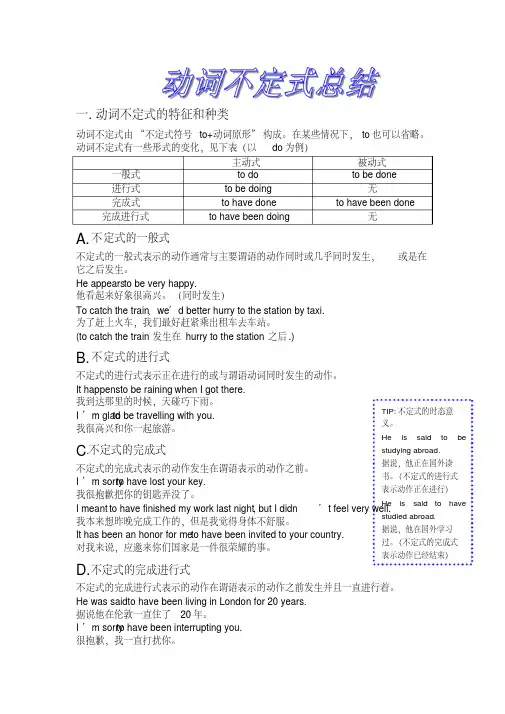
一.动词不定式的特征和种类动词不定式由“不定式符号to+动词原形”构成。
在某些情况下,to 也可以省略。
动词不定式有一些形式的变化,见下表(以do 为例)主动式被动式一般式to do to be done进行式to be doing 无完成式to have done to have been done完成进行式to have been doing无A.不定式的一般式不定式的一般式表示的动作通常与主要谓语的动作同时或几乎同时发生,或是在它之后发生。
He appears to be very happy.他看起来好象很高兴。
(同时发生)To catch the train ,we ’d better hurry to the station by taxi.为了赶上火车,我们最好赶紧乘出租车去车站。
(to catch the train 发生在hurry to the station 之后.)B.不定式的进行式不定式的进行式表示正在进行的或与谓语动词同时发生的动作。
It happens t o be raining when I got there. 我到达那里的时候,天碰巧下雨。
I ’m glad to be travelling with you. 我很高兴和你一起旅游。
C .不定式的完成式不定式的完成式表示的动作发生在谓语表示的动作之前。
I ’m sorry to have lost your key.我很抱歉把你的钥匙弄没了。
I meant to have finished my work last night, but I didn ’t feel very well.我本来想昨晚完成工作的,但是我觉得身体不舒服。
It has been an honor for me to have been invited to your country.对我来说,应邀来你们国家是一件很荣耀的事。
D.不定式的完成进行式不定式的完成进行式表示的动作在谓语表示的动作之前发生并且一直进行着。
非谓语动词讲解高中
非谓语动词讲解高中非谓语动词是指在句子中作动词的用法,而不是表示谓语动作或状态的主要成分。
非谓语动词包括动词不定式、动名词和分词。
在高中英语中,非谓语动词经常用于句子的修饰、独立主语和补语等的结构。
下面将对非谓语动词进行详细的讲解和提供相关的参考内容。
一、动词不定式(infinitive)动词不定式是动词的一种非谓语形式,常用于句子中作主语、表语、宾语、状语和补足语等。
动词不定式的基本形式是“to+ 动词原形”,它具有名词、形容词和副词的特点。
1. 作主语- It's difficult to learn a new language.(学习一门新语言是困难的。
)2. 作宾语- I want to go to the movies.(我想去看电影。
)3. 作表语- Her dream is to become a doctor.(她的梦想是成为一名医生。
)4. 作状语- She studies hard to improve her grades.(她努力学习以提高自己的成绩。
)5. 作补语- He made me laugh.(他让我笑了。
)二、动名词(gerund)动名词是动词的一种非谓语形式,常用于句子中作主语、宾语、表语和状语等。
动名词的基本形式是动词+ing形式,它具有名词的特点,可以在句子中起到名词的作用。
1. 作主语- Swimming is good exercise.(游泳是很好的运动。
)2. 作宾语- I enjoy reading novels.(我喜欢读小说。
)3. 作表语- His favorite activity is playing basketball.(他最喜欢的活动是打篮球。
)4. 作状语- She learned English by watching American movies.(她通过看美国电影学习英语。
)三、分词(participle)分词是动词的一种非谓语形式,常用于句子中作定语、状语和表语等。
英语语法-动词不定式课件
d. saw
forget/remember doing sth.
stop/go on to do sth
stop/go on doing sth
The scientist stopped __ to me though he was
busy.
√
a. talking
b. to talk
c. to have talk
It’s +adj+of sb+to do sth. Eg:你能邀请我,你真是太善良了。 It’s very kind of you to invit me. 若形容词是描述人的性格、品质的,如 kind,good,nice,right,wrong,clever, careless,polite,foolish等,用of sb. Eg:你真聪明,解出了这道数学题。 It’s clever of you to work out the maths problem.
1. It takes you ten minutes to get there. 主语
2. I hope to see him soon.
宾语
3. His wish is to become an artist.
表语
4. People eat to live, but not live to eat. 状语
I wish to go with you.
need to do learn to do agree to do
plan to do decide to do refuse to do
begin to do start to do
try to do
forget to do remember to do like to do
高中英语知识点归纳动词不定式的用法和结构
高中英语知识点归纳动词不定式的用法和结构动词不定式是英语中的一种非谓语动词形式,由动词原形加上to构成。
它可以充当名词、形容词或副词,具有时态、语态和语气的特点。
在高中英语学习中,动词不定式的用法和结构非常重要。
本文将对其进行归纳总结。
一、动词不定式作主语动词不定式可以充当句子的主语,常见的结构有:1. It + be + 形容词 + 不定式作主语例如:- It is important to learn a foreign language.学习一门外语很重要。
- It is necessary to finish the task before deadline.在截止日期之前完成任务是必要的。
2. 不定式结构作主语例如:- To travel around the world is my dream.环游世界是我的梦想。
- To study hard is the key to success.努力学习是成功的关键。
二、动词不定式作宾语动词不定式可以作及物动词的宾语,常见的结构有:1. 动词 + 不定式作宾语例如:- I want to go shopping this weekend.这个周末我想去购物。
- She decided to take a break and relax.她决定休息一下,放松一下。
2. 常见的动词有:agree, hope, promise, refuse, plan, learn, wish等。
三、动词不定式作补语动词不定式可以作宾语补足语,常见的结构有:1. 动词 + 宾语 + 不定式作补足语例如:- They made him work overtime.他们让他加班工作。
- We find it interesting to solve puzzles.我们发现解谜很有趣。
2. 情态动词 + 动词原形作补足语例如:- He can't afford to buy a new car.他买不起新车。
动词不定式的高中总结
动词不定式的高中总结动词不定式是英语学习中的重要语法点,也是高考的必备知识点。
本文将从定义、种类、语法功能、用法、注意事项以及练习与巩固等方面,对动词不定式进行总结。
1、动词不定式的定义动词不定式是一种非谓语动词形式,由“to+”动词原形组成,可以表达一个完整的动作,具有名词、形容词和副词的特点。
在句子中,它可以作为主语、宾语、宾语补足语、状语等成分。
2、动词不定式的种类动词不定式可以分为三种类型:基本形式、完成形式和被动形式。
基本形式是“to+”动词原形;完成形式是“to have+过去分词”;被动形式是“to be+过去分词”。
3、动词不定式的语法功能动词不定式可以修饰名词、代词、形容词等,也可以作为主语、宾语、宾语补足语、状语等成分使用。
在句子中,它可以表示未来的动作或状态,或者表示一个条件、一种可能性等。
4、动词不定式的用法5、动词不定式的用法包括变化、重复、否定等。
变化包括第三人称单数变化、现在分词变化和过去分词变化。
重复包括原形动词和动词短语的使用。
否定形式是“not+动词不定式”。
6、动词不定式的注意事项在使用动词不定式时,需要注意一些问题,例如不能用于被动结构、无被动态等。
此外,还需要注意一些常用的动词不定式短语,如“to be able to”、“to prefer”、“tochoose”等。
7、练习与巩固为了更好地掌握动词不定式的知识,可以进行一些针对性的练习。
例如,可以尝试用动词不定式造句,或者完成一些语法填空题和选择题等。
通过不断的练习,可以加深对动词不定式的理解和掌握。
动词不定式是英语学习中的重要语法点,也是高考的必备知识点。
通过掌握动词不定式的定义、种类、语法功能、用法、注意事项以及练习与巩固等方面,可以更好地掌握这一语法知识,提高英语应用能力。
高考高中英语核心语法详解 动词不定式
高考高中英语核心语法详解动词不定式一、基础知识1.构成方式:动词原形前加to 构成,即 to + v;同时继承原形动词本身的所有用法;传统语法上也叫非谓语动词。
常见形式:以do为例一般时:主动态 to do(原形) ;被动态 to be + done (过去分词);进行时:主动态 to be + doing(现在分词);无被动态;完成时:主动态 to have +done (过去分词);被动态 to have been+ done过去分词);完成进行时:主动态 to have been +doing (现在分词);无被动态;否定形式: not/never to + v;2.内在含义:未做之事,具有不确定的语气;要去做某事,或是未来的一种状态。
3. 动词不定式to的省略(1)使役动词,指的是像 let, make, have, get…之类的动词,共同点是都带有强迫意味,没有不确定的语气。
Now let the boy go.现在让男孩走。
(2) 感官动词,指的是像 see, hear, feel, smell…之类的动词,表示看到、听到、感觉到后面那件事情应该确实发生了,才能够看到或听到。
不适合采用具有不确定意味的不定词.Did you feel the desk shake? 你感到课桌摇晃了吗?4. 表示不定式to与介词to的区别不定式to,介词也拼成to,有时会造成混淆。
不定式的to带有不确定语气,后面要接原形动词;介词 to 类似 toward,表示「对、向」,后面要接名词(包括动名词)。
(1)I used to walk 3 km to school when I was a kid. (我小时候经常走三公里上学。
)(表示过去的习惯,即要去做什么)(2)I am looking forward to spending the weekend in the mountains.(我盼望到山上去过周末。