
新高一英语外研版Module 4 Sandstorms in Asia
新教材高一英语Unit 4 Sandstorms in Asia仁怀市酒都高级中学周洪敏课堂教学是高中英语教学的主要途径,而课堂教学又是在教学活动中得以体现。
在新课程背景下,构建以学生为主体的有效课堂教学活动成为英语教学的追求。
然而在当前的高中英语教学实践中,我们也可看到:The same teacher , the same class and the same students’ books , but the diffe rent effects on students .反思我们目前的课堂教学,不能只注意活动的多样性而忽略对学生认知水平的了解;不能只关注活动却缺少语言;于是,要上好一堂学生听得懂的课,上一优质课,是教学的关键,所以,应从课堂教学的两个重要方面即课堂活动的设计和实施,并结合课例,探讨如何提高英语课堂教学活动的有效性。
一.课堂教学活动设计的有效性课堂活动设计的有效性是课堂活动有效性的基础和起点,要想提高课堂活动的质量,首先要靠教师精心设计课堂的活动内容。
无效的设计是不可能牵动有效的课堂学习活动的。
课堂活动应有利于学生获得语言知识和发展语言的技能。
教师设计和安排的各项活动都必须有明确的目的,每个活动都应以达成教学目标为导向。
如果教学活动脱离了教学内容,偏离了教学目标,那么再有趣的教学活动也难以收到理想的教学效果。
二.活动的设计要有利于激发学生学习英语的兴趣案例1:现以新教材高一英语Unit 4 Sandstorms in Asia中的Reading and V ocabulary部分的教学为例,来介绍一下阅读课教学活动的设计和应用。
设计思路如下:先让学生进行课前几分钟的free talk以持续发展学生听和说的技能;接下来通过和学生用英语就weather的对话导入本单元模块的中心话题“sandstorms”(沙尘暴),并让学生就这一中心话题进行open discussion;然后要求学生完成通过多媒体课件设置的有关本阅读文中语言知识方面的一系列Task-based activities来体验和运用语言;再然后要求学生通过小组讨论的形式进一步巩固所学的内容并共同评价活动的落实情况;最后由教师引导学生将课文知识进行适当的延伸。
1.教学目标围绕本单元模块的中心话题“sandstorms”(沙尘暴),一方面让学生掌握该阅读文的大意及阅读文中所包含的一些语言知识,另一方面对学生渗透“环保意识”的德育理念,增强其社会责任感。
在小组讨论的基础上,学生能独立完成一篇关于“sandstorms”习得的短文。
2.教学步骤:⑴free talk :课前给学生约3分钟进行free talk,一方面有利于让学生争取更多的交际机会、发展听说技能,另一方面有利于塑造学生积极参加语言学习活动和大胆实践的精神。
⑵lead-in通过谈论今天的天气导入话题“sandstorms”(沙尘暴):T: What’s the weather like today?S: It’s sunny(or: rainy/windy---)T: Is the weather nice or bad?S: (Suppose today’s weather is sunny. The Ss will answer like this.) Very nice.T: En, nice, very nice. But the weather is not always nice. Now listen to another sound and tell me what your feeling is.(此时教师可用多媒体播放一些灾难性天气的画面及声音让学生体验,然后询问学生的感受)S:(学生自然会答)Terrible, very terrible!T: En, terrible! It’s really terrible! And we can call the terrible weather “natural disaster”. Do you know “disaster”?S: Yes, we doT: Good. We have just learnt some disasters in the last module—Module 3. And can you speak out the names of some disastrous weather in the module?S: Yes. Such as flood, hurricane, lightning and tornado.T: Oh, it’s wonderful! And in this module—Module 4, we’ll continue to learn about another disastrous weather named sandstorms. Let’s go!由于这个导入通过多媒体创设了真实的情境,且导入的话题联系了实际生活,因而很快地激起了学生的表达欲望和学习热情。
加之导入的话题回顾了前一单元模块所学的内容,每个学生都敢于参与进来,所以课堂气氛非常活跃。
于是我趁热打铁,迅速转入本模块话题讨论之中。
⑶Pre-reading open discussion教师以开放讨论的形式设置以下问题:Have you ever been in a sandstorm? If yes, describe it to us. If not, please imagine what it will be like.设计这项活动的目的是为每个学生营造一种充分表达自己观点和充分发挥想象力的民主、和谐的课堂教学氛围,同时通过这种相互沟通的开放式讨论,每个学生多少能从他人那儿获取有关sandstorms的一些信息,这为后面正式开始阅读作了很好的铺垫。
⑷Show the Ss some pictures and ask them to recognize which one refers tosandstorms. And say why.经过上面开放式讨论,几乎每个学生对sandstorms的特征有了一定的了解。
为了将学生头脑中的想象和现实联系起来,我借助多媒体展示出一些天气图片,要求学生从中辨别哪一张图片内的天气是sandstorms。
picture 1 picture 2 picture 3picture 4 picture 5 picture 6学生们普遍反映,经过开放讨论后再把他们带入到一种真实的学习情境中,⑸Reading :阅读是本课教学活动的重心,这一部分所要达到的教学目的就是使学生整体了解课文内容,通过语篇教学来掌握课本知识,并通过完成由多媒体课件设置的有关课文中语言知识方面的一系列Task-based activities(任务驱动型活动)来体验和运用语言。
具体设计如下:Ⅰ. Fast readingThis teaching step can be designed as follows:1)T: If we want to learn more about sandstorms. Let’s get close to them. Now please read thetext quickly with the tape of it and try to find out the answers to the following questions:①What’s a sandstorm?②What’s the weather experts’advice when a sandstorm comes? Why do they advise so?2)In order to help the Ss (to) read the text better, the teacher can ask the Ss to finish Activity 2 at Page 33.Ⅱ. Careful readingActivity 1.Directions: Ask the Ss to choose the correct answer by the context(上下文)of this text.①Sand dunes (in Paragraph 2)mean _____(a) plants growing in sand (b) sand hills②desertification (in Paragraph 3) means _____(a) making land become desert (b) throwing sth away③If you want to wear a mask (in Paragraph 5), you should wear it over your ____(a) face (b) body不难看出,以上阅读活动的设计遵循了任务型教学的新理念,学生们在这些活动中注意力非常集中,头脑反映也很灵活,他们不仅获得相当的成就感,且在生动的应用活动中理解了所学的知识,并通过体验和运用语言促进了语言知识、交际技能与情感体验的衔接。
其中,Fast reading部分的第②个问题后附加的Why do they advise so?有利于培养学生用英语思维的习惯及发挥一定的创造潜能;Careful reading部分的Activity 2对他们学习策略的培养是大有裨益的。
为了将所学的知识进一步升华,我还设计了下一活动。
⑹Further discussion教师要求学生以小组合作的形式讨论以下问题:Sandstorms brings us not only “sand”but also-----? 并提出了下面两点要求:①each member in the group is supposed to speak; ②write down key words and sentences学生们大都能围绕traffic / health / travel / environment / etc.等各抒己见。
设计此项活动的目的是将所学的知识与现实生活联系起来,渗透德育教育的理念,以帮助学生树立正确的人生观,增强社会责任感,全面提高人文素养。
⑺Homework为了实现由课堂向课外的延伸,也为了引起学生更强烈的情感共鸣,我用多媒体展示了一些引发sandstorms的图片:⑴atmospheric factors ⑵deforestation ⑶excessive use of water resources然后要求学生根据以上图片并结合所学的知识用英语写一篇120字左右的短文,且短文必须说明以下2个问题:⑴What causes sandstorms?; ⑵As a senior student, what should we do to prevent sandstorms?总之,有效的课堂活动有利于学生获得英语知识、发展语言技能和提高实际语言运用能力,并激发情感,促进学生的发展。
高一英语 Book Ⅲ Module 4 Sandstorms in Asia学案 外研版
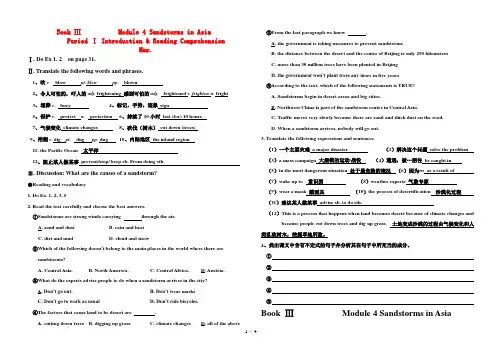
Book Ⅲ Module 4 Sandstorms in AsiaPeriod Ⅰ Introduction & Reading ComprehensionMar.Ⅰ. Do Ex 1. 2 on page 31.Ⅱ. Translate the following words and phrases.1、吹v.blow pt. blew pp.blown2、令人可怕的,吓人的adj. frightening 感到可怕的adj.frightened v. frighten n. fright3、埋葬v.bury4、标记,手势,迹象sign5、保护v.protect n.protection6、持续了10小时last (for) 10 hours7、气候变化climate changes 8、砍伐(树木)cut down (trees)9、挖掘v. dig pt.dug pp. dug 10、内陆地区the inland region11. the Pacific Ocean 太平洋12、阻止某人做某事prevent/stop/ keep sb. From doing sth.Ⅲ. Discussion: What are the causes of a sandstorm?●Reading and vocabulary1. Do Ex. 1, 2, 3, 52. Read the text carefully and choose the best answers.①Sandstorms are strong winds carrying through the air.A. sand and dustB. rain and heatC. dirt and mudD. cloud and snow②Which of the following doesn’t belong to the main places in the world where there aresandstorms?A. Central Asia.B. North America.C. Central Africa.D. Austria.③What do the experts advise people to do when a sandstorm arrives in the city?A. Don’t go out.B. Don’t w ear masksC. Don’t go to work as usualD. Don’t ride bicycles.④The factors that cause land to be desert are .A. cutting down treesB. digging up grassC. climate changesD. all of the above⑤From the last paragraph we know .A. the government is taking measures to prevent sandstormsB. the distance between the desert and the center of Beijing is only 250 kilometersC. more than 30 million trees have been planted in BeijingD. the government won’t plant trees any m ore in five years⑥According to the text, which of the following statements is TRUE?A. Sandstorms begin in desert areas and big cities.B. Northwest China is part of the sandstorm center in Central Asia.C. Traffic moves very slowly because there are sand and thick dust on the road.D. When a sandstorm arrives, nobody will go out.3. Translate the following expressions and sentences.(1)一个主要灾难a major disaster (2)解决这个问题solve the problem (3)a mass campaign 大规模的运动/战役(4)遭遇,被…困住be caught in(5)in the most dangerous situation 处于最危险的境况(6)因为…as a result of(7)wake up to 意识到(8)weather experts 气象专家(9)wear a mask 戴面具(10)the process of desertification 沙漠化过程(11)建议某人做某事advise sb. to do sth.(12)This is a process that happens when land becomes desert because of climate changes and because people cut down trees and dig up grass. 土地变成沙漠的过程由气候变化和人类乱砍树木,挖掘草地所致。
《Module 4 Sandstorms in Asia》(外研版必修3)
5.atmosphere n.
大气.大气层;the atmosphere around the earth地球周围的气
体 空气; The atmosphere of the city is very much polluted.
那个城市的空气受到严重污染。
气氛 :The hotel had a relaxed atmosphere . 这个宾馆有很宽松的氛围 The atmosphere at home was rather tense.
e.g.: such events may forecast Nhomakorabeaars.
E.g. The Federal Reserve Bank forecasts that the economy will grow by 2% this year.
联邦储备银行预言今年经济将增长百分之二
forecast n 预测 sales/growth/weather forecast 销售/增长预测/天气预报
8 Complain V .抱怨 ,发牢骚; 诉说( to sb) a. complain (that clause)
eg. She complained that no one had been at the airport
to meet her. 她抱怨说没人到机场去接她
b. complain about/of
这部电影涉及到我们的日常学校生活。
Her job is something concerned with computers.
他的工作和计算机有关。
c. be concerned in sth
More than one person is concerned in the crime.
高一英语Module 4 Sandstorms in Asia外研社知识精讲
高一英语Module 4 Sandstorms in Asia外研社知识精讲【本讲教育信息】一. 教学内容:Module 4 Sandstorms in Asia教学目标:通过介绍亚洲(主要是中国) 沙尘暴的情况,引入了与沙尘暴和环保有关的词汇。
要求学生了解沙尘暴方面的知识并掌握相关词汇,培养学生用英语谈论沙尘暴及环保的语言技能。
单词:sandstorm frightening inland mass campaign dune desertificationprocess citizen dust forecast strengthen cycle maskatmosphere carbon dioxide chemical environmentgarbage melt pollution recycle coastal concernedevidence major urgent pollute complain nutshell scaryabsolutely protection短语:cut down be caught in one after another have a bad effect ontake in give out in a nutshell look through重点词语:frightening inland mass forecast strengthen cycleenvironment melt pollution recycle concernedevidence major urgent pollute complain scaryabsolutely protection cut down be caught in one after anotherhave a bad effect on take in give out look through词语要点归纳:1. 潜点解读It lasted for ten hours and was very frightening.它(沙尘暴)持续了十个小时,而且是非常可怕的。
高中英语外研版高中Module 4 Sandstorms in Asia教案
汇报课教案Teaching ContentThe topic of this class is “environment”. In this class, we are going to learn a passageThe GreenMovement, to learn some basic information of The Green Movement. Also we are going to have a further learning about garbage classification, as well as a further discussion about how to protect the environment.Teaching AimsAims of knowledge and ability: have students master the new words in the passage; have students understand the main idea of the passage.Aims of strategy: have students learn the reading strategies of skimming and scanning.Aims of emotion: have students realize the importance of protecting the environment; have students be familiar with garbage classification.Key PointsNew words and expressions;Understanding of the passage.Difficult pointUnderstanding the importance of protecting the environment.Teaching MethodsDiscussing; elicitingTeaching ProceduresStep 1 Lead inT: What's the biggest event these days?Ss: The College Entrance Examination(Gaokao)T: Can you tell me the date of Gaokao?Ss: It is on June 7th and 8th.T: We all know the date of Gaokao. But does anyone know what day June 5th is, two days before Gaokao.Discussing...Teacher shows the calendar and elicits The World Environment Day. After introducing the basic information of The World Environment Day, teacher elicits the passage----The Green Movement, a passage about protecting the environment.Step 2 Pre-readingT: Let's look at the picture and the title of the passage. Can you guess what The Green Movement means?Discussing...Ss: It is a series of activities to protect the environment.T: Let's look through the passage and check your guess.Step 3 While-readingScanningListen to the tape and find out the key sentence or key phrase of each paragraph.Looking after the environment & The Green MovementSkimmingLook through the passage again and answer the following questions.A、What/s the background of the “Green" movement?B、What/s the aim of the “Green" movement?C、What does the “Green" mov ement do?(1)Further studyingDiscussing garbage classification.(How many kinds of garbage are there? And what do they contain?) . Recyclable & PaperPaper is a kind of recyclable garbage.Discussing...Students share their ideas.Explanation of garbage classification.(pictures & vedioes)Step 4 Post-readingExcept garbage classification, what else can we do to protect the environment?Ss discussing...Ss sharing their ideas...Explanation of ways to protect the environment.(planting trees; save water; public transportation...)Step 5 SummeryThe topic of this class is environment. Surrounding it, we have known The World Environment Day, learned a passage The Green Movement, learned some knowledge about garbage classification, and discussed how to protect the environment.Teaching EvaluationI need to be calmer when facing unexpected situations;The courseware need to be optimized (less Chinese);Pay more attention to the cohesion of each reaching procedure.。
高中英语外研版高中Module 4 Sandstorms in Asia教学设计

3.给出学生根据校园环境问题拍制的小影再次地练习有关环境问题的句式。
12′
Show Time
First, Make Ss find out their own mistakes.
Saveis the traditional virtue of the Chinese nation.
节俭是我们中华民族的传统美德。
Second,Let Ss complete the sentence.
The school is our home and we have the duty ___________ .
学校是我们的家,我们有责任去保护它。
Third,Make Ss learn translate some useful sentence about environmental problems.
2.如何引导学生运用多种方式去表达他们所想表达的句子。
教学方法
教法:任务型教学法,情景教学法
学法:小组合作+导学案
教学手段
黑板、图片、导学案、多媒体、游戏
二、教学过程
预设
时间
教学步骤
教师活动
学生活动
设计意图
3′
Lead in
1. Greetings.
2.Startthe ley showing picture. Ask the students“our home is changing. There are many threats to are they ?”tomake a simple lead-in.
There is a problem with......,we should......
高一英语外研版3学案:单词巧记典句考点Module4 SandstormsinAsia含解析
名师导航单词·巧记·典句·考点sandstorm ['s ndst m] n.沙尘暴【巧记提示】sand(沙子,沙)+storm(风暴)【经典例句】Sandstorms begin in desert areas.沙尘暴始于沙漠地区。
【考点聚焦】1)sands n.(复数)沙滩;沙地2)联想:sandwich n.三明治;夹心面包片。
frightening ['fraIt nI]adj。
吓人的;可怕的【巧记提示】frighten (害怕)+ing【经典例句】It is frightening to be cycling in a sandstorm。
在沙尘暴中骑自行车太可怕了.【考点聚焦】1)fright n.惊吓,惊悸;fright+后缀ful 变成形容词;加上后缀+-en构成(使役)动词,作“使惊恐、吓唬,惊吓、害怕”解.2)frightened和afraid的区别:frightened adj.“受惊吓的;害怕……的",作定语和表语形容词。
afraid adj.“害怕”,只作表语形容词,后接of短语或不定式短语,也可以接that从句,表示“恐怕”,婉转拒绝别人的表达方法。
inland ['Inl nd] adj。
内地的;内陆的【巧记提示】in(在……里面)+land(土地,陆地)【经典例句】In China,the inland region has more sandstorms than the one near the sea.在中国,内陆地区遭受沙尘暴侵害比沿海地区多。
【考点聚焦】1)前缀in表示“在……内部”,如:indoor(室内的),inside(在里面、内部)等。
2)前缀in也表否定意义,如:inactive,insensitive3)inland作定语形容词用,无比较等级。
作副词时,重音发生改变:[In'l nd].例如:The mountains are 50 km inland。
英语必修ⅲ外研版module4sandstormsinasiavocabulary教案4
高一(外研版)Module 4 Sandstorms in Asia 教案Teaching goals 教学目标1. Target language 目标语言(A). important vocabulary and phrasesblow, bury, frightening, last(v), sandstorm, dig, protection, sign, earthquake, cut down, give out, dig up(B). important sentence structureI couldn’t agree with---------, I think-------,You are /It is absolutely right------, It’s extremely serious-------,I have no idea-------, It couldn’t--------,Give one’s ideas-------, In my opinion, we---------,We should/ need to/ must----,2. Ability goals 能力目标Enable the students to talk about the sandstorms, the reasons for causing sandstorms and the importance of protecting environment3. Learning ability goals 学能目标Help the students to how to talk about the sandstorms, the reasons for causing sandstorms and the importance of protecting environment.Teaching important points 教学重点1. How to describe sandstorms and environmental protection2. How to express one’s opinionsTeaching difficult points 教学难点Learn to look for the general idea and specific information.Teaching aids 教具准备A tape recorder and a computerStep I Revision1. Check the homework2. Ask students to read the words together and check theirpronunciationStep II Pre-listeningT: Good morning, everyone. Today we are going on to study a new module, Module 4 Sandstorms in Asia . I will show you some pictures of sandstorms.Talk about them in your words.Show them some pictures.T: No 1S1: In the first picture I can see a woman is riding a bike hard.The sky is yellow.T: Can you see the buildings clearly?S2:No,I Can’t see them, they are not clear.T: Look at this picture, can you describe it?S3: I can see many people riding bikes wearing masks. The weather is very cold, so they wear gloves and more clothes.Step III Warming upT: Open your books on Page 31. Look at the pictures in your books.S: There is a strong wind carrying sand in the sky .and a car covered with sand with running slowlyT: Right. Now complete the sentences using the words in the box .Three minutes late , check the answersAnswers: sandstorms .lasts. frightening . blows .T; From this short paragraph ,we can see sandstorms is very frightening , Have you ever experienced the sandstorms ?How is it created? Now please look at the words in the box .Explain the meanings of the words in class together .Then divide thewhole class into four groups to discuss the questions in Activity2.At last, call back the answers.Step IV Pronunciation and FunctionNow listen to the tape and ask students to underline the words stressedand conclude when and where the word will be stressed .Then ask studentsto practice Activity1&2. Listen again to check the answers. Ask studentsto complete the sentences in EX3 using expressions from EX1&2Step V TalkingSuppose you are a citizen. There is a sandstorm in you city. A reporter wants to interviewyou about this sandstorm. Make a dialogue about your interview with your partner.S1:S2:Step VI Homework1, Write a composition according to the pictures.2, Write a short passage to describe the pollution around you.。
新高一英语外研版Module 4 Sandstorms in Asia
新教材高一英语Unit 4 Sandstorms in Asia仁怀市酒都高级中学周洪敏课堂教学是高中英语教学的主要途径,而课堂教学又是在教学活动中得以体现。
在新课程背景下,构建以学生为主体的有效课堂教学活动成为英语教学的追求。
然而在当前的高中英语教学实践中,我们也可看到:The same teacher , the same class and the same students’ books , but the diffe rent effects on students .反思我们目前的课堂教学,不能只注意活动的多样性而忽略对学生认知水平的了解;不能只关注活动却缺少语言;于是,要上好一堂学生听得懂的课,上一优质课,是教学的关键,所以,应从课堂教学的两个重要方面即课堂活动的设计和实施,并结合课例,探讨如何提高英语课堂教学活动的有效性。
一.课堂教学活动设计的有效性课堂活动设计的有效性是课堂活动有效性的基础和起点,要想提高课堂活动的质量,首先要靠教师精心设计课堂的活动内容。
无效的设计是不可能牵动有效的课堂学习活动的。
课堂活动应有利于学生获得语言知识和发展语言的技能。
教师设计和安排的各项活动都必须有明确的目的,每个活动都应以达成教学目标为导向。
如果教学活动脱离了教学内容,偏离了教学目标,那么再有趣的教学活动也难以收到理想的教学效果。
二.活动的设计要有利于激发学生学习英语的兴趣案例1:现以新教材高一英语Unit 4 Sandstorms in Asia中的Reading and V ocabulary部分的教学为例,来介绍一下阅读课教学活动的设计和应用。
设计思路如下:先让学生进行课前几分钟的free talk以持续发展学生听和说的技能;接下来通过和学生用英语就weather的对话导入本单元模块的中心话题“sandstorms”(沙尘暴),并让学生就这一中心话题进行open discussion;然后要求学生完成通过多媒体课件设置的有关本阅读文中语言知识方面的一系列Task-based activities来体验和运用语言;再然后要求学生通过小组讨论的形式进一步巩固所学的内容并共同评价活动的落实情况;最后由教师引导学生将课文知识进行适当的延伸。
Module4SandstormsinAsia(外研版高一英语必修四教案教学设计)
Module4SandstormsinAsia(外研版⾼⼀英语必修四教案教学设计)发布时间:2016-6-16编辑:互联⽹⼿机版设计、讲解⼈:黎桂华Period 11. Background about the topic of this module2. IntroductionI Talking about the topic of this moduleThe topic of this module is “environmental conservation”(环境保护).This module mainly introduces sth about the sandstorms in Asia, especially in China. At the same time, it brings in some words about sandstorms and environmental conservation.What is a sandstorm? A sandstorm, a kind of disastrous [dizα:strs](灾难性的)weather system, is a combination of sand and strong wind.What on earth causes sandstorms? In my opinion, severe sandstorms are usually caused by both natural and contrived[kntraivd](⼈为的)factors, that is, climatic, geographical, social and human factors. Of all the factors, the overuse of natural resources, such as cutting down too many trees and opening up too much untouched land, leads to the frequent occurrence of sandstorms.Where does a sandstorm usually go? As mentioned above, disastrous as it is, a sandstorm does not go everywhere, coming to only those places with dry weather and little vegetation.(植物的总称).Take China for example, in the northwest of our country, where there is little forest, sandstorms are worsened with(因为---⽽恶化)people’s activities like digging up grass and mining(采矿).Bare land easily gives away its land when strong winds come, interaction of sand and wind forming a sandstorm..And what damage will sandstorms usually cause? In a word, a lot of damage. Sandstorms can kill people and animals, put down buildings and cause poor harvests. What’s more, they can pollute the atmosphere and blow away top soil.As a senior student, what should we do to prevent sandstorms? Here are some valuable suggestions:①Control air and water pollution;②Build green fences along the desert;③Forecast sandstorm’s real time to prevent disaster;④All countries should join hands to propose a master plan in sandstorm s control and prevention.Ⅱ Dealing with IntroductionIntroduction is the warming up of this module. This part mainly introduces some words related to sandstorms. We’ll learn it by finishing the following 3 activities.Activity 1 (at P31)1. Ask the Ss to look at the picture and ask “What happens?” The Ss will give their possible answers like this: There is a terrible sandstorm. Some cars are almost buried. That is, they are almost covered with sand.2. Then ask the Ss to complete the sentences using the correct form of each of these words in the box..3. Explain some words:1) frighten: (vt)“使害怕”、“使(⼈)感到恐惧”eg: The storm frightens the baby.(暴风⾬使那个婴⼉受惊吓)He looked frightened as he spoke.(他说话时显得⾮常恐惧)Nuclear war is very frightening.(核战争是⾮常恐怖的)2) last: (vi) “持续”、“持久”、“⾜够维持”, 后⾯常接⼀端的时间状语,且状语前可带或不带for.eg: The war lasted (for) 5 years.(战争持续了5年)How long do you think the fine weather will last?(你认为这样的好天⽓会持续多久呢?)We have enough food to last a week.(我们的⾷物⾜够维持⼀个星期)[extend](拓展):⑴last: (adj)“最后的”、“过去的”eg: Saturday is the last day of a week.(星期六是⼀周的最后⼀天)Great changes have taken place in China in the last ten years.(在过去10年⾥中国发⽣了很⼤变化)(2)last: (n)“最后的⼈或事物”eg: These are the last of our books.(我们就剩下这些书了)Activity 2 (at P31)1. Read out the words and ask the Ss to repeat them after you.2. Then ask the Ss to work in pairs to decide which of the following states is false.3. Explain the word “sign”.1)作n:①“标志牌”、“符号”、“动作”、“⼿势”eg: Haven’t you seen the sign “No parking”?(你没有看到牌⼦上写着“不许停车”吗?)Shaking heads is a sign of disagreement.(摇头是表⽰不同意的动作)②“迹象”、“征兆”、“痕迹”eg: Very often dark clouds are a sign of rain.(乌云常常是下⾬的征兆)Scientists have found no signs of life on Mars[mα:z](⽕星) so far.2)作vt:①“签名”、“签约”eg: He signed his name on the book.(他在那本书上签上了他的名字)Lu Dehua has signed with the television station to act in the new movie.(刘德华已经和那家电视台签约在新剧中出影)②“⽰意”、“作⼿势”eg: He signed me to be quiet.(他⽰意要我安静)The policeman signed for them to stop.(警察作⼿势要他们停下来)Activity 3 (at P31)1. Ask the Ss to choose one discussion question which interests them most, then ask them to discuss it in groups.2. Give the Ss some requirements on how to discuss as follows:①Each member in the group is supposed to speak.②Support your idea with proper reasons③Write down key words and sentences.Homework:Discuss the rest of the questions of Activity 3 at Page 31 after class.Periods 2~31. Reading and Vocabulary2. Cultural CornerThe fist period of the reading teachingⅠ. Lead-intoThe teacher can lead the Ss into the topic of the text by talking about the weather as follows:T: What’s the weather like today?S: It’s sunny(or: rainy/windy---)T: Is the weather nice or bad?S: (Suppose today’s weather is sunny. The Ss will answer like this.) Very nice.T: En, nice, very nice. But the weather is not always nice, sometimes there is a lot of bad or even terrible weather. We can call the bad or even terrible weather “natural disaster”. Do you know “disaster”?S: Yes, we do. It means “灾害”in Chinese.T: Good. Can you speak out the names of some disastrous [dizα:strs](灾难性的)weather in the last module-Module 3 The Violence of Nature?S: Yes. Such as flood, hurricane, lightning and tornado.T: Oh, it’s wonderful! And in this module-Module 4, we’ll continue to learn about another disastrous weather named sandstorms. Let’s go!Ⅱ. Open discussion before readingThe teacher can design a discussion question like this:Have you ever been in a sandstorm? / Have you ever experienced a sandstorm? If yes, describe it to us. If not, please imagine what it will be like.Ⅲ. Show the Ss some pictures below to ask them to recognize which one refers to sandstorms. And say why.Ⅳ. Fast readingThis teaching step can be designed as follows:1.T: If we want to learn more about sandstorms. Let’s get close to them. Now please read the text quickly with the tape of it and try to find out the answers to the following 3 questions:1) What’s a sandstorm?(A possible key: Sandstorms are strong, dry winds that carry sand)2) Where in the world are the main four sandstorm places/areas? And how about in China?(A possible key: Central Asia, North America, Central Asia & Australia. Northwest China)3) What’s the weather experts’ advice when a sandstorm comes?(A possible key: They advise us not to go out. If we have to , we’d better wear a mask.)2.In order to help the Ss (to) read the text better, the teacher can ask the Ss to finish Activity 2 at Page 33.Ⅴ. Careful readingT: This time you should read the text very carefully. Then finish the following 3 activities designed by myselfActivity 1Directions: Decide if the following statements are true( T ) or false( F ).⑴Scientists have tried many ways to deal with sandstorms. ( T )⑵Land becomes desert only because people cut down trees and dig up grass. ( F )⑶The Chinese Central West Station can not forecast sandstorm before it comes. ( F )⑷Our government has planed more than 30 billion trees and plants to continue planting for the next 5 years. ( T )Activity 2Directions: Ask the Ss to choose the correct answer by the context(上下⽂)of this text.⑴Sand dunes mean ________(a) plants growing in sand (b) sand hills⑵strength is the noun of _________(a) strong (b) strange⑶If you want to wear a mask, you should wear it over your _________(a) face (b) bodyActivity 3Directions: Fill in the blanks according to what you read. The first letter is provided for you.Sandstorms have been a major disaster for many Asian countries for centuries. Northwest China is part of the sandstorm center in Central Asia. Sandstorms begin in desert areas. This is a process that happens when land becomes desert because of climate changes and because people cut down trees and dig up grass. It was frightening to be outside in a sandstorm. I was in a very big sandstorm some years ago. Luckily, everyone survived.Ⅺ. Further discussion.Sandstorms brings us not only “sand” but also-----?(traffic environment health travel )Homework:How to make our earth more beautiful?The second period of the reading teachingI Focus on the main language problems in the text of this module1.辨析solve / settle : (v.)⑴ solve作v,主要有以下两个⽤法:①“解答、解决(难题等)”;“解答、揭⽰(秘密等)”eg: With the help of my friends, I finally solved the problem.(在朋友的帮助下,我最终把那道题解答出来了)He tried to solve a crossword puzzle.(他试图去把那个纵横字谜猜出来)②“解决(困难等)”eg: Helped me to solve my financial troubles. (他帮我解决经济困难)⑵ settle作v,主要有以下⼏个⽤法:①“解决、处理(争论、分歧等)”;“终于或圆满地安排好某事物”eg: It’s time for you to settle your dispute(争论)with him.We have settled that we will leave next week.(我们已经安排好下星期⾛)②“安居”、“安家落户”eg: I’m going to settle in Hangzhou in the future.③“在某处停歇或停留⼀时”eg: The bird settled on a branch (那只鸟落在树枝上了)④“使(某⼈/某物)平静、放松”eg: The pill will help to settle your nerves. (这药丸有助于让你的神经放松)2.辨析so----that----- / such-----that------这两个句型都可以引导结果状语从句,译为“如此----以致于----”,但so为副词,修饰后⾯的形容词或副词;⽽such为形容词,修饰最后的中⼼名词。
高中英语_外研版必修三Module4 Sandstorms in Asia Reading教学设计学情分析教材分析课后反思
Book3 Module 4 Sandstorms in Asia Reading(教学设计)(一)教学目标的设计1.知识目标:结合本课内容让学生谈论沙漠化的原因。
2.学习方法能力目标:培养学生的阅读能力—速读和细读。
3.情感目标:让学生感受保护生态环境的重要性。
(二)教学策略的设计:1.教学重点:培养学生的阅读能力。
2.教学难点:运用英语谈论如何保护“生态环境”。
3. 突破方法:对于重点的突破:设计出快速阅读和精读的问题,让学生阅读后做出回答。
4.不同层次学生的引导方法:略读问题的答案一般容易找出,可让中下等水平的学生来回答。
精读,对话题的谈论可以找中上等学生来完成。
5.全体学生主动参与教学活动的引导方法:不同的环节或教学活动既采用集体回答,又采用个人或小组活动形式,让全体学生都乐于、主动的参与课堂教学活动。
(三)教学媒体的设计:课件制作:1.在导入部分引用沙尘暴的视频。
2.在结尾让学生欣赏Michael Jackson的“heal the world”歌词倡导人们保护和珍惜我们的环境,让学生们在轻松愉快的环境中结束本节课。
(四)教学过程的设计【teaching content】Book3 Module 4 Sandstorms in Asia Reading 【teaching aims】To let students master the main words and expressions;To improve student’s reading skills by reading;To train students to protect our environment.【difficult and important points】To comprehend the passage through exercises;To express students’ ideas in fluent English.【before-class activity】课前活动What disasters have you learned?【while-class activity】课中活动Step I: lead-inReview the natural disaster we learned in last module, then watch a video about sandstorms.设计意图:通过视频,激发学生的好奇心和求知欲,并引出本节课学习的有关沙尘暴话题。