
2019-2020学年高中英语 Unit 1 School life Section Ⅳ Lan
Section ⅣLanguage points(Ⅱ) (Word power,Grammar and usage& Task)Ⅰ.单词拼写根据汉语或首字母提示,写出下列单词。
1.His father is a professor(教授)at a college.2.Somehow(不知为什么),I just don't think it'll work.3.The way of life has changed a lot in recent(最近的)years.4.The book has a lot of splendid photos.5.Even as a child he was very independent.6.The girl in white is his former girlfriend.Ⅱ.拓展词汇根据词性和汉语提示,写出下列单词。
1.graduate vi.毕业 n.毕业生→graduation n.毕业2.fluent adj.流利的→fluency n.流利,流畅→fluently adv.流利地3.paint v.绘画;油漆→painting n.绘画,绘画作品4.donate vt.捐赠→donation n.捐赠;捐献→donator n.捐赠者Ⅲ.补全短语根据提示补全下列短语。
1.develop an interest in... 对……产生了兴趣2.donate...to... 把……捐献给……3.make(good)use of (充分)利用4.for another thing 再则5.graduate from 毕业于6.refer to 提到,涉及7.inform...of... 告知……Ⅳ.选词填空选用上述短语的适当形式填空。
1.It was in Oxford University that he developed an interest in Chinese culture.2.Alexander donated most of his art collections to the museum last month.3.It will be two years before I graduate from high school.4.You cannot choose what you are given ,but you can choose how you make use ofit.graduate vi.毕业 n .毕业生(教材P 9)After graduating from university ,he went to China to study Chinese at Beijing Language and Culture University.大学毕业后,他就去了中国北京语言文化大学学习汉语。
他说他是一名高中毕业生。
②He'll graduate from college with a degree in law next year.明年他就大学毕业了,将获得法学学位。
③What are you going to do after graduation(graduate)?毕业后你打算做什么?donate vt.捐赠(教材P9)He donated most of them to our school library.他把它们的大部分都捐给了我们学校图书馆。
我们学校将赠送给你们班500本不同的、有价值的书。
②We should never question the judgment of the donor.我们不应该质疑捐赠者的判断力。
③She made a donation(donate) of $ 5,000 to the Children's Hospital.她捐了五千美元给这家儿童医院。
④The businessman donated a lot of money to the hospital.这个商人捐给这家医院很多钱。
[名师点津]donate是及物动词,但不能接双宾语,常与介词to搭配。
类似用法的还有say;explain;introduce等。
independent adj.独立的(教材P11)The rest of the time which they spend at school is used for independent study.他们在学校度过的其余的时间被用来独立学习。
他年龄够大可以不依赖父母了。
②At the age of twelve,I began to live a life of independence (independent).十二岁时,我就开始独立生活了。
③Whether we can go for a picnic depends on the weather.我们是否能去野餐取决于天气。
[名师点津]depend/dependent/dependence与介词on搭配,表示“依靠,依赖,取决于”;但independent与介词of搭配,independence与介词from搭配,表示“独立于……之外”。
make use of利用(教材P11)With so much free time,students who do not make good use of their time may not pass their exams.有那么多自由的时间,没有充分利用时间的学生可能不会通过考试。
我们应当好好利用时间学习。
②You must make the best/most of this chance to be independent of your parents.你必须好好利用这个机会从父母那儿独立。
[名师点津](1)make use of常用于被动语态,其结构有两种:当sth.作主语时为:sth.+be made use of;当名词use作主语时为:use+be made of sth.。
(2)use充当先行词,make use of用于宾语从句中。
③Extra time should be made good use of to study(study).额外时间应该被充分利用来学习。
④Who can tell the new use that the computer will be made of in the future?谁能说出未来人们对于电脑的新的利用?somehow adv.不知为什么;不知怎么地;以某种方式,用某种方法(教材P14)However,somehow I can't remember the title.但是,不知为什么,我没能记住这个书名。
无论如何,让我们暂时忘了那件事。
②The cake we made was somewhat of a failure.我们做的蛋糕不大成功。
③Maybe we could glue it together somehow or other.也许我们可以想什么办法把它粘起来。
inform vt.通知,告知(教材P16)We regret to inform you that our library will be closed next Wednesday,Thursday and Friday for the sports meeting.我们很遗憾地通知您,我们图书馆将在下周三、周四和周五因运动会而关闭。
①He informed me that he would be on a business trip the next week.他告诉我他下个星期将要出差。
②Please inform me of your arrival time beforehand.请事先通知我你抵达的时间。
③Please keep me informed(inform)when you change your phone number.你换电话号码的时候请告诉我。
(教材P7)Whether students want to exercise or just want some fun,they can use our gym.不管学生们是想要锻炼身体还是仅仅为了娱乐,他们都可以使用我们的体育馆。
【要点提炼】句中whether...or...“不管……还是……”,引导让步状语从句,强调任意选择,此时不能把whether换成if。
不管是你还是我,总得有人洗碗。
②It has nothing to do with me whether you will leave or stay.你的去与留与我无关。
③I do not know whether she will like the present or not.我不知道她是否会喜欢这件礼物。
④I am sure we will see each other again soon,whether here or in New York.我相信我们很快就会再见面的,不是在这儿,就是在纽约。
(教材P9)Upon finishing his studies,he started travelling in China.学习一结束,他就开始游历中国。
【要点提炼】Upon finishing相当于As soon as he finished,在句中作状语,upon 也可替换为on。
一回到故乡他就去地里干活了。
②I was moved to tears as soon as/immediately/directly/instantly/ the moment/the minute/the instant I saw his moving performance in the movie.我一看到他在电影中的感人的表演,就感动得流泪了。
③He jumped with joy on hearing(hear) the news.他一听到这个消息就高兴地跳了起来。
④He had no sooner reached the airport than the plane took off.=No sooner had he reached the airport than the plane took off.他一到机场飞机就起飞了。
(教材P14)The more choices you have,the better your decisions will be.你的选择越多,你的决定就越好。
2019-2020年高中英语Unit1Schoollife

2019-2020年高中英语Unit1SchoollifeTeaching aims:1. Warm up for the topic of this unit.2. Let Ss know each other and improve their spoken skills.3. Encourage Ss to talk about their ideal school life for future changes.Teaching procedures:Step 1. Greeting1. Make a brief self-introduction to the Ss, include your experience, interest, your habit of teaching and your requirements of the class as well.2. Ask Ss to make a self-introduction card: their names, interest, motto, ambition, promise or whatever they’d like others to know about themselves. Ask 2 or 3 students to make a brief introduction.3. Ask Ss to form groups of 6 or 8, and introduce themselves to each other, meanwhile collect information about different tastes or interests in their groups and make notes.Step 2. Going through the tasks in textbook1. Say “You’ve met each other and you’ll spend 3 years together here for your senior high school period. Before you graduate from junior middle school, what did you think high school is like?”Collect different ideas about what they thought of high school. And then sum up their ideas: “High school may be a time of discovery, learning and hard work for Ss all over the world.”2. Go through the pictures on page 1 of our textbook with the whole class, while checking whether they’re the same with Chinese schcool life.Collect answers to the first 2 questions by asking Ss individually.3. Allow Ss some minutes to discuss the third topic with each other in small groups or in pairs and list down the key points of their dream school life. To simplize the task, you can instruct them to discuss the topic in such aspects as time, subjects, homework, activities, teachers, classmates, rules and so on.Step 3. Free choices for different classesRead and explain half of the words and expressions in this unit if possible. Or give Ss some extra materials to read if possible.Step 4. Homework1. Write a short passage to show what your dream school life is like.2. Preview the new words & expressions and the text “School life in the UK”.3. Finish some extra reading tasks for best class.Period TwoTeaching aims:1. Allow Ss to get some information about British school life.2. Practise Ss’ reading skills by reading the text and finding useful information to answer questions3. Practise Ss’ ability of organizing materials by the retelling task.Teaching procedures:Step 1. Reviewing and warming upAsk Ss to read out their passages about their dream school life while listing out the key words in their passages, eg: time, subjects, freedom, choices, homework…Tell Ss “We’re going to learn a new passage about the school life in the U K, see if there is sth. that can meet your dream of the ideal school life.”Step 2. Reading and prehending1. Tell Ss the strategy of skimming and scanning.Ask them to read the text and find answers to the questions in Part A as fast as they can.Check their answers.2. Ask Ss to read the text intensively again and finish the tasks in Part C1+2. Play the tape at the same time to control time, allow them some minutes to discuss and finish the tasks.Collect answers to the 2 parts by asking Ss individually.Step 3. ConsolidationRead the text again to get familiar with the text. Then do the running race game: Ask the 4 groups of students to write down as much information as possible on the Bb and pare which group gets the most.Step 4. Homework1. Write a short passage to show what the school life in the UK is like.2. Make up a dialogue between Weihua and a journalist to talk about W eihua’s school life in the UK.3. Read the passage on page 91 and answer the questions below the text.Period ThreeTeaching aims:1. Allow Ss to get some general ideas about American school life.2. Practise Ss’ reading skills by reading and finding information.3. Practise Ss’ oral skills by paring different school lives in different countries.4. Practise Ss’ writing skills by assigning the writing task.Teaching procedures:Step 1. Reviewing and warming upInterview: Invite a student to stand out as Weihua and the others as journalists. Make an interview about Weihua’s school life in the UK. You can also pete to see which group gives the mostquestions or the best performers.Step 2. Reading and prehendinga. Ask Ss to read the passage on page 91 following the tape and think about the questions below, play the tape at the same time to control time.Check the answers.b. Pair work: finish the following form in pairs.School life time subject homework activities teachers testsCheck their answers by filling in the form with the whole class.Ask Ss to discuss which they like best, the school life in the UK, in China or in the USA and why. Step 3. ConsolidationAsk Ss to finish the task in part E, page 5. Check the answers.Then suppose Daniel Adams is writing to you and would very much like to be your penfriend, can you write back to him and tell him more about Chinese school life?Have a discussion on class if time permits, otherwise, set it as a written homework.Step 4. Homework1. Write a letter to Daniel Adams to tell sth about the Chinese school life.2. Finish part D on page 4 and review the texts we’ve learned.3. Some extra reading materials.Period FourTeaching aims:1. Inform Ss of the useful sentences and phrases in this unit.2. Build Ss’ basic knowledge by practicing the language points.Teaching procedures:Step 1. RevisionCheck their homework and explain the language points mentioned. Ask Ss to take notes wherever necessary.Step 2. Language teaching1. Go through the important sentences and grammar points in the text with the whole class. Give them explanation detailed enough and practice some difficult ones.2. The langue points that should be mentioned are on the handout. You can also go through the handouts with the whole class.Step 3. ExerciseFinish the workbook exercises on page 79, 81, D1 first.If time is limited, set D2 as homework.Step 4. Homework1. Review wh at we’ve learned in this lesson.2. Finish the tasks on Page 81+82.3. Prepare a debating according to the passage on P 82.Period FiveStep 1. ReviewingCheck Ss’ homework of translation and reading on P 81 and P82.Step 2. Oral practiceAsk Ss to work in groups and show their own opinions about school uniform.Make a debate in groups or whole class about whether we should have school uniforms. (for best class)Step 3. Listening testListen to the tape and finish the related tasks on page 84. Go through the tasks one by one with the whole class, do make everything clear.Step 4. HomeworkSome tasks about what Ss learned in this unit, such as sentence translation or so.2019-2020年高中英语Unit1Schoollife0Teaching contents :1. Read an article about school life in the UK2. Listen to a headmaster talking about school activities3. Discuss daily school life with your partner4. Report your school activities to your class teacher5. Write a notice about school activities6. Make a poster for a new school clubTeaching Time :Wele to the unit 1 课时Reading 2课时Word Power 1课时Grammar and usage 2课时Task 1课时Project 1课时Revision & exercises 2课时Test 1-2课时Period 1 Wele to the unitTeaching Aim:Give the students some impression of the school life in the UK. Enlarge the student s’ knowledge and make them know the importance of school life in one’s life .Important point :Encourage the students to introduce themselves and talk about their former school life and about their dream life .Difficult point :To ensure every student to have a chance to express himself / herself.Teaching method :Individual, pair or group work to make every student work in class.Teaching Procedures :Step 1 Greetings and self-introductionGood morning, guys and girls!Wele to our school! Glad to meet you here and I’m your English teacher this year. First of all, please allow me to introduce myse lf to you. My name is …. Above all, I like my job teaching very much and do hope to have a good time with you.Step 2 Free talk between the teacher and studentsNow, I want to ask some of you to introduce yourselves to us. Any volunteers?(What’s your n ame, please?Which school did you graduate from? / Which school are you from?Do you have any hobbies? / How do you often spend your spare time?What school activities did you often have? / What kind of school activities do you like?)(T may ask several students to give a self-introduction. This is a good chance for them to make themselves known. In the meantime, the teacher may know about their English level.)Step 3 School introduction(After several students have given their self-introduction, the teacher may transfer to introduce the new school and some activities that they may often have in the future.)Just now some of you introduced yourselves and said something about your former schools. Now we are here, so let’s show you around the campus and hav e a look at some school activities you may have in the future.(Show some pictures of the school and ask the students to say something about each picture.)Step 4 Further discussion1. About the school activities in China and in the UK.Now, look at the pictures on page 1. These pictures show some parts of high school life in the UK.Picture 1: This is the school campus in the UK. Can you see any difference?(huge / low-rise buildings / look like farms in the countryside)Picture 2: From the picture, can you guess what it is used for? Do you have such a locker? Do you want sucha locker?(A locker is a small cupboard where clothes, books, snacks or something else can be kept)Picture 3: How many students are there in each class in our country?(big or small? )Picture 4: Look at the picture, what is the biologist teacher doing? Is he giving his classes in the classroom? Can you describe the picture?(He is giving his classes in the open air instead of in the classroom.)2. Do you know of any other differences between the lives of Chinese and British high school students?(more relaxed / less burdened / more active in class)3. What kind of school activities do you enjoy?Step 4 ExpectationI think there are also some differences between our school and your former school. Since this is a new beginning, I want to ask you:What do you want to get from this new school?What is your dream school life like?Step 5 Language focus1.two other articles 另外两篇文章Tom still has three other questions to ask.The job is hard. We will need five other days to finish it.Ten chairs are not enough. We need three more chairs / another three chairs.联想拓展in 3 more days 再过三天(数词+more + 名词=another + 数词+ 名词)in another 3 days 再过三天one after another 一个接一个one another 彼此;互相思维演练If you want to buy a round-trip ticket, you’ll have to pay ______ $30 .A. moreB. other D. the otherYou may take any of these books. If you don’t like this one you may take _______.A. the otherB. all the others D. one moreWill you stay here for _______ weeks?A. other 2B. more 2 D. 2 another2.know of sth. / sb (间接地)了解;听说;知道有关……的情况know 表示直接地“认识;知道”具体的人或事I happen to know of him, but I don’t know him . 我碰巧听说过他,但我不认识他。
2019-2020年高中英语《Unit1 School Life》教案 牛津译林版必修1 (I)

Students:diligent, energetic, civilized, polite, petitive, co-operate, open-minded,strong-minded
School life: excitement, challenges, success,laughter’s, tears, joys, sorrows, dreams, discoveries, failures.
Step2wele to the Unit
T: High school is a time of discovery, learning and hard work.You should cherish the time and make
【教学难点】How to ask Ss practice their spoken English and share their opinions with others?
【教 具】Multi-media projector
【教学过程】
Step 1Greeting and lead-in
Wele to our English class.I’m very glad to see you here.It’s the beginning of a new team you have just finished junior school and are about to enter a new period in your studies.In your opinion, what do you think of your school life?
2019-2020年高中英语 Module 1 School life教案 新人教版必修1
2019-2020年高中英语 Module 1 School life教案新人教版必修1【美文阅读】School years in different countries当你正在享受假期的时候,世界上有些国家的孩子却还在学校里学习。
由于地域、文化、时区的差异,在世界上不同的国家,学校里的学制、假期及课程安排等也形式各异。
Somewhere in the world, right now, students are hard at work in school and some are enjoying holidays. With over 190 nations across the globe's 24 time zones(时区), there are different types of school year. Here's a brief introduction to the typical school year in the following three countries.AustraliaStudents in Australia attend school for 200 days a year. Their school year lasts from late January to late November. Since Australia is in the Southern Hemisphere(半球), it experiences summer while it's winter in China. Summer vacation for Australian students is from December to late January. The school year in Australia is divided into four terms, with each term lasting 9 to 11 weeks. Students then have two weeks of vacation between each term. The typical school day is from 9 a.m. to 3:30 p.m., and lunch is eaten at school. Students are required to attend school for at least nine years.FranceThe school day in France typically runs from 8 a.m. to 4 p.m., with a half day on Saturday. Lunch is a two-hour break for public school students. Students usually attend school from the age of 6 to 18. The school year lasts from August to June, and is divided into four seven-week terms. Students in the primary grades learn basic skills in reading, writing, and math, as well as participate(参与) in exercises to develop observation,imagination, and physical abilities. Older students study French, math, physical and natural sciences, foreign language, history, etc.JapanMost Japanese schools run on a trimester(三学期制) schedule. The school year begins in April and ends in the following March, with summer, winter and spring holidays to separate the three terms. Uniforms are required and there are many rules for hairstyles, shoes, socks, skirt length, etc. Students in Japan study academic subjects, such as Japanese language, math, reading, social studies, and they also receive moral(道德的) education. Moral education involves teaching students about health and safety, understanding and confidence, public manners, and environmental awareness.From:http://factmonster.【诱思导学】1.What is the difference between our school year and theirs?【答案】We have different terms. There are usually two terms in our school year while in both Australia and France, they have four terms and Japan has three.2.Do you think our present school year is good or not, and why?【答案】It is hard to say good or bad because different countries lie in different time zones, they enjoy different holidays and different schools.3.Do you want to know the school life in the UK?Why or why not?【答案】Yes. Because the school life in the UK interests me very much./No. Because I have no interest in the school life there. It's none of my business.PeriodⅠPreviewing(教师用书独具)●教学目标本课时主要是通过学生对学案所给出的内容的学习,了解本课文中所出现的词汇,初步了解课文以及相关的背景知识,对下一堂课课文的全面理解起到一个铺垫作用。
2019-2020学年高中英语 Unit 1 School life Section Ⅱ Lan
Section Ⅱ Language points(Ⅰ)(Welcometo the unit & Reading)Ⅰ.单词拼写根据汉语或首字母提示,写出下列单词。
1.They have struggled(抗争)for years to free their country from the enemy.2.We exchanged(交换)our opinions about the event at the meeting.3.Many headmasters(校长)from key senior middle schools are visiting our school.4.That writer has a high place in the history of American literature(文学).5.Though he is in bad condition ,he never stops doing academic(学术的)research.6.He went to the library to find out what the average rainfall of April was in this city.7.Tom's mother watched his performance with great satisfaction .8.To make breakfast more attractive is a challenging job.9.She earned a hard living by selling vegetables day and night in the past years.10.The government has promised an extra $1 billion for health care. Ⅱ.拓展词汇根据词性和汉语提示,写出下列单词。
2019-2020年牛津译林版高中英语必修一Unit 1《School Life》(Welcome to the unit)教案
重点
How to enable the Ss to master the pronunciations of some words and its basic usages.
Do you know the differences of school betweenChinaandUK?
Step three: Lead in
School life of the welcome
This is the subject of our first unit. Today we are going to look at schools in the United Kingdom and try to work out if they are the same or different from schools in China. Here are four pictures that show some aspects of school life in theUK. Please look at the pictures, read the instructions and tr y to determine the differences between schools inChinaand theUK
难点
Different forms of the new word
教法及教具
Blackboard speaking discussion
教
学
过
程
教学内容
个案调整
教师主导活动
2019-2020年高中英语Unit1SchoolLifeReadingSchoollifeintheUK1
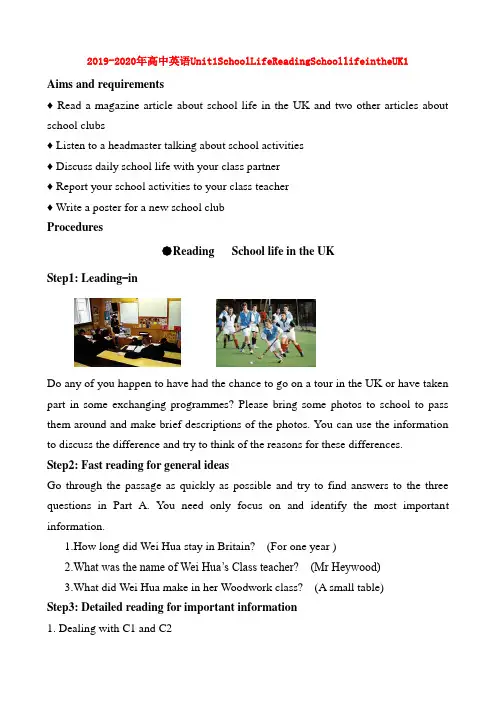
2019-2020年高中英语Unit1SchoolLifeReadingSchoollifeintheUK1Aims and requirements♦ Read a magazine article about school life in the UK and two other articles about school clubs♦ Listen to a headmaster talking about school activities♦ Discuss daily school life with your class partner♦ Report your school activities to your class teacher♦ Write a poster for a new school clubProcedures●Reading School life in the UKStep1: Leading-inDo any of you happen to have had the chance to go on a tour in the UK or have taken part in some exchanging programmes? Please bring some photos to school to pass them around and make brief descriptions of the photos. You can use the information to discuss the difference and try to think of the reasons for these differences.Step2: Fast reading for general ideasGo through the passage as quickly as possible and try to find answers to the three questions in Part A. You need only focus on and identify the most important information.1.How long did Wei Hua stay in Britain? (For one year )2.What was the name of Wei Hua’s Class teacher? (Mr Heywood)3.What did Wei Hua make in her Woodwork class? (A small table)Step3: Detailed reading for important information1. Dealing with C1 and C2Now reread the passage and plete Part C1 and C2 individually. Questions in Part C1 are to check your ability to read and locate specific information. Statements in Part C2 serve as a strengthening activity for your prehension of this passage.2. Dealing with specific aspectsGo through the article first and find out what topics are covered in it.Some aspects that reflect school life in the UK are mentioned in Wei Hua’s letter. Try to find out what specific aspects are mentioned and then fill in the form with relevant information.Are the following aspects of school life mentioned in the article?teachers, classmates, friends, subjects,homework/assignments, grades, timetable,activities, school facilities, host family, food,hobbies, customs, traditions, festivals3. Focus on the two exercisesNow we’ve found out the most important information and got the main idea of the article. But I’m curious about the reading method you use when reading the article. Can you tell me how you find the main idea in such a shorttime? Do you think you have to read the whole article slowly and carefully in order to get a brief understanding of it?4. Dealing with D and Eplete Parts D and E individually first and then we’ll check the answers togethe r. Part D helps you prehend the meanings of the words from the context and match them with the correct definitions; while Part E is a letter from a British student who wants to make friends with Wei Hua. You’ve got to first understand the letter and then f ill in the blanks with proper words.Step4: Post-reading1. Suppose you have a chance to interview Wei Hua. Apart from the things you have been told, what other information would you like to know about her life and study in the UK? (The teacher can fire students’ imagination with the following) So far we ourselves haven’t had the opportunity to go abroad to experience a foreign way of life. We are very happy today to have a student here who has just finished one year of study in the UK. Now you can all ask her some questions.2. Suppose you are asked to write an article about the differences between high schools in the UK and in China. What kinds of differences will be dealt with in your article? ( The teacher can give some hints if necessary: timetable, subjects, teachers and students, size of the classroom, campus, school facilities, atmosphere, teaching methods, school rules and principles)3. Write a summary of the article written by Wei Hua.4. Read the two articles in Reading on pages 82 and 83 in Workbook and answer the questions below them, so that you can find more about school life in other countries. (They can also do this as their homework.)5. For the article in Part A, more questions will be asked to test your understanding of some new words. For example: What does the phrase school uniforms mean? What kinds of clothes are fashionable? What clothes are leisure clothes?6. For the article in Part B, I’ve got two sentences for you to finish.1) When you are taking SATs, you will .A. have to find answers to some math questions onlyB. only solve some problemsC. be chosen by the best collegesD. be tested on some math questions as well as some problem-solving questions(D)2) A special counselor is a person .A. who wants to go to a very good collegeB. who works in a high school to help students choose suitable colleges to go toC. who works in a college or a university to help high school students choose suitablecolleges to go toD. who writes letters of application to colleges for high school students(B)7. Please do Parts A and B of Listening on page 84 in Workbook, then fill in Part C according to what you’ve heard on the tape. (or leave as homework)2019-2020年高中英语Unit1SchoolLifeReadingSchoollifeintheUK2Part Two:Teaching Resources第二部分教学资源●Reading School life in the UKI.Text analysis1. Read the text SCHOOL LIFE IN THE UK and then plete the following chart2. A retold version of the textWei Hua enjoyed one-year study life in Britain. He made many friends there. He had many teachers and each of them taught one subject. The number of students in his class was smaller than that in China. He’d got to finish homework in English which is somewhat challenging and they could choose the subjects they liked. In addition, they could have extra classes such as Woodwork. If he waned to connect with his family, he could e-mail his parents and friends. British food is different and he missed Chinese food a lot. After lunch he usually had a break under a tree or sat on the grass.After one-year study there, he found his English improved a lot. It was an exciting and unforgettable experience for him.II. Language points1. At ease with our teacher. ( p1 )与我们的老师相处自如。
2019-2020年高一英语Module 1《Unit 1 School life 》Period
2019-2020年高一英语Module 1《Unit 1 School life 》Period 1 Wele andReading 学案Learning aims1. Knowledge (知识):Learn the new words and phrases and learn attributive clauses2. Ability (能力):Improve the abilities of reading3. Emotion (情感):Talk about school lifePeriod 1 Wele and ReadingStep 1 Pre-class1. Wele to the unit1) High school is a time of discovery, learning and hard work! Then what is your dreamhighschool life like?Teachers:Teachers should be fair, patient, learned, kind, humorous, helpful…Students:Relationship between teachers and students:Classrooms:Campus (校园):School activities:2) The differences between the lives of Chinese and British high school students.2. ReadingWe will have to answer some questions after reading the text. Not only should we answer the questions but also we should tell how you know the answer or from which line of the test we find the answer. For example:Read the text quickly and answer the following question.How long did Wei Hua stay in Britain? One year (line 1)1) Read the text quickly and do part A on page 2.2) Reading strategy. (Try to answer the questions with your own words.)When and how shall we skim a text?When and how shall we scan a text?3) Design five questions of your own and you can answer the questions by skimming orscanning the text.Q1. What did all the students do on the first day?Answer:Go to attend assembly. (by skimming) Q2.Answer:Q3.Answer:Q4.Answer:Q5.Answer:4) Read the article again carefully. Underline(下划线)new words and difficult sentenceswhile reading and then do part C1, C2 and D on page 43. Language pointsWords and phrases:1) attend v.参加练:(1) According to the law in China, all children between 6 and 14 must attend school.中国法律,六到十四岁的儿童必须。
2019-2020年高中英语Unit1Schoollife0
2019-2020年高中英语Unit1Schoollife0Teaching contents :1. Read an article about school life in the UK2. Listen to a headmaster talking about school activities3. Discuss daily school life with your partner4. Report your school activities to your class teacher5. Write a notice about school activities6. Make a poster for a new school clubTeaching Time :Wele to the unit 1 课时Reading 2课时Word Power 1课时Grammar and usage 2课时Task 1课时Project 1课时Revision & exercises 2课时Test 1-2课时Period 1 Wele to the unitTeaching Aim:Give the students some impression of the school life in the UK. Enlarge the student s’ knowledge and make them know the importance of school life in one’s life .Important point :Encourage the students to introduce themselves and talk about their former school life and about their dream life .Difficult point :To ensure every student to have a chance to express himself / herself.Teaching method :Individual, pair or group work to make every student work in class.Teaching Procedures :Step 1 Greetings and self-introductionGood morning, guys and girls!Wele to our school! Glad to meet you here and I’m your English teacher this yea r. First of all, please allow me to introduce myself to you. My name is …. Above all, I like my job teaching very much and do hope to have a good time with you.Step 2 Free talk between the teacher and studentsNow, I want to ask some of you to introduce yourselves to us. Any volunteers?(What’s your name, please?Which school did you graduate from? / Which school are you from?Do you have any hobbies? / How do you often spend your spare time?What school activities did you often have? / What kind of school activities do you like?)(T may ask several students to give a self-introduction. This is a good chance for them to make themselves known. In the meantime, the teacher may know about their English level.)Step 3 School introduction(After several students have given their self-introduction, the teacher may transfer to introduce the new school and some activities that they may often have in the future.)Just now some of you introduced yourselves and said something about your former schools. Now we are here, so let’s show you around the campus and have a look at some school activities you may have in the future.(Show some pictures of the school and ask the students to say something about each picture.)Step 4 Further discussion1. About the school activities in China and in the UK.Now, look at the pictures on page 1. These pictures show some parts of high school life in the UK.Picture 1: This is the school campus in the UK. Can you see any difference?(huge / low-rise buildings / look like farms in the countryside)Picture 2: From the picture, can you guess what it is used for? Do you have such a locker? Do you want sucha locker?(A locker is a small cupboard where clothes, books, snacks or something else can be kept)Picture 3: How many students are there in each class in our country?(big or small? )Picture 4: Look at the picture, what is the biologist teacher doing? Is he giving his classes in the classroom? Can you describe the picture?(He is giving his classes in the open air instead of in the classroom.)2. Do you know of any other differences between the lives of Chinese and British high school students?(more relaxed / less burdened / more active in class)3. What kind of school activities do you enjoy?Step 4 ExpectationI think there are also some differences between our school and your former school. Since this is a new beginning, I want to ask you:What do you want to get from this new school?What is your dream school life like?Step 5 Language focus1.two other articles 另外两篇文章Tom still has three other questions to ask.The job is hard. We will need five other days to finish it.Ten chairs are not enough. We need three more chairs / another three chairs.联想拓展in 3 more days 再过三天(数词+more + 名词=another + 数词+ 名词)in another 3 days 再过三天one after another 一个接一个one another 彼此;互相思维演练If you want to buy a round-trip ticket, you’ll have to pay ______ $30 .A. moreB. other D. the otherYou may take any of these books. If you don’t like this one you may take _______.A. the otherB. all the others D. one moreWill you stay here for _______ weeks?A. other 2B. more 2 D. 2 another2.know of sth. / sb (间接地)了解;听说;知道有关……的情况know 表示直接地“认识;知道”具体的人或事I happen to know of him, but I don’t know him . 我碰巧听说过他,但我不认识他。
2019-2020年牛津译林版高中英语必修一Unit 1《School Life》(Grammar and usage)教案
③The planthat/whichthey argued aboutwas settled at last.(作宾语)
whom
人
宾语
Mr. Smith is the person with whom I am
working
The boy (whom) she loved died in the
war.
whose
人,物
定语
I like those books whose topics are about
history.
2019-2020年牛津译林版高中英语必修一Unit 1《School Life》(Grammar and usage)教案
【教学目标】
1. know what an attributive clause is like;
2. have a general idea of the usage of relative pronouns who, whose, which;
Step 2 Presentation
1)Get the students to watch some pictures aboutAustraliaand listen to the introduction at the same time.
1)Ask them some questions about the contents of the introduction.
[设计说明]通过学生非常容易理解的句子自然地呈现定语先行词是人的、由“which”和“whose”引导的定语从句。
2019_2020学年高中英语Unit1SchoollifeSectionⅠWelcometotheunit
西班牙的
school.Those who are fond of 6. 喜欢 the
program can apply for it.If we want to know more about the academic
7.
学术的,学业的
life in the Spanish school,we can
词海拾贝 难句剖析 理解诱思
C 晨读晚诵 HENDUWANSONG
X 新知导学 INZHI DAOXUE
D 答疑解惑 AYI JIEHUO
1.According to the passage,how many differences are mentioned?
A.Three.
B.Four.
C.Five.
to learn it well. —Come on.More efforts and some extra (额外的)work,and
you can make it. —Thank you for your encouragement (鼓励).I think I will.
一二三四五
C 晨读晚诵 HENDUWANSONG
front of the stone sculpture 2. 石雕 of Zhou Enlai this
morning.The headmaster 3. 校长 announced that an exchange 4.
交换;交流 program will be held between our school and a Spanish 5.
-9-
C 晨读晚诵 HENDUWANSONG
X 新知导学 INZHI DAOXUE
D 答疑解惑 AYI JIEHUO